

I've decided that today will be the last day of the year.
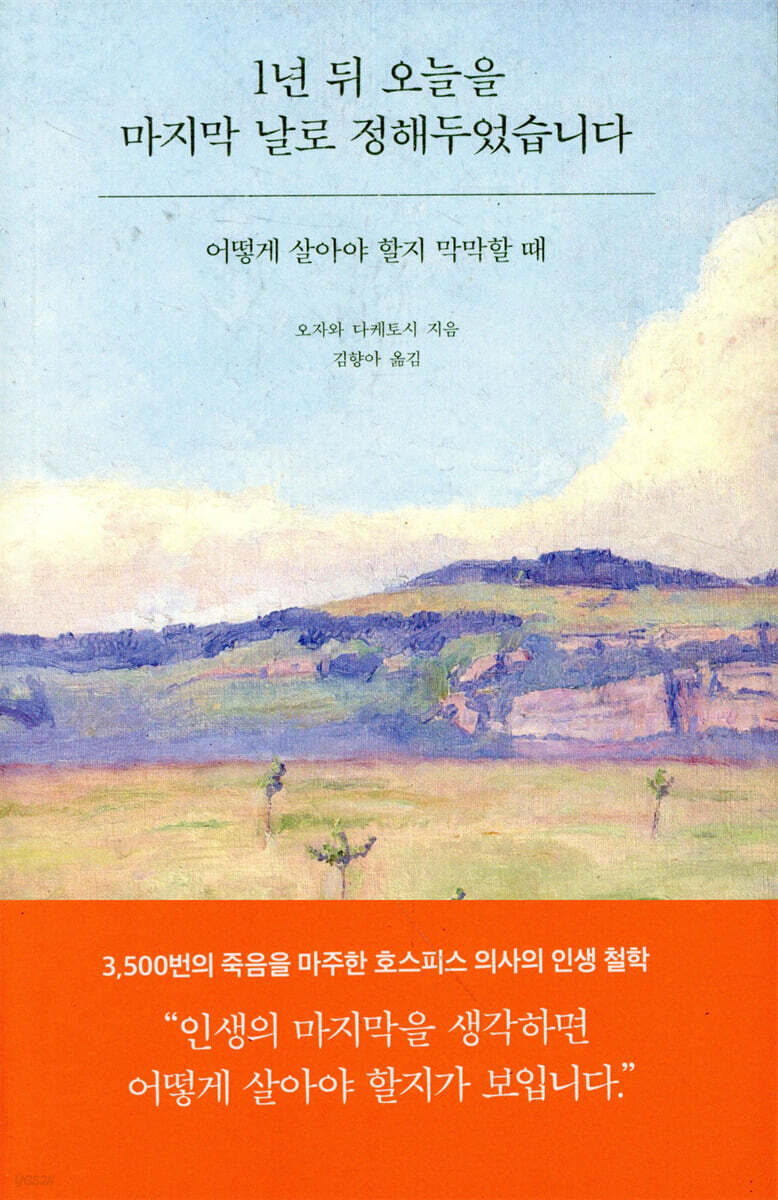 |
Description
Book Introduction
Our lives today are the best result of countless choices.
Hospice, a hospital where people facing death gather.
A doctor who has seen off more patients than anyone else for 25 years has put 17 essential questions in life into a book.
The author advises that when you feel lost about how to live, think about the last moments of your life.
The way you live your life is clearly different depending on whether you want to think of it as a colorful and interesting life before leaving this world, or whether you want to be proud of having lived a good life.
Thinking about how you want to feel when your life ends can help you reflect on your current life a little more pointedly and objectively, he says.
Hospice, a hospital where people facing death gather.
A doctor who has seen off more patients than anyone else for 25 years has put 17 essential questions in life into a book.
The author advises that when you feel lost about how to live, think about the last moments of your life.
The way you live your life is clearly different depending on whether you want to think of it as a colorful and interesting life before leaving this world, or whether you want to be proud of having lived a good life.
Thinking about how you want to feel when your life ends can help you reflect on your current life a little more pointedly and objectively, he says.
- You can preview some of the book's contents.
Preview
index
Entering
Chapter 1 If My Life Ends in One Year
01 What do you think is the meaning of my life?
02 Is there something you really want to do?
03 Do you have any regrets now?
04 What do you want to cherish during the remaining time?
Column: How does the end of life come?
Chapter 2 Can I Say I Loved You?
05 Aren't you trying to do it alone?
06 Have you discovered your own uniqueness?
07 Are you spending enough time with your loved ones?
08 Are you lonely and desolate?
Chapter 3: Can we know what true happiness is?
09 Are you satisfied with what you have done and how you have done it so far?
10 Do you feel like your efforts are in vain?
11 What are you most proud of in your life so far?
12 Do you have any dreams for the future?
Chapter 4: Can I Live the Way I Want?
13 How can I know that I have had a good life?
14 Are you having any difficult or painful issues?
15 Aren't you pushing yourself too hard?
16 Do you feel like life isn't going the way you want it to?
17 Can you hear the voice of my heart?
Coming out
Chapter 1 If My Life Ends in One Year
01 What do you think is the meaning of my life?
02 Is there something you really want to do?
03 Do you have any regrets now?
04 What do you want to cherish during the remaining time?
Column: How does the end of life come?
Chapter 2 Can I Say I Loved You?
05 Aren't you trying to do it alone?
06 Have you discovered your own uniqueness?
07 Are you spending enough time with your loved ones?
08 Are you lonely and desolate?
Chapter 3: Can we know what true happiness is?
09 Are you satisfied with what you have done and how you have done it so far?
10 Do you feel like your efforts are in vain?
11 What are you most proud of in your life so far?
12 Do you have any dreams for the future?
Chapter 4: Can I Live the Way I Want?
13 How can I know that I have had a good life?
14 Are you having any difficult or painful issues?
15 Aren't you pushing yourself too hard?
16 Do you feel like life isn't going the way you want it to?
17 Can you hear the voice of my heart?
Coming out
Detailed image

Into the book
Even though I am at an age where I can do nothing, I think that if I have a strong emotional connection with someone who reassures me that it is okay, I can stay by the patient's side. And because I am at an age where I can do nothing, I might be able to share the patient's pain. I came to think that staying by the patient's side is what supports my helpless heart.
Some patients have difficulty moving and cannot do anything, so they feel that life has no value and no meaning. However, it is thanks to the support of such patients that I have been able to continue this work.
Everyone who lives in this world has a mission, and everyone is fulfilling that mission simply by living.
--- From "01 What do you think is the meaning of my life?"
When I look back on my life and the decisions I've made in the past, I wonder if my life would have been different if I had chosen a different path, or if I really made the right decision.
The feeling of regret is so complex.
When faced with a crossroads, no one deliberately chooses the bad option.
Most people will always choose the one they think is better.
Regretting doesn't change reality, and comparing the future you imagined in your head, asking yourself, "What would have happened if I had taken a different path?", to reality is absurd.
--- From "03 Do you have any regrets now?"
If you focus only on “How should I live?” you will inevitably end up thinking about too many things.
They are only concerned with obtaining more money, higher status, and fame, and they are also overly concerned with what other people think.
Of course, considering such things may be important in life.
However, if we only pursue what we see or are bound by various constraints, we run the risk of missing important considerations that cannot be overlooked when making a decision in the first place.
But when I think about how I want to end my life with only one year left, only what I truly need and truly want comes to mind.
--- From "04 What do you want to cherish for the rest of your time?"
Living true to myself is not necessarily the same as always being comfortable and in a good mood, asserting myself, or living my life the way I want.
Even when we are nervous and uncomfortable, when we are upset and having a hard time, and when we are considerate and patient, we are actually living our true selves.
Perhaps the phrase “I want to live my own life” simply comes from a dislike of the way you’ve been seen so far, or a desire to deny the way you’ve lived your life so far.
I think that the person I am now is different from what I dreamed of.
This thought came to me as, since I have not lived my life true to myself, I want to live true to myself from now on.
--- From "06 Have you discovered your own uniqueness?"
We always keep making better choices until the very last moment we leave this world.
If you feel like you haven't lived the life you want, look at the process of choices you make in your daily life without a second thought.
If you can realize how many choices you normally take for granted and freely, you will undoubtedly begin to view life more positively and be able to make each choice more consciously, starting tomorrow.
Some patients have difficulty moving and cannot do anything, so they feel that life has no value and no meaning. However, it is thanks to the support of such patients that I have been able to continue this work.
Everyone who lives in this world has a mission, and everyone is fulfilling that mission simply by living.
--- From "01 What do you think is the meaning of my life?"
When I look back on my life and the decisions I've made in the past, I wonder if my life would have been different if I had chosen a different path, or if I really made the right decision.
The feeling of regret is so complex.
When faced with a crossroads, no one deliberately chooses the bad option.
Most people will always choose the one they think is better.
Regretting doesn't change reality, and comparing the future you imagined in your head, asking yourself, "What would have happened if I had taken a different path?", to reality is absurd.
--- From "03 Do you have any regrets now?"
If you focus only on “How should I live?” you will inevitably end up thinking about too many things.
They are only concerned with obtaining more money, higher status, and fame, and they are also overly concerned with what other people think.
Of course, considering such things may be important in life.
However, if we only pursue what we see or are bound by various constraints, we run the risk of missing important considerations that cannot be overlooked when making a decision in the first place.
But when I think about how I want to end my life with only one year left, only what I truly need and truly want comes to mind.
--- From "04 What do you want to cherish for the rest of your time?"
Living true to myself is not necessarily the same as always being comfortable and in a good mood, asserting myself, or living my life the way I want.
Even when we are nervous and uncomfortable, when we are upset and having a hard time, and when we are considerate and patient, we are actually living our true selves.
Perhaps the phrase “I want to live my own life” simply comes from a dislike of the way you’ve been seen so far, or a desire to deny the way you’ve lived your life so far.
I think that the person I am now is different from what I dreamed of.
This thought came to me as, since I have not lived my life true to myself, I want to live true to myself from now on.
--- From "06 Have you discovered your own uniqueness?"
We always keep making better choices until the very last moment we leave this world.
If you feel like you haven't lived the life you want, look at the process of choices you make in your daily life without a second thought.
If you can realize how many choices you normally take for granted and freely, you will undoubtedly begin to view life more positively and be able to make each choice more consciously, starting tomorrow.
--- From "16 Do you think life isn't going as planned?"
Publisher's Review
In these days when there are many people who feel no meaning in anything, the uselessness of death
Why do people so reluctantly consider death, viewing it as a distant future that will never arrive? The COVID-19 pandemic that began in 2020 disrupted our daily lives, forcing us to realize that life doesn't always go as planned.
The importance of contemplating the 'meaning of life' is growing day by day.
This is a moment when we must set important criteria for how to navigate this difficult situation.
At this point, the author recommends having a healthy relationship with death.
Having worked as a hospice doctor for 25 years, the author has faced death more times than anyone else and has always answered patients' endless questions with sincerity. This writing shows how important it is to take time to think about death and how much meaning in life can be expanded through it.
This book shines with the author's insight, having witnessed the deaths of countless people.
The author says that even the ultimate pain of death cannot completely take away from humans the freedom to dream of the future.
Death, on the contrary, brings us to the starting point of a new life.
He reminisces about the people he cared for as a hospice doctor, such as a patient who had a child after a long period of infertility treatment after marriage but ended up with cancer, and a patient who worked hard to save money in hopes of traveling around the world with his wife after retirement but ended up with lung cancer. He talks about the times he matured and dreamed of on the brink of death.
The book contains a total of 17 colorful questions placed at the beginning and end of each chapter.
We even created a page where patients can write down their own answers, similar to the 'dignity therapy' method that allows patients to reflect on their own lives through questions.
I added the encouragement and support that a third party can never judge whether a person has lived a good life, and the practical advice I gave as a doctor when patients and their families had to make important decisions.
If my life ended in a year, would I know what true happiness is?
The book specifically suggests that we imagine ourselves as if we only had one year left.
The way you live your life will depend on whether you want to think of your life as eventful and fun before you leave this world, or whether you want to be proud of having lived a good life.
She tells us to think specifically about who we would like to have by our side in our last moments, where we would like to be, and what emotions we would like to feel.
Just as you can only run when you know the end, it is advised that thinking about the end of life will show you how to live.
Above all, it raises questions about the 'self' that people commonly think of.
Living my own way is not necessarily the same as always being comfortable and in a good mood, asserting myself, and living my own way.
He explains that even when we are nervous and uncomfortable, when we are in a bad mood and having a hard time, and when we are considerate and patient, we are actually living as ourselves.
The sum total of all choices is your identity and your life.
The author also says that when you have worries, try not to bear them alone, but rather discuss them with someone you can open up to.
It tells us that it doesn't matter whether it's a living person, a deceased person, a god, or nature.
He confesses that when he is going through a difficult time, he often consults with his father, who passed away from kidney cancer more than 20 years ago.
Patients say that there is no point in living because they can no longer do anything, but he calmly talks about his mission as a doctor, saying that it is thanks to the support of such patients that he has been able to continue working.
In this way, the author's writing stands out with its paradoxical insight.
We look at life through death, discover our true selves in superficial appearances, and share our concerns with non-existent beings.
Is it because I have faced death more than anyone else?
His attitude, which breaks away from common sense, allows us to look back on our lives so far and face tomorrow with a new perspective.
On days when everything feels overwhelming, this book gives you the unfamiliar courage to believe that perhaps death will show you the way forward in life.
Why do people so reluctantly consider death, viewing it as a distant future that will never arrive? The COVID-19 pandemic that began in 2020 disrupted our daily lives, forcing us to realize that life doesn't always go as planned.
The importance of contemplating the 'meaning of life' is growing day by day.
This is a moment when we must set important criteria for how to navigate this difficult situation.
At this point, the author recommends having a healthy relationship with death.
Having worked as a hospice doctor for 25 years, the author has faced death more times than anyone else and has always answered patients' endless questions with sincerity. This writing shows how important it is to take time to think about death and how much meaning in life can be expanded through it.
This book shines with the author's insight, having witnessed the deaths of countless people.
The author says that even the ultimate pain of death cannot completely take away from humans the freedom to dream of the future.
Death, on the contrary, brings us to the starting point of a new life.
He reminisces about the people he cared for as a hospice doctor, such as a patient who had a child after a long period of infertility treatment after marriage but ended up with cancer, and a patient who worked hard to save money in hopes of traveling around the world with his wife after retirement but ended up with lung cancer. He talks about the times he matured and dreamed of on the brink of death.
The book contains a total of 17 colorful questions placed at the beginning and end of each chapter.
We even created a page where patients can write down their own answers, similar to the 'dignity therapy' method that allows patients to reflect on their own lives through questions.
I added the encouragement and support that a third party can never judge whether a person has lived a good life, and the practical advice I gave as a doctor when patients and their families had to make important decisions.
If my life ended in a year, would I know what true happiness is?
The book specifically suggests that we imagine ourselves as if we only had one year left.
The way you live your life will depend on whether you want to think of your life as eventful and fun before you leave this world, or whether you want to be proud of having lived a good life.
She tells us to think specifically about who we would like to have by our side in our last moments, where we would like to be, and what emotions we would like to feel.
Just as you can only run when you know the end, it is advised that thinking about the end of life will show you how to live.
Above all, it raises questions about the 'self' that people commonly think of.
Living my own way is not necessarily the same as always being comfortable and in a good mood, asserting myself, and living my own way.
He explains that even when we are nervous and uncomfortable, when we are in a bad mood and having a hard time, and when we are considerate and patient, we are actually living as ourselves.
The sum total of all choices is your identity and your life.
The author also says that when you have worries, try not to bear them alone, but rather discuss them with someone you can open up to.
It tells us that it doesn't matter whether it's a living person, a deceased person, a god, or nature.
He confesses that when he is going through a difficult time, he often consults with his father, who passed away from kidney cancer more than 20 years ago.
Patients say that there is no point in living because they can no longer do anything, but he calmly talks about his mission as a doctor, saying that it is thanks to the support of such patients that he has been able to continue working.
In this way, the author's writing stands out with its paradoxical insight.
We look at life through death, discover our true selves in superficial appearances, and share our concerns with non-existent beings.
Is it because I have faced death more than anyone else?
His attitude, which breaks away from common sense, allows us to look back on our lives so far and face tomorrow with a new perspective.
On days when everything feels overwhelming, this book gives you the unfamiliar courage to believe that perhaps death will show you the way forward in life.
GOODS SPECIFICS
- Publication date: February 22, 2022
- Page count, weight, size: 212 pages | 216g | 120*188*17mm
- ISBN13: 9791188469956
- ISBN10: 1188469959
You may also like
카테고리
korean


korean

![GQ KOREA Mark (Monthly): December [2025]](http://librairie.coreenne.fr/cdn/shop/files/8ef265dbbfbf186523ed75ba7319009d.jpg?v=1765340328&width=3840)


