

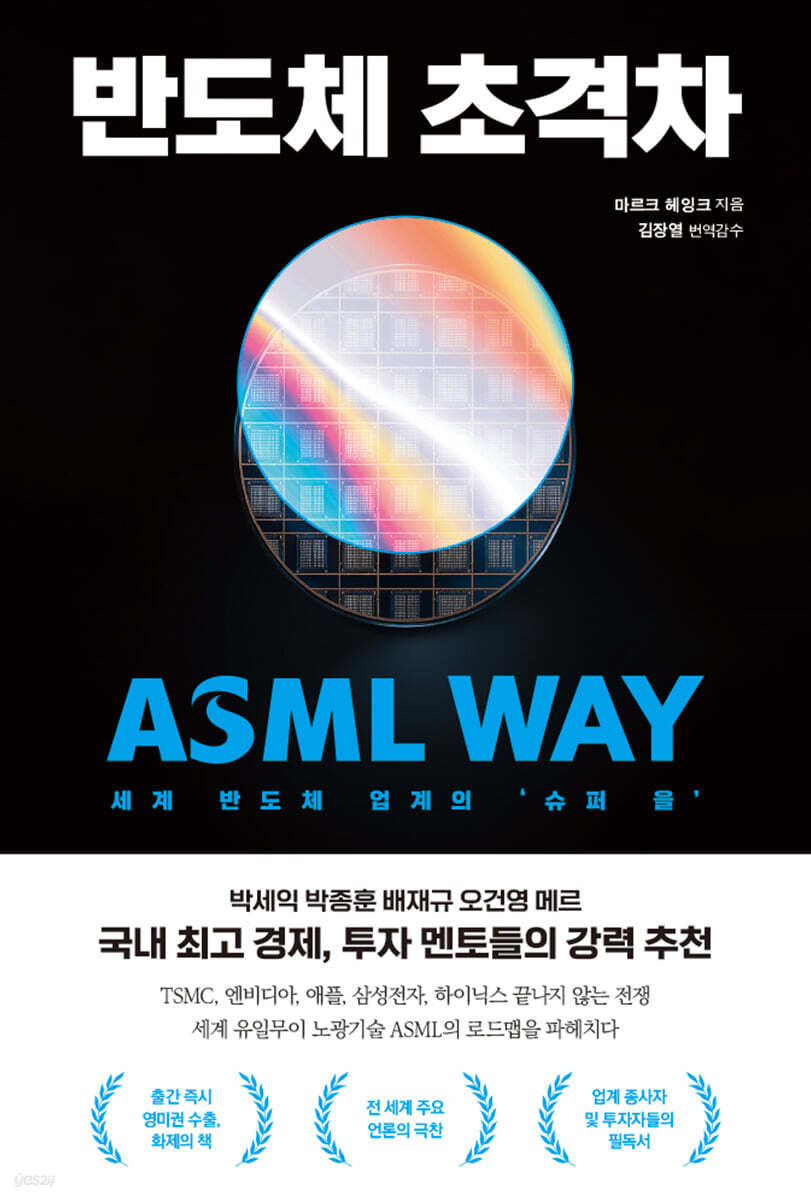
Semiconductor Super Gap
 |
Description
Book Introduction
Park Se-ik, Park Jong-hoon, Bae Jae-gyu, Oh Geon-yeong, Mer
Highly recommended by Korea's top economic and investment mentors!
The enormous challenges brought about by endless technological competition and geopolitical crises.
What is the new growth formula that will dominate the semiconductor industry?
***** Exported to English-speaking countries immediately after publication, becoming a hot topic of conversation
***** Rave reviews from major media outlets around the world
***** A must-read for industry professionals and investors
This book is about a company that has grown secretly, yet powerfully, for decades, largely unnoticed by most people.
Chips made by the company's machines power smartphones and laptops around the world, make coffee, run refrigerators and washing machines, drive planes, trains, and cars, operate cruise missiles and the radars that shoot them down, and power AI assistants.
From its humble beginnings in a small Dutch village to its rise to global dominance with a 90 percent market share, and from its rise to becoming embroiled in an unpredictable political power struggle, this book chronicles ASML's history.
To do this, author Marc Heink conducted over 300 interviews over a period of more than 10 years, and spent the last three years inside ASML, doggedly following senior executives and employees, including co-CEOs Peter Wennink and Marc van den Brink.
Following his journey across Germany, the US, South Korea, China, and Taiwan, mapping ASML's complex business network—from partners and key customers to government officials—provides a fascinating understanding of the current semiconductor industry ecosystem. This book is a must-read for anyone seeking a breakthrough amidst fierce competition among TSMC, Nvidia, Samsung Electronics, Hynix, and Intel, and escalating geopolitical tensions between the US and China.
Highly recommended by Korea's top economic and investment mentors!
The enormous challenges brought about by endless technological competition and geopolitical crises.
What is the new growth formula that will dominate the semiconductor industry?
***** Exported to English-speaking countries immediately after publication, becoming a hot topic of conversation
***** Rave reviews from major media outlets around the world
***** A must-read for industry professionals and investors
This book is about a company that has grown secretly, yet powerfully, for decades, largely unnoticed by most people.
Chips made by the company's machines power smartphones and laptops around the world, make coffee, run refrigerators and washing machines, drive planes, trains, and cars, operate cruise missiles and the radars that shoot them down, and power AI assistants.
From its humble beginnings in a small Dutch village to its rise to global dominance with a 90 percent market share, and from its rise to becoming embroiled in an unpredictable political power struggle, this book chronicles ASML's history.
To do this, author Marc Heink conducted over 300 interviews over a period of more than 10 years, and spent the last three years inside ASML, doggedly following senior executives and employees, including co-CEOs Peter Wennink and Marc van den Brink.
Following his journey across Germany, the US, South Korea, China, and Taiwan, mapping ASML's complex business network—from partners and key customers to government officials—provides a fascinating understanding of the current semiconductor industry ecosystem. This book is a must-read for anyone seeking a breakthrough amidst fierce competition among TSMC, Nvidia, Samsung Electronics, Hynix, and Intel, and escalating geopolitical tensions between the US and China.
- You can preview some of the book's contents.
Preview
index
· Recommendation
· Preface by the editor
· Prologue: Starry Sky
| Part 1 | Good Ideas, Bad Plans
Chapter 1 Repeater
Chapter 2 Promoter
Chapter 3 Promising Talent
Chapter 4 The Holey Hat
Chapter 5: A Great Legacy
Chapter 6 4022 Network
Chapter 7: The Spouse from the South
| Part 2 | The Big Boys
Chapter 8: Moving the Mountain
Chapter 9 Money Printer
Chapter 10: Quick Learners
Chapter 11 Doug's Iron Fist
Chapter 12: George W. Bush's Compassion
Chapter 13 Two Cash Cows
Chapter 14: Japan's Revenge
Chapter 15: Zeiss's Wisdom
Chapter 16 Living Organisms
Chapter 17: The Nurse Corps
| Part 3 | Achieving the Impossible
Chapter 18: Invisible Monopolies
Chapter 19: Don't Trust Small Drops of Liquid
Chapter 20 The Three Musketeers
Chapter 21 Joan's Hand
Chapter 22 Yin and Yang
Chapter 23: Forget About Getting Off Work
Chapter 24: Morris and his companions
Chapter 25: The Non-Existent Camera
Chapter 26 Golf Ball on the Moon
Chapter 27: Voodoo Sense
| Part 4 | Going on Stage
Chapter 28: Shoot First, Aim Later
Chapter 29: The Merchant's Spirit
Chapter 30: Washington, D.C.'s Death Grip
Chapter 31: Codename Missing
Chapter 32: Billions of Dollars Pouring In
Chapter 33: The Fear That Swept the Pentagon
| Part 5 | Growing Pains
Chapter 34: Family is Everything
Chapter 35: Welcome to 5L, or rather 5-Hell
Read Chapter 36 for details first.
Chapter 37 Not in My Backyard
Chapter 38: A Piece of the Puzzle
Chapter 39 Martin's Law
Chapter 40: Avoid the Right
Epilogue: The ASML Way
Acknowledgements
· Preface by the editor
· Prologue: Starry Sky
| Part 1 | Good Ideas, Bad Plans
Chapter 1 Repeater
Chapter 2 Promoter
Chapter 3 Promising Talent
Chapter 4 The Holey Hat
Chapter 5: A Great Legacy
Chapter 6 4022 Network
Chapter 7: The Spouse from the South
| Part 2 | The Big Boys
Chapter 8: Moving the Mountain
Chapter 9 Money Printer
Chapter 10: Quick Learners
Chapter 11 Doug's Iron Fist
Chapter 12: George W. Bush's Compassion
Chapter 13 Two Cash Cows
Chapter 14: Japan's Revenge
Chapter 15: Zeiss's Wisdom
Chapter 16 Living Organisms
Chapter 17: The Nurse Corps
| Part 3 | Achieving the Impossible
Chapter 18: Invisible Monopolies
Chapter 19: Don't Trust Small Drops of Liquid
Chapter 20 The Three Musketeers
Chapter 21 Joan's Hand
Chapter 22 Yin and Yang
Chapter 23: Forget About Getting Off Work
Chapter 24: Morris and his companions
Chapter 25: The Non-Existent Camera
Chapter 26 Golf Ball on the Moon
Chapter 27: Voodoo Sense
| Part 4 | Going on Stage
Chapter 28: Shoot First, Aim Later
Chapter 29: The Merchant's Spirit
Chapter 30: Washington, D.C.'s Death Grip
Chapter 31: Codename Missing
Chapter 32: Billions of Dollars Pouring In
Chapter 33: The Fear That Swept the Pentagon
| Part 5 | Growing Pains
Chapter 34: Family is Everything
Chapter 35: Welcome to 5L, or rather 5-Hell
Read Chapter 36 for details first.
Chapter 37 Not in My Backyard
Chapter 38: A Piece of the Puzzle
Chapter 39 Martin's Law
Chapter 40: Avoid the Right
Epilogue: The ASML Way
Acknowledgements
Into the book
Sixty years after the invention of the microprocessor, the world is now powered by chips.
Chips are an indispensable resource in all aspects of modern society.
Today, most of these chips are made using machines from one company: ASML.
--- From the "Prologue"
As the partnership between TSMC and ASML began in earnest, Taiwan's semiconductor industry began to grow rapidly.
The two companies had more in common than you might think.
Both operated in a fast-paced, chaotic manner, and both were completely dependent on each other to produce flawless chips hour after hour.
“We are responsible for them, and they are responsible for us” was the creed of ASML employees, and this phrase became the formula that dominated the semiconductor market.
--- From "Part 1, Chapter 5, The Great Legacy"
Tensions were high in the conference room in Seoul.
The memory chip industry was a place where margins were extremely thin, everything depended on efficiency, and Samsung was known for its uncompromising ruthlessness.
If the lithography equipment broke down and caused delays, the person in charge could be in big trouble.
The meeting bordered on interrogation. As soon as ASML employees arrived in Korea, their passports were confiscated and they were taken straight to the "negotiation room."
As the shouting continued, chalk, plates, ashtrays, and coffee cups flew through the air.
It seemed like I could pick up and throw anything I could get my hands on.
--- From "Money Printer", Part 2, Chapter 9
ASML has once again adopted the strategy of “delivery first, improvement later.”
This also worked to the advantage of chip factories, as they were able to pilot the most advanced chips ahead of their competitors. ASML readily followed this strategy.
These early deliveries were a surefire way to keep competitors out of the chip factory.
Martin van den Brink says, “If you wait until the machine is perfectly working, it is already too late.”
--- From "Part 2, Chapter 13, Two Cash Cows"
American politicians tend to perceive chip technology as if it had been "stolen" by Asia.
They believe their EUV light source technology has been stolen by a Dutch company.
But Van den Brink thinks differently.
…simply put, Asian semiconductor manufacturers were able to lead because they took greater risks than their American competitors.
--- From "Forget About Getting Off Work", Part 3, Chapter 23
One of Taiwan's secrets to success lies in its strict separation of customers.
Engineers supporting customers like Apple have no knowledge of the chips NVIDIA makes. ASML employees are also subject to strict confidentiality, requiring explicit permission to email documents and even forbidden from taking quick photos of drawings on boards during meetings.
--- From "Part 3, Chapter 24: Maurice and His Companions"
Despite the deep divisions between political parties in America, there is agreement on one thing.
The point is that China's technological advancement poses a threat to the free world.
Soon, this competitor appeared poised to become more powerful than the United States in AI and cyber-espionage.
It's a familiar story in America.
We are on the threshold of another 'Sputnik moment'.
…like the space race between the United States and the Soviet Union in the 1950s and 1960s, China and the United States are now locked in a fierce competition for technological superiority.
--- From "Part 4: Going on Stage"
ASML has long sought to avoid the geopolitical arena.
But Fritz van Hout thinks that was naive thinking.
As a company that produces the equipment that forms the foundation of the modern world, it cannot operate forever unnoticed.
--- From "Part 4, Chapter 29: The Merchant's Spirit"
China was forced to adopt a "More than Moore" strategy (another growth strategy that goes beyond Moore's Law) and began focusing on chips that were needed in large quantities for things like energy transitions, electric vehicles, home appliances, or industrial automation, rather than relying on the most sophisticated technologies.
At the same time, Chinese semiconductor manufacturers have been cautious about boasting about their technological advancements to avoid drawing attention from the United States.
Some factories tried to avoid sanctions by renaming their existing 14-nanometer technology as "17."
No one wanted to be noticed by America.
--- From "Chapter 31, Part 4: Codename Disappearance"
However, export restrictions to China present a new opportunity for SMEE. If stronger measures are taken to block ASML and Nikon's scanners, Chinese manufacturers will be forced into a corner and will ultimately have no choice but to turn to SMEE.
As a result, SMEE will gain more experience and secure funding to solve problems with its own machines.
More funds could be invested in developing new technologies, such as self-immersion scanners.
As China becomes more isolated, the possibility of a fully fledged Chinese competitor developing its own semiconductor production chain grows.
This is the exact opposite of what the United States was trying to achieve. This is also why ASML employees find the US strategy so incomprehensible.
--- From "Chapter 31, Part 4: Codename Disappearance"
Over the past 40 years, ASML has undergone remarkable transformation.
It started as a startup, scaled up, became a market leader, and is now firmly established as a monopoly.
Even as the tech war between the United States and China intensified, the expansion showed no signs of stopping.
The energy transition and AI revolution have created an explosion in demand for chips, leaving the world wanting one thing:
More chip equipment.
Companies like Nvidia are entirely dependent on TSMC, which cannot produce enough processors to deliver the computing power required by ChatGPT and its derivative applications.
--- From "Part 5: Growing Pains"
“We don’t make anything here,” says Martin van den Brink.
While his words are a bit hyperbolic, his point is clear: ASML only assembles lithography equipment, and its components come from a variety of suppliers.
This model allowed ASML to run smoothly and demonstrated remarkable resilience over its early decades.
Meanwhile, vertically integrated Japanese competitors were still hampered by having to manufacture most of their components in-house.
It's like a lightweight boxer can get up faster than a heavyweight boxer.
--- From "Part 5, Chapter 34: Family is Everything"
The only way to win the technological race is to run faster than your opponent.
It is naive to think that security will always be perfect, or that your patents will always be respected in China.
Industrial espionage is always on your side, so you should assume everyone is watching your every move.
In the meantime, we need to make as much money as possible and reinvest that capital in research to stay one step ahead.
If you want to win the competition, “outpace them in innovation.”
--- From "Part 5, Chapter 38: A Piece of the Puzzle"
Looking back, ASML's growth was achieved in a favorable geopolitical environment.
After the fall of the Iron Curtain in 1989, Western capitalism seemed like the only viable economic system.
Only economic logic and industrial base determined who could produce the best chips and manufacture the equipment.
But as Xi Jinping's China threatens America's established dominance, geopolitical boundaries are once again in sharp relief.
If there was an Iron Curtain during the Cold War, the current technology war has a 'Silicon Curtain'.
Chips are an indispensable resource in all aspects of modern society.
Today, most of these chips are made using machines from one company: ASML.
--- From the "Prologue"
As the partnership between TSMC and ASML began in earnest, Taiwan's semiconductor industry began to grow rapidly.
The two companies had more in common than you might think.
Both operated in a fast-paced, chaotic manner, and both were completely dependent on each other to produce flawless chips hour after hour.
“We are responsible for them, and they are responsible for us” was the creed of ASML employees, and this phrase became the formula that dominated the semiconductor market.
--- From "Part 1, Chapter 5, The Great Legacy"
Tensions were high in the conference room in Seoul.
The memory chip industry was a place where margins were extremely thin, everything depended on efficiency, and Samsung was known for its uncompromising ruthlessness.
If the lithography equipment broke down and caused delays, the person in charge could be in big trouble.
The meeting bordered on interrogation. As soon as ASML employees arrived in Korea, their passports were confiscated and they were taken straight to the "negotiation room."
As the shouting continued, chalk, plates, ashtrays, and coffee cups flew through the air.
It seemed like I could pick up and throw anything I could get my hands on.
--- From "Money Printer", Part 2, Chapter 9
ASML has once again adopted the strategy of “delivery first, improvement later.”
This also worked to the advantage of chip factories, as they were able to pilot the most advanced chips ahead of their competitors. ASML readily followed this strategy.
These early deliveries were a surefire way to keep competitors out of the chip factory.
Martin van den Brink says, “If you wait until the machine is perfectly working, it is already too late.”
--- From "Part 2, Chapter 13, Two Cash Cows"
American politicians tend to perceive chip technology as if it had been "stolen" by Asia.
They believe their EUV light source technology has been stolen by a Dutch company.
But Van den Brink thinks differently.
…simply put, Asian semiconductor manufacturers were able to lead because they took greater risks than their American competitors.
--- From "Forget About Getting Off Work", Part 3, Chapter 23
One of Taiwan's secrets to success lies in its strict separation of customers.
Engineers supporting customers like Apple have no knowledge of the chips NVIDIA makes. ASML employees are also subject to strict confidentiality, requiring explicit permission to email documents and even forbidden from taking quick photos of drawings on boards during meetings.
--- From "Part 3, Chapter 24: Maurice and His Companions"
Despite the deep divisions between political parties in America, there is agreement on one thing.
The point is that China's technological advancement poses a threat to the free world.
Soon, this competitor appeared poised to become more powerful than the United States in AI and cyber-espionage.
It's a familiar story in America.
We are on the threshold of another 'Sputnik moment'.
…like the space race between the United States and the Soviet Union in the 1950s and 1960s, China and the United States are now locked in a fierce competition for technological superiority.
--- From "Part 4: Going on Stage"
ASML has long sought to avoid the geopolitical arena.
But Fritz van Hout thinks that was naive thinking.
As a company that produces the equipment that forms the foundation of the modern world, it cannot operate forever unnoticed.
--- From "Part 4, Chapter 29: The Merchant's Spirit"
China was forced to adopt a "More than Moore" strategy (another growth strategy that goes beyond Moore's Law) and began focusing on chips that were needed in large quantities for things like energy transitions, electric vehicles, home appliances, or industrial automation, rather than relying on the most sophisticated technologies.
At the same time, Chinese semiconductor manufacturers have been cautious about boasting about their technological advancements to avoid drawing attention from the United States.
Some factories tried to avoid sanctions by renaming their existing 14-nanometer technology as "17."
No one wanted to be noticed by America.
--- From "Chapter 31, Part 4: Codename Disappearance"
However, export restrictions to China present a new opportunity for SMEE. If stronger measures are taken to block ASML and Nikon's scanners, Chinese manufacturers will be forced into a corner and will ultimately have no choice but to turn to SMEE.
As a result, SMEE will gain more experience and secure funding to solve problems with its own machines.
More funds could be invested in developing new technologies, such as self-immersion scanners.
As China becomes more isolated, the possibility of a fully fledged Chinese competitor developing its own semiconductor production chain grows.
This is the exact opposite of what the United States was trying to achieve. This is also why ASML employees find the US strategy so incomprehensible.
--- From "Chapter 31, Part 4: Codename Disappearance"
Over the past 40 years, ASML has undergone remarkable transformation.
It started as a startup, scaled up, became a market leader, and is now firmly established as a monopoly.
Even as the tech war between the United States and China intensified, the expansion showed no signs of stopping.
The energy transition and AI revolution have created an explosion in demand for chips, leaving the world wanting one thing:
More chip equipment.
Companies like Nvidia are entirely dependent on TSMC, which cannot produce enough processors to deliver the computing power required by ChatGPT and its derivative applications.
--- From "Part 5: Growing Pains"
“We don’t make anything here,” says Martin van den Brink.
While his words are a bit hyperbolic, his point is clear: ASML only assembles lithography equipment, and its components come from a variety of suppliers.
This model allowed ASML to run smoothly and demonstrated remarkable resilience over its early decades.
Meanwhile, vertically integrated Japanese competitors were still hampered by having to manufacture most of their components in-house.
It's like a lightweight boxer can get up faster than a heavyweight boxer.
--- From "Part 5, Chapter 34: Family is Everything"
The only way to win the technological race is to run faster than your opponent.
It is naive to think that security will always be perfect, or that your patents will always be respected in China.
Industrial espionage is always on your side, so you should assume everyone is watching your every move.
In the meantime, we need to make as much money as possible and reinvest that capital in research to stay one step ahead.
If you want to win the competition, “outpace them in innovation.”
--- From "Part 5, Chapter 38: A Piece of the Puzzle"
Looking back, ASML's growth was achieved in a favorable geopolitical environment.
After the fall of the Iron Curtain in 1989, Western capitalism seemed like the only viable economic system.
Only economic logic and industrial base determined who could produce the best chips and manufacture the equipment.
But as Xi Jinping's China threatens America's established dominance, geopolitical boundaries are once again in sharp relief.
If there was an Iron Curtain during the Cold War, the current technology war has a 'Silicon Curtain'.
--- From "Epilogue"
Publisher's Review
The least known company that makes the world's most important machines
How ASML Failed and Grew
Most of today's semiconductor chips are made using ASML machines.
ASML's lithography machines, which The New York Times described in 2021 as "the world's most complex machines," are the supercomplex devices used by semiconductor manufacturers to produce chips. They are the most important equipment in any chip factory and by far the largest investment in the multi-billion dollar factory equipment.
In its most recent version, the machine, which is about the size of a steam locomotive, can aim a beam so small it's invisible to the naked eye with an accuracy of just one nanometer, or one millionth of a millimeter.
This latest machine was sold before it was even completed.
A typical ASML machine consists of more than 300,000 parts from about 70 suppliers, and 80 percent of its entire manufacturing workforce comes from its external network.
And to ensure that these machines run without stopping, more than 40,000 ASML employees work at more than 60 locations in 16 countries.
Operating such a massive device, both in terms of scale and technology, without any issues in such a complex ecosystem must be an enormous burden.
In short, ASML achieved its current growth by simultaneously overcoming both physical and business limitations. ASML's greatest strength lies in its single-product focus, which allowed it to outpace Japanese competitors and achieve ruthless speed.
And with a "delivery first, improvement later" strategy, ASML boldly forged ahead by first delivering machines to factories and then identifying and eliminating their imperfections. This goal-oriented approach also influenced ASML's strategic decisions.
The company grew through bold acquisitions, deep collaborations, and investments that looked 10 or 15 years ahead.
They were able to avoid financial difficulties by requiring customers to pay deposits or agree to investments, and they became stronger each time they faced takeover attempts or patent attacks.
ASML has achieved its peak of growth through decades of experimentation and industrialization, building on the legacy of Philips engineers.
Engineers continually refined their designs to improve the capabilities of lithography machines, and their innovations in pushing physical limits spread throughout ASML's supply chain.
The journey of a small technology company that started out modestly with an uncertain business plan and eventually established itself as a "super B" among global semiconductor companies is a heart-pounding growth story in itself.
Readers will also gain a deeper understanding of ASML's business philosophy, its research and investment in developing cutting-edge technologies, and the organizational culture fostering sustainable growth. This insight will provide much-needed insight into the current challenging situation, where the nation's status as a semiconductor powerhouse is being challenged.
◆ Semiconductors as Weapons and the New Rules of the Game
Contains strategies and insights to navigate the era of technological warfare.
ASML grew up in an environment where it was recognized solely for its economic logic and industrial efforts, and for a long time tried to avoid the spotlight of global politics.
But in recent years, ASML has found itself at the center of a geopolitical storm brewing between the United States, China, and Europe.
The rise of China, which threatens the technological superiority of the United States and the West, has led to continued attempts by the United States to reorganize the global semiconductor supply chain and regain technological hegemony.
Despite the deep divisions between political parties in America, there is agreement on one thing.
The point was that China's technological advancements were a threat to the free world.
ASML has emerged as a key player in this race for supremacy, both technologically and strategically, making its presence felt on the global stage, defying its past reputation as a relatively unknown company.
As the exclusive supplier of equipment essential for high-performance chip production, ASML was also Europe's most powerful industrial force against both American high-tech imperialism and Chinese expansion. ASML knows that both relying on China and blindly trusting the United States are naive.
At the same time, they do not view technology as political.
Technology is a means to connect the world and create a better, cleaner, healthier, and more efficient world. ASML positions itself as a neutral public service company, supplying machines to all chip manufacturers.
The United States is supporting the semiconductor industry, promoting reshoring policies, and strengthening regulations to prevent technology outflow.
China has no intention of giving up on its semiconductor ambitions and continues to tout its technological innovations.
In this environment, South Korea, today's semiconductor powerhouse, faces enormous challenges.
This book depicts the reality and prospects of the semiconductor industry, which has become intertwined with geopolitical power struggles beyond a single industrial sector, and will serve as an essential reference for those contemplating the future of the Korean semiconductor industry.
How ASML Failed and Grew
Most of today's semiconductor chips are made using ASML machines.
ASML's lithography machines, which The New York Times described in 2021 as "the world's most complex machines," are the supercomplex devices used by semiconductor manufacturers to produce chips. They are the most important equipment in any chip factory and by far the largest investment in the multi-billion dollar factory equipment.
In its most recent version, the machine, which is about the size of a steam locomotive, can aim a beam so small it's invisible to the naked eye with an accuracy of just one nanometer, or one millionth of a millimeter.
This latest machine was sold before it was even completed.
A typical ASML machine consists of more than 300,000 parts from about 70 suppliers, and 80 percent of its entire manufacturing workforce comes from its external network.
And to ensure that these machines run without stopping, more than 40,000 ASML employees work at more than 60 locations in 16 countries.
Operating such a massive device, both in terms of scale and technology, without any issues in such a complex ecosystem must be an enormous burden.
In short, ASML achieved its current growth by simultaneously overcoming both physical and business limitations. ASML's greatest strength lies in its single-product focus, which allowed it to outpace Japanese competitors and achieve ruthless speed.
And with a "delivery first, improvement later" strategy, ASML boldly forged ahead by first delivering machines to factories and then identifying and eliminating their imperfections. This goal-oriented approach also influenced ASML's strategic decisions.
The company grew through bold acquisitions, deep collaborations, and investments that looked 10 or 15 years ahead.
They were able to avoid financial difficulties by requiring customers to pay deposits or agree to investments, and they became stronger each time they faced takeover attempts or patent attacks.
ASML has achieved its peak of growth through decades of experimentation and industrialization, building on the legacy of Philips engineers.
Engineers continually refined their designs to improve the capabilities of lithography machines, and their innovations in pushing physical limits spread throughout ASML's supply chain.
The journey of a small technology company that started out modestly with an uncertain business plan and eventually established itself as a "super B" among global semiconductor companies is a heart-pounding growth story in itself.
Readers will also gain a deeper understanding of ASML's business philosophy, its research and investment in developing cutting-edge technologies, and the organizational culture fostering sustainable growth. This insight will provide much-needed insight into the current challenging situation, where the nation's status as a semiconductor powerhouse is being challenged.
◆ Semiconductors as Weapons and the New Rules of the Game
Contains strategies and insights to navigate the era of technological warfare.
ASML grew up in an environment where it was recognized solely for its economic logic and industrial efforts, and for a long time tried to avoid the spotlight of global politics.
But in recent years, ASML has found itself at the center of a geopolitical storm brewing between the United States, China, and Europe.
The rise of China, which threatens the technological superiority of the United States and the West, has led to continued attempts by the United States to reorganize the global semiconductor supply chain and regain technological hegemony.
Despite the deep divisions between political parties in America, there is agreement on one thing.
The point was that China's technological advancements were a threat to the free world.
ASML has emerged as a key player in this race for supremacy, both technologically and strategically, making its presence felt on the global stage, defying its past reputation as a relatively unknown company.
As the exclusive supplier of equipment essential for high-performance chip production, ASML was also Europe's most powerful industrial force against both American high-tech imperialism and Chinese expansion. ASML knows that both relying on China and blindly trusting the United States are naive.
At the same time, they do not view technology as political.
Technology is a means to connect the world and create a better, cleaner, healthier, and more efficient world. ASML positions itself as a neutral public service company, supplying machines to all chip manufacturers.
The United States is supporting the semiconductor industry, promoting reshoring policies, and strengthening regulations to prevent technology outflow.
China has no intention of giving up on its semiconductor ambitions and continues to tout its technological innovations.
In this environment, South Korea, today's semiconductor powerhouse, faces enormous challenges.
This book depicts the reality and prospects of the semiconductor industry, which has become intertwined with geopolitical power struggles beyond a single industrial sector, and will serve as an essential reference for those contemplating the future of the Korean semiconductor industry.
GOODS SPECIFICS
- Date of issue: January 24, 2025
- Page count, weight, size: 500 pages | 890g | 152*225*30mm
- ISBN13: 9791194353119
- ISBN10: 1194353118
You may also like
카테고리
korean


korean

![GQ KOREA Mark (Monthly): December [2025]](http://librairie.coreenne.fr/cdn/shop/files/8ef265dbbfbf186523ed75ba7319009d.jpg?v=1765340328&width=3840)


