

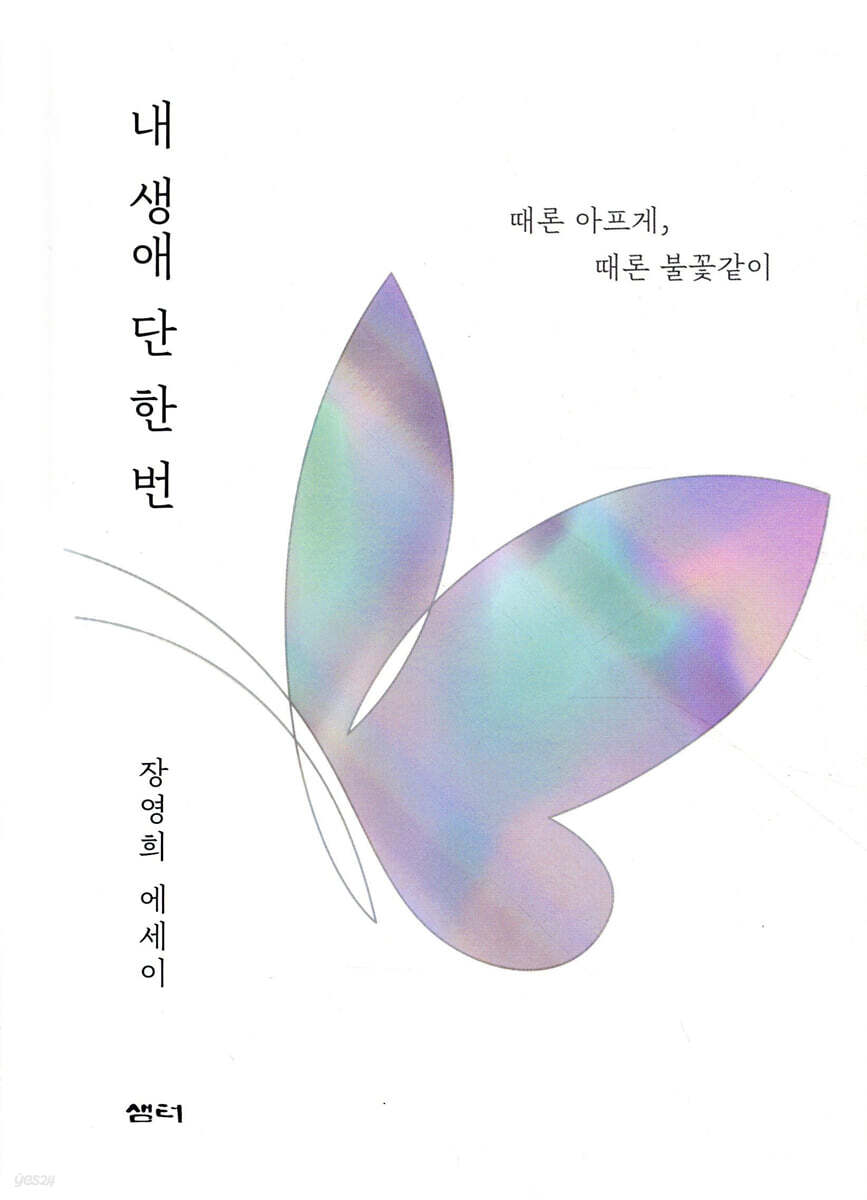
Once in my life
 |
Description
Book Introduction
Spreading positive life, hope and love
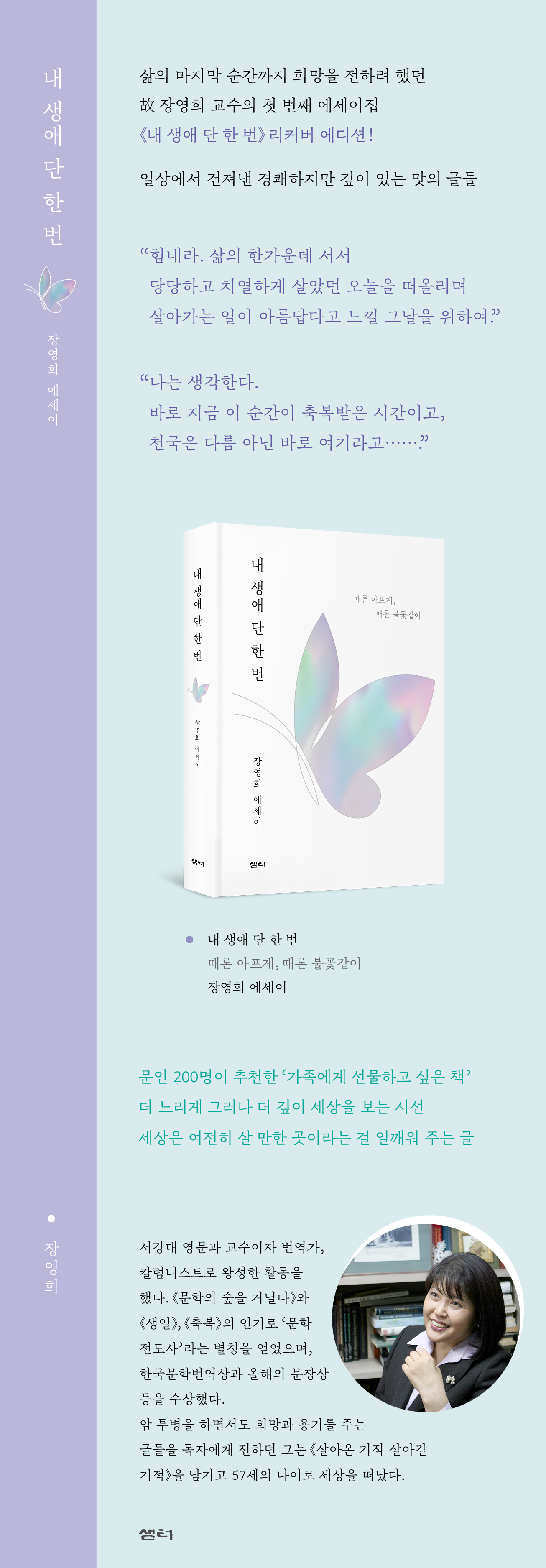
The late Professor Jang Young-hee's first collection of essays
A slower but deeper perspective on the world
Professor Jang Young-hee's first Korean-language essay collection, "Only Once in My Life," has been republished, dressed in beautiful clothing like her pure and shining soul.
Professor Jang Young-hee, who first made a name for herself as a translator, earned the nickname “literature evangelist” for her literary essays “Walking through the Forest of Literature,” “Birthday,” and “Blessing.”
Her pure essay collections, 『Only Once in My Life』 and 『The Miracle of Living, the Miracle of Living』, in which she delicately unfolds her life and thoughts, were also greatly loved.
This book, “Only Once in My Life,” is a collection of new writings as well as writings that were previously serialized in the monthly magazine “Samteo” and received favorable reviews from numerous readers.
With the main themes of 'the preciousness of life', 'hope', and 'trust', it movingly depicts the precious values of life that we must never forget through fragments we encounter in various aspects of our lives.
This book, which also won the 'Writing of the Year Award', is filled with lighthearted and refreshing writings gleaned from everyday life, helping us realize the preciousness of life that we often forget while living busy lives.
Even as we live in these difficult times, where it's difficult to dream of hope amidst ongoing hardships, this book reminds us that the world is still a beautiful and livable place, and gives us the strength to embrace hope again.
'Cheer up.
Professor Jang Young-hee's encouragement, saying, "For the day when you can stand in the middle of life and feel the beauty of living by recalling today, when you lived proudly and fiercely," will be the strength to live today.
The late Professor Jang Young-hee's first collection of essays
A slower but deeper perspective on the world
Professor Jang Young-hee's first Korean-language essay collection, "Only Once in My Life," has been republished, dressed in beautiful clothing like her pure and shining soul.
Professor Jang Young-hee, who first made a name for herself as a translator, earned the nickname “literature evangelist” for her literary essays “Walking through the Forest of Literature,” “Birthday,” and “Blessing.”
Her pure essay collections, 『Only Once in My Life』 and 『The Miracle of Living, the Miracle of Living』, in which she delicately unfolds her life and thoughts, were also greatly loved.
This book, “Only Once in My Life,” is a collection of new writings as well as writings that were previously serialized in the monthly magazine “Samteo” and received favorable reviews from numerous readers.
With the main themes of 'the preciousness of life', 'hope', and 'trust', it movingly depicts the precious values of life that we must never forget through fragments we encounter in various aspects of our lives.
This book, which also won the 'Writing of the Year Award', is filled with lighthearted and refreshing writings gleaned from everyday life, helping us realize the preciousness of life that we often forget while living busy lives.
Even as we live in these difficult times, where it's difficult to dream of hope amidst ongoing hardships, this book reminds us that the world is still a beautiful and livable place, and gives us the strength to embrace hope again.
'Cheer up.
Professor Jang Young-hee's encouragement, saying, "For the day when you can stand in the middle of life and feel the beauty of living by recalling today, when you lived proudly and fiercely," will be the strength to live today.
- You can preview some of the book's contents.
Preview
index
Introduction - The Ignorance of the Bee
1.
Love painfully
Why of All Things | Promise │ Living Twice │ The Aesthetics of Tears │ The Path to Becoming 'Real' │ Love Painfully │ Two Jang Young-hees? │ Regret in Heaven │ The Milky Way and the Ant Heart │ The Season of Understanding │ I Love You
2.
dead end
A beggar's stool │ A+ mind │ Me and others │ Love letters │ The teacher has grown old too │ It is a sin to give up hope │ Love that enters the eyes │ Dead end │ How does a blind boy help?
3.
To a bigger world
Mother's Tears │ My Crutches │ Reasons I Can't Give │ Dreams │ A Test Without Failure │ Inside and Out │ A Spring in Life │ To a Bigger World │ Socrates and Farmer Park │ The Lively Maria │ Ordinary is the Best
4.
But love remains
True Victory │ Yeonju! │ The Last Words I Leave in This World │ A Twenty-Year-Old's Book │ I'm Sorry │ God's Handwriting │ Is He a Fool? │ But Love Remains │ King Kong's Eyes
1.
Love painfully
Why of All Things | Promise │ Living Twice │ The Aesthetics of Tears │ The Path to Becoming 'Real' │ Love Painfully │ Two Jang Young-hees? │ Regret in Heaven │ The Milky Way and the Ant Heart │ The Season of Understanding │ I Love You
2.
dead end
A beggar's stool │ A+ mind │ Me and others │ Love letters │ The teacher has grown old too │ It is a sin to give up hope │ Love that enters the eyes │ Dead end │ How does a blind boy help?
3.
To a bigger world
Mother's Tears │ My Crutches │ Reasons I Can't Give │ Dreams │ A Test Without Failure │ Inside and Out │ A Spring in Life │ To a Bigger World │ Socrates and Farmer Park │ The Lively Maria │ Ordinary is the Best
4.
But love remains
True Victory │ Yeonju! │ The Last Words I Leave in This World │ A Twenty-Year-Old's Book │ I'm Sorry │ God's Handwriting │ Is He a Fool? │ But Love Remains │ King Kong's Eyes
Detailed image
Into the book
But the 'why of all things' that my second-grade niece, Areum, threw at me last night was not like that at all.
When I bought a cute panda bear doll on the street and gave it to Arami, Arami opened her eyes wide and smiled brightly, saying, “But Auntie, why did you give this to me of all people?”
There were many other siblings and cousins, and no matter how much I thought about it, I felt like I didn't deserve it, but A-reum was expressing her gratitude in her own way for receiving an unexpected gift.
It was an example of A-reum, who came from living abroad and whose Korean was still awkward, using the word 'Hapil-myeon' inappropriately, but I realized that when I used 'Hapil-myeon' in a good situation like A-reum, my 'Hapil-myeon' fate also suddenly began to shine brightly.
Many of the happiness I enjoyed turned out to be truly unbelievable and surprising.
--- p.16~17 From “Why of All Things”
Unrequited love is the shortcut to maturity and the best practice in love.
The path of learning may also be a lonely and painful path of unrequited love.
Although we feel endless frustration when we face a wall that remains unanswered no matter how hard we knock and dig, only those who do not give up and keep pushing through to the end will eventually break down that wall and become victors who can step out into a wider world.
So, young people, love confidently and passionately.
Love people, love God, love learning, love truth, love those green trees and those high skies, and passionately love the everyday life you live.
--- p.47 From “Love Painfully”
If you trace the etymology of the verbs 'to love' and 'to live', they are said to ultimately come from the same word.
In English, 'live' and 'love' are only one letter different.
Perhaps living is a continuation of loving.
Love God, love people, love your country, love roses, Goethe, Mozart, coffee… … .
We are always in endless pain and shedding tears because we love, but if we take love out of our lives, life would be nothing more than a vain shadow show.
--- p.74~75 From “I Love You”
Sometimes, something someone does to me is so ridiculous and infuriating that I can't stand it.
Even after suffering from heartache and not being able to sleep for days, there are times when the thought suddenly comes to me, 'If I were in that person's shoes, I might have done the same thing.'
Then, even if you don't necessarily understand, you will feel sympathy and wonder, 'Why must it be like that?'
Of course, it would have been better if it hadn't happened, and it's so unfair and heartbreaking that I was the target, but still, as the lump in my heart gradually melts away, there are times when I think, 'It's nothing, I should just forgive him.'
It is a miracle that occurs when we understand the mind of others with our own mind.
--- p.95~96 From “Me and Others”
Danger and misfortune lurk in every aspect of life, but living each day with the invincible spirit of "destroyed but not defeated" is truly sublime.
But if there is no hope, the fight becomes so desperate and sad.
The hope that the pain of today will one day disappear, the hope that someone will reach out in the darkness, the hope that tomorrow will bring me light and life—only with such hope can our fighting spirit shine, and only then can we develop a camaraderie for life, like the old man's for the fish.
And it is a sin not to have that hope.
Because closing your eyes to the light is like committing suicide by locking yourself in a prison of darkness.
In "The Old Man and the Sea," a work more like a magnificent epic poem than a novel, the old man teaches us true humanity through his composure and indomitable courage even in the face of pain and the threat of death.
--- p.116~117 From “Giving Up Hope is a Sin”
She was always a cautious and quiet mother, but she was also a tenacious warrior who believed that she had to fight to the death to ensure that her helpless daughter had a place in this world.
When it snowed, she would spread coal briquette ash on the snow, and when it rained, she would carry her daughter on her back with one hand and hold an umbrella with the other, becoming her daughter's path and shield. Every day was a series of sad and difficult battles for the mother.
Not only that, I had to have surgeries frequently and stay in the hospital for two or three months, and the schools that wouldn't even allow me to take the entrance exam because of my disability whenever I went to a higher level school... ... Even though I begged and pleaded that I could do well and be given a spot, the world kept pushing me to the edge, and I was able to cling tenaciously to it all because of my mother.
My mother had never shed tears in front of me, a silent lesson that the sorrows of this world could not be conquered by tears, but the 'mother's tears' flowing in her heart were something even my ten-year-old daughter could not ignore.
--- p.143~144 From “Mother’s Tears”
I am neither fatalist nor anti-fatalist.
But I try to remember Ahab.
Even if there is such a thing as fate and whether I am the winner or loser of my life is beyond my free will, I will still fight, like Ahab.
Ahab rebelled against human incompetence and weakness, refusing to be a mere beggar who accepted whatever life offered him.
Ultimately, his efforts led to his own death and the death of others, but he chose a death of challenge rather than a life of surrender.
--- p.242 From “The Book of a Twenty-Year-Old”
Emerson, the 19th-century American thinker and poet, said, “Beauty is God's handwriting.”
If everything in this world is handwritten by God, then what could be less beautiful? Peonies, blooming in their vibrant colors, are beautiful, but so are the tiny wildflowers blooming hidden in the crevices of rocks.
Miss Korea in her glittering crown, a general adorned with medals, a high-ranking official with dozens of attendants—they are all beautiful people.
But the fruit vendor who shamelessly breastfeeds her child with her breasts exposed on the market floor, the laborer who bends his back carrying bricks at a construction site, the sanitation workers who work in a pile of garbage covered in dust so much that they cannot even tell their eyes, nose, and mouth from each other—these are also beautiful people.
When I bought a cute panda bear doll on the street and gave it to Arami, Arami opened her eyes wide and smiled brightly, saying, “But Auntie, why did you give this to me of all people?”
There were many other siblings and cousins, and no matter how much I thought about it, I felt like I didn't deserve it, but A-reum was expressing her gratitude in her own way for receiving an unexpected gift.
It was an example of A-reum, who came from living abroad and whose Korean was still awkward, using the word 'Hapil-myeon' inappropriately, but I realized that when I used 'Hapil-myeon' in a good situation like A-reum, my 'Hapil-myeon' fate also suddenly began to shine brightly.
Many of the happiness I enjoyed turned out to be truly unbelievable and surprising.
--- p.16~17 From “Why of All Things”
Unrequited love is the shortcut to maturity and the best practice in love.
The path of learning may also be a lonely and painful path of unrequited love.
Although we feel endless frustration when we face a wall that remains unanswered no matter how hard we knock and dig, only those who do not give up and keep pushing through to the end will eventually break down that wall and become victors who can step out into a wider world.
So, young people, love confidently and passionately.
Love people, love God, love learning, love truth, love those green trees and those high skies, and passionately love the everyday life you live.
--- p.47 From “Love Painfully”
If you trace the etymology of the verbs 'to love' and 'to live', they are said to ultimately come from the same word.
In English, 'live' and 'love' are only one letter different.
Perhaps living is a continuation of loving.
Love God, love people, love your country, love roses, Goethe, Mozart, coffee… … .
We are always in endless pain and shedding tears because we love, but if we take love out of our lives, life would be nothing more than a vain shadow show.
--- p.74~75 From “I Love You”
Sometimes, something someone does to me is so ridiculous and infuriating that I can't stand it.
Even after suffering from heartache and not being able to sleep for days, there are times when the thought suddenly comes to me, 'If I were in that person's shoes, I might have done the same thing.'
Then, even if you don't necessarily understand, you will feel sympathy and wonder, 'Why must it be like that?'
Of course, it would have been better if it hadn't happened, and it's so unfair and heartbreaking that I was the target, but still, as the lump in my heart gradually melts away, there are times when I think, 'It's nothing, I should just forgive him.'
It is a miracle that occurs when we understand the mind of others with our own mind.
--- p.95~96 From “Me and Others”
Danger and misfortune lurk in every aspect of life, but living each day with the invincible spirit of "destroyed but not defeated" is truly sublime.
But if there is no hope, the fight becomes so desperate and sad.
The hope that the pain of today will one day disappear, the hope that someone will reach out in the darkness, the hope that tomorrow will bring me light and life—only with such hope can our fighting spirit shine, and only then can we develop a camaraderie for life, like the old man's for the fish.
And it is a sin not to have that hope.
Because closing your eyes to the light is like committing suicide by locking yourself in a prison of darkness.
In "The Old Man and the Sea," a work more like a magnificent epic poem than a novel, the old man teaches us true humanity through his composure and indomitable courage even in the face of pain and the threat of death.
--- p.116~117 From “Giving Up Hope is a Sin”
She was always a cautious and quiet mother, but she was also a tenacious warrior who believed that she had to fight to the death to ensure that her helpless daughter had a place in this world.
When it snowed, she would spread coal briquette ash on the snow, and when it rained, she would carry her daughter on her back with one hand and hold an umbrella with the other, becoming her daughter's path and shield. Every day was a series of sad and difficult battles for the mother.
Not only that, I had to have surgeries frequently and stay in the hospital for two or three months, and the schools that wouldn't even allow me to take the entrance exam because of my disability whenever I went to a higher level school... ... Even though I begged and pleaded that I could do well and be given a spot, the world kept pushing me to the edge, and I was able to cling tenaciously to it all because of my mother.
My mother had never shed tears in front of me, a silent lesson that the sorrows of this world could not be conquered by tears, but the 'mother's tears' flowing in her heart were something even my ten-year-old daughter could not ignore.
--- p.143~144 From “Mother’s Tears”
I am neither fatalist nor anti-fatalist.
But I try to remember Ahab.
Even if there is such a thing as fate and whether I am the winner or loser of my life is beyond my free will, I will still fight, like Ahab.
Ahab rebelled against human incompetence and weakness, refusing to be a mere beggar who accepted whatever life offered him.
Ultimately, his efforts led to his own death and the death of others, but he chose a death of challenge rather than a life of surrender.
--- p.242 From “The Book of a Twenty-Year-Old”
Emerson, the 19th-century American thinker and poet, said, “Beauty is God's handwriting.”
If everything in this world is handwritten by God, then what could be less beautiful? Peonies, blooming in their vibrant colors, are beautiful, but so are the tiny wildflowers blooming hidden in the crevices of rocks.
Miss Korea in her glittering crown, a general adorned with medals, a high-ranking official with dozens of attendants—they are all beautiful people.
But the fruit vendor who shamelessly breastfeeds her child with her breasts exposed on the market floor, the laborer who bends his back carrying bricks at a construction site, the sanitation workers who work in a pile of garbage covered in dust so much that they cannot even tell their eyes, nose, and mouth from each other—these are also beautiful people.
--- p.268~269 From “God’s Handwriting”
Publisher's Review
Books to Give to Your Family, Recommended by 200 Writers
Lighthearted and refreshing writings gleaned from everyday life.
Many writers complain of a lack of material.
However, when reading Professor Jang Young-hee's writing, I am amazed at how everything I see and experience around me naturally becomes material for my writing.
This book is mostly filled with writings that come from the author's life and experiences, such as reading a book, looking out the window, teaching students, and watching television.
Instead of emphasizing grand literary themes, it invites readers into the most ordinary of everyday lives, imbuing ordinary and simple writing with value and depth that is hard to find anywhere else.
It perfectly reflects the attitude of looking closely at small things and finding enlightenment in them.
Professor Jang Young-hee suffered from polio as a baby and has lived with the help of crutches ever since.
However, it is difficult to find any sense of inferiority due to disability anywhere in her writing.
Rather, it is always bright, cheerful, and friendly.
She seems like a naive girl who likes to play around and indulge in daydreaming whenever she gets the chance.
The righteousness of standing on the side of those in need and the true heart that knows how to cherish the value of small things are clearly reflected.
From the story of boldly giving an A+ to a student who helped a poor grandmother, to respect for parents' boundless love and faith, to honest stories about the unique experiences of being disabled, to sharp criticism of social prejudice, all are told in a colorful way, sublimated with his signature humor and wit.
So, there are tears and laughter between every line.
This is the literary talent and leisure that only she possesses, and the unique color and beauty of her writing.
Readers will come to realize that in this attitude toward life, they can transform unbearable pain into a healthy and confident path, and that inadequacies can become stepping stones to new hope.
A precious treasure of the heart that allows us to feel 'life' as a 'beautiful life'
A message of hope and trust from one person to another
In this book, the author expresses gratitude for each and every relationship he has encountered over the course of eternity, and continually proves that even an unhappy life has its own value and hope.
It sings of a heart that feels more attached to old and dirty things than to fancy things, and that knows how to read the most simple and sincere feelings of a human being in a childish love letter.
The scent and sentiments of our lives, which resonate too deeply to be considered the story of one individual, are neatly and warmly melted into it.
Even without mentioning the equation, “writing is the person,” the author’s usual outlook on life is well reflected in the book: “Rather than living a dull and habitual life, you should work hard as if it were your first and last.”
As we follow the author's gaze, which not only offers calm self-reflection but also warmly sublimates the meaning of life and death, we find clear waves of color and sound penetrating our hearts.
It poses important questions for reflection and introspection to those of us who like to complain about our shortcomings and forget ourselves while being immersed in the harshness of daily life, and delivers a valuable message that we have forgotten or overlooked.
Instead of complaining, “Why am I the only one who is unhappy and unlucky?”, when you feel grateful and ask, “Why was this joy given to me?”, your “dry and habitual life” will feel like a “beautiful life.”
These are the messages of hope and trust that Professor Jang Young-hee sends us.
In this book, which gently embodies the true values that sustain life and the virtues that make us truly human, you will be able to enjoy the author's well-seasoned literary fragrance and the peace and joy that come with finding your spiritual home.
Lighthearted and refreshing writings gleaned from everyday life.
Many writers complain of a lack of material.
However, when reading Professor Jang Young-hee's writing, I am amazed at how everything I see and experience around me naturally becomes material for my writing.
This book is mostly filled with writings that come from the author's life and experiences, such as reading a book, looking out the window, teaching students, and watching television.
Instead of emphasizing grand literary themes, it invites readers into the most ordinary of everyday lives, imbuing ordinary and simple writing with value and depth that is hard to find anywhere else.
It perfectly reflects the attitude of looking closely at small things and finding enlightenment in them.
Professor Jang Young-hee suffered from polio as a baby and has lived with the help of crutches ever since.
However, it is difficult to find any sense of inferiority due to disability anywhere in her writing.
Rather, it is always bright, cheerful, and friendly.
She seems like a naive girl who likes to play around and indulge in daydreaming whenever she gets the chance.
The righteousness of standing on the side of those in need and the true heart that knows how to cherish the value of small things are clearly reflected.
From the story of boldly giving an A+ to a student who helped a poor grandmother, to respect for parents' boundless love and faith, to honest stories about the unique experiences of being disabled, to sharp criticism of social prejudice, all are told in a colorful way, sublimated with his signature humor and wit.
So, there are tears and laughter between every line.
This is the literary talent and leisure that only she possesses, and the unique color and beauty of her writing.
Readers will come to realize that in this attitude toward life, they can transform unbearable pain into a healthy and confident path, and that inadequacies can become stepping stones to new hope.
A precious treasure of the heart that allows us to feel 'life' as a 'beautiful life'
A message of hope and trust from one person to another
In this book, the author expresses gratitude for each and every relationship he has encountered over the course of eternity, and continually proves that even an unhappy life has its own value and hope.
It sings of a heart that feels more attached to old and dirty things than to fancy things, and that knows how to read the most simple and sincere feelings of a human being in a childish love letter.
The scent and sentiments of our lives, which resonate too deeply to be considered the story of one individual, are neatly and warmly melted into it.
Even without mentioning the equation, “writing is the person,” the author’s usual outlook on life is well reflected in the book: “Rather than living a dull and habitual life, you should work hard as if it were your first and last.”
As we follow the author's gaze, which not only offers calm self-reflection but also warmly sublimates the meaning of life and death, we find clear waves of color and sound penetrating our hearts.
It poses important questions for reflection and introspection to those of us who like to complain about our shortcomings and forget ourselves while being immersed in the harshness of daily life, and delivers a valuable message that we have forgotten or overlooked.
Instead of complaining, “Why am I the only one who is unhappy and unlucky?”, when you feel grateful and ask, “Why was this joy given to me?”, your “dry and habitual life” will feel like a “beautiful life.”
These are the messages of hope and trust that Professor Jang Young-hee sends us.
In this book, which gently embodies the true values that sustain life and the virtues that make us truly human, you will be able to enjoy the author's well-seasoned literary fragrance and the peace and joy that come with finding your spiritual home.
GOODS SPECIFICS
- Publication date: July 30, 2021
- Format: Hardcover book binding method guide
- Page count, weight, size: 296 pages | 398g | 142*195*18mm
- ISBN13: 9788946421851
- ISBN10: 8946421851
You may also like
카테고리
korean


korean

![GQ KOREA Mark (Monthly): December [2025]](http://librairie.coreenne.fr/cdn/shop/files/8ef265dbbfbf186523ed75ba7319009d.jpg?v=1765340328&width=3840)


