

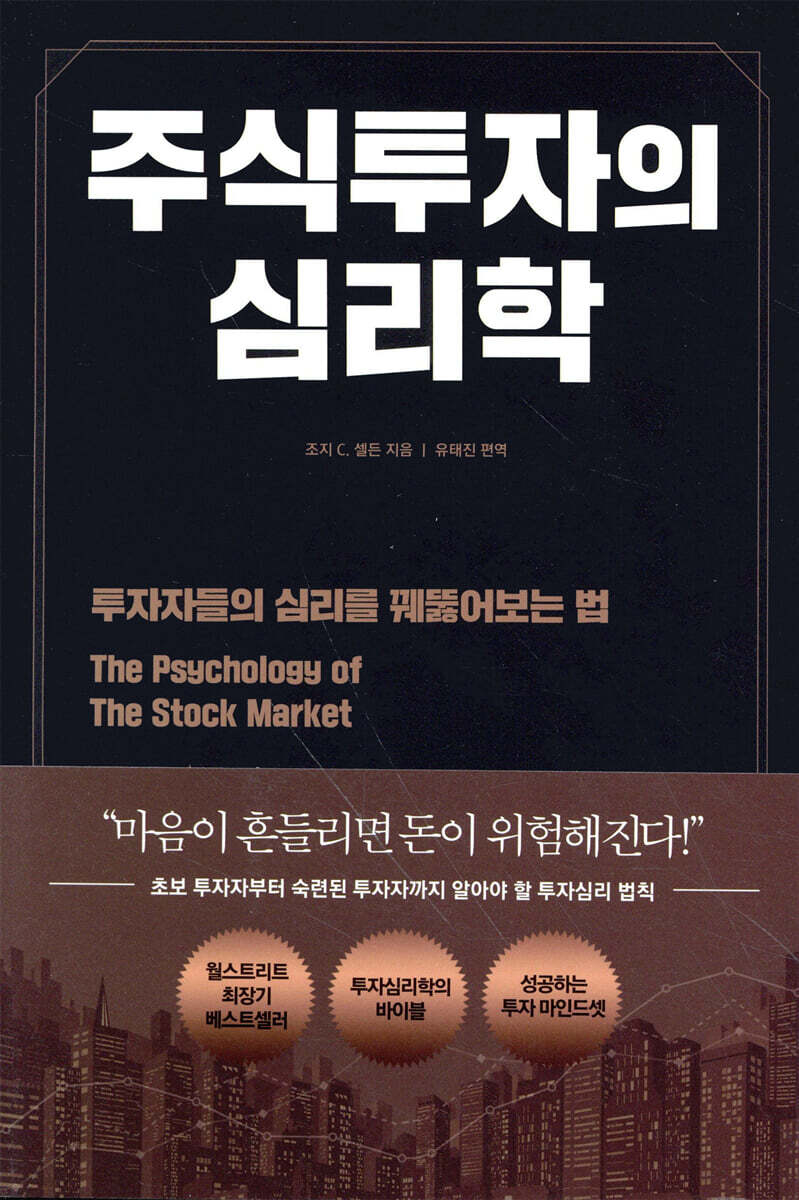
The Psychology of Stock Investment
 |
Description
Book Introduction
“If your heart wavers, your money is in danger!”
The Principles of the Stock Market from a Legendary Investor
Investment Psychology Rules That Every Beginner and Experienced Investor Should Know
The answer to 'how to invest' lies in understanding the 'psychology' of the stock market.
Based on the fact that stock market price fluctuations are significantly influenced by the psychology of investors, the main players in investment and trading, this book offers keen insights into the powerful influence of psychology on the stock market.
It develops the ability to read the movements of the stock market, such as how the constantly changing psychological attitudes of people affect stock prices, what characteristics of the market are influenced by psychological factors, and what attitude to take in bull and bear markets.
Through this, you will be able to learn the psychological characteristics of successful investors and develop a stable attitude towards the market.
The Principles of the Stock Market from a Legendary Investor
Investment Psychology Rules That Every Beginner and Experienced Investor Should Know
The answer to 'how to invest' lies in understanding the 'psychology' of the stock market.
Based on the fact that stock market price fluctuations are significantly influenced by the psychology of investors, the main players in investment and trading, this book offers keen insights into the powerful influence of psychology on the stock market.
It develops the ability to read the movements of the stock market, such as how the constantly changing psychological attitudes of people affect stock prices, what characteristics of the market are influenced by psychological factors, and what attitude to take in bull and bear markets.
Through this, you will be able to learn the psychological characteristics of successful investors and develop a stable attitude towards the market.
- You can preview some of the book's contents.
Preview
index
introduction
Chapter 1: To understand stock prices, you must understand psychology.
How to Read a Speculation Cycle
The psychology of the buyer and the psychology of the seller
Speculative cycle of bull market
The stock market is a place of mixed emotions
Speculative cycle in a bear market
Stock prices are determined by hope and fear.
Chapter 2: Don't Sell at the Ceiling, Don't Buy at the Floor
The money you invest speaks for itself
Why Stock Prices Fall Despite Good News
The big shots don't hide
How to view good and bad news
Sometimes it's better to just see things as they are
Chapter 3 Those People
A story about 'those people'
Who are 'those people'?
Those people are big shots
'Those people' are actually all investors.
Don't be bound by the rules
You can't force a horse to drink water.
'Those people' are also after money in the end.
Chapter 4: An Unwavering Attitude to the Market
Always think flexibly
Every morning, check your baseline.
Understanding the link between signs
Uncertainty is the biggest negative.
Everyone falls into the swamp of fear at least once.
Don't dwell on the past
Chapter 5: Stock Prices Don't Move the Way I Want
The market is forever cold
Whether you bought it two years ago or two minutes ago, be cool-headed and make a judgment call.
See facts, not illusions
Don't fall into the hole you made yourself.
Use prejudice against others
Chapter 6: Get Rich Quick, Become Poor Quick
How Panic Comes
Money must always flow
Be extra cautious when riding the rising tide.
Don't act like you're already rich.
Look ahead through the stock market
Chapter 7: The Intersection of Boom and Bust
Impulsive investors and cool investors
Don't miss the turning point
Chapter 8: The Mindset of a Successful Investor
Back to basics
Only when you are calm can you see the essence.
Look at the forest, not the trees
How to invest
10 Psychological Traits of Successful Investors
Chapter 1: To understand stock prices, you must understand psychology.
How to Read a Speculation Cycle
The psychology of the buyer and the psychology of the seller
Speculative cycle of bull market
The stock market is a place of mixed emotions
Speculative cycle in a bear market
Stock prices are determined by hope and fear.
Chapter 2: Don't Sell at the Ceiling, Don't Buy at the Floor
The money you invest speaks for itself
Why Stock Prices Fall Despite Good News
The big shots don't hide
How to view good and bad news
Sometimes it's better to just see things as they are
Chapter 3 Those People
A story about 'those people'
Who are 'those people'?
Those people are big shots
'Those people' are actually all investors.
Don't be bound by the rules
You can't force a horse to drink water.
'Those people' are also after money in the end.
Chapter 4: An Unwavering Attitude to the Market
Always think flexibly
Every morning, check your baseline.
Understanding the link between signs
Uncertainty is the biggest negative.
Everyone falls into the swamp of fear at least once.
Don't dwell on the past
Chapter 5: Stock Prices Don't Move the Way I Want
The market is forever cold
Whether you bought it two years ago or two minutes ago, be cool-headed and make a judgment call.
See facts, not illusions
Don't fall into the hole you made yourself.
Use prejudice against others
Chapter 6: Get Rich Quick, Become Poor Quick
How Panic Comes
Money must always flow
Be extra cautious when riding the rising tide.
Don't act like you're already rich.
Look ahead through the stock market
Chapter 7: The Intersection of Boom and Bust
Impulsive investors and cool investors
Don't miss the turning point
Chapter 8: The Mindset of a Successful Investor
Back to basics
Only when you are calm can you see the essence.
Look at the forest, not the trees
How to invest
10 Psychological Traits of Successful Investors
Detailed image

Into the book
The hopes and fears that come to investors in the stock market, and the movements and variations that occur between the two, do not arise from sophisticated judgments of various market conditions, but rather from psychological attitudes that arise from each individual's position in the market.
This could also be said to be the public using their imagination to project the current situation onto the future.
--- p.38
When predicting the stock market or making investment decisions, don't try to apply elaborate theories to obvious realities.
The obvious reality must be seen and accepted as it is.
The way of the stock market is to experience and practice, not to analyze and name.
--- p.84
There is one guideline that can help us avoid this error of confusing the present with the future in relation to other phenomena in the stock market.
This means that we should not try to tie stock price movements to any existing laws, equate them with similar cases in the past, or analyze the phenomena separately.
Just because stock prices moved in the past doesn't mean you should assume that the current situation will unfold in the same way as in the past.
No matter how familiar the present situation may be, it is by no means the same as the past.
It's a completely new and different situation.
--- p.121
The stock market cannot be moved by individual will or hope alone.
No matter how new theories and methods you are armed with, they alone cannot directly raise or lower stock prices.
In the stock market, individual investors are nothing more than people on a raft, tossed about by the waves.
An optimist must not believe that the currents and waves will constantly carry this piece of wood somewhere, but that it can ride the current and move towards its intended destination.
Optimism is not a willpower, it is an intellect.
This could also be said to be the public using their imagination to project the current situation onto the future.
--- p.38
When predicting the stock market or making investment decisions, don't try to apply elaborate theories to obvious realities.
The obvious reality must be seen and accepted as it is.
The way of the stock market is to experience and practice, not to analyze and name.
--- p.84
There is one guideline that can help us avoid this error of confusing the present with the future in relation to other phenomena in the stock market.
This means that we should not try to tie stock price movements to any existing laws, equate them with similar cases in the past, or analyze the phenomena separately.
Just because stock prices moved in the past doesn't mean you should assume that the current situation will unfold in the same way as in the past.
No matter how familiar the present situation may be, it is by no means the same as the past.
It's a completely new and different situation.
--- p.121
The stock market cannot be moved by individual will or hope alone.
No matter how new theories and methods you are armed with, they alone cannot directly raise or lower stock prices.
In the stock market, individual investors are nothing more than people on a raft, tossed about by the waves.
An optimist must not believe that the currents and waves will constantly carry this piece of wood somewhere, but that it can ride the current and move towards its intended destination.
Optimism is not a willpower, it is an intellect.
--- p.201
Publisher's Review
Wall Street's longest-running bestseller
The Bible of Investment Psychology
About the investment sentiment that moves the stock market
The author of this book, George C.
Selden was a legendary investment analyst and author active on Wall Street, and enjoyed international renown for his thorough and incisive analysis of the effects of economic factors on investment and business.
He did not simply list theories; he wrote many books on stocks and investing, drawing on the keen insight he gained from his experience as a practicing investor.
Among them, this book in particular is called a classic in investment psychology and has established itself as the longest-running bestseller on Wall Street.
What Selden wants to talk about is not the economic fundamentals that influence the stock market, but rather the various psychological factors at play within it.
The purpose is to track why they occur and what fluctuations occur in the stock market as a result.
The rise and fall of stock prices have various consequences depending on the psychology and mental attitude of the public in the stock market.
In particular, the fact that the stock price of a specific stock fluctuates repeatedly over a short period of time is almost always due to public psychological factors.
Therefore, if we can understand the public sentiment and behavior behind stock investment, we can infer whether the public sentiment is optimistic or pessimistic and what the future outlook will be based on that.
This book presents methods for interpreting the speculative cycle between bull and bear markets, determining what criteria should be used when evaluating positive and negative news, and reducing errors in timing buys and sells, as well as establishing the fundamentals of investment.
When investing, the question of 'where and how to invest' is a point of concern at every moment.
Knowing how to read investors' psychology, emotions, and behaviors will be of great help in establishing your own investment principles and achieving successful investment.
The Bible of Investment Psychology
About the investment sentiment that moves the stock market
The author of this book, George C.
Selden was a legendary investment analyst and author active on Wall Street, and enjoyed international renown for his thorough and incisive analysis of the effects of economic factors on investment and business.
He did not simply list theories; he wrote many books on stocks and investing, drawing on the keen insight he gained from his experience as a practicing investor.
Among them, this book in particular is called a classic in investment psychology and has established itself as the longest-running bestseller on Wall Street.
What Selden wants to talk about is not the economic fundamentals that influence the stock market, but rather the various psychological factors at play within it.
The purpose is to track why they occur and what fluctuations occur in the stock market as a result.
The rise and fall of stock prices have various consequences depending on the psychology and mental attitude of the public in the stock market.
In particular, the fact that the stock price of a specific stock fluctuates repeatedly over a short period of time is almost always due to public psychological factors.
Therefore, if we can understand the public sentiment and behavior behind stock investment, we can infer whether the public sentiment is optimistic or pessimistic and what the future outlook will be based on that.
This book presents methods for interpreting the speculative cycle between bull and bear markets, determining what criteria should be used when evaluating positive and negative news, and reducing errors in timing buys and sells, as well as establishing the fundamentals of investment.
When investing, the question of 'where and how to invest' is a point of concern at every moment.
Knowing how to read investors' psychology, emotions, and behaviors will be of great help in establishing your own investment principles and achieving successful investment.
GOODS SPECIFICS
- Date of issue: September 25, 2023
- Page count, weight, size: 216 pages | 140*210*14mm
- ISBN13: 9791190312899
- ISBN10: 1190312891
You may also like
카테고리
korean


korean

![ELLE 엘르 스페셜 에디션 A형 : 12월 [2025]](http://librairie.coreenne.fr/cdn/shop/files/b8e27a3de6c9538896439686c6b0e8fb.jpg?v=1766436872&width=3840)


