

Yukio Mishima
 |
Description
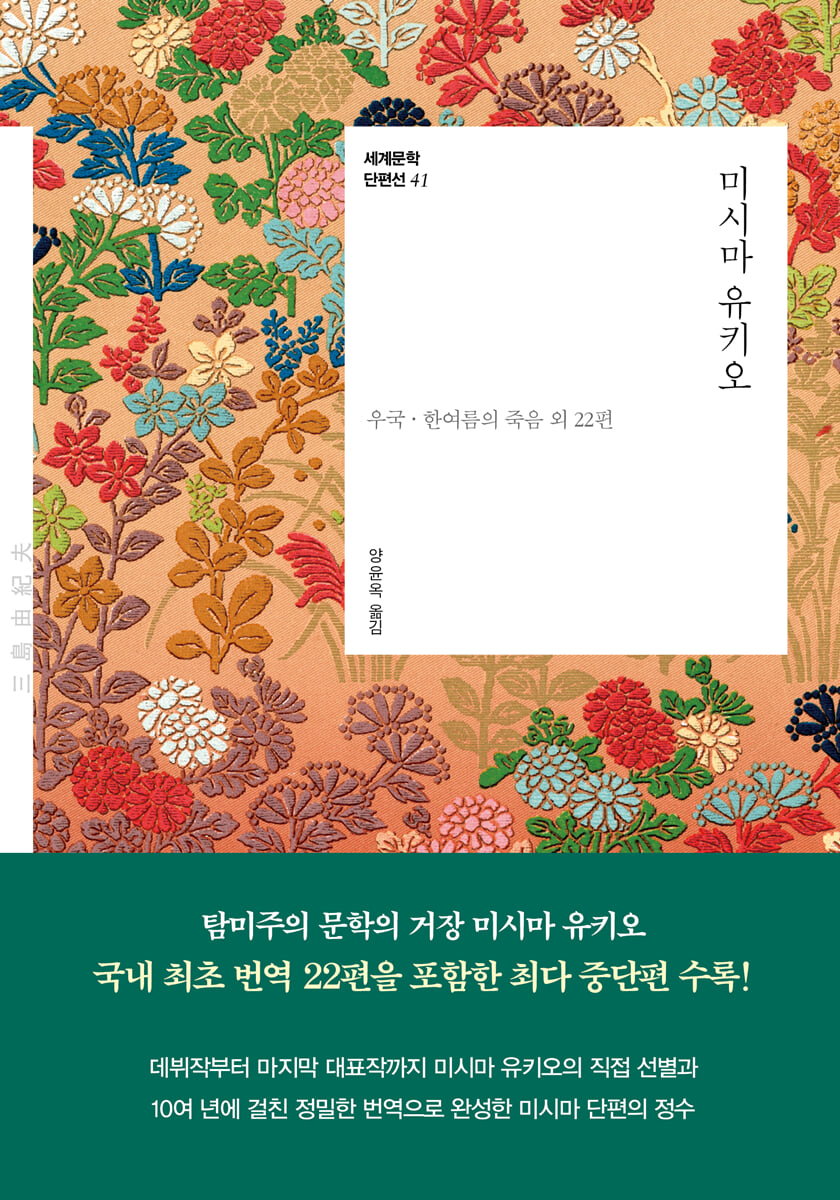
Book Introduction
Yukio Mishima, a master of aesthetic literature
“Creating beautiful works and becoming beautiful myself
“I found that we held ourselves to the same ethical standards.”
From his debut work to his last masterpiece, Yukio Mishima personally selected and
The essence of Mishima's short stories, completed through precise translation over ten years.
☆The largest collection of short stories, including 22 translated for the first time in Korea!☆
Yukio Mishima, a master of Japanese aesthetic literature, has been nominated for the Nobel Prize in Literature for many years and has garnered worldwide attention.
His works, which had been neglected in Korea due to his right-wing tendencies in his later years, are being re-examined in celebration of the 100th anniversary of his birth.
Although his major works, such as 『The Temple of the Golden Pavilion』, 『Confession of a Mask』, and the "Sea of Abundance" series, were translated and introduced, he was a star of the literary world of his time who enjoyed popular popularity by demonstrating his writing skills in entertainment novels that focused on interesting plot developments.
In modern literature, the short story collection 『Mishima Yukio』, which condenses the diverse spectrum of this author who has freely crossed genres, is presented as the forty-first volume of the "Modern Literature World Literature Short Story Collection."
Yukio Mishima published a lot of short stories throughout his 20s and early to mid 30s, including "Forest in Full Bloom," which made his pen name known when he published it in a doujinshi magazine at the age of 16, and "Tobacco," which marked his official literary debut at the age of 21 upon the recommendation of Yasunari Kawabata, "Death in Midsummer," which induces immersion from the very beginning with a tragic incident that sweeps through the story, and "Patriotism," which caused shock and controversy by depicting a seppuku (self-mutilation).
He left behind a whopping 144 short stories before his death at the age of 45 in 1970. This collection of short stories is the answer for readers who are wondering which of his numerous works to read first.
This book, which contains a total of 24 short stories in two volumes of charity short story collections published in 1968 and 1970, is a compilation of works that Yukio Mishima himself considered to be of a high level of completion. At the end of the book, there is a commentary written by Mishima himself at the time of publication, allowing readers to check out his self-evaluation of the works and the starting points of his creation.
As the majority of the works are being introduced to Korea for the first time, translator Yang Yun-ok, a master of Japanese literature translation, has spent a long time restoring the precise and beautiful style.
“Creating beautiful works and becoming beautiful myself
“I found that we held ourselves to the same ethical standards.”
From his debut work to his last masterpiece, Yukio Mishima personally selected and
The essence of Mishima's short stories, completed through precise translation over ten years.
☆The largest collection of short stories, including 22 translated for the first time in Korea!☆
Yukio Mishima, a master of Japanese aesthetic literature, has been nominated for the Nobel Prize in Literature for many years and has garnered worldwide attention.
His works, which had been neglected in Korea due to his right-wing tendencies in his later years, are being re-examined in celebration of the 100th anniversary of his birth.
Although his major works, such as 『The Temple of the Golden Pavilion』, 『Confession of a Mask』, and the "Sea of Abundance" series, were translated and introduced, he was a star of the literary world of his time who enjoyed popular popularity by demonstrating his writing skills in entertainment novels that focused on interesting plot developments.
In modern literature, the short story collection 『Mishima Yukio』, which condenses the diverse spectrum of this author who has freely crossed genres, is presented as the forty-first volume of the "Modern Literature World Literature Short Story Collection."
Yukio Mishima published a lot of short stories throughout his 20s and early to mid 30s, including "Forest in Full Bloom," which made his pen name known when he published it in a doujinshi magazine at the age of 16, and "Tobacco," which marked his official literary debut at the age of 21 upon the recommendation of Yasunari Kawabata, "Death in Midsummer," which induces immersion from the very beginning with a tragic incident that sweeps through the story, and "Patriotism," which caused shock and controversy by depicting a seppuku (self-mutilation).
He left behind a whopping 144 short stories before his death at the age of 45 in 1970. This collection of short stories is the answer for readers who are wondering which of his numerous works to read first.
This book, which contains a total of 24 short stories in two volumes of charity short story collections published in 1968 and 1970, is a compilation of works that Yukio Mishima himself considered to be of a high level of completion. At the end of the book, there is a commentary written by Mishima himself at the time of publication, allowing readers to check out his self-evaluation of the works and the starting points of his creation.
As the majority of the works are being introduced to Korea for the first time, translator Yang Yun-ok, a master of Japanese literature translation, has spent a long time restoring the precise and beautiful style.
- You can preview some of the book's contents.
Preview
index
A forest in full bloom · 7
Excerpts from the Philosophical Diary of a Medieval Murderer · 50
Cigarettes · 63
Haruko · 82
Circus · 133
Won Seung-hoe · 144
Wings - A Gautier-esque Story · 165
Rikyu's Pine Tree · 181
Crossword Puzzle · 201
Death in Midsummer · 228
Fireworks · 288
Eggs · 306
The Poet Boy · 324
Sea and Sunset · 341
Newspaper · 355
Peony · 365
Bridge Stepping · 372
Return · 396
Onnagata · 430
Million Yen Jeonbyeong · 463
Patriotism · 484
Moon · 515
Grape Bread · 538
Fountain in the Rain · 560
Author's Note 1 · 572
Author's Note 2 · 579
Translator's Note · 586
Yukio Mishima Chronology · 598
Excerpts from the Philosophical Diary of a Medieval Murderer · 50
Cigarettes · 63
Haruko · 82
Circus · 133
Won Seung-hoe · 144
Wings - A Gautier-esque Story · 165
Rikyu's Pine Tree · 181
Crossword Puzzle · 201
Death in Midsummer · 228
Fireworks · 288
Eggs · 306
The Poet Boy · 324
Sea and Sunset · 341
Newspaper · 355
Peony · 365
Bridge Stepping · 372
Return · 396
Onnagata · 430
Million Yen Jeonbyeong · 463
Patriotism · 484
Moon · 515
Grape Bread · 538
Fountain in the Rain · 560
Author's Note 1 · 572
Author's Note 2 · 579
Translator's Note · 586
Yukio Mishima Chronology · 598
Detailed image

Into the book
He is sometimes accepted as an adult, and sometimes as a child.
Is it because he lacks something certain?
No, I think there is something definite about boyhood that is hard to find in any other period, and he is desperate to give it a name.
That's growth.
He finally gives it a name.
Success reassures him and boosts his self-esteem.
But when a name is given, in an instant that certain something changes into something different from what it would have been if it had not been given a name.
Moreover, he doesn't even realize that it is so.
That is, he became an adult.
- Childhood is a tightly sealed box that is treasured.
The boy tries to open it somehow.
The lid is open.
There is nothing inside.
There he realizes.
'This is how a treasure chest is always empty.' From that moment on, he begins to value the theorem he had established more.
In other words, he has 'become an adult'.
But was the box really empty?
As soon as I opened the lid, I wondered if something important, invisible, had escaped.
--- From "Cigarettes"
As I was waiting at S Station, a bright apricot-colored umbrella approached me from the suburban tram platform.
Even though the two of them were sharing an umbrella (they didn't seem to notice me standing on the side of the road yet), the rain wasn't that heavy, but they were so close together that our cheeks were almost touching.
It was impossible to tell whose hair it was.
Far from being jealous, the sight captivated me to the point where I forgot that I was waiting for my first secret meeting with Michiko.
It was something close to the impression of pure pleasure.
Even though they were so close together, it seemed like one umbrella was too much. As they got closer, Haruko's hands, holding the agate-colored umbrella handle, became white and wet with rainwater, giving off a cold, alluring charm.
The sight of two beautiful women's faces, bathed in the light of the bright apricot-colored cloth beneath the umbrella, shuffling about as if they were about to burst out, gave the impression of a bountiful basket of fruit.
--- From "Haruko"
Mutsuo, the troublemaker, burst into tears.
Mutsuo was an only child, just over a year old, who had been abandoned by his mistress as if she had forgotten something at this age.
'Mankine' is a newly opened store.
As a result of the couple moving into the store with an employee without a separate residence, there was no way to deal with the baby's crying on a busy day like today.
The landlady called Miyo, who was watching the child, and told her to play outside until it got dark.
He also gave me some pocket money.
Miyo is sixteen years old.
He was so small that he looked like he was only about fourteen years old.
She was born in Choshi and adopted by her uncle and his wife in Tokyo. However, when her uncle passed away, the family was having a hard time financially, so she went to work as a childminder for 'Mankine'.
(…) Miyo felt the baby getting heavier every day.
The belt on my shoulder is getting tighter day by day.
It was terrifying to think how much heavier it would become in the future.
He was a cute baby when you looked at him while he was on your lap, but he was a completely different being when you carried him on your back.
Instead of being able to forget about the child on her back and think about something else, Miyo felt like the 'weight' of whatever she thought about was mixing into her thoughts.
--- From "Rikyu's Pine Tree"
The three children were tired of building sand castles.
I started running, erasing the traces on the sand with my feet.
Seeing that, Yasue woke up from the comfortable world he had been in.
I jumped up from my seat and ran after the children.
But the children did not do anything dangerous.
I was afraid of the roar of the waves.
Where the waves crashed and surged back, shallow, gentle eddies always swirled in the opposite direction.
Kiyoo and Keiko stood still, their eyes sparkling with the fun of holding hands and standing in water that reached their chests, resisting the force of the water flowing in and out around them, and the force of the sand flowing out around the soles of their feet.
“Look at this, it looks like someone is pulling it.”
That's what the little brother said.
Yasue approached him and advised him not to go any deeper.
He pointed to Katsuo, who was left alone at the water's edge, and told him not to leave his younger brother behind and to come out and play with him.
Kiyoo and Keiko didn't listen.
We held hands and smiled at each other, feeling some secret pleasure underwater as the sand flowed away, leaving behind the soles of our feet.
Yasue was really afraid of the sun.
She looked at her shoulders and saw her breasts exposed above her swimsuit.
That white skin reminded me of the snow in my hometown.
I gently touched the chest of my swimsuit with my fingertips and smiled at the warmth.
Yasue saw that her nails were a little long and had black sand on them, so she thought that she would have to cut them when she got back today.
There was no sign of Kiyoo and Keiko.
I thought he had already left.
When I looked back towards the land, I saw Katsuo standing alone.
Katsuo was pointing this way and his face was distorted with a strange expression.
Yasue's heart suddenly started pounding.
I saw the water in the basin.
The water began to recede again, and a small, grayish-white body was seen floating in the foam about two meters ahead.
Kiyoo's tiny navy blue pants caught my eye.
Yasue's heart pounded even harder.
He ran towards them without saying a word, with an expression like that of a pursuer.
Then, unexpectedly, a wave came closer without breaking and blocked her path, collapsing before her eyes.
And then he hit her chest straight in the face.
Yasue fell into the waves.
--- From "Death in Midsummer"
Jukichi, Jataro, Mosuke, Satsuo, and Nogoro are exceptionally cheerful students.
All five of them are tall, large, with very rough voices, and are great lazy bums who have never attended school.
All five of them were members of the rowing club, and the atmosphere during the training camp carried over to their daily lives.
Find a regular family boarding house with a 20-tatami room, and live together by sharing the cost of that room.
This room in the boarding house is said to have been built as an extension to her deceased husband, who was worried that a regular room would not fit him as he had grown over time due to elephantiasis.
The five students competitively slept in in the mornings and spent their days and nights in discipline, sleeping in their bedding.
--- From "Egg"
Sanogawa Mangiku is a rare onnagata actor these days.
In other words, he is a person who cannot do both tachiyaku and tachiyaku skillfully.
It's bright but gloomy, and the various acting lines are extremely delicate.
She is a person who never expresses strength, authority, patience, courage, wisdom, or strong resistance without passing through the single gateway of feminine expression.
It is a talent that knows how to filter all human emotions into feminine expressions.
That's what a real onnagata is, but it's really hard to find such actors these days.
That is the tone of a special, delicate and ingenious instrument, not something that can be obtained by putting a mute on an ordinary instrument.
It's something that can't be achieved by just blindly imitating women.
--- From "Onnagata"
“I just received my guard shift order and was allowed to go home tonight.
Tomorrow morning, I'll definitely be going out to subdue those guys.
“I can’t possibly do something like that, Reiko.”
Reiko sat up straight and lowered her gaze.
I knew it beforehand, but my husband had already mentioned one thing: death.
The lieutenant's mind was already made up.
Every word supports death, and language reveals its unwavering power to make that dark and solid argument.
The lieutenant spoke as if he was thinking about it, but there was no hesitation in it.
But in the silence between them, there was a refreshing coolness like the water of a valley flowing from melting snow.
After two long days of agony, the lieutenant finally felt peace when he saw his beautiful wife's face at home.
Because I knew that my wife had guessed my intentions without me having to say anything.
“I have something to tell you.” The lieutenant opened his clear, firm eyes wide despite repeated sleeplessness and looked straight into his wife’s eyes for the first time.
“I decided to commit seppuku tonight.”
There was no sign of hesitation in Reiko's eyes.
Those round eyes revealed a liveliness like the sound of a strong bell.
And he said this.
“I was prepared for it.
“I want to be with you too.”
The lieutenant felt overwhelmed by the power of those eyes.
The words came out so smoothly as if it were a joke, and I was bewildered at how such a serious permission could be expressed so lightly.
“Okay, let’s do it together.
I just want you to watch me commit seppuku.
“You understand?”
After speaking, a sudden sense of liberation welled up in both of their hearts.
Reiko's heart was touched by her husband's great trust.
As a lieutenant, no matter what happened, he could not fail to die.
To do that, you need someone to watch over you.
The first trust was that he had chosen his wife there.
The second, even greater trust was that, although they had promised to die together, he did not let his wife die first, but left her death to a future time when he could no longer confirm it himself.
If the lieutenant had been a suspicious husband, he would have chosen to kill his wife first, as was the common practice in double suicide.
--- From "Patriotism"
Following Hyminal's instructions, the three began drinking together.
Hyminal took a can of beer and a Coca-Cola out of a paper bag on the desk and placed them on the floor.
He and Kiko drank beer and Peter drank Coca-Cola.
They quickly got drunk, and even Peter got drunk on a can of Coke.
If I thought about getting drunk, I could get drunk right away.
What would it be like for a paratrooper to suddenly step into an empty space?
Like it or not, that's how they've lived.
“Let’s play this game.
You designate me as something.
Then I will immediately become the thing you named.
Then I'll name the object again."
Hyminal spoke in a tone that had become even more sluggish as he became drunk.
Peter, with his natural quick wit, pointed his manicured fingers at him and said:
"refrigerator!"
“Okay, ham!”
Hyminal pointed to Kiko.
“Peter is… a mixer.”
- Hyminal sat down with his legs crossed and made a gesture of opening the door in front of his chest.
The refrigerator door opened, and a sudden blast of cold air blew out, revealing an empty rib shelf as a frozen light bulb flickered on Hyminal's chest.
Kiko became a salty ham.
She became a peach-colored flesh, more naked than naked, and flexibly crawled from Hyminal's lap to his chest, clinging to him.
"widely!"
Hyminal closed the door between his two arms.
Peter was trying to create a beautiful and fantastically colored juice by putting various fruits and vegetables in his head, shaking his whole body and spinning it several times.
“Wouldn’t it be good to add eggs too? They’re nutritious.”
He deftly cracked an invisible egg over his head.
one.
Another one.
- The three of them laughed and shook each other's shoulders.
But the echo of the wall, so prominent, stopped the laughter in its tracks.
--- From "The Moon"
I feel like I've already become estranged from the literary genre of short stories, to the point where I'm publishing a charity collection of short stories in paperback format.
However, this does not mean that the production of short stories has begun to be regulated, as if shortening the working hours of a silk factory, in accordance with the modern journalism trend called the decline of short stories.
Naturally, I became more and more interested in producing short films.
And I think that the joys and sorrows I poured into poetry and short stories during my childhood have, as the years have passed, flowed into plays for the former and novels for the latter.
In any case, it is evidence that I have pushed myself toward more structured, more versatile, and more patient work, and it also shows that I need the stimulation and tension of a larger project.
I think this has to do with my gradual transition from an aphoristic style to a more systematic way of thinking.
When describing an idea in a work, I began to prefer a slow and deliberate way of making it persuasive, and I avoided using harsh language.
It would be nice to hear that it is a mature thought, but it corresponds to the fact that the hasty but quick-witted associations have withered with age.
In other words, the equipment was changed from light cavalry to heavy cavalry.
Therefore, the works included in this book are from my days as a light cavalryman.
Although this is said in general terms, there are works that are purely light cavalry in themselves, while there are also works that hide the transition to heavy cavalry deeply within and were written solely for the purpose of training.
Is it because he lacks something certain?
No, I think there is something definite about boyhood that is hard to find in any other period, and he is desperate to give it a name.
That's growth.
He finally gives it a name.
Success reassures him and boosts his self-esteem.
But when a name is given, in an instant that certain something changes into something different from what it would have been if it had not been given a name.
Moreover, he doesn't even realize that it is so.
That is, he became an adult.
- Childhood is a tightly sealed box that is treasured.
The boy tries to open it somehow.
The lid is open.
There is nothing inside.
There he realizes.
'This is how a treasure chest is always empty.' From that moment on, he begins to value the theorem he had established more.
In other words, he has 'become an adult'.
But was the box really empty?
As soon as I opened the lid, I wondered if something important, invisible, had escaped.
--- From "Cigarettes"
As I was waiting at S Station, a bright apricot-colored umbrella approached me from the suburban tram platform.
Even though the two of them were sharing an umbrella (they didn't seem to notice me standing on the side of the road yet), the rain wasn't that heavy, but they were so close together that our cheeks were almost touching.
It was impossible to tell whose hair it was.
Far from being jealous, the sight captivated me to the point where I forgot that I was waiting for my first secret meeting with Michiko.
It was something close to the impression of pure pleasure.
Even though they were so close together, it seemed like one umbrella was too much. As they got closer, Haruko's hands, holding the agate-colored umbrella handle, became white and wet with rainwater, giving off a cold, alluring charm.
The sight of two beautiful women's faces, bathed in the light of the bright apricot-colored cloth beneath the umbrella, shuffling about as if they were about to burst out, gave the impression of a bountiful basket of fruit.
--- From "Haruko"
Mutsuo, the troublemaker, burst into tears.
Mutsuo was an only child, just over a year old, who had been abandoned by his mistress as if she had forgotten something at this age.
'Mankine' is a newly opened store.
As a result of the couple moving into the store with an employee without a separate residence, there was no way to deal with the baby's crying on a busy day like today.
The landlady called Miyo, who was watching the child, and told her to play outside until it got dark.
He also gave me some pocket money.
Miyo is sixteen years old.
He was so small that he looked like he was only about fourteen years old.
She was born in Choshi and adopted by her uncle and his wife in Tokyo. However, when her uncle passed away, the family was having a hard time financially, so she went to work as a childminder for 'Mankine'.
(…) Miyo felt the baby getting heavier every day.
The belt on my shoulder is getting tighter day by day.
It was terrifying to think how much heavier it would become in the future.
He was a cute baby when you looked at him while he was on your lap, but he was a completely different being when you carried him on your back.
Instead of being able to forget about the child on her back and think about something else, Miyo felt like the 'weight' of whatever she thought about was mixing into her thoughts.
--- From "Rikyu's Pine Tree"
The three children were tired of building sand castles.
I started running, erasing the traces on the sand with my feet.
Seeing that, Yasue woke up from the comfortable world he had been in.
I jumped up from my seat and ran after the children.
But the children did not do anything dangerous.
I was afraid of the roar of the waves.
Where the waves crashed and surged back, shallow, gentle eddies always swirled in the opposite direction.
Kiyoo and Keiko stood still, their eyes sparkling with the fun of holding hands and standing in water that reached their chests, resisting the force of the water flowing in and out around them, and the force of the sand flowing out around the soles of their feet.
“Look at this, it looks like someone is pulling it.”
That's what the little brother said.
Yasue approached him and advised him not to go any deeper.
He pointed to Katsuo, who was left alone at the water's edge, and told him not to leave his younger brother behind and to come out and play with him.
Kiyoo and Keiko didn't listen.
We held hands and smiled at each other, feeling some secret pleasure underwater as the sand flowed away, leaving behind the soles of our feet.
Yasue was really afraid of the sun.
She looked at her shoulders and saw her breasts exposed above her swimsuit.
That white skin reminded me of the snow in my hometown.
I gently touched the chest of my swimsuit with my fingertips and smiled at the warmth.
Yasue saw that her nails were a little long and had black sand on them, so she thought that she would have to cut them when she got back today.
There was no sign of Kiyoo and Keiko.
I thought he had already left.
When I looked back towards the land, I saw Katsuo standing alone.
Katsuo was pointing this way and his face was distorted with a strange expression.
Yasue's heart suddenly started pounding.
I saw the water in the basin.
The water began to recede again, and a small, grayish-white body was seen floating in the foam about two meters ahead.
Kiyoo's tiny navy blue pants caught my eye.
Yasue's heart pounded even harder.
He ran towards them without saying a word, with an expression like that of a pursuer.
Then, unexpectedly, a wave came closer without breaking and blocked her path, collapsing before her eyes.
And then he hit her chest straight in the face.
Yasue fell into the waves.
--- From "Death in Midsummer"
Jukichi, Jataro, Mosuke, Satsuo, and Nogoro are exceptionally cheerful students.
All five of them are tall, large, with very rough voices, and are great lazy bums who have never attended school.
All five of them were members of the rowing club, and the atmosphere during the training camp carried over to their daily lives.
Find a regular family boarding house with a 20-tatami room, and live together by sharing the cost of that room.
This room in the boarding house is said to have been built as an extension to her deceased husband, who was worried that a regular room would not fit him as he had grown over time due to elephantiasis.
The five students competitively slept in in the mornings and spent their days and nights in discipline, sleeping in their bedding.
--- From "Egg"
Sanogawa Mangiku is a rare onnagata actor these days.
In other words, he is a person who cannot do both tachiyaku and tachiyaku skillfully.
It's bright but gloomy, and the various acting lines are extremely delicate.
She is a person who never expresses strength, authority, patience, courage, wisdom, or strong resistance without passing through the single gateway of feminine expression.
It is a talent that knows how to filter all human emotions into feminine expressions.
That's what a real onnagata is, but it's really hard to find such actors these days.
That is the tone of a special, delicate and ingenious instrument, not something that can be obtained by putting a mute on an ordinary instrument.
It's something that can't be achieved by just blindly imitating women.
--- From "Onnagata"
“I just received my guard shift order and was allowed to go home tonight.
Tomorrow morning, I'll definitely be going out to subdue those guys.
“I can’t possibly do something like that, Reiko.”
Reiko sat up straight and lowered her gaze.
I knew it beforehand, but my husband had already mentioned one thing: death.
The lieutenant's mind was already made up.
Every word supports death, and language reveals its unwavering power to make that dark and solid argument.
The lieutenant spoke as if he was thinking about it, but there was no hesitation in it.
But in the silence between them, there was a refreshing coolness like the water of a valley flowing from melting snow.
After two long days of agony, the lieutenant finally felt peace when he saw his beautiful wife's face at home.
Because I knew that my wife had guessed my intentions without me having to say anything.
“I have something to tell you.” The lieutenant opened his clear, firm eyes wide despite repeated sleeplessness and looked straight into his wife’s eyes for the first time.
“I decided to commit seppuku tonight.”
There was no sign of hesitation in Reiko's eyes.
Those round eyes revealed a liveliness like the sound of a strong bell.
And he said this.
“I was prepared for it.
“I want to be with you too.”
The lieutenant felt overwhelmed by the power of those eyes.
The words came out so smoothly as if it were a joke, and I was bewildered at how such a serious permission could be expressed so lightly.
“Okay, let’s do it together.
I just want you to watch me commit seppuku.
“You understand?”
After speaking, a sudden sense of liberation welled up in both of their hearts.
Reiko's heart was touched by her husband's great trust.
As a lieutenant, no matter what happened, he could not fail to die.
To do that, you need someone to watch over you.
The first trust was that he had chosen his wife there.
The second, even greater trust was that, although they had promised to die together, he did not let his wife die first, but left her death to a future time when he could no longer confirm it himself.
If the lieutenant had been a suspicious husband, he would have chosen to kill his wife first, as was the common practice in double suicide.
--- From "Patriotism"
Following Hyminal's instructions, the three began drinking together.
Hyminal took a can of beer and a Coca-Cola out of a paper bag on the desk and placed them on the floor.
He and Kiko drank beer and Peter drank Coca-Cola.
They quickly got drunk, and even Peter got drunk on a can of Coke.
If I thought about getting drunk, I could get drunk right away.
What would it be like for a paratrooper to suddenly step into an empty space?
Like it or not, that's how they've lived.
“Let’s play this game.
You designate me as something.
Then I will immediately become the thing you named.
Then I'll name the object again."
Hyminal spoke in a tone that had become even more sluggish as he became drunk.
Peter, with his natural quick wit, pointed his manicured fingers at him and said:
"refrigerator!"
“Okay, ham!”
Hyminal pointed to Kiko.
“Peter is… a mixer.”
- Hyminal sat down with his legs crossed and made a gesture of opening the door in front of his chest.
The refrigerator door opened, and a sudden blast of cold air blew out, revealing an empty rib shelf as a frozen light bulb flickered on Hyminal's chest.
Kiko became a salty ham.
She became a peach-colored flesh, more naked than naked, and flexibly crawled from Hyminal's lap to his chest, clinging to him.
"widely!"
Hyminal closed the door between his two arms.
Peter was trying to create a beautiful and fantastically colored juice by putting various fruits and vegetables in his head, shaking his whole body and spinning it several times.
“Wouldn’t it be good to add eggs too? They’re nutritious.”
He deftly cracked an invisible egg over his head.
one.
Another one.
- The three of them laughed and shook each other's shoulders.
But the echo of the wall, so prominent, stopped the laughter in its tracks.
--- From "The Moon"
I feel like I've already become estranged from the literary genre of short stories, to the point where I'm publishing a charity collection of short stories in paperback format.
However, this does not mean that the production of short stories has begun to be regulated, as if shortening the working hours of a silk factory, in accordance with the modern journalism trend called the decline of short stories.
Naturally, I became more and more interested in producing short films.
And I think that the joys and sorrows I poured into poetry and short stories during my childhood have, as the years have passed, flowed into plays for the former and novels for the latter.
In any case, it is evidence that I have pushed myself toward more structured, more versatile, and more patient work, and it also shows that I need the stimulation and tension of a larger project.
I think this has to do with my gradual transition from an aphoristic style to a more systematic way of thinking.
When describing an idea in a work, I began to prefer a slow and deliberate way of making it persuasive, and I avoided using harsh language.
It would be nice to hear that it is a mature thought, but it corresponds to the fact that the hasty but quick-witted associations have withered with age.
In other words, the equipment was changed from light cavalry to heavy cavalry.
Therefore, the works included in this book are from my days as a light cavalryman.
Although this is said in general terms, there are works that are purely light cavalry in themselves, while there are also works that hide the transition to heavy cavalry deeply within and were written solely for the purpose of training.
--- From "Author's Commentary 1"
Publisher's Review
Aesthetics and the view of art, perception of the body and death
: Pieces containing the seeds of Yukio Mishima's world of works.
These two short story collections were published in Japan in 1968 and 1970, a time when Yukio Mishima had already moved away from writing short stories and was concentrating on plays and novels.
As the author, who had already become a master in his 40s, looked back on his previous works from a distance of time and selected only the best, we can see the entire world of his works from various angles, including the development of his thematic consciousness, changes in his style, and the reflections of the times and personal transformations reflected in his works.
The works are published in order of publication, starting with the debut work.
To understand Yukio Mishima's work, one cannot help but delve into his complex inner world. His early short stories, as he himself notes, are well-preserved of the sensual truths of his childhood memories and the recollections of small episodes.
The narrator, a literary youth in "Cigarettes," "The Boy Writing Poetry," and "The Forest in Full Bloom," reflects Mishima himself not only in his starting point in literature and his attitude toward language, but also in his recollections of his childhood and his relationships with those around him, allowing us to guess at the background of his growth as a writer.
The themes he would explore throughout his life were also established early on, and the prose poem "Excerpts from the Philosophical Diary of a Medieval Murderer" written at the age of 18 contained the seeds of many of the long novels he wrote later, such as art likened to murder in the sense of capturing the beauty of a moment, and the contrast between artists and activists.
He is also famous for directly addressing the topic of homosexuality, which was taboo at the time. Queer codes are hinted at in "Haruko," which he himself describes as consistently sensual, and "Onnagata," which depicts a male actor playing a female role in a kabuki play.
On the one hand, the anxiety felt in anticipation of defeat during the war and the experience of working at an airplane factory as a forced laborer are allegorically expressed in short stories such as “The Sea and the Sunset” and “Wings.”
He was sickly and had been exempted from conscription in 1945 due to a misdiagnosis in a physical examination. This led to a complex about being “rejected from action,” and ironically, he seemed to long for both a strong body and death. The work that best reveals this influence is the controversial work “Patriotism.”
This work, published at the age of 36 when he was already world-renowned, caused a stir with its fusion of love and death, and its sensual yet grotesque depiction.
He also starred in a film adaptation of this work, ultimately completing a self-fulfilling prophecy by choosing to die in the same manner.
Intellectual thinking, persistent observation, and technical experimentation…
The aesthetics of short stories completed using various methodologies
The author's commentary included at the end of the book reveals the secrets of creation while evaluating the short stories included.
Some works were born from the process of delving into themes or materials that would later be expanded into full-length novels, while others were written without hesitation through rapid associations and metaphors.
Some reflect the styles of specific authors, such as Jules Pierre Théophile Gautier, Walter Pater, or Edgar Allan Poe, while others focus on specific techniques or experiment with novel compositions.
Specifically, in his critique of "The Riding Club," Mishima mentions that the riding club's riding experience, which in reality was nothing dramatic, was a conventional means of creating short stories by "weaving a story into a detailed sketch."
"Takeshi Tamaki" depicts the world of geisha, "Onnagata" depicts the scenes behind the scenes of a kabuki play, and "Grape Bread" and "Moon" borrow the difficult language of the newly emerging beatniks. These works are all written in a style that was refined after leisurely observing various worlds as if playing a game.
"Gwihyeon" is modeled after a real person, and the character's personality, which is abstracted and delicately depicted, drives the narrative.
In comparison, works in the skit genre rely on intellectual operation and wit.
If "Fireworks," which borrows the devices of a horror novel to create tension, or "Eggs," a farce armed with nonsense, are said to unfold through the techniques demanded by the genre itself, then it is interesting that "Peony" and "Million Yen Senbei" have a new meaning and a reversal of the impression of the entire work through the final narrative.
A work that stands out for its compositional experimentation is “Death in Midsummer.”
Inspired by a true story, this novel is the longest of the collected works and is a medium-length work, and the catastrophe in the general sense of the word appears at the beginning.
The plot is excellent in that it doesn't lose tension even though the novel's structure is intentionally turned upside down.
In this way, the works of Yukio Mishima included in this book display a diverse spectrum of techniques and genres, reflecting the author's life and the changing times, while maintaining the condensed density of short stories.
This could be said to be the single most perfect volume to encompass the elaborately constructed world of Yukio Mishima's works.
Author's comments on the included works
Forest in Full Bloom (1941)
“This Rilke-esque novel, written in 1941, now seems to have a negative Romantic influence and an old-fashioned, pretentious attitude.
“There’s something about a sixteen-year-old boy trying to reach for originality, but being unable to do so, he has no choice but to pretend to be.”
Excerpts from the Philosophical Diary of a Medieval Murderer (1944)
“It is no exaggeration to say that the themes of the philosophy of murder and the contrast between the murderer (artist) and the navigator (man of action) revealed in this short prose-style work contain all the seeds that would become themes for many later novels.
Moreover, it is densely packed with allegorical metaphors of the dark yet dazzlingly beautiful spiritual world of a boy who, living in the midst of wartime in 1943, foresaw the impending collapse of Japan.”
Cigarettes (1946)
“I wrote this long and static novel in the unprecedented chaos immediately following the war, not out of anachronistic passion, but simply to reaffirm the skills I had possessed up to that time.
(…) What surprised me when I reread my old works was that the memories of my boyhood and childhood, the sensual truth of those memories, and the memories of countless small episodes were all so well preserved, at least until I was in my late twenties.”
Haruko (1947)
“It is perhaps the post-war precursor to the lesbian novels that are so popular these days.
(…) It is a work that is thoroughly sensual and consistent with almost no ideological manipulation.
“What I aimed for in ‘Haruko’ was to deal with literary decadence with a healthy realism, and this has largely been the basis of my novel writing to this day.”
The Circus (1948)
“At that time, many new magazines appeared, filled with high-quality reviews and difficult novels.
(…) If I were to explain this phenomenon from the writer’s perspective, it would be like having grassroots literature practice everywhere, so there was no need to think about compromising with commercialism.
“Circus” is a prop that was created during that gap and used as I pleased.”
Wonseunghoe (1950)
“This is a watercolor painting using the parallelism technique, created at a time when my short story writing skills were finally maturing. The depiction of the riding club itself was a sketch of a riding club I myself had participated in at the Palace Riding Club. This method of weaving a story into the subtle sketches of experiences that were actually nothing dramatic has become a standard method of my short story writing to this day.”
Wings (1951)
““Wings” has the subtitle ‘A Tale in the Style of Gautier,’ but while imitating Gautier’s short stories, which clearly broke away from realism, it is actually an allegorical account of the heartbreaking experiences of a young man forced to live through the wartime and postwar era.”
"Rikyu's Pine Tree" (1951), "Crossword Puzzle" (1952)
“It was a technical experiment to mathematically create what I thought was the flavor of a short story, and I have always been more interested in methodology than sentiment.”
Death in Midsummer (1952)
“I thought of a structure that was the opposite of a typical novel, like a cone deliberately turned upside down.
That is, catastrophe in the general sense comes first, and furthermore, there is no necessity for that catastrophe.
The fate as inevitability is hinted at in the last line, and if this were a Greek play, it should have started from the last line and concluded with the catastrophe of the beginning.
“I intentionally put it upside down.”
Fireworks (1953)
“This short story uses the extremely simple technique of a horror novel to deliberately introduce the stale coincidence that modern novelists most likely avoid—the “others who resemble each other like fish-shaped bread”—and attempts to depict a fleeting political sketch within it: the face of a powerful figure turning pale behind a dazzling display of fireworks.”
Egg (1953)
“This genuine copy of Edgar Allan Poe’s Parse is my favorite.
“While it is entirely up to each individual to interpret this as a satire on the powers that be that judge the student movement, what I aimed for was nonsense that transcended satire, and my pen has rarely reached the heights of this ‘pure foolishness.’”
The Boy Who Writes Poetry (1954)
“I talked about the relationship between myself and language (ideas) in my childhood, and the starting point of literature, its arbitrary but fateful establishment.
Here we have a cold-hearted boy with a critical eye, whose confidence comes from a place he himself does not know, and which, moreover, gives him a glimpse of a hell he has not yet opened.”
The Sea and Sunset (1955)
“This work condenses the theme of believing in the advent of a miracle, but the strangeness of it not coming—no, the mystery that is even stranger than the miracle itself.”
"Newspaper" (1955), "Peony" (1955), "Million Yen Soldier" (1960)
“It’s a work that maintains a tense form in every corner like a bow pulled taut toward a certain effect without a main theme, and if that flies and hits the reader’s mind, then that’s fine.”
It would also be enough if it constituted a game of intellectual tension, a game of meaningless play, that a chess player might savor.”
"Bridge Stepping" (1956), "Onnagata" (1957)
The snobbery, humanity, and ruthlessness of the geisha world covered in "Bridge Stepping", the grandeur, vulgarity, and self-centeredness of the actor world covered in "Onnagata" (...) As I happened to look into that world because it was interesting, its unique color tones, language, and manners of living came to dance among the seaweed like strange tropical fish in a tank, and because they naturally led to the stories of each world (...) they must have given it a certain richness and flavor.
"Return" (1957)
“There is a clear model, and as stated in the work, it is a short story that faithfully imitates Walter Pater’s ‘imaginary portrait’ technique by abstracting the model of childhood memories as much as possible.
“I was careful to express as much cold, orphaned, icy sensuality as possible, in addition to the Walter Pater school, hoping that this technique would naturally make the protagonist’s aristocratic character part of the character of the work itself.”
Patriotism (1961)
“The spectacle of love and death depicted in this work, the perfect fusion and synergy of Eros and righteousness, is the only bliss I can hope for in this life.
(…) I once wrote, ‘If a very busy person wants to read just one of Mishima’s novels, a novel that is like an extract that condenses both Mishima’s strengths and weaknesses, then he should read ‘Patriotism.’ That sentiment remains unchanged to this day.”
"Moon" (1962), "Grape Bread" (1963)
“At that time, twist was becoming popular in Tokyo and several beat bars opened.
While visiting one of those places, I listened to the stories of the boys and girls I met at the bar, became familiar with their special grammar, learned slang, and gradually came into contact with the undertones of their lives, which led to the creation of two short stories.”
Fountain in the Rain (1963)
“I have a taste for these cute-looking skits, and that cuteness needs to be mixed with cruelty, vulgarity, and poetry.”
: Pieces containing the seeds of Yukio Mishima's world of works.
These two short story collections were published in Japan in 1968 and 1970, a time when Yukio Mishima had already moved away from writing short stories and was concentrating on plays and novels.
As the author, who had already become a master in his 40s, looked back on his previous works from a distance of time and selected only the best, we can see the entire world of his works from various angles, including the development of his thematic consciousness, changes in his style, and the reflections of the times and personal transformations reflected in his works.
The works are published in order of publication, starting with the debut work.
To understand Yukio Mishima's work, one cannot help but delve into his complex inner world. His early short stories, as he himself notes, are well-preserved of the sensual truths of his childhood memories and the recollections of small episodes.
The narrator, a literary youth in "Cigarettes," "The Boy Writing Poetry," and "The Forest in Full Bloom," reflects Mishima himself not only in his starting point in literature and his attitude toward language, but also in his recollections of his childhood and his relationships with those around him, allowing us to guess at the background of his growth as a writer.
The themes he would explore throughout his life were also established early on, and the prose poem "Excerpts from the Philosophical Diary of a Medieval Murderer" written at the age of 18 contained the seeds of many of the long novels he wrote later, such as art likened to murder in the sense of capturing the beauty of a moment, and the contrast between artists and activists.
He is also famous for directly addressing the topic of homosexuality, which was taboo at the time. Queer codes are hinted at in "Haruko," which he himself describes as consistently sensual, and "Onnagata," which depicts a male actor playing a female role in a kabuki play.
On the one hand, the anxiety felt in anticipation of defeat during the war and the experience of working at an airplane factory as a forced laborer are allegorically expressed in short stories such as “The Sea and the Sunset” and “Wings.”
He was sickly and had been exempted from conscription in 1945 due to a misdiagnosis in a physical examination. This led to a complex about being “rejected from action,” and ironically, he seemed to long for both a strong body and death. The work that best reveals this influence is the controversial work “Patriotism.”
This work, published at the age of 36 when he was already world-renowned, caused a stir with its fusion of love and death, and its sensual yet grotesque depiction.
He also starred in a film adaptation of this work, ultimately completing a self-fulfilling prophecy by choosing to die in the same manner.
Intellectual thinking, persistent observation, and technical experimentation…
The aesthetics of short stories completed using various methodologies
The author's commentary included at the end of the book reveals the secrets of creation while evaluating the short stories included.
Some works were born from the process of delving into themes or materials that would later be expanded into full-length novels, while others were written without hesitation through rapid associations and metaphors.
Some reflect the styles of specific authors, such as Jules Pierre Théophile Gautier, Walter Pater, or Edgar Allan Poe, while others focus on specific techniques or experiment with novel compositions.
Specifically, in his critique of "The Riding Club," Mishima mentions that the riding club's riding experience, which in reality was nothing dramatic, was a conventional means of creating short stories by "weaving a story into a detailed sketch."
"Takeshi Tamaki" depicts the world of geisha, "Onnagata" depicts the scenes behind the scenes of a kabuki play, and "Grape Bread" and "Moon" borrow the difficult language of the newly emerging beatniks. These works are all written in a style that was refined after leisurely observing various worlds as if playing a game.
"Gwihyeon" is modeled after a real person, and the character's personality, which is abstracted and delicately depicted, drives the narrative.
In comparison, works in the skit genre rely on intellectual operation and wit.
If "Fireworks," which borrows the devices of a horror novel to create tension, or "Eggs," a farce armed with nonsense, are said to unfold through the techniques demanded by the genre itself, then it is interesting that "Peony" and "Million Yen Senbei" have a new meaning and a reversal of the impression of the entire work through the final narrative.
A work that stands out for its compositional experimentation is “Death in Midsummer.”
Inspired by a true story, this novel is the longest of the collected works and is a medium-length work, and the catastrophe in the general sense of the word appears at the beginning.
The plot is excellent in that it doesn't lose tension even though the novel's structure is intentionally turned upside down.
In this way, the works of Yukio Mishima included in this book display a diverse spectrum of techniques and genres, reflecting the author's life and the changing times, while maintaining the condensed density of short stories.
This could be said to be the single most perfect volume to encompass the elaborately constructed world of Yukio Mishima's works.
Author's comments on the included works
Forest in Full Bloom (1941)
“This Rilke-esque novel, written in 1941, now seems to have a negative Romantic influence and an old-fashioned, pretentious attitude.
“There’s something about a sixteen-year-old boy trying to reach for originality, but being unable to do so, he has no choice but to pretend to be.”
Excerpts from the Philosophical Diary of a Medieval Murderer (1944)
“It is no exaggeration to say that the themes of the philosophy of murder and the contrast between the murderer (artist) and the navigator (man of action) revealed in this short prose-style work contain all the seeds that would become themes for many later novels.
Moreover, it is densely packed with allegorical metaphors of the dark yet dazzlingly beautiful spiritual world of a boy who, living in the midst of wartime in 1943, foresaw the impending collapse of Japan.”
Cigarettes (1946)
“I wrote this long and static novel in the unprecedented chaos immediately following the war, not out of anachronistic passion, but simply to reaffirm the skills I had possessed up to that time.
(…) What surprised me when I reread my old works was that the memories of my boyhood and childhood, the sensual truth of those memories, and the memories of countless small episodes were all so well preserved, at least until I was in my late twenties.”
Haruko (1947)
“It is perhaps the post-war precursor to the lesbian novels that are so popular these days.
(…) It is a work that is thoroughly sensual and consistent with almost no ideological manipulation.
“What I aimed for in ‘Haruko’ was to deal with literary decadence with a healthy realism, and this has largely been the basis of my novel writing to this day.”
The Circus (1948)
“At that time, many new magazines appeared, filled with high-quality reviews and difficult novels.
(…) If I were to explain this phenomenon from the writer’s perspective, it would be like having grassroots literature practice everywhere, so there was no need to think about compromising with commercialism.
“Circus” is a prop that was created during that gap and used as I pleased.”
Wonseunghoe (1950)
“This is a watercolor painting using the parallelism technique, created at a time when my short story writing skills were finally maturing. The depiction of the riding club itself was a sketch of a riding club I myself had participated in at the Palace Riding Club. This method of weaving a story into the subtle sketches of experiences that were actually nothing dramatic has become a standard method of my short story writing to this day.”
Wings (1951)
““Wings” has the subtitle ‘A Tale in the Style of Gautier,’ but while imitating Gautier’s short stories, which clearly broke away from realism, it is actually an allegorical account of the heartbreaking experiences of a young man forced to live through the wartime and postwar era.”
"Rikyu's Pine Tree" (1951), "Crossword Puzzle" (1952)
“It was a technical experiment to mathematically create what I thought was the flavor of a short story, and I have always been more interested in methodology than sentiment.”
Death in Midsummer (1952)
“I thought of a structure that was the opposite of a typical novel, like a cone deliberately turned upside down.
That is, catastrophe in the general sense comes first, and furthermore, there is no necessity for that catastrophe.
The fate as inevitability is hinted at in the last line, and if this were a Greek play, it should have started from the last line and concluded with the catastrophe of the beginning.
“I intentionally put it upside down.”
Fireworks (1953)
“This short story uses the extremely simple technique of a horror novel to deliberately introduce the stale coincidence that modern novelists most likely avoid—the “others who resemble each other like fish-shaped bread”—and attempts to depict a fleeting political sketch within it: the face of a powerful figure turning pale behind a dazzling display of fireworks.”
Egg (1953)
“This genuine copy of Edgar Allan Poe’s Parse is my favorite.
“While it is entirely up to each individual to interpret this as a satire on the powers that be that judge the student movement, what I aimed for was nonsense that transcended satire, and my pen has rarely reached the heights of this ‘pure foolishness.’”
The Boy Who Writes Poetry (1954)
“I talked about the relationship between myself and language (ideas) in my childhood, and the starting point of literature, its arbitrary but fateful establishment.
Here we have a cold-hearted boy with a critical eye, whose confidence comes from a place he himself does not know, and which, moreover, gives him a glimpse of a hell he has not yet opened.”
The Sea and Sunset (1955)
“This work condenses the theme of believing in the advent of a miracle, but the strangeness of it not coming—no, the mystery that is even stranger than the miracle itself.”
"Newspaper" (1955), "Peony" (1955), "Million Yen Soldier" (1960)
“It’s a work that maintains a tense form in every corner like a bow pulled taut toward a certain effect without a main theme, and if that flies and hits the reader’s mind, then that’s fine.”
It would also be enough if it constituted a game of intellectual tension, a game of meaningless play, that a chess player might savor.”
"Bridge Stepping" (1956), "Onnagata" (1957)
The snobbery, humanity, and ruthlessness of the geisha world covered in "Bridge Stepping", the grandeur, vulgarity, and self-centeredness of the actor world covered in "Onnagata" (...) As I happened to look into that world because it was interesting, its unique color tones, language, and manners of living came to dance among the seaweed like strange tropical fish in a tank, and because they naturally led to the stories of each world (...) they must have given it a certain richness and flavor.
"Return" (1957)
“There is a clear model, and as stated in the work, it is a short story that faithfully imitates Walter Pater’s ‘imaginary portrait’ technique by abstracting the model of childhood memories as much as possible.
“I was careful to express as much cold, orphaned, icy sensuality as possible, in addition to the Walter Pater school, hoping that this technique would naturally make the protagonist’s aristocratic character part of the character of the work itself.”
Patriotism (1961)
“The spectacle of love and death depicted in this work, the perfect fusion and synergy of Eros and righteousness, is the only bliss I can hope for in this life.
(…) I once wrote, ‘If a very busy person wants to read just one of Mishima’s novels, a novel that is like an extract that condenses both Mishima’s strengths and weaknesses, then he should read ‘Patriotism.’ That sentiment remains unchanged to this day.”
"Moon" (1962), "Grape Bread" (1963)
“At that time, twist was becoming popular in Tokyo and several beat bars opened.
While visiting one of those places, I listened to the stories of the boys and girls I met at the bar, became familiar with their special grammar, learned slang, and gradually came into contact with the undertones of their lives, which led to the creation of two short stories.”
Fountain in the Rain (1963)
“I have a taste for these cute-looking skits, and that cuteness needs to be mixed with cruelty, vulgarity, and poetry.”
GOODS SPECIFICS
- Date of issue: November 15, 2025
- Page count, weight, size: 612 pages | 684g | 145*207*30mm
- ISBN13: 9791167903310
- ISBN10: 1167903315
You may also like
카테고리
korean


korean

![GQ KOREA Mark (Monthly): December [2025]](http://librairie.coreenne.fr/cdn/shop/files/8ef265dbbfbf186523ed75ba7319009d.jpg?v=1765340328&width=3840)


