

Damian: Original first edition cover design
 |
Description
Book Introduction
For the true destiny that comes from within,
A fierce journey of a young soul searching for herself!
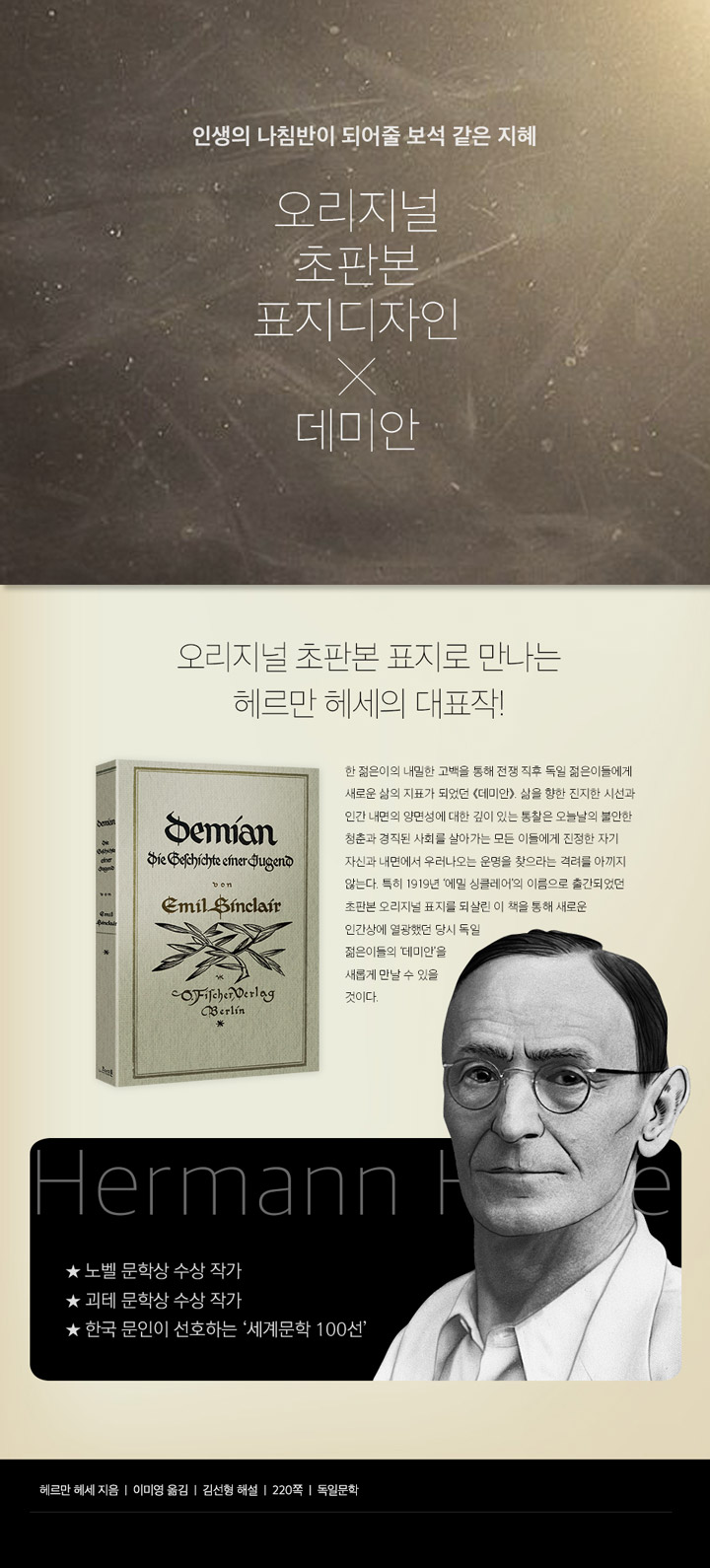
The original first edition cover of 『Demian』, published under the name of Emil Sinclair!
Hermann Hesse's "Demian," introduced as a "biography of the soul," is his masterpiece, delicately depicting the thorny path of self-reflection through deep psychoanalysis and self-exploration.
Revisit this book in its elegant 1919 original first edition cover.
Sinclair, who lived in a bright world of peace and order, is constantly robbed and bullied by the delinquent Franz Kromer after lying to him.
Sinclair, who is tormented by having stepped into a dark, forbidden world, is rescued by the mysterious transfer student Max Demian, who leads him to reinterpret the dualistic religious views he had previously accepted without question, such as Cain and Abel, good and evil, light and darkness.
After graduating from Latin school and parting ways with Damian, Sinclair once again wanders the dark world. One day, he receives a strange note from Damian containing the name of the god, 'Abraxas'...
A fierce journey of a young soul searching for herself!
The original first edition cover of 『Demian』, published under the name of Emil Sinclair!
Hermann Hesse's "Demian," introduced as a "biography of the soul," is his masterpiece, delicately depicting the thorny path of self-reflection through deep psychoanalysis and self-exploration.
Revisit this book in its elegant 1919 original first edition cover.
Sinclair, who lived in a bright world of peace and order, is constantly robbed and bullied by the delinquent Franz Kromer after lying to him.
Sinclair, who is tormented by having stepped into a dark, forbidden world, is rescued by the mysterious transfer student Max Demian, who leads him to reinterpret the dualistic religious views he had previously accepted without question, such as Cain and Abel, good and evil, light and darkness.
After graduating from Latin school and parting ways with Damian, Sinclair once again wanders the dark world. One day, he receives a strange note from Damian containing the name of the god, 'Abraxas'...
index
"*《Under the Wheel》
Under the wheel
Chapter 1
Chapter 2
Chapter 3
Chapter 4
Chapter 5
Chapter 6
Chapter 7
Commentary on the work: What does “Under the Wheel” contain?
*《Demian》
Damian
1 ? Two worlds
2 ? Cain
3 ? Thief
4? Beatrice
5 ? The bird struggles to come out of the egg.
6 ? Jacob's wrestling
7 ? Madame Eva
8 ? The beginning of the end
Commentary on the work: "Demian": A Journey of Self-Reflection
Under the wheel
Chapter 1
Chapter 2
Chapter 3
Chapter 4
Chapter 5
Chapter 6
Chapter 7
Commentary on the work: What does “Under the Wheel” contain?
*《Demian》
Damian
1 ? Two worlds
2 ? Cain
3 ? Thief
4? Beatrice
5 ? The bird struggles to come out of the egg.
6 ? Jacob's wrestling
7 ? Madame Eva
8 ? The beginning of the end
Commentary on the work: "Demian": A Journey of Self-Reflection
Detailed image
Publisher's Review
Replace the existing values destroyed by war,
Let's meet Hesse's masterpiece, which shows a new image of humanity and the possibilities of life, with the original first edition cover!
Hermann Hesse's "Demian," which is still widely known today and was selected as one of the "100 Best World Literatures" preferred by Korean writers, was published in 1919, right after World War I, and had a great influence on many young people and the literary world.
The protagonist's wandering, fearful, yet stubborn search for his own self resonated deeply with Germany, where war had destroyed existing values such as religion, morality, and customs, presenting a new image of humanity and a new direction for life.
The anecdote that Hesse revealed his real name and withdrew the award when the pseudonym Emil Sinclair, which he used when publishing the novel, won the Fontane Prize, given to young writers, also gives us an idea of the love this work received.
Demian, through the intimate confession of a young man, became a guide to a new life for young Germans in the immediate post-war period.
His earnest outlook on life and profound insight into the duality of human nature offer encouragement to today's anxious youth and all those living in a rigid society to find their true selves and the destiny that springs from within.
In particular, through this book, which revives the original cover of the first edition from 1919, you will be able to encounter the 'Demian' of the German youth at the time who were enthusiastic about a new type of human being.
(…) I did not exist to write poetry, preach, or paint.
It was the same for other people.
All of that was just a side issue.
For everyone, the only true calling was to find themselves.
(…) What he should be concerned with was not living whatever came his way, but finding his own destiny and living that destiny to the fullest.
Everything else was incompleteness, escapism, a flight into popular ideals, conformity, and fear of one's own inner self.
(…)
-From the text
Every human life is a journey to find oneself,
It is an attempt to go that way, and a hint at that way.
The emotions that Sinclair, the protagonist of Demian, experiences as he grows up - such as rebellion and separation from the family and teacher he unconditionally followed, curiosity and guilt about the dark world, pure love for his ideal partner, and anxiety about the future and himself - are similar to the universal emotions that today's youth experience as they grow up.
The numerous trials and errors he experienced are also things that anyone would have experienced at least once.
The protagonist's emotions and actions in the arduous journey to self, which was completed through Hesse's philosophy and psychoanalysis of humanity, evoke empathy that transcends time and breathes eternal life into the work.
The wandering, pain, and hope that Sinclair, the protagonist of 『Demian』, experienced in order to be himself, gives lonely modern people who are consumed like machine parts in a standardized education and society an opportunity to look into their inner selves, and delivers a message of courage and hope to find their true selves.
(...) If you ever have any absurd or bad thoughts again, Sinclair, if you ever feel like killing someone or doing something terrible, stop for a moment and think that it's Abraxas imagining it inside you! The person you want to kill is never Mr. So-and-so, but a disguised being.
If we hate someone, it is because we see something in ourselves in that person.
Because what is not inside us cannot torment us.
-From the text
A classic with an original first edition cover.
A great classic that moves the heart!
Great classics that touch the heart have a value that does not change with the passage of time.
Cornerstone Publishing's 'Hermann Hesse First Edition Collection' offers a special opportunity to encounter two of Hesse's representative works, which offer new emotions every time you read them, in their original first edition covers from the time of publication.
In addition to the cover, it is neatly edited to help readers focus on the work, and its small format makes it easy to open and read anywhere.
"Demian" is Hermann Hesse's masterpiece, a delicate depiction of the thorny path of self-reflection through deep psychoanalysis and self-exploration. It is also called Hesse's "biography of the soul."
Here, we have included a detailed commentary by Professor Kim Seon-hyeong, a domestic Hesse expert, to help you understand Hesse's world in a rich and clear way.
Let's meet Hesse's masterpiece, which shows a new image of humanity and the possibilities of life, with the original first edition cover!
Hermann Hesse's "Demian," which is still widely known today and was selected as one of the "100 Best World Literatures" preferred by Korean writers, was published in 1919, right after World War I, and had a great influence on many young people and the literary world.
The protagonist's wandering, fearful, yet stubborn search for his own self resonated deeply with Germany, where war had destroyed existing values such as religion, morality, and customs, presenting a new image of humanity and a new direction for life.
The anecdote that Hesse revealed his real name and withdrew the award when the pseudonym Emil Sinclair, which he used when publishing the novel, won the Fontane Prize, given to young writers, also gives us an idea of the love this work received.
Demian, through the intimate confession of a young man, became a guide to a new life for young Germans in the immediate post-war period.
His earnest outlook on life and profound insight into the duality of human nature offer encouragement to today's anxious youth and all those living in a rigid society to find their true selves and the destiny that springs from within.
In particular, through this book, which revives the original cover of the first edition from 1919, you will be able to encounter the 'Demian' of the German youth at the time who were enthusiastic about a new type of human being.
(…) I did not exist to write poetry, preach, or paint.
It was the same for other people.
All of that was just a side issue.
For everyone, the only true calling was to find themselves.
(…) What he should be concerned with was not living whatever came his way, but finding his own destiny and living that destiny to the fullest.
Everything else was incompleteness, escapism, a flight into popular ideals, conformity, and fear of one's own inner self.
(…)
-From the text
Every human life is a journey to find oneself,
It is an attempt to go that way, and a hint at that way.
The emotions that Sinclair, the protagonist of Demian, experiences as he grows up - such as rebellion and separation from the family and teacher he unconditionally followed, curiosity and guilt about the dark world, pure love for his ideal partner, and anxiety about the future and himself - are similar to the universal emotions that today's youth experience as they grow up.
The numerous trials and errors he experienced are also things that anyone would have experienced at least once.
The protagonist's emotions and actions in the arduous journey to self, which was completed through Hesse's philosophy and psychoanalysis of humanity, evoke empathy that transcends time and breathes eternal life into the work.
The wandering, pain, and hope that Sinclair, the protagonist of 『Demian』, experienced in order to be himself, gives lonely modern people who are consumed like machine parts in a standardized education and society an opportunity to look into their inner selves, and delivers a message of courage and hope to find their true selves.
(...) If you ever have any absurd or bad thoughts again, Sinclair, if you ever feel like killing someone or doing something terrible, stop for a moment and think that it's Abraxas imagining it inside you! The person you want to kill is never Mr. So-and-so, but a disguised being.
If we hate someone, it is because we see something in ourselves in that person.
Because what is not inside us cannot torment us.
-From the text
A classic with an original first edition cover.
A great classic that moves the heart!
Great classics that touch the heart have a value that does not change with the passage of time.
Cornerstone Publishing's 'Hermann Hesse First Edition Collection' offers a special opportunity to encounter two of Hesse's representative works, which offer new emotions every time you read them, in their original first edition covers from the time of publication.
In addition to the cover, it is neatly edited to help readers focus on the work, and its small format makes it easy to open and read anywhere.
"Demian" is Hermann Hesse's masterpiece, a delicate depiction of the thorny path of self-reflection through deep psychoanalysis and self-exploration. It is also called Hesse's "biography of the soul."
Here, we have included a detailed commentary by Professor Kim Seon-hyeong, a domestic Hesse expert, to help you understand Hesse's world in a rich and clear way.
GOODS SPECIFICS
- Date of issue: January 1, 2017
- Page count, weight, size: 220 pages | 318g | 130*190*20mm
- ISBN13: 9791187011590
- ISBN10: 1187011592
You may also like
카테고리
korean


korean

![GQ KOREA Mark (Monthly): December [2025]](http://librairie.coreenne.fr/cdn/shop/files/8ef265dbbfbf186523ed75ba7319009d.jpg?v=1765340328&width=3840)


