

New song set
 |
Description
Book Introduction
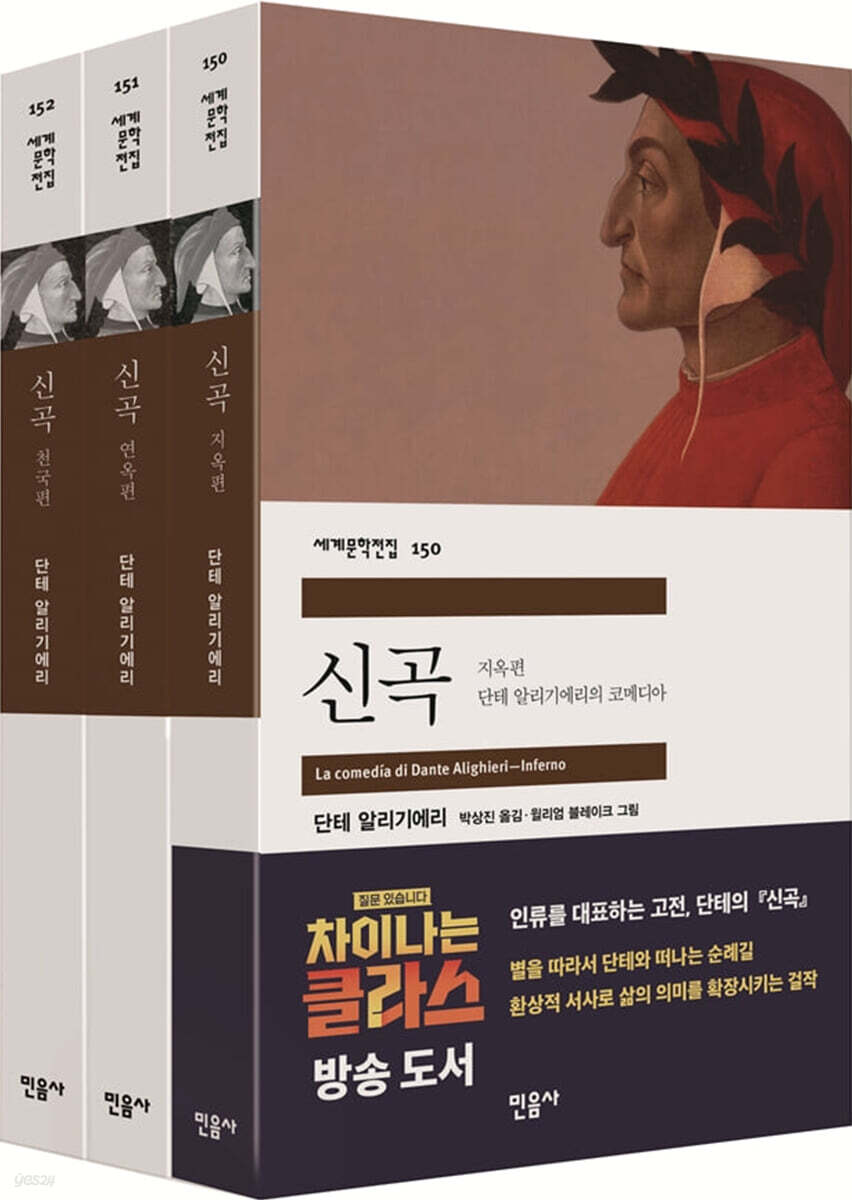
Dante, the intellectual who broke the darkness of the Middle Ages and illuminated the dawn of modernity Deep reflections that practically consider all topics of human history The magnificent epic poem "Divine Comedy" by the poet Dante was written during the 20 years of exile he spent in until his death after being expelled from his hometown of Florence due to his political activities. This book, which is a critique of reality, synthesizes all medieval scholarship, and inherits the classical epic tradition of Homer and Virgil, features hundreds of characters, including real people such as Plato, Thomas Aquinas, emperors and popes, as well as mythological beings such as Zeus, Odysseus, and Achilles, and biblical figures such as Judas and Solomon, showing the myriad aspects of humanity. Through these characters he encounters on his journey through Hell, Purgatory, and Heaven, Dante portrays the human condition yearning for salvation, achieving universality that transcends time and space. The pilgrimage from hell to purgatory and from purgatory to heaven, although it is a journey to the world after death, is by no means a fantasy beyond reality. Hell, a world containing the eternal continuation of sin and punishment, shows the consequences of sins committed in this world, and the ghosts of purgatory, who constantly climb up and up to finally attain salvation, can shorten their sentences with sincere prayers in the real world, thus becoming more directly connected to reality. Above all, the fact that this work is oriented toward reality is revealed in the fact that it borrows the form and spirit of comedy instead of tragedy and features people of various classes and inclinations. Through this, Dante criticizes the corrupt papacy and royal power, and the people of the world steeped in sin. Set composition World Literature Collection 150: Hell World Literature Collection 151: Purgatory World Literature Collection 152 Heaven |
- You can preview some of the book's contents.
Preview
Detailed image
Publisher's Review
Good and evil, crime and punishment, politics and religion, literature and philosophy, myth and reality
A masterpiece of human imagination, embracing all themes of human history.
William Blake, a poet and genius painter, recreated it with dynamic illustrations.
A magnificent fantasy epic of 14,233 lines
The best thing made by human hands.
—Johann Wolfgang von Goethe
The pinnacle of all literature.
―Jorge Luis Borges
A sound that breaks the silence of a thousand years in the Middle Ages.
―Thomas Carlyle
Western modernity is divided between Dante and Shakespeare.
There is no third party in between.
―T.
S. Eliot
The end of the feudal Middle Ages and the beginning of modern capitalism can be marked by one great figure.
That person is Dante.
He is the last medieval poet and the first modern poet.
—Friedrich Engels
Dante, the intellectual who broke the darkness of the Middle Ages and illuminated the dawn of modernity
― Deep reflections that practically consider all topics of human history.
The magnificent epic poem "Divine Comedy" by the poet Dante was written during the 20 years of exile he spent in until his death after being expelled from his hometown of Florence due to his political activities.
This book, which is a critique of reality, synthesizes all medieval scholarship, and inherits the classical epic tradition of Homer and Virgil, features hundreds of characters, including real people such as Plato, Thomas Aquinas, emperors and popes, as well as mythological beings such as Zeus, Odysseus, and Achilles, and biblical figures such as Judas and Solomon, showing the myriad aspects of humanity.
Through these characters he encounters on his journey through Hell, Purgatory, and Heaven, Dante portrays the human condition yearning for salvation, achieving universality that transcends time and space.
Dante, who incorporated all the learning of the Middle Ages into his works, including the Bible, Greco-Roman classics, the theology of Thomas Aquinas, Plato's cosmology, Ptolemy's astronomy, and Aristotle's ethics, was an intellectual who had already broken free from the secure embrace of the Middle Ages and taken a step into the vibrant dawn of the modern era.
Dante's knowledge of the universe, although grounded in medieval astronomical systems, is surprisingly sophisticated and comprehensive, and is implicated in human values, which are, to a great extent, modern values.
Likewise, his theology was not at odds with the principles of reason.
Furthermore, the fact that he used Florentine, which was merely a colloquial language compared to Latin at the time, in his writings is also a clue that allows us to see Dante as a practical intellectual.
At the heart of the remarkable event that established Italy's "national language" with the Divine Comedy written in Florentine lies the author's pious reflections and representations on universal humanity.
It was the role of an intellectual with a historical consciousness who sought the meaning of salvation in the reality of his time.
A dense composition and a grand imagination depicting the afterlife
― Conditions for the perfection and salvation of the world, and the transformation of reality.
The form and structure that support the 『Divine Comedy』 are reminiscent of a surprisingly dense and magnificent building.
The three parts of the Divine Comedy, “Inferno,” “Purgatorio,” and “Paradise,” are each composed of thirty-three independent cantos, and only the “Inferno” has an overture, making a total of 100 cantos.
And each song is approximately 140 lines long, and each line consists of 11 syllables, totaling 14,233 lines.
This dense structure supports the perfection of the world that Dante presents.
The work begins with Dante, aged thirty-five, waking up on Thursday night, the day before Good Friday, to find himself lost in a dark forest.
As Dante faces all the evils of the world and trembles in fear, the Roman poet Virgil, whom he respected like a father, appears before him and promises to be his guide to the eternal world.
And on Friday evening, they finally arrive at the gates of hell, and their week-long pilgrimage to the afterlife begins.
After three days in Hell, where blood oozes, the stench is foul, and the screams are deafening, and after three more days in Purgatory, filled with the sounds of repentance and penitence yearning for the moment of salvation that will come, Dante sends Virgil away.
And before ascending to heaven, he meets Beatrice, the eternal love of his dreams.
Guided by Beatrice, on the last day of his pilgrimage, he opens his eyes to God's love, shining with pure joy.
This pilgrimage from hell to purgatory and from purgatory to heaven, although it is a journey to the world after death, is by no means a fantasy beyond reality.
Hell, a world containing the eternal continuation of sin and punishment, shows the consequences of sins committed in this world, and the ghosts of purgatory, who constantly climb up and up to finally attain salvation, can shorten their sentences with sincere prayers in the real world, thus becoming more directly connected to reality.
Finally, even in Heaven, where he witnesses the pure joy of heaven, Dante uses his knowledge of theology and philosophy to reflect on himself, history, and the world. Ultimately, the salvation Dante desires is nothing other than a “change in reality” that will allow him to receive the promise of the afterlife.
Above all, the fact that this work is oriented toward reality is revealed in the fact that it borrows the form and spirit of comedy instead of tragedy and features people of various classes and inclinations. Through this, Dante criticizes the corrupt papacy and royal power, and the people of the world steeped in sin.
A work written by the author Dante and featuring the pilgrim Dante, which goes from a sad beginning to a happy ending.
― Japanese translations of 'Divine Comedy' and 'Dante Alighieri's Commedia'
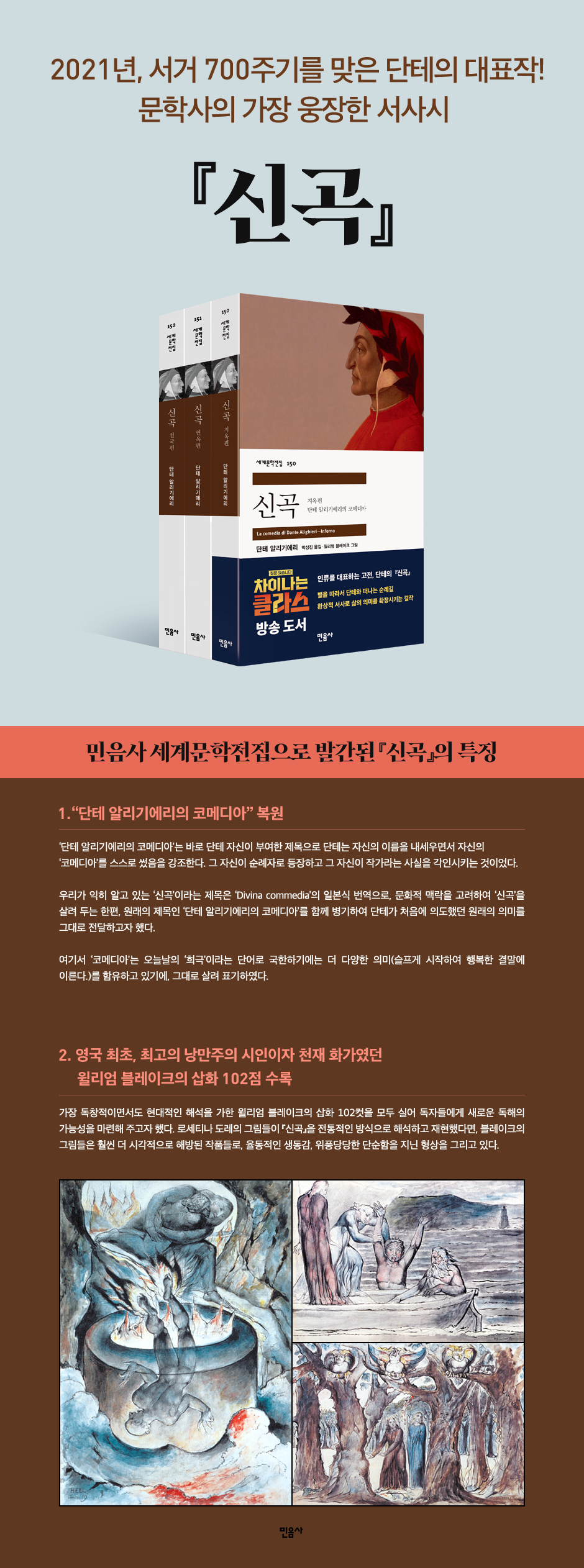
The special feature of 『Divine Comedy』, published in Minumsa World Literature Collection, is that it has restored the original title, “Dante Alighieri’s Commedia.”
Professor Sangjin Park, the translator, explains this as follows:
In East Asia, this book has been widely known under the title 'Divine Comedy', but this time, in order to overcome that, another alternative has been presented.
The subtitle 'Commedia de Dante Alighieri' was the title given by Dante himself.
Dante emphasizes that he wrote his 'Commedia' himself, putting his name forward.
It was to impress upon himself that he himself appeared as a pilgrim and that he himself was a writer.
Looking at the cover of this translation, with Dante Alighieri's name alongside the title and author, we are reminded of a world surrounded by multiple layers.
As a pilgrim and writer, Dante moves in and out of the text 『Commedia』, ceaselessly breaking down the boundaries between fantasy and reality.
However, in the title with such implications, the genitive case of 'Dante Alighieri' was dropped and the meaning of 'divine' was added instead.
The title 'Shingok' that we are all familiar with is the Japanese translation of the newly created title 'Divina commedia'.
It is not that 『Commedia』 is not extremely sacred, but it is a pity that the genitive case of ‘Dante Alighieri’s’ has been dropped.
Moreover, the Japanese translation preserved the meaning of "sacred" but abandoned the meaning of "commedia." (From the commentary on the work)
So, this time, Minumsa, taking into account the cultural context in which this work has been known in Korea under the name of 'Divine Comedy', has decided to preserve 'Divine Comedy' while also using the original title, 'Dante Alighieri's Commedia', in order to convey the original meaning that Dante initially intended.
Here, 'commedia' has a wider range of meanings (beginning sadly and ending happily) than can be limited to the word 'comedy' today, so it is written as is.
Includes 102 illustrations by William Blake, Britain's first and greatest Romantic poet and genius painter.
― An original interpretation recreated with rhythmic vitality and majestic simplicity.
Dante's Divine Comedy has inspired countless artists throughout the ages.
Scenes from the Divine Comedy have been recreated on canvas by artists over the centuries, from medieval manuscripts to Sandro Botticelli, William Blake, Dante Gabriel Rossetti, Gustave Doré, and John Flaxman.
This time, Minumsa's 『Divine Comedy』 published all 102 of William Blake's illustrations, which are the most original and modern interpretations of all of them, aims to provide readers with new reading possibilities.
While Rossetti and Doré's paintings interpreted and reproduced the Divine Comedy in a traditional manner, Blake's paintings are much more visually liberated, depicting figures with rhythmic vitality and majestic simplicity.
Clearly, Blake's paintings are the result of his re-creating the symbolic world of the Commedia into an iconographic world.
However, when we juxtapose Dante's writings and Blake's paintings in a single space, transcending temporal continuity, we witness not only Dante's writings being reproduced in Blake's paintings, but conversely, Blake's paintings being reproduced in Dante's writings.
It is a matter of pitting Dante and Blake against each other over the various interpretations of the Commedia and of putting the open language of the Commedia to work.
(Park Sang-jin, from his commentary on the work)
A masterpiece of human imagination, embracing all themes of human history.
William Blake, a poet and genius painter, recreated it with dynamic illustrations.
A magnificent fantasy epic of 14,233 lines
The best thing made by human hands.
—Johann Wolfgang von Goethe
The pinnacle of all literature.
―Jorge Luis Borges
A sound that breaks the silence of a thousand years in the Middle Ages.
―Thomas Carlyle
Western modernity is divided between Dante and Shakespeare.
There is no third party in between.
―T.
S. Eliot
The end of the feudal Middle Ages and the beginning of modern capitalism can be marked by one great figure.
That person is Dante.
He is the last medieval poet and the first modern poet.
—Friedrich Engels
Dante, the intellectual who broke the darkness of the Middle Ages and illuminated the dawn of modernity
― Deep reflections that practically consider all topics of human history.
The magnificent epic poem "Divine Comedy" by the poet Dante was written during the 20 years of exile he spent in until his death after being expelled from his hometown of Florence due to his political activities.
This book, which is a critique of reality, synthesizes all medieval scholarship, and inherits the classical epic tradition of Homer and Virgil, features hundreds of characters, including real people such as Plato, Thomas Aquinas, emperors and popes, as well as mythological beings such as Zeus, Odysseus, and Achilles, and biblical figures such as Judas and Solomon, showing the myriad aspects of humanity.
Through these characters he encounters on his journey through Hell, Purgatory, and Heaven, Dante portrays the human condition yearning for salvation, achieving universality that transcends time and space.
Dante, who incorporated all the learning of the Middle Ages into his works, including the Bible, Greco-Roman classics, the theology of Thomas Aquinas, Plato's cosmology, Ptolemy's astronomy, and Aristotle's ethics, was an intellectual who had already broken free from the secure embrace of the Middle Ages and taken a step into the vibrant dawn of the modern era.
Dante's knowledge of the universe, although grounded in medieval astronomical systems, is surprisingly sophisticated and comprehensive, and is implicated in human values, which are, to a great extent, modern values.
Likewise, his theology was not at odds with the principles of reason.
Furthermore, the fact that he used Florentine, which was merely a colloquial language compared to Latin at the time, in his writings is also a clue that allows us to see Dante as a practical intellectual.
At the heart of the remarkable event that established Italy's "national language" with the Divine Comedy written in Florentine lies the author's pious reflections and representations on universal humanity.
It was the role of an intellectual with a historical consciousness who sought the meaning of salvation in the reality of his time.
A dense composition and a grand imagination depicting the afterlife
― Conditions for the perfection and salvation of the world, and the transformation of reality.
The form and structure that support the 『Divine Comedy』 are reminiscent of a surprisingly dense and magnificent building.
The three parts of the Divine Comedy, “Inferno,” “Purgatorio,” and “Paradise,” are each composed of thirty-three independent cantos, and only the “Inferno” has an overture, making a total of 100 cantos.
And each song is approximately 140 lines long, and each line consists of 11 syllables, totaling 14,233 lines.
This dense structure supports the perfection of the world that Dante presents.
The work begins with Dante, aged thirty-five, waking up on Thursday night, the day before Good Friday, to find himself lost in a dark forest.
As Dante faces all the evils of the world and trembles in fear, the Roman poet Virgil, whom he respected like a father, appears before him and promises to be his guide to the eternal world.
And on Friday evening, they finally arrive at the gates of hell, and their week-long pilgrimage to the afterlife begins.
After three days in Hell, where blood oozes, the stench is foul, and the screams are deafening, and after three more days in Purgatory, filled with the sounds of repentance and penitence yearning for the moment of salvation that will come, Dante sends Virgil away.
And before ascending to heaven, he meets Beatrice, the eternal love of his dreams.
Guided by Beatrice, on the last day of his pilgrimage, he opens his eyes to God's love, shining with pure joy.
This pilgrimage from hell to purgatory and from purgatory to heaven, although it is a journey to the world after death, is by no means a fantasy beyond reality.
Hell, a world containing the eternal continuation of sin and punishment, shows the consequences of sins committed in this world, and the ghosts of purgatory, who constantly climb up and up to finally attain salvation, can shorten their sentences with sincere prayers in the real world, thus becoming more directly connected to reality.
Finally, even in Heaven, where he witnesses the pure joy of heaven, Dante uses his knowledge of theology and philosophy to reflect on himself, history, and the world. Ultimately, the salvation Dante desires is nothing other than a “change in reality” that will allow him to receive the promise of the afterlife.
Above all, the fact that this work is oriented toward reality is revealed in the fact that it borrows the form and spirit of comedy instead of tragedy and features people of various classes and inclinations. Through this, Dante criticizes the corrupt papacy and royal power, and the people of the world steeped in sin.
A work written by the author Dante and featuring the pilgrim Dante, which goes from a sad beginning to a happy ending.
― Japanese translations of 'Divine Comedy' and 'Dante Alighieri's Commedia'
The special feature of 『Divine Comedy』, published in Minumsa World Literature Collection, is that it has restored the original title, “Dante Alighieri’s Commedia.”
Professor Sangjin Park, the translator, explains this as follows:
In East Asia, this book has been widely known under the title 'Divine Comedy', but this time, in order to overcome that, another alternative has been presented.
The subtitle 'Commedia de Dante Alighieri' was the title given by Dante himself.
Dante emphasizes that he wrote his 'Commedia' himself, putting his name forward.
It was to impress upon himself that he himself appeared as a pilgrim and that he himself was a writer.
Looking at the cover of this translation, with Dante Alighieri's name alongside the title and author, we are reminded of a world surrounded by multiple layers.
As a pilgrim and writer, Dante moves in and out of the text 『Commedia』, ceaselessly breaking down the boundaries between fantasy and reality.
However, in the title with such implications, the genitive case of 'Dante Alighieri' was dropped and the meaning of 'divine' was added instead.
The title 'Shingok' that we are all familiar with is the Japanese translation of the newly created title 'Divina commedia'.
It is not that 『Commedia』 is not extremely sacred, but it is a pity that the genitive case of ‘Dante Alighieri’s’ has been dropped.
Moreover, the Japanese translation preserved the meaning of "sacred" but abandoned the meaning of "commedia." (From the commentary on the work)
So, this time, Minumsa, taking into account the cultural context in which this work has been known in Korea under the name of 'Divine Comedy', has decided to preserve 'Divine Comedy' while also using the original title, 'Dante Alighieri's Commedia', in order to convey the original meaning that Dante initially intended.
Here, 'commedia' has a wider range of meanings (beginning sadly and ending happily) than can be limited to the word 'comedy' today, so it is written as is.
Includes 102 illustrations by William Blake, Britain's first and greatest Romantic poet and genius painter.
― An original interpretation recreated with rhythmic vitality and majestic simplicity.
Dante's Divine Comedy has inspired countless artists throughout the ages.
Scenes from the Divine Comedy have been recreated on canvas by artists over the centuries, from medieval manuscripts to Sandro Botticelli, William Blake, Dante Gabriel Rossetti, Gustave Doré, and John Flaxman.
This time, Minumsa's 『Divine Comedy』 published all 102 of William Blake's illustrations, which are the most original and modern interpretations of all of them, aims to provide readers with new reading possibilities.
While Rossetti and Doré's paintings interpreted and reproduced the Divine Comedy in a traditional manner, Blake's paintings are much more visually liberated, depicting figures with rhythmic vitality and majestic simplicity.
Clearly, Blake's paintings are the result of his re-creating the symbolic world of the Commedia into an iconographic world.
However, when we juxtapose Dante's writings and Blake's paintings in a single space, transcending temporal continuity, we witness not only Dante's writings being reproduced in Blake's paintings, but conversely, Blake's paintings being reproduced in Dante's writings.
It is a matter of pitting Dante and Blake against each other over the various interpretations of the Commedia and of putting the open language of the Commedia to work.
(Park Sang-jin, from his commentary on the work)
GOODS SPECIFICS
- Date of issue: August 8, 2013
- Page count, weight, size: 1,120 pages | 132*225*80mm
- ISBN13: 9788937488061
- ISBN10: 893748806X
You may also like
카테고리
korean


korean

![GQ KOREA Mark (Monthly): December [2025]](http://librairie.coreenne.fr/cdn/shop/files/8ef265dbbfbf186523ed75ba7319009d.jpg?v=1765340328&width=3840)


