

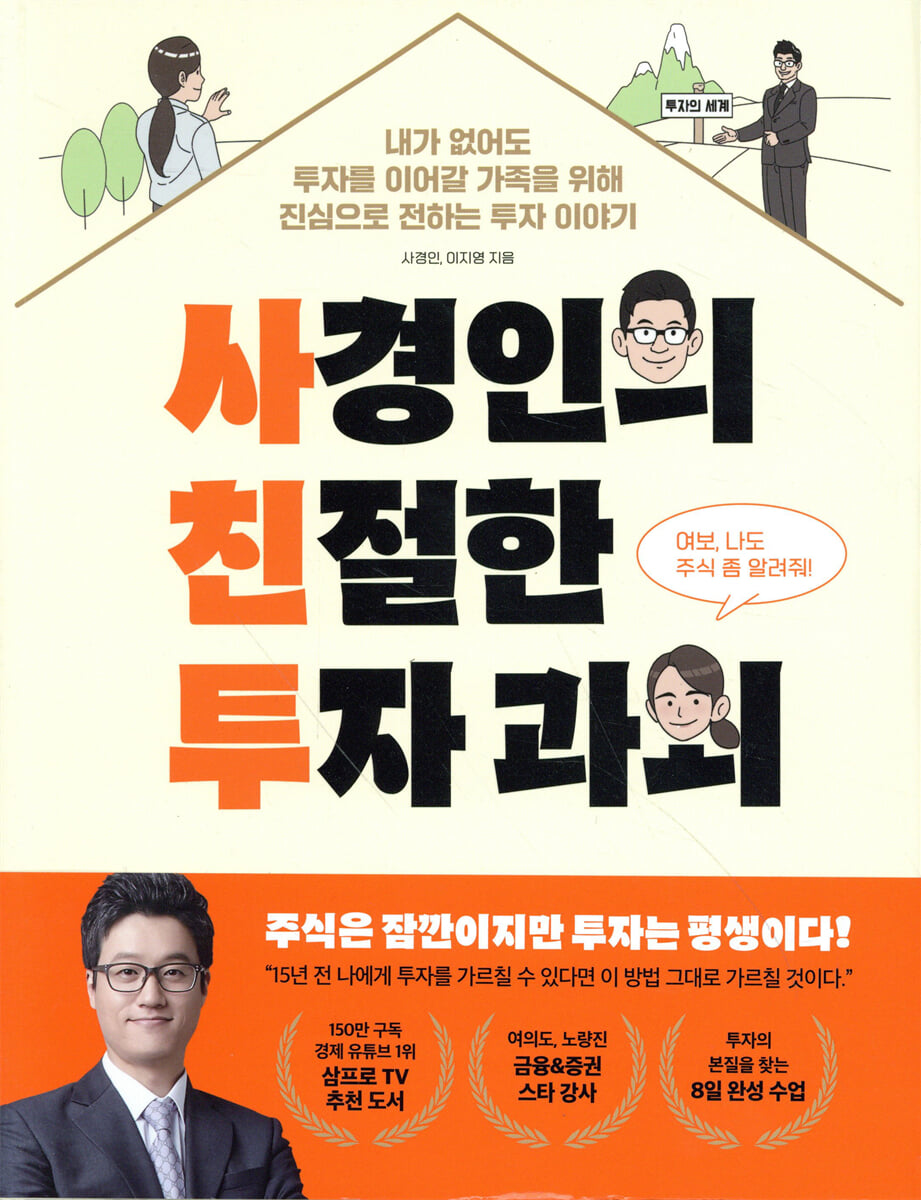
Sa Kyung-in's friendly investment tutoring
 |
Description
Book Introduction
Stocks are temporary, but investing is a lifetime. A heartfelt investment story from Sa Kyung-in, the top star lecturer in finance and securities. Even though countless successful investors' winning strategies are abundant in books and on YouTube, why do so many still fail? The reason is that there's no right answer when it comes to investing. Even the secret to guaranteed success can have vastly different returns depending on each individual's circumstances and psychology. Unless you understand and master the principles of investment, asset allocation, and the reasons for long-term investment, you will only make temporary gains through luck, and will be forced to continue investing anxiously and restlessly for the rest of your life. "Sa Kyung-in's Friendly Investment Lessons" is a book that compiles eight investment lectures delivered directly by Sa Kyung-in, a star lecturer in the finance and securities industry, to his beloved family. This friendly book, written step by step to suit the level of a complete beginner wife who doesn't even know KOSPI or KOSDAQ and is not a securities broker in Yeouido, contains the sincerity of an accountant who wants his beloved family to make stable and wise investments more than anyone else. |
- You can preview some of the book's contents.
Preview
Detailed image

Into the book
So you need the ability to decide for yourself.
There isn't much fruit to be had in this season, and you know that fish is delicious, so you should go to a fishmonger instead of a fruitmonger.
When I leave the house, I can't ask anyone whether I should go to the fruit shop or the fish shop.
You can go to a fruit shop and ask what kind of fruit is delicious, or go to a fish shop and ask what kind of fish is delicious.
Investing is the same.
I don't know much, so I think I should just ask an expert and leave it to them, but first I have to decide for myself whether I want to leave it to a securities firm, a bank, or an insurance company.
In such cases, you need to be able to look at the data yourself and make a judgment.
--- p.
70
People who diversify their investments have better results on average than those who focus on investing.
However, the people who get the best results are those who invest intensively and then hit the jackpot repeatedly.
Of course, there are many more people who invested heavily and then failed.
The problem here is that people only care about the rich who have made a lot of money.
When I asked people who made a lot of money how they became rich, they all said that they invested heavily.
So I think that you have to invest intensively to become rich.
In fact, many more people have failed because of concentrated investment, but those who failed are invisible.
Because you don't ask a failed person how he failed.
And people who have failed don't brag about how they failed because they invested so heavily.
--- p.
124-125
If you start without deciding on an asset allocation ratio, you will often end up with a loss even if you buy or sell good stocks at the right time or at a good price.
Even though I bought and sold stocks I learned from a master at the same price, I ended up losing money because my bet was wrong.
And then you start cursing the expert.
I did as I was told, but I lost money.
The reason I don't tell you the stocks you keep asking me about is because I'd lose money if I did.
If you don't know the basics, like how to allocate assets or the principles of investing, you're bound to lose money nine times out of ten.
If you can't tell the difference between the arithmetic mean and the geometric mean, and you don't know what it means to divide money into an arithmetic mean and time into a geometric mean, then you can't talk about stocks.
I understand the urgency to make money right away, but if you swallow food in that state, you'll end up with indigestion.
I know you're going to get sick, but I can't share the food.
--- p.
139-140
You need to decide what to include in your core assets and how to invest them.
Then, the next step is to decide how to structure the surrounding assets with the remaining money.
Even when we take exams, there are required subjects and electives, right? There are required subjects like Korean, English, and math, and electives like arts and physical education.
So which of the two should I study first? I should start with Korean, English, and math, and then focus on the rest.
Likewise, we need to think about what to put in our core assets first, but people don't think about these core assets and focus on peripheral assets without properly organizing them.
He came to me and said, 'I'm thinking about investing in stocks. Can you teach me?'
Most people who ask questions like, "What should I do? What should I buy?" approach stocks as a peripheral asset.
'Let me know and I'll invest 80% of my assets in stocks!' That's not how it works.
He asked, "I have some spare money left over, so I'm thinking about investing in stocks."
The way I invested then didn't match the way I invest now.
I approach stocks as core assets.
The way I invest is different from the way I invest in peripheral assets, because it's a method that applies when stocks are the core asset.
People who want to invest in stocks with their surrounding assets don't need to follow my method.
But people who ask how to invest in stocks with peripheral assets are putting their core assets in strange places.
Either you just leave it as a deposit, or you sit on it as a deposit for a rental property.
So, for you too, what to do with your core assets comes first.
That has to be decided.
--- p.
330-331
When talking about investing, I always emphasize the MDD, right? Stocks eventually rise, but they also plummet occasionally. The MDD averages (-)50%.
What you need to do in such a situation is to be able to wait! "Looking at past data, stocks can lose half their value over a five-year investment period. But if you wait, they'll rise again, recover, and become positive in the long run." Assets that allow you to wait with this mindset are reliable assets, and they're the ones you can embrace as your core.
Eventually, I have to be able to wait for my core assets to grow and become rich.
So, I think it's right to hold assets that I can wait for, assets that I can trust, as my core assets.
Of course, this is purely my opinion and my standard.
Everyone's standards may be different, and I think it's important to set your own standards.
You have to think about that yourself, and only after much thought and consideration can you continue to stick to the principles you have established.
That ultimately becomes your own investment philosophy.
--- p.
351-352
If you look at the ways to become rich, they are all ways to become rich slowly.
Getting rich in a short period of time is a result of good luck, and following the same method doesn't guarantee the same success.
It's possible if you have a lot of luck.
If I see someone who won the lottery and became rich in a short period of time and buy a lottery ticket, I won't become rich either.
Even though the method of buying and scratching a lottery ticket is the same, the results are completely different.
The way to get rich quickly is to rely on luck, and the way to get truly rich is to get rich slowly.
It's about slowly growing your core assets.
--- p.
401-402
Just as a doctor can talk about medications and treatments, he can't dictate how someone should live. The same holds true for investing. I can explain the past performance and MDD of products like AOR, NTSX, RPAR, and SWAN.
But I can't tell you how to live your life.
The results of our investments have a huge impact on our lives.
What products you invest in are linked to who you are and what kind of life you pursue.
--- p.
508-509
If you feel like studying is beyond your ability, too difficult, or too overwhelming, you can invest at a level that suits your level.
It's okay to leave everything to asset allocation ETFs and not hold any peripheral assets.
Because it's a choice based on your level.
'In the time I should be studying investment, I want to study music and art, I want to exercise, I want to spend time with my kids, I want to travel' are all perfectly fine choices.
It's not necessary for all citizens to study stocks.
Studying core assets is mandatory, but studying anything beyond that is optional.
There isn't much fruit to be had in this season, and you know that fish is delicious, so you should go to a fishmonger instead of a fruitmonger.
When I leave the house, I can't ask anyone whether I should go to the fruit shop or the fish shop.
You can go to a fruit shop and ask what kind of fruit is delicious, or go to a fish shop and ask what kind of fish is delicious.
Investing is the same.
I don't know much, so I think I should just ask an expert and leave it to them, but first I have to decide for myself whether I want to leave it to a securities firm, a bank, or an insurance company.
In such cases, you need to be able to look at the data yourself and make a judgment.
--- p.
70
People who diversify their investments have better results on average than those who focus on investing.
However, the people who get the best results are those who invest intensively and then hit the jackpot repeatedly.
Of course, there are many more people who invested heavily and then failed.
The problem here is that people only care about the rich who have made a lot of money.
When I asked people who made a lot of money how they became rich, they all said that they invested heavily.
So I think that you have to invest intensively to become rich.
In fact, many more people have failed because of concentrated investment, but those who failed are invisible.
Because you don't ask a failed person how he failed.
And people who have failed don't brag about how they failed because they invested so heavily.
--- p.
124-125
If you start without deciding on an asset allocation ratio, you will often end up with a loss even if you buy or sell good stocks at the right time or at a good price.
Even though I bought and sold stocks I learned from a master at the same price, I ended up losing money because my bet was wrong.
And then you start cursing the expert.
I did as I was told, but I lost money.
The reason I don't tell you the stocks you keep asking me about is because I'd lose money if I did.
If you don't know the basics, like how to allocate assets or the principles of investing, you're bound to lose money nine times out of ten.
If you can't tell the difference between the arithmetic mean and the geometric mean, and you don't know what it means to divide money into an arithmetic mean and time into a geometric mean, then you can't talk about stocks.
I understand the urgency to make money right away, but if you swallow food in that state, you'll end up with indigestion.
I know you're going to get sick, but I can't share the food.
--- p.
139-140
You need to decide what to include in your core assets and how to invest them.
Then, the next step is to decide how to structure the surrounding assets with the remaining money.
Even when we take exams, there are required subjects and electives, right? There are required subjects like Korean, English, and math, and electives like arts and physical education.
So which of the two should I study first? I should start with Korean, English, and math, and then focus on the rest.
Likewise, we need to think about what to put in our core assets first, but people don't think about these core assets and focus on peripheral assets without properly organizing them.
He came to me and said, 'I'm thinking about investing in stocks. Can you teach me?'
Most people who ask questions like, "What should I do? What should I buy?" approach stocks as a peripheral asset.
'Let me know and I'll invest 80% of my assets in stocks!' That's not how it works.
He asked, "I have some spare money left over, so I'm thinking about investing in stocks."
The way I invested then didn't match the way I invest now.
I approach stocks as core assets.
The way I invest is different from the way I invest in peripheral assets, because it's a method that applies when stocks are the core asset.
People who want to invest in stocks with their surrounding assets don't need to follow my method.
But people who ask how to invest in stocks with peripheral assets are putting their core assets in strange places.
Either you just leave it as a deposit, or you sit on it as a deposit for a rental property.
So, for you too, what to do with your core assets comes first.
That has to be decided.
--- p.
330-331
When talking about investing, I always emphasize the MDD, right? Stocks eventually rise, but they also plummet occasionally. The MDD averages (-)50%.
What you need to do in such a situation is to be able to wait! "Looking at past data, stocks can lose half their value over a five-year investment period. But if you wait, they'll rise again, recover, and become positive in the long run." Assets that allow you to wait with this mindset are reliable assets, and they're the ones you can embrace as your core.
Eventually, I have to be able to wait for my core assets to grow and become rich.
So, I think it's right to hold assets that I can wait for, assets that I can trust, as my core assets.
Of course, this is purely my opinion and my standard.
Everyone's standards may be different, and I think it's important to set your own standards.
You have to think about that yourself, and only after much thought and consideration can you continue to stick to the principles you have established.
That ultimately becomes your own investment philosophy.
--- p.
351-352
If you look at the ways to become rich, they are all ways to become rich slowly.
Getting rich in a short period of time is a result of good luck, and following the same method doesn't guarantee the same success.
It's possible if you have a lot of luck.
If I see someone who won the lottery and became rich in a short period of time and buy a lottery ticket, I won't become rich either.
Even though the method of buying and scratching a lottery ticket is the same, the results are completely different.
The way to get rich quickly is to rely on luck, and the way to get truly rich is to get rich slowly.
It's about slowly growing your core assets.
--- p.
401-402
Just as a doctor can talk about medications and treatments, he can't dictate how someone should live. The same holds true for investing. I can explain the past performance and MDD of products like AOR, NTSX, RPAR, and SWAN.
But I can't tell you how to live your life.
The results of our investments have a huge impact on our lives.
What products you invest in are linked to who you are and what kind of life you pursue.
--- p.
508-509
If you feel like studying is beyond your ability, too difficult, or too overwhelming, you can invest at a level that suits your level.
It's okay to leave everything to asset allocation ETFs and not hold any peripheral assets.
Because it's a choice based on your level.
'In the time I should be studying investment, I want to study music and art, I want to exercise, I want to spend time with my kids, I want to travel' are all perfectly fine choices.
It's not necessary for all citizens to study stocks.
Studying core assets is mandatory, but studying anything beyond that is optional.
--- p.
557
557
Publisher's Review
“If you could teach me investing 15 years ago, I would teach it this way!”
Let's start learning about investing right from the beginning!
Many people only hope for a winning strategy that will bring them immediate profits.
So, they seek out so-called "reading rooms" and constantly ask experts what stocks they should buy.
This is because most of the success stories of stock experts shown in the media talk about investing in individual stocks.
The media often cites examples of certain stocks that have multiplied by dozens of times and become huge hits, tempting people to believe that "anyone can do this," but the reality is different.
If you play rock-paper-scissors 10 times, there is a very small chance that someone will win all 10 times.
However, many people do not recognize the low probability and invest in becoming a winner who wins all 10 times.
"Sa Kyung-in's Friendly Investment Class" provides novice investors with the right guidelines to understand the essence of investing, gain insight, and construct their own investment products through eight actual classes conducted by Sa Kyung-in and his wife.
When his wife told him she wanted to learn about stock investment, the author discarded all of his previous manuscripts and rewrote them at a beginner's level.
And this book contains real investment stories that you won't find anywhere else.
Instead of investing in individual stocks, which have low odds and only a small number of people can succeed, we introduce asset allocation investment products that generate safe and steady returns. We provide a wise compass for investors who are anxious about when their profits will drop and for prospective investors who are afraid of losses and cannot enter the market.
The magic of compound interest, which yields an annual return of 8% and multiplies your investment by 20 times.
Customized investment mentoring from experts for beginners
Investment legend Warren Buffett accumulated 93.3 trillion of his total net worth of 93.7 trillion after he turned 50.
The reason is welfare.
Warren Buffett was a man who understood the benefits of compound interest better than anyone else, and he slowly accumulated wealth by investing almost his entire life, starting in middle school, and became the rich man he is today.
However, many people dream of becoming as rich as Warren Buffett, but do not follow his investment methods.
Because his investments are 'wait-and-see'.
However, for those who believe that investing is not a short-term gamble but something to be done for life, the investment method discussed in this book will teach you how to become rich without rushing, but with certainty.
"The Friendly Investment Lessons of a Savvy Investor" focuses on products that consistently yield returns without any ups and downs, like Warren Buffett's investments, and aims for an annual return of 8%.
And it provides guidelines for selecting investment products that can achieve returns by analyzing past data on your own.
At first glance, an annual return of 8% may seem like a small number.
However, if you earn a steady 8% return on 10 million won every year, it will grow to 46.61 million won in 20 years and 217.25 million won in 40 years according to the principle of compound interest.
It is the magic of compound interest that makes you rich by investing and waiting leisurely without any complicated calculations or worries.
This book explains the principles of long-term investment and the magic of compound interest that made Warren Buffett rich, using data and case studies.
CPA Sa Kyung-in, a star lecturer in the Yeouido finance and securities industry, goes beyond simply asserting that "long-term investment is essential." Instead, he persuasively demonstrates, with numerous examples, why long-term investment is the only way to become wealthy.
By reading about investments with graphs, diagrams, and illustrations that help you understand, even beginners can easily understand difficult data as if it were a story.
Even beginners will never fail if they follow these simple rules.
From setting target returns to asset allocation and portfolio construction, even beginners can invest like experts.
The way to become rich is, in some ways, simple.
All you need to do is figure out how much return you want to make with the investment you have now, find a product that can achieve that return, and invest consistently.
This book doesn't just hastily tell the answer to a complete beginner wife who doesn't even know KOSPI or KOSDAQ, but rather empowers her to find it on her own.
This book presents a step-by-step guide to investing that anyone can follow through four main steps.
① Setting a realistic target rate of return without being vague
② Calculate the investment ratio by identifying your core and peripheral assets.
③ Analysis of asset allocation investment products to achieve target returns
④ Portfolio composition and rebalancing strategy
No expert has the answers to investing.
Only you know the right investment method for you.
This book helps smart investors who want to start investing from the ground up understand the fundamentals of investing.
By setting a realistic target return and understanding how much loss you can afford, you can invest safely and comfortably in the volatile stock market, with profits following your lead.
GOODS SPECIFICS
- Publication date: October 27, 2021
- Page count, weight, size: 576 pages | 1,060g | 185*240*35mm
- ISBN13: 9791190977418
- ISBN10: 1190977419
You may also like
카테고리
korean


korean

![ELLE 엘르 스페셜 에디션 A형 : 12월 [2025]](http://librairie.coreenne.fr/cdn/shop/files/b8e27a3de6c9538896439686c6b0e8fb.jpg?v=1766436872&width=3840)


