

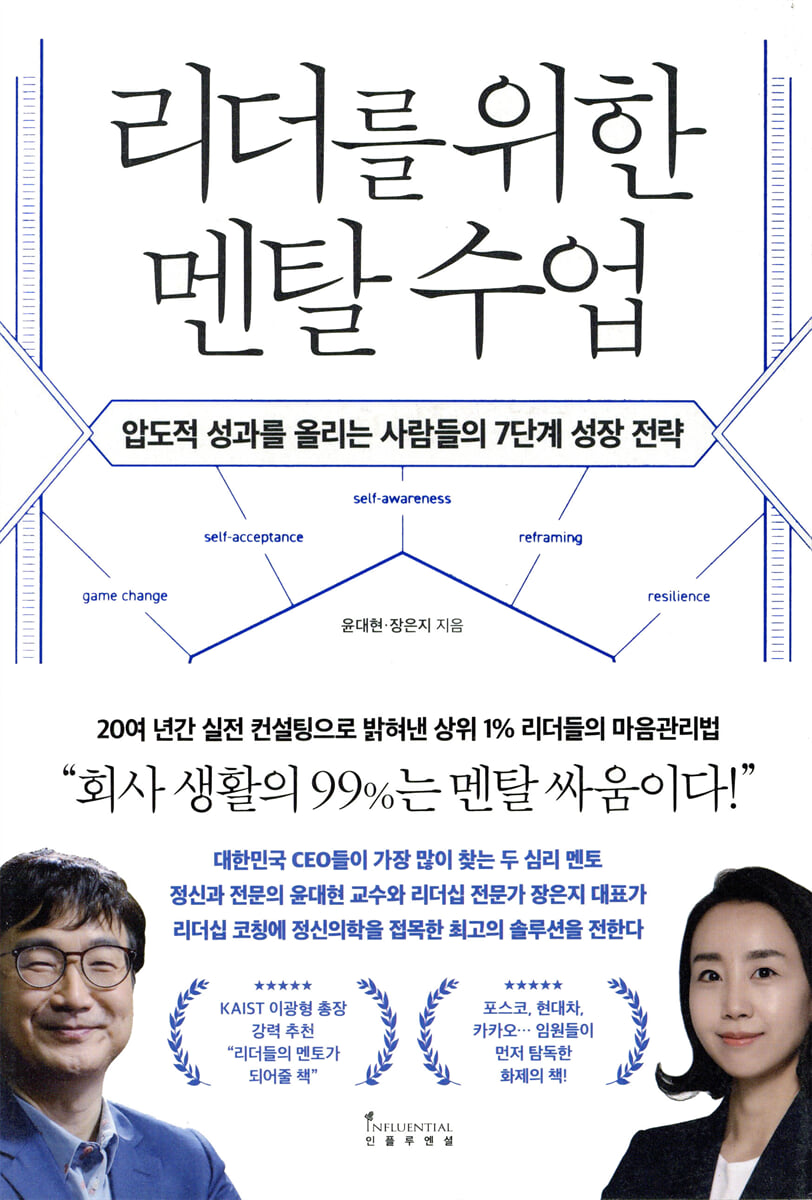
Mental Health Lessons for Leaders
 |
Description
Book Introduction
- A word from MD
- What the top 1% of leaders have in common is a high level of self-awareness.
Even in unstable and uncertain situations, the power to 'look closely at yourself' contributes to the solid growth of not only yourself but also the organization.
Introducing the '7 Stages of Leader Growth', crafted from the insights of leadership experts and psychiatrists.
- Economics and Management MD Kang Min-ji
Leadership coaching from the two most sought-after psychological mentors among South Korea's CEOs!
KAIST President Lee Kwang-hyung strongly recommends, "A book that will mentor leaders!"
POSCO, Hyundai Motor Group, Kakao… A hot topic book that executives have already read!
“99% of corporate life is a mental battle!”
Professor Daehyun Yoon, a psychiatrist, and Jang Eunji, a leadership expert
We deliver the best solutions by incorporating psychiatry into leadership coaching.
In this pandemic era, there are leaders who remain steadfast and demonstrate overwhelming performance amidst uncertainty.
They flexibly adapt to new management environments and chart their own growth curve.
What is the secret to the bold leadership of those who transform fear into achievement in a situation where even ordinary leaders find it difficult to manage their own minds?
Professor Dae-Hyeon Yoon of the Department of Psychiatry at Seoul National University Hospital, who has advised numerous leaders through practical consulting for over 20 years, and Jang Eun-Ji, former director of the McKinsey Leadership Center, say that this secret is the "power to look into the heart."
Even without the impact of the pandemic, organizations are rapidly shifting away from standardization and economies of scale and toward individual creativity and emotional expression.
The ability of leaders to understand and communicate with others based on their own understanding of themselves is becoming increasingly important.
The new book, "Mental Health Lessons for Leaders," combines the two authors' practical management experience with psychiatry and management theory to provide performance coaching and mental solutions for leaders in an era where mental health has become a core competency.
Leaders who thought they were good leaders, leaders who overwork themselves with excessive perfectionism, startup CEOs gripped by a sense of defeat after a single rejection, team leaders working with underperforming team members who don't respond to feedback, executives struggling with introversion... What are the concerns of today's leaders, and how can they be addressed? For these solitary leaders, who must overcome the limitations and challenges they face on their own, this book will serve as the ultimate mentor.
KAIST President Lee Kwang-hyung strongly recommends, "A book that will mentor leaders!"
POSCO, Hyundai Motor Group, Kakao… A hot topic book that executives have already read!
“99% of corporate life is a mental battle!”
Professor Daehyun Yoon, a psychiatrist, and Jang Eunji, a leadership expert
We deliver the best solutions by incorporating psychiatry into leadership coaching.
In this pandemic era, there are leaders who remain steadfast and demonstrate overwhelming performance amidst uncertainty.
They flexibly adapt to new management environments and chart their own growth curve.
What is the secret to the bold leadership of those who transform fear into achievement in a situation where even ordinary leaders find it difficult to manage their own minds?
Professor Dae-Hyeon Yoon of the Department of Psychiatry at Seoul National University Hospital, who has advised numerous leaders through practical consulting for over 20 years, and Jang Eun-Ji, former director of the McKinsey Leadership Center, say that this secret is the "power to look into the heart."
Even without the impact of the pandemic, organizations are rapidly shifting away from standardization and economies of scale and toward individual creativity and emotional expression.
The ability of leaders to understand and communicate with others based on their own understanding of themselves is becoming increasingly important.
The new book, "Mental Health Lessons for Leaders," combines the two authors' practical management experience with psychiatry and management theory to provide performance coaching and mental solutions for leaders in an era where mental health has become a core competency.
Leaders who thought they were good leaders, leaders who overwork themselves with excessive perfectionism, startup CEOs gripped by a sense of defeat after a single rejection, team leaders working with underperforming team members who don't respond to feedback, executives struggling with introversion... What are the concerns of today's leaders, and how can they be addressed? For these solitary leaders, who must overcome the limitations and challenges they face on their own, this book will serve as the ultimate mentor.
- You can preview some of the book's contents.
Preview
index
Recommendation
Introduction: What Makes Leaders Who Grow Exceptionally Different?
[STEP 1 Self-Awareness]
Chapter 1: I Thought I Was a Good Leader_ Looking at Myself Objectively
- Can you evaluate yourself objectively?
Why a leader's "inwardness" is dangerous
Chapter 2: Why Feedback Doesn't Work for Him: How to Work with Underperforming Team Members
- We consider our abilities to be above average.
- Don't blame yourself for team members who don't change.
* Self-Awareness Checklist
[STEP 2: Acceptance]
Chapter 3: I'm concerned about what others think of me: Dealing with negative feedback
- The depth of acceptance determines the size of growth.
- Take a step back and create some mental space.
Chapter 4: When You're Feeling Powerless After Being Pushed Away for a Promotion - Accepting Frustration
- Don't avoid problems, face them head on.
- A moment of frustration, a fresh look at myself
* Introspection Checklist
[STEP 3: Change your perspective]
Chapter 5: How to avoid being swayed by trivial situations: _Taking psychological control
- Separate the given situation from my reaction.
- We need to keep our distance from each other emotionally too.
Chapter 6: Why It's Difficult to Change Even When You Admit a Mistake: Changing Your Mindset
- Why can't he change even though he knows the problem?
- How to break out of a negative frame
Chapter 7: Feeling like I'm going to collapse if I make even the smallest mistake - Breaking free from perfectionism
- An excellent leader is not a perfect leader.
- Success and perfectionism are not related.
* Perspective Change Checklist
[STEP 4: Overcoming Limitations]
Chapter 8: Everyone is afraid of new challenges - Just try it.
- Leverage your strengths but acknowledge your vulnerabilities.
- As you gain new success experiences, your perspective changes.
Chapter 9: People Are Harder Than Achievements: Overcoming Relationship Conflict
- Why you must win people's hearts first
- Move hearts with gentle communication.
* Limit Overcoming Checklist
[STEP 5 Resilience]
Chapter 10: True Leaders Learn from Failure: Overcoming Defeat
A growth mindset increases resilience.
- Excessive self-criticism is toxic.
Chapter 11: When a Rejection Shrinks Your Heart - How to Overcome Rejection
- Wise leaders learn from rejection.
How to Deal with the Anxiety That Comes After Being Rejected
Chapter 12: When Your Company is Caught in Public Criticism: How to Turn a Crisis into an Opportunity
- In a crisis, leaders step forward.
- A true apology that demonstrates leadership
* Resilience Checklist
[STEP 6 Sustainability]
Chapter 13: Stagnation After Rapid Success: Finding Growth Engines
- The dangers of chasing only the immediate goal
- Compassion for myself leads to motivation
Chapter 14: I Don't Want to Lose Myself as I Continue to Grow - Making My Goals Specific
- Haven't we achieved only the goals given so far?
- Wise decisions come when you have enough mental energy.
Chapter 15: Can Introverted Leaders Succeed? _ Sustainable Leadership
Why Introverted Leaders Are Getting the Attention
Empathy and Inclusion: Becoming New Competitive Edges for Leaders
* Sustainability Checklist
[STEP 7 Self-Boundaries]
Chapter 16: Common Mistakes Successful Leaders Make: Beware of Pride
- Don't you consider the organization a tool for advancement?
- The mind also needs appropriate compensation.
Chapter 17: Why Do Kids These Days Want Things to Be Easy? _How to Avoid Becoming a Knock-Off
- Don't force your own way of success
- A leader's character comes from a relaxed mind.
* Self-Boundary Checklist
Conclusion: In the end, the leader who understands the heart wins.
Acknowledgements
Appendix Self-Leadership Study
References
Introduction: What Makes Leaders Who Grow Exceptionally Different?
[STEP 1 Self-Awareness]
Chapter 1: I Thought I Was a Good Leader_ Looking at Myself Objectively
- Can you evaluate yourself objectively?
Why a leader's "inwardness" is dangerous
Chapter 2: Why Feedback Doesn't Work for Him: How to Work with Underperforming Team Members
- We consider our abilities to be above average.
- Don't blame yourself for team members who don't change.
* Self-Awareness Checklist
[STEP 2: Acceptance]
Chapter 3: I'm concerned about what others think of me: Dealing with negative feedback
- The depth of acceptance determines the size of growth.
- Take a step back and create some mental space.
Chapter 4: When You're Feeling Powerless After Being Pushed Away for a Promotion - Accepting Frustration
- Don't avoid problems, face them head on.
- A moment of frustration, a fresh look at myself
* Introspection Checklist
[STEP 3: Change your perspective]
Chapter 5: How to avoid being swayed by trivial situations: _Taking psychological control
- Separate the given situation from my reaction.
- We need to keep our distance from each other emotionally too.
Chapter 6: Why It's Difficult to Change Even When You Admit a Mistake: Changing Your Mindset
- Why can't he change even though he knows the problem?
- How to break out of a negative frame
Chapter 7: Feeling like I'm going to collapse if I make even the smallest mistake - Breaking free from perfectionism
- An excellent leader is not a perfect leader.
- Success and perfectionism are not related.
* Perspective Change Checklist
[STEP 4: Overcoming Limitations]
Chapter 8: Everyone is afraid of new challenges - Just try it.
- Leverage your strengths but acknowledge your vulnerabilities.
- As you gain new success experiences, your perspective changes.
Chapter 9: People Are Harder Than Achievements: Overcoming Relationship Conflict
- Why you must win people's hearts first
- Move hearts with gentle communication.
* Limit Overcoming Checklist
[STEP 5 Resilience]
Chapter 10: True Leaders Learn from Failure: Overcoming Defeat
A growth mindset increases resilience.
- Excessive self-criticism is toxic.
Chapter 11: When a Rejection Shrinks Your Heart - How to Overcome Rejection
- Wise leaders learn from rejection.
How to Deal with the Anxiety That Comes After Being Rejected
Chapter 12: When Your Company is Caught in Public Criticism: How to Turn a Crisis into an Opportunity
- In a crisis, leaders step forward.
- A true apology that demonstrates leadership
* Resilience Checklist
[STEP 6 Sustainability]
Chapter 13: Stagnation After Rapid Success: Finding Growth Engines
- The dangers of chasing only the immediate goal
- Compassion for myself leads to motivation
Chapter 14: I Don't Want to Lose Myself as I Continue to Grow - Making My Goals Specific
- Haven't we achieved only the goals given so far?
- Wise decisions come when you have enough mental energy.
Chapter 15: Can Introverted Leaders Succeed? _ Sustainable Leadership
Why Introverted Leaders Are Getting the Attention
Empathy and Inclusion: Becoming New Competitive Edges for Leaders
* Sustainability Checklist
[STEP 7 Self-Boundaries]
Chapter 16: Common Mistakes Successful Leaders Make: Beware of Pride
- Don't you consider the organization a tool for advancement?
- The mind also needs appropriate compensation.
Chapter 17: Why Do Kids These Days Want Things to Be Easy? _How to Avoid Becoming a Knock-Off
- Don't force your own way of success
- A leader's character comes from a relaxed mind.
* Self-Boundary Checklist
Conclusion: In the end, the leader who understands the heart wins.
Acknowledgements
Appendix Self-Leadership Study
References
Detailed image

Into the book
After spending a long time working alongside leaders of various organizations, sharing their concerns and suggesting solutions, I've come to realize an important truth.
No matter how capable a leader is, if he or she runs forward without looking into and examining his or her own heart, he or she will ultimately be unable to achieve sustainable growth.
Leaders who achieve outstanding results and continue to grow happily all possess the power to look into their own hearts.
---From "Introduction [What Makes Leaders Who Grow Excellent Different]"
Accurate self-awareness is the first step toward a leader's growth.
So many leaders I've met in my performance coaching practice are surprisingly ignorant of themselves and can't even properly identify their own problems.
According to the results of a diagnosis conducted by American organizational psychologist Tasha Eurich on leaders of leading American companies, only 10 to 15 percent of leaders have accurate self-awareness.
---From Chapter 1 [I Thought I Was a Good Leader]
His attitude toward self-evaluation and acceptance of feedback was like a litmus test that showed how sustainable his growth as a leader could be.
In other words, leaders with high feedback acceptance rates achieved sustainable growth by quickly moving to the next stage of growth without exception, while leaders with low feedback acceptance rates often resigned from their positions without further growth.
It is no exaggeration to say that how deeply you accept self-evaluation and feedback determines the extent of your growth as a leader.
---From Chapter 3 [I Care About What People Think of Me]
If you look closely at cases where you overreact to a situation, you'll often find that past experiences or beliefs are influencing your current judgment.
So, instead of being able to objectively judge the current situation, we end up exaggerating or distorting the problem.
In cases like these, we must first separate the situation from the reaction.
In other words, you must be able to separate the problematic situation from your own emotional response to that situation and look at it objectively.
Then you need to examine the perspective from which your emotional reaction originated and whether that perspective is objectively valid.
---From Chapter 5 [How to avoid being swayed by trivial situations]
'Just trying' is a very effective way to overcome limitations because it allows new, successful experiences to foster a different perspective within your personality.
As you accumulate memories of 'successful experiences by changing your perspective,' you can change your reactions and actions to situations.
For example, even if a person had extreme perfectionist tendencies, if they repeatedly experience that "even if things aren't perfect, I still receive recognition and love from others," they will develop the perspective that "it's okay not to be recognized by everyone" within their personality, and then they will be able to accept situations with much more flexibility in the future.
---From Chapter 8 [Everyone is afraid of new challenges]
The reason rejection has such a big psychological impact is because it is usually perceived as a 'breakup of the relationship'.
The other person simply rejected the offer, but the person being rejected feels as if his or her existence has been denied, and feels pain.
People who perceive rejection as a severing of a relationship or a denial of their existence are highly "rejection sensitive," and often have a hard time not only being rejected but also rejecting others.
---From Chapter 11 [When your heart is crushed by a single rejection]
When your mind is on strike like Team Leader Jin, you need to comfort your mind from the perspective of self-compassion, not self-criticism.
Self-compassion is having a perspective that tenderly understands my heart.
In Team Leader Jin's case, he thinks to himself, "It's not my fault that I've become stagnant and burned out.
I tried hard enough and achieved great results.
We need to say with affection, “The current situation is something that any leader who works hard and takes on challenges experiences.”
---From Chapter 13 [Falling into a slump after rapid success]
In fact, regardless of age or position, the term 'old fart' refers to 'a person who forces their past success methods on others' and 'a person who lacks empathy for others and unilaterally insists on their own opinions.'
So why do leaders who are good at their jobs have such poor empathy skills?
There are many reasons, but I think the biggest reason is that we lack the humility to admit that we might be wrong.
So, we don't even try to understand the situation other people are in.
No matter how capable a leader is, if he or she runs forward without looking into and examining his or her own heart, he or she will ultimately be unable to achieve sustainable growth.
Leaders who achieve outstanding results and continue to grow happily all possess the power to look into their own hearts.
---From "Introduction [What Makes Leaders Who Grow Excellent Different]"
Accurate self-awareness is the first step toward a leader's growth.
So many leaders I've met in my performance coaching practice are surprisingly ignorant of themselves and can't even properly identify their own problems.
According to the results of a diagnosis conducted by American organizational psychologist Tasha Eurich on leaders of leading American companies, only 10 to 15 percent of leaders have accurate self-awareness.
---From Chapter 1 [I Thought I Was a Good Leader]
His attitude toward self-evaluation and acceptance of feedback was like a litmus test that showed how sustainable his growth as a leader could be.
In other words, leaders with high feedback acceptance rates achieved sustainable growth by quickly moving to the next stage of growth without exception, while leaders with low feedback acceptance rates often resigned from their positions without further growth.
It is no exaggeration to say that how deeply you accept self-evaluation and feedback determines the extent of your growth as a leader.
---From Chapter 3 [I Care About What People Think of Me]
If you look closely at cases where you overreact to a situation, you'll often find that past experiences or beliefs are influencing your current judgment.
So, instead of being able to objectively judge the current situation, we end up exaggerating or distorting the problem.
In cases like these, we must first separate the situation from the reaction.
In other words, you must be able to separate the problematic situation from your own emotional response to that situation and look at it objectively.
Then you need to examine the perspective from which your emotional reaction originated and whether that perspective is objectively valid.
---From Chapter 5 [How to avoid being swayed by trivial situations]
'Just trying' is a very effective way to overcome limitations because it allows new, successful experiences to foster a different perspective within your personality.
As you accumulate memories of 'successful experiences by changing your perspective,' you can change your reactions and actions to situations.
For example, even if a person had extreme perfectionist tendencies, if they repeatedly experience that "even if things aren't perfect, I still receive recognition and love from others," they will develop the perspective that "it's okay not to be recognized by everyone" within their personality, and then they will be able to accept situations with much more flexibility in the future.
---From Chapter 8 [Everyone is afraid of new challenges]
The reason rejection has such a big psychological impact is because it is usually perceived as a 'breakup of the relationship'.
The other person simply rejected the offer, but the person being rejected feels as if his or her existence has been denied, and feels pain.
People who perceive rejection as a severing of a relationship or a denial of their existence are highly "rejection sensitive," and often have a hard time not only being rejected but also rejecting others.
---From Chapter 11 [When your heart is crushed by a single rejection]
When your mind is on strike like Team Leader Jin, you need to comfort your mind from the perspective of self-compassion, not self-criticism.
Self-compassion is having a perspective that tenderly understands my heart.
In Team Leader Jin's case, he thinks to himself, "It's not my fault that I've become stagnant and burned out.
I tried hard enough and achieved great results.
We need to say with affection, “The current situation is something that any leader who works hard and takes on challenges experiences.”
---From Chapter 13 [Falling into a slump after rapid success]
In fact, regardless of age or position, the term 'old fart' refers to 'a person who forces their past success methods on others' and 'a person who lacks empathy for others and unilaterally insists on their own opinions.'
So why do leaders who are good at their jobs have such poor empathy skills?
There are many reasons, but I think the biggest reason is that we lack the humility to admit that we might be wrong.
So, we don't even try to understand the situation other people are in.
---From Chapter 17 [Why do kids these days want to work easily?]
Publisher's Review
* “How Great Leaders Manage Their Mental Health”
- The mental management methods of the top 1% of leaders, revealed through 20 years of practical consulting.
The COVID-19 pandemic has reminded us that even ordinary people find it difficult to manage their own minds.
Leaders at the forefront of organizations, in particular, have had to adapt to the severe economic downturn and rapid market changes, and there has been an increase in complaints of stress and anxiety.
In fact, the American business journal Harvard Business Review has seen an explosive increase in articles on organizational psychology and mind management before and after COVID-19.
A recent leadership study found that while before the pandemic, employees preferred leaders who empathized with their struggles, after the pandemic, they now much more prefer leaders who manage their emotions well.
In unstable situations like a pandemic, the ability of leaders to understand and manage their emotions has become crucial.
This book emphasizes the power of "introspection" as a crucial skill for leaders in these uncertain times.
Looking into your heart means becoming aware of who you want to be, what you're good at, and what you lack, while simultaneously reflecting on how you can complement your vulnerabilities through collaboration.
Many leaders in Korean society are so busy with work and performance pressures that they fail to take care of their own minds.
However, leaders who are ahead of the curve have long recognized the importance of mental management and are pursuing inner growth through deep reflection.
In this book, the two authors, who have collaborated with top leaders, offer solutions on how leaders can manage their mental health and lead their organizations to sustainable growth.
* “Successful leaders grow along similar paths.”
Why leaders with high self-awareness achieve high performance
Leaders who solve their own problems and lead them to success have something in common.
After analyzing the growth paths of numerous leaders, the two authors systematized their paths to success and established a seven-step growth strategy for leaders.
Step 1: Self-Awareness: "Can I look at myself objectively?"
Step 2: Internal Acceptance: "How will I deal with negative evaluations?"
Step 3: Change Your Perspective: "Can You Avoid Being Swayed by Minor Situations?"
Step 4: Overcoming Limitations: "How to Adapt to People"
Step 5: Resilience: "Are you prone to excessive self-criticism?"
Step 6: Sustainability: "Have you plateaued after a quick success?"
Step 7: Self-Boundaries: "How to Work with Subordinates"
This book examines the challenges faced in organizational life through the "7 Stages of Leader Growth" and proposes solutions for each, drawing on the insights of leadership experts and psychiatrists.
After completing each step, you can self-assess your leadership skills.
The growth of a leader has many similarities to the epic of a hero.
After leaving home, the hero faces a period of harsh trials on the verge of success.
Leaders, too, inevitably go through a process of trials and training in the face of dramatic growth.
When your team's performance doesn't improve no matter how hard you try, when your relationships with team members deteriorate and you're losing confidence, when you're frustrated by unexpected limitations, you can embark on the path to becoming a true leader by not giving up and challenging yourself to grow to the next level.
Following the seven stages of leadership growth presented in this book will be a journey toward creating your own path to success.
* “People have psychological patterns that cause them to stumble at the same point over and over again.”
Clear solutions for everything from excessive perfectionism to interpersonal problems, feedback for underperformers, and burnout syndrome.
There are leaders who complain of suffering from excessive perfectionism, saying, “I feel like I’ll fall apart if I make even the smallest mistake” (Case in Chapter 7).
The biggest cause of this suffering is ‘anxiety.’
Perfectionism is pursued defensively because of the anxiety that failure to satisfy others could lead to serious problems.
However, in the unpredictable VUCA era (an acronym for Volatility, Uncertainty, Complexity, and Ambiguity), being meticulous and thorough can actually be detrimental.
This is because the ability to flexibly adapt to rapid changes and creatively solve problems has become more important than paying close attention to details.
The two authors advise perfectionist leaders to understand that their anxiety is excessive worry and focus on completing tasks on time.
The standard of perfection varies from person to person and from situation to situation.
Because producing flawless results is an unrealistic goal to begin with, you need to have the mental space to objectively judge that even reaching 80 percent of your standards is a "success."
There are leaders whose mentality is shaken even by minor situations (Case in Chapter 5).
The two authors advise leaders to "separate the emotional response from the given situation" in response to the leader's concern that "the CEO walked out with a serious expression in the middle of an important presentation, and I completely ruined the presentation because I thought, 'Did my presentation sound weird?'"
To have a mature mentality, you must be able to separate the problematic situation from your emotional response to that situation and look at it objectively.
When similar problematic situations recur, it can be helpful to create your own 'ritual', such as exercising or taking a walk, to help you calm down from the overly gloomy emotional state and get away from the situation.
In addition, we share the challenges faced by real leaders, including startup CEOs who feel defeated by rejection, leaders who feel stagnant after a single success, team leaders who work with underperforming team members who don't respond to feedback, and executives who struggle with leadership due to introversion, along with the most realistic and professional solutions to these challenges.
* “In the end, the leader who knows the heart wins.”
― Mental leadership that protects me and grows the organization
There are leaders who achieve quick success through outstanding skills, but then feel empty or stagnant.
This is called the 'plateau effect', and when you reach a plateau, it's important to change your perspective and set new goals.
At this time, it is better to set your own long-term vision rather than a short-term achievable goal.
Leaders must not be satisfied with their own success, but must also play a role in expanding it into the success of the organization.
Those who have accumulated personal success but are unable to organize it are bound to have limited leadership potential.
Understanding the people in your network and connecting them to your vision and goals is a crucial step toward expanding your influence and expanding your experience of success as a leader.
We can see leaders in successful companies failing to sustain success and suddenly falling from grace due to problems such as abusive language and bullying.
The two authors emphasize 'self-vigilance', which means maintaining a humble attitude and guarding against arrogance even after reaching the heights of success.
Leaders must create channels through which they can hear any feedback without filtering, and they warn that the moment they only listen to flattery and pleasant words, their downfall begins.
The era of standardization is coming to an end, and organizations are rapidly transforming toward a direction that allows for the expression of innate human creativity and emotions.
In this age of change, the secret to leaders who achieve outstanding results is their 'mentality.'
An organization comes to life only when its leaders deeply understand themselves and run the organization based on a mature mentality.
This book provides valuable insights not only for leaders but also for future leaders who work with them, enabling them to move beyond one-time success to sustainable success through continuous self-reflection.
As KAITS President Lee Kwang-hyung recommends, “This book will serve as a true mentor to leaders in this era who desperately need a spiritual mentor,” this book will serve as the ultimate guide for leaders who struggle and fiercely lead their organizations in a chaotic and complex environment.
- The mental management methods of the top 1% of leaders, revealed through 20 years of practical consulting.
The COVID-19 pandemic has reminded us that even ordinary people find it difficult to manage their own minds.
Leaders at the forefront of organizations, in particular, have had to adapt to the severe economic downturn and rapid market changes, and there has been an increase in complaints of stress and anxiety.
In fact, the American business journal Harvard Business Review has seen an explosive increase in articles on organizational psychology and mind management before and after COVID-19.
A recent leadership study found that while before the pandemic, employees preferred leaders who empathized with their struggles, after the pandemic, they now much more prefer leaders who manage their emotions well.
In unstable situations like a pandemic, the ability of leaders to understand and manage their emotions has become crucial.
This book emphasizes the power of "introspection" as a crucial skill for leaders in these uncertain times.
Looking into your heart means becoming aware of who you want to be, what you're good at, and what you lack, while simultaneously reflecting on how you can complement your vulnerabilities through collaboration.
Many leaders in Korean society are so busy with work and performance pressures that they fail to take care of their own minds.
However, leaders who are ahead of the curve have long recognized the importance of mental management and are pursuing inner growth through deep reflection.
In this book, the two authors, who have collaborated with top leaders, offer solutions on how leaders can manage their mental health and lead their organizations to sustainable growth.
* “Successful leaders grow along similar paths.”
Why leaders with high self-awareness achieve high performance
Leaders who solve their own problems and lead them to success have something in common.
After analyzing the growth paths of numerous leaders, the two authors systematized their paths to success and established a seven-step growth strategy for leaders.
Step 1: Self-Awareness: "Can I look at myself objectively?"
Step 2: Internal Acceptance: "How will I deal with negative evaluations?"
Step 3: Change Your Perspective: "Can You Avoid Being Swayed by Minor Situations?"
Step 4: Overcoming Limitations: "How to Adapt to People"
Step 5: Resilience: "Are you prone to excessive self-criticism?"
Step 6: Sustainability: "Have you plateaued after a quick success?"
Step 7: Self-Boundaries: "How to Work with Subordinates"
This book examines the challenges faced in organizational life through the "7 Stages of Leader Growth" and proposes solutions for each, drawing on the insights of leadership experts and psychiatrists.
After completing each step, you can self-assess your leadership skills.
The growth of a leader has many similarities to the epic of a hero.
After leaving home, the hero faces a period of harsh trials on the verge of success.
Leaders, too, inevitably go through a process of trials and training in the face of dramatic growth.
When your team's performance doesn't improve no matter how hard you try, when your relationships with team members deteriorate and you're losing confidence, when you're frustrated by unexpected limitations, you can embark on the path to becoming a true leader by not giving up and challenging yourself to grow to the next level.
Following the seven stages of leadership growth presented in this book will be a journey toward creating your own path to success.
* “People have psychological patterns that cause them to stumble at the same point over and over again.”
Clear solutions for everything from excessive perfectionism to interpersonal problems, feedback for underperformers, and burnout syndrome.
There are leaders who complain of suffering from excessive perfectionism, saying, “I feel like I’ll fall apart if I make even the smallest mistake” (Case in Chapter 7).
The biggest cause of this suffering is ‘anxiety.’
Perfectionism is pursued defensively because of the anxiety that failure to satisfy others could lead to serious problems.
However, in the unpredictable VUCA era (an acronym for Volatility, Uncertainty, Complexity, and Ambiguity), being meticulous and thorough can actually be detrimental.
This is because the ability to flexibly adapt to rapid changes and creatively solve problems has become more important than paying close attention to details.
The two authors advise perfectionist leaders to understand that their anxiety is excessive worry and focus on completing tasks on time.
The standard of perfection varies from person to person and from situation to situation.
Because producing flawless results is an unrealistic goal to begin with, you need to have the mental space to objectively judge that even reaching 80 percent of your standards is a "success."
There are leaders whose mentality is shaken even by minor situations (Case in Chapter 5).
The two authors advise leaders to "separate the emotional response from the given situation" in response to the leader's concern that "the CEO walked out with a serious expression in the middle of an important presentation, and I completely ruined the presentation because I thought, 'Did my presentation sound weird?'"
To have a mature mentality, you must be able to separate the problematic situation from your emotional response to that situation and look at it objectively.
When similar problematic situations recur, it can be helpful to create your own 'ritual', such as exercising or taking a walk, to help you calm down from the overly gloomy emotional state and get away from the situation.
In addition, we share the challenges faced by real leaders, including startup CEOs who feel defeated by rejection, leaders who feel stagnant after a single success, team leaders who work with underperforming team members who don't respond to feedback, and executives who struggle with leadership due to introversion, along with the most realistic and professional solutions to these challenges.
* “In the end, the leader who knows the heart wins.”
― Mental leadership that protects me and grows the organization
There are leaders who achieve quick success through outstanding skills, but then feel empty or stagnant.
This is called the 'plateau effect', and when you reach a plateau, it's important to change your perspective and set new goals.
At this time, it is better to set your own long-term vision rather than a short-term achievable goal.
Leaders must not be satisfied with their own success, but must also play a role in expanding it into the success of the organization.
Those who have accumulated personal success but are unable to organize it are bound to have limited leadership potential.
Understanding the people in your network and connecting them to your vision and goals is a crucial step toward expanding your influence and expanding your experience of success as a leader.
We can see leaders in successful companies failing to sustain success and suddenly falling from grace due to problems such as abusive language and bullying.
The two authors emphasize 'self-vigilance', which means maintaining a humble attitude and guarding against arrogance even after reaching the heights of success.
Leaders must create channels through which they can hear any feedback without filtering, and they warn that the moment they only listen to flattery and pleasant words, their downfall begins.
The era of standardization is coming to an end, and organizations are rapidly transforming toward a direction that allows for the expression of innate human creativity and emotions.
In this age of change, the secret to leaders who achieve outstanding results is their 'mentality.'
An organization comes to life only when its leaders deeply understand themselves and run the organization based on a mature mentality.
This book provides valuable insights not only for leaders but also for future leaders who work with them, enabling them to move beyond one-time success to sustainable success through continuous self-reflection.
As KAITS President Lee Kwang-hyung recommends, “This book will serve as a true mentor to leaders in this era who desperately need a spiritual mentor,” this book will serve as the ultimate guide for leaders who struggle and fiercely lead their organizations in a chaotic and complex environment.
GOODS SPECIFICS
- Publication date: October 20, 2021
- Page count, weight, size: 352 pages | 604g | 150*220*30mm
- ISBN13: 9791191056990
- ISBN10: 1191056996
You may also like
카테고리
korean


korean

![GQ KOREA Mark (Monthly): December [2025]](http://librairie.coreenne.fr/cdn/shop/files/8ef265dbbfbf186523ed75ba7319009d.jpg?v=1765340328&width=3840)


