

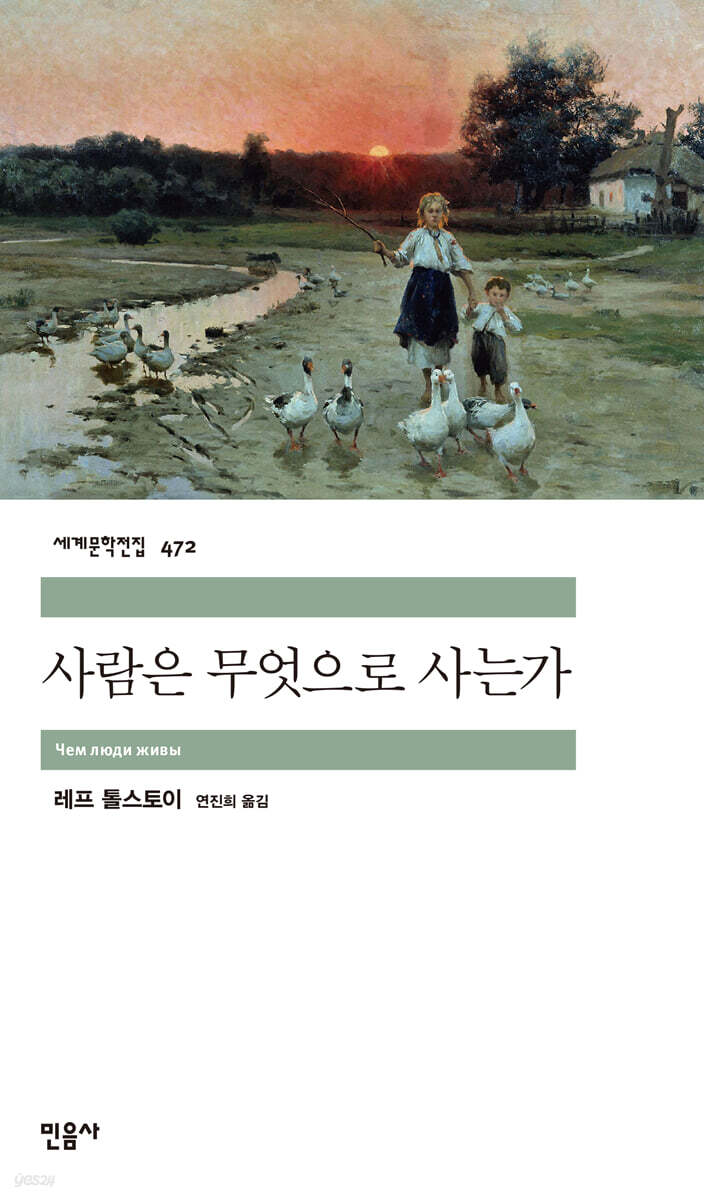
What do people live by?
 |
Description
Book Introduction
“Now I realize.
People feel alive because they are concerned about themselves.
As you can see, they are alive only because of love.”
Tolstoy, the master of War and Peace and Anna Karenina
The final insight discovered at the end of deep depression and wandering
So that even those who cannot read can listen with their hearts
A selection of masterpiece short stories written in easy language
"What Men Live By", "Ivan the Fool", "Holstomer",
"Does Man Need Much Land?", "The Master and the Worker", "Alyosha the Jar"
From works that stand out for their aesthetic experimentation,
A selection of later works that convey profound wisdom.
“If the world could write, it would write like Tolstoy.” ─Isaac Babel
Leo Tolstoy's short story collection, "What Men Live By," has been published in Minumsa's World Literature Collection.
This is a collection of six 'small stories' that he wrote after he was in his fifties, when he faced the existential fear of 'death', leaving behind the fame of great writers such as 'War and Peace' and 'Anna Karenina'.
After Tolstoy reached the peak of his writing career in middle age, he realized that although he had accomplished much, he was still afraid of something: death.
Death, which Tolstoy had vaguely feared since childhood, was gradually drawing closer to him.
So how should we live now? Should we remain trapped in the futility of life, awaiting the impending doom? At the end of his profound depression and anxiety, Tolstoy discovers a new meaning, a new ethics, and a reason to love life.
The 'little stories' introduced in this book were written by Tolstoy to share what he had realized with everyone else.
It used simple and easy language so that even illiterate people could remember it after hearing it once, and it reflected the language of farmers who used the term "you" regardless of the status of the person they were talking to.
This 'little story' contains compassion for human existence and a great love for life.
People feel alive because they are concerned about themselves.
As you can see, they are alive only because of love.”
Tolstoy, the master of War and Peace and Anna Karenina
The final insight discovered at the end of deep depression and wandering
So that even those who cannot read can listen with their hearts
A selection of masterpiece short stories written in easy language
"What Men Live By", "Ivan the Fool", "Holstomer",
"Does Man Need Much Land?", "The Master and the Worker", "Alyosha the Jar"
From works that stand out for their aesthetic experimentation,
A selection of later works that convey profound wisdom.
“If the world could write, it would write like Tolstoy.” ─Isaac Babel
Leo Tolstoy's short story collection, "What Men Live By," has been published in Minumsa's World Literature Collection.
This is a collection of six 'small stories' that he wrote after he was in his fifties, when he faced the existential fear of 'death', leaving behind the fame of great writers such as 'War and Peace' and 'Anna Karenina'.
After Tolstoy reached the peak of his writing career in middle age, he realized that although he had accomplished much, he was still afraid of something: death.
Death, which Tolstoy had vaguely feared since childhood, was gradually drawing closer to him.
So how should we live now? Should we remain trapped in the futility of life, awaiting the impending doom? At the end of his profound depression and anxiety, Tolstoy discovers a new meaning, a new ethics, and a reason to love life.
The 'little stories' introduced in this book were written by Tolstoy to share what he had realized with everyone else.
It used simple and easy language so that even illiterate people could remember it after hearing it once, and it reflected the language of farmers who used the term "you" regardless of the status of the person they were talking to.
This 'little story' contains compassion for human existence and a great love for life.
- You can preview some of the book's contents.
Preview
index
What Men Live By 7
The Tale of the Fool Ivan, his two older brothers, the soldier Semyon and the pot-bellied Taras, his mute sister Malanya, and the Old Demon and the Three Little Devils 49
Holstomer (The Story of a Horse) 99
Do Humans Need Much Land? 169
Master and Worker 197
Jar Alyosha 283
Commentary on the work 295
Author's Chronology 327
The Tale of the Fool Ivan, his two older brothers, the soldier Semyon and the pot-bellied Taras, his mute sister Malanya, and the Old Demon and the Three Little Devils 49
Holstomer (The Story of a Horse) 99
Do Humans Need Much Land? 169
Master and Worker 197
Jar Alyosha 283
Commentary on the work 295
Author's Chronology 327
Detailed image

Into the book
So the shoemaker kept going.
I passed the chapel.
The man was no longer visible.
After passing the chapel, I looked back and saw a man moving away from the chapel, as if he was looking in my direction.
The shoemaker thinks to himself, even more frightened.
Should I go closer, or just pass by? What if I go closer and something bad happens? Who knows what kind of person he is? He probably didn't come here for good.
If you get close, it might jump up and strangle you.
Then you can't run away.
Even if I don't get strangled, I'm sure I'll get caught up in that guy.
What can I do for that man, that naked man? I can't just take off my last clothes and give them to him.
God, just get me out of here!'
--- p.15 From “What People Live By”
'Go and take the soul out of the mother's body and make it understand three words.
Realize what is inside people, what is not given to people, and what people live by.
When you realize these three words, you will return to heaven.'
--- p.42 From “What People Live By”
“Look over there,” he says.
“There live three brothers.
They are called Soldier Semyon, Potbelly Taras, and Fool Ivan.
They should be fighting with each other, but they live peacefully.
We welcome each other warmly.
That idiot ruined all my work.
You three go and take charge of three brothers and cause them to strife until they tear out each other's eyes.
“Can you do that?”
--- p.54 From "Ivan the Fool"
“That’s because you’re stupid,” he says.
“I will teach you how to work with your head.
Then you too will find that it is more advantageous to work with your head than with your hands.”
--- p.93 From "Ivan the Fool"
However, there is one custom in his kingdom.
A person with calluses on both hands can join the table, while a person without calluses has to eat what others have left.
--- p.97 From "Ivan the Fool"
There is a dignified old age, an ugly old age, and a pitiful old age.
There are also old people who are both ugly and dignified.
That was exactly what happened to the old age of the eel.
--- p.97 From "Holstomer"
People say 'my house' but they never live in it, they only care about the construction and maintenance of the building.
The merchant says, 'My shop.'
For example, let's say it's called 'My Lumber Shop'.
But he doesn't have a suit made from the store's finest tailoring.
There are people who say that the land is theirs.
But they never see the land or walk on it.
There are people who say that other people are theirs.
But they never see these people.
The relationship between them and these people is that they do bad things to these people.
--- p.135 From "Holstomer"
My older sister came from the city to the countryside to see my younger sister.
The older sister, who married a merchant, lived in the city, and the younger sister, who married a farmer, lived in the countryside.
The sisters chat over tea.
My sister started to act cocky.
He began to praise his own city life.
How freely and cleanly they live in the city, how well they dress their children, how deliciously they eat and drink, how they go on picnics in boats, sleighs, and carriages, and go to the theater.
--- p.135 From “Do Humans Need Much Land?”
“We sell by the day.
Your land is as much as you walk in a day.
“The price for one day is 1000 rubles.”
Pahom was surprised.
“But if you walk around for a day...” he says.
“The land area must be quite large.”
The village chief burst into laughter.
“It’s all yours!” he says.
“There is one condition.
If you don't return to where you started within a day, your money is gone.”
--- pp.186-187 From “Do Humans Need Much Land?”
“No, brother, because of work!” said Vasily Andreich.
“If you miss an hour, you can’t make up for it in a year,” he added, thinking of the forest and the merchants who might intercept his trade.
“Can we really get there?” he asked Nikita.
“As long as I don’t get lost again,” he said gloomily.
--- pp.186-187 From "The Master and the Worker"
Alyosha lived like that for a year and six months.
And then, in the second half of his second year, the strangest thing in his life happened.
The incident was the astonishing discovery that, apart from the relationships that arise between people out of mutual need, there are also very special relationships, relationships where people are needed not just to polish their boots, carry their purchases from the market, or hitch their horses to the carriage, but simply to be cared for and loved, even when doing nothing else; and that Alyosha himself sometimes becomes one of those people.
I passed the chapel.
The man was no longer visible.
After passing the chapel, I looked back and saw a man moving away from the chapel, as if he was looking in my direction.
The shoemaker thinks to himself, even more frightened.
Should I go closer, or just pass by? What if I go closer and something bad happens? Who knows what kind of person he is? He probably didn't come here for good.
If you get close, it might jump up and strangle you.
Then you can't run away.
Even if I don't get strangled, I'm sure I'll get caught up in that guy.
What can I do for that man, that naked man? I can't just take off my last clothes and give them to him.
God, just get me out of here!'
--- p.15 From “What People Live By”
'Go and take the soul out of the mother's body and make it understand three words.
Realize what is inside people, what is not given to people, and what people live by.
When you realize these three words, you will return to heaven.'
--- p.42 From “What People Live By”
“Look over there,” he says.
“There live three brothers.
They are called Soldier Semyon, Potbelly Taras, and Fool Ivan.
They should be fighting with each other, but they live peacefully.
We welcome each other warmly.
That idiot ruined all my work.
You three go and take charge of three brothers and cause them to strife until they tear out each other's eyes.
“Can you do that?”
--- p.54 From "Ivan the Fool"
“That’s because you’re stupid,” he says.
“I will teach you how to work with your head.
Then you too will find that it is more advantageous to work with your head than with your hands.”
--- p.93 From "Ivan the Fool"
However, there is one custom in his kingdom.
A person with calluses on both hands can join the table, while a person without calluses has to eat what others have left.
--- p.97 From "Ivan the Fool"
There is a dignified old age, an ugly old age, and a pitiful old age.
There are also old people who are both ugly and dignified.
That was exactly what happened to the old age of the eel.
--- p.97 From "Holstomer"
People say 'my house' but they never live in it, they only care about the construction and maintenance of the building.
The merchant says, 'My shop.'
For example, let's say it's called 'My Lumber Shop'.
But he doesn't have a suit made from the store's finest tailoring.
There are people who say that the land is theirs.
But they never see the land or walk on it.
There are people who say that other people are theirs.
But they never see these people.
The relationship between them and these people is that they do bad things to these people.
--- p.135 From "Holstomer"
My older sister came from the city to the countryside to see my younger sister.
The older sister, who married a merchant, lived in the city, and the younger sister, who married a farmer, lived in the countryside.
The sisters chat over tea.
My sister started to act cocky.
He began to praise his own city life.
How freely and cleanly they live in the city, how well they dress their children, how deliciously they eat and drink, how they go on picnics in boats, sleighs, and carriages, and go to the theater.
--- p.135 From “Do Humans Need Much Land?”
“We sell by the day.
Your land is as much as you walk in a day.
“The price for one day is 1000 rubles.”
Pahom was surprised.
“But if you walk around for a day...” he says.
“The land area must be quite large.”
The village chief burst into laughter.
“It’s all yours!” he says.
“There is one condition.
If you don't return to where you started within a day, your money is gone.”
--- pp.186-187 From “Do Humans Need Much Land?”
“No, brother, because of work!” said Vasily Andreich.
“If you miss an hour, you can’t make up for it in a year,” he added, thinking of the forest and the merchants who might intercept his trade.
“Can we really get there?” he asked Nikita.
“As long as I don’t get lost again,” he said gloomily.
--- pp.186-187 From "The Master and the Worker"
Alyosha lived like that for a year and six months.
And then, in the second half of his second year, the strangest thing in his life happened.
The incident was the astonishing discovery that, apart from the relationships that arise between people out of mutual need, there are also very special relationships, relationships where people are needed not just to polish their boots, carry their purchases from the market, or hitch their horses to the carriage, but simply to be cared for and loved, even when doing nothing else; and that Alyosha himself sometimes becomes one of those people.
--- p.289 From "Alyosha the Jar"
Publisher's Review
A Guide to Life Found by a Lost Literary Master
Leo Tolstoy reached the pinnacle of his career as a writer by publishing 『War and Peace』 and 『Anna Karenina』 in succession.
He originally aimed for self-fulfillment and dreamed of continuing to grow like the protagonist of a 'billionaire novel'.
But in his late forties, he suddenly realizes that his body is headed not toward growth, but toward "decline, suffering, and inescapable extinction."
Having lost his parents at a young age and witnessed countless deaths in battle, 'death' was not a vague object of observation for him, but an existential fear that threatened to consume him.
In 1875, at the age of forty-seven, he confessed in a letter to a friend, "I see nothing before me but death."
What he, a successful writer and the head of a happy family, faced was the abyss of meaninglessness of life itself, and he eventually reached the point of having extreme thoughts.
Around this time, he became absorbed in primitive Christian thought, criticized the private property system, quit drinking and smoking, and pursued an ascetic life, working in the fields himself.
He also abandoned his aristocratic life and actively devoted himself to social activities, such as helping farmers who were going bankrupt due to their inability to pay their land rent, setting up a free soup kitchen during a famine, and petitioning to prevent the execution of the emperor's assassin.
He wrote 22 folk tales for the public to read easily, and among them, “Does Man Need Much Land?” included in this book was even considered by novelist James Joyce to be “the greatest story in the history of literature.”
The core of 'true art', as Tolstoy argued in 'What is Art?' (1897), which he later published, is 'infectious power.'
This signifies a universal experience in which the viewer becomes one with the artist, and further, escapes loneliness and becomes one with others.
What Tolstoy wanted to convey was clear.
It was the consciousness that ‘everyone is equal before God’ and the simple love and ethics in everyday life.
The 'small stories' contained in 'What Men Live By' are a 'guide to life' for the lost, which Tolstoy discovered on his own at the end of extreme despair.
The Rule of Three and the Appellation "You": The Great Truth in the Simplest Things
Tolstoy chose the form of the 'folk tale' to realize his new artistic ideal.
He also established a publishing house called 'Posrednik' (Middleman) in Moscow to enable the public to purchase books at low prices, and published his works by giving up the copyright to lower the prices.
Representative works such as “What Men Live By,” “Ivan the Fool,” and “Does Man Need Much Land?” included in “What Men Live By” actively utilize the technique of “three repetitions.”
"What Men Live By" centers around the "three smiles" of the angel Michaela and the "three questions" of God, "Ivan the Fool" centers around the confrontation between the "three brothers" and the "three devils," and "Does Man Need Much Land?" centers around the "three traps" with which the devil tempts Pahom.
This repetition not only gives the story a sense of rhythm, but also clearly imprints the work's message.
What is even more noteworthy is the use of language.
Tolstoy followed the format of traditional folk tales and had the characters call each other "you" regardless of their social status.
In this world where commoners address kings and angels address gods as “you,” all humans are portrayed as equal beings, transcending class.
Of course, Tolstoy did not neglect his aesthetic experiments as an 'artist' until his later years.
In the later short story "Holstomer" included in this book, the author uses the "defamiliarization" technique to criticize the private property system through the perspective of a horse, and in "Master and Worker," he demonstrates the master's skill in meticulously building up the fear of death through "details" like frozen laundry.
From didactic folktales to later short stories that shine with intricate artistry, these "little stories" capture the great truths of life that Tolstoy reached in their most brilliant form.
Leo Tolstoy reached the pinnacle of his career as a writer by publishing 『War and Peace』 and 『Anna Karenina』 in succession.
He originally aimed for self-fulfillment and dreamed of continuing to grow like the protagonist of a 'billionaire novel'.
But in his late forties, he suddenly realizes that his body is headed not toward growth, but toward "decline, suffering, and inescapable extinction."
Having lost his parents at a young age and witnessed countless deaths in battle, 'death' was not a vague object of observation for him, but an existential fear that threatened to consume him.
In 1875, at the age of forty-seven, he confessed in a letter to a friend, "I see nothing before me but death."
What he, a successful writer and the head of a happy family, faced was the abyss of meaninglessness of life itself, and he eventually reached the point of having extreme thoughts.
Around this time, he became absorbed in primitive Christian thought, criticized the private property system, quit drinking and smoking, and pursued an ascetic life, working in the fields himself.
He also abandoned his aristocratic life and actively devoted himself to social activities, such as helping farmers who were going bankrupt due to their inability to pay their land rent, setting up a free soup kitchen during a famine, and petitioning to prevent the execution of the emperor's assassin.
He wrote 22 folk tales for the public to read easily, and among them, “Does Man Need Much Land?” included in this book was even considered by novelist James Joyce to be “the greatest story in the history of literature.”
The core of 'true art', as Tolstoy argued in 'What is Art?' (1897), which he later published, is 'infectious power.'
This signifies a universal experience in which the viewer becomes one with the artist, and further, escapes loneliness and becomes one with others.
What Tolstoy wanted to convey was clear.
It was the consciousness that ‘everyone is equal before God’ and the simple love and ethics in everyday life.
The 'small stories' contained in 'What Men Live By' are a 'guide to life' for the lost, which Tolstoy discovered on his own at the end of extreme despair.
The Rule of Three and the Appellation "You": The Great Truth in the Simplest Things
Tolstoy chose the form of the 'folk tale' to realize his new artistic ideal.
He also established a publishing house called 'Posrednik' (Middleman) in Moscow to enable the public to purchase books at low prices, and published his works by giving up the copyright to lower the prices.
Representative works such as “What Men Live By,” “Ivan the Fool,” and “Does Man Need Much Land?” included in “What Men Live By” actively utilize the technique of “three repetitions.”
"What Men Live By" centers around the "three smiles" of the angel Michaela and the "three questions" of God, "Ivan the Fool" centers around the confrontation between the "three brothers" and the "three devils," and "Does Man Need Much Land?" centers around the "three traps" with which the devil tempts Pahom.
This repetition not only gives the story a sense of rhythm, but also clearly imprints the work's message.
What is even more noteworthy is the use of language.
Tolstoy followed the format of traditional folk tales and had the characters call each other "you" regardless of their social status.
In this world where commoners address kings and angels address gods as “you,” all humans are portrayed as equal beings, transcending class.
Of course, Tolstoy did not neglect his aesthetic experiments as an 'artist' until his later years.
In the later short story "Holstomer" included in this book, the author uses the "defamiliarization" technique to criticize the private property system through the perspective of a horse, and in "Master and Worker," he demonstrates the master's skill in meticulously building up the fear of death through "details" like frozen laundry.
From didactic folktales to later short stories that shine with intricate artistry, these "little stories" capture the great truths of life that Tolstoy reached in their most brilliant form.
GOODS SPECIFICS
- Date of issue: October 28, 2025
- Page count, weight, size: 384 pages | 132*225*30mm
- ISBN13: 9788937464720
- ISBN10: 8937464721
You may also like
카테고리
korean


korean

![ELLE 엘르 스페셜 에디션 A형 : 12월 [2025]](http://librairie.coreenne.fr/cdn/shop/files/b8e27a3de6c9538896439686c6b0e8fb.jpg?v=1766436872&width=3840)


