

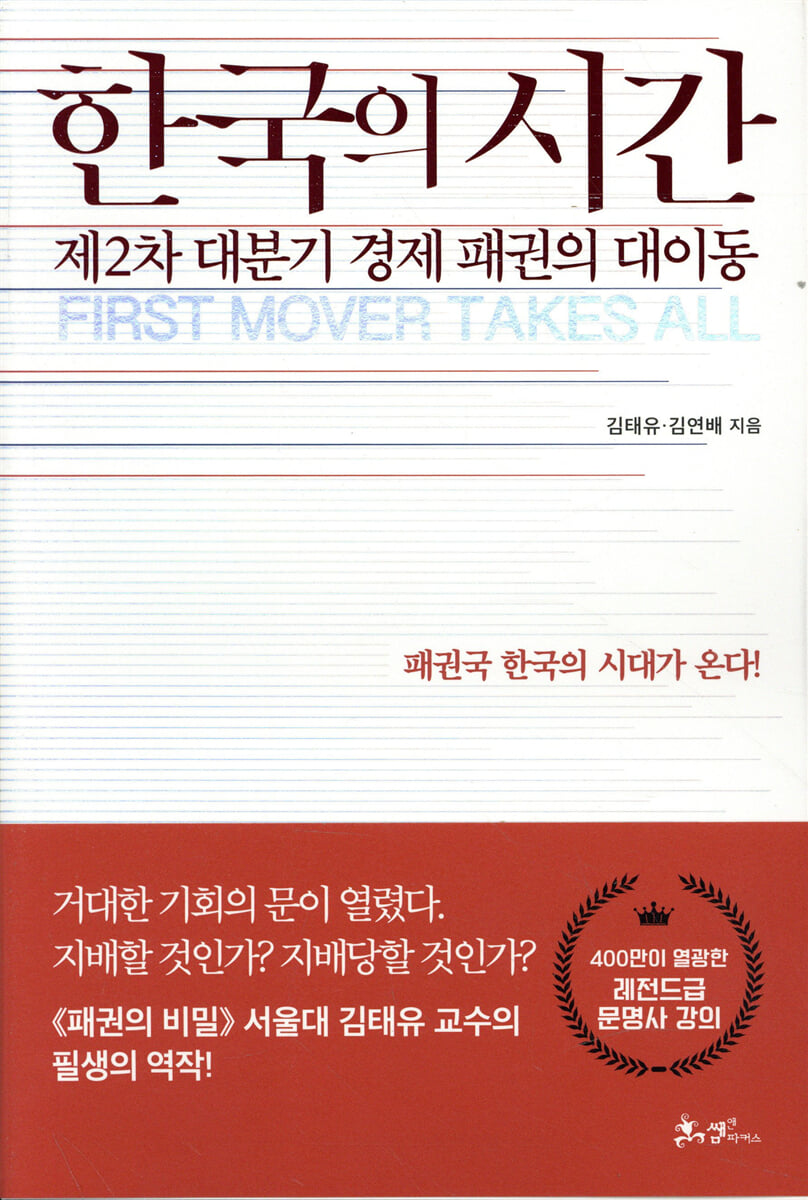
Korean time
 |
Description
Book Introduction
What will 'Korean Time' look like?
Seize the last chance of the second great turning point with the Korean accelerated genes! Korea is running out of time! Amidst this pivotal shift in global economic power, what direction should South Korea take? This book examines the major events in South Korea's economic history, exploring the secrets of the Miracle on the Han River, why we fell into the middle-income trap, and how we can leap forward to become a developed nation. It offers solutions. Professor Kim Tae-yu of Seoul National University, who gave a refreshing shock to South Korean opinion leaders with his 2017 book, "The Secret of Hegemony," introduces the national development theory he has researched throughout his life and proposes three innovative solutions to become the winners of the future global hegemony war. The Fourth Industrial Revolution is already upon us. In a world where things have shifted from deceleration to acceleration, and from acceleration to even greater acceleration, how should individuals, organizations, and nations prepare for the future? How can we awaken and leverage the Korean DNA, optimized for the Fourth Industrial Revolution? The door to enormous opportunity has already opened for Korea! What choices should we make? |
- You can preview some of the book's contents.
Preview
index
Preface _ A Book of the Fourth Industrial Revolution
Prologue _ The Secret of Happiness, the Secret of Hegemony
PART 1.
The Industrial Revolution divided the world into rulers and ruled.
At the crossroads of revolution
Same Perception, Different Responses | Harmonious and Prosperous Society, or the Protest of the Righteous? | Joseon Mistaken for "Governing the Nation" | Yoshida Shoin and Choi Ik-hyeon | The Fate of a Nation That Rejected the Industrial Revolution
The Qing Dynasty failed and Japan succeeded.
They had Brown Bess | Bringing in wolves to drive out lynxes | The Self-War Movement failed, the Meiji Restoration succeeded | The Industrial Revolution that determined the success or failure of the three Eastern countries | And for a long time after that
Limits to growth
The Malthusian Trap | The Rise of Class | Increasing Labor, Malnutrition, and the Spread of Disease | A Slowing Society Filled with War and Plunder
Neo-utopia, industrial society
Deceleration and Acceleration | Humans Created Industry | The New Utopia of the Knowledge-Industrial Society
The Fourth Industrial Revolution and the Knowledge Industry Society
Everything About the Industrial Revolutions, from the First to the Fourth | Industrialization, Not a Revolution? | The Fourth Industrial Revolution Is Coming Bigger | From the Age of Atoms to the Age of Bits | The Second Great Divergence is Coming
PART 2.
The miracle brought about by comprador capital
Boarding too late
How poorly have we lived? | The significance of surpassing $10 billion in exports | Why the Miracle on the Han River is truly a miracle.
export-led industrialization
At a Crossroads | Comparative Advantage and Free Trade | Import-Substitution Industrialization vs. Export-Driven Industrialization | From Squid Exporter to Semiconductor Exporter | The Miracle on the Han River: The First Secret: Export-Driven Industrialization
The economics of deficit exports
The desperate measure of bleeding exports | How to convert the unemployed's labor into dollars | The export deficit burdening the wealthy | Does economic growth also improve integrity? | The second secret of the Miracle on the Han River: 'Deficit Exports'
Lowest price bidding system
Logistics costs drive manufacturing | Rice is in short supply, so why bother with highways? | Construction projects that are bigger than the boat | Faster, cheaper, more | The third secret of the Miracle on the Han River: the "lowest-price bidding system."
The Miracle on the Han River as Seen Through the Lens of an Expanded Reproduction System
Endogenous Growth, Exogenous Growth | Closing the Gap with Advanced Countries | Creating Miracles through Exogenous Innovation | Why Must Export-Led Industrialization Be the Only Way?
PART 3.
The Fourth Industrial Revolution: The Phoenix Is Alive
Half success
Compressed Growth and Authoritarian Government | Dictatorship and Democratization | Reckless Management and Labor Disputes | The Stigma of Being a "Republic of Accidents"
Falling into the middle-income trap
The IMF crisis caused by unprepared globalization | The aftereffects of overtreatment | Adding insult to injury | The economy faltered on the verge of becoming a developed nation
The problem is economic growth
The Frog in the Hot Pot | Generation N and Hell Joseon | The Poor Elderly, Retiring Baby Boomers | Deceleration and Acceleration: The Two Forces That Move the World
Selection of the country of origin
Endogenous growth | Exogenous growth
The success formula for latecomers
Internal and external growth narrows the gap | Catch up or overtake? | Sprints and obstacles
The Fourth Industrial Revolution and the Phoenix Effect
The Phoenix Effect | More Important Than Victory or Defeat | The Future Depends on Industry and Technology
PART 4.
Misconceptions and Truths about the Middle-Income Trap
Principles of industrial ecosystem
The Consequences of Sparrow Eradication | The Consequences of Tongil Rice Development | Fortune Favors the Brave | Concerns About the Fourth Industrial Revolution
The Fourth Industrial Revolution and the Future of Jobs
The Illusion of Job Depletion | The End of Work Is a Long-Gone 'Past'
Is the age of materialism coming?
Does economic development reduce fine dust? | Does economic development reduce industrial accidents? | Does economic development restore humanity?
The rich get richer, but the poor don't get poorer.
It's not polarization, it's unipolarization. The solution is to grow businesses and increase employment.
There is no trickle-down effect?
Wealth from business and wealth from unearned income are different | Industrial development reduces the gap between rich and poor
PART 5.
The Fourth Industrial Revolution is driven by policy.
Three Secrets and Three Secret Strategies
Government Innovation - Deregulation | Social Innovation - Securing Talent | External Innovation - Preempting the Northern Sea Route and Expanding into Russia
Why don't regulations go away?
The Consequences of Lack of Civil Service Professionalism | Koi's Law
Change the government's genes
Where have all the respected elite bureaucrats gone? | How to survive a minefield | Rotational positions only produce incompetent 'all-rounders' | A goalkeeper remains a goalkeeper even after transferring | Commander or staff type? | Players and referees | Maximum effect with minimum change
The era of dual-cropping of the national economy begins.
Zero Birth Rate: The Cruel Times Await | Fluid Intelligence and Crystallized Intelligence | The Growth Principles of a Double-Crop Economy
PART 6.
Take the lead in securing the Northern Sea Route
When the road opens, an era opens.
The Silk Road, the Spice Route, and the Atlantic Route | The Arctic Sea Route is Opening
Why will the Northern Sea Route become the center of the Fourth Industrial Revolution?
Explosive increase in water volume | Energy buried in the Northern Sea Route | Relations with Russia, where there's much to give and take | The Korean Peninsula could become a hell of fine dust from North Korea
The alliance between Korea, China, and Japan
Korea, China, and Japan reject shared growth | Masang Deukji Masang Chiji
Korea-Military alliance
The US-led world order | Complementary relationships are possible from the economy to security | America's strategy to encircle China | Akitas and Trump's poodles | The Thucydides Trap
Is it a union or a horizontal alliance?
Learning from Silla's alliances and alliances | 3 innovations that will drive the Fourth Industrial Revolution
Epilogue: It's Not Politics, It's Policy
Prologue _ The Secret of Happiness, the Secret of Hegemony
PART 1.
The Industrial Revolution divided the world into rulers and ruled.
At the crossroads of revolution
Same Perception, Different Responses | Harmonious and Prosperous Society, or the Protest of the Righteous? | Joseon Mistaken for "Governing the Nation" | Yoshida Shoin and Choi Ik-hyeon | The Fate of a Nation That Rejected the Industrial Revolution
The Qing Dynasty failed and Japan succeeded.
They had Brown Bess | Bringing in wolves to drive out lynxes | The Self-War Movement failed, the Meiji Restoration succeeded | The Industrial Revolution that determined the success or failure of the three Eastern countries | And for a long time after that
Limits to growth
The Malthusian Trap | The Rise of Class | Increasing Labor, Malnutrition, and the Spread of Disease | A Slowing Society Filled with War and Plunder
Neo-utopia, industrial society
Deceleration and Acceleration | Humans Created Industry | The New Utopia of the Knowledge-Industrial Society
The Fourth Industrial Revolution and the Knowledge Industry Society
Everything About the Industrial Revolutions, from the First to the Fourth | Industrialization, Not a Revolution? | The Fourth Industrial Revolution Is Coming Bigger | From the Age of Atoms to the Age of Bits | The Second Great Divergence is Coming
PART 2.
The miracle brought about by comprador capital
Boarding too late
How poorly have we lived? | The significance of surpassing $10 billion in exports | Why the Miracle on the Han River is truly a miracle.
export-led industrialization
At a Crossroads | Comparative Advantage and Free Trade | Import-Substitution Industrialization vs. Export-Driven Industrialization | From Squid Exporter to Semiconductor Exporter | The Miracle on the Han River: The First Secret: Export-Driven Industrialization
The economics of deficit exports
The desperate measure of bleeding exports | How to convert the unemployed's labor into dollars | The export deficit burdening the wealthy | Does economic growth also improve integrity? | The second secret of the Miracle on the Han River: 'Deficit Exports'
Lowest price bidding system
Logistics costs drive manufacturing | Rice is in short supply, so why bother with highways? | Construction projects that are bigger than the boat | Faster, cheaper, more | The third secret of the Miracle on the Han River: the "lowest-price bidding system."
The Miracle on the Han River as Seen Through the Lens of an Expanded Reproduction System
Endogenous Growth, Exogenous Growth | Closing the Gap with Advanced Countries | Creating Miracles through Exogenous Innovation | Why Must Export-Led Industrialization Be the Only Way?
PART 3.
The Fourth Industrial Revolution: The Phoenix Is Alive
Half success
Compressed Growth and Authoritarian Government | Dictatorship and Democratization | Reckless Management and Labor Disputes | The Stigma of Being a "Republic of Accidents"
Falling into the middle-income trap
The IMF crisis caused by unprepared globalization | The aftereffects of overtreatment | Adding insult to injury | The economy faltered on the verge of becoming a developed nation
The problem is economic growth
The Frog in the Hot Pot | Generation N and Hell Joseon | The Poor Elderly, Retiring Baby Boomers | Deceleration and Acceleration: The Two Forces That Move the World
Selection of the country of origin
Endogenous growth | Exogenous growth
The success formula for latecomers
Internal and external growth narrows the gap | Catch up or overtake? | Sprints and obstacles
The Fourth Industrial Revolution and the Phoenix Effect
The Phoenix Effect | More Important Than Victory or Defeat | The Future Depends on Industry and Technology
PART 4.
Misconceptions and Truths about the Middle-Income Trap
Principles of industrial ecosystem
The Consequences of Sparrow Eradication | The Consequences of Tongil Rice Development | Fortune Favors the Brave | Concerns About the Fourth Industrial Revolution
The Fourth Industrial Revolution and the Future of Jobs
The Illusion of Job Depletion | The End of Work Is a Long-Gone 'Past'
Is the age of materialism coming?
Does economic development reduce fine dust? | Does economic development reduce industrial accidents? | Does economic development restore humanity?
The rich get richer, but the poor don't get poorer.
It's not polarization, it's unipolarization. The solution is to grow businesses and increase employment.
There is no trickle-down effect?
Wealth from business and wealth from unearned income are different | Industrial development reduces the gap between rich and poor
PART 5.
The Fourth Industrial Revolution is driven by policy.
Three Secrets and Three Secret Strategies
Government Innovation - Deregulation | Social Innovation - Securing Talent | External Innovation - Preempting the Northern Sea Route and Expanding into Russia
Why don't regulations go away?
The Consequences of Lack of Civil Service Professionalism | Koi's Law
Change the government's genes
Where have all the respected elite bureaucrats gone? | How to survive a minefield | Rotational positions only produce incompetent 'all-rounders' | A goalkeeper remains a goalkeeper even after transferring | Commander or staff type? | Players and referees | Maximum effect with minimum change
The era of dual-cropping of the national economy begins.
Zero Birth Rate: The Cruel Times Await | Fluid Intelligence and Crystallized Intelligence | The Growth Principles of a Double-Crop Economy
PART 6.
Take the lead in securing the Northern Sea Route
When the road opens, an era opens.
The Silk Road, the Spice Route, and the Atlantic Route | The Arctic Sea Route is Opening
Why will the Northern Sea Route become the center of the Fourth Industrial Revolution?
Explosive increase in water volume | Energy buried in the Northern Sea Route | Relations with Russia, where there's much to give and take | The Korean Peninsula could become a hell of fine dust from North Korea
The alliance between Korea, China, and Japan
Korea, China, and Japan reject shared growth | Masang Deukji Masang Chiji
Korea-Military alliance
The US-led world order | Complementary relationships are possible from the economy to security | America's strategy to encircle China | Akitas and Trump's poodles | The Thucydides Trap
Is it a union or a horizontal alliance?
Learning from Silla's alliances and alliances | 3 innovations that will drive the Fourth Industrial Revolution
Epilogue: It's Not Politics, It's Policy
Into the book
The important thing is the ‘effect of first-come, first-served.’
The saying that well begun is half done is an adage in our slow-paced society that says, even if it is difficult, we should at least start.
But in an accelerating society, the beginning is not 'half' but 'all'.
This is because the ‘first-come, first-served effect’ works absolutely to your advantage.
Once a first, always a first.
The first-come, first-served effect may be forgotten, but it cannot disappear.
The Dutch commercial revolution, which first introduced humanity to an accelerated society, was reborn as the British Industrial Revolution, and the glory of the British Empire, which first completed an accelerated society, was also splendidly revived in the United States.
It's not that there are no opportunities for a latecomer country.
Because even a small arrival is a first arrival.
Germany's chemical industry and Japan's materials industry still reign as hidden champions, taking advantage of the first-mover advantage, and Korea's semiconductor industry is also evolving by taking advantage of the first-mover advantage.
Moreover, the second great turning point, the so-called Fourth Industrial Revolution, is waiting for the 'first arrival of the new millennium.'
Succeeding in the Fourth Industrial Revolution is currently the only way for us to overtake advanced countries.
Even if you don't become number one in a specific industry while focusing on the 4th Industrial Revolution, you are still successful.
Once you accumulate technology and experience, you can become number one in a similar industry with the same technology.
Hegemony is not limited to 'monopoly hegemony' where one person dominates, but also includes 'oligopoly hegemony' where several people divide up similar industries.
If we do our best for the Fourth Industrial Revolution, we can become a powerful nation that can easily join the ranks of advanced countries as a member of the "oligopoly hegemony."
--- p.206, from “The Effect of First-Come-First”
So the Korean government chose the drastic measure of export-led industrialization.
The plan is to import cutting-edge technology, domestically produce new products from advanced countries, and export them.
A country that can't even make bicycles properly decided to manufacture and export automobiles.
In some ways, it was an absurd choice that ran counter to the liberal trade order.
This is because the plan was to strategically create a 'new' industry that 'does not exist' in the country, not a comparative advantage, or even a comparative disadvantage, and then export it.
The absurd idea of making a color TV and exporting it to developed countries when we can't even make a black and white TV.
But that absurdity became the trigger that created the Miracle on the Han River.
After many twists and turns, once exports were successful, dollars were secured.
With that foreign currency, new technologies were introduced again, advanced products were domestically produced with that technology and exported, and with that foreign currency, new technologies were introduced again.
In the process, we were able to gradually secure export competitiveness.
If things continued like this, I thought we might one day become a developed country.
It was the beginning of a grand dream: hatch an egg, raise a chick, raise it into a chicken, buy a calf, and raise the calf into a cow to create a huge ranch.
--- p.99, “Import Substitution Industrialization vs.
From “Export-led Industrialization”
If there were three great secrets hidden behind the Miracle on the Han River, there are also three prepared strategies for success in the Fourth Industrial Revolution.
The three major innovations—government innovation, social innovation, and external innovation—are not ideologically biased politics, but rather “policies.”
It is a policy only for the people and their livelihood.
There can be no progress or conservatism in the Fourth Industrial Revolution and science and technology.
Now, we must all work together to unify public opinion, consolidate national strength, and dedicate ourselves to the three major innovations.
This is possible through policy, not politics.
Let me emphasize again that policy is about being loyal to the people in order to achieve the goals of the country.
It is to develop the economy and enrich the people's food, clothing, and shelter, and to strengthen national defense and protect the people from invasion by foreign enemies.
If a rich nation and a strong military are intermediate goals of policy, the happiness of the people is the ultimate goal of policy.
So, only maximum welfare is true welfare.
Because welfare is the happiness of the people.
However, unsustainable welfare is nothing more than selling the happiness of future generations to buy our own happiness today.
--- p.362, from “A Leader Who Prioritizes National Interest Over Justification”
If an individual's 'subjective well-being' is a sufficient condition for happiness, then a nation's 'objective well-being' is a necessary condition for happiness.
Unless we were born to suffer poverty and exploitation, or to be ravaged by foreign invasion.
The definition of happiness can vary depending on the times and individual's subjective perspective.
However, we must never overlook the fact that all this happiness begins within the confines of a 'nation'.
Of course, just because a country is wealthy does not mean that all its citizens are rich and happy.
However, it is highly unlikely that someone born in Silicon Valley in a developed country will enjoy the same level of happiness throughout their lives as someone born in a slum in a developing country.
In that sense, the country must develop and the economy must grow.
Only on the foundation of the nation can each individual freely reap the fruits of happiness they desire.
--- p.19, from “The State is a Necessary Condition for Happiness”
So, in China and Joseon, which advocated civil service, who was responsible for exploiting farmers?
He was a nobleman.
Just as religious leaders in Europe offered a carrot, scholars who studied Confucianism offered the logic of exploitation in the name of human morality.
And the role that the knights played was enforced by government officials appointed through the civil service system with the whip of laws and regulations.
Zhu Xi's teachings taught absolute obedience between king and subject, parents and children, husband and wife, and noblemen and commoners, justifying exploitation and maintaining a strictly vertical hierarchical class society.
It is a mistake to think that the emperor of an agricultural society had a spirit of love for the people.
The reason the ruling class distributed food to farmers during a famine was not because they truly sympathized with the hunger of the people, but because they were the people who would be responsible for agricultural production the following year.
In some ways, the love for the people of the agricultural society can be compared to the love of the Mongol army for horses.
In Mongolia, anyone who hit a horse's eye or head was punishable by death.
Soldiers who cooked before feeding their horses in the barracks were also severely punished.
Because if you abuse horses, people will die on the battlefield.
Just like the love for horses for war, the love that the emperor showed to his people in an agricultural society and dynastic state was only to the extent of collecting a lot of taxes.
--- p.53, from “The Birth of Status”
In an industrial society, industry typically refers to manufacturing, also known as atom industry.
The knowledge-based society of the future is one in which the digital industry, or bit industry, represented by computers and the Internet, is added to the modern industrial society.
Bit Industry plays a role in increasing productivity in the industrial society's atom industry through automation, robotization, and artificial intelligence.
Moreover, the bit industry is emerging as a new independent industry with a stagnant production function, like the information network industry.
The knowledge-based society, where the new bit industry is added to the atom industry with increased productivity, is a 'faster accelerating society' with an economic growth rate that is even faster than the accelerating industrial society.
The saying that well begun is half done is an adage in our slow-paced society that says, even if it is difficult, we should at least start.
But in an accelerating society, the beginning is not 'half' but 'all'.
This is because the ‘first-come, first-served effect’ works absolutely to your advantage.
Once a first, always a first.
The first-come, first-served effect may be forgotten, but it cannot disappear.
The Dutch commercial revolution, which first introduced humanity to an accelerated society, was reborn as the British Industrial Revolution, and the glory of the British Empire, which first completed an accelerated society, was also splendidly revived in the United States.
It's not that there are no opportunities for a latecomer country.
Because even a small arrival is a first arrival.
Germany's chemical industry and Japan's materials industry still reign as hidden champions, taking advantage of the first-mover advantage, and Korea's semiconductor industry is also evolving by taking advantage of the first-mover advantage.
Moreover, the second great turning point, the so-called Fourth Industrial Revolution, is waiting for the 'first arrival of the new millennium.'
Succeeding in the Fourth Industrial Revolution is currently the only way for us to overtake advanced countries.
Even if you don't become number one in a specific industry while focusing on the 4th Industrial Revolution, you are still successful.
Once you accumulate technology and experience, you can become number one in a similar industry with the same technology.
Hegemony is not limited to 'monopoly hegemony' where one person dominates, but also includes 'oligopoly hegemony' where several people divide up similar industries.
If we do our best for the Fourth Industrial Revolution, we can become a powerful nation that can easily join the ranks of advanced countries as a member of the "oligopoly hegemony."
--- p.206, from “The Effect of First-Come-First”
So the Korean government chose the drastic measure of export-led industrialization.
The plan is to import cutting-edge technology, domestically produce new products from advanced countries, and export them.
A country that can't even make bicycles properly decided to manufacture and export automobiles.
In some ways, it was an absurd choice that ran counter to the liberal trade order.
This is because the plan was to strategically create a 'new' industry that 'does not exist' in the country, not a comparative advantage, or even a comparative disadvantage, and then export it.
The absurd idea of making a color TV and exporting it to developed countries when we can't even make a black and white TV.
But that absurdity became the trigger that created the Miracle on the Han River.
After many twists and turns, once exports were successful, dollars were secured.
With that foreign currency, new technologies were introduced again, advanced products were domestically produced with that technology and exported, and with that foreign currency, new technologies were introduced again.
In the process, we were able to gradually secure export competitiveness.
If things continued like this, I thought we might one day become a developed country.
It was the beginning of a grand dream: hatch an egg, raise a chick, raise it into a chicken, buy a calf, and raise the calf into a cow to create a huge ranch.
--- p.99, “Import Substitution Industrialization vs.
From “Export-led Industrialization”
If there were three great secrets hidden behind the Miracle on the Han River, there are also three prepared strategies for success in the Fourth Industrial Revolution.
The three major innovations—government innovation, social innovation, and external innovation—are not ideologically biased politics, but rather “policies.”
It is a policy only for the people and their livelihood.
There can be no progress or conservatism in the Fourth Industrial Revolution and science and technology.
Now, we must all work together to unify public opinion, consolidate national strength, and dedicate ourselves to the three major innovations.
This is possible through policy, not politics.
Let me emphasize again that policy is about being loyal to the people in order to achieve the goals of the country.
It is to develop the economy and enrich the people's food, clothing, and shelter, and to strengthen national defense and protect the people from invasion by foreign enemies.
If a rich nation and a strong military are intermediate goals of policy, the happiness of the people is the ultimate goal of policy.
So, only maximum welfare is true welfare.
Because welfare is the happiness of the people.
However, unsustainable welfare is nothing more than selling the happiness of future generations to buy our own happiness today.
--- p.362, from “A Leader Who Prioritizes National Interest Over Justification”
If an individual's 'subjective well-being' is a sufficient condition for happiness, then a nation's 'objective well-being' is a necessary condition for happiness.
Unless we were born to suffer poverty and exploitation, or to be ravaged by foreign invasion.
The definition of happiness can vary depending on the times and individual's subjective perspective.
However, we must never overlook the fact that all this happiness begins within the confines of a 'nation'.
Of course, just because a country is wealthy does not mean that all its citizens are rich and happy.
However, it is highly unlikely that someone born in Silicon Valley in a developed country will enjoy the same level of happiness throughout their lives as someone born in a slum in a developing country.
In that sense, the country must develop and the economy must grow.
Only on the foundation of the nation can each individual freely reap the fruits of happiness they desire.
--- p.19, from “The State is a Necessary Condition for Happiness”
So, in China and Joseon, which advocated civil service, who was responsible for exploiting farmers?
He was a nobleman.
Just as religious leaders in Europe offered a carrot, scholars who studied Confucianism offered the logic of exploitation in the name of human morality.
And the role that the knights played was enforced by government officials appointed through the civil service system with the whip of laws and regulations.
Zhu Xi's teachings taught absolute obedience between king and subject, parents and children, husband and wife, and noblemen and commoners, justifying exploitation and maintaining a strictly vertical hierarchical class society.
It is a mistake to think that the emperor of an agricultural society had a spirit of love for the people.
The reason the ruling class distributed food to farmers during a famine was not because they truly sympathized with the hunger of the people, but because they were the people who would be responsible for agricultural production the following year.
In some ways, the love for the people of the agricultural society can be compared to the love of the Mongol army for horses.
In Mongolia, anyone who hit a horse's eye or head was punishable by death.
Soldiers who cooked before feeding their horses in the barracks were also severely punished.
Because if you abuse horses, people will die on the battlefield.
Just like the love for horses for war, the love that the emperor showed to his people in an agricultural society and dynastic state was only to the extent of collecting a lot of taxes.
--- p.53, from “The Birth of Status”
In an industrial society, industry typically refers to manufacturing, also known as atom industry.
The knowledge-based society of the future is one in which the digital industry, or bit industry, represented by computers and the Internet, is added to the modern industrial society.
Bit Industry plays a role in increasing productivity in the industrial society's atom industry through automation, robotization, and artificial intelligence.
Moreover, the bit industry is emerging as a new independent industry with a stagnant production function, like the information network industry.
The knowledge-based society, where the new bit industry is added to the atom industry with increased productivity, is a 'faster accelerating society' with an economic growth rate that is even faster than the accelerating industrial society.
--- p.73, from “From the Age of Atoms to the Age of Bits”
Publisher's Review
A huge door of opportunity has opened.
To rule or to be ruled?
There is a lecture on the history of civilization that has garnered 4 million views and is ranked #1 on YouTube for the 4th Industrial Revolution.
This is a lecture by Professor Kim Tae-yu of Seoul National University.
Despite being a rather long and difficult lecture with a running time of over 1 hour and 50 minutes on a somewhat stiff topic called 'The Path to a Rich Nation in the Era of the Fourth Industrial Revolution', it created a huge sensation, spreading quietly from CEO breakfast meetings to local mom cafes.
In fact, Professor Kim Tae-yu already gave a refreshing shock to Korean opinion leaders in 2017 with his book, “The Secret of Hegemony.”
And before that, as a unique scholar with a comprehensive perspective of 'engineering, economics, and history,' he served as the first Senior Secretary to the President for Information and Science Technology under the Roh Moo-hyun administration, striving to realize the national development theory he had researched throughout his life into policy.
Professor Kim Tae-yu asks us this question in the introduction to his new book, “Time in Korea.”
'Korean time' was a proud time in which Korea maintained its national dignity and ethnic identity for over 5,000 years, competing with all the hegemonic powers that emerged in Northeast Asia.
There was a shameful time when we rejected the Industrial Revolution and brought about our own ruin, and there was also a time when we healed that pain with the Miracle of the Han River.
We are now at a critical juncture: whether to remain in the middle-income trap or leap forward to become a developed country.
There is no more time to hesitate.
(…) In the era of the Fourth Industrial Revolution, will we rule, or will we be ruled again? - From the introduction
“The era of Korea as a hegemonic power has arrived!”
With the accelerated genes of Koreans
Seize the last chance of the second quarter!
This book first looks back at the history of the Industrial Revolution and explains how the world was divided into rulers and ruled.
As we move from a slowing agricultural society to an accelerating industrial society, and from an accelerating society to an even more rapidly accelerating knowledge-based society, the world has changed from the age of atoms to the age of bits, and from the age of the North Star to the age of the Milky Way.
In this situation, why are we unable to move forward? How can we become a global powerhouse? To find the answer, this book explores the three secrets that created the "Miracle on the Han River." It also presents three innovative strategies to escape the middle-income trap amidst the phoenix effect of the Fourth Industrial Revolution, the surge of latecomers, and the obstacles faced by advanced nations.
Suggested by Korea's best scholars
The New Ilpyoiseo in the Era of the Fourth Industrial Revolution
Which 'Korean time' will we choose?
There is no one who does not know what the 'Fourth Industrial Revolution' is.
But if we continue to be swept along thoughtlessly and passively like we are now, we will only fall prey to those who ‘lay the first stone.’
Professor Kim Tae-yu said, “The Fourth Industrial Revolution will not just come.
He emphasizes, “It is only caused by policy.”
Only by understanding the great currents of human civilization, such as the Industrial Revolution, and understanding the principles of national development in both advanced and developing countries, can individuals, organizations, and nations prepare for the future.
This book also presents concrete alternatives on how to awaken and utilize the DNA of Koreans, optimized for the Fourth Industrial Revolution, and how to seize the last opportunity.
Reviewers who previewed the book praised it, saying, “I lost track of time reading this book, which is full of fact-checking statistics and data, and a wealth of knowledge that crosses history and economics.” and “This is a masterpiece that provides both a broad direction and a specific path, armed with solid practical logic.”
To rule or to be ruled?
There is a lecture on the history of civilization that has garnered 4 million views and is ranked #1 on YouTube for the 4th Industrial Revolution.
This is a lecture by Professor Kim Tae-yu of Seoul National University.
Despite being a rather long and difficult lecture with a running time of over 1 hour and 50 minutes on a somewhat stiff topic called 'The Path to a Rich Nation in the Era of the Fourth Industrial Revolution', it created a huge sensation, spreading quietly from CEO breakfast meetings to local mom cafes.
In fact, Professor Kim Tae-yu already gave a refreshing shock to Korean opinion leaders in 2017 with his book, “The Secret of Hegemony.”
And before that, as a unique scholar with a comprehensive perspective of 'engineering, economics, and history,' he served as the first Senior Secretary to the President for Information and Science Technology under the Roh Moo-hyun administration, striving to realize the national development theory he had researched throughout his life into policy.
Professor Kim Tae-yu asks us this question in the introduction to his new book, “Time in Korea.”
'Korean time' was a proud time in which Korea maintained its national dignity and ethnic identity for over 5,000 years, competing with all the hegemonic powers that emerged in Northeast Asia.
There was a shameful time when we rejected the Industrial Revolution and brought about our own ruin, and there was also a time when we healed that pain with the Miracle of the Han River.
We are now at a critical juncture: whether to remain in the middle-income trap or leap forward to become a developed country.
There is no more time to hesitate.
(…) In the era of the Fourth Industrial Revolution, will we rule, or will we be ruled again? - From the introduction
“The era of Korea as a hegemonic power has arrived!”
With the accelerated genes of Koreans
Seize the last chance of the second quarter!
This book first looks back at the history of the Industrial Revolution and explains how the world was divided into rulers and ruled.
As we move from a slowing agricultural society to an accelerating industrial society, and from an accelerating society to an even more rapidly accelerating knowledge-based society, the world has changed from the age of atoms to the age of bits, and from the age of the North Star to the age of the Milky Way.
In this situation, why are we unable to move forward? How can we become a global powerhouse? To find the answer, this book explores the three secrets that created the "Miracle on the Han River." It also presents three innovative strategies to escape the middle-income trap amidst the phoenix effect of the Fourth Industrial Revolution, the surge of latecomers, and the obstacles faced by advanced nations.
Suggested by Korea's best scholars
The New Ilpyoiseo in the Era of the Fourth Industrial Revolution
Which 'Korean time' will we choose?
There is no one who does not know what the 'Fourth Industrial Revolution' is.
But if we continue to be swept along thoughtlessly and passively like we are now, we will only fall prey to those who ‘lay the first stone.’
Professor Kim Tae-yu said, “The Fourth Industrial Revolution will not just come.
He emphasizes, “It is only caused by policy.”
Only by understanding the great currents of human civilization, such as the Industrial Revolution, and understanding the principles of national development in both advanced and developing countries, can individuals, organizations, and nations prepare for the future.
This book also presents concrete alternatives on how to awaken and utilize the DNA of Koreans, optimized for the Fourth Industrial Revolution, and how to seize the last opportunity.
Reviewers who previewed the book praised it, saying, “I lost track of time reading this book, which is full of fact-checking statistics and data, and a wealth of knowledge that crosses history and economics.” and “This is a masterpiece that provides both a broad direction and a specific path, armed with solid practical logic.”
GOODS SPECIFICS
- Publication date: April 30, 2021
- Page count, weight, size: 384 pages | 710g | 153*224*24mm
- ISBN13: 9791165343385
- ISBN10: 116534338X
You may also like
카테고리
korean


korean

![ELLE 엘르 스페셜 에디션 A형 : 12월 [2025]](http://librairie.coreenne.fr/cdn/shop/files/b8e27a3de6c9538896439686c6b0e8fb.jpg?v=1766436872&width=3840)


