

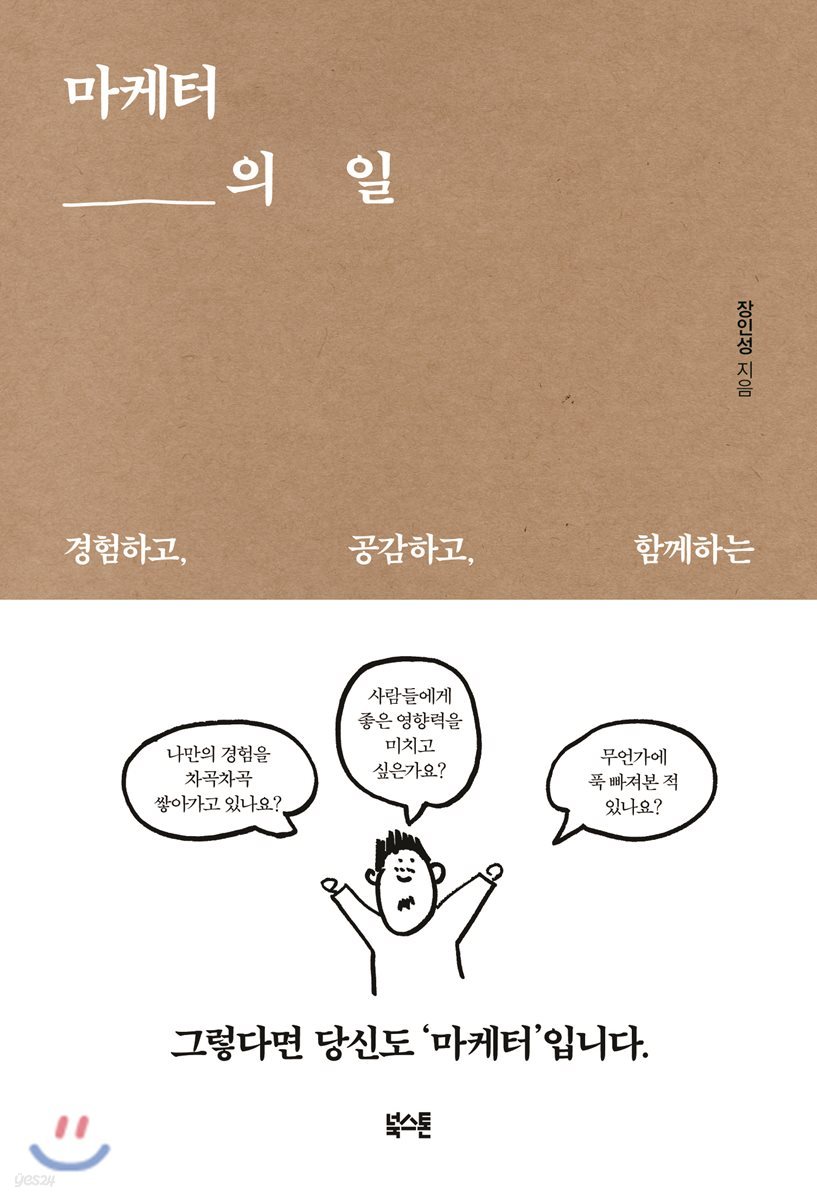
A marketer's job
 |
Description
Book Introduction
Talking about 'marketing as a profession' A book for marketers who fiercely set goals, find ways, and make plans come true. "A Marketer's Work" is a story shared by senior marketers who have grown through similar struggles to junior marketers. The author says that while the work that marketers do may vary from company to company and from individual to individual, it's crucial to never lose sight of the essence of marketing. The essence of marketing lies in the ‘consumer.’ Setting goals for who to sell to, finding the best way to do it, and mobilizing the power of multiple people to execute it properly is the job of every marketer. Based on this, this book presents the fundamentals, planning skills, execution skills, and leadership that marketers must possess. It will serve as a guide for those who aspire to become marketers, marketing practitioners, and organizations that need marketing DNA. |
- You can preview some of the book's contents.
Preview
index
A marketer's job
Chapter 1.
Marketer's Basics
A person who is good at his job
Experience speaks louder than experience
Investing in experience assets
Have you ever loved someone?
Growth acceleration? 0
Learn from everyday life.
Observation skills
Consider the return on investment
Let's not sell, let's buy
Marketer's Note
Do you have a favorite brand?
Chapter 2.
Marketer's planning skills
Who should I sell to?
If you're not sure, just try selling it.
A good way is to stay true to the 'why'
Become a split personality
How to put yourself in the consumer's shoes
Half rational, half emotional
Create an event worth talking about
Let's imagine
Let's not imagine
Story rather than report
Find a way to do it, not a reason why it can't be done.
Useful 'Sseulgokal'
Chapter 3.
Marketer's execution power
small short fast
'Decided work' and 'decided work'
Let's change today what we decided yesterday.
Tomorrow will change even more
If marketers only do marketing and designers only do design, the results will be a mess.
Digesting feedback
If you have similar experiences and positions, persuasion will happen naturally.
When persuading, do so without confidence
Let's say 'good/bad' rather than 'right/wrong'
Some charms are abilities
How to Work with a Bad-Tempered Coworker
Description of the document
About injustice
A and B, each with their own role
Chapter 4.
Marketer Leadership
A leader who loses to his teammates
Do better at what you do well
Diligence is good, busyness is bad
I want to be a lazy manager
Is work fun?
Feedback skills
What kind of person do you choose?
Working with the right people,
If you like your coworkers,
Marketer _______'s job
Thank you
Chapter 1.
Marketer's Basics
A person who is good at his job
Experience speaks louder than experience
Investing in experience assets
Have you ever loved someone?
Growth acceleration? 0
Learn from everyday life.
Observation skills
Consider the return on investment
Let's not sell, let's buy
Marketer's Note
Do you have a favorite brand?
Chapter 2.
Marketer's planning skills
Who should I sell to?
If you're not sure, just try selling it.
A good way is to stay true to the 'why'
Become a split personality
How to put yourself in the consumer's shoes
Half rational, half emotional
Create an event worth talking about
Let's imagine
Let's not imagine
Story rather than report
Find a way to do it, not a reason why it can't be done.
Useful 'Sseulgokal'
Chapter 3.
Marketer's execution power
small short fast
'Decided work' and 'decided work'
Let's change today what we decided yesterday.
Tomorrow will change even more
If marketers only do marketing and designers only do design, the results will be a mess.
Digesting feedback
If you have similar experiences and positions, persuasion will happen naturally.
When persuading, do so without confidence
Let's say 'good/bad' rather than 'right/wrong'
Some charms are abilities
How to Work with a Bad-Tempered Coworker
Description of the document
About injustice
A and B, each with their own role
Chapter 4.
Marketer Leadership
A leader who loses to his teammates
Do better at what you do well
Diligence is good, busyness is bad
I want to be a lazy manager
Is work fun?
Feedback skills
What kind of person do you choose?
Working with the right people,
If you like your coworkers,
Marketer _______'s job
Thank you
Into the book
A marketer's job
When conducting job interviews, you sometimes meet people who list off things they've done, saying things like, "I've done this and that."
It happens often.
But just having done some great project that everyone knows about doesn't mean much.
The more successful a project is, the more people there are who say, "I did that."
So, even more than 'I did it', I want to hear 'what did you do and how did you do it'.
I'm more interested in how many people worked together, how they divided up the work, what their roles were, how they did things differently, and how they changed themselves after doing it.
If you prioritize "how to do it" over "what to do," what you're doing will look a little different.
Even if you're involved in a great project, if you just watch, you'll have nothing to gain. If you make even the smallest things not trivial, you can create a great experience.
- From 'Experience speaks louder than career'
When experiencing, you must go beyond simply observing the object and observe yourself observing the object.
Even if it's something you do, if you're just spending money, you might not really know what you're doing.
While consuming, I observe myself as an observer, detaching myself from about 30% of my ego and feeling as if I am out of my body.
I observe and record things from a third-party perspective, in my mind.
What caught my eye, what's the difference between an ad I just pass by and one I see again, why I didn't buy something after looking at it for a while, what's the reason I always put it off because it's annoying and end up buying it, why I bought a limited edition collaboration product even though I knew it was expensive, what made me angry today, what post I shared, and why.
If you look closely at events like music festivals or exhibitions, you can see the movements of the event staff.
Even if you can't hear them, you can imagine what they're talking about on the radio.
I can visualize the route I took and observe whether visitors are moving according to the designer's intention.
You can take a picture of an unexpected discovery and save it to try again later.
If you catch yourself lining up in front of a booth and observe your thoughts and actions, you can tell when you're paying attention and when you're bored.
If you talk to your fellow marketers who have similar experiences with this observation tool, you will see that the asset growth effect is doubled, tripled, or even multiplied.
-From 'Investing in Experience Assets'
It's scary to narrow down your target.
The seller thinks he wants to sell to a lot of people.
But there is no such thing as an 'ordinary person'.
It may be a fantasy creature.
Looking at statistics, it seems like we can define 'this is what an average person is', but that 'average' is not average, it's just 'average'.
If you average the ages of the people in a village that only has children and the elderly, it would come out to young adults.
You can't substitute 'average' for 'normal'.
We are all different.
There is no such thing as average, but there is an average.
We are all on the periphery.
The term 'normal person' is also strange.
Only when we can think of each of us as distinct individuals can we begin to see the face of the consumer.
We must not forget this point.
They are people.
No one is ordinary.
There are real people behind the numbers.
-From 'Who Should I Sell to?'
I heard an interesting story a while ago. I don't remember the details, but it was about editing pop music.
To create good sound, you need good equipment.
Both the musical instruments and the speakers are very expensive and good.
But in an editing room full of expensive equipment, after editing and paying attention to even the slightest sound, they listen to it on cheap speakers that are easily available.
Music is truly good if it sounds good even on cheap speakers.
The real thing is not the high-quality sound that vividly reproduces the original sound, but the low-quality sound that the public hears.
When I heard this story, my eyes were opened and my ears perked up.
In fact, the environment in which we normally encounter popular music is not optimized for music appreciation.
You listen to it through your laptop speakers, through your smartphone speakers, through the default earphones that come with your smartphone package, or through the chatter of people in cafes, bars, or clothing stores.
It's a relatively good environment to watch TV in the living room.
I think the same goes for marketing messages.
The copy we wrote with our hearts and souls, line by line, is read by people through the cheap speakers mentioned in the previous story.
I can't hear the main copy, the sub copy, and the detailed, heartfelt words below it.
Because they don't put so much effort into reading our story and actively trying to understand it.
- From 'How to Stand in the Consumer's Position'
It all started with a small incident.
There was a workshop for new employees at my company, and since it would be boring if we just lectured, we played a game in between.
Each group had a representative come out and blindfolded them and had to guess what kind of chicken it was.
What is this? Everyone was on their feet, their palms sweating, it was really exciting and thrilling.
Someone called the winner a "chicken taster," and someone else said, "There are water sommeliers, so why can't there be a chicken sommelier?" and added, "There should be separate fried chicken and seasoned chicken categories to taste chicken," and others joked, "Let's have separate theory and practical exams like the TOEIC," "It would be fun if they had online mock exams," "There should be a past exam booklet," and "There should be study groups."
We had a great time laughing and playing for about 20 minutes.
After laughing for a while, I came to my senses and organized what we had been talking about into a document.
That became the plan for this event.
Of course, many of the details of the initial plan changed as it was implemented.
- From the 'Baemin Chimmelier Qualification Test'
Every organization has a different culture and many great leaders with different leadership styles.
I also respect the methods of a diligent organization leader who manages things tightly.
But I still want to be a lazy organization leader.
Being 'lazy' means making your team members do it themselves.
I try to make only big decisions, check occasionally to see if I'm on track to my work goals, and decide on the appropriate resources to meet those goals. I try not to make any haphazard decisions about the rest of the smaller ones.
When I ask for opinions, I try to say something like, "This is just my opinion."
If the organization leader takes care of even the smallest decisions and takes care of everything from start to finish, team members won't be able to think for themselves.
The more you can decide, the more you think.
What is the most difficult thing for a marketer? I think it's things that don't give a reason or that don't resonate with the direction.
It's coming.
If you know the background and goals of the work, you can figure out the method, but if you only ask for the method without any explanation, it will be difficult to do the work well.
Working without knowing what your goal is can be unsettling, and even if you come up with several solutions, it's difficult to determine which one is better.
Even if the person who ordered the work is satisfied.
It is also difficult to respond to situations that change from moment to moment while running.
If you don't know what your goal is or what results you want to achieve, then that's it.
- From 'I want to be a lazy manager'
When conducting job interviews, you sometimes meet people who list off things they've done, saying things like, "I've done this and that."
It happens often.
But just having done some great project that everyone knows about doesn't mean much.
The more successful a project is, the more people there are who say, "I did that."
So, even more than 'I did it', I want to hear 'what did you do and how did you do it'.
I'm more interested in how many people worked together, how they divided up the work, what their roles were, how they did things differently, and how they changed themselves after doing it.
If you prioritize "how to do it" over "what to do," what you're doing will look a little different.
Even if you're involved in a great project, if you just watch, you'll have nothing to gain. If you make even the smallest things not trivial, you can create a great experience.
- From 'Experience speaks louder than career'
When experiencing, you must go beyond simply observing the object and observe yourself observing the object.
Even if it's something you do, if you're just spending money, you might not really know what you're doing.
While consuming, I observe myself as an observer, detaching myself from about 30% of my ego and feeling as if I am out of my body.
I observe and record things from a third-party perspective, in my mind.
What caught my eye, what's the difference between an ad I just pass by and one I see again, why I didn't buy something after looking at it for a while, what's the reason I always put it off because it's annoying and end up buying it, why I bought a limited edition collaboration product even though I knew it was expensive, what made me angry today, what post I shared, and why.
If you look closely at events like music festivals or exhibitions, you can see the movements of the event staff.
Even if you can't hear them, you can imagine what they're talking about on the radio.
I can visualize the route I took and observe whether visitors are moving according to the designer's intention.
You can take a picture of an unexpected discovery and save it to try again later.
If you catch yourself lining up in front of a booth and observe your thoughts and actions, you can tell when you're paying attention and when you're bored.
If you talk to your fellow marketers who have similar experiences with this observation tool, you will see that the asset growth effect is doubled, tripled, or even multiplied.
-From 'Investing in Experience Assets'
It's scary to narrow down your target.
The seller thinks he wants to sell to a lot of people.
But there is no such thing as an 'ordinary person'.
It may be a fantasy creature.
Looking at statistics, it seems like we can define 'this is what an average person is', but that 'average' is not average, it's just 'average'.
If you average the ages of the people in a village that only has children and the elderly, it would come out to young adults.
You can't substitute 'average' for 'normal'.
We are all different.
There is no such thing as average, but there is an average.
We are all on the periphery.
The term 'normal person' is also strange.
Only when we can think of each of us as distinct individuals can we begin to see the face of the consumer.
We must not forget this point.
They are people.
No one is ordinary.
There are real people behind the numbers.
-From 'Who Should I Sell to?'
I heard an interesting story a while ago. I don't remember the details, but it was about editing pop music.
To create good sound, you need good equipment.
Both the musical instruments and the speakers are very expensive and good.
But in an editing room full of expensive equipment, after editing and paying attention to even the slightest sound, they listen to it on cheap speakers that are easily available.
Music is truly good if it sounds good even on cheap speakers.
The real thing is not the high-quality sound that vividly reproduces the original sound, but the low-quality sound that the public hears.
When I heard this story, my eyes were opened and my ears perked up.
In fact, the environment in which we normally encounter popular music is not optimized for music appreciation.
You listen to it through your laptop speakers, through your smartphone speakers, through the default earphones that come with your smartphone package, or through the chatter of people in cafes, bars, or clothing stores.
It's a relatively good environment to watch TV in the living room.
I think the same goes for marketing messages.
The copy we wrote with our hearts and souls, line by line, is read by people through the cheap speakers mentioned in the previous story.
I can't hear the main copy, the sub copy, and the detailed, heartfelt words below it.
Because they don't put so much effort into reading our story and actively trying to understand it.
- From 'How to Stand in the Consumer's Position'
It all started with a small incident.
There was a workshop for new employees at my company, and since it would be boring if we just lectured, we played a game in between.
Each group had a representative come out and blindfolded them and had to guess what kind of chicken it was.
What is this? Everyone was on their feet, their palms sweating, it was really exciting and thrilling.
Someone called the winner a "chicken taster," and someone else said, "There are water sommeliers, so why can't there be a chicken sommelier?" and added, "There should be separate fried chicken and seasoned chicken categories to taste chicken," and others joked, "Let's have separate theory and practical exams like the TOEIC," "It would be fun if they had online mock exams," "There should be a past exam booklet," and "There should be study groups."
We had a great time laughing and playing for about 20 minutes.
After laughing for a while, I came to my senses and organized what we had been talking about into a document.
That became the plan for this event.
Of course, many of the details of the initial plan changed as it was implemented.
- From the 'Baemin Chimmelier Qualification Test'
Every organization has a different culture and many great leaders with different leadership styles.
I also respect the methods of a diligent organization leader who manages things tightly.
But I still want to be a lazy organization leader.
Being 'lazy' means making your team members do it themselves.
I try to make only big decisions, check occasionally to see if I'm on track to my work goals, and decide on the appropriate resources to meet those goals. I try not to make any haphazard decisions about the rest of the smaller ones.
When I ask for opinions, I try to say something like, "This is just my opinion."
If the organization leader takes care of even the smallest decisions and takes care of everything from start to finish, team members won't be able to think for themselves.
The more you can decide, the more you think.
What is the most difficult thing for a marketer? I think it's things that don't give a reason or that don't resonate with the direction.
It's coming.
If you know the background and goals of the work, you can figure out the method, but if you only ask for the method without any explanation, it will be difficult to do the work well.
Working without knowing what your goal is can be unsettling, and even if you come up with several solutions, it's difficult to determine which one is better.
Even if the person who ordered the work is satisfied.
It is also difficult to respond to situations that change from moment to moment while running.
If you don't know what your goal is or what results you want to achieve, then that's it.
- From 'I want to be a lazy manager'
---From the text
Publisher's Review
A marketer's job
Talking about 'marketing as a profession'
A book for marketers who fiercely set goals, find ways, and make plans come true.
'How can we better promote our products and services?'
There is only one goal to achieve, but marketers are given so much to do.
You have to take care of everything from small things like customer events and SNS account management to large things like advertising strategies and sales increase.
Is that all?
Marketers' days are often hectic, as they must stay ahead of the competition, gain diverse experience, and keep an eye on the rapidly changing world.
Are you thrown into the real world of marketing without even a chance to properly learn it? Have you ever felt stuck, stuck in a rut, caught up in tasks both big and small?
"A Marketer's Work" is a story shared by senior marketers who have grown through similar struggles to junior marketers.
The author says that while the work that marketers do may vary from company to company and from individual to individual, it's crucial to never lose sight of the essence of marketing.
The essence of marketing lies in the ‘consumer.’
Setting goals for who to sell to, finding the best way to do it, and mobilizing the power of multiple people to execute it properly is the job of every marketer.
Based on this, this book presents the fundamentals, planning ability, execution ability, and leadership that marketers must possess.
It will serve as a guide for those who aspire to become marketers, marketing practitioners, and organizations that need marketing DNA.
Baedal Minjok's CBO talks about the fundamentals of a marketer: planning, execution, and leadership!
If you can experience it to the fullest, empathize with the consumer, and be with them, you too are a marketer.
_ Observing experiences becomes an asset to marketers.
_ A good way is to stay true to the 'why'.
_ There are real people behind the numbers.
_ Instead of looking for reasons why it can't be done, start by looking for 'how to do it'.
_ Start small, see short, and execute fast.
_ Saying 'I don't understand' destroys comprehension.
_ A knee-slapping story needs no logic.
The most distinctive feature of this book is that, instead of focusing on marketing skills or textbook-like rules like those found in other marketing books, it unravels the "work of a marketer" with thoughts and experiences that will resonate with both new and senior marketers.
The author began writing to share his experience with junior marketers struggling between practice and growth, and so he vividly captured his personal experiences.
He talks about the story of how he fell in love with a specific brand, why he observes even the smallest details of daily life rather than just letting them pass by, how he imagines a marketing campaign as concretely as if writing a scenario, how he digests feedback and makes it his own, and the process of persuading someone with a different perspective. Sometimes from the perspective of a colleague, sometimes from the perspective of a senior, he talks about this in a comfortable and easy-to-understand way.
Another thing to note in this book is the story of Baedal Minjok, which won the advertising award for four consecutive years as a chimmelier.
The author attributes the secret to Baemin's unique creatives, such as the Baemin New Year's Literary Contest, Chimmelier, and 3-second ads, to the way they work with fellow marketers.
By finding ways to do things instead of reasons why they can't be done, focusing on execution rather than flashy reports, and creating "events worth talking about" with colleagues, you can achieve successful results.
The author himself has given this book the hidden title "Marketer Craftsmanship's Work," based on his personal experience. However, it is also full of practical and realistic content that will make any marketer think about their own work at least once.
By the end of this book, you'll naturally learn the attitude a marketer should have while working, the process of setting goals and finding the best methods, the ability to achieve them as planned, and how to work with other marketers to achieve greater, more valuable work.
This is a must-read for new marketers who want to further develop their personal capabilities, senior marketers who need to lead organizations, startup CEOs, marketers, and those who aspire to become marketers.
Talking about 'marketing as a profession'
A book for marketers who fiercely set goals, find ways, and make plans come true.
'How can we better promote our products and services?'
There is only one goal to achieve, but marketers are given so much to do.
You have to take care of everything from small things like customer events and SNS account management to large things like advertising strategies and sales increase.
Is that all?
Marketers' days are often hectic, as they must stay ahead of the competition, gain diverse experience, and keep an eye on the rapidly changing world.
Are you thrown into the real world of marketing without even a chance to properly learn it? Have you ever felt stuck, stuck in a rut, caught up in tasks both big and small?
"A Marketer's Work" is a story shared by senior marketers who have grown through similar struggles to junior marketers.
The author says that while the work that marketers do may vary from company to company and from individual to individual, it's crucial to never lose sight of the essence of marketing.
The essence of marketing lies in the ‘consumer.’
Setting goals for who to sell to, finding the best way to do it, and mobilizing the power of multiple people to execute it properly is the job of every marketer.
Based on this, this book presents the fundamentals, planning ability, execution ability, and leadership that marketers must possess.
It will serve as a guide for those who aspire to become marketers, marketing practitioners, and organizations that need marketing DNA.
Baedal Minjok's CBO talks about the fundamentals of a marketer: planning, execution, and leadership!
If you can experience it to the fullest, empathize with the consumer, and be with them, you too are a marketer.
_ Observing experiences becomes an asset to marketers.
_ A good way is to stay true to the 'why'.
_ There are real people behind the numbers.
_ Instead of looking for reasons why it can't be done, start by looking for 'how to do it'.
_ Start small, see short, and execute fast.
_ Saying 'I don't understand' destroys comprehension.
_ A knee-slapping story needs no logic.
The most distinctive feature of this book is that, instead of focusing on marketing skills or textbook-like rules like those found in other marketing books, it unravels the "work of a marketer" with thoughts and experiences that will resonate with both new and senior marketers.
The author began writing to share his experience with junior marketers struggling between practice and growth, and so he vividly captured his personal experiences.
He talks about the story of how he fell in love with a specific brand, why he observes even the smallest details of daily life rather than just letting them pass by, how he imagines a marketing campaign as concretely as if writing a scenario, how he digests feedback and makes it his own, and the process of persuading someone with a different perspective. Sometimes from the perspective of a colleague, sometimes from the perspective of a senior, he talks about this in a comfortable and easy-to-understand way.
Another thing to note in this book is the story of Baedal Minjok, which won the advertising award for four consecutive years as a chimmelier.
The author attributes the secret to Baemin's unique creatives, such as the Baemin New Year's Literary Contest, Chimmelier, and 3-second ads, to the way they work with fellow marketers.
By finding ways to do things instead of reasons why they can't be done, focusing on execution rather than flashy reports, and creating "events worth talking about" with colleagues, you can achieve successful results.
The author himself has given this book the hidden title "Marketer Craftsmanship's Work," based on his personal experience. However, it is also full of practical and realistic content that will make any marketer think about their own work at least once.
By the end of this book, you'll naturally learn the attitude a marketer should have while working, the process of setting goals and finding the best methods, the ability to achieve them as planned, and how to work with other marketers to achieve greater, more valuable work.
This is a must-read for new marketers who want to further develop their personal capabilities, senior marketers who need to lead organizations, startup CEOs, marketers, and those who aspire to become marketers.
GOODS SPECIFICS
- Date of issue: April 5, 2018
- Page count, weight, size: 223 pages | 258g | 128*188*18mm
- ISBN13: 9791187289319
- ISBN10: 1187289310
You may also like
카테고리
korean


korean

![ELLE 엘르 스페셜 에디션 A형 : 12월 [2025]](http://librairie.coreenne.fr/cdn/shop/files/b8e27a3de6c9538896439686c6b0e8fb.jpg?v=1766436872&width=3840)


