

Thich Nhat Hanh Meditation
 |
Description
Book Introduction
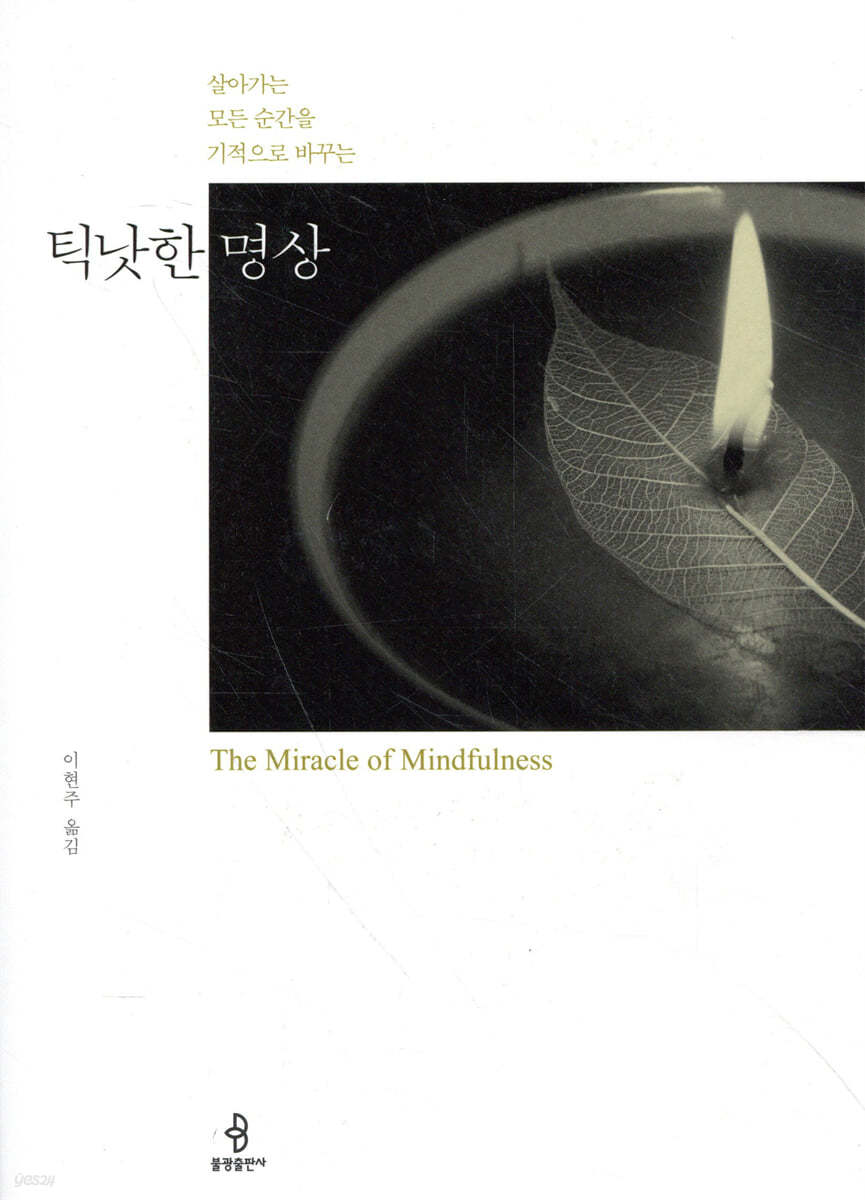
Thich Nhat Hanh's meditation on living fully in the present moment—eating, walking, and working.
A miracle is none other than ‘this very moment.’
We hope for miracles as we go through life.
Because we have a desire in our hearts for our lives to change dramatically.
So what exactly is a miracle? A miracle is none other than "this very moment."
Every step you take, the blue sky and white clouds, the dark eyes of a curious child, they are all miracles.
In this book, Thich Nhat Hanh introduces meditation that brightens our eyes and opens our hearts.
It guides us through various meditation techniques that can be easily practiced in our living spaces, rather than in special places where there is no one.
The monk advises us to focus on what we are doing and experience it as it is without any judgment.
When you eat an orange, you experience everything, including its taste and scent, the feeling of chewing it, and the reactions of your body.
The meditation that allows us to fully experience every moment of our lives is called 'mindfulness', and the monk says that mindfulness gives us the strength to live and a world worth living in.
This book is a compilation of letters written by the monk in 1974.
Even in the extreme circumstances of war, the youth volunteers were able to carry out their tasks quietly and peacefully.
This is why we should pay attention to Thich Nhat Hanh's message contained in this book.
A miracle is none other than ‘this very moment.’
We hope for miracles as we go through life.
Because we have a desire in our hearts for our lives to change dramatically.
So what exactly is a miracle? A miracle is none other than "this very moment."
Every step you take, the blue sky and white clouds, the dark eyes of a curious child, they are all miracles.
In this book, Thich Nhat Hanh introduces meditation that brightens our eyes and opens our hearts.
It guides us through various meditation techniques that can be easily practiced in our living spaces, rather than in special places where there is no one.
The monk advises us to focus on what we are doing and experience it as it is without any judgment.
When you eat an orange, you experience everything, including its taste and scent, the feeling of chewing it, and the reactions of your body.
The meditation that allows us to fully experience every moment of our lives is called 'mindfulness', and the monk says that mindfulness gives us the strength to live and a world worth living in.
This book is a compilation of letters written by the monk in 1974.
Even in the extreme circumstances of war, the youth volunteers were able to carry out their tasks quietly and peacefully.
This is why we should pay attention to Thich Nhat Hanh's message contained in this book.
- You can preview some of the book's contents.
Preview
index
Recommended articles
Chapter 1: Fundamental Practice
How to Free Yourself from Time
Dishes for washing dishes
The teacup in your hand
How to eat an orange
fundamental practice
Chapter 2: The Miracle of Walking on Earth
How to Live a Miracle-Filled Life
Sit down
Hold your breath
Follow the breath
Breathe quietly
Counting breaths
All actions are conscious
Chapter 3: A Day of Mindful Living
Mindfulness Day
morning
Lunch, afternoon, and night
Chapter 4 Pebbles
Sit and meditate
Become a pebble
Watch your heart
When you look at the heart with the heart
When the mind stays in the mind
Chapter 5: One is All, All is One
Viewing the universe from a table
Be free from pain
Riding the waves of life and death
Chapter 6: The Peach Tree in Your Yard
Three realities
The sound of the tide
Meditation reveals and heals
Self-care, world-care
The water becomes clearer, the grass becomes greener,
Chapter 7 Three Great Answers
The Emperor's Three Questions
Creating a world worth living in
Chapter 8: Mindfulness Practice
Translator's note
Chapter 1: Fundamental Practice
How to Free Yourself from Time
Dishes for washing dishes
The teacup in your hand
How to eat an orange
fundamental practice
Chapter 2: The Miracle of Walking on Earth
How to Live a Miracle-Filled Life
Sit down
Hold your breath
Follow the breath
Breathe quietly
Counting breaths
All actions are conscious
Chapter 3: A Day of Mindful Living
Mindfulness Day
morning
Lunch, afternoon, and night
Chapter 4 Pebbles
Sit and meditate
Become a pebble
Watch your heart
When you look at the heart with the heart
When the mind stays in the mind
Chapter 5: One is All, All is One
Viewing the universe from a table
Be free from pain
Riding the waves of life and death
Chapter 6: The Peach Tree in Your Yard
Three realities
The sound of the tide
Meditation reveals and heals
Self-care, world-care
The water becomes clearer, the grass becomes greener,
Chapter 7 Three Great Answers
The Emperor's Three Questions
Creating a world worth living in
Chapter 8: Mindfulness Practice
Translator's note
Publisher's Review
Recommended by Monk Jeongmok of Yuna Broadcasting!
A steady seller in the meditation field in the United States since its publication in 1976.
The Miracle of Mindfulness Korean Edition
Since the first Korean edition was published in 1995
It has been loved consistently and has conveyed true reflection and emotion.
Thich Nhat Hanh's representative meditation book
Living fully in this moment of eating, walking, and working
A book that contains everything about Thich Nhat Hanh's meditations.
We hope for miracles as we go through life.
Because we have a desire in our hearts for our lives to change dramatically.
So then, what exactly is a miracle?
The miracle is none other than ‘this moment’.
Every step you take, the blue sky and white clouds, the dark eyes of a curious child, they are all miracles.
Stop for a moment and think about them.
Doesn't your heart swell with excitement? The reason we usually fail to experience the wondrous world surrounding us is because distracting thoughts and worries block our eyes and hearts.
In this book, Thich Nhat Hanh introduces meditation that brightens our eyes and opens our hearts.
It guides us through various meditation techniques that can be easily practiced in our living spaces, rather than in special places where there is no one.
The monk advises us to focus on what we are doing and experience it as it is without any judgment.
When you eat an orange, you experience everything, including its taste and scent, the feeling of chewing it, and the reactions of your body.
The meditation that allows us to fully experience every moment of our lives is called 'mindfulness', and the monk says that mindfulness gives us the strength to live and a world worth living in.
The monk tells a story written by Tolstoy and talks about it.
The most important time is now,
The most important people are those who are by your side,
The most important thing is to make the people around you happy.
An emperor asks a hermit three questions and seeks answers.
“When is the best time to do anything?”, “Who is the most important person to work with?”, “What is the most important thing to do at all times?” When the hermit did not answer and just continued to plow the field, the emperor took the shovel from the hermit’s hand and plowed the field for him.
Then, a wounded man approaches the emperor and collapses unconscious.
The emperor carefully tends to the wounded man all night, revives him, and then falls asleep leaning against a pillar.
When he opened his eyes in the morning, the wounded man looked at the emperor and opened his mouth.
In fact, he came to take the emperor's life, but was attacked and wounded by the emperor's attendants, and instead, he asks for forgiveness, saying that he owes the emperor his life.
The emperor, who had forgiven the wounded man, again sought an answer from the hermit.
The hermit answers like this.
“If you had not taken pity on my old age and helped me to plough the fields, I would have been attacked by him on the way down.
Then you must have greatly regretted not being with me.
So the most important time was when you were working the field, the most important person was me, and the most important task was helping me.
When someone who was injured came here later, the most important time was when you washed his wounds.
If you hadn't done that, you wouldn't have been able to reconcile with your enemy.
Likewise, the most important person was him, and the most important thing was to take care of his wounds.
Remember, there is only one most important time in the world, and that time is now.
This moment is the only time we can write.
The most important person is always the one who is with you, the one who is right in front of you.
Who knows who you'll face in the future? And the most important thing is to make those around you happy.
“That is the only thing to pursue in life.”
In the tragic situation of war
So that Vietnamese youth can blossom with humanity
A book of letters that gave me strength
In the early 1970s, during the Vietnam War, young volunteers in South Vietnam were rebuilding bombed-out villages, teaching children, and providing medical care.
In 1974, while in exile in France, the Buddhist monk Thich Nhat Hanh sent a long letter to a South Vietnamese youth volunteer, urging him on the importance of a meditative life.
The most important thing is to love and help those around you, and only then can you contribute to creating a better world to live in. Meditation gives you the strength to do so.
In a kind and affectionate piece, the monk talks about how we can meditate while washing dishes, doing laundry, helping our children with their homework, eating, and walking down the street.
It is said that meditation, which is practiced in this way, saves us from anger and ignorance and leads us to live in the eternal peace and joy that resides within us.
That's how we change, and when we change, the world changes too.
In our desperate struggle to learn and gain more in order to survive, we not only lose ourselves, but also put other lives and the world at risk.
How can we break free from these shackles?
This book is a compilation of letters written by the monk in 1974.
Even in the extreme circumstances of war, the youth volunteers were able to carry out their tasks quietly and peacefully.
This is why we should pay attention to Thich Nhat Hanh's message contained in this book.
* The Miracle of Mindfulness was published in 1995 by Janggyeonggak as Waking Up from Life (translated by Yang Mi-seong) and in 2002 by Namusimneunsaram as Becoming One with It There (translated by Lee Hyeon-ju).
Thich Nhat Hanh's Meditations is a revised and supplemented version of the 2002 edition.
A steady seller in the meditation field in the United States since its publication in 1976.
The Miracle of Mindfulness Korean Edition
Since the first Korean edition was published in 1995
It has been loved consistently and has conveyed true reflection and emotion.
Thich Nhat Hanh's representative meditation book
Living fully in this moment of eating, walking, and working
A book that contains everything about Thich Nhat Hanh's meditations.
We hope for miracles as we go through life.
Because we have a desire in our hearts for our lives to change dramatically.
So then, what exactly is a miracle?
The miracle is none other than ‘this moment’.
Every step you take, the blue sky and white clouds, the dark eyes of a curious child, they are all miracles.
Stop for a moment and think about them.
Doesn't your heart swell with excitement? The reason we usually fail to experience the wondrous world surrounding us is because distracting thoughts and worries block our eyes and hearts.
In this book, Thich Nhat Hanh introduces meditation that brightens our eyes and opens our hearts.
It guides us through various meditation techniques that can be easily practiced in our living spaces, rather than in special places where there is no one.
The monk advises us to focus on what we are doing and experience it as it is without any judgment.
When you eat an orange, you experience everything, including its taste and scent, the feeling of chewing it, and the reactions of your body.
The meditation that allows us to fully experience every moment of our lives is called 'mindfulness', and the monk says that mindfulness gives us the strength to live and a world worth living in.
The monk tells a story written by Tolstoy and talks about it.
The most important time is now,
The most important people are those who are by your side,
The most important thing is to make the people around you happy.
An emperor asks a hermit three questions and seeks answers.
“When is the best time to do anything?”, “Who is the most important person to work with?”, “What is the most important thing to do at all times?” When the hermit did not answer and just continued to plow the field, the emperor took the shovel from the hermit’s hand and plowed the field for him.
Then, a wounded man approaches the emperor and collapses unconscious.
The emperor carefully tends to the wounded man all night, revives him, and then falls asleep leaning against a pillar.
When he opened his eyes in the morning, the wounded man looked at the emperor and opened his mouth.
In fact, he came to take the emperor's life, but was attacked and wounded by the emperor's attendants, and instead, he asks for forgiveness, saying that he owes the emperor his life.
The emperor, who had forgiven the wounded man, again sought an answer from the hermit.
The hermit answers like this.
“If you had not taken pity on my old age and helped me to plough the fields, I would have been attacked by him on the way down.
Then you must have greatly regretted not being with me.
So the most important time was when you were working the field, the most important person was me, and the most important task was helping me.
When someone who was injured came here later, the most important time was when you washed his wounds.
If you hadn't done that, you wouldn't have been able to reconcile with your enemy.
Likewise, the most important person was him, and the most important thing was to take care of his wounds.
Remember, there is only one most important time in the world, and that time is now.
This moment is the only time we can write.
The most important person is always the one who is with you, the one who is right in front of you.
Who knows who you'll face in the future? And the most important thing is to make those around you happy.
“That is the only thing to pursue in life.”
In the tragic situation of war
So that Vietnamese youth can blossom with humanity
A book of letters that gave me strength
In the early 1970s, during the Vietnam War, young volunteers in South Vietnam were rebuilding bombed-out villages, teaching children, and providing medical care.
In 1974, while in exile in France, the Buddhist monk Thich Nhat Hanh sent a long letter to a South Vietnamese youth volunteer, urging him on the importance of a meditative life.
The most important thing is to love and help those around you, and only then can you contribute to creating a better world to live in. Meditation gives you the strength to do so.
In a kind and affectionate piece, the monk talks about how we can meditate while washing dishes, doing laundry, helping our children with their homework, eating, and walking down the street.
It is said that meditation, which is practiced in this way, saves us from anger and ignorance and leads us to live in the eternal peace and joy that resides within us.
That's how we change, and when we change, the world changes too.
In our desperate struggle to learn and gain more in order to survive, we not only lose ourselves, but also put other lives and the world at risk.
How can we break free from these shackles?
This book is a compilation of letters written by the monk in 1974.
Even in the extreme circumstances of war, the youth volunteers were able to carry out their tasks quietly and peacefully.
This is why we should pay attention to Thich Nhat Hanh's message contained in this book.
* The Miracle of Mindfulness was published in 1995 by Janggyeonggak as Waking Up from Life (translated by Yang Mi-seong) and in 2002 by Namusimneunsaram as Becoming One with It There (translated by Lee Hyeon-ju).
Thich Nhat Hanh's Meditations is a revised and supplemented version of the 2002 edition.
GOODS SPECIFICS
- Date of publication: April 26, 2013
- Page count, weight, size: 160 pages | 225g | 143*200*20mm
- ISBN13: 9788974790271
- ISBN10: 8974790270
You may also like
카테고리
korean


korean

![GQ KOREA Mark (Monthly): December [2025]](http://librairie.coreenne.fr/cdn/shop/files/8ef265dbbfbf186523ed75ba7319009d.jpg?v=1765340328&width=3840)


