

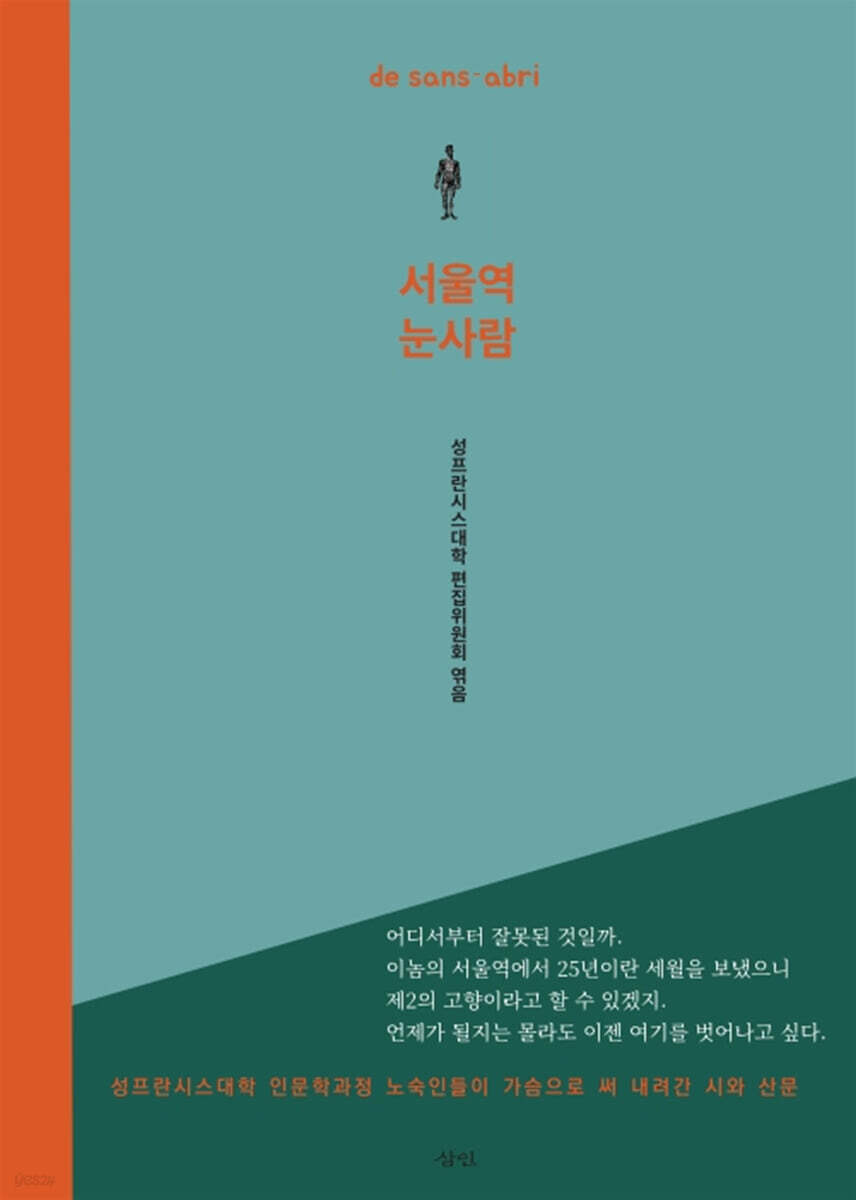
Seoul Station Snowman
 |
Description
Book Introduction
There are people who wander at the lowest point of their lives on the streets represented by Seoul Station.
But they picked up their pens again.
This book is a 20th-anniversary anthology of carefully selected poems, prose, and interviews written by homeless people and those who have experienced homelessness around Seoul Station during a year-long course at the University of St. Francis's Humanities program.
The writing that I had to choose in order not to give up on myself, those records are vividly alive in this book.
Literature is most powerful when it contains the truth of life itself, not flowery rhetoric.
The writings in this book speak a deeper truth than any literary work or reportage.
This is because it is not a record of an observer, but a record of those who directly experienced the cold reality.
The memory of defeat that lingers like a brand, the despair of the moment when all relationships were severed, and the memory of warmth and the small spark of hope that bloomed miraculously from the depths are all given form in poetry and prose.
This book vividly captures the voices of those who have endured the cold winds of the streets.
Some writings bring tears to our eyes, others bring back forgotten smiles, and still others raise weighty questions that our society must confront.
These living writings, born on the streets, in shelters, and in shantytowns, will strongly strike the hearts of readers.
But they picked up their pens again.
This book is a 20th-anniversary anthology of carefully selected poems, prose, and interviews written by homeless people and those who have experienced homelessness around Seoul Station during a year-long course at the University of St. Francis's Humanities program.
The writing that I had to choose in order not to give up on myself, those records are vividly alive in this book.
Literature is most powerful when it contains the truth of life itself, not flowery rhetoric.
The writings in this book speak a deeper truth than any literary work or reportage.
This is because it is not a record of an observer, but a record of those who directly experienced the cold reality.
The memory of defeat that lingers like a brand, the despair of the moment when all relationships were severed, and the memory of warmth and the small spark of hope that bloomed miraculously from the depths are all given form in poetry and prose.
This book vividly captures the voices of those who have endured the cold winds of the streets.
Some writings bring tears to our eyes, others bring back forgotten smiles, and still others raise weighty questions that our society must confront.
These living writings, born on the streets, in shelters, and in shantytowns, will strongly strike the hearts of readers.
index
Congratulatory Message _ "Seoul Station Snowman," I am a Dignified Human Being (Bishop Kim Seong-su)
Acknowledgments: There Are No Second-Rate Lives (President Kwak No-Hyeon)
Publisher's Note: Humanities Teachers, You've Been Totally Fooled (St. Francis University Editorial Board)
Part 1: Gaori's Star Song
Part 2: Who is there?
1. Prison of Relationships
2. Father's back
3. Naedong Yangban and Naedong House
Part 3: The Power of Cleaning
1. Spring, summer, fall, winter
2. Auditory hallucinations
3. Evening snow
4. It's salty
Part 4: Seoul Station Snowman
1. Breathing sound
2. I hate humanities
Part 5: Build Together
Part 6 Character Interviews
Blooming with the writing and drawings of the 7th Street
Acknowledgments: There Are No Second-Rate Lives (President Kwak No-Hyeon)
Publisher's Note: Humanities Teachers, You've Been Totally Fooled (St. Francis University Editorial Board)
Part 1: Gaori's Star Song
Part 2: Who is there?
1. Prison of Relationships
2. Father's back
3. Naedong Yangban and Naedong House
Part 3: The Power of Cleaning
1. Spring, summer, fall, winter
2. Auditory hallucinations
3. Evening snow
4. It's salty
Part 4: Seoul Station Snowman
1. Breathing sound
2. I hate humanities
Part 5: Build Together
Part 6 Character Interviews
Blooming with the writing and drawings of the 7th Street
Into the book
Over the years, countless friends have knocked on the doors of this university.
Some have spent years on the streets, while others have lost their way, worn down by the weight of life.
But through reading and writing here, laughing and crying together, and discussing, we became human again.
This university did not grant degrees, but it offered a precious gift that no one could easily obtain.
It was a bold declaration: “I am still a dignified human being.”
The recently published collection of essays, “Seoul Station Snowman,” is further evidence of that declaration.
This book vividly captures the voices of those who have endured the cold winds of the streets.
Some writings bring tears to our eyes, others bring back forgotten smiles, and still others raise weighty questions that our society must confront.
--- pp.4-5 From "Seoul Station Snowman - I am a Dignified Human"
Snowmen are fragile creatures that melt and disappear quickly, but that is what makes them all the more beautiful.
On a winter night at Seoul Station, a snowman standing on the cold stone floor symbolizes human dignity in itself.
The same goes for the articles in this book.
It may seem like a record of a moment, but within it lies an undying light of hope.
Instead of using flowery rhetoric, the writers pressed the truth of life into writing, and that truth shakes our hearts and ultimately makes us reflect on ourselves.
--- p.5 From “Seoul Station Snowman - I am a dignified human being”
Each of the articles grouped here are written by people who have experienced homelessness, far from being professional writers.
There are some spelling mistakes, but I left it as is because it is more vivid.
Yet, it has the magic to draw you in and make you read it to the end no matter where you open it.
Readers will occasionally find themselves moved from the depths of their hearts and brought to tears.
When faced with the many psalms and short passages, one cannot help but marvel at how well they can be written.
It's hard to believe that these are the writings of people who haven't taken literature classes or received any writing training.
Among the writings included in 『Seoul Station Snowman』, there is not a single dead piece that was written while groaning at the desk.
These are vivid words that burst out into lifelike writing when vivid scenes that are engraved in the authors' hearts meet the letters.
--- p.8 From “There is no second-rate life anywhere”
"Seoul Station Snowman" is a collection of writings by people who once slept on the streets around Seoul Station, written in their spare time while studying humanities.
"Why would a homeless person study the humanities? If you're going to learn, you should learn skills that will help you make a living right away." This is a question I've heard countless times.
But the order was wrong.
No matter how much skill an athlete learns without physical strength, it is useless.
A homeless person is someone who has lost all of their mental and emotional stamina and the will to live.
So, to stand up again (self-reliance), more than anything, you need the strength to have the will to live.
This strength begins with the self-respect of self-existence, the belief that 'I, my life is precious.'
--- p.12 From “Humanities Teachers, I Was Totally Fooled”
The St. Francis Humanities Program begins with ‘encounter.’
Meetings between professors, students, practitioners, volunteers, and alumni.
Through this meeting, we seek to restore the broken relationships between people and humanity.
The humanities, including literature, history, and philosophy, are an exploration of the infinite breadth and depth between people.
For homeless teachers, humanities is not knowledge to be understood with the head, but wisdom to be accepted with the heart.
Even abstract concepts in difficult texts are accepted as life wisdom through reflection and introspection by contrasting and contrasting them with one's own specific experiences.
The St. Francis Humanities Program is where humanities, confined to schools and texts, descends into street life and becomes anthropology.
Through human encounters and exploration, the dislocated bones of the homeless teachers gradually find their place and begin to gain flesh.
However, this does not mean that a torn cruciate ligament will reattach immediately.
To reattach, you must first find the ligament that has been torn and sprained.
You have to go down to the floor you fell on.
You have to go down and face yourself, broken and scattered.
This honest and solitary confrontation is writing.
Some have spent years on the streets, while others have lost their way, worn down by the weight of life.
But through reading and writing here, laughing and crying together, and discussing, we became human again.
This university did not grant degrees, but it offered a precious gift that no one could easily obtain.
It was a bold declaration: “I am still a dignified human being.”
The recently published collection of essays, “Seoul Station Snowman,” is further evidence of that declaration.
This book vividly captures the voices of those who have endured the cold winds of the streets.
Some writings bring tears to our eyes, others bring back forgotten smiles, and still others raise weighty questions that our society must confront.
--- pp.4-5 From "Seoul Station Snowman - I am a Dignified Human"
Snowmen are fragile creatures that melt and disappear quickly, but that is what makes them all the more beautiful.
On a winter night at Seoul Station, a snowman standing on the cold stone floor symbolizes human dignity in itself.
The same goes for the articles in this book.
It may seem like a record of a moment, but within it lies an undying light of hope.
Instead of using flowery rhetoric, the writers pressed the truth of life into writing, and that truth shakes our hearts and ultimately makes us reflect on ourselves.
--- p.5 From “Seoul Station Snowman - I am a dignified human being”
Each of the articles grouped here are written by people who have experienced homelessness, far from being professional writers.
There are some spelling mistakes, but I left it as is because it is more vivid.
Yet, it has the magic to draw you in and make you read it to the end no matter where you open it.
Readers will occasionally find themselves moved from the depths of their hearts and brought to tears.
When faced with the many psalms and short passages, one cannot help but marvel at how well they can be written.
It's hard to believe that these are the writings of people who haven't taken literature classes or received any writing training.
Among the writings included in 『Seoul Station Snowman』, there is not a single dead piece that was written while groaning at the desk.
These are vivid words that burst out into lifelike writing when vivid scenes that are engraved in the authors' hearts meet the letters.
--- p.8 From “There is no second-rate life anywhere”
"Seoul Station Snowman" is a collection of writings by people who once slept on the streets around Seoul Station, written in their spare time while studying humanities.
"Why would a homeless person study the humanities? If you're going to learn, you should learn skills that will help you make a living right away." This is a question I've heard countless times.
But the order was wrong.
No matter how much skill an athlete learns without physical strength, it is useless.
A homeless person is someone who has lost all of their mental and emotional stamina and the will to live.
So, to stand up again (self-reliance), more than anything, you need the strength to have the will to live.
This strength begins with the self-respect of self-existence, the belief that 'I, my life is precious.'
--- p.12 From “Humanities Teachers, I Was Totally Fooled”
The St. Francis Humanities Program begins with ‘encounter.’
Meetings between professors, students, practitioners, volunteers, and alumni.
Through this meeting, we seek to restore the broken relationships between people and humanity.
The humanities, including literature, history, and philosophy, are an exploration of the infinite breadth and depth between people.
For homeless teachers, humanities is not knowledge to be understood with the head, but wisdom to be accepted with the heart.
Even abstract concepts in difficult texts are accepted as life wisdom through reflection and introspection by contrasting and contrasting them with one's own specific experiences.
The St. Francis Humanities Program is where humanities, confined to schools and texts, descends into street life and becomes anthropology.
Through human encounters and exploration, the dislocated bones of the homeless teachers gradually find their place and begin to gain flesh.
However, this does not mean that a torn cruciate ligament will reattach immediately.
To reattach, you must first find the ligament that has been torn and sprained.
You have to go down to the floor you fell on.
You have to go down and face yourself, broken and scattered.
This honest and solitary confrontation is writing.
--- p.12 From “Humanities Teachers, I Was Totally Fooled”
Publisher's Review
The Process of Humanities Becoming Anthropology, the Humanities Program at the University of St. Francis
The cruciate ligament that most firmly holds our self-esteem as humans is the home, the core of human relationships.
A homeless person is someone whose cruciate ligament, called family, has been severed.
When your knees give out and your self-esteem plummets to the floor, the horizontal relationships such as 'friends, neighbors, work, and society' begin to fall apart in a chain reaction.
Street homelessness is a phenomenon in which all vertical and horizontal relationships are severed, the will to live is drained, and the entire body is dislocated.
The humanities program at St. Francis University begins with ‘encounter.’
Meetings between professors, students, practitioners, volunteers, and alumni.
Through this meeting, we seek to restore the broken relationships between people and humanity.
The humanities, including literature, history, and philosophy, are an exploration of the infinite breadth and depth between people.
For homeless teachers, humanities is not knowledge to be understood with the head, but wisdom to be accepted with the heart.
Even abstract concepts in difficult texts are accepted as life wisdom through reflection and introspection by contrasting and contrasting them with one's own concrete experiences.
The humanities program at the University of St. Francis is where the humanities, confined to schools and texts, descend into street life and become anthropology.
Through human encounters and exploration, the homeless teachers' shattered self-esteem and will to live slowly find their place and begin to gain strength.
However, this does not mean that a torn cruciate ligament will reattach immediately.
To reattach, you must first find the ligament that has been torn and sprained.
You have to go down to the floor you fell on.
You have to go down and face yourself, broken and scattered.
This honest and solitary confrontation is writing.
Writing that reestablishes existence, a record of that recovery.
Homelessness is not just a loss of housing.
It is a total disconnection, where family, society, dreams, and human connections are all severed at once.
What is needed to rise again from that despair is not a job or job training to solve the immediate problem of making a living, but rather the mental strength to hold on to the will to live.
Unless this mental strength is restored, we will not be able to escape the cycle of leaving for a while and then returning again depending on the situation.
This book is a record of that recovery.
The essays written over the course of a year of humanities classes illustrate the process of recovery through each part of this book.
In Part 1, “Gaori’s Star Song,” we recall the times when we were poor but loved, and the presence of family and friends who supported us.
In the midst of a crumbling reality, I rediscover warm memories and express my gratitude, regret, and longing for those times in words.
Part 2, “No One Is There,” is about distorted relationships, pain and loss, self-reproach and anger.
By facing the dark room of your life that you most wanted to avoid, you face your wounds and write them down.
Part 3, “The Power of Cleaning,” is a reflection on the small daily tasks such as doing laundry and organizing the room.
I am recording reality in a calm manner, as if shaking off old emotions and drying them in the sunny sky.
Part 4, “Seoul Station Snowman,” tells the story of Seoul Station, the workplace, home, school, and playground of homeless teachers.
It is not the soliloquy of people passing through the central station of the Republic of Korea, but of people who live here, and the sound of breathing coming from the floor that says, 'People live here.'
It is also a declaration of existence that says, 'Although we are as fragile as a snowman, there is beauty in that fragility as a human being.'
Part 5 "Building Together" This is a poetry tower that was built together, not alone, by the classmates who took the class together, writing line by line.
Part 6, “Character Interview,” is a conversation in the form of an interview with five homeless teachers, one from each class.
This is a five-part human theater that truly listens to their stories.
Part 7, “Words that Sprout from the Streets, Blossoming into Pictures,” is a collection of writings from the 1st to 15th classes of the St. Francis Humanities program in 2020. It features a selection of works from the book “A Poem, a Bundle of Writings that Bloomed on the Streets,” which was published in 2020. Five artists from the Korean Federation of Arts and Culture Education and alumni drew illustrations. It also features some of the works from the poetry and painting exhibition titled “Words that Sprout from the Streets, Blossoming into Pictures” held at the National Assembly Members’ Hall from September 26 to 30, 2022.
A small miracle created by 'comments', courage
Aside from being a collection of diverse writings by people who were once homeless, what sets this book apart from existing anthologies is that it includes the comments attached to each piece.
The comments from fellow students, volunteers, and professors on the late-night or early-morning, drunkenly posted articles on each rider's cafe must have been like hangover soup on an empty stomach when I woke up.
Homeless teachers who existed but were invisible, who had no one to talk to or listen to, and who were silent, and thus lost their voices.
Those who had never written a proper piece before found the courage to speak out because, for the first time, someone was willing to listen to their stories.
Because we made eye contact with comments and replies.
Between the text and the comments, a stepping stone of the mind was placed, and the tendons in my knees, which had been loose from walking back and forth, began to grow.
This book contains vivid footage of that scene.
By reading the comments and replies below the work, you can gain a deeper understanding of the work and feel the author's human voice.
The cruciate ligament that most firmly holds our self-esteem as humans is the home, the core of human relationships.
A homeless person is someone whose cruciate ligament, called family, has been severed.
When your knees give out and your self-esteem plummets to the floor, the horizontal relationships such as 'friends, neighbors, work, and society' begin to fall apart in a chain reaction.
Street homelessness is a phenomenon in which all vertical and horizontal relationships are severed, the will to live is drained, and the entire body is dislocated.
The humanities program at St. Francis University begins with ‘encounter.’
Meetings between professors, students, practitioners, volunteers, and alumni.
Through this meeting, we seek to restore the broken relationships between people and humanity.
The humanities, including literature, history, and philosophy, are an exploration of the infinite breadth and depth between people.
For homeless teachers, humanities is not knowledge to be understood with the head, but wisdom to be accepted with the heart.
Even abstract concepts in difficult texts are accepted as life wisdom through reflection and introspection by contrasting and contrasting them with one's own concrete experiences.
The humanities program at the University of St. Francis is where the humanities, confined to schools and texts, descend into street life and become anthropology.
Through human encounters and exploration, the homeless teachers' shattered self-esteem and will to live slowly find their place and begin to gain strength.
However, this does not mean that a torn cruciate ligament will reattach immediately.
To reattach, you must first find the ligament that has been torn and sprained.
You have to go down to the floor you fell on.
You have to go down and face yourself, broken and scattered.
This honest and solitary confrontation is writing.
Writing that reestablishes existence, a record of that recovery.
Homelessness is not just a loss of housing.
It is a total disconnection, where family, society, dreams, and human connections are all severed at once.
What is needed to rise again from that despair is not a job or job training to solve the immediate problem of making a living, but rather the mental strength to hold on to the will to live.
Unless this mental strength is restored, we will not be able to escape the cycle of leaving for a while and then returning again depending on the situation.
This book is a record of that recovery.
The essays written over the course of a year of humanities classes illustrate the process of recovery through each part of this book.
In Part 1, “Gaori’s Star Song,” we recall the times when we were poor but loved, and the presence of family and friends who supported us.
In the midst of a crumbling reality, I rediscover warm memories and express my gratitude, regret, and longing for those times in words.
Part 2, “No One Is There,” is about distorted relationships, pain and loss, self-reproach and anger.
By facing the dark room of your life that you most wanted to avoid, you face your wounds and write them down.
Part 3, “The Power of Cleaning,” is a reflection on the small daily tasks such as doing laundry and organizing the room.
I am recording reality in a calm manner, as if shaking off old emotions and drying them in the sunny sky.
Part 4, “Seoul Station Snowman,” tells the story of Seoul Station, the workplace, home, school, and playground of homeless teachers.
It is not the soliloquy of people passing through the central station of the Republic of Korea, but of people who live here, and the sound of breathing coming from the floor that says, 'People live here.'
It is also a declaration of existence that says, 'Although we are as fragile as a snowman, there is beauty in that fragility as a human being.'
Part 5 "Building Together" This is a poetry tower that was built together, not alone, by the classmates who took the class together, writing line by line.
Part 6, “Character Interview,” is a conversation in the form of an interview with five homeless teachers, one from each class.
This is a five-part human theater that truly listens to their stories.
Part 7, “Words that Sprout from the Streets, Blossoming into Pictures,” is a collection of writings from the 1st to 15th classes of the St. Francis Humanities program in 2020. It features a selection of works from the book “A Poem, a Bundle of Writings that Bloomed on the Streets,” which was published in 2020. Five artists from the Korean Federation of Arts and Culture Education and alumni drew illustrations. It also features some of the works from the poetry and painting exhibition titled “Words that Sprout from the Streets, Blossoming into Pictures” held at the National Assembly Members’ Hall from September 26 to 30, 2022.
A small miracle created by 'comments', courage
Aside from being a collection of diverse writings by people who were once homeless, what sets this book apart from existing anthologies is that it includes the comments attached to each piece.
The comments from fellow students, volunteers, and professors on the late-night or early-morning, drunkenly posted articles on each rider's cafe must have been like hangover soup on an empty stomach when I woke up.
Homeless teachers who existed but were invisible, who had no one to talk to or listen to, and who were silent, and thus lost their voices.
Those who had never written a proper piece before found the courage to speak out because, for the first time, someone was willing to listen to their stories.
Because we made eye contact with comments and replies.
Between the text and the comments, a stepping stone of the mind was placed, and the tendons in my knees, which had been loose from walking back and forth, began to grow.
This book contains vivid footage of that scene.
By reading the comments and replies below the work, you can gain a deeper understanding of the work and feel the author's human voice.
GOODS SPECIFICS
- Date of issue: October 31, 2025
- Page count, weight, size: 260 pages | 128*188*20mm
- ISBN13: 9788964362907
- ISBN10: 896436290X
You may also like
카테고리
korean


korean

![GQ KOREA Mark (Monthly): December [2025]](http://librairie.coreenne.fr/cdn/shop/files/8ef265dbbfbf186523ed75ba7319009d.jpg?v=1765340328&width=3840)


