

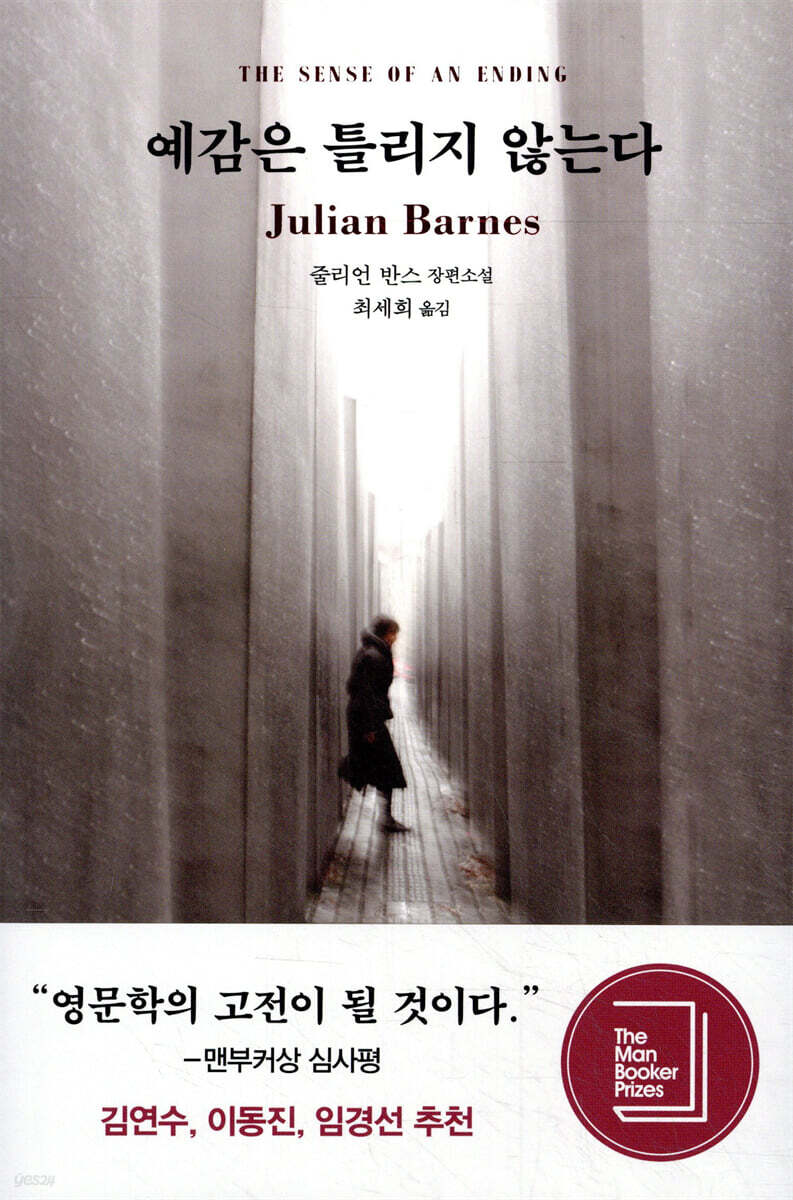
Premonitions are never wrong
 |
Description
Book Introduction
2011 Commonwealth Literary Award
Man Booker Prize winner!
The latest work by Julian Barnes, the king of British literature!
The Times, Guardian, Telegraph, UK and US Amazon, Independent,
Selected as Book of the Year by 23 major media outlets, including the Observer and the Herald.
A mixture of heart-wrenching, cool insight and intelligent wit.
A brilliant masterpiece of English literature!
The 2011 Man Booker Prize final round was reminiscent of a spy war.
What on earth happened in British literature?
“There was absolutely no blood on the carpet.
There was no one who left their seat grumbling.
We all became friends and were happy with the outcome.”
_Stella Rimington (Chairperson of the Man Booker Prize judges)
novelist.
Former Director of MI5 (British Domestic Intelligence Service)
On the evening of October 18, 2011, the eyes and ears of all British people were focused on one place.
It was the moment when the Man Booker Prize, the Commonwealth's highest literary award, was announced.
The winner is Julian Barnes, the king of British novels, whose latest work is "The Sense of an Ending."
Along with that, all the noise surrounding the Man Booker Prize in the British literary world in 2011 almost disappeared at once.
What on earth happened around the 2011 Booker Prize?
The story began in September 2011, when the Man Booker Prize judges chair, novelist and former MI5 chief Stella Rimington, announced the six finalists from a preliminary selection of 13, declaring that this year's judging criteria would be "readability."
“We’re looking for books that are enjoyable, books that are readable,” Rimington said.
We hope that readers will buy these books and read them for themselves.
“I don’t buy it, I just worship it,” he added.
Then a swarm of writers, critics, and literary agents rose up.
Andrew Motion, the poet and chair of last year's jury, criticized this year's jury for "simplifying" literature and "creating a false distinction between high literature and readable books."
Novelist Jeannette Winterson wrote in her Guardian column, “There are plenty of entertaining reads out there for the enjoyment of everyday life.
But they cannot be called literature.
(For it to become literature) it must pass one test.
He published an article titled, “Can the linguistic ability of a writer truly broaden the reader’s thoughts and senses?”
This controversy persisted for some time, and even led to several British and American novelists and literary agents getting together to announce the establishment of a new literary award.
A week before the Man Booker Prize winner was announced, a group of novelists and literary agents, including John Banville, Nicholas Krauss, and David Mitchell, announced the creation of a new literary prize to rival the Man Booker Prize.
The new literary prize, called 'The Literature Prize', is not limited to Commonwealth novels like the Man Booker Prize, but is open to 'any novel written in English and published in the UK within the past year', including American ones.
Meanwhile, the counterattack was not easy.
Novelist Graham Joyce responded, “If literature is to change what people want, it must first come down from the mountain and talk to them.” Ian Trewin, director of the Booker Prize, the sponsors of the prize, said, “From the time it was founded (in 1969) to the present, the motto has been the same:
“It’s about selecting the best work in the eyes of the judges,” he said.
But all this noise was put to rest when “The Premonition is Never Wrong” was selected as the winner.
Mark Brown, a journalist for The Guardian, expressed his unanimity about his award, saying, "No critic could argue that Barnes's novels are not excellent."
The right-wing Telegraph also agreed with the left-wing Guardian.
Anita Singh, a journalist at The Telegraph, reported that “the judges unanimously agreed on the winner just 31 minutes after the main judging began,” and Gaby Woo, a senior editor at The Telegraph and one of the 2011 Man Booker Prize judges, said:
“I am deeply delighted that the award has gone to Barnes and am delighted to say that this will be a monumental moment in British literary history,” he said in a statement.
Man Booker Prize winner!
The latest work by Julian Barnes, the king of British literature!
The Times, Guardian, Telegraph, UK and US Amazon, Independent,
Selected as Book of the Year by 23 major media outlets, including the Observer and the Herald.
A mixture of heart-wrenching, cool insight and intelligent wit.
A brilliant masterpiece of English literature!
The 2011 Man Booker Prize final round was reminiscent of a spy war.
What on earth happened in British literature?
“There was absolutely no blood on the carpet.
There was no one who left their seat grumbling.
We all became friends and were happy with the outcome.”
_Stella Rimington (Chairperson of the Man Booker Prize judges)
novelist.
Former Director of MI5 (British Domestic Intelligence Service)
On the evening of October 18, 2011, the eyes and ears of all British people were focused on one place.
It was the moment when the Man Booker Prize, the Commonwealth's highest literary award, was announced.
The winner is Julian Barnes, the king of British novels, whose latest work is "The Sense of an Ending."
Along with that, all the noise surrounding the Man Booker Prize in the British literary world in 2011 almost disappeared at once.
What on earth happened around the 2011 Booker Prize?
The story began in September 2011, when the Man Booker Prize judges chair, novelist and former MI5 chief Stella Rimington, announced the six finalists from a preliminary selection of 13, declaring that this year's judging criteria would be "readability."
“We’re looking for books that are enjoyable, books that are readable,” Rimington said.
We hope that readers will buy these books and read them for themselves.
“I don’t buy it, I just worship it,” he added.
Then a swarm of writers, critics, and literary agents rose up.
Andrew Motion, the poet and chair of last year's jury, criticized this year's jury for "simplifying" literature and "creating a false distinction between high literature and readable books."
Novelist Jeannette Winterson wrote in her Guardian column, “There are plenty of entertaining reads out there for the enjoyment of everyday life.
But they cannot be called literature.
(For it to become literature) it must pass one test.
He published an article titled, “Can the linguistic ability of a writer truly broaden the reader’s thoughts and senses?”
This controversy persisted for some time, and even led to several British and American novelists and literary agents getting together to announce the establishment of a new literary award.
A week before the Man Booker Prize winner was announced, a group of novelists and literary agents, including John Banville, Nicholas Krauss, and David Mitchell, announced the creation of a new literary prize to rival the Man Booker Prize.
The new literary prize, called 'The Literature Prize', is not limited to Commonwealth novels like the Man Booker Prize, but is open to 'any novel written in English and published in the UK within the past year', including American ones.
Meanwhile, the counterattack was not easy.
Novelist Graham Joyce responded, “If literature is to change what people want, it must first come down from the mountain and talk to them.” Ian Trewin, director of the Booker Prize, the sponsors of the prize, said, “From the time it was founded (in 1969) to the present, the motto has been the same:
“It’s about selecting the best work in the eyes of the judges,” he said.
But all this noise was put to rest when “The Premonition is Never Wrong” was selected as the winner.
Mark Brown, a journalist for The Guardian, expressed his unanimity about his award, saying, "No critic could argue that Barnes's novels are not excellent."
The right-wing Telegraph also agreed with the left-wing Guardian.
Anita Singh, a journalist at The Telegraph, reported that “the judges unanimously agreed on the winner just 31 minutes after the main judging began,” and Gaby Woo, a senior editor at The Telegraph and one of the 2011 Man Booker Prize judges, said:
“I am deeply delighted that the award has gone to Barnes and am delighted to say that this will be a monumental moment in British literary history,” he said in a statement.
index
Part 1
Part 2
Translator's Note
Part 2
Translator's Note
Into the book
“At first glance, it might seem like we could start with a simple question.
What is history, you say?
“Does anything come to mind, Webster?”
“History is a lie told by the victors.” My answer came out rather quickly.
“Yeah, I was a little worried you might say that.
“Do you remember that that’s also the self-deception of losers, Simpson?”
---p.33
"In fact, isn't shifting responsibility a complete evasion? We want to blame one individual, so we can all get a pardon.
Otherwise, blame the unfolding of history to pardon the individual.
Or even if it's all due to the anarchic chaos, the result is the same.
I think there is a chain of personal responsibility going on, both now and then.
“Each link in that chain of responsibility may have been inevitable, but that doesn’t mean the chain is so long that everyone can blame everyone else without a second thought.”
---p.26
“Don’t give Veronica too much.”
I didn't know what to say in response.
Should I express my displeasure at this interference in our relationship?
Or should I throw myself into the atmosphere of confession and 'discuss' the Veronica problem?
I responded with a slightly harsh tone.
“Mother, what do you mean?”
---p.256
It was obvious that he wanted to end the conversation at that point, but I was persistent.
“So what do you think about that person?”
Adrian was silent for a moment.
After taking a sip of beer, he suddenly spoke fiercely.
“I hate how the British are not serious when they should be.
“I really hate it.”
---p.61
Margaret used to say there are two kinds of women.
A woman who is clear about everything and a woman who leaves a mystery behind.
And this is the first thing a man senses when he sees a woman, and the first thing that attracts him or not.
---p.116
I think maybe this is the difference between young people and old people.
When you're young, you dream up your own future, and when you get older, you dream up other people's pasts.
---p.141
I left the message in my inbox and reread it from time to time.
If you are not cremated and buried in the mountains after death, it would be a phrase that could be used as an epitaph on a stone or marble tombstone.
'Tony Webster, I have no idea.' But it was so sentimental, even self-pitying.
How about "Now he's alone"? That sounds better.
It feels more real.
Or maybe you'll stick to 'every day is Sunday'.
What is history, you say?
“Does anything come to mind, Webster?”
“History is a lie told by the victors.” My answer came out rather quickly.
“Yeah, I was a little worried you might say that.
“Do you remember that that’s also the self-deception of losers, Simpson?”
---p.33
"In fact, isn't shifting responsibility a complete evasion? We want to blame one individual, so we can all get a pardon.
Otherwise, blame the unfolding of history to pardon the individual.
Or even if it's all due to the anarchic chaos, the result is the same.
I think there is a chain of personal responsibility going on, both now and then.
“Each link in that chain of responsibility may have been inevitable, but that doesn’t mean the chain is so long that everyone can blame everyone else without a second thought.”
---p.26
“Don’t give Veronica too much.”
I didn't know what to say in response.
Should I express my displeasure at this interference in our relationship?
Or should I throw myself into the atmosphere of confession and 'discuss' the Veronica problem?
I responded with a slightly harsh tone.
“Mother, what do you mean?”
---p.256
It was obvious that he wanted to end the conversation at that point, but I was persistent.
“So what do you think about that person?”
Adrian was silent for a moment.
After taking a sip of beer, he suddenly spoke fiercely.
“I hate how the British are not serious when they should be.
“I really hate it.”
---p.61
Margaret used to say there are two kinds of women.
A woman who is clear about everything and a woman who leaves a mystery behind.
And this is the first thing a man senses when he sees a woman, and the first thing that attracts him or not.
---p.116
I think maybe this is the difference between young people and old people.
When you're young, you dream up your own future, and when you get older, you dream up other people's pasts.
---p.141
I left the message in my inbox and reread it from time to time.
If you are not cremated and buried in the mountains after death, it would be a phrase that could be used as an epitaph on a stone or marble tombstone.
'Tony Webster, I have no idea.' But it was so sentimental, even self-pitying.
How about "Now he's alone"? That sounds better.
It feels more real.
Or maybe you'll stick to 'every day is Sunday'.
---p.247
Publisher's Review
The uncrowned emperor, who suffered defeat three times, finally ascends the throne.
“2011 is the year of Philip Roth and Julian Barnes.”
Claire Armistead (Literature Editor, The Guardian)
Julian Barnes' award has a special meaning for the author himself.
He was nominated 28 years ago in 1984 for Flaubert's Parrot, but lost to Anita Bruckner's Hotel du Lac. He was nominated a second time in 1998 for England, England, but this time he lost to Ian McEwan's Amsterdam.
In 2005, his third nomination for Arthur and George was against John Banville's And the Gods Went to Sea, but this time too he lost.
The Guardian's Claire Armistead recalled, 'I don't think anyone was more nervous than Julian Barnes at the awards ceremony that day (when Barnes was nominated for his third Booker Prize).'
The author, who is a representative British novelist who has swept major European literary awards and medals, but has been the uncrowned king of awards representing English literature, has not hidden his bitter feelings.
Before winning the prize, he sarcastically described the Booker Prize as a "luxurious bingo game."
And finally, on the day he won the award after being nominated for the fourth time, he expressed his feelings as follows.
“Yes, I was actually relieved because this was my fourth time being nominated.
“Because I didn’t want to accept the 2011 special prize, which was established in memory of the British novelist Beryl Bainbridge, who was nominated for the Booker Prize five times after she passed away, but never won.”
He also humorously mentioned in his acceptance speech the story of Jorge Luis Borges, the great novelist who, like him, had repeatedly been defeated for the Nobel Prize in Literature.
When asked why he didn't seem to win awards, Borges would reply:
"Because somewhere in the world, there's a cottage industry formed to block my award." Over the years, whenever my fantasies occasionally flared, I couldn't help but suspect that somewhere, somewhere, there might be a similarly evil organization."
The ending of the story you had a feeling would come but couldn't accept is coming!
In the end, what you remember is what you actually saw and always
It's not the same.
_Page 11 of the text
The novel begins with the story of four boys who meet in high school in the 1960s.
The first-person narrator is the protagonist Tony Webster, his gang of friends Alex and Colin, and the bright and intelligent transfer student Adrian Finn.
The three boys admire him, and all the teachers at school take note of Adrian's exceptional intellect and unique perspective, which is like a guiding light in a circle.
Tony goes to Bristol University and Adrian goes to Cambridge on a scholarship.
The late 1960s were a time of uproar, cultural movements, and sexual liberation.
However, that energy had not yet reached the college students at the time.
Dating was still old-fashioned, and girlfriends wouldn't give themselves to each other until marriage and a future were promised.
Tony, who is dating a girl named Veronica, visits her house and is intimidated by the class gap.
And then we get some strangely suggestive advice from Veronica's mother: "Don't give her too much."
Tony and Veronica, unable to overcome their sexual dissatisfaction and complexes, eventually break up, and one day, a letter arrives to Tony from Adrian, saying that he is dating Veronica.
Tony believes he has forgotten about the incident after sending a short letter to the two condoning their relationship, but in fact, that was not the only letter.
After a long trip to the United States, Tony hears from a friend that Adrian committed suicide by slitting his arteries.
Forty years have passed, and now Tony, now in his sixties, receives a will out of nowhere.
Veronica's mother, Mrs. Sarah Ford, left him Adrian's diary as a keepsake along with five hundred pounds.
However, Adrian's diary is currently in Veronica's possession, and she refuses to give it to Tony.
Why on earth did Mrs. Ford come into possession of Adrian's diary, and why did she leave it with Tony? And what is the significance of the five hundred pounds Veronica refers to as "blood money"?
Tony sets out to meet Veronica to uncover all of this.
And then he encounters another letter he had sent over 40 years ago, and the great tragedy it had brought about.
Memories betray us, and illusions lead us to happiness…
A thriller of memory and ethics!
Who are you? If you're not who you think you are?
What if it never happened?_San Francisco Chronicle
Major English-speaking media outlets and critics, such as The Independent and The Times, introduced "The Sense of a Premonition" by calling it a "psychological thriller" about memory and ethics.
This short novel, which is only about 150 pages long, has the power to captivate readers, the suspense, and the delicate and sophisticated composition.
Moreover, at the end, perhaps the most devastating twist since Oedipus the King awaits the reader.
It's not just a genre novel with the question "Who is the culprit?", but one that has the weight of shaking the very foundation of existence and the entire life lived.
Critics and journalists have also said that Barnes' latest work rivals Henry James's The Turn of the Screw, a novella of similar length, in terms of its novelistic perfection and the weight of its tragic themes.
It relies on the imperfect and unreliable first-person narrator's perspective to explore the distortions of human memory and perspective, and delivers a profound resonance when the truth finally emerges.
The protagonist, Tony Webster, is one of the most unreliable protagonists in literary history.
He misinterprets the people around him and distorts their meaning for the reader because of a single unpleasant impression that passes through his mind, or a single shadow of doubt that suddenly enters his mind.
Because of this, about halfway through the novel, the reader cannot fully trust Tony Webster's perspective and cannot help but interpret the hidden meaning between the lines from an independent and objective perspective.
And as I close the last page and contemplate his fate, I cannot help but feel pity and comfort for 'most lives', so flawed and yet so like our own.
The theme of this work, 'distorted memory', is also a topic that Julian Barnes addressed in his non-fiction book 'Nothing to Fear', when he talked about his difficult relationship with his older brother, the philosopher Jonathan Barnes.
The author's reflection begins when, in response to the teacher's question of what history is, Adrian quotes Lagrange (a fictional historian in the author's novel) and answers, "History is the certainty that arises where inaccurate memory meets insufficient documentation."
The theme that history, which we believe to be the true course of humanity, is in fact closer to a 'fiction' containing the individual interpretations of historians, has been repeated in many of Barnes's previous works.
This is no different not only in capitalized history, but also in personal history, which is the compilation of our individual stories.
And as we distort our memories, our fate is cruelly toyed with by them.
A brutal story that evokes strong human empathy
The most horrific twist since Oedipus Rex
A meticulous and sophisticated reflection on aging, memory, and regret._The Guardian
The original title of 『The Sense of an Ending』 is 『The Sense of an Ending』.
In Korean, it would be something like 'feeling of the ending' or 'a premonition of the ending'.
The two titles of this novel, which features a protagonist who “can’t get the hang of it” until the very end, are quite ironic.
But this sarcasm is not cynicism, but is dedicated to human empathy.
This book is the story of a person who lived an ordinary life, one that had never been the subject of literature, a person who lived a cowardly life and told stories.
When the protagonist Tony is young, he answers his teacher's question by saying that history is "the lies of the victors," but in his old age, he changes his mind and says that "history is more like the memoirs of the survivors, who are mostly neither victors nor losers."
Through fiction, Julian Barnes vividly exposes the ordinary, the foolish, the unspoken—the "most"—of our lives.
But at the same time, it embraces it with the ultimate humanism, through human wit and deep remorse.
The strange healing power of the sharp reflections and self-mockery, like a knife, has the power to enable the reader to accept and live with their past and future.
It is perhaps for this very reason that this work simply put an end to the controversies, big and small, surrounding the Booker Prize.
Just as length and readability cannot be the criteria for judging whether a work is literature or not, winning a literary award does not necessarily guarantee that it will be recognized as a classic that will remain in history for a long time.
However, Stella Rimington, chair of the Man Booker Prize jury, who stirred up the literary world with the word 'readability', declared the following at the Man Booker Prize award ceremony:
“The Sense of Premonition is Never Wrong” will become a classic of English literature.
There aren't many works that can be read two or three times.
But this novel reveals new depths every time you read it.”
“2011 is the year of Philip Roth and Julian Barnes.”
Claire Armistead (Literature Editor, The Guardian)
Julian Barnes' award has a special meaning for the author himself.
He was nominated 28 years ago in 1984 for Flaubert's Parrot, but lost to Anita Bruckner's Hotel du Lac. He was nominated a second time in 1998 for England, England, but this time he lost to Ian McEwan's Amsterdam.
In 2005, his third nomination for Arthur and George was against John Banville's And the Gods Went to Sea, but this time too he lost.
The Guardian's Claire Armistead recalled, 'I don't think anyone was more nervous than Julian Barnes at the awards ceremony that day (when Barnes was nominated for his third Booker Prize).'
The author, who is a representative British novelist who has swept major European literary awards and medals, but has been the uncrowned king of awards representing English literature, has not hidden his bitter feelings.
Before winning the prize, he sarcastically described the Booker Prize as a "luxurious bingo game."
And finally, on the day he won the award after being nominated for the fourth time, he expressed his feelings as follows.
“Yes, I was actually relieved because this was my fourth time being nominated.
“Because I didn’t want to accept the 2011 special prize, which was established in memory of the British novelist Beryl Bainbridge, who was nominated for the Booker Prize five times after she passed away, but never won.”
He also humorously mentioned in his acceptance speech the story of Jorge Luis Borges, the great novelist who, like him, had repeatedly been defeated for the Nobel Prize in Literature.
When asked why he didn't seem to win awards, Borges would reply:
"Because somewhere in the world, there's a cottage industry formed to block my award." Over the years, whenever my fantasies occasionally flared, I couldn't help but suspect that somewhere, somewhere, there might be a similarly evil organization."
The ending of the story you had a feeling would come but couldn't accept is coming!
In the end, what you remember is what you actually saw and always
It's not the same.
_Page 11 of the text
The novel begins with the story of four boys who meet in high school in the 1960s.
The first-person narrator is the protagonist Tony Webster, his gang of friends Alex and Colin, and the bright and intelligent transfer student Adrian Finn.
The three boys admire him, and all the teachers at school take note of Adrian's exceptional intellect and unique perspective, which is like a guiding light in a circle.
Tony goes to Bristol University and Adrian goes to Cambridge on a scholarship.
The late 1960s were a time of uproar, cultural movements, and sexual liberation.
However, that energy had not yet reached the college students at the time.
Dating was still old-fashioned, and girlfriends wouldn't give themselves to each other until marriage and a future were promised.
Tony, who is dating a girl named Veronica, visits her house and is intimidated by the class gap.
And then we get some strangely suggestive advice from Veronica's mother: "Don't give her too much."
Tony and Veronica, unable to overcome their sexual dissatisfaction and complexes, eventually break up, and one day, a letter arrives to Tony from Adrian, saying that he is dating Veronica.
Tony believes he has forgotten about the incident after sending a short letter to the two condoning their relationship, but in fact, that was not the only letter.
After a long trip to the United States, Tony hears from a friend that Adrian committed suicide by slitting his arteries.
Forty years have passed, and now Tony, now in his sixties, receives a will out of nowhere.
Veronica's mother, Mrs. Sarah Ford, left him Adrian's diary as a keepsake along with five hundred pounds.
However, Adrian's diary is currently in Veronica's possession, and she refuses to give it to Tony.
Why on earth did Mrs. Ford come into possession of Adrian's diary, and why did she leave it with Tony? And what is the significance of the five hundred pounds Veronica refers to as "blood money"?
Tony sets out to meet Veronica to uncover all of this.
And then he encounters another letter he had sent over 40 years ago, and the great tragedy it had brought about.
Memories betray us, and illusions lead us to happiness…
A thriller of memory and ethics!
Who are you? If you're not who you think you are?
What if it never happened?_San Francisco Chronicle
Major English-speaking media outlets and critics, such as The Independent and The Times, introduced "The Sense of a Premonition" by calling it a "psychological thriller" about memory and ethics.
This short novel, which is only about 150 pages long, has the power to captivate readers, the suspense, and the delicate and sophisticated composition.
Moreover, at the end, perhaps the most devastating twist since Oedipus the King awaits the reader.
It's not just a genre novel with the question "Who is the culprit?", but one that has the weight of shaking the very foundation of existence and the entire life lived.
Critics and journalists have also said that Barnes' latest work rivals Henry James's The Turn of the Screw, a novella of similar length, in terms of its novelistic perfection and the weight of its tragic themes.
It relies on the imperfect and unreliable first-person narrator's perspective to explore the distortions of human memory and perspective, and delivers a profound resonance when the truth finally emerges.
The protagonist, Tony Webster, is one of the most unreliable protagonists in literary history.
He misinterprets the people around him and distorts their meaning for the reader because of a single unpleasant impression that passes through his mind, or a single shadow of doubt that suddenly enters his mind.
Because of this, about halfway through the novel, the reader cannot fully trust Tony Webster's perspective and cannot help but interpret the hidden meaning between the lines from an independent and objective perspective.
And as I close the last page and contemplate his fate, I cannot help but feel pity and comfort for 'most lives', so flawed and yet so like our own.
The theme of this work, 'distorted memory', is also a topic that Julian Barnes addressed in his non-fiction book 'Nothing to Fear', when he talked about his difficult relationship with his older brother, the philosopher Jonathan Barnes.
The author's reflection begins when, in response to the teacher's question of what history is, Adrian quotes Lagrange (a fictional historian in the author's novel) and answers, "History is the certainty that arises where inaccurate memory meets insufficient documentation."
The theme that history, which we believe to be the true course of humanity, is in fact closer to a 'fiction' containing the individual interpretations of historians, has been repeated in many of Barnes's previous works.
This is no different not only in capitalized history, but also in personal history, which is the compilation of our individual stories.
And as we distort our memories, our fate is cruelly toyed with by them.
A brutal story that evokes strong human empathy
The most horrific twist since Oedipus Rex
A meticulous and sophisticated reflection on aging, memory, and regret._The Guardian
The original title of 『The Sense of an Ending』 is 『The Sense of an Ending』.
In Korean, it would be something like 'feeling of the ending' or 'a premonition of the ending'.
The two titles of this novel, which features a protagonist who “can’t get the hang of it” until the very end, are quite ironic.
But this sarcasm is not cynicism, but is dedicated to human empathy.
This book is the story of a person who lived an ordinary life, one that had never been the subject of literature, a person who lived a cowardly life and told stories.
When the protagonist Tony is young, he answers his teacher's question by saying that history is "the lies of the victors," but in his old age, he changes his mind and says that "history is more like the memoirs of the survivors, who are mostly neither victors nor losers."
Through fiction, Julian Barnes vividly exposes the ordinary, the foolish, the unspoken—the "most"—of our lives.
But at the same time, it embraces it with the ultimate humanism, through human wit and deep remorse.
The strange healing power of the sharp reflections and self-mockery, like a knife, has the power to enable the reader to accept and live with their past and future.
It is perhaps for this very reason that this work simply put an end to the controversies, big and small, surrounding the Booker Prize.
Just as length and readability cannot be the criteria for judging whether a work is literature or not, winning a literary award does not necessarily guarantee that it will be recognized as a classic that will remain in history for a long time.
However, Stella Rimington, chair of the Man Booker Prize jury, who stirred up the literary world with the word 'readability', declared the following at the Man Booker Prize award ceremony:
“The Sense of Premonition is Never Wrong” will become a classic of English literature.
There aren't many works that can be read two or three times.
But this novel reveals new depths every time you read it.”
GOODS SPECIFICS
- Date of publication: March 26, 2012
- Format: Hardcover book binding method guide
- Page count, weight, size: 264 pages | 127*188*20mm
- ISBN13: 9788963708386
- ISBN10: 8963708381
You may also like
카테고리
korean


korean

![GQ KOREA Mark (Monthly): December [2025]](http://librairie.coreenne.fr/cdn/shop/files/8ef265dbbfbf186523ed75ba7319009d.jpg?v=1765340328&width=3840)


