

Kafka on the Shore 2
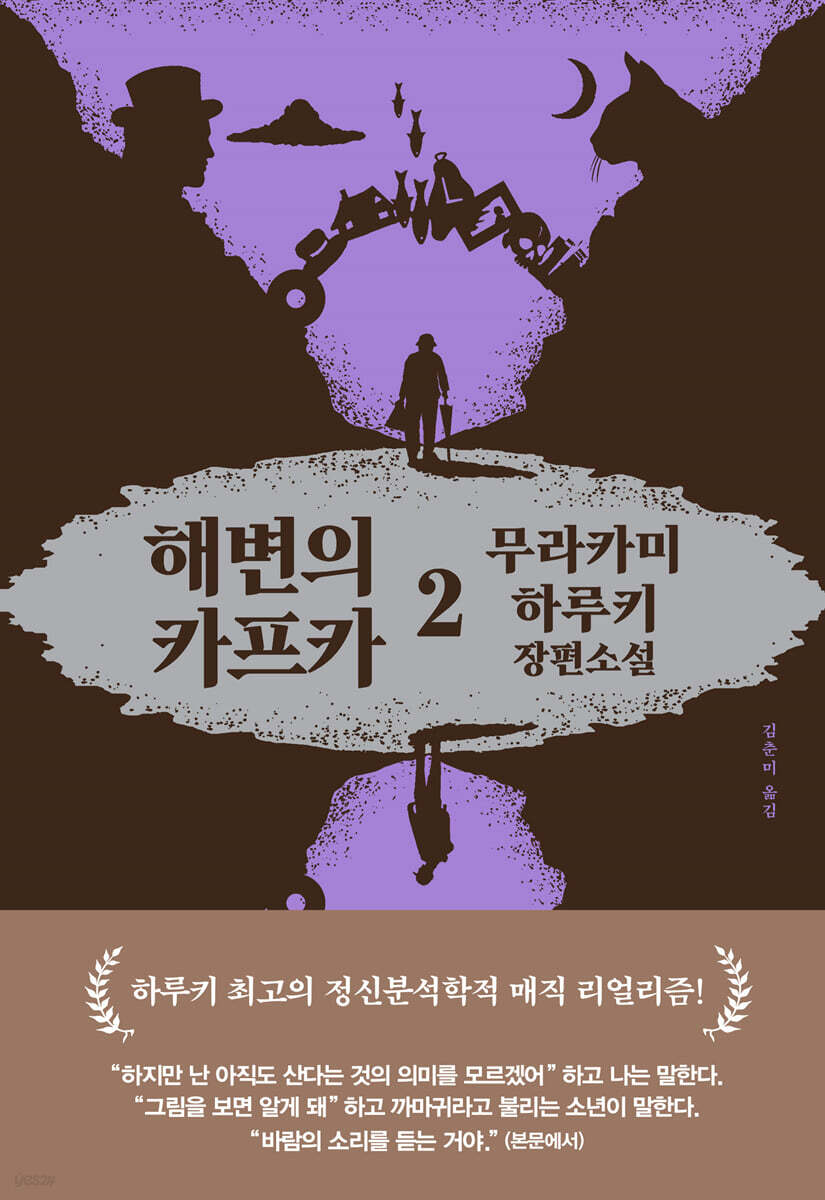 |
Description
Book Introduction
“From now on, you will be the toughest fifteen-year-old boy in the world.”
“And when you open your eyes, you find yourself part of a new world.”
A completely revised edition, the first in 16 years, that captures the essence of Haruki Murakami's style!
Psychoanalytic magic realism that explores the archetypes of human life
Kafka on the Shore, a masterpiece of the "Haruki World" loved not only in Japan but around the world, was selected as the "Book of the Year" by the New York Times and acclaimed by critics as Haruki Murakami's best novel, and has been republished after 16 years in a completely revised edition (3rd edition) that fully captures the essence of Haruki Murakami's style.
"Kafka on the Shore" first captures readers' attention with the strange sense of loneliness and lyricism that its title conveys.
Regarding this title, which has also raised a lot of curiosity in Japan, Haruki Murakami said in an interview, “The title ‘Kafka on the Shore’ evokes a unique image,” and “After it suddenly came to mind, I played it around in my head for a while and thought, ‘Okay, let’s do this,’ and after that, I couldn’t think of any other titles.”
'We know how tough the world can be.
But at the same time, I know that the world can be a truly wonderful and elegant object.
Kafka on the Shore is an attempt to portray the world as it is through the eyes of a fifteen-year-old boy.
I repeat, Mr. Kafka Tamura is me, and you, the readers, are also me.
If you could look at this work with those eyes, there would be nothing more desirable for me as a writer.
' - Haruki Murakami, from 'Author's Note'
Published as a 826-page original book in both volumes, "Kafka on the Shore" is a vast book, but it flows without a dull moment, with the story building steadily as you turn the pages and the characters each captivating with their own charm.
Haruki Murakami shows a boy growing up through a rite of passage into another world in a novel that deftly connects past and present, dreams and reality, breaking free from the rules of linear space and time.
“And when you open your eyes, you find yourself part of a new world.”
A completely revised edition, the first in 16 years, that captures the essence of Haruki Murakami's style!
Psychoanalytic magic realism that explores the archetypes of human life
Kafka on the Shore, a masterpiece of the "Haruki World" loved not only in Japan but around the world, was selected as the "Book of the Year" by the New York Times and acclaimed by critics as Haruki Murakami's best novel, and has been republished after 16 years in a completely revised edition (3rd edition) that fully captures the essence of Haruki Murakami's style.
"Kafka on the Shore" first captures readers' attention with the strange sense of loneliness and lyricism that its title conveys.
Regarding this title, which has also raised a lot of curiosity in Japan, Haruki Murakami said in an interview, “The title ‘Kafka on the Shore’ evokes a unique image,” and “After it suddenly came to mind, I played it around in my head for a while and thought, ‘Okay, let’s do this,’ and after that, I couldn’t think of any other titles.”
'We know how tough the world can be.
But at the same time, I know that the world can be a truly wonderful and elegant object.
Kafka on the Shore is an attempt to portray the world as it is through the eyes of a fifteen-year-old boy.
I repeat, Mr. Kafka Tamura is me, and you, the readers, are also me.
If you could look at this work with those eyes, there would be nothing more desirable for me as a writer.
' - Haruki Murakami, from 'Author's Note'
Published as a 826-page original book in both volumes, "Kafka on the Shore" is a vast book, but it flows without a dull moment, with the story building steadily as you turn the pages and the characters each captivating with their own charm.
Haruki Murakami shows a boy growing up through a rite of passage into another world in a novel that deftly connects past and present, dreams and reality, breaking free from the rules of linear space and time.
- You can preview some of the book's contents.
Preview
index
Chapters 24 to 46
The Boy Called Crow
Chapters 47-49
Commentary: A masterpiece exploring unconscious violence and responsibility for life (Kwon Taek-young)
Translator's Note: Haruki Murakami's outstanding work, which demonstrates his literary maturity (Kim Chun-mi)
The Boy Called Crow
Chapters 47-49
Commentary: A masterpiece exploring unconscious violence and responsibility for life (Kwon Taek-young)
Translator's Note: Haruki Murakami's outstanding work, which demonstrates his literary maturity (Kim Chun-mi)
Into the book
“Look here, Hoshino.
God exists only in human consciousness.
Especially in Japan, whether good or bad, God is always flexible.
As evidence, the Emperor, who was a god before World War II, was instructed by General Douglas MacArthur, the commander of the occupying forces, to "stop being a god," and replied, "Yes, I am an ordinary human being now," and ceased to be a god after 1946.
The Japanese gods are something that can be adjusted to that extent.
A few words of instruction from an American soldier wearing sunglasses and smoking a cheap pipe can change the way you live.
It's such a super postmodern existence.
If you think it exists, it exists, and if you think it doesn't exist, it doesn't exist.
“There’s no need to worry about such things.”
--- pp.119-120
Instead, I think about war.
I think about the Napoleonic wars, and I think about the wars that Japanese soldiers had to fight.
I feel the definite weight of the hatchet in my palm.
The sharp, white blade of a new blade stares vividly into my eyes.
I look away without realizing it.
Why do people fight? Why do hundreds of thousands, even millions, of people feel compelled to kill each other en masse? Does such fighting stem from anger? Or from fear? Or are fear and anger simply different aspects of the same soul?
--- p.326
“We all keep losing things that are precious to us,” he says after the phone stops ringing.
“Precious opportunities and possibilities, irreversible feelings.
That's one meaning of living.
But in our heads, I think it's probably just our heads, there's a little room there to store those things as memories.
It's probably a room like the bookshelf in this library.
And we must continue to create search cards for that room in order to know the exact current address of our own hearts.
You also have to do things like cleaning, ventilating, and changing the water in the flowers.
In other words, you will live in your own library forever.”
--- pp.488-489
Time, which has weight, comes over you like an old dream that had a lot of meaning.
You keep moving to escape from that time.
Even if you go to the very end of the world, you will never be free from that time.
But even if that's the case, you still can't avoid going to the very end of the world.
Because there are things you can't do without going to the ends of the earth.
God exists only in human consciousness.
Especially in Japan, whether good or bad, God is always flexible.
As evidence, the Emperor, who was a god before World War II, was instructed by General Douglas MacArthur, the commander of the occupying forces, to "stop being a god," and replied, "Yes, I am an ordinary human being now," and ceased to be a god after 1946.
The Japanese gods are something that can be adjusted to that extent.
A few words of instruction from an American soldier wearing sunglasses and smoking a cheap pipe can change the way you live.
It's such a super postmodern existence.
If you think it exists, it exists, and if you think it doesn't exist, it doesn't exist.
“There’s no need to worry about such things.”
--- pp.119-120
Instead, I think about war.
I think about the Napoleonic wars, and I think about the wars that Japanese soldiers had to fight.
I feel the definite weight of the hatchet in my palm.
The sharp, white blade of a new blade stares vividly into my eyes.
I look away without realizing it.
Why do people fight? Why do hundreds of thousands, even millions, of people feel compelled to kill each other en masse? Does such fighting stem from anger? Or from fear? Or are fear and anger simply different aspects of the same soul?
--- p.326
“We all keep losing things that are precious to us,” he says after the phone stops ringing.
“Precious opportunities and possibilities, irreversible feelings.
That's one meaning of living.
But in our heads, I think it's probably just our heads, there's a little room there to store those things as memories.
It's probably a room like the bookshelf in this library.
And we must continue to create search cards for that room in order to know the exact current address of our own hearts.
You also have to do things like cleaning, ventilating, and changing the water in the flowers.
In other words, you will live in your own library forever.”
--- pp.488-489
Time, which has weight, comes over you like an old dream that had a lot of meaning.
You keep moving to escape from that time.
Even if you go to the very end of the world, you will never be free from that time.
But even if that's the case, you still can't avoid going to the very end of the world.
Because there are things you can't do without going to the ends of the earth.
--- p.495
Publisher's Review
A coming-of-age story about a fifteen-year-old boy heading to the end of the world.
“There are few writers who make us feel like we’re dreaming like Haruki Murakami.”
—Laura Miller (New York Times columnist)
It is significant that Tamura Kafka, the protagonist of Kafka on the Shore, which Haruki Murakami described as “a work in which I poured everything I had and which I am extremely satisfied with,” is a 15-year-old boy.
This is because a 15-year-old boy symbolizes the pure archetype of a human being who stands at the 'end of childhood' and the 'starting point of adulthood.'
The archetype of human beings can be seen as 'das Selbst', the 'original self', untainted by the world's filth and absurdity, rather than 'das Man' (man of the world) who conforms to the common sense and orbit of the world, as Franz Kafka said.
Born and raised in Nakano Ward, Tokyo, Tamura Kafka left home on his fifteenth birthday.
To escape the prophecy that he would kill his father and have sexual relations with his older sister and mother.
On his journey to Shikoku, a place he had never been before, Kafka meets Sakura, a woman his sister's age who left home with her mother when she was young, and visits the Komura Library he had seen in a magazine.
In the library, there is Oshima with a gentle smile and the elegant and beautiful director Saeki.
The peaceful routine of lying about my age, staying in a hotel, reading books at the library, and working out regularly at the gym came crashing down on the eighth day after leaving home.
Kafka wakes up unconscious and covered in blood, and soon after learns that his father has been murdered.
He suspects that the blood on his clothes that night, when he has no memory of the events before and after, is his father's.
A prophecy, like a curse swirling like a sandstorm, gradually weighs down on the boy.
The novel's protagonist, Tamura Kafka, is a complex character who lives a life that moves between reality and fantasy.
Haruki Murakami, who has written stories with young men in their twenties and thirties as the main characters, portrayed a world that is both bleak and wonderful, as it is, in "Kafka on the Shore" by using a fifteen-year-old boy with undefined values and lifestyle as the narrator.
The protagonist, who chose the Czech word for crow, Kafka, as his new name, has no choice but to live alone, separated from the flock like a crow, but he faces life with a strong body and mind.
The boy called the Crow, who appears in the form of a monologue throughout the novel, is his assistant and another self who lets us hear his inner voice.
The psychoanalytic magic realism, which crosses time and space with a boy and an old man as the central axis, draws the reader into a fantastic adventure.
Haruki Murakami's unique imaginative sentences and detailed inner descriptions add depth to the narrative that unfolds without interruption, with metaphors based on Eastern and Western classics and Greek tragedy.
Kafka, the boy who reaches the end of the world following a prophecy like a curse and moves on to a different stage than before, is Haruki himself and also the readers of the novel.
Anyone who has ever crossed a boundary, big or small, will be completely immersed in the journey of a boy who experiences excruciating growing pains in a dream that touches reality.
Responsibility begins in the midst of dreams and imagination
“A true page-turner and metaphysical hallucinogen.
Haruki Murakami is a painter of negative space.” —John Updike (novelist)
The novel features two characters who travel through Shikoku.
The main characters are Kafka Tamura, a fifteen-year-old boy who ran away from home to escape his father's curse, and Satoru Nakata, a sixty-year-old man who became intellectually disabled in a childhood accident but can talk to cats.
The two, who seem to have no connection on the surface, move from Tokyo to Takamatsu, each driven by an instinctive pull.
Kafka and Nakata reach Saeki through a labyrinthine forest and a passageway leading to a giant bridge over the sea.
Saeki, who runs the Gomura Library, is the person they must inevitably meet and the final destination of this strange journey.
Although they have traveled similar paths but have never actually met, they are connected through dreams, transcending physical distance.
As in Haruki Murakami's previous works, the fantasy and surrealism expressed through dreams play a major role in the development of "Kafka on the Shore."
Dreams are not simply mental phenomena experienced while sleeping.
It is an event that reflects the inner unconscious, and since it is directly connected to the real world, responsibility is also assigned accordingly.
After an accident as a boy, Nakata experiences two weeks of unconsciousness and wakes up feeling like he has lost his "normal" self.
With a shorter shadow than others, he unknowingly kills cat killer Johnny Walker and causes a strange phenomenon in which fish and leeches fall from the sky.
Meanwhile, Kafka hypothesizes that he must have killed his father in Tokyo through a special dream circuit on the day he woke up with blood on his clothes.
It's all a matter of imagination.
Our responsibility begins in our imagination.
Yeats writes about it this way:
In dreams begin the responsibilities.
That's exactly what he said.
Conversely, where there is no imagination, there may not be any responsibility.
(Volume 1, page 273)
Oshima's critique of humans lacking imagination raises questions about what modern people living in an empty society tend to forget but 'can never forget.'
The violence, insensitivity, lack of understanding, and intolerance committed without thought are endlessly repeated in modern society in various forms.
Some people easily forget about life-changing events, while others live their entire lives obsessed with them.
I also dream of an ideal space where I can escape the present.
The novel depicts the loss and violence experienced by individuals in Japan, a country still reeling from the aftermath of World War II.
The fantasy in the work, which makes it difficult to discern clear truths at the boundaries of art, love, and time, ultimately connects to reality.
Can we, by borrowing the power of metaphor, return to the peaceful days before we were wounded?
Nakata and Hoshino found the stone at the entrance and opened the door with difficulty.
Yet, the world before my eyes did not change.
Even if you reach the end of the world, what has already happened cannot be undone.
Still, the reason we can't give up on life is because there are things we can't know until we try them ourselves.
Just as an ordinary stone that seems to be found anywhere is actually the entrance to a secret door, the world may be governed by complex, invisible rules.
It is impossible to fully understand a world that changes every day.
I just live by meeting someone, loving them, and remembering them.
At the end of a hard day, we close our eyes.
“You’d better go to sleep now,” says the boy called Crow.
“When you wake up from sleep, you will find yourself in a new world.”
Eventually you fall asleep.
And when you open your eyes, you find yourself in a new world.
(Volume 2, pp. 496-497)
In an interview conducted after writing “Kafka on the Shore,” Haruki Murakami said, “I want to write a novel that, no matter how many times you read it, you can feel new meaning, fun, and deep meaning every time you read it.”
Just as his passion for the work is evident in the fact that he continued revising it for over six months after the deadline, there are hidden elements in the work that can be easily missed if you don't read it carefully.
This is why you should reread Haruki Murakami's masterpiece in a completely revised edition that has restored the author's intentions, style, and narrative techniques as closely as possible to the original.
“There are few writers who make us feel like we’re dreaming like Haruki Murakami.”
—Laura Miller (New York Times columnist)
It is significant that Tamura Kafka, the protagonist of Kafka on the Shore, which Haruki Murakami described as “a work in which I poured everything I had and which I am extremely satisfied with,” is a 15-year-old boy.
This is because a 15-year-old boy symbolizes the pure archetype of a human being who stands at the 'end of childhood' and the 'starting point of adulthood.'
The archetype of human beings can be seen as 'das Selbst', the 'original self', untainted by the world's filth and absurdity, rather than 'das Man' (man of the world) who conforms to the common sense and orbit of the world, as Franz Kafka said.
Born and raised in Nakano Ward, Tokyo, Tamura Kafka left home on his fifteenth birthday.
To escape the prophecy that he would kill his father and have sexual relations with his older sister and mother.
On his journey to Shikoku, a place he had never been before, Kafka meets Sakura, a woman his sister's age who left home with her mother when she was young, and visits the Komura Library he had seen in a magazine.
In the library, there is Oshima with a gentle smile and the elegant and beautiful director Saeki.
The peaceful routine of lying about my age, staying in a hotel, reading books at the library, and working out regularly at the gym came crashing down on the eighth day after leaving home.
Kafka wakes up unconscious and covered in blood, and soon after learns that his father has been murdered.
He suspects that the blood on his clothes that night, when he has no memory of the events before and after, is his father's.
A prophecy, like a curse swirling like a sandstorm, gradually weighs down on the boy.
The novel's protagonist, Tamura Kafka, is a complex character who lives a life that moves between reality and fantasy.
Haruki Murakami, who has written stories with young men in their twenties and thirties as the main characters, portrayed a world that is both bleak and wonderful, as it is, in "Kafka on the Shore" by using a fifteen-year-old boy with undefined values and lifestyle as the narrator.
The protagonist, who chose the Czech word for crow, Kafka, as his new name, has no choice but to live alone, separated from the flock like a crow, but he faces life with a strong body and mind.
The boy called the Crow, who appears in the form of a monologue throughout the novel, is his assistant and another self who lets us hear his inner voice.
The psychoanalytic magic realism, which crosses time and space with a boy and an old man as the central axis, draws the reader into a fantastic adventure.
Haruki Murakami's unique imaginative sentences and detailed inner descriptions add depth to the narrative that unfolds without interruption, with metaphors based on Eastern and Western classics and Greek tragedy.
Kafka, the boy who reaches the end of the world following a prophecy like a curse and moves on to a different stage than before, is Haruki himself and also the readers of the novel.
Anyone who has ever crossed a boundary, big or small, will be completely immersed in the journey of a boy who experiences excruciating growing pains in a dream that touches reality.
Responsibility begins in the midst of dreams and imagination
“A true page-turner and metaphysical hallucinogen.
Haruki Murakami is a painter of negative space.” —John Updike (novelist)
The novel features two characters who travel through Shikoku.
The main characters are Kafka Tamura, a fifteen-year-old boy who ran away from home to escape his father's curse, and Satoru Nakata, a sixty-year-old man who became intellectually disabled in a childhood accident but can talk to cats.
The two, who seem to have no connection on the surface, move from Tokyo to Takamatsu, each driven by an instinctive pull.
Kafka and Nakata reach Saeki through a labyrinthine forest and a passageway leading to a giant bridge over the sea.
Saeki, who runs the Gomura Library, is the person they must inevitably meet and the final destination of this strange journey.
Although they have traveled similar paths but have never actually met, they are connected through dreams, transcending physical distance.
As in Haruki Murakami's previous works, the fantasy and surrealism expressed through dreams play a major role in the development of "Kafka on the Shore."
Dreams are not simply mental phenomena experienced while sleeping.
It is an event that reflects the inner unconscious, and since it is directly connected to the real world, responsibility is also assigned accordingly.
After an accident as a boy, Nakata experiences two weeks of unconsciousness and wakes up feeling like he has lost his "normal" self.
With a shorter shadow than others, he unknowingly kills cat killer Johnny Walker and causes a strange phenomenon in which fish and leeches fall from the sky.
Meanwhile, Kafka hypothesizes that he must have killed his father in Tokyo through a special dream circuit on the day he woke up with blood on his clothes.
It's all a matter of imagination.
Our responsibility begins in our imagination.
Yeats writes about it this way:
In dreams begin the responsibilities.
That's exactly what he said.
Conversely, where there is no imagination, there may not be any responsibility.
(Volume 1, page 273)
Oshima's critique of humans lacking imagination raises questions about what modern people living in an empty society tend to forget but 'can never forget.'
The violence, insensitivity, lack of understanding, and intolerance committed without thought are endlessly repeated in modern society in various forms.
Some people easily forget about life-changing events, while others live their entire lives obsessed with them.
I also dream of an ideal space where I can escape the present.
The novel depicts the loss and violence experienced by individuals in Japan, a country still reeling from the aftermath of World War II.
The fantasy in the work, which makes it difficult to discern clear truths at the boundaries of art, love, and time, ultimately connects to reality.
Can we, by borrowing the power of metaphor, return to the peaceful days before we were wounded?
Nakata and Hoshino found the stone at the entrance and opened the door with difficulty.
Yet, the world before my eyes did not change.
Even if you reach the end of the world, what has already happened cannot be undone.
Still, the reason we can't give up on life is because there are things we can't know until we try them ourselves.
Just as an ordinary stone that seems to be found anywhere is actually the entrance to a secret door, the world may be governed by complex, invisible rules.
It is impossible to fully understand a world that changes every day.
I just live by meeting someone, loving them, and remembering them.
At the end of a hard day, we close our eyes.
“You’d better go to sleep now,” says the boy called Crow.
“When you wake up from sleep, you will find yourself in a new world.”
Eventually you fall asleep.
And when you open your eyes, you find yourself in a new world.
(Volume 2, pp. 496-497)
In an interview conducted after writing “Kafka on the Shore,” Haruki Murakami said, “I want to write a novel that, no matter how many times you read it, you can feel new meaning, fun, and deep meaning every time you read it.”
Just as his passion for the work is evident in the fact that he continued revising it for over six months after the deadline, there are hidden elements in the work that can be easily missed if you don't read it carefully.
This is why you should reread Haruki Murakami's masterpiece in a completely revised edition that has restored the author's intentions, style, and narrative techniques as closely as possible to the original.
GOODS SPECIFICS
- Date of issue: June 10, 2024
- Format: Hardcover book binding method guide
- Page count, weight, size: 516 pages | 133*192*35mm
- ISBN13: 9788970125473
- ISBN10: 8970125477
You may also like
카테고리
korean


korean

![GQ KOREA Mark (Monthly): December [2025]](http://librairie.coreenne.fr/cdn/shop/files/8ef265dbbfbf186523ed75ba7319009d.jpg?v=1765340328&width=3840)


