

Moby Dick
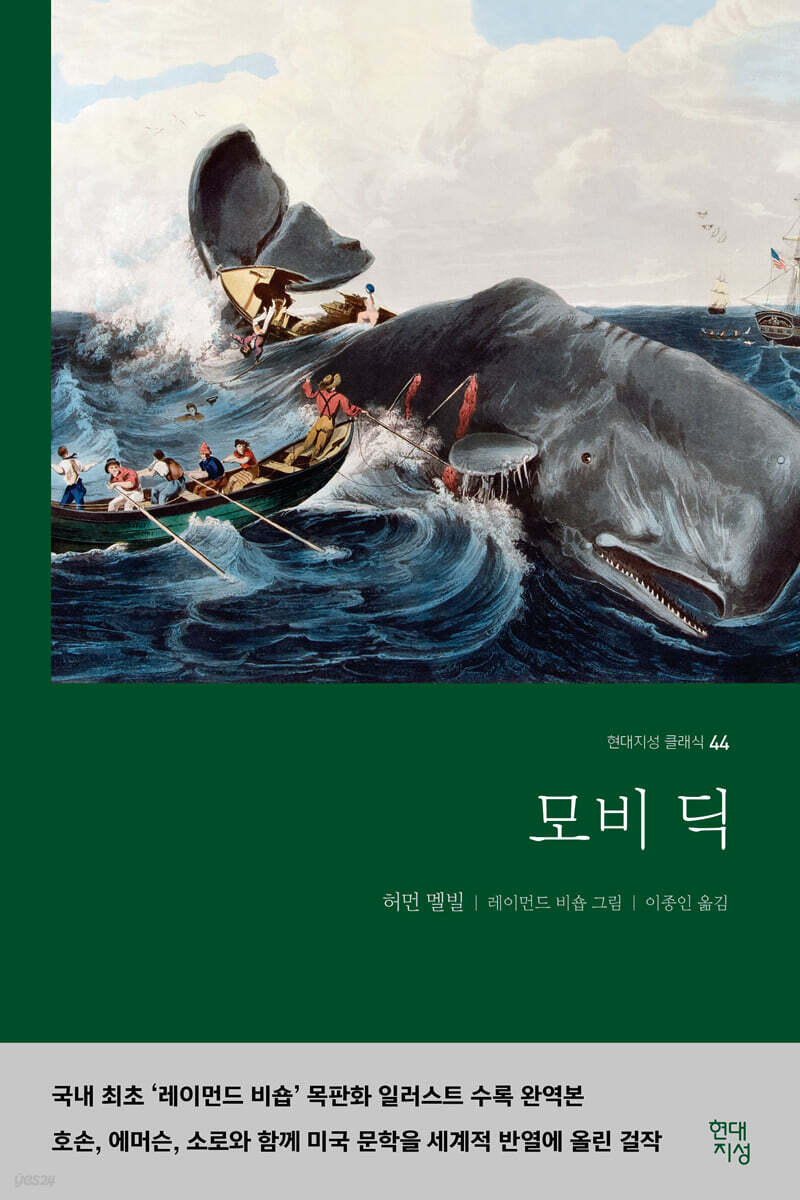 |
Description
Book Introduction
The novel read by Woo Young-woo in the drama [The Strange Lawyer Woo Young-woo]
The first complete translation of Raymond Bishop's woodcut illustrations in Korea
Against the backdrop of an era of violence that enforced only absolute truth
An immortal classic that marked the beginning of experimental and avant-garde literature.
Moby Dick is not just a simple maritime adventure novel, but a multifaceted novel filled with numerous symbols and metaphors.
“Call me Ishmael.” This famous first sentence carries a symbolic meaning that runs through the entire novel (selected by the British daily newspaper The Telegraph as one of the ‘30 Greatest First Sentences in the World’).
In addition to the main character Ishmael, figures from the Bible and Greek mythology, such as Ahab, Jonah, Job, Prometheus, Perseus, and Narcissus, serve as major motifs and allegories.
Additionally, the narrative flows magnificently, with the dramatic confrontation between Captain Ahab and Moby Dick, the class and racial conflicts within the sailor community, and the individual characters and psychology of the characters all intertwined in a complex manner.
Published in 1851, Moby Dick already predicted the modernism that would come in the 20th century half a century earlier.
Unlike the 19th-century realist novelists who wrote novels from the position of God as if they knew all the truths of the world, 20th-century modernist novelists focused on dramatizing the narrator's subjective viewpoint and inner psychology as they viewed the world.
Thus, Moby Dick became the foremost work of American modernism and a representative work of symbolist literature with its groundbreaking fusion-style storytelling, original work structure, tracing diverse human figures, exquisite combination of story and symbol, deep religious and philosophical exploration of the mysteries of life, outstanding sense of humor and satire, open ending, and other unprecedented experimental and avant-garde forms.
So what does the white whale Moby Dick ultimately symbolize in this novel? The "white" whale isn't an absolute entity, limited to a single interpretation, but rather symbolizes virtually everything.
This is because the color of the symbol changes depending on the light the reader gives it.
In the translator's note, it is interpreted as god, monster, slavery, trauma, and mystery of existence from the religious, mythological, social, psychological, and philosophical aspects, respectively.
If you read the novel with these five interpretations in mind, the work's meaning will become more three-dimensional and richer.
Veteran classic translator Lee Jong-in translates Melville's signature solemn, bold, yet witty and delicate prose into excellent, highly readable Korean, offering a delightful reading experience.
Now the initiative for interpretation is given to each reader.
How about going on a long voyage to find your own 'white whale' through 'Moby Dick'?
The first complete translation of Raymond Bishop's woodcut illustrations in Korea
Against the backdrop of an era of violence that enforced only absolute truth
An immortal classic that marked the beginning of experimental and avant-garde literature.
Moby Dick is not just a simple maritime adventure novel, but a multifaceted novel filled with numerous symbols and metaphors.
“Call me Ishmael.” This famous first sentence carries a symbolic meaning that runs through the entire novel (selected by the British daily newspaper The Telegraph as one of the ‘30 Greatest First Sentences in the World’).
In addition to the main character Ishmael, figures from the Bible and Greek mythology, such as Ahab, Jonah, Job, Prometheus, Perseus, and Narcissus, serve as major motifs and allegories.
Additionally, the narrative flows magnificently, with the dramatic confrontation between Captain Ahab and Moby Dick, the class and racial conflicts within the sailor community, and the individual characters and psychology of the characters all intertwined in a complex manner.
Published in 1851, Moby Dick already predicted the modernism that would come in the 20th century half a century earlier.
Unlike the 19th-century realist novelists who wrote novels from the position of God as if they knew all the truths of the world, 20th-century modernist novelists focused on dramatizing the narrator's subjective viewpoint and inner psychology as they viewed the world.
Thus, Moby Dick became the foremost work of American modernism and a representative work of symbolist literature with its groundbreaking fusion-style storytelling, original work structure, tracing diverse human figures, exquisite combination of story and symbol, deep religious and philosophical exploration of the mysteries of life, outstanding sense of humor and satire, open ending, and other unprecedented experimental and avant-garde forms.
So what does the white whale Moby Dick ultimately symbolize in this novel? The "white" whale isn't an absolute entity, limited to a single interpretation, but rather symbolizes virtually everything.
This is because the color of the symbol changes depending on the light the reader gives it.
In the translator's note, it is interpreted as god, monster, slavery, trauma, and mystery of existence from the religious, mythological, social, psychological, and philosophical aspects, respectively.
If you read the novel with these five interpretations in mind, the work's meaning will become more three-dimensional and richer.
Veteran classic translator Lee Jong-in translates Melville's signature solemn, bold, yet witty and delicate prose into excellent, highly readable Korean, offering a delightful reading experience.
Now the initiative for interpretation is given to each reader.
How about going on a long voyage to find your own 'white whale' through 'Moby Dick'?
- You can preview some of the book's contents.
Preview
index
etymology
Excerpts
Chapter 1: Things that are vaguely revealed
Chapter 2 Travel Bag
Chapter 3: Water Spray Inn
4 sheets of blanket
Chapter 5 Breakfast
Chapter 6 Distance
Chapter 7: Chapel
Chapter 8 Pulpit
Chapter 9 Sermon
Chapter 10: Close Friends
Chapter 11 Pajamas
Chapter 12 Days of Life
Chapter 13: Wheelbarrow
Chapter 14 Nantucket
Chapter 15 Chowder
Chapter 16: Pear
Chapter 17 Ramadan
Chapter 18 His Sign
Chapter 19: The Prophet
Chapter 20: Preparing to Depart
Chapter 21: Boarding the Ship
Chapter 22: Merry Christmas
Chapter 23: The Windward Shore
Chapter 24 Defense
Chapter 25 Addendum
Chapter 26: The Knight and the Seed 1
Chapter 27: The Knight and the Seed 2
Chapter 28 Ahab
Chapter 29: Ahab appears, followed by Stubb.
30 pipes
Chapter 31 Queen Maeve
Chapter 32: Whale Science
Chapter 33: The Spearfishing Grounds
Chapter 34: Cabin Table
Chapter 35: Top of the Mast
Chapter 36: The Afterdeck
Chapter 37 Sunset
Chapter 38: Twilight
Chapter 39: The First Night Shift
Chapter 40: Midnight, Foredeck
Chapter 41: Moby Dick
Chapter 42: The White of the Whale
Chapter 43: Listen carefully!
Even if it's 44 chapters
Chapter 45 Statement
Chapter 46: Guessing
Chapter 47: Weaving a Giant
Chapter 48: The First Boat Departure
Chapter 49: Hyena
Chapter 50 Ahab's Boat and Crew, Pedalla
Chapter 51: The Ghostly Stream
Chapter 52 Albatross
Chapter 53: The Meeting of Whalers, Gam
Chapter 54: The Tale of Town Hoho
Chapter 55: Ridiculous Whale Drawings
Chapter 56: Whale Drawings with Fewer Errors and Realistic Whaling Illustrations
Chapter 57: Painting, Teeth, Trees, Iron Plates, Stones, Mountains, Stars
About the whale that appeared on the seat etc.
Chapter 58 Copepods
Chapter 59 Squid
60 Whaling Ropes
Chapter 61: Stubbs Kills the Whale
Chapter 62: Throwing the Harpoon
Chapter 63: The Harpooner
Chapter 64: Stubb's Dinner
Chapter 65 Whale Meat Dishes
Chapter 66: Shark Massacre
Chapter 67: Whale Dismantling
Chapter 68 Blanket
Chapter 69: Funeral
Chapter 70: The Sphinx
Chapter 71: The Story of the Zero Encryption
Chapter 72 Monkey Rope
Chapter 73: Stubb and Flask, Killing the Whale
Talk about him
Chapter 74: The Sperm Whale's Head - A Comparative Review
Chapter 75: The Head of the Whale - A Comparative Review
Chapter 76: Siege Rams
Chapter 77: The Great Heidelberg Cask
Chapter 78 Oil Cans and Buckets
Chapter 79: The Great Plains
Chapter 80: The Whale's Brain
Chapter 81: Pequod Meets Jungfrau
Chapter 82: The Honor and Glory of Whaling
Chapter 83: Jonah in Historical Perspective
Chapter 84: Throwing the Spear
Chapter 85 Fractions
Chapter 86 Tail
Chapter 87: The Invincible Fleet
Chapter 88: Schools and Principals
Chapter 89: The Caught and the Missing Whale
Chapter 90 Head or Tail
Chapter 91: Pequod Meets Rosebud
Chapter 92: Dragon's Breath
Chapter 93: The Abandoned
Chapter 94: Squeezing with Your Hand
Chapter 95 Priestly Vestments
Chapter 96: The Oil Press
Chapter 97: The Lamp
Filling and Clearing Chapter 98
99 Spanish gold coins
Chapter 100: Legs and Arms - The Pequod of Nantucket Meets the Samuel Enderby of London
Chapter 101: Bottle of Liquor
Chapter 102: The Shade of the Trees of the Arsacid Islands
Chapter 103: Measuring the Whale's Skeleton
Chapter 104: Fossil Whales
Chapter 105: Are whales shrinking in size? Will they become extinct?
Chapter 106: Ahab's Bridge
Chapter 107 Carpenter
Chapter 108: Ahab and the Carpenter
Chapter 109: Ahab and Starbuck in the Captain's Cabin
Chapter 110: Queequeg in the Coffin
Chapter 111 Pacific
Chapter 112 The Blacksmith
Chapter 113: The Furnace
Chapter 114: The Golden Sea
Chapter 115: The Pequod Meets the Bachelor
Chapter 116: The Dying Whale
Chapter 117: Whale Watch
Chapter 118 Fourths
Chapter 119 Candles
Chapter 120: Deck at the end of the first night shift
Chapter 121: Midnight - The Foredeck's Bow
Chapter 122: Midnight Mast Tops - Thunder and Lightning
Chapter 123 Musket
Chapter 124 Compass Needle
Chapter 125 Measuring Instruments and Measuring Lines
Chapter 126 Lifebuoy
Deck 127
Chapter 128: The Pequod Meets the Rachel
Chapter 129: Cabin
130 hats
Chapter 131: Pequod Meets Delight
Symphony No. 132
Chapter 133: The Pursuit - Day 1
Chapter 134: The Pursuit - Day 2
Chapter 135: The Pursuit - Day 3
Epilogue
Release | Lee Jong-in
Herman Melville Chronology
Excerpts
Chapter 1: Things that are vaguely revealed
Chapter 2 Travel Bag
Chapter 3: Water Spray Inn
4 sheets of blanket
Chapter 5 Breakfast
Chapter 6 Distance
Chapter 7: Chapel
Chapter 8 Pulpit
Chapter 9 Sermon
Chapter 10: Close Friends
Chapter 11 Pajamas
Chapter 12 Days of Life
Chapter 13: Wheelbarrow
Chapter 14 Nantucket
Chapter 15 Chowder
Chapter 16: Pear
Chapter 17 Ramadan
Chapter 18 His Sign
Chapter 19: The Prophet
Chapter 20: Preparing to Depart
Chapter 21: Boarding the Ship
Chapter 22: Merry Christmas
Chapter 23: The Windward Shore
Chapter 24 Defense
Chapter 25 Addendum
Chapter 26: The Knight and the Seed 1
Chapter 27: The Knight and the Seed 2
Chapter 28 Ahab
Chapter 29: Ahab appears, followed by Stubb.
30 pipes
Chapter 31 Queen Maeve
Chapter 32: Whale Science
Chapter 33: The Spearfishing Grounds
Chapter 34: Cabin Table
Chapter 35: Top of the Mast
Chapter 36: The Afterdeck
Chapter 37 Sunset
Chapter 38: Twilight
Chapter 39: The First Night Shift
Chapter 40: Midnight, Foredeck
Chapter 41: Moby Dick
Chapter 42: The White of the Whale
Chapter 43: Listen carefully!
Even if it's 44 chapters
Chapter 45 Statement
Chapter 46: Guessing
Chapter 47: Weaving a Giant
Chapter 48: The First Boat Departure
Chapter 49: Hyena
Chapter 50 Ahab's Boat and Crew, Pedalla
Chapter 51: The Ghostly Stream
Chapter 52 Albatross
Chapter 53: The Meeting of Whalers, Gam
Chapter 54: The Tale of Town Hoho
Chapter 55: Ridiculous Whale Drawings
Chapter 56: Whale Drawings with Fewer Errors and Realistic Whaling Illustrations
Chapter 57: Painting, Teeth, Trees, Iron Plates, Stones, Mountains, Stars
About the whale that appeared on the seat etc.
Chapter 58 Copepods
Chapter 59 Squid
60 Whaling Ropes
Chapter 61: Stubbs Kills the Whale
Chapter 62: Throwing the Harpoon
Chapter 63: The Harpooner
Chapter 64: Stubb's Dinner
Chapter 65 Whale Meat Dishes
Chapter 66: Shark Massacre
Chapter 67: Whale Dismantling
Chapter 68 Blanket
Chapter 69: Funeral
Chapter 70: The Sphinx
Chapter 71: The Story of the Zero Encryption
Chapter 72 Monkey Rope
Chapter 73: Stubb and Flask, Killing the Whale
Talk about him
Chapter 74: The Sperm Whale's Head - A Comparative Review
Chapter 75: The Head of the Whale - A Comparative Review
Chapter 76: Siege Rams
Chapter 77: The Great Heidelberg Cask
Chapter 78 Oil Cans and Buckets
Chapter 79: The Great Plains
Chapter 80: The Whale's Brain
Chapter 81: Pequod Meets Jungfrau
Chapter 82: The Honor and Glory of Whaling
Chapter 83: Jonah in Historical Perspective
Chapter 84: Throwing the Spear
Chapter 85 Fractions
Chapter 86 Tail
Chapter 87: The Invincible Fleet
Chapter 88: Schools and Principals
Chapter 89: The Caught and the Missing Whale
Chapter 90 Head or Tail
Chapter 91: Pequod Meets Rosebud
Chapter 92: Dragon's Breath
Chapter 93: The Abandoned
Chapter 94: Squeezing with Your Hand
Chapter 95 Priestly Vestments
Chapter 96: The Oil Press
Chapter 97: The Lamp
Filling and Clearing Chapter 98
99 Spanish gold coins
Chapter 100: Legs and Arms - The Pequod of Nantucket Meets the Samuel Enderby of London
Chapter 101: Bottle of Liquor
Chapter 102: The Shade of the Trees of the Arsacid Islands
Chapter 103: Measuring the Whale's Skeleton
Chapter 104: Fossil Whales
Chapter 105: Are whales shrinking in size? Will they become extinct?
Chapter 106: Ahab's Bridge
Chapter 107 Carpenter
Chapter 108: Ahab and the Carpenter
Chapter 109: Ahab and Starbuck in the Captain's Cabin
Chapter 110: Queequeg in the Coffin
Chapter 111 Pacific
Chapter 112 The Blacksmith
Chapter 113: The Furnace
Chapter 114: The Golden Sea
Chapter 115: The Pequod Meets the Bachelor
Chapter 116: The Dying Whale
Chapter 117: Whale Watch
Chapter 118 Fourths
Chapter 119 Candles
Chapter 120: Deck at the end of the first night shift
Chapter 121: Midnight - The Foredeck's Bow
Chapter 122: Midnight Mast Tops - Thunder and Lightning
Chapter 123 Musket
Chapter 124 Compass Needle
Chapter 125 Measuring Instruments and Measuring Lines
Chapter 126 Lifebuoy
Deck 127
Chapter 128: The Pequod Meets the Rachel
Chapter 129: Cabin
130 hats
Chapter 131: Pequod Meets Delight
Symphony No. 132
Chapter 133: The Pursuit - Day 1
Chapter 134: The Pursuit - Day 2
Chapter 135: The Pursuit - Day 3
Epilogue
Release | Lee Jong-in
Herman Melville Chronology
Detailed image
.jpg)
Into the book
Call me Ishmael.
A few years ago (don't ask me exactly when), with my wallet running low and nothing interesting happening on land, I decided I should take a boat out and explore the world's oceans.
This is how I shake off my depression and get the stagnant blood circulating in my body.
When I feel my lips growing increasingly grim, when my soul becomes like a damp November drizzle, when I find myself stopping in front of an undertaker or chasing after a funeral procession, when I must summon a great deal of moral courage to keep myself from running out into the street and knocking off people's hats in a fit of melancholy, then I think I must get to the sea as quickly as possible.
This method replaces a pistol and bullets for me.
Cato of ancient Rome threw himself on his sword while reciting philosophical sentences, but I quietly board the ship.
It's no surprise.
Although there may be differences in degree, anyone who knows the sea will eventually feel similar feelings toward the sea as I do.
---From "Chapter 1: Things That Appear Vaguely"
I was a devout Christian, born and raised in a strict Presbyterian family.
How could I, like you, pray to a piece of wood alongside a barbaric idolater? But what is worship? Ishmael, do you think that the benevolent God, the Lord of heaven and earth, of all people, including pagans, would be jealous of this insignificant, black piece of wood? That is impossible! But what is worship? Worship is doing God's will.
So what is God's will? It is God's will that I do to my neighbor what I would have them do to me.
Now Queekeg is my neighbor.
What would Queequeg like me to do? Worship with me in the Presbyterian way.
Then I too must join his worship.
You must become an idolater.
So I set fire to the shavings, helped the harmless little idol to stay on its feet, offered it some baked biscuits with Queekeg, bowed down before it two or three times, and kissed its nose.
After we finished the ceremony, we took off our clothes and went to bed.
There was nothing to be ashamed of, either in my conscience or in the world.
We talked some more and then fell asleep.
---From "Chapter 10 Close Friends"
"There is no true dignity in whaling?" The dignity of our profession is attested by the heavens.
There's a constellation called Cetus in the southern sky! What more proof is there? Even if you wear your hat pulled down low before the Russian Tsar, you must take it off before Queequeg! Needless to say, it's not like that.
I know a man who has killed 350 whales in his lifetime, and I think he is better than the great generals of ancient times who boast of conquering 350 walled cities.
And if by any chance there be any excellence in me which I have not yet discovered, and if it is not unreasonable that I should desire real fame in that small but very quiet world, but if I am truly entitled to it, and if I do in the future anything which is better done than left undone, and if, when I die, my executors, or rather my creditors, find a precious manuscript on my desk, I will hereby declare that all the honor and glory go to the whaling business.
Because the whaling ship is my Yale and Harvard.
---From "Chapter 24 Defense"
At that time, I went up to the deck to stand the morning duty, but as soon as I turned my gaze to the stern railing, an ominous feeling came over me and my whole body began to tremble.
Before I could even recognize the source of my premonition, reality unfolded before my eyes.
Captain Ahab was standing on the stern deck.
There was no sign that he was sick or recovering.
He looked like a man who had been engulfed in flames and had broken his limbs, but had managed to break free from the stake before he could use them completely, or before he had lost all the strength he had gained over the years.
His tall, broad-shouldered body seemed to be made of solid bronze.
Like the bronze statue of Perseus cast by Cellini, the body seemed to retain its shape in no way.
From his ashen hair he could see a thin, leaden scar running down one side of his tanned face and neck, disappearing into his clothes.
…I was so struck by Ahab's gloomy appearance and the long, leaden scar that for a time I hardly noticed that much of the overwhelming gloom came from the savage white legs on which he stood, supporting a part of his body.
I had heard before that this ivory bridge was made from the jawbone of a sperm whale ground down during a voyage.
---From "Chapter 28 Ahab"
The rest of the body was covered in the same white stripes, spots and marble patterns, giving it the appearance of being wrapped in a shroud, and eventually the whale was given the unique name of 'white whale'.
When you see the vivid image of Moby Dick gliding through the deep blue sea at midday, leaving behind a golden, creamy foam like the Milky Way, you can't help but think that the name "White Whale" is a perfect fit for him.
What makes the whale so feared is not its unusual size, striking coloration, or deformed lower jaw, but its unparalleled intelligence and hostility.
According to specific testimony, the guy has clearly shown this trait on several occasions when attacking people.
Above all, the whalers were astonished by the creature's deceptive retreat.
More than once did Moby Dick appear to swim anxiously before his proud pursuers, then suddenly veer off and smash into the boats, sending the frightened boats scrambling back to their own ships.
---From "Chapter 41 Moby Dick"
“Come on, come on, my dear subordinates.
Row, my children.
“Row, my little ones,” Stubb said with a long sigh, as if trying to calm his still-uneasy subordinates.
"Hey, why don't you row until your back breaks? What the hell are you looking at? Those guys in that boat? Tsk! Five more people just came to help us.
Don't worry about where they come from.
The more people who come to help, the better.
Stir, keep stirring.
Don't worry about the fire and brimstone of hell.
Even the devil is a good friend if you get to know him.
Yeah, okay.
Now you're stirring it properly.
That's a 1,000 pound oar.
It looks like it's going to wipe out all the money.
Heroes, let us cheer for the golden cup filled with sperm whale oil! Let us give three cheers! Everyone is brimming with energy.
Calm down, calm down.
Don't rush.
Don't rush.
Why can't you row hard, you scoundrels! Bite everything, you dogs! Yeah, yeah, like that.
Gently, softly.
Yeah, that's it.
You bastards that the devil will bite, you rag-picking vagabonds, you're all asleep.
Sleepyheads, stop snoring and start rowing.
Row the boat, quickly.
Row, can't you? Row, won't you? Why don't you row until your bones break? Row until everything breaks.
I'm telling you to scream until your eyes pop out.
“Now!” he said, drawing a sharp dagger from his belt.
“Okay, everyone, draw your daggers and bite your lip and row.
Yes, yes.
I think I'm finally doing it right.
You're sharp as a knife.
"Forward, forward, silver spoons! Forward, threaders!"
---From "Chapter 48: The First Boat Departure"
“Sharks, I don’t blame you for your appetite.
It can't be helped because it's nature.
But controlling that evil nature is what's important.
Of course you are a shark.
But if you know how to control your inner shark, you too can become an angel.
An angel is simply a being who masters the shark within himself.
Listen carefully, brothers.
I hope you behave a little when you eat that whale.
Don't steal the whale blubber that goes into your neighbor's mouth.
Doesn't any shark have the same rights over that whale? In fact, you have no rights over that whale.
That whale belongs to someone else.
Some of you may have jaws much larger than those of other sharks.
There are some that have big mouths but small bellies.
So, having a big mouth doesn't mean you should swallow everything indiscriminately, but it means you should break through the chaos and share what you take with the baby sharks who can't fill their bellies."
---From "Chapter 64: Stubb's Dinner"
But he was only looking at what was too close to the boat.
Moby Dick was now swimming steadily forward again, as if he intended to escape with the corpse hanging from his body, or as if the spot where they had last met were merely a stopover on his way downwind.
The whale now passed by the main line, almost brushing past.
The main line had been approaching the whale from the opposite direction a moment ago, but then stopped for a moment.
The whale was swimming at full speed and now seemed intent on going straight on its way.
“Oh, Ahave!” cried Starbuck.
“It’s the third day, but it’s not too late.
Look! Moby Dick isn't chasing you.
“You are the one who is chasing the whale like crazy!”
---From "Chapter 135: The Chase - Day 3"
“I will turn my back on the sun.
Oh Tashtego, let me hear the sound of your hammer.
Oh, the three spires of my ship that know no surrender.
You are a keel that has not gone to the gold.
A hull that only God can torment.
You, firm deck, proud height, prow pointing to the North Star.
Oh, ship, facing an honorable death! Are you truly willing to leave me behind? Will you deny me even the last precious pride enjoyed by even the most wretched shipwrecked captain? Oh, the lonely death of a lonely life.
Oh, at this very moment I feel that in the greatest sorrow of life there is the greatest greatness.
Ho, ho! You, wave that surges from the far reaches of the sea, raging waves of my past life, push me higher, above the white peaks of death! Whale that destroys all but cannot conquer, I come toward you.
I will fight you to the end, stab you in the heart of hell, and spit my last breath filled with hatred at you.
Sink all coffins and caskets into one pit! But no coffin, no pedestal, can ever be mine, so even if I am torn to pieces by you, I will still pursue you.
“You damn whale! That’s why I don’t throw my spear.”
A few years ago (don't ask me exactly when), with my wallet running low and nothing interesting happening on land, I decided I should take a boat out and explore the world's oceans.
This is how I shake off my depression and get the stagnant blood circulating in my body.
When I feel my lips growing increasingly grim, when my soul becomes like a damp November drizzle, when I find myself stopping in front of an undertaker or chasing after a funeral procession, when I must summon a great deal of moral courage to keep myself from running out into the street and knocking off people's hats in a fit of melancholy, then I think I must get to the sea as quickly as possible.
This method replaces a pistol and bullets for me.
Cato of ancient Rome threw himself on his sword while reciting philosophical sentences, but I quietly board the ship.
It's no surprise.
Although there may be differences in degree, anyone who knows the sea will eventually feel similar feelings toward the sea as I do.
---From "Chapter 1: Things That Appear Vaguely"
I was a devout Christian, born and raised in a strict Presbyterian family.
How could I, like you, pray to a piece of wood alongside a barbaric idolater? But what is worship? Ishmael, do you think that the benevolent God, the Lord of heaven and earth, of all people, including pagans, would be jealous of this insignificant, black piece of wood? That is impossible! But what is worship? Worship is doing God's will.
So what is God's will? It is God's will that I do to my neighbor what I would have them do to me.
Now Queekeg is my neighbor.
What would Queequeg like me to do? Worship with me in the Presbyterian way.
Then I too must join his worship.
You must become an idolater.
So I set fire to the shavings, helped the harmless little idol to stay on its feet, offered it some baked biscuits with Queekeg, bowed down before it two or three times, and kissed its nose.
After we finished the ceremony, we took off our clothes and went to bed.
There was nothing to be ashamed of, either in my conscience or in the world.
We talked some more and then fell asleep.
---From "Chapter 10 Close Friends"
"There is no true dignity in whaling?" The dignity of our profession is attested by the heavens.
There's a constellation called Cetus in the southern sky! What more proof is there? Even if you wear your hat pulled down low before the Russian Tsar, you must take it off before Queequeg! Needless to say, it's not like that.
I know a man who has killed 350 whales in his lifetime, and I think he is better than the great generals of ancient times who boast of conquering 350 walled cities.
And if by any chance there be any excellence in me which I have not yet discovered, and if it is not unreasonable that I should desire real fame in that small but very quiet world, but if I am truly entitled to it, and if I do in the future anything which is better done than left undone, and if, when I die, my executors, or rather my creditors, find a precious manuscript on my desk, I will hereby declare that all the honor and glory go to the whaling business.
Because the whaling ship is my Yale and Harvard.
---From "Chapter 24 Defense"
At that time, I went up to the deck to stand the morning duty, but as soon as I turned my gaze to the stern railing, an ominous feeling came over me and my whole body began to tremble.
Before I could even recognize the source of my premonition, reality unfolded before my eyes.
Captain Ahab was standing on the stern deck.
There was no sign that he was sick or recovering.
He looked like a man who had been engulfed in flames and had broken his limbs, but had managed to break free from the stake before he could use them completely, or before he had lost all the strength he had gained over the years.
His tall, broad-shouldered body seemed to be made of solid bronze.
Like the bronze statue of Perseus cast by Cellini, the body seemed to retain its shape in no way.
From his ashen hair he could see a thin, leaden scar running down one side of his tanned face and neck, disappearing into his clothes.
…I was so struck by Ahab's gloomy appearance and the long, leaden scar that for a time I hardly noticed that much of the overwhelming gloom came from the savage white legs on which he stood, supporting a part of his body.
I had heard before that this ivory bridge was made from the jawbone of a sperm whale ground down during a voyage.
---From "Chapter 28 Ahab"
The rest of the body was covered in the same white stripes, spots and marble patterns, giving it the appearance of being wrapped in a shroud, and eventually the whale was given the unique name of 'white whale'.
When you see the vivid image of Moby Dick gliding through the deep blue sea at midday, leaving behind a golden, creamy foam like the Milky Way, you can't help but think that the name "White Whale" is a perfect fit for him.
What makes the whale so feared is not its unusual size, striking coloration, or deformed lower jaw, but its unparalleled intelligence and hostility.
According to specific testimony, the guy has clearly shown this trait on several occasions when attacking people.
Above all, the whalers were astonished by the creature's deceptive retreat.
More than once did Moby Dick appear to swim anxiously before his proud pursuers, then suddenly veer off and smash into the boats, sending the frightened boats scrambling back to their own ships.
---From "Chapter 41 Moby Dick"
“Come on, come on, my dear subordinates.
Row, my children.
“Row, my little ones,” Stubb said with a long sigh, as if trying to calm his still-uneasy subordinates.
"Hey, why don't you row until your back breaks? What the hell are you looking at? Those guys in that boat? Tsk! Five more people just came to help us.
Don't worry about where they come from.
The more people who come to help, the better.
Stir, keep stirring.
Don't worry about the fire and brimstone of hell.
Even the devil is a good friend if you get to know him.
Yeah, okay.
Now you're stirring it properly.
That's a 1,000 pound oar.
It looks like it's going to wipe out all the money.
Heroes, let us cheer for the golden cup filled with sperm whale oil! Let us give three cheers! Everyone is brimming with energy.
Calm down, calm down.
Don't rush.
Don't rush.
Why can't you row hard, you scoundrels! Bite everything, you dogs! Yeah, yeah, like that.
Gently, softly.
Yeah, that's it.
You bastards that the devil will bite, you rag-picking vagabonds, you're all asleep.
Sleepyheads, stop snoring and start rowing.
Row the boat, quickly.
Row, can't you? Row, won't you? Why don't you row until your bones break? Row until everything breaks.
I'm telling you to scream until your eyes pop out.
“Now!” he said, drawing a sharp dagger from his belt.
“Okay, everyone, draw your daggers and bite your lip and row.
Yes, yes.
I think I'm finally doing it right.
You're sharp as a knife.
"Forward, forward, silver spoons! Forward, threaders!"
---From "Chapter 48: The First Boat Departure"
“Sharks, I don’t blame you for your appetite.
It can't be helped because it's nature.
But controlling that evil nature is what's important.
Of course you are a shark.
But if you know how to control your inner shark, you too can become an angel.
An angel is simply a being who masters the shark within himself.
Listen carefully, brothers.
I hope you behave a little when you eat that whale.
Don't steal the whale blubber that goes into your neighbor's mouth.
Doesn't any shark have the same rights over that whale? In fact, you have no rights over that whale.
That whale belongs to someone else.
Some of you may have jaws much larger than those of other sharks.
There are some that have big mouths but small bellies.
So, having a big mouth doesn't mean you should swallow everything indiscriminately, but it means you should break through the chaos and share what you take with the baby sharks who can't fill their bellies."
---From "Chapter 64: Stubb's Dinner"
But he was only looking at what was too close to the boat.
Moby Dick was now swimming steadily forward again, as if he intended to escape with the corpse hanging from his body, or as if the spot where they had last met were merely a stopover on his way downwind.
The whale now passed by the main line, almost brushing past.
The main line had been approaching the whale from the opposite direction a moment ago, but then stopped for a moment.
The whale was swimming at full speed and now seemed intent on going straight on its way.
“Oh, Ahave!” cried Starbuck.
“It’s the third day, but it’s not too late.
Look! Moby Dick isn't chasing you.
“You are the one who is chasing the whale like crazy!”
---From "Chapter 135: The Chase - Day 3"
“I will turn my back on the sun.
Oh Tashtego, let me hear the sound of your hammer.
Oh, the three spires of my ship that know no surrender.
You are a keel that has not gone to the gold.
A hull that only God can torment.
You, firm deck, proud height, prow pointing to the North Star.
Oh, ship, facing an honorable death! Are you truly willing to leave me behind? Will you deny me even the last precious pride enjoyed by even the most wretched shipwrecked captain? Oh, the lonely death of a lonely life.
Oh, at this very moment I feel that in the greatest sorrow of life there is the greatest greatness.
Ho, ho! You, wave that surges from the far reaches of the sea, raging waves of my past life, push me higher, above the white peaks of death! Whale that destroys all but cannot conquer, I come toward you.
I will fight you to the end, stab you in the heart of hell, and spit my last breath filled with hatred at you.
Sink all coffins and caskets into one pit! But no coffin, no pedestal, can ever be mine, so even if I am torn to pieces by you, I will still pursue you.
“You damn whale! That’s why I don’t throw my spear.”
---From "Chapter 135: The Chase - Day 3"
Publisher's Review
Sailing the vast ocean
Wandering through a huge library
The story of Moby Dick is simple.
This is an adventure story and tragic revenge drama about Captain Ahab, who lost one of his legs because of the white whale Moby Dick, and goes back to find the whale to fight it in revenge, but ends up dying.
However, compared to the monotonous story, the novel's length is strangely vast.
What on earth did author Herman Melville pack into his whale-sized novel?
As you open the first page of the novel, the etymology of the word whale is suddenly introduced in 13 languages, from Hebrew to Eromango.
The next page lists 80 excerpts about whales, from a wide range of sources, including the Bible, Pliny's Natural History, Montaigne, Bacon, Shakespeare, Hobbes, Bunyan, and Milton.
After a long feast of excerpts, the real adventure begins with the sentence, “Call me Ishmael.”
But when I read this work, I get confused as to whether I am reading a novel or an encyclopedia of whale science.
You will be amazed by the vast and detailed knowledge, not only of whale species, ecology, and anatomy, but also of the history, technology, equipment, and whale handling and processing of whaling.
Melville confessed that he “sailed mighty oceans and scoured vast libraries” to write this novel.
At the time of its publication, there was a rumor that this novel was placed in the fisheries section of the library rather than the literature section.
The play format is also noticeable here and there throughout the novel.
It is strictly a first-person perspective novel, but out of nowhere, the characters' dialogue continues, and explanatory text explaining their actions or situations is added.
Before we knew it, the deck of the ship had turned into a stage for a play, and the characters' speech patterns resembled those of actors.
But the awkwardness is fleeting, and you soon find yourself drawn into the heart-wrenching power of the lines.
Melville was strongly inspired by the playwright Shakespeare and incorporated the dramatic form into his novels.
The entire novel also adopts the same five-act dramatic format as Shakespeare's plays (chapters 1-23 [Act 1, preparation for the whale hunt], 24-47 [Act 2, introduction to the whaling industry], 48-76 [Act 3, the chase for the whale], 77-105 [Act 4, the capture of the whale], 106-135 [Act 5, the confrontation and ordeal with the whale]).
The 'Melville Revival' took place
Going against the times
Melville, who was closer to a philosopher or contemplative than an adventurer in terms of character, wanted to include philosophical reflections on life and destiny, as well as social criticism on religious and racial issues, in his novels.
He had previously gained popularity with his maritime novels, Typee (1846) and Omu (1847), and had entered the path of a full-time writer. However, Mardi, full of philosophical ideals and allegories, did not receive the public's love, unlike his previous works.
When I was struggling with the question of whether to write the novels the public wanted to read or the novels I wanted to write, my mentor and colleague, Nathaniel Hawthorne, encouraged me to choose the latter.
Melville, with confidence, published Moby Dick, but it was a miserable failure, selling only 2,000 copies.
Both critics and the public reacted coldly to the unfamiliar and groundbreaking format that differed from existing grammar and the strange content that made it difficult to tell whether it was an adventure novel or a philosophical novel.
Melville never lived to see his novel become an immortal classic.
Only a genius like Hawthorne recognized Melville's genius, but Melville died an unfortunate writer without being loved by his contemporaries.
But on the centennial of Melville's birth, he is summoned from the grave again.
In 1919, when Raymond Weaver, a professor of English literature at Columbia University, published a review praising Melville, Moby Dick began to receive attention again, and its popularity began to reverse course.
In 1923, British writer D.
H. Lawrence also commented in 『Studies in American Classics』 that “Melville, along with Tolstoy and Dostoevsky, is a writer the world fears.”
In addition, with the publication of his posthumous novella, Billy Budd, the Sailor, in 1924, the era of the so-called 'Melville revival' began.
So why did Melville only receive recognition in the 1920s? According to translator Lee Jong-in, who wrote the commentary, it was in the 1920s that later writers began to re-evaluate Melville, noting his modernist style.
At that time, a new literary movement called Modernism was emerging in Britain and continental Europe.
Novels before the advent of modernism were thoroughly realistic.
19th century realist novelists wrote novels from the position of God, as if they knew all the truths of the world.
In contrast, early 20th-century modernist writers were skeptical of the premise that novelists knew everything, believing that they could only know what they saw, experienced, and imagined.
Therefore, I believed that we should focus on the psychological reality of the self rather than the world, and accordingly, I naturally focused on dramatizing the speaker's subjective viewpoint and inner psychology of looking at the world.
This is the core of the modernist movement.
Published in 1851, Moby Dick was a work that foreshadowed modernism in many ways, half a century earlier.
It became the forerunner of American modernism literature and a representative work of symbolist literature with its groundbreaking fusion-style storytelling, original work structure, tracing diverse human figures, exquisite combination of story and symbol, deep religious and philosophical exploration of the mysteries of life, outstanding sense of humor and satire, open ending, etc., an experimental and avant-garde form never seen before.
Find your own 'Moby Dick'
Give them the courage to embark on an adventure
Moby Dick is not just a simple maritime adventure novel, but a multifaceted novel filled with numerous symbols and metaphors.
“Call me Ishmael.” This famous first sentence carries a symbolic meaning that runs through the entire novel (selected by the British daily newspaper The Telegraph as one of the ‘30 Greatest First Sentences in the World’).
“While searching for my missing son, I found myself, another orphan.” In this last sentence, the word ‘orphan’ is also an important rhetorical allusion.
In addition to the main character Ishmael, figures from the Bible and Greek mythology, such as Ahab, Jonah, Job, Prometheus, Perseus, and Narcissus, serve as the main motifs and allegories of this work.
Above all, the symbolism of Moby Dick, the white whale ultimately pursued in this novel, is most significant.
So what does the white whale mean? The "white" whale isn't an absolute entity with a single interpretation, but rather symbolizes virtually everything.
This is because the color of the symbol changes depending on the light the reader gives it.
In the translator's note, it is interpreted as god, monster, slavery, trauma, and mystery of existence from the religious, mythological, social, psychological, and philosophical aspects, respectively.
If you keep these five interpretations in mind when rereading the novel, the meaning of the work will become more three-dimensional and richer.
Veteran classic translator Lee Jong-in translates Melville's signature solemn, bold, yet witty and delicate prose into excellent, highly readable Korean, offering a delightful reading experience.
Additionally, we felt that nothing could be more appropriate to depict the long and arduous voyage in search of a great whale than the 1930s-style black-and-white woodcuts, and so we included 29 woodcuts by Raymond Bishop for the first time in Korea.
The front of the book contains 'Prints from the time that help readers understand 'Moby Dick'', helping readers vividly picture the unfamiliar 19th century whaling scene in their minds.
Now the initiative to interpret Moby Dick, the White Whale, is given to each reader.
Like Herman Melville, who bravely set out on an adventure against a violent era that insisted on absolute truth, why not embark on a long voyage to find your own "white whale" through the novel "Moby Dick"?
Wandering through a huge library
The story of Moby Dick is simple.
This is an adventure story and tragic revenge drama about Captain Ahab, who lost one of his legs because of the white whale Moby Dick, and goes back to find the whale to fight it in revenge, but ends up dying.
However, compared to the monotonous story, the novel's length is strangely vast.
What on earth did author Herman Melville pack into his whale-sized novel?
As you open the first page of the novel, the etymology of the word whale is suddenly introduced in 13 languages, from Hebrew to Eromango.
The next page lists 80 excerpts about whales, from a wide range of sources, including the Bible, Pliny's Natural History, Montaigne, Bacon, Shakespeare, Hobbes, Bunyan, and Milton.
After a long feast of excerpts, the real adventure begins with the sentence, “Call me Ishmael.”
But when I read this work, I get confused as to whether I am reading a novel or an encyclopedia of whale science.
You will be amazed by the vast and detailed knowledge, not only of whale species, ecology, and anatomy, but also of the history, technology, equipment, and whale handling and processing of whaling.
Melville confessed that he “sailed mighty oceans and scoured vast libraries” to write this novel.
At the time of its publication, there was a rumor that this novel was placed in the fisheries section of the library rather than the literature section.
The play format is also noticeable here and there throughout the novel.
It is strictly a first-person perspective novel, but out of nowhere, the characters' dialogue continues, and explanatory text explaining their actions or situations is added.
Before we knew it, the deck of the ship had turned into a stage for a play, and the characters' speech patterns resembled those of actors.
But the awkwardness is fleeting, and you soon find yourself drawn into the heart-wrenching power of the lines.
Melville was strongly inspired by the playwright Shakespeare and incorporated the dramatic form into his novels.
The entire novel also adopts the same five-act dramatic format as Shakespeare's plays (chapters 1-23 [Act 1, preparation for the whale hunt], 24-47 [Act 2, introduction to the whaling industry], 48-76 [Act 3, the chase for the whale], 77-105 [Act 4, the capture of the whale], 106-135 [Act 5, the confrontation and ordeal with the whale]).
The 'Melville Revival' took place
Going against the times
Melville, who was closer to a philosopher or contemplative than an adventurer in terms of character, wanted to include philosophical reflections on life and destiny, as well as social criticism on religious and racial issues, in his novels.
He had previously gained popularity with his maritime novels, Typee (1846) and Omu (1847), and had entered the path of a full-time writer. However, Mardi, full of philosophical ideals and allegories, did not receive the public's love, unlike his previous works.
When I was struggling with the question of whether to write the novels the public wanted to read or the novels I wanted to write, my mentor and colleague, Nathaniel Hawthorne, encouraged me to choose the latter.
Melville, with confidence, published Moby Dick, but it was a miserable failure, selling only 2,000 copies.
Both critics and the public reacted coldly to the unfamiliar and groundbreaking format that differed from existing grammar and the strange content that made it difficult to tell whether it was an adventure novel or a philosophical novel.
Melville never lived to see his novel become an immortal classic.
Only a genius like Hawthorne recognized Melville's genius, but Melville died an unfortunate writer without being loved by his contemporaries.
But on the centennial of Melville's birth, he is summoned from the grave again.
In 1919, when Raymond Weaver, a professor of English literature at Columbia University, published a review praising Melville, Moby Dick began to receive attention again, and its popularity began to reverse course.
In 1923, British writer D.
H. Lawrence also commented in 『Studies in American Classics』 that “Melville, along with Tolstoy and Dostoevsky, is a writer the world fears.”
In addition, with the publication of his posthumous novella, Billy Budd, the Sailor, in 1924, the era of the so-called 'Melville revival' began.
So why did Melville only receive recognition in the 1920s? According to translator Lee Jong-in, who wrote the commentary, it was in the 1920s that later writers began to re-evaluate Melville, noting his modernist style.
At that time, a new literary movement called Modernism was emerging in Britain and continental Europe.
Novels before the advent of modernism were thoroughly realistic.
19th century realist novelists wrote novels from the position of God, as if they knew all the truths of the world.
In contrast, early 20th-century modernist writers were skeptical of the premise that novelists knew everything, believing that they could only know what they saw, experienced, and imagined.
Therefore, I believed that we should focus on the psychological reality of the self rather than the world, and accordingly, I naturally focused on dramatizing the speaker's subjective viewpoint and inner psychology of looking at the world.
This is the core of the modernist movement.
Published in 1851, Moby Dick was a work that foreshadowed modernism in many ways, half a century earlier.
It became the forerunner of American modernism literature and a representative work of symbolist literature with its groundbreaking fusion-style storytelling, original work structure, tracing diverse human figures, exquisite combination of story and symbol, deep religious and philosophical exploration of the mysteries of life, outstanding sense of humor and satire, open ending, etc., an experimental and avant-garde form never seen before.
Find your own 'Moby Dick'
Give them the courage to embark on an adventure
Moby Dick is not just a simple maritime adventure novel, but a multifaceted novel filled with numerous symbols and metaphors.
“Call me Ishmael.” This famous first sentence carries a symbolic meaning that runs through the entire novel (selected by the British daily newspaper The Telegraph as one of the ‘30 Greatest First Sentences in the World’).
“While searching for my missing son, I found myself, another orphan.” In this last sentence, the word ‘orphan’ is also an important rhetorical allusion.
In addition to the main character Ishmael, figures from the Bible and Greek mythology, such as Ahab, Jonah, Job, Prometheus, Perseus, and Narcissus, serve as the main motifs and allegories of this work.
Above all, the symbolism of Moby Dick, the white whale ultimately pursued in this novel, is most significant.
So what does the white whale mean? The "white" whale isn't an absolute entity with a single interpretation, but rather symbolizes virtually everything.
This is because the color of the symbol changes depending on the light the reader gives it.
In the translator's note, it is interpreted as god, monster, slavery, trauma, and mystery of existence from the religious, mythological, social, psychological, and philosophical aspects, respectively.
If you keep these five interpretations in mind when rereading the novel, the meaning of the work will become more three-dimensional and richer.
Veteran classic translator Lee Jong-in translates Melville's signature solemn, bold, yet witty and delicate prose into excellent, highly readable Korean, offering a delightful reading experience.
Additionally, we felt that nothing could be more appropriate to depict the long and arduous voyage in search of a great whale than the 1930s-style black-and-white woodcuts, and so we included 29 woodcuts by Raymond Bishop for the first time in Korea.
The front of the book contains 'Prints from the time that help readers understand 'Moby Dick'', helping readers vividly picture the unfamiliar 19th century whaling scene in their minds.
Now the initiative to interpret Moby Dick, the White Whale, is given to each reader.
Like Herman Melville, who bravely set out on an adventure against a violent era that insisted on absolute truth, why not embark on a long voyage to find your own "white whale" through the novel "Moby Dick"?
GOODS SPECIFICS
- Date of issue: September 2, 2022
- Page count, weight, size: 744 pages | 936g | 150*225*40mm
- ISBN13: 9791139707137
- ISBN10: 1139707132
You may also like
카테고리
korean


korean

![GQ KOREA Mark (Monthly): December [2025]](http://librairie.coreenne.fr/cdn/shop/files/8ef265dbbfbf186523ed75ba7319009d.jpg?v=1765340328&width=3840)


