

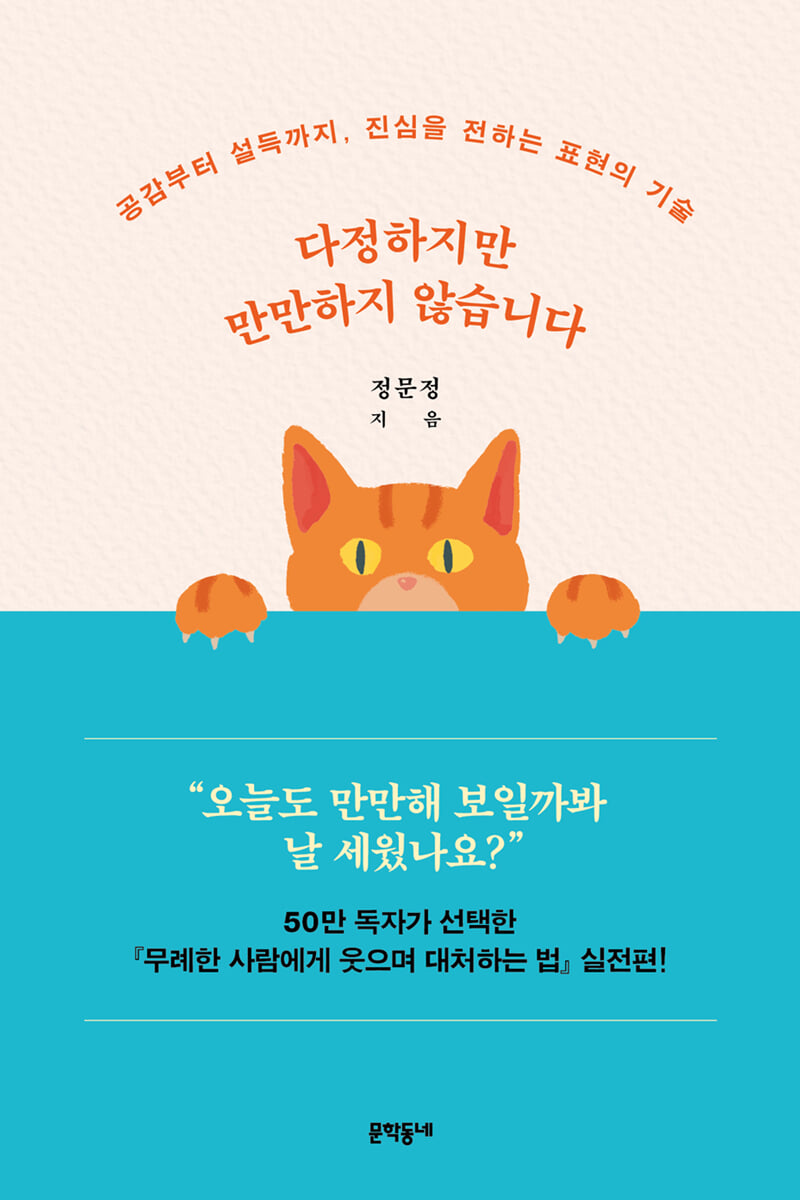
Affectionate but not easy
 |
Description
Book Introduction
★ Bestseller "How to Smile and Deal with Rude People" Practical Edition! ★ 2.5 million views! Learn the essentials of speaking from a renowned speaker on "Sebashi." ★ Includes practical 'tips' that will help you be both affectionate and decisive. “Did you stop me today because you thought I might look easy?” A Guide to Self-Expression for Those Who Find Words and Writing Painful Have you ever blurted out harsh words to avoid seeming cheap, lost your temper in the heat of the moment and let out a loud rage, or held back something you absolutely had to say for fear of ruining a relationship, only to lose sleep and regret it? "Affectionate, But Not Easy" teaches anyone struggling with speech and writing how to express themselves gently and clearly, from those fresh in their careers, brimming with enthusiasm but often filled with tension and mistakes, to organizational leaders who, with experience, unintentionally become "old farts." Author Jeong Moon-jeong, who has previously addressed growth in work and relationships with books like "How to Smile and Deal with Rude People" and "Let's Go to a Better Place," has now turned her attention to "self-expression," filling this book with the core communication skills she has personally acquired. He guides our speech and writing to a better place with his kindness, providing vivid examples from his own experience at the right time, and his inclusiveness, without insisting that his methods are absolutely right. If you're someone who keeps getting sharp when trying to be precise, someone who gets their message unclear when trying to be kind, or someone who's afraid of speaking and writing because they think it's a talent, this book will help you become a master of communication that wins people's favor while still being able to say what you want to say. |
- You can preview some of the book's contents.
Preview
index
Prologue | No one is good at something from the start.
1.
Speak softly, write clearly
: How to convey thoughts and sincerity without misunderstanding or distortion
The mind to write, the attitude to speak
What to add when speaking and what to subtract when writing
The Secret of Classy Speech
TIP! Books to help you improve your vocabulary
It's not that I can't speak, it's that I'm frozen
Lee Geum-hee's hospitality, Yoo Si-min's metaphor, Kim Young-ha's reversal
How to be less swayed by the world's judgment
What is your 'urine bag'?
TIP! Recommended Books for a Soft and Solid Life
2.
Empathize like a salesperson, persuade like a scientist.
: How to win people's hearts
"Keep your eyes wide, keep your ears open": The Power of a Salesman's Mindset
Practice telling kind lies
Why "Good People" Lack Empathy
Good Questions vs. Bad Questions
Why “I’m sorry” isn’t a true apology
What's needed for comfort isn't 'skill' but 'waiting'
My personality and my limit, Cho
TIP! Training methods to increase good language habits and reduce bad ones.
The specialness of 'ordinariness'
The joys and sorrows of context blindness
TIP! Step-by-step practical exercises to enhance your understanding of context.
Now is the time to consult the scientists.
3.
Anger is elegant, rejection is firm
: How to maintain dignity even in the worst situations
Asking gracefully instead of immediately indignantly
What it really means to talk like a lady
Rejection: It's just as important to receive it well as to give it well.
When to empty and when to fill the soul
TIP! How to Transform Your Heart into Public Language
The status of speech begins with the title.
Nonviolent language that maintains dignity even in the worst situations
TIP! Nonviolent Communication: Application Examples for Different Relationships
Before you say you want to be harmless
Yes, we are 'Men'
Epilogue | Practice Raising Life Resolution
supplement
Lecture 1: How to Deal with Rude People with a Smile
Lecture 2: If a person without money or connections wants to go to a better place
Source of citation
1.
Speak softly, write clearly
: How to convey thoughts and sincerity without misunderstanding or distortion
The mind to write, the attitude to speak
What to add when speaking and what to subtract when writing
The Secret of Classy Speech
TIP! Books to help you improve your vocabulary
It's not that I can't speak, it's that I'm frozen
Lee Geum-hee's hospitality, Yoo Si-min's metaphor, Kim Young-ha's reversal
How to be less swayed by the world's judgment
What is your 'urine bag'?
TIP! Recommended Books for a Soft and Solid Life
2.
Empathize like a salesperson, persuade like a scientist.
: How to win people's hearts
"Keep your eyes wide, keep your ears open": The Power of a Salesman's Mindset
Practice telling kind lies
Why "Good People" Lack Empathy
Good Questions vs. Bad Questions
Why “I’m sorry” isn’t a true apology
What's needed for comfort isn't 'skill' but 'waiting'
My personality and my limit, Cho
TIP! Training methods to increase good language habits and reduce bad ones.
The specialness of 'ordinariness'
The joys and sorrows of context blindness
TIP! Step-by-step practical exercises to enhance your understanding of context.
Now is the time to consult the scientists.
3.
Anger is elegant, rejection is firm
: How to maintain dignity even in the worst situations
Asking gracefully instead of immediately indignantly
What it really means to talk like a lady
Rejection: It's just as important to receive it well as to give it well.
When to empty and when to fill the soul
TIP! How to Transform Your Heart into Public Language
The status of speech begins with the title.
Nonviolent language that maintains dignity even in the worst situations
TIP! Nonviolent Communication: Application Examples for Different Relationships
Before you say you want to be harmless
Yes, we are 'Men'
Epilogue | Practice Raising Life Resolution
supplement
Lecture 1: How to Deal with Rude People with a Smile
Lecture 2: If a person without money or connections wants to go to a better place
Source of citation
Detailed image
.jpg)
Into the book
One of the important attitudes in writing is to be uncertain.
It might be different if you're writing for academic purposes.
Essays, for example, are more likely to resonate with readers the more nuanced they are in expressing the process of delving into a problem and the effort to understand the incomprehensible.
If you write decisively as if you are declaring something, the reader may feel burdened.
There is no need to draw a conclusion.
It's okay to leave a lingering impression while giving room for people to think differently.
Rather than someone who explains or persuades everything one by one, the writer is closer to a guide who shows readers the way to appreciate and think for themselves.
---p.20 From “The Mind of Writing, the Attitude of Speaking”
When I have to give a long explanation in front of people, I intentionally use conjunctions actively.
When you feel that the explanation is not enough, use 'for example'; when you want to create a reversal effect, use 'however', 'however', or 'nevertheless'; when you want to emphasize a causal relationship, use 'because of that'; and when you want to emphasize something at the end, use 'if I may add one more thing'.
Putting these expressions in the right places can help your audience anticipate what you're going to say next, which can help you stay focused.
---p.24 From “What to Add When Speaking, What to Subtract When Writing”
It's easy to conclude that "I'm a person who can't speak" because we only vividly remember experiences in situations where self-expression is difficult, but we must not forget that most people are able to speak fluently in comfortable environments.
There is no one who is always speechless.
There are people who just freeze in certain environments.
Start by finding the cause of the tense situation.
Figuring that out will give me the foundation to tell my story without fear.
---pp.46-47 From "It's Not That I Can't Speak, It's That I'm Frozen"
Intellectual speech like that of author Yoo Si-min requires a vast amount of reading, and unexpected speech like that of author Kim Young-ha requires creativity.
Even if you know the secret, it's hard to follow.
Because it is the internal energy of a master that has been perfected through long training.
However, having such a 'big rock face' allows me to know how I want to speak and to realize what practice method I need most right now.
---p.54 From “Lee Geum-hee’s Hospitality, Yoo Si-min’s Metaphor, Kim Young-ha’s Reversal”
In reality, the outcome is often more important than the process in life, but at least in speech and writing, the process is far more important than the outcome (conclusion).
The 'storytelling' technique is more important than the story itself.
Depending on how you tell the story, interesting material can become boring, and vice versa.
Those who know that there are areas where the process is more important than the result will not regret it, even if they wander.
With that power, it maintains its own speed and temperature.
If you polish your writing and speech, you cannot help but trust the process, and if you can trust your own process, you will be less swayed by the world's judgment.
---p.62 From “How to be less swayed by the world’s judgment”
We need to practice lying a little to communicate smoothly.
Lying in this case does not mean deceiving the other person.
It means that you don't have to tell everything honestly as it is.
---p.93 From "Practicing Kind Lies"
The mistakes that 'good people' make are not due to a lack of empathy, as is often said.
They also have a 'kind of' empathy for the suffering of others.
The problem is that this empathy is mostly limited to one's own experiences, values, and situations commonly seen around them.
---p.98 From “Why ‘good people’ lack empathy”
Speaking is not about winning or losing, but an interaction to share thoughts and opinions. Whenever you feel a sense of urgency that you are finished if you don't do it right, you have to reassure yourself that it is not true. When you take your time and take a deep breath, you know that it is okay to say you don't know what you don't know. This is where speaking accurately begins.
---p.178 From “The Real Meaning of Speaking Like a Lady”
As you practice putting information into your speech, you will find that the anger amplifier no longer works.
Because there is no need to nitpick.
If you look closely at the process of an argument, you will see that most of the time, the person is more offended by the attitude with which the message is delivered than by the message itself, and they react emotionally, eventually bursting into flames of anger.
It might be different if you're writing for academic purposes.
Essays, for example, are more likely to resonate with readers the more nuanced they are in expressing the process of delving into a problem and the effort to understand the incomprehensible.
If you write decisively as if you are declaring something, the reader may feel burdened.
There is no need to draw a conclusion.
It's okay to leave a lingering impression while giving room for people to think differently.
Rather than someone who explains or persuades everything one by one, the writer is closer to a guide who shows readers the way to appreciate and think for themselves.
---p.20 From “The Mind of Writing, the Attitude of Speaking”
When I have to give a long explanation in front of people, I intentionally use conjunctions actively.
When you feel that the explanation is not enough, use 'for example'; when you want to create a reversal effect, use 'however', 'however', or 'nevertheless'; when you want to emphasize a causal relationship, use 'because of that'; and when you want to emphasize something at the end, use 'if I may add one more thing'.
Putting these expressions in the right places can help your audience anticipate what you're going to say next, which can help you stay focused.
---p.24 From “What to Add When Speaking, What to Subtract When Writing”
It's easy to conclude that "I'm a person who can't speak" because we only vividly remember experiences in situations where self-expression is difficult, but we must not forget that most people are able to speak fluently in comfortable environments.
There is no one who is always speechless.
There are people who just freeze in certain environments.
Start by finding the cause of the tense situation.
Figuring that out will give me the foundation to tell my story without fear.
---pp.46-47 From "It's Not That I Can't Speak, It's That I'm Frozen"
Intellectual speech like that of author Yoo Si-min requires a vast amount of reading, and unexpected speech like that of author Kim Young-ha requires creativity.
Even if you know the secret, it's hard to follow.
Because it is the internal energy of a master that has been perfected through long training.
However, having such a 'big rock face' allows me to know how I want to speak and to realize what practice method I need most right now.
---p.54 From “Lee Geum-hee’s Hospitality, Yoo Si-min’s Metaphor, Kim Young-ha’s Reversal”
In reality, the outcome is often more important than the process in life, but at least in speech and writing, the process is far more important than the outcome (conclusion).
The 'storytelling' technique is more important than the story itself.
Depending on how you tell the story, interesting material can become boring, and vice versa.
Those who know that there are areas where the process is more important than the result will not regret it, even if they wander.
With that power, it maintains its own speed and temperature.
If you polish your writing and speech, you cannot help but trust the process, and if you can trust your own process, you will be less swayed by the world's judgment.
---p.62 From “How to be less swayed by the world’s judgment”
We need to practice lying a little to communicate smoothly.
Lying in this case does not mean deceiving the other person.
It means that you don't have to tell everything honestly as it is.
---p.93 From "Practicing Kind Lies"
The mistakes that 'good people' make are not due to a lack of empathy, as is often said.
They also have a 'kind of' empathy for the suffering of others.
The problem is that this empathy is mostly limited to one's own experiences, values, and situations commonly seen around them.
---p.98 From “Why ‘good people’ lack empathy”
Speaking is not about winning or losing, but an interaction to share thoughts and opinions. Whenever you feel a sense of urgency that you are finished if you don't do it right, you have to reassure yourself that it is not true. When you take your time and take a deep breath, you know that it is okay to say you don't know what you don't know. This is where speaking accurately begins.
---p.178 From “The Real Meaning of Speaking Like a Lady”
As you practice putting information into your speech, you will find that the anger amplifier no longer works.
Because there is no need to nitpick.
If you look closely at the process of an argument, you will see that most of the time, the person is more offended by the attitude with which the message is delivered than by the message itself, and they react emotionally, eventually bursting into flames of anger.
---p.208 From “Non-violent language that maintains dignity even in the worst situations”
Publisher's Review
The bare minimum of practice needed to say what you want to say properly
Let's put aside the weapons of honesty and hasty apologies.
There's probably at least one person around you who is kind but doesn't seem easy.
A person who is not shy but does not cross the line, and is kind but speaks clearly.
What these people have in common is that they are considerate of others through carefully chosen words and attitudes when speaking, and when communicating in writing, they logically convey what they want from the other person.
The author confesses that, in his ten years of working and many years of teaching, he has met many people who have difficulty communicating, and that he himself is no exception.
However, driven by a strong desire to become proficient in speaking and writing, the fundamentals of communication, I continued to observe and analyze, and ultimately realized that comfort is the beginning of all conversation.
First of all, when speaking, the attitude that comes first is to “take a deep breath, immerse yourself in the situation, relax as much as possible, and speak humbly while trusting the other person and yourself.”
It's easy to give up public speaking altogether, blaming yourself, "Why can't I speak up?" in situations where you're nervous or even afraid, such as giving a presentation to an audience or giving an important meeting.
The author consoles himself by saying that no one is good at speaking from the beginning, but advises that it is helpful to immediately identify situations that make you nervous, create similar situations to practice, and organize your thoughts before speaking.
“The determination to appear professional, the tension of never making a mistake, and the defensive mindset of wanting to attack rather than be attacked all make us appear vulnerable in front of others.” (p. 174)
In addition, we should reduce the use of vague sentence endings and insecure expressions like “I think so.”
Also, you have to be careful when apologizing.
In a problematic situation, saying “I’m sorry” doesn’t solve anything.
Rather than trying to avoid a situation with a hasty apology, suggesting a solution by saying, "How about doing this in this situation?" can reduce mistakes and increase trust.
First of all, let's put aside for a moment the saying that 'honesty is a virtue'.
We can avoid hurting others by telling "friendly lies" that involve being interested in each other's tastes and perspectives.
As remote work expands and face-to-face communication decreases compared to the past, opportunities to encounter examples of smooth communication up close are decreasing.
At this point, "Affectionate but Not Easy" provides practical tips for everyday communication, while also reminding us of the importance of our attitude when approaching a conversation.
“Be careful not to show excessive likes and dislikes, express negative emotions, or have one side talk for too long.
It feels like you're flicking a feather shuttlecock to the other side and receiving it.
Like badminton, which is played as a hobby rather than a competition.
“The kindness of recognizing the other person’s good qualities, discovering commonalities to discuss, and bringing up compliments with the energy to point out something to criticize keeps the relationship going.” (p. 92)
Are you context-blind?
Pause before I raise my voice!
Another reason the author focused on the art of self-expression is that as the platforms on which we spend more time change, the way we communicate also changes.
In particular, 'context blindness', a phenomenon that can be considered a lack of literacy, is related to the instantaneous communication method that has arisen from the comment culture of social media and the popularity of short-form content.
While teaching writing classes to people in their 20s and 30s, the author has often encountered cases where people delve into minor details without any consideration for the context, distorting the speaker's intentions and spreading misinformation.
In the process, I realized that the decline in the ability to understand 'context' made communication difficult.
Understanding context requires a high-level effort, but our disconnected and accelerated communication culture often overlooks its importance.
The author emphasizes the importance of moving away from self-centered thinking and being considerate of others.
In a conversation, it is important to have an open mind and listen to what the other person has to say.
The same goes for writing.
Rather than interpreting someone else's writing through my own framework or preconceptions, I need to first try to understand the context in which the other person wrote the piece and what the writer ultimately wanted to say. This will allow me to express my own opinion more rationally and reasonably.
This training in being considerate of others and situations also shines in private conversations.
Anyone who knows the frustration of hearing someone say they understand something when they don't really know will completely agree with this statement.
“When you feel like saying something to someone, you shouldn’t bring up your own past experiences first, but rather understand how individual the other person’s situation is.
“I deeply feel that the ability to speak well does not come from the clarity of one’s argument, but rather from an interest in understanding what the other person wants to hear and then adjusting to their level.” (p. 174)
Lee Geum-hee's hospitality, Yoo Si-min's metaphor, Kim Young-ha's twist...
To find my own way of speaking and gain empathy
"Affectionate but Not Easy" is composed of three parts.
Part 1, “Speak softly, write clearly,” contains know-how on how to use writing and speaking more effectively.
Since publishing his first book, the author has been actively working as a lecturer and has come to realize the difference between writing and speaking.
Conjunctions should be added in speech and omitted in writing as much as possible.
'Pretend' is necessary in lectures, but dangerous in writing.
Jumping straight to the conclusion can be effective in speech, but it can be reckless in some writing.
Only by knowing the difference between speech and writing can we use them effectively.
Part 2, “Empathize Like a Salesperson, Persuade Like a Scientist,” advises that in order to be good at persuading and arguing, you must learn the speaking skills of scientists and salespeople.
It requires the mind of a salesperson who understands what the other person wants and ultimately makes them curious about his words and writings, and the effort to assert one's opinions based on sufficient evidence without confusing personal beliefs with the realm of facts, just as a scientist retests a hypothesis to establish a theory.
Part 3, "Anger Gracefully, Rejection Firmly," offers tips on how to speak gracefully even in the worst situations.
Our words and writings are filled with emotions, such as persuasion, rejection, comfort, and anger.
When words and writing hurt, it is often because these emotions are revealed without filtering.
The author emphasizes again that respect for the recipient of speech and writing is of utmost importance.
Rather than just expressing our emotions, we examine our own thoughts and consider the other person's perspective, which gives us the opportunity to empathize with each other and persuade each other through conversation.
The author believes that speaking and writing with respect for others can foster personal and relationship growth.
Because speech and writing are areas where the process is as important as the result (conclusion) due to the message, method of delivery, attitude, and expression.
If you've ever felt uncomfortable and frustrated at having to express your opinions in a haphazard manner or living in a gray area, obscuring your own, why not learn the skills to communicate comfortably, both verbally and in writing, and expand both your diversity and uniqueness through this book?
Just as Yoo Si-min, whose logical speaking skills are strong, Kim Young-ha, a master of creative reversals, and Lee Geum-hee, brimming with kindness and consideration, speak, if we examine our own style of expression and consistently strive for it, we too can sufficiently develop the ability to convey sincerity and elicit empathy.
“When I admired writer Yoo Si-min, I wanted to speak logically. When I envied writer Kim Young-ha, I wanted to speak interestingly. These days, when I often watch announcer Lee Geum-hee’s videos, I want to speak comfortably and softly, without being too forceful.
It's good to read books by teachers you want to be like, but it's especially helpful to watch and listen to videos frequently.
“The more desperate you are, the more you will begin to resemble each other, even if only in subtle ways.” (p. 55)
Let's put aside the weapons of honesty and hasty apologies.
There's probably at least one person around you who is kind but doesn't seem easy.
A person who is not shy but does not cross the line, and is kind but speaks clearly.
What these people have in common is that they are considerate of others through carefully chosen words and attitudes when speaking, and when communicating in writing, they logically convey what they want from the other person.
The author confesses that, in his ten years of working and many years of teaching, he has met many people who have difficulty communicating, and that he himself is no exception.
However, driven by a strong desire to become proficient in speaking and writing, the fundamentals of communication, I continued to observe and analyze, and ultimately realized that comfort is the beginning of all conversation.
First of all, when speaking, the attitude that comes first is to “take a deep breath, immerse yourself in the situation, relax as much as possible, and speak humbly while trusting the other person and yourself.”
It's easy to give up public speaking altogether, blaming yourself, "Why can't I speak up?" in situations where you're nervous or even afraid, such as giving a presentation to an audience or giving an important meeting.
The author consoles himself by saying that no one is good at speaking from the beginning, but advises that it is helpful to immediately identify situations that make you nervous, create similar situations to practice, and organize your thoughts before speaking.
“The determination to appear professional, the tension of never making a mistake, and the defensive mindset of wanting to attack rather than be attacked all make us appear vulnerable in front of others.” (p. 174)
In addition, we should reduce the use of vague sentence endings and insecure expressions like “I think so.”
Also, you have to be careful when apologizing.
In a problematic situation, saying “I’m sorry” doesn’t solve anything.
Rather than trying to avoid a situation with a hasty apology, suggesting a solution by saying, "How about doing this in this situation?" can reduce mistakes and increase trust.
First of all, let's put aside for a moment the saying that 'honesty is a virtue'.
We can avoid hurting others by telling "friendly lies" that involve being interested in each other's tastes and perspectives.
As remote work expands and face-to-face communication decreases compared to the past, opportunities to encounter examples of smooth communication up close are decreasing.
At this point, "Affectionate but Not Easy" provides practical tips for everyday communication, while also reminding us of the importance of our attitude when approaching a conversation.
“Be careful not to show excessive likes and dislikes, express negative emotions, or have one side talk for too long.
It feels like you're flicking a feather shuttlecock to the other side and receiving it.
Like badminton, which is played as a hobby rather than a competition.
“The kindness of recognizing the other person’s good qualities, discovering commonalities to discuss, and bringing up compliments with the energy to point out something to criticize keeps the relationship going.” (p. 92)
Are you context-blind?
Pause before I raise my voice!
Another reason the author focused on the art of self-expression is that as the platforms on which we spend more time change, the way we communicate also changes.
In particular, 'context blindness', a phenomenon that can be considered a lack of literacy, is related to the instantaneous communication method that has arisen from the comment culture of social media and the popularity of short-form content.
While teaching writing classes to people in their 20s and 30s, the author has often encountered cases where people delve into minor details without any consideration for the context, distorting the speaker's intentions and spreading misinformation.
In the process, I realized that the decline in the ability to understand 'context' made communication difficult.
Understanding context requires a high-level effort, but our disconnected and accelerated communication culture often overlooks its importance.
The author emphasizes the importance of moving away from self-centered thinking and being considerate of others.
In a conversation, it is important to have an open mind and listen to what the other person has to say.
The same goes for writing.
Rather than interpreting someone else's writing through my own framework or preconceptions, I need to first try to understand the context in which the other person wrote the piece and what the writer ultimately wanted to say. This will allow me to express my own opinion more rationally and reasonably.
This training in being considerate of others and situations also shines in private conversations.
Anyone who knows the frustration of hearing someone say they understand something when they don't really know will completely agree with this statement.
“When you feel like saying something to someone, you shouldn’t bring up your own past experiences first, but rather understand how individual the other person’s situation is.
“I deeply feel that the ability to speak well does not come from the clarity of one’s argument, but rather from an interest in understanding what the other person wants to hear and then adjusting to their level.” (p. 174)
Lee Geum-hee's hospitality, Yoo Si-min's metaphor, Kim Young-ha's twist...
To find my own way of speaking and gain empathy
"Affectionate but Not Easy" is composed of three parts.
Part 1, “Speak softly, write clearly,” contains know-how on how to use writing and speaking more effectively.
Since publishing his first book, the author has been actively working as a lecturer and has come to realize the difference between writing and speaking.
Conjunctions should be added in speech and omitted in writing as much as possible.
'Pretend' is necessary in lectures, but dangerous in writing.
Jumping straight to the conclusion can be effective in speech, but it can be reckless in some writing.
Only by knowing the difference between speech and writing can we use them effectively.
Part 2, “Empathize Like a Salesperson, Persuade Like a Scientist,” advises that in order to be good at persuading and arguing, you must learn the speaking skills of scientists and salespeople.
It requires the mind of a salesperson who understands what the other person wants and ultimately makes them curious about his words and writings, and the effort to assert one's opinions based on sufficient evidence without confusing personal beliefs with the realm of facts, just as a scientist retests a hypothesis to establish a theory.
Part 3, "Anger Gracefully, Rejection Firmly," offers tips on how to speak gracefully even in the worst situations.
Our words and writings are filled with emotions, such as persuasion, rejection, comfort, and anger.
When words and writing hurt, it is often because these emotions are revealed without filtering.
The author emphasizes again that respect for the recipient of speech and writing is of utmost importance.
Rather than just expressing our emotions, we examine our own thoughts and consider the other person's perspective, which gives us the opportunity to empathize with each other and persuade each other through conversation.
The author believes that speaking and writing with respect for others can foster personal and relationship growth.
Because speech and writing are areas where the process is as important as the result (conclusion) due to the message, method of delivery, attitude, and expression.
If you've ever felt uncomfortable and frustrated at having to express your opinions in a haphazard manner or living in a gray area, obscuring your own, why not learn the skills to communicate comfortably, both verbally and in writing, and expand both your diversity and uniqueness through this book?
Just as Yoo Si-min, whose logical speaking skills are strong, Kim Young-ha, a master of creative reversals, and Lee Geum-hee, brimming with kindness and consideration, speak, if we examine our own style of expression and consistently strive for it, we too can sufficiently develop the ability to convey sincerity and elicit empathy.
“When I admired writer Yoo Si-min, I wanted to speak logically. When I envied writer Kim Young-ha, I wanted to speak interestingly. These days, when I often watch announcer Lee Geum-hee’s videos, I want to speak comfortably and softly, without being too forceful.
It's good to read books by teachers you want to be like, but it's especially helpful to watch and listen to videos frequently.
“The more desperate you are, the more you will begin to resemble each other, even if only in subtle ways.” (p. 55)
GOODS SPECIFICS
- Date of issue: May 3, 2024
- Page count, weight, size: 256 pages | 338g | 140*210*15mm
- ISBN13: 9791141600020
- ISBN10: 1141600021
You may also like
카테고리
korean


korean

![GQ KOREA Mark (Monthly): December [2025]](http://librairie.coreenne.fr/cdn/shop/files/8ef265dbbfbf186523ed75ba7319009d.jpg?v=1765340328&width=3840)


