

Moby Dick
 |
Description
Book Introduction
“At the end of the world’s most dangerous and longest voyage,
The second voyage begins… … ”
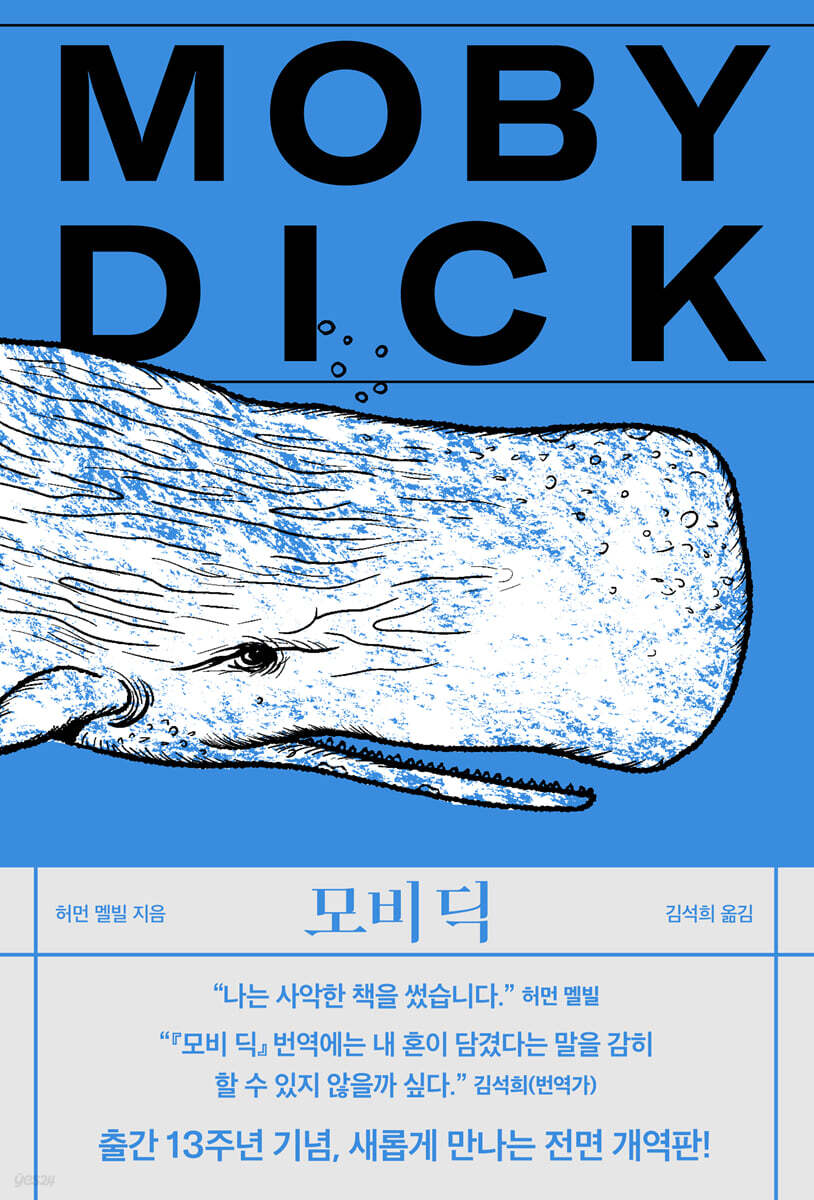
Celebrating the 13th anniversary of publication, a new, fully revised edition is available!
A complete translation of Moby Dick, translated by Kim Seok-hee, Korea's best translator.
“I dare say that my soul was poured into the translation of ‘Moby Dick.’” _Kim Seok-hee (translator)
Moby Dick, a reverent hymn to the largest mammal on Earth, resembling the vast mysteries of the universe, and an encyclopedia of vast and absolute knowledge about whales.
A completely revised edition of Moby Dick, considered one of the three greatest tragedies written in English along with King Lear and Wuthering Heights, has been published.
Herman Melville's Moby Dick, written in a refined, epic prose, is a unique novel that includes etymological research and excerpts about whales from the beginning, as well as the author's experience as a whaling ship crew member and the various knowledge he gathered about whales and whaling from research and study at the library.
At the time of its publication, it was dismissed as difficult and unfamiliar, but it began to be re-evaluated about 30 years after the author's death, and today it has become a masterpiece representing American literature.
"Moby Dick" is a work that depicts the desperate duel and demise of Captain Ahab and his crew who embark on a quest for revenge after losing one of his legs to the giant white whale, Moby Dick, which inspires fear and awe.
The crew of the Pequod may have already been overcome by the great 'white terror', by the primordial nature, from the moment they began this incredible chase that would lead them across all the seas of the earth.
After a beautiful yet terrifying voyage, they finally meet Moby Dick after much suffering, but the moment of revenge is a moment of destruction, and they quietly sink into the sea that swallows up countless questions.
This novel, filled with knowledge about whales and whaling that humanity has explored and accumulated, and philosophical meditations on the universe and humanity, makes us reflect on the multiple defeats and triumphs of the human soul, the impulse to destruction, the conflict between good and evil, and the very existence of humanity through the tragedy of Ahab, whose soul is paralyzed by a negative and gloomy worldview.
The confrontation between Ahab and Moby Dick in the ocean brings to mind the image of humanity opposing the will of nature and the power of the universe, and at that time, the ocean becomes a place that teaches us about the providence of the universe and the tragedy of life.
This book was revised and revised through a comprehensive comparison of the original manuscript by translator Seok-hee Kim, who was the first to translate and introduce a full-fledged translation of Moby Dick in Korea. He supplemented the existing edition with approximately 150 translated notes, ensuring that it is a definitive edition.
In addition, it helps readers understand the profound implications of the novel through character introductions, the author's chronology, translator's commentary, and interviews. It also includes a wealth of related materials for readers without specific prior knowledge of whaling, including navigational maps, illustrations and photographs of whaling ships, and the structure of whaling ships' hulls and decks.
This revised edition will serve as a guide to a deeper understanding of the deep and expansive world of Moby Dick, considered one of the greatest works of all time.
The second voyage begins… … ”
Celebrating the 13th anniversary of publication, a new, fully revised edition is available!
A complete translation of Moby Dick, translated by Kim Seok-hee, Korea's best translator.
“I dare say that my soul was poured into the translation of ‘Moby Dick.’” _Kim Seok-hee (translator)
Moby Dick, a reverent hymn to the largest mammal on Earth, resembling the vast mysteries of the universe, and an encyclopedia of vast and absolute knowledge about whales.
A completely revised edition of Moby Dick, considered one of the three greatest tragedies written in English along with King Lear and Wuthering Heights, has been published.
Herman Melville's Moby Dick, written in a refined, epic prose, is a unique novel that includes etymological research and excerpts about whales from the beginning, as well as the author's experience as a whaling ship crew member and the various knowledge he gathered about whales and whaling from research and study at the library.
At the time of its publication, it was dismissed as difficult and unfamiliar, but it began to be re-evaluated about 30 years after the author's death, and today it has become a masterpiece representing American literature.
"Moby Dick" is a work that depicts the desperate duel and demise of Captain Ahab and his crew who embark on a quest for revenge after losing one of his legs to the giant white whale, Moby Dick, which inspires fear and awe.
The crew of the Pequod may have already been overcome by the great 'white terror', by the primordial nature, from the moment they began this incredible chase that would lead them across all the seas of the earth.
After a beautiful yet terrifying voyage, they finally meet Moby Dick after much suffering, but the moment of revenge is a moment of destruction, and they quietly sink into the sea that swallows up countless questions.
This novel, filled with knowledge about whales and whaling that humanity has explored and accumulated, and philosophical meditations on the universe and humanity, makes us reflect on the multiple defeats and triumphs of the human soul, the impulse to destruction, the conflict between good and evil, and the very existence of humanity through the tragedy of Ahab, whose soul is paralyzed by a negative and gloomy worldview.
The confrontation between Ahab and Moby Dick in the ocean brings to mind the image of humanity opposing the will of nature and the power of the universe, and at that time, the ocean becomes a place that teaches us about the providence of the universe and the tragedy of life.
This book was revised and revised through a comprehensive comparison of the original manuscript by translator Seok-hee Kim, who was the first to translate and introduce a full-fledged translation of Moby Dick in Korea. He supplemented the existing edition with approximately 150 translated notes, ensuring that it is a definitive edition.
In addition, it helps readers understand the profound implications of the novel through character introductions, the author's chronology, translator's commentary, and interviews. It also includes a wealth of related materials for readers without specific prior knowledge of whaling, including navigational maps, illustrations and photographs of whaling ships, and the structure of whaling ships' hulls and decks.
This revised edition will serve as a guide to a deeper understanding of the deep and expansive world of Moby Dick, considered one of the greatest works of all time.
- You can preview some of the book's contents.
Preview
index
Etymology 21
Excerpt 23
Chapter 1: Things Visible in the Dark 43
Chapter 2: Travel Bag 51
Chapter 3: Water Spray Inn 57
Chapter 4: Blankets 76
Chapter 5 Breakfast 81
Chapter 6: Street 83
Chapter 7: Chapel 87
Chapter 8: The Pulpit 91
Chapter 9 Sermon 94
Chapter 10: True Friends 107
Chapter 11 Pajamas 112
Chapter 12: A Brief Life 114
Chapter 13: Wheelbarrow 117
Chapter 14 Nantucket 123
Chapter 15 Chowder 126
Chapter 16: Ship 130
Chapter 17 Ramadan 148
Chapter 18: Queequeg's Sign 155
Chapter 19: The Prophet 160
Chapter 20: Preparing for Departure 165
Chapter 21: Boarding 168
Chapter 22: Merry Christmas 172
Chapter 23: The Windward Shore 178
Chapter 24: Defense 179
Chapter 25 Addendum 185
Chapter 26: Knights and Seekers 186
Chapter 27: Knights and Seekers (continued) 191
Chapter 28: Captain Ahab 197
Chapter 29: Ahab Appears, followed by Stubbs 202
Chapter 30: Pipes 205
Chapter 31: Queen Maeve 207
Chapter 32: Whale Science 209
Chapter 33: The Spearfishing Grounds 226
Chapter 34: The Captain's Table 229
Chapter 35: The Mast Tower 237
Chapter 36: The Quarterdeck 245
Chapter 37: Sunset 256
Chapter 38: Twilight 258
Chapter 39: The First Night 260
Chapter 40: Midnight, Foredeck 261
Chapter 41: Moby Dick 271
Chapter 42: The White of the Whale 283
Chapter 43: Listen carefully! 295
Chapter 44: Sea 296
Chapter 45 Statement 303
Chapter 46: Conjecture 314
Chapter 47: Weaving a Giant 317
Chapter 48: The First Pursuit 320
Chapter 49: Hyena 333
Chapter 50: Ahab's Boat and His Men, and Pedalla 336
Chapter 51: Ghostly Spray 339
Chapter 52: The Albatross, 344
Chapter 53: Social Visits 347
Chapter 54: The Story of the Township 352
Chapter 55: Strange Whale Drawings 378
Chapter 56 Less Wrong Whale Drawings
384 Proper Whaling Scene Pictures
Chapter 57: Whales Appearing in Paintings, Teeth, Trees, Sheet Metal, Stones, Mountains, and Stars (389)
Chapter 58: Krill 392
Chapter 59: Squid 395
Chapter 60: The Harpoon Rope 399
Chapter 61: Stubb Kills the Whale 403
Chapter 62: Harpoon Throwing 410
Chapter 63: The Harpoon Stand 412
Chapter 64: Stubb's Dinner 413
Chapter 65: Whale Meat Dishes 423
Chapter 66: Shark Massacre 426
Chapter 67: Whale Dismemberment 428
Chapter 68: Blankets 430
Chapter 69: Funeral 434
Chapter 70: The Sphinx 436
Chapter 71: The Story of the Jerboam 439
Chapter 72: The Monkey Rope 447
Chapter 73: Stubb and Flask Talk After Catching a Whale (452)
Chapter 74: The Sperm Whale's Head - A Comparative Study 459
Chapter 75: The Head of the Whale - A Comparative Study 464
Chapter 76: The Battle of the Pause 468
Chapter 77: The Giant Heidelberg Cask 471
Chapter 78: Oil Barrels and Buckets 473
Chapter 79: The Prairie 478
Chapter 80 Head 482
Chapter 81: Pequod Meets Jungfrau 484
Chapter 82: The Honor and Glory of Whaling 498
Chapter 83: Jonah in Historical Perspective 502
Chapter 84: Javelin Throw 504
Chapter 85: Water Spray 507
Chapter 86: Tail 513
Chapter 87: The Invincible Fleet 520
Chapter 88: Schools and Teachers 535
Chapter 89: The Caught and the Missing Whales 539
Chapter 90: Head or Tail 544
Chapter 91: The Pequod Meets the Rosebud 548
Chapter 92: Dragon Breath 556
Chapter 93: Castaways 559
Chapter 94: Squeezing by Hand 565
Chapter 95: Priestly Vestments 569
Chapter 96: Oil Furnace 571
Chapter 97: Lamp 577
Chapter 98: Stacking and Clearing 578
Chapter 99: Doblon Gold Coin 581
Chapter 100: Legs and Arms - The Pequod of Nantucket meets the Samuel Enderby of London. 590
Chapter 101: The Bottle 599
Chapter 102: The Shade of the Trees of the Arsacid Islands 605
Chapter 103: Dimensions of the Whale Skeleton 610
Chapter 104: Fossil Whales 613
Chapter 105: Are Whales Shrinking? Will They Go Extinct? 618
Chapter 106: Ahab's Bridge 623
Chapter 107: Carpenters 626
Chapter 108: Ahab and the Carpenter 630
Chapter 109: Ahab and Starbuck in the Captain's Cabin 635
Chapter 110: Queequeg in the Coffin 639
Chapter 111: Pacific 646
Chapter 112: The Blacksmith 648
Chapter 113: The Blacksmith 651
Chapter 114: The Goldsmith 655
Chapter 115: The Pequod Meets the Bachelor (658)
Chapter 116: The Dying Whale 661
Chapter 117: The Whale Watcher 663
Chapter 118: 665 Quarters
Chapter 119: Three Candles 668
Chapter 120: Deck 678 at the End of the First Night
Chapter 121: Midnight - Foredeck, 679
Chapter 122: The Midnight Watchtower - Thunder and Lightning 681
Chapter 123: Muskets 682
Chapter 124: The Compass Needle 686
Chapter 125: Measurement and the Line 690
Chapter 126: Lifebuoys 695
Chapter 127 Deck 699
Chapter 128: The Pequod Meets the Rachel 702
Chapter 129: Captain's Room 707
Chapter 130: Hats 709
Chapter 131: The Pequod Meets the Delight 715
Symphony No. 132, No. 717
Chapter 133: The Pursuit - Day 1, 723
Chapter 134: The Pursuit - Day 2, 735
Chapter 135: The Pursuit - Day 3, 746
Epilogue 762
Translator's Note 765
Author's chronology 783
Appendix 793
Excerpt 23
Chapter 1: Things Visible in the Dark 43
Chapter 2: Travel Bag 51
Chapter 3: Water Spray Inn 57
Chapter 4: Blankets 76
Chapter 5 Breakfast 81
Chapter 6: Street 83
Chapter 7: Chapel 87
Chapter 8: The Pulpit 91
Chapter 9 Sermon 94
Chapter 10: True Friends 107
Chapter 11 Pajamas 112
Chapter 12: A Brief Life 114
Chapter 13: Wheelbarrow 117
Chapter 14 Nantucket 123
Chapter 15 Chowder 126
Chapter 16: Ship 130
Chapter 17 Ramadan 148
Chapter 18: Queequeg's Sign 155
Chapter 19: The Prophet 160
Chapter 20: Preparing for Departure 165
Chapter 21: Boarding 168
Chapter 22: Merry Christmas 172
Chapter 23: The Windward Shore 178
Chapter 24: Defense 179
Chapter 25 Addendum 185
Chapter 26: Knights and Seekers 186
Chapter 27: Knights and Seekers (continued) 191
Chapter 28: Captain Ahab 197
Chapter 29: Ahab Appears, followed by Stubbs 202
Chapter 30: Pipes 205
Chapter 31: Queen Maeve 207
Chapter 32: Whale Science 209
Chapter 33: The Spearfishing Grounds 226
Chapter 34: The Captain's Table 229
Chapter 35: The Mast Tower 237
Chapter 36: The Quarterdeck 245
Chapter 37: Sunset 256
Chapter 38: Twilight 258
Chapter 39: The First Night 260
Chapter 40: Midnight, Foredeck 261
Chapter 41: Moby Dick 271
Chapter 42: The White of the Whale 283
Chapter 43: Listen carefully! 295
Chapter 44: Sea 296
Chapter 45 Statement 303
Chapter 46: Conjecture 314
Chapter 47: Weaving a Giant 317
Chapter 48: The First Pursuit 320
Chapter 49: Hyena 333
Chapter 50: Ahab's Boat and His Men, and Pedalla 336
Chapter 51: Ghostly Spray 339
Chapter 52: The Albatross, 344
Chapter 53: Social Visits 347
Chapter 54: The Story of the Township 352
Chapter 55: Strange Whale Drawings 378
Chapter 56 Less Wrong Whale Drawings
384 Proper Whaling Scene Pictures
Chapter 57: Whales Appearing in Paintings, Teeth, Trees, Sheet Metal, Stones, Mountains, and Stars (389)
Chapter 58: Krill 392
Chapter 59: Squid 395
Chapter 60: The Harpoon Rope 399
Chapter 61: Stubb Kills the Whale 403
Chapter 62: Harpoon Throwing 410
Chapter 63: The Harpoon Stand 412
Chapter 64: Stubb's Dinner 413
Chapter 65: Whale Meat Dishes 423
Chapter 66: Shark Massacre 426
Chapter 67: Whale Dismemberment 428
Chapter 68: Blankets 430
Chapter 69: Funeral 434
Chapter 70: The Sphinx 436
Chapter 71: The Story of the Jerboam 439
Chapter 72: The Monkey Rope 447
Chapter 73: Stubb and Flask Talk After Catching a Whale (452)
Chapter 74: The Sperm Whale's Head - A Comparative Study 459
Chapter 75: The Head of the Whale - A Comparative Study 464
Chapter 76: The Battle of the Pause 468
Chapter 77: The Giant Heidelberg Cask 471
Chapter 78: Oil Barrels and Buckets 473
Chapter 79: The Prairie 478
Chapter 80 Head 482
Chapter 81: Pequod Meets Jungfrau 484
Chapter 82: The Honor and Glory of Whaling 498
Chapter 83: Jonah in Historical Perspective 502
Chapter 84: Javelin Throw 504
Chapter 85: Water Spray 507
Chapter 86: Tail 513
Chapter 87: The Invincible Fleet 520
Chapter 88: Schools and Teachers 535
Chapter 89: The Caught and the Missing Whales 539
Chapter 90: Head or Tail 544
Chapter 91: The Pequod Meets the Rosebud 548
Chapter 92: Dragon Breath 556
Chapter 93: Castaways 559
Chapter 94: Squeezing by Hand 565
Chapter 95: Priestly Vestments 569
Chapter 96: Oil Furnace 571
Chapter 97: Lamp 577
Chapter 98: Stacking and Clearing 578
Chapter 99: Doblon Gold Coin 581
Chapter 100: Legs and Arms - The Pequod of Nantucket meets the Samuel Enderby of London. 590
Chapter 101: The Bottle 599
Chapter 102: The Shade of the Trees of the Arsacid Islands 605
Chapter 103: Dimensions of the Whale Skeleton 610
Chapter 104: Fossil Whales 613
Chapter 105: Are Whales Shrinking? Will They Go Extinct? 618
Chapter 106: Ahab's Bridge 623
Chapter 107: Carpenters 626
Chapter 108: Ahab and the Carpenter 630
Chapter 109: Ahab and Starbuck in the Captain's Cabin 635
Chapter 110: Queequeg in the Coffin 639
Chapter 111: Pacific 646
Chapter 112: The Blacksmith 648
Chapter 113: The Blacksmith 651
Chapter 114: The Goldsmith 655
Chapter 115: The Pequod Meets the Bachelor (658)
Chapter 116: The Dying Whale 661
Chapter 117: The Whale Watcher 663
Chapter 118: 665 Quarters
Chapter 119: Three Candles 668
Chapter 120: Deck 678 at the End of the First Night
Chapter 121: Midnight - Foredeck, 679
Chapter 122: The Midnight Watchtower - Thunder and Lightning 681
Chapter 123: Muskets 682
Chapter 124: The Compass Needle 686
Chapter 125: Measurement and the Line 690
Chapter 126: Lifebuoys 695
Chapter 127 Deck 699
Chapter 128: The Pequod Meets the Rachel 702
Chapter 129: Captain's Room 707
Chapter 130: Hats 709
Chapter 131: The Pequod Meets the Delight 715
Symphony No. 132, No. 717
Chapter 133: The Pursuit - Day 1, 723
Chapter 134: The Pursuit - Day 2, 735
Chapter 135: The Pursuit - Day 3, 746
Epilogue 762
Translator's Note 765
Author's chronology 783
Appendix 793
Detailed image

Into the book
“But, my friends, on the other side of all suffering, there is a definite joy.
And the peak of joy is higher than the bottom of suffering.
Is not the watchtower higher than the low keel? There is joy in defying the proud gods and captains of this earth and asserting one's own unwavering self.
--- p.106
The end of the world's most dangerous and longest voyage means the beginning of a second voyage, and when the second ends, a third begins, and so on forever.
That endless continuation is the unbearable toil of the world.
--- p.120
From a dramatic point of view, such a character would have an overwhelming melancholy that would seem almost intentional, whether innate or due to other circumstances, but that would not in the least diminish his value.
Tragically, great men become so through pathological depression.
Ambitious young people, take note.
That human greatness is nothing but a disease.
--- p.139
In other words, even the brave warriors who had been charging recklessly toward the battery would immediately cower in surprise when the huge tail of a sperm whale suddenly appeared and stirred the air above their heads, creating a whirlwind.
Because compared to the intricately intertwined wonders and horrors of God, the fears that humans can understand are nothing.
--- p.180
People of honest hearts refrain from the kind of reckless behavior often exhibited by others in dangerous professions such as whaling.
“I will never take on board a boat that is not afraid of whales,” said Starbuck.
This meant not only that the most reliable and useful courage comes from properly assessing danger when faced with it, but also that a fearless man is a far more dangerous comrade than a coward.
--- p.188
In this strangely tangled mess we call life, there are strange moments when the entire universe seems like a joke of colossal proportions.
(...) The strange whims I am talking about come only at moments when a person is going through extreme trials.
Because he comes only at the most serious moments, what seemed like the most serious thing just a moment ago now feels like nothing more than part of a routine joke.
There is nothing more suitable for the birth of this free and easy philosophy than whaling, with all its dangers.
--- pp.333-334
Every human being lives surrounded by a harpoon rope.
Every human being is born with a rope around their neck.
But it is only when life suddenly takes a sharp turn toward death that humans become aware of the silent, elusive, yet ever-present dangers of life.
If you are a philosopher, you will not feel any more fear when you sit in a whaling boat than when you sit by the fire with a poker instead of a harpoon.
--- p.403
It is here that the whale's unique vitality, its thick walls and spacious interior, and its rare effectiveness are evident.
Oh, humans! Praise the whales and emulate them! You too, keep warm in the ice.
You too, do not become a part of this world, but live in this world.
Stay cool at the equator, and keep your blood flowing at the poles.
Oh, humans! Like the great dome of St. Peter's Basilica, and like the whale, maintain your own body temperature at all times.
--- p.434
What else are human rights and world freedom but "missed whales"? What else are the minds and thoughts of all humans but "missed whales"? What else are the principles of their religious beliefs but "missed whales"? What else are the philosopher's thoughts to the plagiarizing pseudo-literati but "missed whales"? What else is this vast Earth itself but "missed whales"? And readers, what else are you, too, but both "missed whales" and "caught whales"?
--- p.543
In our lives, there is no such thing as a constant progression that does not go back the way it came.
Nor does it proceed through a set of stages and then stop at the final stage? That is, it does not proceed through the unconscious intoxication of childhood, the blind faith of boyhood, the doubt of adolescence (which is the fate of all people), then the stages of skepticism and distrust, and finally stop at the stage of adulthood's careful consideration and contemplation, thinking, "What if?"
Once we've gone through all those stages, we go back to the first stage, through childhood and adolescence, and then into adulthood, repeating the 'what if' forever.
--- p.657
O mighty waves of my past life, surge from the distant shores, and raise the high tide of my death even higher! O whale, who destroys all but never conquers! I run to you.
I will fight with you to the end.
I will stab you in the middle of hell and spit my last breath full of hatred at you.
And the peak of joy is higher than the bottom of suffering.
Is not the watchtower higher than the low keel? There is joy in defying the proud gods and captains of this earth and asserting one's own unwavering self.
--- p.106
The end of the world's most dangerous and longest voyage means the beginning of a second voyage, and when the second ends, a third begins, and so on forever.
That endless continuation is the unbearable toil of the world.
--- p.120
From a dramatic point of view, such a character would have an overwhelming melancholy that would seem almost intentional, whether innate or due to other circumstances, but that would not in the least diminish his value.
Tragically, great men become so through pathological depression.
Ambitious young people, take note.
That human greatness is nothing but a disease.
--- p.139
In other words, even the brave warriors who had been charging recklessly toward the battery would immediately cower in surprise when the huge tail of a sperm whale suddenly appeared and stirred the air above their heads, creating a whirlwind.
Because compared to the intricately intertwined wonders and horrors of God, the fears that humans can understand are nothing.
--- p.180
People of honest hearts refrain from the kind of reckless behavior often exhibited by others in dangerous professions such as whaling.
“I will never take on board a boat that is not afraid of whales,” said Starbuck.
This meant not only that the most reliable and useful courage comes from properly assessing danger when faced with it, but also that a fearless man is a far more dangerous comrade than a coward.
--- p.188
In this strangely tangled mess we call life, there are strange moments when the entire universe seems like a joke of colossal proportions.
(...) The strange whims I am talking about come only at moments when a person is going through extreme trials.
Because he comes only at the most serious moments, what seemed like the most serious thing just a moment ago now feels like nothing more than part of a routine joke.
There is nothing more suitable for the birth of this free and easy philosophy than whaling, with all its dangers.
--- pp.333-334
Every human being lives surrounded by a harpoon rope.
Every human being is born with a rope around their neck.
But it is only when life suddenly takes a sharp turn toward death that humans become aware of the silent, elusive, yet ever-present dangers of life.
If you are a philosopher, you will not feel any more fear when you sit in a whaling boat than when you sit by the fire with a poker instead of a harpoon.
--- p.403
It is here that the whale's unique vitality, its thick walls and spacious interior, and its rare effectiveness are evident.
Oh, humans! Praise the whales and emulate them! You too, keep warm in the ice.
You too, do not become a part of this world, but live in this world.
Stay cool at the equator, and keep your blood flowing at the poles.
Oh, humans! Like the great dome of St. Peter's Basilica, and like the whale, maintain your own body temperature at all times.
--- p.434
What else are human rights and world freedom but "missed whales"? What else are the minds and thoughts of all humans but "missed whales"? What else are the principles of their religious beliefs but "missed whales"? What else are the philosopher's thoughts to the plagiarizing pseudo-literati but "missed whales"? What else is this vast Earth itself but "missed whales"? And readers, what else are you, too, but both "missed whales" and "caught whales"?
--- p.543
In our lives, there is no such thing as a constant progression that does not go back the way it came.
Nor does it proceed through a set of stages and then stop at the final stage? That is, it does not proceed through the unconscious intoxication of childhood, the blind faith of boyhood, the doubt of adolescence (which is the fate of all people), then the stages of skepticism and distrust, and finally stop at the stage of adulthood's careful consideration and contemplation, thinking, "What if?"
Once we've gone through all those stages, we go back to the first stage, through childhood and adolescence, and then into adulthood, repeating the 'what if' forever.
--- p.657
O mighty waves of my past life, surge from the distant shores, and raise the high tide of my death even higher! O whale, who destroys all but never conquers! I run to you.
I will fight with you to the end.
I will stab you in the middle of hell and spit my last breath full of hatred at you.
--- p.760
Publisher's Review
“I wrote a wicked book” (Herman Melville)
Even today, with various hints and symbols
A problematic work that has produced countless interpretations and evaluations
A thrilling adventure novel depicting the struggles and ruin of a man consumed by obsession and madness, a masterpiece of maritime literature, a Gothic novel full of mystery and horror, and a masterpiece of symbolism or naturalism.
The narrator of Moby Dick, which has been interpreted and evaluated from various angles, is 'Ishmael', a being who is like an alter ego of Herman Melville himself, who was born with a wanderlust.
Ishmael, fed up with life on land, leaves Manhattan, New York, and arrives in New Bedford to encounter a wondrous and mysterious monster, a gigantic whale.
And here, at the inn, he meets Queequeg, a strange, tattooed savage, and feels a genuine humanity that he rarely finds in Christians, and he heads to Nantucket with him.
They board the whaling ship Pequod and set out on a fateful voyage on Christmas Day, but just before boarding, they are warned of their doomed fate by a madman named Elijah.
Ishmael, who boarded the whaling ship Pequod despite the priest's warning that "those who challenge the sea will lose their souls," is surprised to see Captain Ahab, who shows up only a few days after setting sail.
He was missing one leg and had a prosthetic leg made of whalebone, and he was on this ship to find Moby Dick and take revenge.
Ahab, ignoring the advice of Starbuck, the first mate and devout Christian, who advised him against such a risky voyage, continued his voyage in pursuit of Moby Dick, rounding the Cape of Good Hope in the Atlantic, into the Indian Ocean, and then into the Pacific.
And finally, after a long voyage, they discover a white whale with countless harpoons stuck in it, thrown from various whaling ships.
“The fruit of my wanderings through libraries and the oceans.”
Consisting of 240,000 words and 135 chapters in total
An encyclopedia of vast and definitive knowledge about whales
The whaling industry in 19th century America enjoyed great prosperity.
The number of whaling ships was three times greater than the number of whaling ships in all of Europe combined.
The story of the huge and ferocious whale 'Mocha Dick', which had long plagued American whalers at the time, was published in the Knickerbocker Magazine in May 1839. Prior to this, in 1820, Owen Chase, a former first mate, wrote in 'The Amazing and Tragic Sinking of the Whaling Ship 'Essex' that a ferocious whale called 'Moby Dick' had sunk the 'Essex' just south of the equator.
In 1941, Melville, a young whaling sailor, read the book while out whaling on the Accissinet, and later met Owen Chase's son to gather information before writing Moby Dick.
The motif for Moby Dick was this very story of the surprising and tragic sinking of the whaling ship Essex.
Moby Dick is a story about Ahab's pursuit of the ocean, obsessed with killing a great white whale, but the text is mostly about 'cetology'.
The descriptions of whale ecology and activities, whaling techniques, and the handling and processing of captured whales are so detailed that they feel like a textbook.
For that reason, until the beginning of the last century, this novel was often placed on the fisheries shelf rather than the literature shelf in libraries.
Even when Melville wrote Typee, which describes his experiences living in a cannibal village in the Marquesas Islands, he scoured every available literature about the South Pacific before completing the work, and he was particularly keen to achieve scientific accuracy when writing Moby Dick.
This novel, consisting of 240,000 words and 135 chapters, begins with an etymological exploration of whales.
The following excerpts from the literature cover a wide range of writings that discuss the great monster or mighty giant, the whale, from the Bible through Pliny's Natural History, Shakespeare, Montaigne, John Milton's Paradise Lost, James Cook's Voyage, Nathaniel Hawthorne, and Charles Darwin.
These remarkably meticulous records were gleaned from library books, and Melville described his painstakingly crafted novel as the result of “scouring libraries and wandering the oceans.”
“O strong waves of my past life,
“Let the waves of my death rise higher!”
The sea and human tragedy as observed by the wanderer Ishmael
The tragic epic poem Moby Dick is divided into three parts: one depicting the narrator, Ishmael, boarding a whaling ship and learning of the purpose of the voyage; the other depicting the voyage from the Atlantic around the Cape of Good Hope to the Pacific; and the final part depicting the duel with Moby Dick and the sinking of the Pequod.
It is the narrator, Ishmael, not Ahab, who leads these stories from beginning to end.
He boards the whaling ship Pequod, led by Captain Ahab, and watches the voyage from beginning to end in pursuit of the white whale Moby Dick.
Having experienced the harsh realities of life to the core, Ishmael shows us the truth behind the mask of the world with a calm, cool, and analytical attitude. He becomes the sole survivor of the doomed ship Pequod and shares the secrets of life gained at the cost of his shipmates' deaths.
In Ishmael's eyes, Captain Ahab was someone who could not tolerate the existence of the unknown and was confident that he could find out for himself.
The captain was an object of fear and terror to all the crew, including Ishmael, more so than Moby Dick.
A three-day battle unfolded in the Pacific Ocean.
Ishmael watches the battle between Ahab and Moby Dick along with the sea.
There was only a cold silence that invaded the heart of life and rendered everything meaningless, and the tolerance or ruthlessness of the sea that did not allow any record.
“Modern American literature began with Moby Dick!”
The depth of human thought and the vastness of imagination
A masterpiece representing a single peak
Moby Dick is considered one of the greatest masterpieces of American literature, but at the time of its publication, it received a lukewarm response from critics and general readers.
When Moby Dick was first published in the fall of 1851, its author, Nathaniel Hawthorne, praised it, saying, "This book is truly wonderful! It has deeply moved me." However, it was a commercial failure, selling only about 3,000 copies in the United States before Melville died at the age of seventy-two.
Then, in the 1920s, after the centennial of the author's birth, literary figures such as Carl Van Doren (The American Novel) and Raymond Weaver (Herman Melville) began to study and re-evaluate his life and works, and critical reviews discussing his greatness began to pour in.
Weaver called Moby Dick “the most brilliant work of fictional imagination produced in 19th-century America,” and Lewis Mumford praised it as “a literary work on a par with Shakespeare’s Hamlet and Dante’s Divine Comedy.”
British novelist Somerset Maugham ranked Moby Dick as one of the world's ten greatest novels, elevating its literary status.
The novel's first sentence, "Let my name be Ishmael," is often called one of the most famous sentences in world literature.
Moby Dick, which was selected as one of the world's 100 greatest literary works by the Nobel Institute, is considered to be the work that had the greatest influence on modern English-speaking writers such as Thomas Pynchon, Cormac McCarthy, William Faulkner, Virginia Woolf, and Joyce Carol Oates.
This work, representing the pinnacle of human thought and the vastness of imagination, is a masterpiece that cannot be left out of the pantheon of world literature, and its fame continues to shine brightly even a century after it was finally made known to the world.
Even a tragedy that is so grand feels beautiful rather than sad.
In aesthetics, that's called "the sublime." It's that feeling of being elevated, of my life being saved. Isn't that why we pursue and experience literature and art?
(…) I dare say that there are few books that provide as much reading pleasure as Moby Dick.
- Kim Seok-hee (translator)
Even today, with various hints and symbols
A problematic work that has produced countless interpretations and evaluations
A thrilling adventure novel depicting the struggles and ruin of a man consumed by obsession and madness, a masterpiece of maritime literature, a Gothic novel full of mystery and horror, and a masterpiece of symbolism or naturalism.
The narrator of Moby Dick, which has been interpreted and evaluated from various angles, is 'Ishmael', a being who is like an alter ego of Herman Melville himself, who was born with a wanderlust.
Ishmael, fed up with life on land, leaves Manhattan, New York, and arrives in New Bedford to encounter a wondrous and mysterious monster, a gigantic whale.
And here, at the inn, he meets Queequeg, a strange, tattooed savage, and feels a genuine humanity that he rarely finds in Christians, and he heads to Nantucket with him.
They board the whaling ship Pequod and set out on a fateful voyage on Christmas Day, but just before boarding, they are warned of their doomed fate by a madman named Elijah.
Ishmael, who boarded the whaling ship Pequod despite the priest's warning that "those who challenge the sea will lose their souls," is surprised to see Captain Ahab, who shows up only a few days after setting sail.
He was missing one leg and had a prosthetic leg made of whalebone, and he was on this ship to find Moby Dick and take revenge.
Ahab, ignoring the advice of Starbuck, the first mate and devout Christian, who advised him against such a risky voyage, continued his voyage in pursuit of Moby Dick, rounding the Cape of Good Hope in the Atlantic, into the Indian Ocean, and then into the Pacific.
And finally, after a long voyage, they discover a white whale with countless harpoons stuck in it, thrown from various whaling ships.
“The fruit of my wanderings through libraries and the oceans.”
Consisting of 240,000 words and 135 chapters in total
An encyclopedia of vast and definitive knowledge about whales
The whaling industry in 19th century America enjoyed great prosperity.
The number of whaling ships was three times greater than the number of whaling ships in all of Europe combined.
The story of the huge and ferocious whale 'Mocha Dick', which had long plagued American whalers at the time, was published in the Knickerbocker Magazine in May 1839. Prior to this, in 1820, Owen Chase, a former first mate, wrote in 'The Amazing and Tragic Sinking of the Whaling Ship 'Essex' that a ferocious whale called 'Moby Dick' had sunk the 'Essex' just south of the equator.
In 1941, Melville, a young whaling sailor, read the book while out whaling on the Accissinet, and later met Owen Chase's son to gather information before writing Moby Dick.
The motif for Moby Dick was this very story of the surprising and tragic sinking of the whaling ship Essex.
Moby Dick is a story about Ahab's pursuit of the ocean, obsessed with killing a great white whale, but the text is mostly about 'cetology'.
The descriptions of whale ecology and activities, whaling techniques, and the handling and processing of captured whales are so detailed that they feel like a textbook.
For that reason, until the beginning of the last century, this novel was often placed on the fisheries shelf rather than the literature shelf in libraries.
Even when Melville wrote Typee, which describes his experiences living in a cannibal village in the Marquesas Islands, he scoured every available literature about the South Pacific before completing the work, and he was particularly keen to achieve scientific accuracy when writing Moby Dick.
This novel, consisting of 240,000 words and 135 chapters, begins with an etymological exploration of whales.
The following excerpts from the literature cover a wide range of writings that discuss the great monster or mighty giant, the whale, from the Bible through Pliny's Natural History, Shakespeare, Montaigne, John Milton's Paradise Lost, James Cook's Voyage, Nathaniel Hawthorne, and Charles Darwin.
These remarkably meticulous records were gleaned from library books, and Melville described his painstakingly crafted novel as the result of “scouring libraries and wandering the oceans.”
“O strong waves of my past life,
“Let the waves of my death rise higher!”
The sea and human tragedy as observed by the wanderer Ishmael
The tragic epic poem Moby Dick is divided into three parts: one depicting the narrator, Ishmael, boarding a whaling ship and learning of the purpose of the voyage; the other depicting the voyage from the Atlantic around the Cape of Good Hope to the Pacific; and the final part depicting the duel with Moby Dick and the sinking of the Pequod.
It is the narrator, Ishmael, not Ahab, who leads these stories from beginning to end.
He boards the whaling ship Pequod, led by Captain Ahab, and watches the voyage from beginning to end in pursuit of the white whale Moby Dick.
Having experienced the harsh realities of life to the core, Ishmael shows us the truth behind the mask of the world with a calm, cool, and analytical attitude. He becomes the sole survivor of the doomed ship Pequod and shares the secrets of life gained at the cost of his shipmates' deaths.
In Ishmael's eyes, Captain Ahab was someone who could not tolerate the existence of the unknown and was confident that he could find out for himself.
The captain was an object of fear and terror to all the crew, including Ishmael, more so than Moby Dick.
A three-day battle unfolded in the Pacific Ocean.
Ishmael watches the battle between Ahab and Moby Dick along with the sea.
There was only a cold silence that invaded the heart of life and rendered everything meaningless, and the tolerance or ruthlessness of the sea that did not allow any record.
“Modern American literature began with Moby Dick!”
The depth of human thought and the vastness of imagination
A masterpiece representing a single peak
Moby Dick is considered one of the greatest masterpieces of American literature, but at the time of its publication, it received a lukewarm response from critics and general readers.
When Moby Dick was first published in the fall of 1851, its author, Nathaniel Hawthorne, praised it, saying, "This book is truly wonderful! It has deeply moved me." However, it was a commercial failure, selling only about 3,000 copies in the United States before Melville died at the age of seventy-two.
Then, in the 1920s, after the centennial of the author's birth, literary figures such as Carl Van Doren (The American Novel) and Raymond Weaver (Herman Melville) began to study and re-evaluate his life and works, and critical reviews discussing his greatness began to pour in.
Weaver called Moby Dick “the most brilliant work of fictional imagination produced in 19th-century America,” and Lewis Mumford praised it as “a literary work on a par with Shakespeare’s Hamlet and Dante’s Divine Comedy.”
British novelist Somerset Maugham ranked Moby Dick as one of the world's ten greatest novels, elevating its literary status.
The novel's first sentence, "Let my name be Ishmael," is often called one of the most famous sentences in world literature.
Moby Dick, which was selected as one of the world's 100 greatest literary works by the Nobel Institute, is considered to be the work that had the greatest influence on modern English-speaking writers such as Thomas Pynchon, Cormac McCarthy, William Faulkner, Virginia Woolf, and Joyce Carol Oates.
This work, representing the pinnacle of human thought and the vastness of imagination, is a masterpiece that cannot be left out of the pantheon of world literature, and its fame continues to shine brightly even a century after it was finally made known to the world.
Even a tragedy that is so grand feels beautiful rather than sad.
In aesthetics, that's called "the sublime." It's that feeling of being elevated, of my life being saved. Isn't that why we pursue and experience literature and art?
(…) I dare say that there are few books that provide as much reading pleasure as Moby Dick.
- Kim Seok-hee (translator)
GOODS SPECIFICS
- Date of issue: April 9, 2024
- Page count, weight, size: 808 pages | 1,168g | 152*224*50mm
- ISBN13: 9791160263404
- ISBN10: 116026340X
You may also like
카테고리
korean


korean

![GQ KOREA Mark (Monthly): December [2025]](http://librairie.coreenne.fr/cdn/shop/files/8ef265dbbfbf186523ed75ba7319009d.jpg?v=1765340328&width=3840)


