

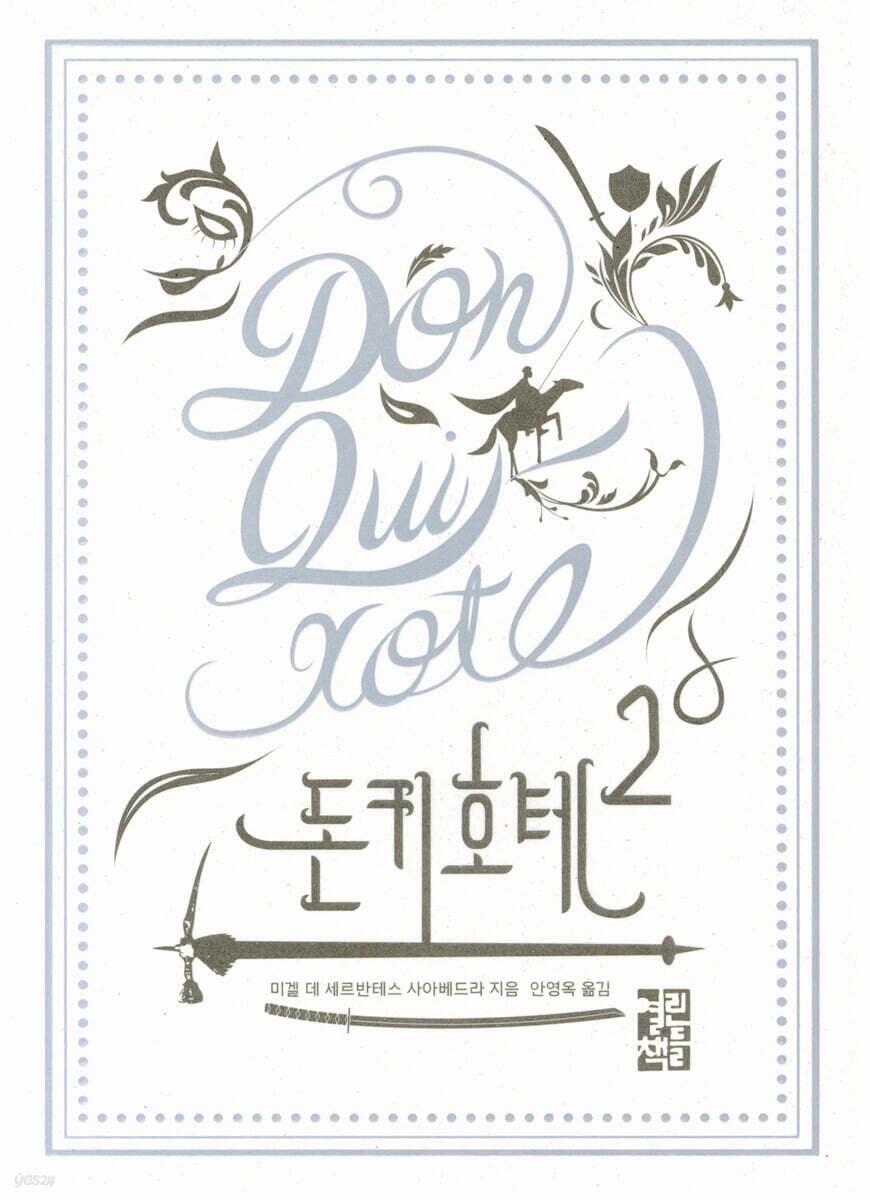
Don Quixote 2
 |
Description
Book Introduction
Born from Professor Ahn Young-ok's research and field trip A fresh and youthful Korean translation of Don Quixote Miguel de Cervantes Saavedra's Don Quixote, the most translated book on Earth after the Bible, has been published by Open Books. In order to fully translate Cervantes' style and spirit contained in "Don Quixote" into Korean, Professor Ahn Young-ok of the Department of Spanish Literature at Korea University conducted five years of research and field trips to Spain to create a new Korean version of "Don Quixote" that had never been seen before in Korea. In keeping with the principle of complete translation that one can only grasp the true meaning of a work by reading the entire work, not just a part of it, he completed an accurate translation of a massive volume of approximately 6,700 pages (based on 200-character manuscript paper) including the second volume of the generally unknown Don Quixote. Open Books published the first part, 『El ingenioso hidalgo don Quijote de la Mancha』, published in 1605, as Volume 1 of 『Don Quixote』, and the second part, 『El ingenioso caballero don Quijote de la Mancha』, published in 1615, as Volume 2 of 『Don Quixote』, in an attempt to reproduce the original work's physicality. Both books contain 100 illustrations by Gustave Doré, considered to be the most detailed and famous illustrations of Don Quixote ever created. |
- You can preview some of the book's contents.
Preview
Publisher's Review
★ 100 Classics Selected by the National Library of Korea, Recommended Books for Youth
★ 100 Books That Moved the World, Selected by the Dong-A Ilbo
★ Classics enjoyed by students from prestigious universities at home and abroad, selected by the Korea Economic Daily
★ Recommended books from Seoul National University, Yonsei University, and Korea University
★ SAT Recommended Books Selected by the College Board
★ The Nobel Institute's 100 Greatest Works of World Literature
★ 1001 Books You Must Read Before You Die, selected by Peter Boxall
★ 100 World Classic Novels Preferred by Korean Writers
★ Literature enjoyed by 125 writers active in the UK, US, and Australia
Miguel de Cervantes Saavedra's Don Quixote, the most translated book on Earth after the Bible, has been published by Open Books.
In order to fully translate Cervantes' style and spirit contained in "Don Quixote" into Korean, Professor Ahn Young-ok of the Department of Spanish Literature at Korea University conducted five years of research and field trips to Spain to create a new Korean version of "Don Quixote" that had never been seen before in Korea.
In keeping with the principle of complete translation that one can only grasp the true meaning of a work by reading the entire work, not just a part of it, he completed an accurate translation of a massive volume of approximately 6,700 pages (based on 200-character manuscript paper) including the second volume of the generally unknown Don Quixote.
Open Books published the first part, 『El ingenioso hidalgo don Quijote de la Mancha』, published in 1605, as Volume 1 of 『Don Quixote』, and the second part, 『El ingenioso caballero don Quijote de la Mancha』, published in 1615, as Volume 2 of 『Don Quixote』, in an attempt to reproduce the original work's physicality.
Both books contain 100 illustrations by Gustave Doré, considered to be the most detailed and famous illustrations of Don Quixote ever created.
Born from Professor Ahn Young-ok's research and field trip
A fresh and youthful Korean translation of Don Quixote
Professor Ahn Young-ok of the Department of Spanish Literature at Korea University, who was in charge of the translation, conducted research and field trips in Spain to create a new Korean complete translation of Don Quixote, keeping in mind Cervantes' intention to write Don Quixote in a plain, resonant, and pleasant way, using meaningful, pure, and well-organized words, as he stated in the preface.
Professor Ahn Young-ok, in her postscript at the end of Volume 2 of Don Quixote, states that translating a proper Korean version of Don Quixote has been a long-cherished dream since she majored in Spanish literature, and that is why she devoted so much time and passion to it.
Professor Ahn Young-ok stayed in Spain to translate Don Quixote, and worked hard to accurately convey the colloquial expressions, vocabulary not in use today, and stories with historical and cultural backgrounds. She also went around asking everyone from professors at the University of Madrid to elderly Spanish people.
With the desire to vividly convey the feelings that Cervantes had, I also followed all the journeys that Don Quixote went on in search of adventure.
From the fields of Montiel, where Don Quixote first set out on his adventure, to the inns of Puerto Lapice, the windmill village of Criptana, the Alcaná market in Toledo, Siena Morena, El Toboso, Almagro, the caves of Montesinos, the swamps of Ruidera, Pedrola, the island of Barataria, and Barcelona, the journey continues through the towns and cities of La Mancha, Aragon, and Catalonia, reaching Andalusia and ending with the places where Cervantes lived.
The translator's field trips for the translation of "Don Quixote" played a role in translating the content mentioned by Cervantes in "Don Quixote" more vividly and accurately.
The meaning and fun that has not faded even after 400 years,
Why You Should Read the True Classic, Don Quixote
Don Quixote is a work that can be said to be the greatest comedy and tragedy of mankind, created by a solemn madman who loses his mind while engrossed in chivalric novels and sets out to become a knight, and his naive and simple servant.
The range of interpretations of this work is as wide and varied as the above, and the adventures of Don Quixote and Sancho contain stories that can bring laughter or tears.
From the 17th century to the present, writers and intellectuals around the world have called Don Quixote a mirror of reality and seen Cervantes' philosophy as an ideal reform for human life, rights, and justice.
Albert Thibaudet called Don Quixote a true novel and the beginning of the modern novel, and Girard even said that novels written after Don Quixote are either rewrites of Don Quixote or parts of it.
Gustave Flaubert said that he found his roots in Don Quixote, and Fyodor Dostoevsky said that in the whole world there is no fiction more sublime and thrilling than Don Quixote.
The Spanish intellectual Ortega y Parma once said that if we could only know clearly what Cervantes' style was and what his way of approaching things was, we would have gained everything.
Don Quixote is a true classic that is still widely read around the world today.
It was selected as a favorite literary work by 125 authors active in the UK, US, and Australia, and was also selected as a recommended SAT book by the College Board of the United States.
In Korea, it has been selected as a recommended book by various media outlets, leading universities, and national libraries, and has become a representative work that everyone, regardless of age, from youth to adults, must read at least once before they die.
From a simply comical work that brings delightful wit and laughter to the bible of humanity, Don Quixote has established itself as a true classic that is still read and loved today.
The classic "Don Quixote" that everyone thinks they've read at least once
But you haven't read everything until you've read Volume 2.
The reason why many reviews of Don Quixote still transcend time and space is probably because the work is filled with both exceptional symbolism and fun.
A brief introduction to the content of Don Quixote is as follows.
In Volume 1 of Don Quixote, there is the story of Alonso Quijano, a hidalgo in his fifties living in a village in La Mancha, Spain, who lives a leisurely life befitting his status. However, he becomes so absorbed in the chivalric novels that were popular at the time that he reads them day and night, refraining from food or drink, until he is driven mad and becomes a knight-errant, embarking on two expeditions to realize his grand dream of establishing justice in the world, overcoming injustice, and helping the weak.
In Volume 2 of Don Quixote, the story begins with the assumption that the stories of Don Quixote and Sancho have been published and acclaimed, and that everyone in the world now knows about these two people.
The seeds of modern literary theory are sprouting, with the problems of fiction and reality, intertextuality and differences in perspective, and the invitation to reader criticism based on the discrepancy between existence and language, which marked the beginning of magical realism.
However, the problem that has arisen today is that because it is such a famous classic, everyone mistakenly thinks they have read it at least once.
If you think that after reading the first volume of Don Quixote, which contains the widely known windmill adventure story, you have read all the stories that Cervantes included in Don Quixote, then you have only read half of Don Quixote.
The content of Volume 2 of Don Quixote, which is less well known than Volume 1, is significant in that it provided a sense of completeness to the work and helped to nurture the seeds of modern literary theory.
The premise that everyone in the story surrounding Don Quixote and Sancho knows about their adventures serves as an important clue that provides the starting point for the surprising and absurd events that occur in Volume 2.
Sancho's accidental experience and Don Quixote's enlightenment suggest that the third expedition covered in Book 2 of Don Quixote is of a different nature from the two expeditions covered in Book 1.
In the preface to Book 2 of Don Quixote, Cervantes writes that Book 2 deals with an expanded version of Don Quixote, and that Don Quixote is buried in a grave so that no one dares to give new testimony about him.
I believe this one sentence from the author is enough to answer the question, "If I've already read Volume 1, is there really a need to read Volume 2?"
Drawn by the renowned French illustrator Gustave Doré
Includes 100 illustrations from Don Quixote
In 1863, 250 years after the publication of Don Quixote, the illustrations of Don Quixote published by the renowned French illustrator Gustave Doré became the most detailed and famous illustrations of Don Quixote ever drawn.
Open Books' 『Don Quixote』 includes over 100 illustrations by Gustave Doré, providing readers with the opportunity to appreciate Doré's work along with that of Cervantes.
Gustave Doré was born in Strasbourg, France in 1832 and grew up without any art education, but he surprised the Parisian publishing world with sketches he created at the age of 15.
In particular, his illustrations for Don Quixote were highly praised for their vivid descriptive power.
Even Picasso was fascinated by his delicate touch, and Van Gogh praised him as the greatest folk painter.
Doré produced over 10,000 prints before his death in Paris in 1883, and was recognized for his exceptional skills by including illustrations for Don Quixote, Dante's Divine Comedy, and John Milton's Paradise Lost.
Doré captured the landscapes and characters of Don Quixote with his outstanding imagination and descriptive power, and expressed them in a single painting with delicate techniques.
If you look at the paintings first, you will be amazed by his technique. If you look at them while reading the book, you will not be able to help but laugh at his outstanding expressiveness. If you read the book and then look at the paintings, you will feel the overall flow of the work and get the effect of reading the book again.
★ 100 Books That Moved the World, Selected by the Dong-A Ilbo
★ Classics enjoyed by students from prestigious universities at home and abroad, selected by the Korea Economic Daily
★ Recommended books from Seoul National University, Yonsei University, and Korea University
★ SAT Recommended Books Selected by the College Board
★ The Nobel Institute's 100 Greatest Works of World Literature
★ 1001 Books You Must Read Before You Die, selected by Peter Boxall
★ 100 World Classic Novels Preferred by Korean Writers
★ Literature enjoyed by 125 writers active in the UK, US, and Australia
Miguel de Cervantes Saavedra's Don Quixote, the most translated book on Earth after the Bible, has been published by Open Books.
In order to fully translate Cervantes' style and spirit contained in "Don Quixote" into Korean, Professor Ahn Young-ok of the Department of Spanish Literature at Korea University conducted five years of research and field trips to Spain to create a new Korean version of "Don Quixote" that had never been seen before in Korea.
In keeping with the principle of complete translation that one can only grasp the true meaning of a work by reading the entire work, not just a part of it, he completed an accurate translation of a massive volume of approximately 6,700 pages (based on 200-character manuscript paper) including the second volume of the generally unknown Don Quixote.
Open Books published the first part, 『El ingenioso hidalgo don Quijote de la Mancha』, published in 1605, as Volume 1 of 『Don Quixote』, and the second part, 『El ingenioso caballero don Quijote de la Mancha』, published in 1615, as Volume 2 of 『Don Quixote』, in an attempt to reproduce the original work's physicality.
Both books contain 100 illustrations by Gustave Doré, considered to be the most detailed and famous illustrations of Don Quixote ever created.
Born from Professor Ahn Young-ok's research and field trip
A fresh and youthful Korean translation of Don Quixote
Professor Ahn Young-ok of the Department of Spanish Literature at Korea University, who was in charge of the translation, conducted research and field trips in Spain to create a new Korean complete translation of Don Quixote, keeping in mind Cervantes' intention to write Don Quixote in a plain, resonant, and pleasant way, using meaningful, pure, and well-organized words, as he stated in the preface.
Professor Ahn Young-ok, in her postscript at the end of Volume 2 of Don Quixote, states that translating a proper Korean version of Don Quixote has been a long-cherished dream since she majored in Spanish literature, and that is why she devoted so much time and passion to it.
Professor Ahn Young-ok stayed in Spain to translate Don Quixote, and worked hard to accurately convey the colloquial expressions, vocabulary not in use today, and stories with historical and cultural backgrounds. She also went around asking everyone from professors at the University of Madrid to elderly Spanish people.
With the desire to vividly convey the feelings that Cervantes had, I also followed all the journeys that Don Quixote went on in search of adventure.
From the fields of Montiel, where Don Quixote first set out on his adventure, to the inns of Puerto Lapice, the windmill village of Criptana, the Alcaná market in Toledo, Siena Morena, El Toboso, Almagro, the caves of Montesinos, the swamps of Ruidera, Pedrola, the island of Barataria, and Barcelona, the journey continues through the towns and cities of La Mancha, Aragon, and Catalonia, reaching Andalusia and ending with the places where Cervantes lived.
The translator's field trips for the translation of "Don Quixote" played a role in translating the content mentioned by Cervantes in "Don Quixote" more vividly and accurately.
The meaning and fun that has not faded even after 400 years,
Why You Should Read the True Classic, Don Quixote
Don Quixote is a work that can be said to be the greatest comedy and tragedy of mankind, created by a solemn madman who loses his mind while engrossed in chivalric novels and sets out to become a knight, and his naive and simple servant.
The range of interpretations of this work is as wide and varied as the above, and the adventures of Don Quixote and Sancho contain stories that can bring laughter or tears.
From the 17th century to the present, writers and intellectuals around the world have called Don Quixote a mirror of reality and seen Cervantes' philosophy as an ideal reform for human life, rights, and justice.
Albert Thibaudet called Don Quixote a true novel and the beginning of the modern novel, and Girard even said that novels written after Don Quixote are either rewrites of Don Quixote or parts of it.
Gustave Flaubert said that he found his roots in Don Quixote, and Fyodor Dostoevsky said that in the whole world there is no fiction more sublime and thrilling than Don Quixote.
The Spanish intellectual Ortega y Parma once said that if we could only know clearly what Cervantes' style was and what his way of approaching things was, we would have gained everything.
Don Quixote is a true classic that is still widely read around the world today.
It was selected as a favorite literary work by 125 authors active in the UK, US, and Australia, and was also selected as a recommended SAT book by the College Board of the United States.
In Korea, it has been selected as a recommended book by various media outlets, leading universities, and national libraries, and has become a representative work that everyone, regardless of age, from youth to adults, must read at least once before they die.
From a simply comical work that brings delightful wit and laughter to the bible of humanity, Don Quixote has established itself as a true classic that is still read and loved today.
The classic "Don Quixote" that everyone thinks they've read at least once
But you haven't read everything until you've read Volume 2.
The reason why many reviews of Don Quixote still transcend time and space is probably because the work is filled with both exceptional symbolism and fun.
A brief introduction to the content of Don Quixote is as follows.
In Volume 1 of Don Quixote, there is the story of Alonso Quijano, a hidalgo in his fifties living in a village in La Mancha, Spain, who lives a leisurely life befitting his status. However, he becomes so absorbed in the chivalric novels that were popular at the time that he reads them day and night, refraining from food or drink, until he is driven mad and becomes a knight-errant, embarking on two expeditions to realize his grand dream of establishing justice in the world, overcoming injustice, and helping the weak.
In Volume 2 of Don Quixote, the story begins with the assumption that the stories of Don Quixote and Sancho have been published and acclaimed, and that everyone in the world now knows about these two people.
The seeds of modern literary theory are sprouting, with the problems of fiction and reality, intertextuality and differences in perspective, and the invitation to reader criticism based on the discrepancy between existence and language, which marked the beginning of magical realism.
However, the problem that has arisen today is that because it is such a famous classic, everyone mistakenly thinks they have read it at least once.
If you think that after reading the first volume of Don Quixote, which contains the widely known windmill adventure story, you have read all the stories that Cervantes included in Don Quixote, then you have only read half of Don Quixote.
The content of Volume 2 of Don Quixote, which is less well known than Volume 1, is significant in that it provided a sense of completeness to the work and helped to nurture the seeds of modern literary theory.
The premise that everyone in the story surrounding Don Quixote and Sancho knows about their adventures serves as an important clue that provides the starting point for the surprising and absurd events that occur in Volume 2.
Sancho's accidental experience and Don Quixote's enlightenment suggest that the third expedition covered in Book 2 of Don Quixote is of a different nature from the two expeditions covered in Book 1.
In the preface to Book 2 of Don Quixote, Cervantes writes that Book 2 deals with an expanded version of Don Quixote, and that Don Quixote is buried in a grave so that no one dares to give new testimony about him.
I believe this one sentence from the author is enough to answer the question, "If I've already read Volume 1, is there really a need to read Volume 2?"
Drawn by the renowned French illustrator Gustave Doré
Includes 100 illustrations from Don Quixote
In 1863, 250 years after the publication of Don Quixote, the illustrations of Don Quixote published by the renowned French illustrator Gustave Doré became the most detailed and famous illustrations of Don Quixote ever drawn.
Open Books' 『Don Quixote』 includes over 100 illustrations by Gustave Doré, providing readers with the opportunity to appreciate Doré's work along with that of Cervantes.
Gustave Doré was born in Strasbourg, France in 1832 and grew up without any art education, but he surprised the Parisian publishing world with sketches he created at the age of 15.
In particular, his illustrations for Don Quixote were highly praised for their vivid descriptive power.
Even Picasso was fascinated by his delicate touch, and Van Gogh praised him as the greatest folk painter.
Doré produced over 10,000 prints before his death in Paris in 1883, and was recognized for his exceptional skills by including illustrations for Don Quixote, Dante's Divine Comedy, and John Milton's Paradise Lost.
Doré captured the landscapes and characters of Don Quixote with his outstanding imagination and descriptive power, and expressed them in a single painting with delicate techniques.
If you look at the paintings first, you will be amazed by his technique. If you look at them while reading the book, you will not be able to help but laugh at his outstanding expressiveness. If you read the book and then look at the paintings, you will feel the overall flow of the work and get the effect of reading the book again.
GOODS SPECIFICS
- Publication date: November 17, 2014
- Page count, weight, size: 922 pages | 1,370g | 188*254*40mm
- ISBN13: 9788932916811
- ISBN10: 8932916810
You may also like
카테고리
korean


korean

![GQ KOREA Mark (Monthly): December [2025]](http://librairie.coreenne.fr/cdn/shop/files/8ef265dbbfbf186523ed75ba7319009d.jpg?v=1765340328&width=3840)


