

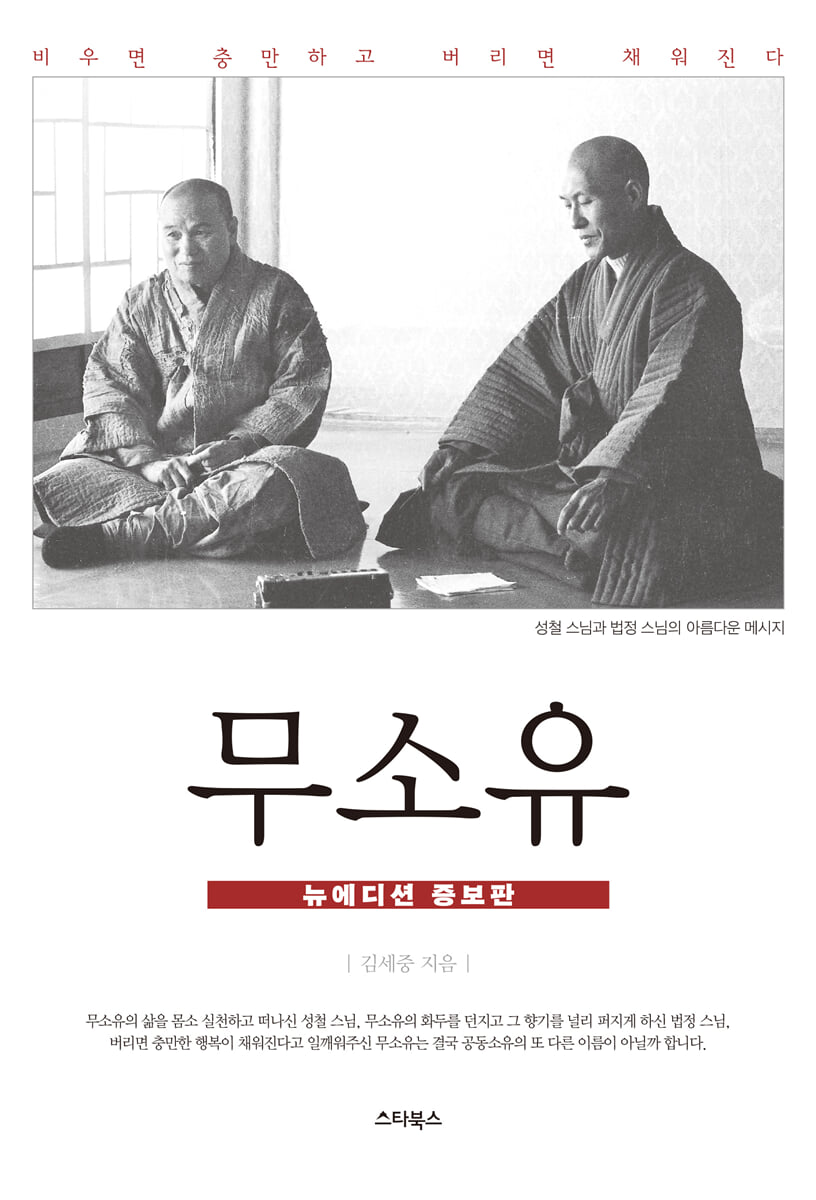
No Possession (New Edition, Expanded Edition)
 |
Description
Book Introduction
New and expanded edition to celebrate the 15th anniversary of publication!
A life free from attachment and greed is true non-possession.
It has been 30 years since our great teacher, Monk Seongcheol, passed away, and next year will mark the 15th anniversary of Monk Beopjeong's passing.
This book, 'No Possession', has sold over 300,000 copies and has become a bestseller that is consistently loved by readers.
Accordingly, at the request and support of readers, two new chapters were added and organized.
Monks Seongcheol and Beopjeong were representative teachers in our society, including the Buddhist community.
The sight of the two monks seeking the truth of life with purity and fragrance was like the sound of a bell breaking through a turbid society, and the respect and trust for them transcended religion.
The masters of this era, Seongcheol and Beopjeong, who raised the topic of non-possession and lived a life of such a belief, leaving the Buddhist community and continuously teaching everyone.
We too will follow their philosophy of life, a life of non-possession, and find the happiness of a clear and fragrant life that purifies our minds and hearts.
Letting go of what you're holding on to actually doubles your happiness, wealth, and joy.
The monk Beopjeong said that non-possession does not mean having nothing, but rather not having unnecessary things.
We have things because we need them, but sometimes we end up worrying about them.
Therefore, to have something is also to be entangled with something, and therefore to have a lot means to be entangled with a lot.
Emptiness may be the gap in life.
We live by supporting a solid form of life.
However, if you only fill up one corner without any gaps, that form of life will not be sustainable.
We gain, empty and purify ourselves from the cracks of life.
The hearts of our ancestors, who left a few ripe persimmons from the persimmon tree for the magpies in the fall, must have been a leisurely life that made people more human.
Wisdom and non-possession that comes from life.
I hope that this book, which contains the truth of the two monks, will become a shortcut and a gap that can help us escape this turbid world. I sincerely hope that the two monks will remain with us for a long time as a happy fragrance to all those living in today's world. I convey their beautiful words to the readers with the lingering scent of kindness and concise writing style.
A life free from attachment and greed is true non-possession.
It has been 30 years since our great teacher, Monk Seongcheol, passed away, and next year will mark the 15th anniversary of Monk Beopjeong's passing.
This book, 'No Possession', has sold over 300,000 copies and has become a bestseller that is consistently loved by readers.
Accordingly, at the request and support of readers, two new chapters were added and organized.
Monks Seongcheol and Beopjeong were representative teachers in our society, including the Buddhist community.
The sight of the two monks seeking the truth of life with purity and fragrance was like the sound of a bell breaking through a turbid society, and the respect and trust for them transcended religion.
The masters of this era, Seongcheol and Beopjeong, who raised the topic of non-possession and lived a life of such a belief, leaving the Buddhist community and continuously teaching everyone.
We too will follow their philosophy of life, a life of non-possession, and find the happiness of a clear and fragrant life that purifies our minds and hearts.
Letting go of what you're holding on to actually doubles your happiness, wealth, and joy.
The monk Beopjeong said that non-possession does not mean having nothing, but rather not having unnecessary things.
We have things because we need them, but sometimes we end up worrying about them.
Therefore, to have something is also to be entangled with something, and therefore to have a lot means to be entangled with a lot.
Emptiness may be the gap in life.
We live by supporting a solid form of life.
However, if you only fill up one corner without any gaps, that form of life will not be sustainable.
We gain, empty and purify ourselves from the cracks of life.
The hearts of our ancestors, who left a few ripe persimmons from the persimmon tree for the magpies in the fall, must have been a leisurely life that made people more human.
Wisdom and non-possession that comes from life.
I hope that this book, which contains the truth of the two monks, will become a shortcut and a gap that can help us escape this turbid world. I sincerely hope that the two monks will remain with us for a long time as a happy fragrance to all those living in today's world. I convey their beautiful words to the readers with the lingering scent of kindness and concise writing style.
- You can preview some of the book's contents.
Preview
index
The Book of Proverbs of the Monk Beopjeong
The Book of Proverbs by Monk Seongcheol
preface
1.
The happiness of non-possession
If you let go of material desires, you will see paradise.
Sacrifice everything for the eternal truth
If you want to be a capital, learn poverty.
In complete non-possession, an unstained spirit comes to life.
When you let go of greed, you see the true nature of truth.
Monk Joju is a monk who thoroughly practices non-possession.
Don't look for me, look for Buddha.
I can see the true nature of everything in the mountains.
2.
The beauty of life
Bow three thousand times for others
Let us respect all life as Buddha.
Become a person who 'eats' rice
Give your mind a rest
The Buddha's words are the medicine that cures our illnesses.
Fate is not decided
Loving your enemies is true Buddhahood.
Let's look at ourselves
3.
The truth of color is emptiness
Everything is Buddhism
A mountain is a mountain, water is water.
Life and death are one, not two.
The distinction between good and evil is a vain one.
Because this exists, that exists.
The Middle Way is Buddha
When you open your mind's eye, reality is paradise.
All living beings always exist and never disappear.
4.
For the salvation of society
Buddha did not come to save this world.
There is no "relief work" in Buddhism.
There is no such thing as 'forgiveness' in Buddhism.
Today is your birthday, happy birthday.
Leaders must abandon selfish desires.
The real big thief is the one who pretends to be an adult.
The mind must dominate and control the material.
Companies must be aware of their social mission.
5.
Encounters deepen with time
Dust is not dust
Friendship through purity
An encounter like a moment lingering in the flow
It's more beautiful because it has an ending
6.
We are connected as one
The 'one thing' that shines within me
If you can stop all your sins,
If you want to gain, empty yourself.
3,000 times to meet the Buddha within me
7.
The path to liberation
Abstinence
abstinence
contempt
Lower mind
Diligence
penance
Yecham (禮懺)
altruism
The Book of Proverbs by Monk Seongcheol
preface
1.
The happiness of non-possession
If you let go of material desires, you will see paradise.
Sacrifice everything for the eternal truth
If you want to be a capital, learn poverty.
In complete non-possession, an unstained spirit comes to life.
When you let go of greed, you see the true nature of truth.
Monk Joju is a monk who thoroughly practices non-possession.
Don't look for me, look for Buddha.
I can see the true nature of everything in the mountains.
2.
The beauty of life
Bow three thousand times for others
Let us respect all life as Buddha.
Become a person who 'eats' rice
Give your mind a rest
The Buddha's words are the medicine that cures our illnesses.
Fate is not decided
Loving your enemies is true Buddhahood.
Let's look at ourselves
3.
The truth of color is emptiness
Everything is Buddhism
A mountain is a mountain, water is water.
Life and death are one, not two.
The distinction between good and evil is a vain one.
Because this exists, that exists.
The Middle Way is Buddha
When you open your mind's eye, reality is paradise.
All living beings always exist and never disappear.
4.
For the salvation of society
Buddha did not come to save this world.
There is no "relief work" in Buddhism.
There is no such thing as 'forgiveness' in Buddhism.
Today is your birthday, happy birthday.
Leaders must abandon selfish desires.
The real big thief is the one who pretends to be an adult.
The mind must dominate and control the material.
Companies must be aware of their social mission.
5.
Encounters deepen with time
Dust is not dust
Friendship through purity
An encounter like a moment lingering in the flow
It's more beautiful because it has an ending
6.
We are connected as one
The 'one thing' that shines within me
If you can stop all your sins,
If you want to gain, empty yourself.
3,000 times to meet the Buddha within me
7.
The path to liberation
Abstinence
abstinence
contempt
Lower mind
Diligence
penance
Yecham (禮懺)
altruism
Detailed image
Into the book
If you insist that only your own religion is the truth and deny other religions, then that in itself is already a pursuit of 'power'.
‘Power’ arises from the black-and-white logic that divides the center and the periphery.
The very attitude of tolerantly accepting other religions means that one has already shaken off worldly attachments.
Having completely cast off worldly desires, we will be able to fully embrace other religions.
By choosing the truth itself rather than a specific religion, Monk Seongcheol was able to completely abandon worldly attachments.
--- pp.34~35 From “Sacrifice Everything for the Eternal Truth”
One day, when Namjeon woke up from a nap, there was a novice monk next to him.
As soon as Namjeon woke up, the novice monk bowed his head and greeted him deeply.
When the novice monk said that he had come from Seosangwon, Namjeon playfully asked, “Did you see the Buddha’s tail there?”
Then the novice monk said, “I did not see the Buddha’s tail, but I saw the Buddha lying down.”
The reclining Buddha was referring to Namjeon himself.
And then Namjeon asked, “Do you have a teacher?”
Then the novice monk bowed deeply to Namjeon.
--- pp.49~50 From “Monk Joju is a thorough monk of non-possession”
There are things that cannot be done by human power.
So, it is also necessary to keep your head clear and empty.
Is it for nothing that the word "stress" emerged in modern society? In this day and age, our minds are overwhelmed with distracting thoughts.
Modern society is like a giant stress factory.
This society doesn't give us the luxury of resting our minds even for a single day, a single hour, or a single minute.
If all these distracting thoughts pile up like this, they might explode one day.
Recently, it is said that a disease called 'chronic fatigue syndrome' has emerged.
Although it is not a fatal disease, it is said that the chronic lack of will to live and constant fatigue are the characteristics of this disease.
--- pp.77~78 From “Let Your Mind Rest”
In Buddhism, it is said that general ethics are formed through the distinction between good and evil.
For example, good is said to be a relative good that is opposed to evil in its relationship with evil.
It is said that evil brings painful results and good brings pleasant results, promising future pleasant results such as wealth, honor, and longevity, but because of this, relative goodness causes attachment in humans.
Ultimately, we can see that the basis of the relative distinction between good and evil is the constantly flowing out delusion.
--- pp.111~112 From “The distinction between good and evil is a vain one”
Monk Seongcheol, who emphasized non-discriminatory compassion, also said the following:
According to the law of cause and effect, in order to reach eternity (liberation), one must truly cultivate the path to immortality in this world, and the path to immortality is to bestow compassion without discrimination upon all living beings.
“Nothing is outside the law of cause and effect, so any effect is directly proportional to its cause.
The law of the universe is that what you sow will reap beans, and what you sow will reap red beans.
Just as you can't get beans from sowing beans, and you can't get beans from sowing red beans, all my results are determined by my efforts.
--- From pp.139, “There is no relief work in Buddhism”
Will you be a well-fed pig or a hungry Socrates? This is the crossroads our age faces.
Such an important problem is difficult to solve without changing the social structure and institutions themselves.
But from now on, we must at least live a spiritual life that is not consumed by material things.
Let's start by putting it into practice, starting with very small things.
Let us all find the way to become saints, like the janitors.
When we stake our lives on the precious values of life, hidden from material gain, the Buddha within us will awaken.
--- From pp.159, “The mind must dominate the material”
The monk Beopjeong said of his friend, "Even without words, all thoughts, wishes, and expectations are exchanged with silent joy."
I think about the friendship between Monk Beopjeong and Sister Haein Lee.
Although they are not old friends who spent their childhood together, there is a childlike quality to this friendship.
So, for them, religion, gender, and age do not matter at all.
Those who have abandoned prejudice empathize with each other's pure passion.
--- pp.175~176 From "Friends Made with Purity"
Monk Seongcheol said that the 3,000 bows start out as a simple bow, but once you finish, you will definitely experience a change in your state of mind.
When people feel something through bowing, they will naturally bow themselves.
And he said that bowing changes from bowing to lowering oneself to bowing to help others, and this in turn changes into a life of helping others.
Bowing is the most active act of concentrating the mind.
Ultimately, what we gain through meditation is to see the Buddha within ourselves.
Those who have discovered the Buddha within themselves will eventually realize that helping others is helping themselves.
Because we have come to realize that all living beings are connected.
‘Power’ arises from the black-and-white logic that divides the center and the periphery.
The very attitude of tolerantly accepting other religions means that one has already shaken off worldly attachments.
Having completely cast off worldly desires, we will be able to fully embrace other religions.
By choosing the truth itself rather than a specific religion, Monk Seongcheol was able to completely abandon worldly attachments.
--- pp.34~35 From “Sacrifice Everything for the Eternal Truth”
One day, when Namjeon woke up from a nap, there was a novice monk next to him.
As soon as Namjeon woke up, the novice monk bowed his head and greeted him deeply.
When the novice monk said that he had come from Seosangwon, Namjeon playfully asked, “Did you see the Buddha’s tail there?”
Then the novice monk said, “I did not see the Buddha’s tail, but I saw the Buddha lying down.”
The reclining Buddha was referring to Namjeon himself.
And then Namjeon asked, “Do you have a teacher?”
Then the novice monk bowed deeply to Namjeon.
--- pp.49~50 From “Monk Joju is a thorough monk of non-possession”
There are things that cannot be done by human power.
So, it is also necessary to keep your head clear and empty.
Is it for nothing that the word "stress" emerged in modern society? In this day and age, our minds are overwhelmed with distracting thoughts.
Modern society is like a giant stress factory.
This society doesn't give us the luxury of resting our minds even for a single day, a single hour, or a single minute.
If all these distracting thoughts pile up like this, they might explode one day.
Recently, it is said that a disease called 'chronic fatigue syndrome' has emerged.
Although it is not a fatal disease, it is said that the chronic lack of will to live and constant fatigue are the characteristics of this disease.
--- pp.77~78 From “Let Your Mind Rest”
In Buddhism, it is said that general ethics are formed through the distinction between good and evil.
For example, good is said to be a relative good that is opposed to evil in its relationship with evil.
It is said that evil brings painful results and good brings pleasant results, promising future pleasant results such as wealth, honor, and longevity, but because of this, relative goodness causes attachment in humans.
Ultimately, we can see that the basis of the relative distinction between good and evil is the constantly flowing out delusion.
--- pp.111~112 From “The distinction between good and evil is a vain one”
Monk Seongcheol, who emphasized non-discriminatory compassion, also said the following:
According to the law of cause and effect, in order to reach eternity (liberation), one must truly cultivate the path to immortality in this world, and the path to immortality is to bestow compassion without discrimination upon all living beings.
“Nothing is outside the law of cause and effect, so any effect is directly proportional to its cause.
The law of the universe is that what you sow will reap beans, and what you sow will reap red beans.
Just as you can't get beans from sowing beans, and you can't get beans from sowing red beans, all my results are determined by my efforts.
--- From pp.139, “There is no relief work in Buddhism”
Will you be a well-fed pig or a hungry Socrates? This is the crossroads our age faces.
Such an important problem is difficult to solve without changing the social structure and institutions themselves.
But from now on, we must at least live a spiritual life that is not consumed by material things.
Let's start by putting it into practice, starting with very small things.
Let us all find the way to become saints, like the janitors.
When we stake our lives on the precious values of life, hidden from material gain, the Buddha within us will awaken.
--- From pp.159, “The mind must dominate the material”
The monk Beopjeong said of his friend, "Even without words, all thoughts, wishes, and expectations are exchanged with silent joy."
I think about the friendship between Monk Beopjeong and Sister Haein Lee.
Although they are not old friends who spent their childhood together, there is a childlike quality to this friendship.
So, for them, religion, gender, and age do not matter at all.
Those who have abandoned prejudice empathize with each other's pure passion.
--- pp.175~176 From "Friends Made with Purity"
Monk Seongcheol said that the 3,000 bows start out as a simple bow, but once you finish, you will definitely experience a change in your state of mind.
When people feel something through bowing, they will naturally bow themselves.
And he said that bowing changes from bowing to lowering oneself to bowing to help others, and this in turn changes into a life of helping others.
Bowing is the most active act of concentrating the mind.
Ultimately, what we gain through meditation is to see the Buddha within ourselves.
Those who have discovered the Buddha within themselves will eventually realize that helping others is helping themselves.
Because we have come to realize that all living beings are connected.
--- pp.206~207 From “Meeting the Buddha Within Me 3,000 Times”
Publisher's Review
'The monk Beopjeong said, 'Non-possession' does not mean not having anything,
It means not to have unnecessary things.
He said that unnecessary things only become a burden of worry and are the seeds of unhappiness.
Monk Seongcheol said, 'We acquire things out of necessity, but sometimes we become concerned about those things.
Therefore, to have something means to be entangled with something else, and to have much means to be entangled with much.'
Therefore, the poverty we have chosen can be seen as something much more valuable and noble than wealth.
Also, Monk Seongcheol said this:
'When people indulge in material things, their conscience becomes clouded.
That is why every religion values the spirit more than the material.
Even in the case of Buddha, he abandoned the luxurious palace and practiced asceticism and preached, wearing only tattered clothes and bare feet, begging for food here and there, carrying only a bowl.
And in the end, he passed away on the path of teaching.
In a life of complete non-possession, an unstained spirit comes to life.'
The will of the late monk Beopjeong, who wished to live strictly and frugally throughout his life, and to avoid becoming a slave to possessions and relationships by emptying himself and letting go, has been made public.
'I am deeply grateful to everyone.
I will continue to repent for the mistakes I made due to my foolishness.
If you have anything left that you call yours, please donate it all to the 'Clean and Fragrant' Foundation so that it can be used for activities that create a clean and fragrant society.
thank you
May you all attain Buddhahood.'
And to the superior, I am grateful that we met through fate and trust.
I want to take all the scars left by my eccentric personality with me on my last journey, so I would be grateful if you could just let them flow away in the indifferent river.
He requested, "When I leave, do not perform any cumbersome and useless black rituals in my name, do not try to find my relics, do not prepare a coffin or shroud, and cremate me without delay in my usual monk's attire in a convenient place that will not disturb the neighbors."
In his pursuit of truth, the Venerable Beopjeong transcended religion and became friends with many people.
In this way, the monk Beopjeong gave us the teaching of non-possession even in his will.
When the monk was young, he was under the Yushin regime, and he participated in the constitutional amendment petition movement to repeal the Yushin regime together with the National Council for the Protection of Democracy. One day, he went down to Bul-il-am in Songgwangsa Temple and devoted himself to asceticism.
The monk later explained the reason he entered Songgwangsa Bul-il-am Temple: “I developed hatred after being persecuted while participating in the democratization movement.
It is painful to deviate from a pure heart… … .
He is said to have said, “I went into the mountains to return to my original place.”
In this way, the monk Beopjeong was a pure and fragrant monk who was wary of impurities entering even his mind.
The monk is also famous for having transcended religions and made friends with many people during his lifetime in the same way he sought the truth.
When Seongcheol became the head monk, he was the first person to come to me and said he would be a bridge between the head monk and the people.
Sister Lee Hae-in wrote this memorial message, praying for the eternal rest of the late monk Beopjeong.
“Through the sermons and writings of a monk who practiced a life of non-possession,
Countless living beings are comforted
I enjoyed joy and peace and was happy.
Venerable Beopjeong! In the hearts of those who cannot forget and miss you,
Blooming like a white lotus of mercy
“Rise up like a full moon that resembles the Buddha’s smile.”
We probably know very well what some adults have taught us about the true value of life.
Buddha, Jesus, Muhammad.
Although they had different religions, they all said that true life does not lie in material gain, but in caring for and loving others.
These two monks are our teachers who practiced a life of non-possession with their whole being.
Since adults are divine beings, you might think that it is easy to follow their words verbally, but difficult to put them into practice.
There may be some who try to compromise with reality, saying, 'Yes, God and ordinary people are different.'
These days, with the number of violent incidents caused by money increasing, the topic of non-possession is becoming a hot topic on people's lips.
There were many people who thought and talked about the need to empty themselves, but no one actually put it into practice. This is because the two monks showed us this very well.
Monk Seongcheol lived among us like a saint, living his entire life in rubber shoes and a single overcoat sewn hundreds of times, denying all material desires and practicing Zen meditation.
Although he was a Buddhist, Monk Seongcheol did not insist on Buddhist doctrines alone. Instead, he endeavored to engage in dialogue with other religions, and rejected the self-righteousness and stubbornness of believing that only he was right.
Additionally, the monk criticized modern materialism.
True life lies in the spirit of befriending poverty, not in wearing fancy clothes and living in a luxurious mansion.
The numerous words left behind by Monk Seongcheol shine even brighter because Monk Seongcheol himself practiced a life of non-possession.
The monk said that one should not bow for oneself, but bow 3000 times for others.
The monk made poverty his lifelong friend, never coveting power or wealth, and also told people not to seek themselves.
So, even when the president and the chairman of a conglomerate came to visit, he refused to meet them, but if he really wanted to meet them, he told them to bow 3,000 times.
The story that Jang Young-ja and Lee Cheol-hee promised to take responsibility for Korea's immortality if they met just once is very famous.
In some ways, it seems that Monk Seongcheol lived a life without much connection to people, but on the day he passed away, countless people from all over the country came to visit him and showed their utmost love and respect for him.
I think everyone sincerely bowed their heads and paid tribute to the monk's spirit of living a life of non-possession.
Following the teachings of these two monks who raised the topic of non-possession and put it into practice themselves, I hope that this book will serve as a beacon that illuminates the world with the spirit of non-possession.
Here, there is a pair of rubber shoes and a durumagi.
Now, how about we too try living a life of ‘non-possession’ by letting go of greed and emptying our minds?
It means not to have unnecessary things.
He said that unnecessary things only become a burden of worry and are the seeds of unhappiness.
Monk Seongcheol said, 'We acquire things out of necessity, but sometimes we become concerned about those things.
Therefore, to have something means to be entangled with something else, and to have much means to be entangled with much.'
Therefore, the poverty we have chosen can be seen as something much more valuable and noble than wealth.
Also, Monk Seongcheol said this:
'When people indulge in material things, their conscience becomes clouded.
That is why every religion values the spirit more than the material.
Even in the case of Buddha, he abandoned the luxurious palace and practiced asceticism and preached, wearing only tattered clothes and bare feet, begging for food here and there, carrying only a bowl.
And in the end, he passed away on the path of teaching.
In a life of complete non-possession, an unstained spirit comes to life.'
The will of the late monk Beopjeong, who wished to live strictly and frugally throughout his life, and to avoid becoming a slave to possessions and relationships by emptying himself and letting go, has been made public.
'I am deeply grateful to everyone.
I will continue to repent for the mistakes I made due to my foolishness.
If you have anything left that you call yours, please donate it all to the 'Clean and Fragrant' Foundation so that it can be used for activities that create a clean and fragrant society.
thank you
May you all attain Buddhahood.'
And to the superior, I am grateful that we met through fate and trust.
I want to take all the scars left by my eccentric personality with me on my last journey, so I would be grateful if you could just let them flow away in the indifferent river.
He requested, "When I leave, do not perform any cumbersome and useless black rituals in my name, do not try to find my relics, do not prepare a coffin or shroud, and cremate me without delay in my usual monk's attire in a convenient place that will not disturb the neighbors."
In his pursuit of truth, the Venerable Beopjeong transcended religion and became friends with many people.
In this way, the monk Beopjeong gave us the teaching of non-possession even in his will.
When the monk was young, he was under the Yushin regime, and he participated in the constitutional amendment petition movement to repeal the Yushin regime together with the National Council for the Protection of Democracy. One day, he went down to Bul-il-am in Songgwangsa Temple and devoted himself to asceticism.
The monk later explained the reason he entered Songgwangsa Bul-il-am Temple: “I developed hatred after being persecuted while participating in the democratization movement.
It is painful to deviate from a pure heart… … .
He is said to have said, “I went into the mountains to return to my original place.”
In this way, the monk Beopjeong was a pure and fragrant monk who was wary of impurities entering even his mind.
The monk is also famous for having transcended religions and made friends with many people during his lifetime in the same way he sought the truth.
When Seongcheol became the head monk, he was the first person to come to me and said he would be a bridge between the head monk and the people.
Sister Lee Hae-in wrote this memorial message, praying for the eternal rest of the late monk Beopjeong.
“Through the sermons and writings of a monk who practiced a life of non-possession,
Countless living beings are comforted
I enjoyed joy and peace and was happy.
Venerable Beopjeong! In the hearts of those who cannot forget and miss you,
Blooming like a white lotus of mercy
“Rise up like a full moon that resembles the Buddha’s smile.”
We probably know very well what some adults have taught us about the true value of life.
Buddha, Jesus, Muhammad.
Although they had different religions, they all said that true life does not lie in material gain, but in caring for and loving others.
These two monks are our teachers who practiced a life of non-possession with their whole being.
Since adults are divine beings, you might think that it is easy to follow their words verbally, but difficult to put them into practice.
There may be some who try to compromise with reality, saying, 'Yes, God and ordinary people are different.'
These days, with the number of violent incidents caused by money increasing, the topic of non-possession is becoming a hot topic on people's lips.
There were many people who thought and talked about the need to empty themselves, but no one actually put it into practice. This is because the two monks showed us this very well.
Monk Seongcheol lived among us like a saint, living his entire life in rubber shoes and a single overcoat sewn hundreds of times, denying all material desires and practicing Zen meditation.
Although he was a Buddhist, Monk Seongcheol did not insist on Buddhist doctrines alone. Instead, he endeavored to engage in dialogue with other religions, and rejected the self-righteousness and stubbornness of believing that only he was right.
Additionally, the monk criticized modern materialism.
True life lies in the spirit of befriending poverty, not in wearing fancy clothes and living in a luxurious mansion.
The numerous words left behind by Monk Seongcheol shine even brighter because Monk Seongcheol himself practiced a life of non-possession.
The monk said that one should not bow for oneself, but bow 3000 times for others.
The monk made poverty his lifelong friend, never coveting power or wealth, and also told people not to seek themselves.
So, even when the president and the chairman of a conglomerate came to visit, he refused to meet them, but if he really wanted to meet them, he told them to bow 3,000 times.
The story that Jang Young-ja and Lee Cheol-hee promised to take responsibility for Korea's immortality if they met just once is very famous.
In some ways, it seems that Monk Seongcheol lived a life without much connection to people, but on the day he passed away, countless people from all over the country came to visit him and showed their utmost love and respect for him.
I think everyone sincerely bowed their heads and paid tribute to the monk's spirit of living a life of non-possession.
Following the teachings of these two monks who raised the topic of non-possession and put it into practice themselves, I hope that this book will serve as a beacon that illuminates the world with the spirit of non-possession.
Here, there is a pair of rubber shoes and a durumagi.
Now, how about we too try living a life of ‘non-possession’ by letting go of greed and emptying our minds?
GOODS SPECIFICS
- Date of issue: May 20, 2024
- Format: Hardcover book binding method guide
- Page count, weight, size: 224 pages | 477g | 143*210*20mm
- ISBN13: 9791157957361
- ISBN10: 1157957366
You may also like
카테고리
korean


korean

![GQ KOREA Mark (Monthly): December [2025]](http://librairie.coreenne.fr/cdn/shop/files/8ef265dbbfbf186523ed75ba7319009d.jpg?v=1765340328&width=3840)


