

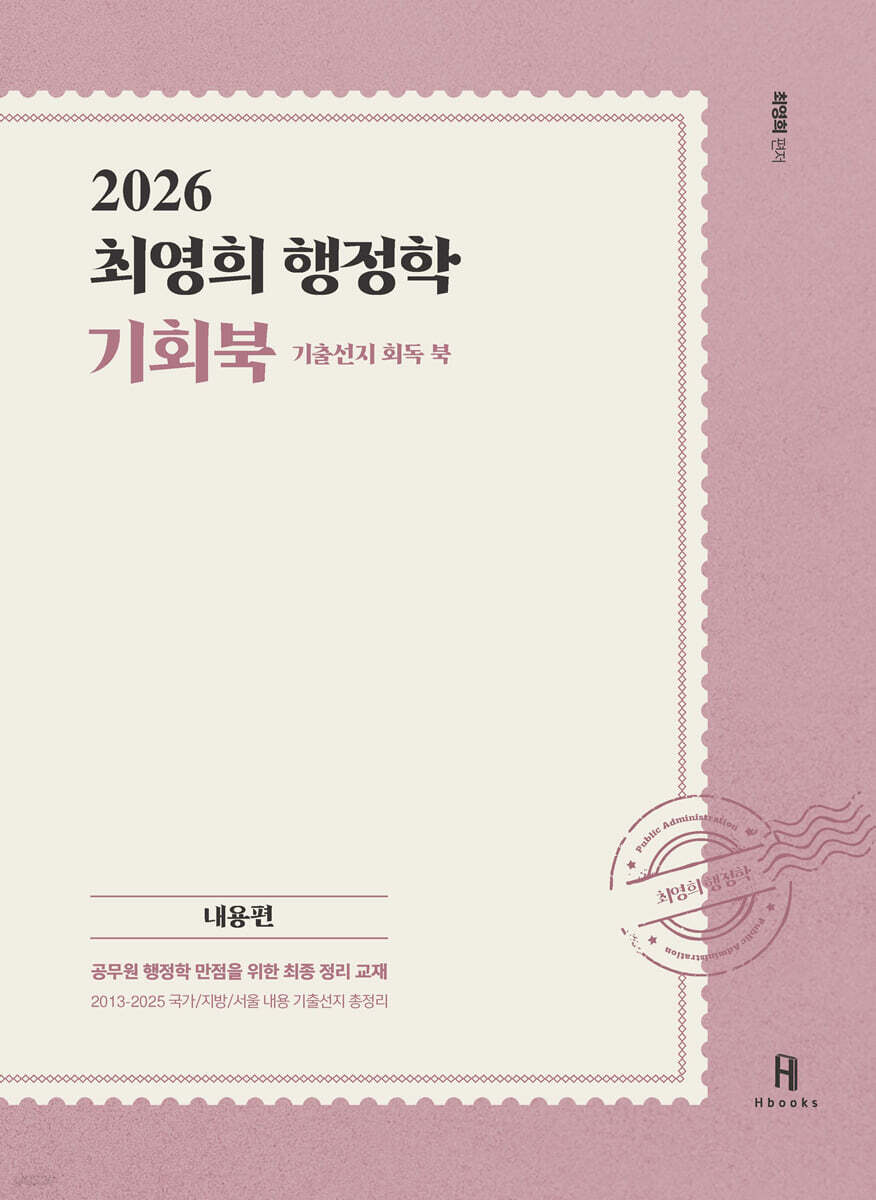
2026 Choi Young-hee Public Administration Past Exam Questions and Answers (Opportunity Book)
 |
Description
Book Introduction
· A final study guide for students aiming for high scores in the civil service administration exam.
· 2013-2025 National/Provincial/Seoul Level 9 and 7 Exam Questions and Answers
· Reflection of the amendments to the Government Organization Act in October 2025
· Table of contents flow chart showing topics and keywords by unit
· Topic-based content summary and clear explanations
· Divided into [Contents] and [Problems] for easy portability
· 2013-2025 National/Provincial/Seoul Level 9 and 7 Exam Questions and Answers
· Reflection of the amendments to the Government Organization Act in October 2025
· Table of contents flow chart showing topics and keywords by unit
· Topic-based content summary and clear explanations
· Divided into [Contents] and [Problems] for easy portability
- You can preview some of the book's contents.
Preview
index
Part 1: Basic Theories of Public Administration
Chapter 1: Fundamentals of Public Administration
1. Definition of administration
2. The nature of administration: competition and exclusivity
3. Evolution of Administration over Time
4 Changes in government officials
5 Administration and Politics
6 Administration and Management
7 Modern administrative environment
Chapter 2 Market Failure and Government Failure
1 Market failure
2 Government regulations
3 Government failures
4 Privatization of the public sector
Chapter 3 Administration and Values
1 Administration and Values
2 Intrinsic value
3 Instrumental value
Chapter 4: Major Theories of Public Administration
1. The development of American administration
2 Classical Public Administration: Administrative Management Theory
3 Human Relations Theory
4 Behavioral Theory
5 New Administrative Theory
6 Ecology, Comparative Public Administration, Systems Theory, and Developmental Public Administration: Studies for Developing Countries
7 Public Choice Theory
8 Neo-Institutional Theory
9 New Public Management Theory
10 New Governance Theory
11 Administration in Post-Modernity (Post-Industrial Society)
12 New Public Service (NPS)
13 Post-New Public Management Theory
14 Public Value Management Theory
15 Nudge Theory
Part 2 Policy Theory
Chapter 1: Foundations of Policy Studies
1. Definition of Policy Studies and Research by Scholars
2 Policy Decision Factor Theory
3 Components of the Policy
4 Types of policies
Chapter 2 Policy Process
1. Participants in the policy process
2 Policy Actor Power Model
3 Policy Network Model
Chapter 3 Policy Agenda Setting Theory
1. Setting the policy agenda
Chapter 4 Policy Analysis
1 Policy Goal
2. Techniques for predicting the outcome of policy alternatives
3 Policy Alternative Analysis: Intuitive Outcome Prediction Techniques
4 Policy Alternative Analysis: Cost-Benefit Analysis and Cost-Effectiveness Analysis
5 Ways to Deal with Uncertainty
6 Janice's Groupthink
Chapter 5 Policy Decisions
1 Policy Decisions: Individual-Level Decision-Making Models
2 Policy Decisions: Group-Level Decision-Making Models
Chapter 6 Policy Enforcement
1 Policy Execution
2. Approaches to Policy Implementation Research
Chapter 7 Policy Evaluation and Feedback
1 Policy Evaluation
2 Types of Policy Evaluation
3 Elements of Policy Evaluation
4. Policy Evaluation Methods
5 Government Performance Evaluation
6 Policy Changes and Reflux
Part 3 Organizational Theory
CHAPTER 1 The Foundations of Organization
01 Structural variables of the organization
02 Principles of Organization
03 Types of Organizations
04 Bureaucracy
05 Post-academic fee system (adhocracy)
CHAPTER 2 ORGANIZATIONAL THEORY
01 Evolution of Organizational Theory (Waldo's Organizational Theory)
02 Macro-organizational theory
03 Motivation Theory
04 Power
05 Conflict
06 Communication
07 Organizational Culture and Organizational Goals
08 Leadership
CHAPTER 3 GOVERNMENT ORGANIZATIONAL SYSTEM
01 Our country's government organization system
02 Responsible Management Organization
03 Public corporations and public institutions
CHAPTER 4 Organizational Management Theory
01 Management by Objectives (MBO)
02 Organization Development (OD)
03 Total Quality Management (TQM)
04 Strategic Management
05 Reengineering
06 Performance Management
Part 4: Personnel Administration
Chapter 1: Fundamentals of Personnel Administration
1. The concept and evolution of personnel administration
2. Leaf crown caution
3. Performance-based
4. Career Civil Service System
5 Representative bureaucracy
6 Central Personnel Administration Agency
7. Active personnel administration
Chapter 2 Classification of Public Offices
1. Class system and position classification system
2 Classification of job classification system
3 Procedures for establishing a job classification system
4. Opening of public offices and personnel exchange
5 Civil servant classification system
Chapter 3 Personnel Administration Activities
1. Appointment
2 Discipline
3. Training
Chapter 4 Performance Management
1. Performance Evaluation Methods and Errors
2. Performance evaluation in our country
Chapter 5 Motivation
1. Conservative
2 Pension
3 Civil service organizations in our country
4. Identity protection
Chapter 6 Code of Conduct for Civil Servants
1 Administrative Ethics
2. Public corruption
3 Public Service Ethics System
Part 5 Financial Administration Theory
Chapter 1 The Essence of Budgeting
1. The concept of budget
2 Format of the budget
3 Functions of the Budget
4 Principles of Budgeting
5 Classification of Budget
6. Income and expenditure of finances
Chapter 2 Classification of Budgets
1 Classification by type: general accounting, special accounting, fund
2 Classification by budget submission period
3 Classification by budget failure
4 Integrated Finance
5 Various budget systems
Chapter 3 Budget Theory
1 Budget Decision Theory
2 Budget system
Chapter 4 Budget Process
1 Budget Cycle and Process
2 Budgeting
3 Budget Review
4. Budget execution
5. Settlement
6 Government Accounting
7 Budget Reform
Part 6 Administrative Reflux Theory
Chapter 1 Administrative Control
1 Administrative responsibility
2 Administrative Control
3 Ombudsman System
4 Civil Affairs Administration
5. Administrative Participation
6 Participatory Budgeting System
Chapter 2 Administrative Reform
1. Essence
2 Administrative reform in our country
Chapter 3 Informatization and Administration
1 Knowledge Information Society and Administration
2 E-Government
Part 7 Local Autonomy Theory
Chapter 1 The Essence of Local Autonomy
1 Local Autonomy and Local Administration
2. Principles and Changes of Local Autonomy
3 Autonomy
Chapter 2 Local Government System
1. The significance of local governments
2. Organizational structure of local governments
3. Relationship between the legislative and executive bodies
4 Local government affairs
Chapter 3 Relationship between the State and Local Governments
1 Intergovernmental Relations
2 Central control - guidance and supervision of the state
3 Special local administrative agencies (frontline agencies)
4 Intergovernmental conflicts and disputes
5 Metropolitan Administration
Chapter 4 Local Government Finances
1 Local Finance
2. Self-financing
3 Dependent resources
4 local bonds
5. Local financial capacity assessment
6 local public enterprises
Chapter 5 Local Autonomy and Residents
1. Resident participation
2. Petition for amendment of the Resident Ordinance (1999)
3. Citizen Audit Request (1999)
4 Residents' Lawsuit (2005)
5 Referendum (2004)
6. Resident Recall (2006)
Chapter 1: Fundamentals of Public Administration
1. Definition of administration
2. The nature of administration: competition and exclusivity
3. Evolution of Administration over Time
4 Changes in government officials
5 Administration and Politics
6 Administration and Management
7 Modern administrative environment
Chapter 2 Market Failure and Government Failure
1 Market failure
2 Government regulations
3 Government failures
4 Privatization of the public sector
Chapter 3 Administration and Values
1 Administration and Values
2 Intrinsic value
3 Instrumental value
Chapter 4: Major Theories of Public Administration
1. The development of American administration
2 Classical Public Administration: Administrative Management Theory
3 Human Relations Theory
4 Behavioral Theory
5 New Administrative Theory
6 Ecology, Comparative Public Administration, Systems Theory, and Developmental Public Administration: Studies for Developing Countries
7 Public Choice Theory
8 Neo-Institutional Theory
9 New Public Management Theory
10 New Governance Theory
11 Administration in Post-Modernity (Post-Industrial Society)
12 New Public Service (NPS)
13 Post-New Public Management Theory
14 Public Value Management Theory
15 Nudge Theory
Part 2 Policy Theory
Chapter 1: Foundations of Policy Studies
1. Definition of Policy Studies and Research by Scholars
2 Policy Decision Factor Theory
3 Components of the Policy
4 Types of policies
Chapter 2 Policy Process
1. Participants in the policy process
2 Policy Actor Power Model
3 Policy Network Model
Chapter 3 Policy Agenda Setting Theory
1. Setting the policy agenda
Chapter 4 Policy Analysis
1 Policy Goal
2. Techniques for predicting the outcome of policy alternatives
3 Policy Alternative Analysis: Intuitive Outcome Prediction Techniques
4 Policy Alternative Analysis: Cost-Benefit Analysis and Cost-Effectiveness Analysis
5 Ways to Deal with Uncertainty
6 Janice's Groupthink
Chapter 5 Policy Decisions
1 Policy Decisions: Individual-Level Decision-Making Models
2 Policy Decisions: Group-Level Decision-Making Models
Chapter 6 Policy Enforcement
1 Policy Execution
2. Approaches to Policy Implementation Research
Chapter 7 Policy Evaluation and Feedback
1 Policy Evaluation
2 Types of Policy Evaluation
3 Elements of Policy Evaluation
4. Policy Evaluation Methods
5 Government Performance Evaluation
6 Policy Changes and Reflux
Part 3 Organizational Theory
CHAPTER 1 The Foundations of Organization
01 Structural variables of the organization
02 Principles of Organization
03 Types of Organizations
04 Bureaucracy
05 Post-academic fee system (adhocracy)
CHAPTER 2 ORGANIZATIONAL THEORY
01 Evolution of Organizational Theory (Waldo's Organizational Theory)
02 Macro-organizational theory
03 Motivation Theory
04 Power
05 Conflict
06 Communication
07 Organizational Culture and Organizational Goals
08 Leadership
CHAPTER 3 GOVERNMENT ORGANIZATIONAL SYSTEM
01 Our country's government organization system
02 Responsible Management Organization
03 Public corporations and public institutions
CHAPTER 4 Organizational Management Theory
01 Management by Objectives (MBO)
02 Organization Development (OD)
03 Total Quality Management (TQM)
04 Strategic Management
05 Reengineering
06 Performance Management
Part 4: Personnel Administration
Chapter 1: Fundamentals of Personnel Administration
1. The concept and evolution of personnel administration
2. Leaf crown caution
3. Performance-based
4. Career Civil Service System
5 Representative bureaucracy
6 Central Personnel Administration Agency
7. Active personnel administration
Chapter 2 Classification of Public Offices
1. Class system and position classification system
2 Classification of job classification system
3 Procedures for establishing a job classification system
4. Opening of public offices and personnel exchange
5 Civil servant classification system
Chapter 3 Personnel Administration Activities
1. Appointment
2 Discipline
3. Training
Chapter 4 Performance Management
1. Performance Evaluation Methods and Errors
2. Performance evaluation in our country
Chapter 5 Motivation
1. Conservative
2 Pension
3 Civil service organizations in our country
4. Identity protection
Chapter 6 Code of Conduct for Civil Servants
1 Administrative Ethics
2. Public corruption
3 Public Service Ethics System
Part 5 Financial Administration Theory
Chapter 1 The Essence of Budgeting
1. The concept of budget
2 Format of the budget
3 Functions of the Budget
4 Principles of Budgeting
5 Classification of Budget
6. Income and expenditure of finances
Chapter 2 Classification of Budgets
1 Classification by type: general accounting, special accounting, fund
2 Classification by budget submission period
3 Classification by budget failure
4 Integrated Finance
5 Various budget systems
Chapter 3 Budget Theory
1 Budget Decision Theory
2 Budget system
Chapter 4 Budget Process
1 Budget Cycle and Process
2 Budgeting
3 Budget Review
4. Budget execution
5. Settlement
6 Government Accounting
7 Budget Reform
Part 6 Administrative Reflux Theory
Chapter 1 Administrative Control
1 Administrative responsibility
2 Administrative Control
3 Ombudsman System
4 Civil Affairs Administration
5. Administrative Participation
6 Participatory Budgeting System
Chapter 2 Administrative Reform
1. Essence
2 Administrative reform in our country
Chapter 3 Informatization and Administration
1 Knowledge Information Society and Administration
2 E-Government
Part 7 Local Autonomy Theory
Chapter 1 The Essence of Local Autonomy
1 Local Autonomy and Local Administration
2. Principles and Changes of Local Autonomy
3 Autonomy
Chapter 2 Local Government System
1. The significance of local governments
2. Organizational structure of local governments
3. Relationship between the legislative and executive bodies
4 Local government affairs
Chapter 3 Relationship between the State and Local Governments
1 Intergovernmental Relations
2 Central control - guidance and supervision of the state
3 Special local administrative agencies (frontline agencies)
4 Intergovernmental conflicts and disputes
5 Metropolitan Administration
Chapter 4 Local Government Finances
1 Local Finance
2. Self-financing
3 Dependent resources
4 local bonds
5. Local financial capacity assessment
6 local public enterprises
Chapter 5 Local Autonomy and Residents
1. Resident participation
2. Petition for amendment of the Resident Ordinance (1999)
3. Citizen Audit Request (1999)
4 Residents' Lawsuit (2005)
5 Referendum (2004)
6. Resident Recall (2006)
Publisher's Review
preface
Review and repeat past exam questions correctly.
It is truly wonderful to be a civil servant in the Republic of Korea.
As a decision-maker and executor of policy in various administrative processes of a country, the task of implementing and practicing the public interest with rational, normative, and emotional motivations is not something that can be done carelessly by just anyone.
In all of these processes, public administration is a subject that requires knowledge and has many practical applications. In terms of content, it is a very interesting subject that allows students to learn theories and cases directly related to policy.
But many test takers get frustrated before they even get to enjoy it.
A vast amount of content elements, explanations so abstract that it's difficult to even grasp their meaning, a feast of mysterious mnemonic devices (acronyms)—no wonder the term "hell school" came about.
They say there is no royal road to studying, but I had no idea how to study for it and it was so difficult that it became a subject I hated.
Eventually, you give up trying to understand and just memorize the first few letters, or you barely memorize the answers to past exam questions without understanding them.
But it's really disappointing that this painful process doesn't lead to good scores.
If you look closely at recent public administration questions, you'll often find that even on topics covered in previous exams, the options are structured differently.
Examiners want to know through the exam whether the candidate has a thorough grasp of the administrative topic and can solve problems by applying it.
If so, it is difficult to develop this kind of control through simple repetition.
Of course, a vicious cycle will repeat itself where you don't get the results you deserve for the time you put in.
However, if you collect and analyze past exam questions on the same topic by pattern, organize them, and then review them repeatedly until you have completely internalized them, you will be able to predict and prepare for any type of question that may appear in the future.
If so, we need an "opportunity book" that breaks down and analyzes past exam questions, organizes them, provides explanations, and reorganizes them so that anyone can easily read them.
Launched for the first time in 2021, the Gi-Chul-Seon-Ji-Hoe-Dok-Book is a textbook for analyzing and repeating past exam questions prepared by the Ministry of Personnel Management. It has been loved by many test takers and has helped them achieve high scores on the exam.
The newly revised 2026 Opportunity Book maintains the strengths of the previous edition, while also revising some elements to reflect the analysis of the new questions presented in 2025.
The features of the Opportunity Book are as follows:
1.
[Opportunity Book Contents] is a summary textbook.
What makes Opportunity Book different from other true/false problem books is that it summarizes key concepts.
All areas required for the 9th and 7th level civil service exams have been condensed and organized by topic.
To ensure that all parts that require memorization and understanding are reflected in the textbook, necessary explanations have been attached along with the content, and key concepts have been highlighted in special colors.
With just one Opportunity Book, you can cover all the content elements of civil service administration.
2.
[Opportunity Book Problems] is an OX textbook.
What makes Opportunity Book different from other concept compression books is that it organizes past exam questions by concept.
All the civil service exam questions that have been given so far have been grouped by type and processed into true or false questions.
Detailed explanations are placed directly below the questions to ensure readability, and the source of previous questions is indicated for each option, allowing you to check the history of questions and learn.
This is impossible without a thorough analysis of the previous exam questions.
Additionally, the 2026 Opportunity Book reflects in detail the revisions to the Government Organization Act and the National Finance Act implemented in 2025.
If you are applying for the 7th grade national civil service additional recruitment scheduled for January 2026, you should organize the previous content, but if you are applying for the 9th grade national civil service examination scheduled for April 2026, you must be familiar with the revised content.
To help you understand this more easily, we have marked the revised content in a special color in the table of contents and commentary, so please refer to it.
Although this book is a work in progress, it is regrettable that it fails to analyze and organize the core concepts required by the problem due to the limitations of the publication.
If you take advantage of the lectures provided by the institute, you will be able to utilize the textbook much faster and more accurately.
Let's do our best together to ensure that this entire process brings about the results it deserves.
I will always be your pacemaker, working hard to keep you from getting tired.
November 2025
Choi Young-hee's dream
Review and repeat past exam questions correctly.
It is truly wonderful to be a civil servant in the Republic of Korea.
As a decision-maker and executor of policy in various administrative processes of a country, the task of implementing and practicing the public interest with rational, normative, and emotional motivations is not something that can be done carelessly by just anyone.
In all of these processes, public administration is a subject that requires knowledge and has many practical applications. In terms of content, it is a very interesting subject that allows students to learn theories and cases directly related to policy.
But many test takers get frustrated before they even get to enjoy it.
A vast amount of content elements, explanations so abstract that it's difficult to even grasp their meaning, a feast of mysterious mnemonic devices (acronyms)—no wonder the term "hell school" came about.
They say there is no royal road to studying, but I had no idea how to study for it and it was so difficult that it became a subject I hated.
Eventually, you give up trying to understand and just memorize the first few letters, or you barely memorize the answers to past exam questions without understanding them.
But it's really disappointing that this painful process doesn't lead to good scores.
If you look closely at recent public administration questions, you'll often find that even on topics covered in previous exams, the options are structured differently.
Examiners want to know through the exam whether the candidate has a thorough grasp of the administrative topic and can solve problems by applying it.
If so, it is difficult to develop this kind of control through simple repetition.
Of course, a vicious cycle will repeat itself where you don't get the results you deserve for the time you put in.
However, if you collect and analyze past exam questions on the same topic by pattern, organize them, and then review them repeatedly until you have completely internalized them, you will be able to predict and prepare for any type of question that may appear in the future.
If so, we need an "opportunity book" that breaks down and analyzes past exam questions, organizes them, provides explanations, and reorganizes them so that anyone can easily read them.
Launched for the first time in 2021, the Gi-Chul-Seon-Ji-Hoe-Dok-Book is a textbook for analyzing and repeating past exam questions prepared by the Ministry of Personnel Management. It has been loved by many test takers and has helped them achieve high scores on the exam.
The newly revised 2026 Opportunity Book maintains the strengths of the previous edition, while also revising some elements to reflect the analysis of the new questions presented in 2025.
The features of the Opportunity Book are as follows:
1.
[Opportunity Book Contents] is a summary textbook.
What makes Opportunity Book different from other true/false problem books is that it summarizes key concepts.
All areas required for the 9th and 7th level civil service exams have been condensed and organized by topic.
To ensure that all parts that require memorization and understanding are reflected in the textbook, necessary explanations have been attached along with the content, and key concepts have been highlighted in special colors.
With just one Opportunity Book, you can cover all the content elements of civil service administration.
2.
[Opportunity Book Problems] is an OX textbook.
What makes Opportunity Book different from other concept compression books is that it organizes past exam questions by concept.
All the civil service exam questions that have been given so far have been grouped by type and processed into true or false questions.
Detailed explanations are placed directly below the questions to ensure readability, and the source of previous questions is indicated for each option, allowing you to check the history of questions and learn.
This is impossible without a thorough analysis of the previous exam questions.
Additionally, the 2026 Opportunity Book reflects in detail the revisions to the Government Organization Act and the National Finance Act implemented in 2025.
If you are applying for the 7th grade national civil service additional recruitment scheduled for January 2026, you should organize the previous content, but if you are applying for the 9th grade national civil service examination scheduled for April 2026, you must be familiar with the revised content.
To help you understand this more easily, we have marked the revised content in a special color in the table of contents and commentary, so please refer to it.
Although this book is a work in progress, it is regrettable that it fails to analyze and organize the core concepts required by the problem due to the limitations of the publication.
If you take advantage of the lectures provided by the institute, you will be able to utilize the textbook much faster and more accurately.
Let's do our best together to ensure that this entire process brings about the results it deserves.
I will always be your pacemaker, working hard to keep you from getting tired.
November 2025
Choi Young-hee's dream
GOODS SPECIFICS
- Date of issue: November 13, 2025
- Page count, weight, size: 516 pages | 190*260*35mm
- ISBN13: 9791174960115
- ISBN10: 1174960116
You may also like
카테고리
korean


korean

![GQ KOREA Mark (Monthly): December [2025]](http://librairie.coreenne.fr/cdn/shop/files/8ef265dbbfbf186523ed75ba7319009d.jpg?v=1765340328&width=3840)


