

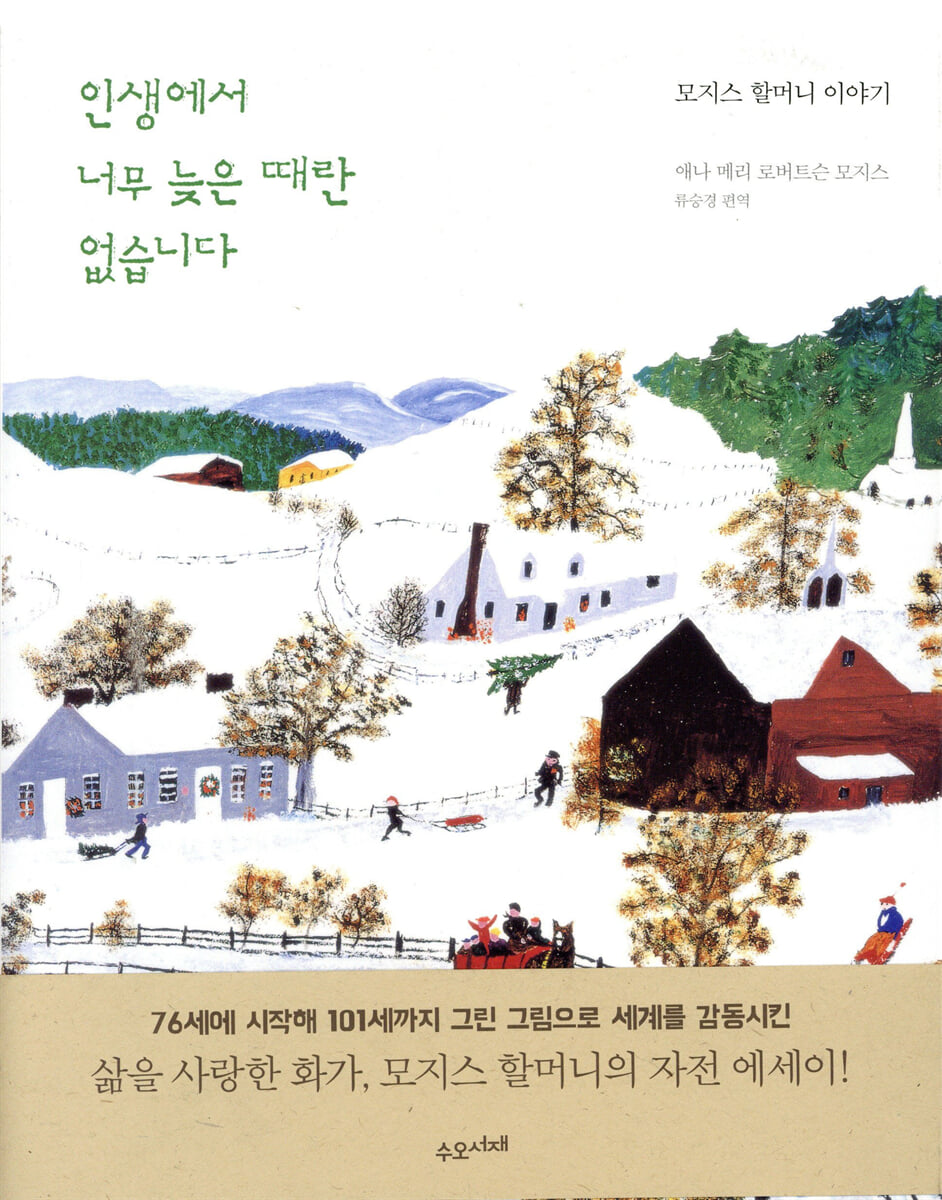
It's never too late in life
 |
Description
Book Introduction
- A word from MD
- [Memories are today, hope is tomorrow] An autobiographical essay by Grandma Moses, a “painter who loved life,” who started painting at the age of 76 and continued painting until she was 101.
It contains 67 drawings and records of the small daily lives of those who are faithful to each day, adapt to the changing seasons, and find joy in them.
Ultimately, the message that life is something we create ourselves resonates deeply.
- Literature MD Kim Do-hoon
He impressed the world with his paintings, which he started at the age of 76 and continued until he was 101.
An autobiographical essay by Grandma Moses, a painter who loved life!
Anna Mary Robertson Moses, American folk artist.
Nicknamed 'Grandma Moses', she began painting at the age of 76.
She had lived a diligent life tending to her farm and making and selling butter and scallion chips, but when arthritis made embroidery, which she had been enjoying as a pastime, difficult, she took up a brush instead of a needle.
She was a cheerful grandmother who would always say that 'now' was the best time to start something when everyone else said it was too late. She held a solo exhibition at the age of 80 and became a world-renowned painter at the age of 100.
This book is a compilation of his autobiography, published at the age of 92, and 67 lovingly drawn paintings.
Her stories and paintings, which capture the simple joys of daily life, adapting to the changing seasons, and finding joy in them, transcend time and convey emotion and hope.
She is talking to us all the time in the book.
Life is unpredictable, but it's still worth living.
The truth is that it's never too late in life.
An autobiographical essay by Grandma Moses, a painter who loved life!
Anna Mary Robertson Moses, American folk artist.
Nicknamed 'Grandma Moses', she began painting at the age of 76.
She had lived a diligent life tending to her farm and making and selling butter and scallion chips, but when arthritis made embroidery, which she had been enjoying as a pastime, difficult, she took up a brush instead of a needle.
She was a cheerful grandmother who would always say that 'now' was the best time to start something when everyone else said it was too late. She held a solo exhibition at the age of 80 and became a world-renowned painter at the age of 100.
This book is a compilation of his autobiography, published at the age of 92, and 67 lovingly drawn paintings.
Her stories and paintings, which capture the simple joys of daily life, adapting to the changing seasons, and finding joy in them, transcend time and convey emotion and hope.
She is talking to us all the time in the book.
Life is unpredictable, but it's still worth living.
The truth is that it's never too late in life.
- You can preview some of the book's contents.
Preview
index
A story told through life
Part 1 Childhood
Part 2 South
Part 3: Eagle Bridge
To us ordinary people who live in an unfortunate world
List of pictures
Part 1 Childhood
Part 2 South
Part 3: Eagle Bridge
To us ordinary people who live in an unfortunate world
List of pictures
Detailed image

Into the book
There are so many things to do when spring comes.
I miss those early spring days, when the snow was still fluttering, when I'd go into the forest to look for the first blooming arbutus flowers of the year—flowers that bloom even in the snow—or pick pussy willows! Those times, I often felt as if I were drawing closer to God's will, closer to Mother Nature.
If you think about it, isn't Mother Nature truly the place where we can be free, a place of beauty and peace, a place we desperately long to escape the noise of life and find tranquility?
--- p.96
I don't think I've ever been so excited and irritable as a sanguine person.
I never had that when I was young.
When I get angry, I just quietly say 'Ishqabibul' in my head.
I don't know what it meant, but it was a common expression at the time, and it was said to have a similar meaning to 'Go get caught by the devil.'
When people get excited, they start saying and doing things they wouldn't normally do in just a few minutes.
But sometimes it's better to let out your anger than to hold a grudge.
If you stay silent, only your insides will rot.
--- p.193
Before Anna left home, I voted for the first time.
I think women should be able to vote too.
Women work just as hard as men, so why shouldn't they be able to speak up? There are plenty of women who are better at their jobs than men.
Even if a woman is supposed to take care of the family, she should be able to assert herself in taking care of the family.
Since gaining the right to vote, women have enjoyed greater freedom.
--- p.225
In my case, I started painting when I was older.
Of course, I had been drawing a little bit before that too.
But one time, my younger sister Celestia came over to visit and saw my yarn drawings and said this.
“Sister, I think it would be prettier and faster to paint with watercolors than to embroider with yarn.” So I did as my sister said.
I started drawing to pass the time.
To me, it was all the same, whether it was embroidery or painting.
--- p.243
Then he asked me how I felt about Gene Hurley becoming famous and what I thought of the Christmas cards I had made with my drawings.
I answered like this.
“Oh, I don’t really care about fame.
Rather than that, I think about what kind of picture I will draw next.
And there are so many things I want to do.
I can't really think of anything to say about Christmas cards, but my granddaughter in Arizona teased me about it.
“She is a witch who flies around the country riding a brush handle, not a broom.”
--- p.263
The next day, Sunday, May 15th, Mrs. Truman invited us to Blair House for tea.
As we were finishing our tea, a loud thunderstorm struck, so we all sat on the sofa and waited for the rain to stop.
President Truman, sitting next to me, said to me, “Don’t be afraid, this building is so big that it has many lightning rods.”
I guess I was worried that this old lady would be scared.
After talking to the President, he seemed just like my son.
I asked him to play a piano piece for me.
So the president played the piano for me, and it was really nice to hear.
--- p.268
If I hadn't been painting, I would probably have been raising chickens.
You can still raise chickens today.
I can never sit still in a rocking chair and wait for someone to help me.
I've told people around me many times, but rather than getting help from others, I'd rather rent a room in a corner of the city and sell pancakes.
It's just pancakes and syrup, though.
Like a simple breakfast.
I never dreamed that I would make so much money by drawing.
I'm too old to care about the fame and media attention that comes with age.
--- p.272
Now that I'm this old, I don't know how time flies.
I think I felt my age the most when I was sixteen.
By the time I left the Whitesides, I was mature and peaceful.
In a way, it seems like I've always lived like that.
Even now, I don't feel old at all.
I am a grandmother with eleven grandchildren and seventeen great-grandchildren.
You've put in so many!
I miss those early spring days, when the snow was still fluttering, when I'd go into the forest to look for the first blooming arbutus flowers of the year—flowers that bloom even in the snow—or pick pussy willows! Those times, I often felt as if I were drawing closer to God's will, closer to Mother Nature.
If you think about it, isn't Mother Nature truly the place where we can be free, a place of beauty and peace, a place we desperately long to escape the noise of life and find tranquility?
--- p.96
I don't think I've ever been so excited and irritable as a sanguine person.
I never had that when I was young.
When I get angry, I just quietly say 'Ishqabibul' in my head.
I don't know what it meant, but it was a common expression at the time, and it was said to have a similar meaning to 'Go get caught by the devil.'
When people get excited, they start saying and doing things they wouldn't normally do in just a few minutes.
But sometimes it's better to let out your anger than to hold a grudge.
If you stay silent, only your insides will rot.
--- p.193
Before Anna left home, I voted for the first time.
I think women should be able to vote too.
Women work just as hard as men, so why shouldn't they be able to speak up? There are plenty of women who are better at their jobs than men.
Even if a woman is supposed to take care of the family, she should be able to assert herself in taking care of the family.
Since gaining the right to vote, women have enjoyed greater freedom.
--- p.225
In my case, I started painting when I was older.
Of course, I had been drawing a little bit before that too.
But one time, my younger sister Celestia came over to visit and saw my yarn drawings and said this.
“Sister, I think it would be prettier and faster to paint with watercolors than to embroider with yarn.” So I did as my sister said.
I started drawing to pass the time.
To me, it was all the same, whether it was embroidery or painting.
--- p.243
Then he asked me how I felt about Gene Hurley becoming famous and what I thought of the Christmas cards I had made with my drawings.
I answered like this.
“Oh, I don’t really care about fame.
Rather than that, I think about what kind of picture I will draw next.
And there are so many things I want to do.
I can't really think of anything to say about Christmas cards, but my granddaughter in Arizona teased me about it.
“She is a witch who flies around the country riding a brush handle, not a broom.”
--- p.263
The next day, Sunday, May 15th, Mrs. Truman invited us to Blair House for tea.
As we were finishing our tea, a loud thunderstorm struck, so we all sat on the sofa and waited for the rain to stop.
President Truman, sitting next to me, said to me, “Don’t be afraid, this building is so big that it has many lightning rods.”
I guess I was worried that this old lady would be scared.
After talking to the President, he seemed just like my son.
I asked him to play a piano piece for me.
So the president played the piano for me, and it was really nice to hear.
--- p.268
If I hadn't been painting, I would probably have been raising chickens.
You can still raise chickens today.
I can never sit still in a rocking chair and wait for someone to help me.
I've told people around me many times, but rather than getting help from others, I'd rather rent a room in a corner of the city and sell pancakes.
It's just pancakes and syrup, though.
Like a simple breakfast.
I never dreamed that I would make so much money by drawing.
I'm too old to care about the fame and media attention that comes with age.
--- p.272
Now that I'm this old, I don't know how time flies.
I think I felt my age the most when I was sixteen.
By the time I left the Whitesides, I was mature and peaceful.
In a way, it seems like I've always lived like that.
Even now, I don't feel old at all.
I am a grandmother with eleven grandchildren and seventeen great-grandchildren.
You've put in so many!
--- p.274
Publisher's Review
He impressed the world with his paintings, which he started at the age of 76 and continued until he was 101.
An autobiographical essay by Grandma Moses, a painter who loved life!
“Do what you really want to do.
God will be pleased and open the door to success.
Even if you are already 80 years old.”
_From the text
Anna Mary Robertson Moses, the American national painter known as 'Grandma Moses'.
She was 76 years old when she started painting in earnest.
She had lived her entire life as a farm worker, but when arthritis made embroidery, which she had enjoyed as a pastime, difficult for her, she began painting with a brush instead of a needle.
She was a cheerful grandmother who would always say that 'now' is the best time to start something when everyone else said it was too late. She held a solo exhibition at the age of 80, just 5 years after she started painting, and became a world-renowned painter at the age of 100.
Although she started painting as a hobby at a 'late' age, Grandma Moses' paintings were enough to captivate people regardless of her age.
Not only did she appear on radio and television, she was featured on the cover of Time magazine, a rarity for a woman at the time, and a documentary was even produced featuring her.
At the age of 92, she published her autobiography, and considering its popularity, which was close to a cultural phenomenon, it was only natural that her book would become a bestseller.
"It's Never Too Late in Life" is a collection of autobiographical essays by Grandma Moses, compiled from her autobiography and 67 lovingly illustrated drawings.
Her life, depicted in the book written by her grandmother herself, is neither glamorous nor grandiose.
Rather, it is a simple continuation of daily life, just like our own lives, of being faithful to each day, adapting to the changing seasons, and finding joy in them.
Nevertheless, her warm paintings, faith in life, and enterprising attitude remain vivid and give us hope even today, transcending our contemporaries.
Grandma Moses always wanted to live on her own rather than rely on help from others.
Just by looking into her daily life through this book, you will gain the courage and comfort to start something new.
When you think it's too late to start something,
When the feeling of hopelessness that nothing can change comes over you,
But if you still want to love your life till the end!
“Memories and hopes are truly strange things. Memories look back, while hope looks forward.
Memories are today, hope is tomorrow.
“Memories are history recorded in the mind, and like a painter, they paint pictures of the past and present.”
_From the text
Despite the public's interest in Grandma Moses' paintings, little is known about her other than the fact that she became a world-renowned artist at a late age.
Perhaps that is why I feel even more welcome about her autobiography, written by herself.
Grandma's uniquely lyrical and charming writings may not be sophisticated, but they are honest, funny, and sweet.
Her uniquely cute and warm work adds to the enjoyment.
Part 1 unfolds the grandmother's childhood.
She recalls the happy times of rocking her younger sister's cradle and picking flowers in the forest, not being able to be called by her proper name or know her birthday, to the difficult times when she had to become a housekeeper at the age of 12.
Part 2 begins with her journey to marry her husband, Thomas Moses, and move to the South.
You can meet her, who diligently raised the five surviving children out of ten.
In Part 3, she returns to the North again.
It is filled with experiences I had after marrying off all my children and finally starting to paint.
From radio appearances to meeting President Truman and receiving an award, the days are filled with interesting events.
Soon after I started drawing, the whole of America was in an uproar.
Her paintings were incorporated into all kinds of household items, and Christmas cards featuring her paintings sold over 100 million copies.
But despite this craze, she speaks calmly.
“I’m too old to care about the fame and media attention that comes with each passing year.
Rather than that, I think about what kind of picture I will draw next.”
Grandma Moses' paintings resemble her life.
This is because I drew the pictures as if I was recording each and every memory of my life.
[Making Syrup] is about a childhood spent making syrup by collecting maple sap in a snow-covered forest, [Making Apple Butter] is about a day when the whole family played butter until late at night, and [The Old Oak Bucket] is about the popular songs and village legends of that time.
Only when the lovely pictures in the book and her simple life come together will we be able to understand.
Life is unpredictable, but it's still worth living, and it's never too late in life.
“After all, life is something we create ourselves.
“It has always been that way, and it always will be that way.”
An autobiographical essay by Grandma Moses, a painter who loved life!
“Do what you really want to do.
God will be pleased and open the door to success.
Even if you are already 80 years old.”
_From the text
Anna Mary Robertson Moses, the American national painter known as 'Grandma Moses'.
She was 76 years old when she started painting in earnest.
She had lived her entire life as a farm worker, but when arthritis made embroidery, which she had enjoyed as a pastime, difficult for her, she began painting with a brush instead of a needle.
She was a cheerful grandmother who would always say that 'now' is the best time to start something when everyone else said it was too late. She held a solo exhibition at the age of 80, just 5 years after she started painting, and became a world-renowned painter at the age of 100.
Although she started painting as a hobby at a 'late' age, Grandma Moses' paintings were enough to captivate people regardless of her age.
Not only did she appear on radio and television, she was featured on the cover of Time magazine, a rarity for a woman at the time, and a documentary was even produced featuring her.
At the age of 92, she published her autobiography, and considering its popularity, which was close to a cultural phenomenon, it was only natural that her book would become a bestseller.
"It's Never Too Late in Life" is a collection of autobiographical essays by Grandma Moses, compiled from her autobiography and 67 lovingly illustrated drawings.
Her life, depicted in the book written by her grandmother herself, is neither glamorous nor grandiose.
Rather, it is a simple continuation of daily life, just like our own lives, of being faithful to each day, adapting to the changing seasons, and finding joy in them.
Nevertheless, her warm paintings, faith in life, and enterprising attitude remain vivid and give us hope even today, transcending our contemporaries.
Grandma Moses always wanted to live on her own rather than rely on help from others.
Just by looking into her daily life through this book, you will gain the courage and comfort to start something new.
When you think it's too late to start something,
When the feeling of hopelessness that nothing can change comes over you,
But if you still want to love your life till the end!
“Memories and hopes are truly strange things. Memories look back, while hope looks forward.
Memories are today, hope is tomorrow.
“Memories are history recorded in the mind, and like a painter, they paint pictures of the past and present.”
_From the text
Despite the public's interest in Grandma Moses' paintings, little is known about her other than the fact that she became a world-renowned artist at a late age.
Perhaps that is why I feel even more welcome about her autobiography, written by herself.
Grandma's uniquely lyrical and charming writings may not be sophisticated, but they are honest, funny, and sweet.
Her uniquely cute and warm work adds to the enjoyment.
Part 1 unfolds the grandmother's childhood.
She recalls the happy times of rocking her younger sister's cradle and picking flowers in the forest, not being able to be called by her proper name or know her birthday, to the difficult times when she had to become a housekeeper at the age of 12.
Part 2 begins with her journey to marry her husband, Thomas Moses, and move to the South.
You can meet her, who diligently raised the five surviving children out of ten.
In Part 3, she returns to the North again.
It is filled with experiences I had after marrying off all my children and finally starting to paint.
From radio appearances to meeting President Truman and receiving an award, the days are filled with interesting events.
Soon after I started drawing, the whole of America was in an uproar.
Her paintings were incorporated into all kinds of household items, and Christmas cards featuring her paintings sold over 100 million copies.
But despite this craze, she speaks calmly.
“I’m too old to care about the fame and media attention that comes with each passing year.
Rather than that, I think about what kind of picture I will draw next.”
Grandma Moses' paintings resemble her life.
This is because I drew the pictures as if I was recording each and every memory of my life.
[Making Syrup] is about a childhood spent making syrup by collecting maple sap in a snow-covered forest, [Making Apple Butter] is about a day when the whole family played butter until late at night, and [The Old Oak Bucket] is about the popular songs and village legends of that time.
Only when the lovely pictures in the book and her simple life come together will we be able to understand.
Life is unpredictable, but it's still worth living, and it's never too late in life.
“After all, life is something we create ourselves.
“It has always been that way, and it always will be that way.”
GOODS SPECIFICS
- Date of publication: December 16, 2017
- Page count, weight, size: 288 pages | 530g | 165*210*20mm
- ISBN13: 9791187498186
- ISBN10: 1187498181
You may also like
카테고리
korean


korean

![GQ KOREA Mark (Monthly): December [2025]](http://librairie.coreenne.fr/cdn/shop/files/8ef265dbbfbf186523ed75ba7319009d.jpg?v=1765340328&width=3840)


