

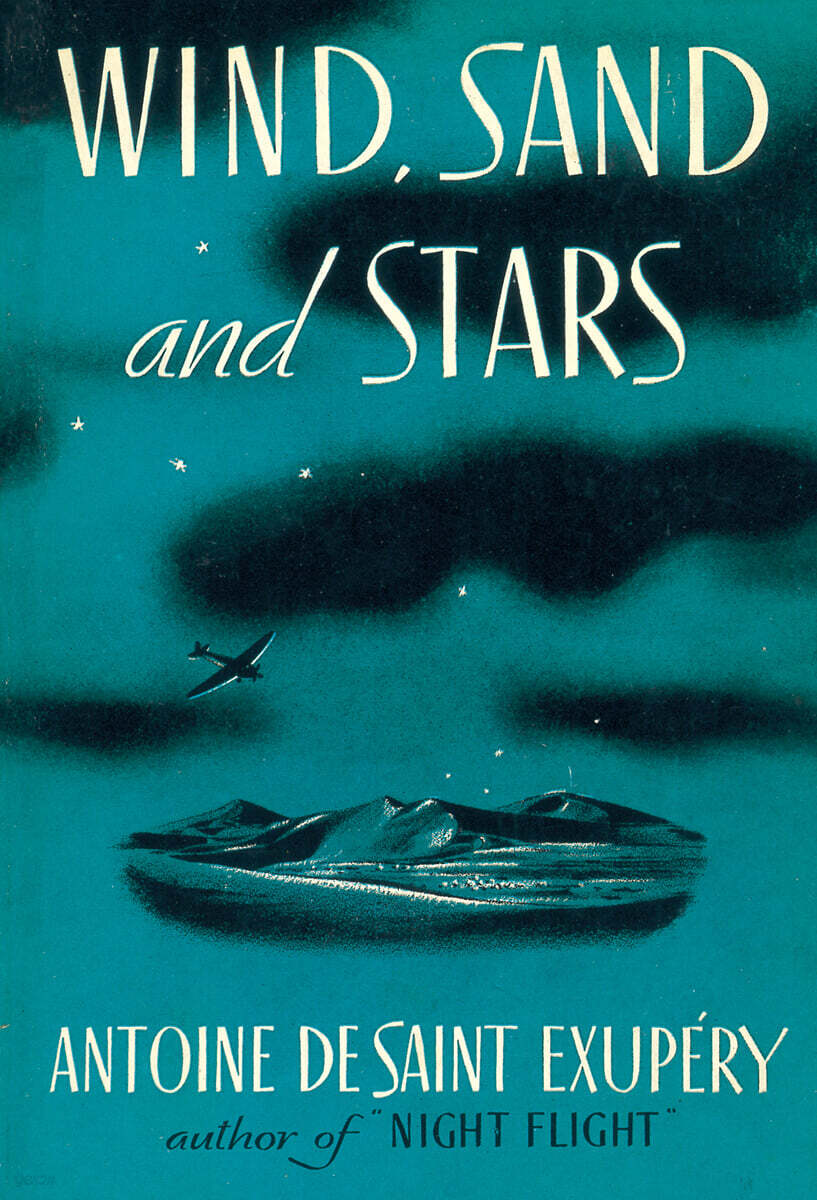
First edition of The Land of Man
 |
Description
Book Introduction
An essay-like novel written by Saint-Exupéry, author of The Little Prince, based on his own experiences.
The definitive flight story, following Southern Mail and Night Flight: The Land of the Humans
Published simultaneously in France and the United States, it became a bestseller with its beautiful and poetic style.
“To love is not to look at each other, but to look in the same direction.”
"The Land of Men," which won the Prix des Novels des Académie Française in 1939, was based on Saint-Exupéry's experiences as an airline pilot for 15 years.
In particular, he focused on the five years of adventure (1926-1930) he spent on night flights to pioneer an African-South American route for Latecoere Airlines, and added his later experiences as a correspondent during the Russian and Spanish Civil Wars. He deeply contemplated the questions, “What kind of place is the world, and what kind of being is a human being?” and wrote them one by one, which were then re-edited and published as a novel.
It was also published simultaneously in the United States under the title Wind, Sand, and Stars, and as the war was raging, this beautiful novel, which spoke of human solidarity and reminded us of human dignity, gained immense popularity.
(cf.
The first edition of The Story used the cover and text illustrations from the first edition of the American version.)
The definitive flight story, following Southern Mail and Night Flight: The Land of the Humans
Published simultaneously in France and the United States, it became a bestseller with its beautiful and poetic style.
“To love is not to look at each other, but to look in the same direction.”
"The Land of Men," which won the Prix des Novels des Académie Française in 1939, was based on Saint-Exupéry's experiences as an airline pilot for 15 years.
In particular, he focused on the five years of adventure (1926-1930) he spent on night flights to pioneer an African-South American route for Latecoere Airlines, and added his later experiences as a correspondent during the Russian and Spanish Civil Wars. He deeply contemplated the questions, “What kind of place is the world, and what kind of being is a human being?” and wrote them one by one, which were then re-edited and published as a novel.
It was also published simultaneously in the United States under the title Wind, Sand, and Stars, and as the war was raging, this beautiful novel, which spoke of human solidarity and reminded us of human dignity, gained immense popularity.
(cf.
The first edition of The Story used the cover and text illustrations from the first edition of the American version.)
- You can preview some of the book's contents.
Preview
index
introduction
Route 1
2 colleagues
3 airplanes
4 Airplanes and the Earth
5 Oasis
6 In the desert
7 In the middle of the desert
8 humans
Translator's Note
Antoine de Saint-Exupéry Chronology
Route 1
2 colleagues
3 airplanes
4 Airplanes and the Earth
5 Oasis
6 In the desert
7 In the middle of the desert
8 humans
Translator's Note
Antoine de Saint-Exupéry Chronology
Into the book
I can always picture the scene of my first night flight over Argentina, that pitch-black night with only the stars twinkling and the occasional light in the grasslands.
Each light signaled the existence of the miracle of consciousness in the midst of the ocean of darkness.
[…] We must strive to reach out to each other.
You should try to connect with some of the lights burning here and there in the field.
--- p.8 From the "Preface"
I was amazed to hear the quiet exchanges between people.
Their stories were about the sad troubles of illness, money, and family.
They painted the faded walls of the prison and these people were locked inside.
But then suddenly the face of fate appeared to me.
Old civil servant here, my colleague, you have no responsibility at all.
Nothing helped you escape.
You just built peace by filling in all the light passages with concrete like termites do.
You would have climbed this humble wall against the wind and mud and stars, curled up in a ball, in the safety of the common people, the routines and the stifling rituals of country life.
You don't want to worry about huge problems.
Because we have already gone through so many hardships that we have even forgotten the human condition.
You are not a resident of the wandering star, and you do not ask unanswered questions.
You are a petit bourgeois from Toulouse.
--- p.26 From "Route"
Kiyome's greatness lies in his sense of responsibility.
He felt responsible for himself, for his mail, and for his hopeful colleagues.
He held their pain and joy in his hands and measured them.
Among the living, I tried to help with the responsibility for what was to be newly established.
He felt some sense of responsibility for the fate of people in terms of his own work.
[…] To be human, to put it bluntly, is to have responsibility.
It is knowing shame in the face of the misery of a world that seems to have nothing to do with oneself.
It is about being proud of the victories achieved by your colleagues.
It is a feeling of contributing to building the world by placing one's own stone.
--- p.61 From “Colleagues”
Once again we realize that we are not the ones in distress.
If they are castaways, they are the ones who should be waiting! They are the ones threatened by our silence.
These are people who have already been torn to pieces by a terrible mistake.
We cannot help but run towards them.
Even Kiyome, who returned from the Andes, said he ran towards the survivors! That is a universal truth.
“If I were left alone in the world, I would have collapsed.”
--- p.196 From "In the Middle of the Desert"
What do we know, other than that the unknown enriches us? Where does human truth lie? Truth is never proven.
If an orange tree takes root and bears fruit in this soil and not elsewhere, then that soil is the truth of the orange tree.
If religion, culture, values, and forms of activity, if nothing else, enrich a man and liberate within him a great lord he never knew existed, then that is the truth of man.
So what's the logic? It's the work of untangling the entanglements to elucidate life! […] If there's one thing you should praise above all else, it's the earth upon which they are founded.
--- p.221 From "Humans"
Only when we become one with our brothers and sisters in a common external goal do we finally breathe.
We learned through experience.
Love is not two people looking at each other, but two people looking in the same direction.
When we are united in the same ranks and aim for the same high ground, we become comrades.
If not, why, in such a comfortable age, did we feel such profound joy sharing our last morsels of food in the desert? Contrary to sociologists' predictions, what truly held value? For someone who experienced the profound joy of rescue work in the Sahara, other pleasures would seem insignificant.
Each light signaled the existence of the miracle of consciousness in the midst of the ocean of darkness.
[…] We must strive to reach out to each other.
You should try to connect with some of the lights burning here and there in the field.
--- p.8 From the "Preface"
I was amazed to hear the quiet exchanges between people.
Their stories were about the sad troubles of illness, money, and family.
They painted the faded walls of the prison and these people were locked inside.
But then suddenly the face of fate appeared to me.
Old civil servant here, my colleague, you have no responsibility at all.
Nothing helped you escape.
You just built peace by filling in all the light passages with concrete like termites do.
You would have climbed this humble wall against the wind and mud and stars, curled up in a ball, in the safety of the common people, the routines and the stifling rituals of country life.
You don't want to worry about huge problems.
Because we have already gone through so many hardships that we have even forgotten the human condition.
You are not a resident of the wandering star, and you do not ask unanswered questions.
You are a petit bourgeois from Toulouse.
--- p.26 From "Route"
Kiyome's greatness lies in his sense of responsibility.
He felt responsible for himself, for his mail, and for his hopeful colleagues.
He held their pain and joy in his hands and measured them.
Among the living, I tried to help with the responsibility for what was to be newly established.
He felt some sense of responsibility for the fate of people in terms of his own work.
[…] To be human, to put it bluntly, is to have responsibility.
It is knowing shame in the face of the misery of a world that seems to have nothing to do with oneself.
It is about being proud of the victories achieved by your colleagues.
It is a feeling of contributing to building the world by placing one's own stone.
--- p.61 From “Colleagues”
Once again we realize that we are not the ones in distress.
If they are castaways, they are the ones who should be waiting! They are the ones threatened by our silence.
These are people who have already been torn to pieces by a terrible mistake.
We cannot help but run towards them.
Even Kiyome, who returned from the Andes, said he ran towards the survivors! That is a universal truth.
“If I were left alone in the world, I would have collapsed.”
--- p.196 From "In the Middle of the Desert"
What do we know, other than that the unknown enriches us? Where does human truth lie? Truth is never proven.
If an orange tree takes root and bears fruit in this soil and not elsewhere, then that soil is the truth of the orange tree.
If religion, culture, values, and forms of activity, if nothing else, enrich a man and liberate within him a great lord he never knew existed, then that is the truth of man.
So what's the logic? It's the work of untangling the entanglements to elucidate life! […] If there's one thing you should praise above all else, it's the earth upon which they are founded.
--- p.221 From "Humans"
Only when we become one with our brothers and sisters in a common external goal do we finally breathe.
We learned through experience.
Love is not two people looking at each other, but two people looking in the same direction.
When we are united in the same ranks and aim for the same high ground, we become comrades.
If not, why, in such a comfortable age, did we feel such profound joy sharing our last morsels of food in the desert? Contrary to sociologists' predictions, what truly held value? For someone who experienced the profound joy of rescue work in the Sahara, other pleasures would seem insignificant.
--- p.234 From "Humans"
Publisher's Review
“To be human is to have responsibility.
It is to feel ashamed before the misery of the world.
“This sense of solidarity is what makes humans human.”
Rookie pilot Saint-Exupéry takes off on his first flight carrying a mail bag.
At the time, airplanes were easily damaged, engines were unreliable, and radio communications were frequently cut off, making night flights extremely dangerous.
If he were caught in the gusts of wind and dark clouds there, the sky and the earth would turn upside down, leaving the pilot completely alone, desperately searching for the lights and voices of his colleagues on the ground.
He recalls the story of his fellow pilots, Guillaume and Mermoz, who miraculously survived a crash in the Andes, and reflects on how he was able to return after crashing in the Libyan desert, dying of thirst and a mirage.
I also recall the first thing Bark, a slave I met in the desert, did after being freed as a free man, the faces of a Polish worker's family being deported by train because of the war, and the sergeant on the Madrid front who, after living an ordinary life as an accountant, joined the army after hearing of the death of a colleague and went on a sortie to fight against Nazi air raids.
And then he constantly asks questions.
What kind of relationship does this world have with humans? What kind of place is this 'Earth' that embraces humans and then cruelly casts them out? Even though reality is so miserable and bleak, are humans truly dignified beings?
Ultimately, when humans feel a sense of responsibility for one another, when they share the pain of all humanity, cry together, and help each other, only then do they realize that they are truly human and great.
“Only the ‘spirit’ breathes life into the clay and creates ‘human beings.’”
It is to feel ashamed before the misery of the world.
“This sense of solidarity is what makes humans human.”
Rookie pilot Saint-Exupéry takes off on his first flight carrying a mail bag.
At the time, airplanes were easily damaged, engines were unreliable, and radio communications were frequently cut off, making night flights extremely dangerous.
If he were caught in the gusts of wind and dark clouds there, the sky and the earth would turn upside down, leaving the pilot completely alone, desperately searching for the lights and voices of his colleagues on the ground.
He recalls the story of his fellow pilots, Guillaume and Mermoz, who miraculously survived a crash in the Andes, and reflects on how he was able to return after crashing in the Libyan desert, dying of thirst and a mirage.
I also recall the first thing Bark, a slave I met in the desert, did after being freed as a free man, the faces of a Polish worker's family being deported by train because of the war, and the sergeant on the Madrid front who, after living an ordinary life as an accountant, joined the army after hearing of the death of a colleague and went on a sortie to fight against Nazi air raids.
And then he constantly asks questions.
What kind of relationship does this world have with humans? What kind of place is this 'Earth' that embraces humans and then cruelly casts them out? Even though reality is so miserable and bleak, are humans truly dignified beings?
Ultimately, when humans feel a sense of responsibility for one another, when they share the pain of all humanity, cry together, and help each other, only then do they realize that they are truly human and great.
“Only the ‘spirit’ breathes life into the clay and creates ‘human beings.’”
GOODS SPECIFICS
- Date of issue: September 30, 2025
- Page count, weight, size: 260 pages | 128*188*20mm
- ISBN13: 9791175240490
- ISBN10: 1175240494
You may also like
카테고리
korean


korean

![GQ KOREA Mark (Monthly): December [2025]](http://librairie.coreenne.fr/cdn/shop/files/8ef265dbbfbf186523ed75ba7319009d.jpg?v=1765340328&width=3840)


