

Some trees
 |
Description
Book Introduction
“From August 1994 to January 1995
“A record of living memories created by a living person.”
Choi Seung-ja's Iowa Diary
Some trees
Poet Choi Seung-ja's second collection of prose, "Some Trees," is published.
This book was published in 1995, so it's been 26 years since it was published.
This is a prose diary in which the poet candidly describes his journey from Sunday, August 26, 1994, to Monday, January 16, 1995, during his first trip abroad as a participant in the International Writing Program (IWP) hosted by the University of Iowa in Iowa City, Iowa, USA.
If the first collection of essays, 『The Story of a Lazy Poet』, was a story of burning 'poetry' at the end of the road of life and death, using the tragic rose as bait, this book is the literary essence of Choi Seung-ja, which fully reveals the poet's daily life armed with his unique honesty and humor, and his small but humane side.
“A record of living memories created by a living person.”
Choi Seung-ja's Iowa Diary
Some trees
Poet Choi Seung-ja's second collection of prose, "Some Trees," is published.
This book was published in 1995, so it's been 26 years since it was published.
This is a prose diary in which the poet candidly describes his journey from Sunday, August 26, 1994, to Monday, January 16, 1995, during his first trip abroad as a participant in the International Writing Program (IWP) hosted by the University of Iowa in Iowa City, Iowa, USA.
If the first collection of essays, 『The Story of a Lazy Poet』, was a story of burning 'poetry' at the end of the road of life and death, using the tragic rose as bait, this book is the literary essence of Choi Seung-ja, which fully reveals the poet's daily life armed with his unique honesty and humor, and his small but humane side.
- You can preview some of the book's contents.
Preview
index
Poet's Note 4
Revised Edition Poet's Note 7
August 1994
Sunday, August 28, 1994 15
Monday, August 29, 1994 22
Tuesday, August 30, 1994 26
Wednesday, August 31, 1994 30
September 1994
Thursday, September 1, 1994 32
Friday, September 2, 1994 35
Saturday, September 3, 1994 37
Sunday, September 4, 1994 41
Monday, September 5, 1994 43
Tuesday, September 6, 1994 46
Wednesday, September 7, 1994 50
Friday, September 9, 1994 53
Saturday, September 10, 1994 56
Sunday, September 11, 1994 61
Monday, September 12, 1994 66
Tuesday, September 13, 1994 67
Wednesday, September 14, 1994 71
Thursday, September 15, 1994 75
Friday, September 16, 1994 80
Saturday, September 17, 1994 83
Sunday, September 18, 1994 88
Tuesday, September 20, 1994 90
Wednesday, September 21, 1994 92
Thursday, September 22, 1994 96
Friday, September 23, 1994 100
Saturday, September 24, 1994 105
Sunday, September 25, 1994 107
Tuesday, September 27, 1994 109
Wednesday, September 28, 1994 112
Thursday, September 29, 1994 114
Friday, September 30, 1994 117
October 1994
Saturday, October 1, 1994 120
Monday, October 3, 1994 124
Tuesday, October 4, 1994 127
Wednesday, October 5, 1994 133
Friday, October 7, 1994 137
Saturday, October 8, 1994 140
Sunday, October 9, 1994 147
Monday, October 10, 1994 150
Wednesday, October 12, 1994 152
Thursday, October 13, 1994 154
Friday, October 14, 1994 157
Saturday, October 15, 1994 160
Monday, October 17, 1994 163
Tuesday, October 18, 1994 167
Wednesday, October 19, 1994 169
Friday, October 21, 1994 170
Saturday, October 22, 1994 173
Monday, October 24, 1994 175
Thursday, October 27, 1994 177
Friday, October 28, 1994 182
Saturday, October 29, 1994 184
Sunday, October 30, 1994 185
November 1994
Tuesday, November 1, 1994 189
Wednesday, November 2, 1994 193
Thursday, November 3, 1994 198
Friday, November 4, 1994 201
Saturday, November 5, 1994 207
Sunday, November 6, 1994 210
Monday, November 7, 1994 217
Tuesday, November 8, 1994 227
Wednesday, November 9, 1994 235
Thursday, November 10, 1994 236
Friday, November 11, 1994 240
Saturday, November 12, 1994 248
Sunday, November 13, 1994 249
Monday, November 14, 1994 252
Tuesday, November 15, 1994 254
Wednesday, November 16, 1994 262
Thursday, November 17, 1994 268
Friday, November 18, 1994 275
Saturday, November 19, 1994 280
Sunday, November 20, 1994 284
Monday, November 21, 1994 287
Tuesday, November 22, 1994 290
Thursday, November 24, 1994 292
Friday, November 25, 1994 294
Saturday, November 26, 1994 296
Sunday, November 27, 1994 302
December 1994
Friday, December 2, 1994 307
Sunday, December 4, 1994 310
Monday, December 5, 1994 315
Tuesday, December 6, 1994 320
Wednesday, December 7, 1994 323
Thursday, December 8, 1994 328
Friday, December 9, 1994 332
Saturday, December 10, 1994 336
Sunday, December 11, 1994 344
Monday, December 12, 1994 349
Tuesday, December 13, 1994 352
Wednesday, December 14, 1994 355
Thursday, December 15, 1994 361
Friday, December 16, 1994 368
Tuesday, December 20, 1994 372
Friday, December 23, 1994 379
Saturday, December 24, 1994 382
Friday, December 30, 1994 383
January 1995
Thursday, January 5, 1995 385
Friday, January 6, 1995 387
Sunday, January 8, 1995 391
Monday, January 9, 1995 393
Tuesday, January 10, 1995 397
Wednesday, January 11, 1995 399
Saturday, January 14, 1995 405
Monday, January 16, 1995 407
Revised Edition Poet's Note 7
August 1994
Sunday, August 28, 1994 15
Monday, August 29, 1994 22
Tuesday, August 30, 1994 26
Wednesday, August 31, 1994 30
September 1994
Thursday, September 1, 1994 32
Friday, September 2, 1994 35
Saturday, September 3, 1994 37
Sunday, September 4, 1994 41
Monday, September 5, 1994 43
Tuesday, September 6, 1994 46
Wednesday, September 7, 1994 50
Friday, September 9, 1994 53
Saturday, September 10, 1994 56
Sunday, September 11, 1994 61
Monday, September 12, 1994 66
Tuesday, September 13, 1994 67
Wednesday, September 14, 1994 71
Thursday, September 15, 1994 75
Friday, September 16, 1994 80
Saturday, September 17, 1994 83
Sunday, September 18, 1994 88
Tuesday, September 20, 1994 90
Wednesday, September 21, 1994 92
Thursday, September 22, 1994 96
Friday, September 23, 1994 100
Saturday, September 24, 1994 105
Sunday, September 25, 1994 107
Tuesday, September 27, 1994 109
Wednesday, September 28, 1994 112
Thursday, September 29, 1994 114
Friday, September 30, 1994 117
October 1994
Saturday, October 1, 1994 120
Monday, October 3, 1994 124
Tuesday, October 4, 1994 127
Wednesday, October 5, 1994 133
Friday, October 7, 1994 137
Saturday, October 8, 1994 140
Sunday, October 9, 1994 147
Monday, October 10, 1994 150
Wednesday, October 12, 1994 152
Thursday, October 13, 1994 154
Friday, October 14, 1994 157
Saturday, October 15, 1994 160
Monday, October 17, 1994 163
Tuesday, October 18, 1994 167
Wednesday, October 19, 1994 169
Friday, October 21, 1994 170
Saturday, October 22, 1994 173
Monday, October 24, 1994 175
Thursday, October 27, 1994 177
Friday, October 28, 1994 182
Saturday, October 29, 1994 184
Sunday, October 30, 1994 185
November 1994
Tuesday, November 1, 1994 189
Wednesday, November 2, 1994 193
Thursday, November 3, 1994 198
Friday, November 4, 1994 201
Saturday, November 5, 1994 207
Sunday, November 6, 1994 210
Monday, November 7, 1994 217
Tuesday, November 8, 1994 227
Wednesday, November 9, 1994 235
Thursday, November 10, 1994 236
Friday, November 11, 1994 240
Saturday, November 12, 1994 248
Sunday, November 13, 1994 249
Monday, November 14, 1994 252
Tuesday, November 15, 1994 254
Wednesday, November 16, 1994 262
Thursday, November 17, 1994 268
Friday, November 18, 1994 275
Saturday, November 19, 1994 280
Sunday, November 20, 1994 284
Monday, November 21, 1994 287
Tuesday, November 22, 1994 290
Thursday, November 24, 1994 292
Friday, November 25, 1994 294
Saturday, November 26, 1994 296
Sunday, November 27, 1994 302
December 1994
Friday, December 2, 1994 307
Sunday, December 4, 1994 310
Monday, December 5, 1994 315
Tuesday, December 6, 1994 320
Wednesday, December 7, 1994 323
Thursday, December 8, 1994 328
Friday, December 9, 1994 332
Saturday, December 10, 1994 336
Sunday, December 11, 1994 344
Monday, December 12, 1994 349
Tuesday, December 13, 1994 352
Wednesday, December 14, 1994 355
Thursday, December 15, 1994 361
Friday, December 16, 1994 368
Tuesday, December 20, 1994 372
Friday, December 23, 1994 379
Saturday, December 24, 1994 382
Friday, December 30, 1994 383
January 1995
Thursday, January 5, 1995 385
Friday, January 6, 1995 387
Sunday, January 8, 1995 391
Monday, January 9, 1995 393
Tuesday, January 10, 1995 397
Wednesday, January 11, 1995 399
Saturday, January 14, 1995 405
Monday, January 16, 1995 407
Detailed image

Into the book
I found greater enjoyment in translating poetry than in creating it.
Anyway, I was glad that the poems I translated were able to resonate with them to some extent.
And I started to think about how different they were from older Korean female poets, and something I once heard from Kim Hye-sun came to mind.
A senior female poet was appointed as a judge for some award and had a hard time finding and reading Kim Hye-soon and my poetry collections to recommend them. When she opened Kim Hye-soon's poetry collection, she heard people talking about this and that from the first page, and when she opened Choi Seung-ja's poetry collection, she heard people talking about excrement (the poet couldn't even pronounce the word "poop" and substituted the word "excrement") from the first page. So she felt so embarrassed that she couldn't even recommend them.
Kim Hye-soon and I were giggling while talking about that.
Beryl looks very old, but she gives off the impression of a strong-willed actress.
That's because her accent is so strong, and even though she always dresses shabbily, like a grandmother strolling around the market in Korea, her sharp eyes and nonstop chatter all come together to create an incredible energy.
She said that she was widowed by her first husband, divorced by her second husband, and that she is not married to the man she is living with now, but rather lives with him as a friend.
And the guy said, 'I'm just a feminist.'
I don't know what it means to be a feminist, though.
She also said that she took care of the man's stroke-stricken mother and received money from him in return.
It's labor anyway.
I envy you for having so much energy despite looking so old.
It makes me wonder if I could have that kind of energy and vitality at that age.
--- p.39~40, from “Saturday, September 3, 1994”
After reading my manuscript, during the question-and-answer session, Clark asked me what I was writing specifically for, what ideology I was writing for.
So I answered that I don't write for anything, if what I write can help some 'ism' or some ideology, and if it's a good 'ism' or ideology, then it's understandable to use my poetry, but if you ask me to write for some 'ism' or ideology, then I don't write.
Then, Astrid from the Netherlands immediately asked, "If writing and publishing poetry is for communication, then why do you write and publish poetry?"
This is a question we hear so often and so familiarly in Korea.
So my answer has to be immediate.
I basically agree that it is for communication, but I answered that it does not mean 'physical communication'.
At that moment, I couldn't think of the right word, so the word 'physical' just popped out of nowhere. Astrid, who likes to argue and argue everywhere, quickly said, "Oh, I understand, I'll withdraw my question."
Astrid loves rebuttals for the sake of rebuttal, opposition for the sake of opposition, wherever she is.
Last time, when I heard Shona talking angrily, it seemed that the writers were discussing some issue in the Mayflower's 8th floor common room, and Astrid had been persistently attacking Shona's views.
So I told her then that Astrid was the type of person who liked to oppose for the sake of opposing, so she didn't have to worry about it.
And that rebuttal, or opposition, was refreshing because it was something I had heard so many times.
That just reinforced the impression that she was opposing for the sake of opposing.
One interesting thing is that when I was describing my poetry collections and said, "The first one came out in such-and-such year (1981) and is now in its 21st printing," almost everyone gasped.
In foreign countries, it is said that a poetry collection sells well once the first edition is sold out, so it is surprising.
I should tell Korean writers that when they talk about their poetry collections, they should mention the number of printings.
In our country, poetry collections sell so well that any poet's poetry collection can sell that much.
He seemed even more surprised when I later told him that in our country, literally million-selling poetry collections are published quite often.
Then Clark told about his experience when he went to Seoul.
I think I went to Kyobo Bookstore.
He said that the bookstore was so big that it was almost as big as a subway station, and that there were so many people buying books that you had to bump into them as you walked.
People looked really surprised.
The biggest reason for this is probably that the population is overly concentrated in Seoul.
--- p.72~74, from “Wednesday, September 14, 1994”
Boy took a piece of paper out of his bag and read a poem to me.
He said it was a poem he wrote the day he went swimming at Coralville Lake.
There was a single phrase mentioning everyone who went there together.
I don't remember all the references now, but I do remember that regarding Amir, Boy also noted his sexy traits, and regarding Mark, he described him as "Mark, the monk of nature," and regarding the winner, it was written that "the winner is afraid of happiness."
It seems to me like Boy is afraid of happiness (or rather, rejects it), and for him to say something like that about me? Does everyone else think I'm a slob? I need to polish my smile mask once more.
--- p.99, from “Thursday, September 22, 1994”
Shawna returned from New York late last night.
His face was half-turned and he looked very tired.
I was so happy to see her back after being alone for a few days.
After I became an adult, I had never lived with other people before, so I was actually a bit worried about communal living, but I think I adapted very successfully.
I can see how happy she was when she came back.
Actually, I've never lived a life like this, surrounded by so many people and greeting them dozens of times a day, and I probably won't ever again.
I'm actually afraid that I might become addicted to this kind of life (because I'm adapting so well).
When Shona saw that I was happy, she seemed happy too, and kissed me under the chin (bending down with her big, heavy body), and that was it, maybe because I had never experienced that before, when I saw scenes like that in movies, I thought why they went through the trouble of greeting each other like that, but contrary to my expectations, that kiss felt so good.
But I never got to kiss her cheek in return.
Shona will understand now that she knows me very well.
I was talking to her once about types of kisses, and I remember what she said about kissing as a greeting.
Usually, it is okay to kiss on one cheek, but if you are more refined than usual, you will kiss on both cheeks.
That was more polite.
The skinship of a kiss.
--- p.194, from “Wednesday, November 2, 1994”
At today's party, I danced for the first time.
People think I can't dance, but when I start dancing hard, everyone is surprised.
Ambrose said, "Look at the winner, he dances the best."
Martin, who arrived late to the party, saw me dancing excitedly and pretended not to take pictures while pressing the camera.
So I go forward and say, Martin, I'm here, get a close-up and he laughs.
One day, Martin asked me to go dancing, and I told him I couldn't dance.
At that time, Martin seemed to take it for granted.
But since you keep dancing, I can't help but be surprised.
Peter seemed surprised too, and kept pushing me towards the center while saying, “You are the one.”
After dancing for a while, everyone else fell out, but Helena and I were the ones who kept dancing without getting tired.
--- p.292~293, from “Thursday, November 24, 1994”
I've always thought I was unhappy.
I've always thought I had nothing.
I used to think that I was too old to start anything anymore.
I've always thought it was too late to start anything.
I thought the present was a prison, I thought the future was a closed, exitless prison, and I thought time was a prison.
It was the result of living in a society where I was unconsciously, collectively programmed to see things that way, where history, tradition, class, conventional wisdom, common sense, power, and school programmed me to see things that way, and where I faithfully conformed to (or rather, overreacted to) what the genes in my cells, my sensibilities, and my thinking power had programmed me to see, feel, and think that way all my life.
Now I feel confident that I can get out of that program.
I no longer feel unhappy.
This is the biggest gain I've ever made.
The fact that I no longer see myself as unhappy means that I can objectively see the true nature of the values that were imposed on me and that I can break free from those values.
When I no longer see myself as unhappy, when I no longer see the present, the future, time as a prison, I stand before the threshold of a possibility.
Now the process will proceed in reverse.
The reverse process of my cells transmitting upward to my unconscious and my unconscious transmitting upward to my conscious will occur.
Now that I am clearly conscious of this, I will transmit it downwards to my unconscious, to my sensibilities, to my way of thinking, and finally to my cells.
Don't be afraid, what you felt was right, keep going in that direction.
Until they can finally be confident in themselves.
Anyway, I was glad that the poems I translated were able to resonate with them to some extent.
And I started to think about how different they were from older Korean female poets, and something I once heard from Kim Hye-sun came to mind.
A senior female poet was appointed as a judge for some award and had a hard time finding and reading Kim Hye-soon and my poetry collections to recommend them. When she opened Kim Hye-soon's poetry collection, she heard people talking about this and that from the first page, and when she opened Choi Seung-ja's poetry collection, she heard people talking about excrement (the poet couldn't even pronounce the word "poop" and substituted the word "excrement") from the first page. So she felt so embarrassed that she couldn't even recommend them.
Kim Hye-soon and I were giggling while talking about that.
Beryl looks very old, but she gives off the impression of a strong-willed actress.
That's because her accent is so strong, and even though she always dresses shabbily, like a grandmother strolling around the market in Korea, her sharp eyes and nonstop chatter all come together to create an incredible energy.
She said that she was widowed by her first husband, divorced by her second husband, and that she is not married to the man she is living with now, but rather lives with him as a friend.
And the guy said, 'I'm just a feminist.'
I don't know what it means to be a feminist, though.
She also said that she took care of the man's stroke-stricken mother and received money from him in return.
It's labor anyway.
I envy you for having so much energy despite looking so old.
It makes me wonder if I could have that kind of energy and vitality at that age.
--- p.39~40, from “Saturday, September 3, 1994”
After reading my manuscript, during the question-and-answer session, Clark asked me what I was writing specifically for, what ideology I was writing for.
So I answered that I don't write for anything, if what I write can help some 'ism' or some ideology, and if it's a good 'ism' or ideology, then it's understandable to use my poetry, but if you ask me to write for some 'ism' or ideology, then I don't write.
Then, Astrid from the Netherlands immediately asked, "If writing and publishing poetry is for communication, then why do you write and publish poetry?"
This is a question we hear so often and so familiarly in Korea.
So my answer has to be immediate.
I basically agree that it is for communication, but I answered that it does not mean 'physical communication'.
At that moment, I couldn't think of the right word, so the word 'physical' just popped out of nowhere. Astrid, who likes to argue and argue everywhere, quickly said, "Oh, I understand, I'll withdraw my question."
Astrid loves rebuttals for the sake of rebuttal, opposition for the sake of opposition, wherever she is.
Last time, when I heard Shona talking angrily, it seemed that the writers were discussing some issue in the Mayflower's 8th floor common room, and Astrid had been persistently attacking Shona's views.
So I told her then that Astrid was the type of person who liked to oppose for the sake of opposing, so she didn't have to worry about it.
And that rebuttal, or opposition, was refreshing because it was something I had heard so many times.
That just reinforced the impression that she was opposing for the sake of opposing.
One interesting thing is that when I was describing my poetry collections and said, "The first one came out in such-and-such year (1981) and is now in its 21st printing," almost everyone gasped.
In foreign countries, it is said that a poetry collection sells well once the first edition is sold out, so it is surprising.
I should tell Korean writers that when they talk about their poetry collections, they should mention the number of printings.
In our country, poetry collections sell so well that any poet's poetry collection can sell that much.
He seemed even more surprised when I later told him that in our country, literally million-selling poetry collections are published quite often.
Then Clark told about his experience when he went to Seoul.
I think I went to Kyobo Bookstore.
He said that the bookstore was so big that it was almost as big as a subway station, and that there were so many people buying books that you had to bump into them as you walked.
People looked really surprised.
The biggest reason for this is probably that the population is overly concentrated in Seoul.
--- p.72~74, from “Wednesday, September 14, 1994”
Boy took a piece of paper out of his bag and read a poem to me.
He said it was a poem he wrote the day he went swimming at Coralville Lake.
There was a single phrase mentioning everyone who went there together.
I don't remember all the references now, but I do remember that regarding Amir, Boy also noted his sexy traits, and regarding Mark, he described him as "Mark, the monk of nature," and regarding the winner, it was written that "the winner is afraid of happiness."
It seems to me like Boy is afraid of happiness (or rather, rejects it), and for him to say something like that about me? Does everyone else think I'm a slob? I need to polish my smile mask once more.
--- p.99, from “Thursday, September 22, 1994”
Shawna returned from New York late last night.
His face was half-turned and he looked very tired.
I was so happy to see her back after being alone for a few days.
After I became an adult, I had never lived with other people before, so I was actually a bit worried about communal living, but I think I adapted very successfully.
I can see how happy she was when she came back.
Actually, I've never lived a life like this, surrounded by so many people and greeting them dozens of times a day, and I probably won't ever again.
I'm actually afraid that I might become addicted to this kind of life (because I'm adapting so well).
When Shona saw that I was happy, she seemed happy too, and kissed me under the chin (bending down with her big, heavy body), and that was it, maybe because I had never experienced that before, when I saw scenes like that in movies, I thought why they went through the trouble of greeting each other like that, but contrary to my expectations, that kiss felt so good.
But I never got to kiss her cheek in return.
Shona will understand now that she knows me very well.
I was talking to her once about types of kisses, and I remember what she said about kissing as a greeting.
Usually, it is okay to kiss on one cheek, but if you are more refined than usual, you will kiss on both cheeks.
That was more polite.
The skinship of a kiss.
--- p.194, from “Wednesday, November 2, 1994”
At today's party, I danced for the first time.
People think I can't dance, but when I start dancing hard, everyone is surprised.
Ambrose said, "Look at the winner, he dances the best."
Martin, who arrived late to the party, saw me dancing excitedly and pretended not to take pictures while pressing the camera.
So I go forward and say, Martin, I'm here, get a close-up and he laughs.
One day, Martin asked me to go dancing, and I told him I couldn't dance.
At that time, Martin seemed to take it for granted.
But since you keep dancing, I can't help but be surprised.
Peter seemed surprised too, and kept pushing me towards the center while saying, “You are the one.”
After dancing for a while, everyone else fell out, but Helena and I were the ones who kept dancing without getting tired.
--- p.292~293, from “Thursday, November 24, 1994”
I've always thought I was unhappy.
I've always thought I had nothing.
I used to think that I was too old to start anything anymore.
I've always thought it was too late to start anything.
I thought the present was a prison, I thought the future was a closed, exitless prison, and I thought time was a prison.
It was the result of living in a society where I was unconsciously, collectively programmed to see things that way, where history, tradition, class, conventional wisdom, common sense, power, and school programmed me to see things that way, and where I faithfully conformed to (or rather, overreacted to) what the genes in my cells, my sensibilities, and my thinking power had programmed me to see, feel, and think that way all my life.
Now I feel confident that I can get out of that program.
I no longer feel unhappy.
This is the biggest gain I've ever made.
The fact that I no longer see myself as unhappy means that I can objectively see the true nature of the values that were imposed on me and that I can break free from those values.
When I no longer see myself as unhappy, when I no longer see the present, the future, time as a prison, I stand before the threshold of a possibility.
Now the process will proceed in reverse.
The reverse process of my cells transmitting upward to my unconscious and my unconscious transmitting upward to my conscious will occur.
Now that I am clearly conscious of this, I will transmit it downwards to my unconscious, to my sensibilities, to my way of thinking, and finally to my cells.
Don't be afraid, what you felt was right, keep going in that direction.
Until they can finally be confident in themselves.
--- p.370~371, from “Friday, December 16, 1994”
Publisher's Review
Poet Choi Seung-ja's second collection of prose, "Some Trees," is published.
This book was published in 1995, so it's been 26 years since it was published.
This is a prose diary in which the poet candidly describes his journey from Sunday, August 26, 1994, to Monday, January 16, 1995, during his first trip abroad as a participant in the International Writing Program (IWP) hosted by the University of Iowa in Iowa City, Iowa, USA.
If the first collection of essays, 『The Story of a Lazy Poet』, was a story of burning 'poetry' at the end of the road of life and death, using the tragic rose as bait, this book is the literary essence of Choi Seung-ja, which fully reveals the poet's daily life armed with his unique honesty and humor, and his small but humane side.
Trying to be reborn while wriggling
The 'life' of the human champion
The poet once worried that “in this uncontrollable writing written in the form of a diary, readers might only find ‘I ate and slept,’” but what we find in these writings, in which the poet, who dislikes dignity, formality, and standards, faithfully records his life as it happens day by day, is probably the scene of the real ‘being alive.’
Who among us doesn't feel shaken day after day?
The act of recording the shaking of that 'middle' without any addition or subtraction.
The poet wrote:
“Some trees yearn for the saltiness of the sea, and bend toward it, no matter how far away it may be.”
If we consider his first prose, “The Story of a Lazy Poet,” as a place of “life” that looks into death, enters death, and finally returns from death, then what we encounter in “Certain Trees” is “my changing self, the seeds of my newly planted consciousness,” and a record of a human being struggling to “squirm and be reborn,” “life.”
This thick page, filled with the records of the 'human champion', is a full-length mirror that reflects my 'life' without any wavering.
Because I don't take a single step back from the relief that I will be able to look back and see myself through the lives of those who have gone before.
“Winner, you look so happy.
“You’re smiling.”
Above all, this book is fun.
This is the human side of poet Choi Seung-ja, who is generous, easygoing, and possesses a precise sense of humor.
Between the records of a carefree day and the contemplative reflections on life, a calm yet sharp humor is placed as naturally as pepper or salt on the table, adding just the right amount of flavor and seasoning to stories from other places that might otherwise be boring and relationships with others that can inevitably be unfamiliar.
Because life isn't just filled with despair and emptiness, because thinking fiercely about death ignites a spark in life and brings laughter, we also encounter moments of humor that poet Choi Seung-ja, 27 years ago, said, "makes me laugh," moments of laughter that warmed an Iowa winter for a moment.
As I read my poems, I felt sorry that they were too dark, so I told the audience that my poems were a bit dark, and many people said yes.
But an old gentleman sitting in the front row kept shaking his head.
Maybe it was because I felt that my poetry was too hopeless.
Because when the reading was over and it was time for questions, that very gentleman asked me, “Do you have a hope?”
My answer is that despair is hope gone, and you can't despair if you don't have hope.
What can I say other than using such clichés?
But later, when everything was over and we were going out, this person looked at me and said, “You must have a hope.”
So I answered, “Yes, I have a hope, I have a dream.”
When I told that story to Mark and Lionel later at the restaurant, they both laughed out loud.
After the question and answer period was over and people were standing up, several people in the audience came up to me and told me that they had really enjoyed my presentation.
As someone who had no reading experience, I wondered why people enjoyed reading so much, but maybe it was because of this very pleasure.
Friday, November 11, 1994, page 243
In order not to be deceived by oneself
Fighting with yourself
Perhaps the reason why the nature of acceptance and mixing shines more than that of scrutiny or fussiness is because life is repeated and conversations continue centered around literature, especially poetry.
This once again emphasizes the importance of this book in the chronicle of the victor.
As Choi Seung-ja has lived as both a poet and a translator, I was able to hear her confession that she felt “greater joy as a poetry translator than as a poetry creator” while translating her own poetry.
Choi Seung-ja was a poet who published eight poetry collections and also a translator who translated more than 20 books.
He translated outstanding works such as Max Picard's "The World of Silence," Nietzsche's "Thus Spoke Zarathustra," and Alfred Alavez's "Studies of Suicide."
Even though he only said nonchalantly, “I read some English books and made a living by translating,” he never neglected to be serious about dealing with language and translating words, and of course, he was meticulous and focused on detail.
This trip to the United States in 1994 was my first trip abroad, so I wasn't very good at speaking or conversing, and as a result, I had some hardships and trials. However, through translating my own poetry, I learned how to share my thoughts and find a way forward through words in this foreign country.
He also assessed the power of language in cultural development and accurately diagnosed the challenges facing Korean literature, assessing the role language can play in globalizing our literature.
The question that took up the most time was "Will you teach me how to bird?"
This is a phrase that even Boyan had a hard time understanding, so I asked Shona about it, and she also said that it was a bit strange.
At that time, Martin happened to be looking at my poetry, so I told him to fix that passage. Later, when he returned my poems, he wrote a comment saying that the passage was perfect the way it was.
So, only Martin liked that passage.
I translated this passage literally as “Would you teach me a bird?”, but Caroline seemed to have a hard time with it too.
She suggested that we try different words, such as 'about being a bird' and 'a birdness'.
But I argued that if I did that, the poem would die.
(……) Eventually, Caroline came up with a clever plan.
The trick was, “Would you teach me; a bird?”
All she had to do was insert a semicolon, and Caroline seemed very pleased with her fix.
I know the translator's feelings.
Because I am the one translating.
How good it feels to have a nice translation of a passage.
Monday, October 17, 1994, pages 164-165
On the riverbank where the water is swaying
I want to reach you
This record, which spans a little over four months, contains the excitement and anxiety of Choi Seung-ja about living abroad for the first time, as well as his excitement and determination to move on to the next life.
What fills the space between them is poetry and literature.
And above all, it is life and people.
In this new book, published after 26 years, we will get to know and embrace both the previous and future winners, and meet their moments.
As if it were the poet's destiny to foresee his own destiny and sense the roots of the world before anyone else, it seemed as if the poet's future and the path forward were already etched in his 1994 and 1995.
Since the path to be taken is already a path that has been reached, the poet sets out toward tomorrow as if flowing, dreaming, without any desire or greed.
Choi Seung-ja is the owner of the “sad shoulder” that only “those who, in this street of desire, have nothing accumulated and expect nothing” can have, but “perhaps it is also the shoulder on which we can finally rely” (Hwang Hyeon-san).
Whenever he felt depressed and lonely, caught between the wavering present and the impending future, he would draw strength from passages from this poet's book and lift himself up.
Perhaps it was poetry and books that sustained him and kept him alive.
Because as it flows, what you will put out and share will also be poetry and writing.
Today I walked across the lawn across from the Mayflower to the Iowa River.
Evening primroses were blooming on the lawn.
As I was lying on a bench by the river, looking at the ducks floating in the river, a line from someone's poem suddenly came to mind.
That's a phrase from a poetry collection by a singer-songwriter named Rod McQueen. I remembered it while reading his poetry collection in my first year of college. Strangely enough, even though I've forgotten all of his other poems over the past few decades, that phrase has remained in my memory drawer.
Well, did I feel a little lonely today, or did I feel uneasy about my future?
The passage is this:
“Lonely rivers go to the sea, give themselves to many brooks.” This is a phrase I often recall to encourage myself whenever I feel a hint of loneliness.
“The lonely river that flows to the sea gives itself up to many rapids.”
Tuesday, September 6, 1994, page 49
In that sense, this book resembles the 'yeast' of life.
I hope this book will fill me with the hunger for literature and poetry, as well as the hunger between life and people, for those who desperately need it.
When defining 'love', wouldn't the closest word to explain it be 'curiosity'?
If you are curious about what kind of poet and person Choi Seung-ja is, I dare say that you should definitely read this book.
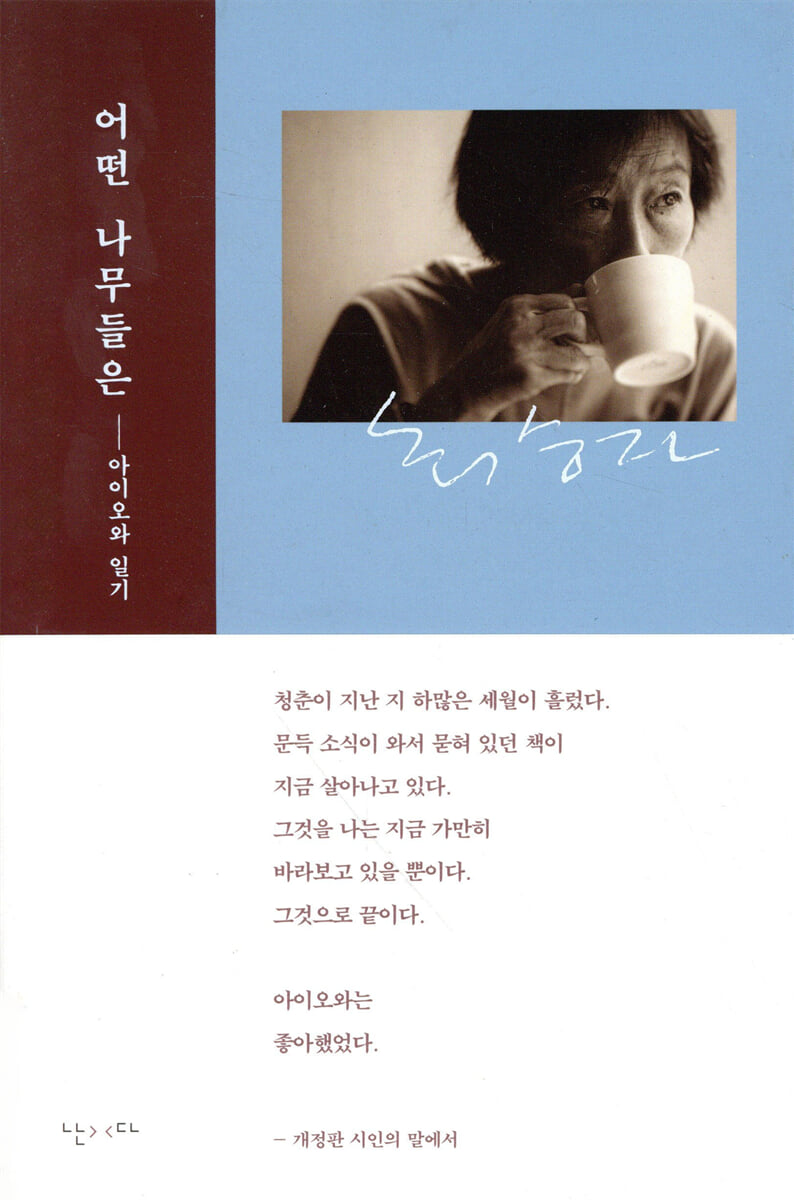
Because we remember the winner, we put his picture on the cover to remember the winner.
Because Choi Seung-ja considered himself a “coffee addict.”
The tree that grew bent toward the sea, longing for its salty taste, is the one who said, “I am a tree.”
Because Choi Seung-ja, who saw the poet's own face in the Iowa sky, which was so transparent and clear amidst the pale blue and cloudy sky.
I would like to touch the book with my hands and feel its softness as if it were flesh.
As we remember the winner, the poet will laugh 'chuck' without any greed or desire.
I'll just look at it quietly and say, 'The end.'
Still, I will speak transparently.
I suddenly heard news of this book coming back to life.
So, I loved poetry, life, and Iowa.
● Revised edition poet's note
Many years have passed since my youth passed.
Suddenly, news came and the buried book
It's coming back to life now.
I'm keeping it quiet now
I'm just looking at it.
That's it.
Iowa is
I liked it
November 15, 2021
Choi Seung-ja
This book was published in 1995, so it's been 26 years since it was published.
This is a prose diary in which the poet candidly describes his journey from Sunday, August 26, 1994, to Monday, January 16, 1995, during his first trip abroad as a participant in the International Writing Program (IWP) hosted by the University of Iowa in Iowa City, Iowa, USA.
If the first collection of essays, 『The Story of a Lazy Poet』, was a story of burning 'poetry' at the end of the road of life and death, using the tragic rose as bait, this book is the literary essence of Choi Seung-ja, which fully reveals the poet's daily life armed with his unique honesty and humor, and his small but humane side.
Trying to be reborn while wriggling
The 'life' of the human champion
The poet once worried that “in this uncontrollable writing written in the form of a diary, readers might only find ‘I ate and slept,’” but what we find in these writings, in which the poet, who dislikes dignity, formality, and standards, faithfully records his life as it happens day by day, is probably the scene of the real ‘being alive.’
Who among us doesn't feel shaken day after day?
The act of recording the shaking of that 'middle' without any addition or subtraction.
The poet wrote:
“Some trees yearn for the saltiness of the sea, and bend toward it, no matter how far away it may be.”
If we consider his first prose, “The Story of a Lazy Poet,” as a place of “life” that looks into death, enters death, and finally returns from death, then what we encounter in “Certain Trees” is “my changing self, the seeds of my newly planted consciousness,” and a record of a human being struggling to “squirm and be reborn,” “life.”
This thick page, filled with the records of the 'human champion', is a full-length mirror that reflects my 'life' without any wavering.
Because I don't take a single step back from the relief that I will be able to look back and see myself through the lives of those who have gone before.
“Winner, you look so happy.
“You’re smiling.”
Above all, this book is fun.
This is the human side of poet Choi Seung-ja, who is generous, easygoing, and possesses a precise sense of humor.
Between the records of a carefree day and the contemplative reflections on life, a calm yet sharp humor is placed as naturally as pepper or salt on the table, adding just the right amount of flavor and seasoning to stories from other places that might otherwise be boring and relationships with others that can inevitably be unfamiliar.
Because life isn't just filled with despair and emptiness, because thinking fiercely about death ignites a spark in life and brings laughter, we also encounter moments of humor that poet Choi Seung-ja, 27 years ago, said, "makes me laugh," moments of laughter that warmed an Iowa winter for a moment.
As I read my poems, I felt sorry that they were too dark, so I told the audience that my poems were a bit dark, and many people said yes.
But an old gentleman sitting in the front row kept shaking his head.
Maybe it was because I felt that my poetry was too hopeless.
Because when the reading was over and it was time for questions, that very gentleman asked me, “Do you have a hope?”
My answer is that despair is hope gone, and you can't despair if you don't have hope.
What can I say other than using such clichés?
But later, when everything was over and we were going out, this person looked at me and said, “You must have a hope.”
So I answered, “Yes, I have a hope, I have a dream.”
When I told that story to Mark and Lionel later at the restaurant, they both laughed out loud.
After the question and answer period was over and people were standing up, several people in the audience came up to me and told me that they had really enjoyed my presentation.
As someone who had no reading experience, I wondered why people enjoyed reading so much, but maybe it was because of this very pleasure.
Friday, November 11, 1994, page 243
In order not to be deceived by oneself
Fighting with yourself
Perhaps the reason why the nature of acceptance and mixing shines more than that of scrutiny or fussiness is because life is repeated and conversations continue centered around literature, especially poetry.
This once again emphasizes the importance of this book in the chronicle of the victor.
As Choi Seung-ja has lived as both a poet and a translator, I was able to hear her confession that she felt “greater joy as a poetry translator than as a poetry creator” while translating her own poetry.
Choi Seung-ja was a poet who published eight poetry collections and also a translator who translated more than 20 books.
He translated outstanding works such as Max Picard's "The World of Silence," Nietzsche's "Thus Spoke Zarathustra," and Alfred Alavez's "Studies of Suicide."
Even though he only said nonchalantly, “I read some English books and made a living by translating,” he never neglected to be serious about dealing with language and translating words, and of course, he was meticulous and focused on detail.
This trip to the United States in 1994 was my first trip abroad, so I wasn't very good at speaking or conversing, and as a result, I had some hardships and trials. However, through translating my own poetry, I learned how to share my thoughts and find a way forward through words in this foreign country.
He also assessed the power of language in cultural development and accurately diagnosed the challenges facing Korean literature, assessing the role language can play in globalizing our literature.
The question that took up the most time was "Will you teach me how to bird?"
This is a phrase that even Boyan had a hard time understanding, so I asked Shona about it, and she also said that it was a bit strange.
At that time, Martin happened to be looking at my poetry, so I told him to fix that passage. Later, when he returned my poems, he wrote a comment saying that the passage was perfect the way it was.
So, only Martin liked that passage.
I translated this passage literally as “Would you teach me a bird?”, but Caroline seemed to have a hard time with it too.
She suggested that we try different words, such as 'about being a bird' and 'a birdness'.
But I argued that if I did that, the poem would die.
(……) Eventually, Caroline came up with a clever plan.
The trick was, “Would you teach me; a bird?”
All she had to do was insert a semicolon, and Caroline seemed very pleased with her fix.
I know the translator's feelings.
Because I am the one translating.
How good it feels to have a nice translation of a passage.
Monday, October 17, 1994, pages 164-165
On the riverbank where the water is swaying
I want to reach you
This record, which spans a little over four months, contains the excitement and anxiety of Choi Seung-ja about living abroad for the first time, as well as his excitement and determination to move on to the next life.
What fills the space between them is poetry and literature.
And above all, it is life and people.
In this new book, published after 26 years, we will get to know and embrace both the previous and future winners, and meet their moments.
As if it were the poet's destiny to foresee his own destiny and sense the roots of the world before anyone else, it seemed as if the poet's future and the path forward were already etched in his 1994 and 1995.
Since the path to be taken is already a path that has been reached, the poet sets out toward tomorrow as if flowing, dreaming, without any desire or greed.
Choi Seung-ja is the owner of the “sad shoulder” that only “those who, in this street of desire, have nothing accumulated and expect nothing” can have, but “perhaps it is also the shoulder on which we can finally rely” (Hwang Hyeon-san).
Whenever he felt depressed and lonely, caught between the wavering present and the impending future, he would draw strength from passages from this poet's book and lift himself up.
Perhaps it was poetry and books that sustained him and kept him alive.
Because as it flows, what you will put out and share will also be poetry and writing.
Today I walked across the lawn across from the Mayflower to the Iowa River.
Evening primroses were blooming on the lawn.
As I was lying on a bench by the river, looking at the ducks floating in the river, a line from someone's poem suddenly came to mind.
That's a phrase from a poetry collection by a singer-songwriter named Rod McQueen. I remembered it while reading his poetry collection in my first year of college. Strangely enough, even though I've forgotten all of his other poems over the past few decades, that phrase has remained in my memory drawer.
Well, did I feel a little lonely today, or did I feel uneasy about my future?
The passage is this:
“Lonely rivers go to the sea, give themselves to many brooks.” This is a phrase I often recall to encourage myself whenever I feel a hint of loneliness.
“The lonely river that flows to the sea gives itself up to many rapids.”
Tuesday, September 6, 1994, page 49
In that sense, this book resembles the 'yeast' of life.
I hope this book will fill me with the hunger for literature and poetry, as well as the hunger between life and people, for those who desperately need it.
When defining 'love', wouldn't the closest word to explain it be 'curiosity'?
If you are curious about what kind of poet and person Choi Seung-ja is, I dare say that you should definitely read this book.
Because we remember the winner, we put his picture on the cover to remember the winner.
Because Choi Seung-ja considered himself a “coffee addict.”
The tree that grew bent toward the sea, longing for its salty taste, is the one who said, “I am a tree.”
Because Choi Seung-ja, who saw the poet's own face in the Iowa sky, which was so transparent and clear amidst the pale blue and cloudy sky.
I would like to touch the book with my hands and feel its softness as if it were flesh.
As we remember the winner, the poet will laugh 'chuck' without any greed or desire.
I'll just look at it quietly and say, 'The end.'
Still, I will speak transparently.
I suddenly heard news of this book coming back to life.
So, I loved poetry, life, and Iowa.
● Revised edition poet's note
Many years have passed since my youth passed.
Suddenly, news came and the buried book
It's coming back to life now.
I'm keeping it quiet now
I'm just looking at it.
That's it.
Iowa is
I liked it
November 15, 2021
Choi Seung-ja
GOODS SPECIFICS
- Publication date: December 20, 2021
- Page count, weight, size: 408 pages | 516g | 14*210*18mm
- ISBN13: 9791191859140
- ISBN10: 1191859142
You may also like
카테고리
korean


korean

![GQ KOREA Mark (Monthly): December [2025]](http://librairie.coreenne.fr/cdn/shop/files/8ef265dbbfbf186523ed75ba7319009d.jpg?v=1765340328&width=3840)


