

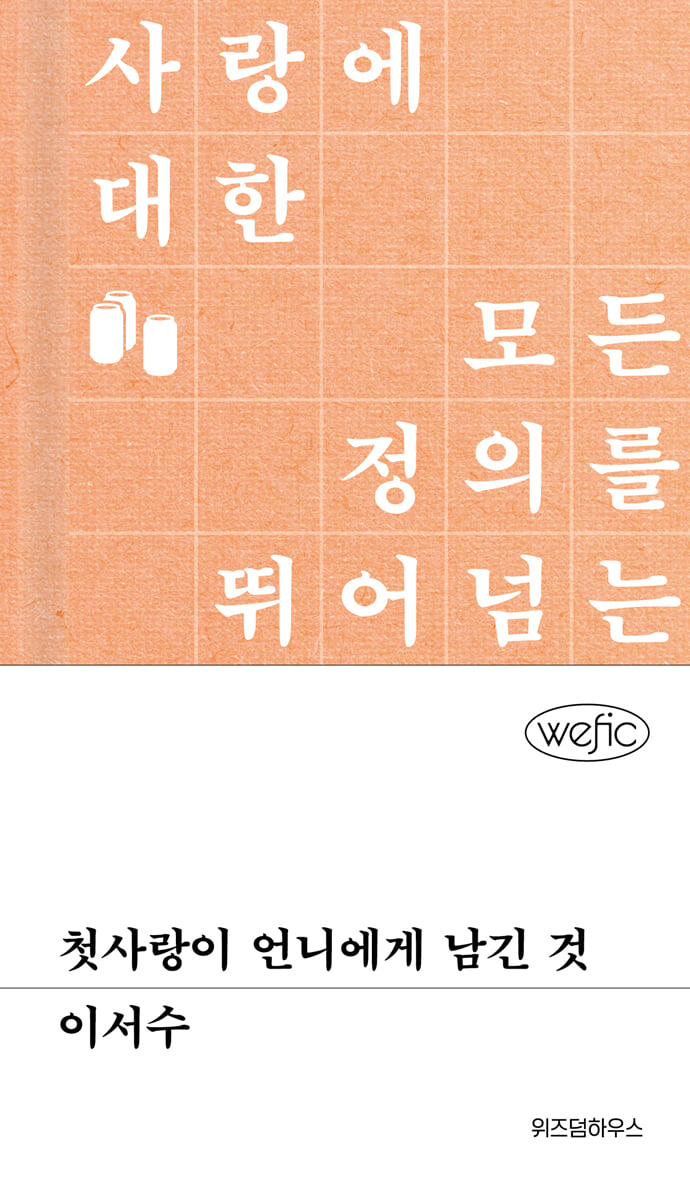
What my first love left me
 |
Description
Book Introduction
“Love is something that transcends all definitions of love.”
"Young Geun-hee's March," a new novel by Lee Seo-su
The new work of Seo-su Lee, the author of 『Young Geun-hee's March』, who has been focusing on young people who pledge to move forward despite the instability of housing and employment by winning the Young Writer's Award, the Lee Hyo-seok Literary Award, and the Hwangsanbeol Youth Literary Award, 『What First Love Left for My Sister』, has been published as part of Wisdom House's short story series, Wepick.
Jeong-yeon's only older sister, Jeong-hye, is someone who falls in love helplessly.
I love things that I shouldn't love, things that would stigmatize me if I loved them.
Even though I gave my whole heart, the people I loved left me, and I wandered the streets like a stray dog in the middle of summer wearing a padded jumper.
The places where such older sisters are found are villas where Koreans living in China live and the 'multicultural streets' where migrant workers gather.
Could I find my sister, who walks like a stepping stone through a city that is Korea but not Korea, the most run-down and shabby place where the only Koreans who visit are those who have come to visit the forest?
"Young Geun-hee's March," a new novel by Lee Seo-su
The new work of Seo-su Lee, the author of 『Young Geun-hee's March』, who has been focusing on young people who pledge to move forward despite the instability of housing and employment by winning the Young Writer's Award, the Lee Hyo-seok Literary Award, and the Hwangsanbeol Youth Literary Award, 『What First Love Left for My Sister』, has been published as part of Wisdom House's short story series, Wepick.
Jeong-yeon's only older sister, Jeong-hye, is someone who falls in love helplessly.
I love things that I shouldn't love, things that would stigmatize me if I loved them.
Even though I gave my whole heart, the people I loved left me, and I wandered the streets like a stray dog in the middle of summer wearing a padded jumper.
The places where such older sisters are found are villas where Koreans living in China live and the 'multicultural streets' where migrant workers gather.
Could I find my sister, who walks like a stepping stone through a city that is Korea but not Korea, the most run-down and shabby place where the only Koreans who visit are those who have come to visit the forest?
- You can preview some of the book's contents.
Preview
Into the book
I held out hope that my sister might feel better.
But one day, when those expectations were at their peak, my sister suddenly disappeared.
I tried everything to find my sister, but as winter passed, spring came, and summer began again, I couldn't find any trace of her.
--- p.15
In this area, there were so few Koreans that I felt more like an outsider, but looking at foreign workers, I wondered if they were adapting well to life in Korea.
During that time, I felt like I was living a little more stable life than them.
It was a feeling I had never felt before at the company I was working for as a contract worker.
--- p.20
A story where the truth behind it is not revealed and exists only in parentheses.
I'd like to put those parentheses together someday and create a completely different story, but I wonder if that day will ever come.
--- p.28
I looked at the label and it said Made in Bangladesh.
The man who lived in Bangladesh, the country chosen by Kim So-hyun, came to Korea to make money, and his wife makes clothes to be sent to Korea in a Bangladeshi factory.
As I imagined her day, I remembered that fast fashion is a major contributor to environmental destruction.
If I stop buying SPA brands, what will happen to the female workers at the local factories?
--- p.59
He handed me a pineapple flavored drink.
I'll give you one out of two plus one.
Aren't these three drinks the same anyway?
It's different in my mind.
--- p.90~91
But, sister, I've never really confessed my love to you.
I've only been in relationships three times so far, and I've been confessed to every single one.
The moment someone tells me they love me, my heart opens wide.
Open too much.
When you start dating, you always give in and write down what you want in a diary.
Maybe I'm just more awkward in love than my sister.
I love myself, but I don't know how to love others.
Still, I'm good at breaking up.
Forget it quickly and never contact me again.
He is a person who has a clear start and end to a relationship.
--- p.95~96
My sister looked at me like a child who has just realized the sorrow of love and said:
Jeongyeon, that's love.
Love is something that transcends all the definitions of love you've ever given.
But one day, when those expectations were at their peak, my sister suddenly disappeared.
I tried everything to find my sister, but as winter passed, spring came, and summer began again, I couldn't find any trace of her.
--- p.15
In this area, there were so few Koreans that I felt more like an outsider, but looking at foreign workers, I wondered if they were adapting well to life in Korea.
During that time, I felt like I was living a little more stable life than them.
It was a feeling I had never felt before at the company I was working for as a contract worker.
--- p.20
A story where the truth behind it is not revealed and exists only in parentheses.
I'd like to put those parentheses together someday and create a completely different story, but I wonder if that day will ever come.
--- p.28
I looked at the label and it said Made in Bangladesh.
The man who lived in Bangladesh, the country chosen by Kim So-hyun, came to Korea to make money, and his wife makes clothes to be sent to Korea in a Bangladeshi factory.
As I imagined her day, I remembered that fast fashion is a major contributor to environmental destruction.
If I stop buying SPA brands, what will happen to the female workers at the local factories?
--- p.59
He handed me a pineapple flavored drink.
I'll give you one out of two plus one.
Aren't these three drinks the same anyway?
It's different in my mind.
--- p.90~91
But, sister, I've never really confessed my love to you.
I've only been in relationships three times so far, and I've been confessed to every single one.
The moment someone tells me they love me, my heart opens wide.
Open too much.
When you start dating, you always give in and write down what you want in a diary.
Maybe I'm just more awkward in love than my sister.
I love myself, but I don't know how to love others.
Still, I'm good at breaking up.
Forget it quickly and never contact me again.
He is a person who has a clear start and end to a relationship.
--- p.95~96
My sister looked at me like a child who has just realized the sorrow of love and said:
Jeongyeon, that's love.
Love is something that transcends all the definitions of love you've ever given.
--- p.107
Publisher's Review
“Love is something that transcends all definitions of love.”
Lee Seo-su's new novel, "Young Geun-hee's March"
The new work of Seo-su Lee, the author of 『Young Geun-hee's March』, who has been focusing on young people who pledge to move forward despite the instability of housing and employment by winning the Young Writer's Award, the Lee Hyo-seok Literary Award, and the Hwangsanbeol Youth Literary Award, 『What First Love Left for My Sister』, has been published as part of Wisdom House's short story series, Wepick.
Jeong-yeon's only older sister, Jeong-hye, is someone who falls in love helplessly.
I love things that I shouldn't love, things that would stigmatize me if I loved them.
Even though I gave my whole heart, the people I loved left me, and I wandered the streets like a stray dog in the middle of summer wearing a padded jumper.
The place where her older sister, who kept running away from Jeongyeon and her family, is found is a villa where Koreans living in China live and a 'multicultural street' where migrant workers gather.
Could I find my sister, who was crossing the city like a stepping stone, in a place that was not Korea, a place that was so old and shabby that the only Koreans who visited there were those who came to visit the forest?
Instead of trying to understand her sister, who only loves incomprehensibly, Jeongyeon tries to bring her sister to where she is so that she won't be hurt anymore.
They take their hands and lead them, telling them to wear clothes appropriate for the season and do cheap labor like everyone else.
It was when Jeongyeon met again the love she thought she had forgotten that she came to accept her sister, whom she thought she would never understand.
The experience of rereading the phrase “In fact, there is no impossible mind” (page 44) as “In fact, there is no impossible understanding, no impossible love” comes suddenly and at such an unexpected moment.
“The unfamiliar and uneasy feelings that arise from not knowing each other well” (p. 85) disappear when we get to know each other.
Jeongyeon and her older sister aren't the only ones who push each other away and are afraid because their footing is weak.
Migrant workers who left their home countries to earn money and the indigenous people who are anxious about their encroachment, landlords who cannot prepare for retirement on their salary alone and are looking for a house they will never live in, and tenants who compete to get into even an old villa.
Lee Seo-su hides the story of these people, who are only able to become the 'one' of 'two plus one', in parentheses.
Sometimes, you may want to pretend not to know the truth behind the parentheses, but if you keep knocking, the parentheses will open and you may be able to find your sister who disappeared inside.
50 stories in 50 books in one year
A special experience that allows you to breathe deeply into 'a single story'
Beginning in November 2022, Wisdom House will be introducing the most diverse and newest stories of Korean literature, one per week, through its short story serial project, "Weekly Fiction."
The series is released every Wednesday through the Wisdom House website and newsletter 'We Pick'.
Beginning with author Koo Byeong-mo's "Shred," 50 stories will be released to readers over the course of a year.
The Wepick series publishes novels that have finished serialization in this way sequentially.
The first five stories will be released on March 8th, and four stories will be published every second Wednesday of the month thereafter, creating a festival of 50 stories throughout the year.
This time, rather than the conventional method of binding together several short stories, the book is composed of only one short story, an unusual attempt that provides readers with a special experience of breathing deeply into each story.
Wepick is not bound by any criteria or distinctions such as material or format, and focuses solely on the completeness of a single story.
Through novels by a variety of authors, including novelists, non-fiction writers, poets, and youth literature writers, we break down genres and boundaries, expanding the possibilities and enjoyment of stories.
There is also a special gift inside the book.
This is a supplementary poster titled 'One Novel', which contains an entire novel on one poster.
A single novel offers readers the special experience of encountering a story in a new way.
Introducing the Wepick Series
Wepick is a short story series from Wisdom House.
It offers a special experience of breathing deeply into ‘one story’.
I dream that this small piece will become a new piece that expands your world, that each small piece will come together to become your story, and that it will become a piece of literature that will be deeply engraved in your heart.
Lee Seo-su's new novel, "Young Geun-hee's March"
The new work of Seo-su Lee, the author of 『Young Geun-hee's March』, who has been focusing on young people who pledge to move forward despite the instability of housing and employment by winning the Young Writer's Award, the Lee Hyo-seok Literary Award, and the Hwangsanbeol Youth Literary Award, 『What First Love Left for My Sister』, has been published as part of Wisdom House's short story series, Wepick.
Jeong-yeon's only older sister, Jeong-hye, is someone who falls in love helplessly.
I love things that I shouldn't love, things that would stigmatize me if I loved them.
Even though I gave my whole heart, the people I loved left me, and I wandered the streets like a stray dog in the middle of summer wearing a padded jumper.
The place where her older sister, who kept running away from Jeongyeon and her family, is found is a villa where Koreans living in China live and a 'multicultural street' where migrant workers gather.
Could I find my sister, who was crossing the city like a stepping stone, in a place that was not Korea, a place that was so old and shabby that the only Koreans who visited there were those who came to visit the forest?
Instead of trying to understand her sister, who only loves incomprehensibly, Jeongyeon tries to bring her sister to where she is so that she won't be hurt anymore.
They take their hands and lead them, telling them to wear clothes appropriate for the season and do cheap labor like everyone else.
It was when Jeongyeon met again the love she thought she had forgotten that she came to accept her sister, whom she thought she would never understand.
The experience of rereading the phrase “In fact, there is no impossible mind” (page 44) as “In fact, there is no impossible understanding, no impossible love” comes suddenly and at such an unexpected moment.
“The unfamiliar and uneasy feelings that arise from not knowing each other well” (p. 85) disappear when we get to know each other.
Jeongyeon and her older sister aren't the only ones who push each other away and are afraid because their footing is weak.
Migrant workers who left their home countries to earn money and the indigenous people who are anxious about their encroachment, landlords who cannot prepare for retirement on their salary alone and are looking for a house they will never live in, and tenants who compete to get into even an old villa.
Lee Seo-su hides the story of these people, who are only able to become the 'one' of 'two plus one', in parentheses.
Sometimes, you may want to pretend not to know the truth behind the parentheses, but if you keep knocking, the parentheses will open and you may be able to find your sister who disappeared inside.
50 stories in 50 books in one year
A special experience that allows you to breathe deeply into 'a single story'
Beginning in November 2022, Wisdom House will be introducing the most diverse and newest stories of Korean literature, one per week, through its short story serial project, "Weekly Fiction."
The series is released every Wednesday through the Wisdom House website and newsletter 'We Pick'.
Beginning with author Koo Byeong-mo's "Shred," 50 stories will be released to readers over the course of a year.
The Wepick series publishes novels that have finished serialization in this way sequentially.
The first five stories will be released on March 8th, and four stories will be published every second Wednesday of the month thereafter, creating a festival of 50 stories throughout the year.
This time, rather than the conventional method of binding together several short stories, the book is composed of only one short story, an unusual attempt that provides readers with a special experience of breathing deeply into each story.
Wepick is not bound by any criteria or distinctions such as material or format, and focuses solely on the completeness of a single story.
Through novels by a variety of authors, including novelists, non-fiction writers, poets, and youth literature writers, we break down genres and boundaries, expanding the possibilities and enjoyment of stories.
There is also a special gift inside the book.
This is a supplementary poster titled 'One Novel', which contains an entire novel on one poster.
A single novel offers readers the special experience of encountering a story in a new way.
Introducing the Wepick Series
Wepick is a short story series from Wisdom House.
It offers a special experience of breathing deeply into ‘one story’.
I dream that this small piece will become a new piece that expands your world, that each small piece will come together to become your story, and that it will become a piece of literature that will be deeply engraved in your heart.
GOODS SPECIFICS
- Date of issue: November 8, 2023
- Format: Hardcover book binding method guide
- Page count, weight, size: 116 pages | 100*180*20mm
- ISBN13: 9791168127357
- ISBN10: 1168127351
You may also like
카테고리
korean


korean

![GQ KOREA Mark (Monthly): December [2025]](http://librairie.coreenne.fr/cdn/shop/files/8ef265dbbfbf186523ed75ba7319009d.jpg?v=1765340328&width=3840)


