

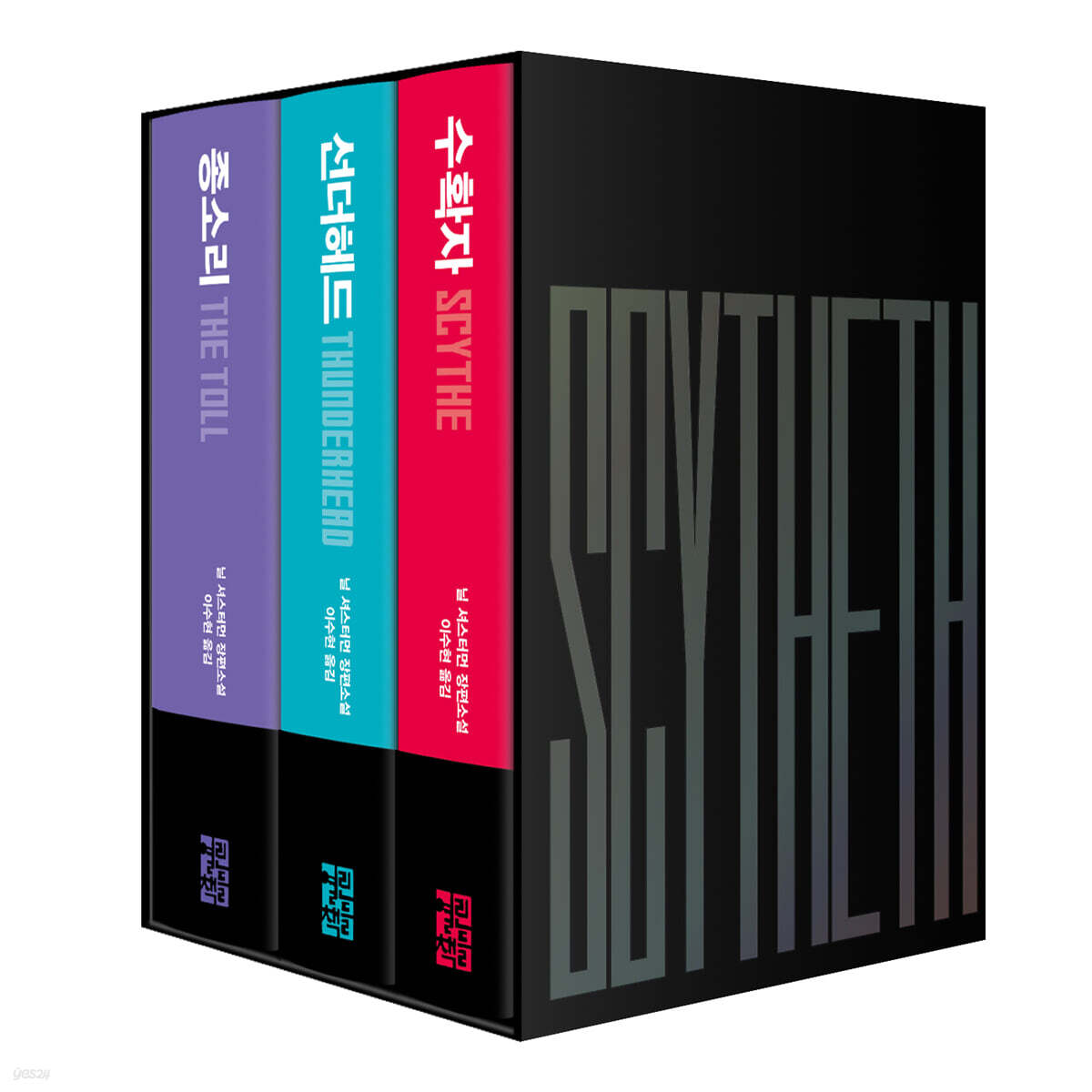
Harvester Series Set
 |
Description
Book Introduction
The best SF hit that created a 『Harvester』 craze around the world!
The "The Harvester" series, which has sold over two million copies in North America alone and cultivated a global fandom, has finally arrived in Korea! National Book Award-winning author Neil Shusterman, whose previous work, "Dry," was also enthusiastically received by Korean readers, is a perennial bestselling novelist who has not only received numerous literary awards but also received explosive acclaim upon publication. In a perfect future where supercomputer-controlled death has disappeared, the only people not under computer control are the "Harvesters," who are tasked with ending lives to control the population. What is a meaningful death? Who should have the right to end life? Each Harvester, with their own beliefs, becomes a living god of death, wielding the scythe of death. The "Reaper" series skillfully explores philosophical questions ranging from the meaning of life and death, amidst an ever-expanding, expansive scale, captivating characters, dazzling battle scenes, and a highly developed future world. Currently, a film adaptation is in the works at Universal Pictures, and even after its completion, the enthusiasm of readers has not cooled down, leading to a fandom that continues to garner hot interest. |
- You can preview some of the book's contents.
Preview
index
The Harvester
Part 1: Robes and Rings
Part 2 No other law is above these commandments.
Part 3: Conservatives and the New Order
Part 4: Fugitive from Midamerica
Part 5 Harvest
Acknowledgements
Thunderhead
Part 1: Power itself
Part 2 Risk
Part 3 Enemies Within Enemies
Part 4: Warning of Doom
Part 5: Situations Beyond
Part 6: Indura and Node
Acknowledgements
"knell"
Part 1: Lost Islands and Locked Cities
Part 2 Sound waves, bells, and thunder
Part 3: The Year of the Cobra
Part 4 The Only Tool We Can Wield
5 bowls
Acknowledgements
Translator's Note
Part 1: Robes and Rings
Part 2 No other law is above these commandments.
Part 3: Conservatives and the New Order
Part 4: Fugitive from Midamerica
Part 5 Harvest
Acknowledgements
Thunderhead
Part 1: Power itself
Part 2 Risk
Part 3 Enemies Within Enemies
Part 4: Warning of Doom
Part 5: Situations Beyond
Part 6: Indura and Node
Acknowledgements
"knell"
Part 1: Lost Islands and Locked Cities
Part 2 Sound waves, bells, and thunder
Part 3: The Year of the Cobra
Part 4 The Only Tool We Can Wield
5 bowls
Acknowledgements
Translator's Note
Detailed image
.jpg)
Into the book
The Harvester
We are required by law to record the innocent people we kill.
---From the "first sentence"
We don't officially call it "killing."
Calling it that is socially and morally incorrect.
In the past and present, this was the work of "harvesting," and the word comes from the ancient practice of poor people following farmers and gathering the ears of grain left behind.
--- p.11
The harvester headed for the door, knife in hand.
It was a move that left no doubt about how to harvest the neighbors.
But before he left, he looked back at Citra.
"You know how to see the other side of the world, Citra Terranova.
“You will be a great harvester.”
Citra flinched.
"I have no desire to become a harvester."
"That's the first condition."
Then he went to kill their neighbors.
--- p.22
Thunderhead literally knew everything.
We knew when and where to build roads, how to eliminate food waste and hunger, and how to protect the ecosystem from the ever-growing population.
Thunderhead created jobs, clothed the poor, and established the "Law of the World."
For the first time in history, law is not a shadow of justice, but justice itself.
Thunderhead gave us a perfect world.
The utopia our ancestors only dreamed of is now a reality for us.
--- pp.67~68
Thunderhead
Since Citra Terranova became the apprentice of the noble Harvester Faraday, the possibility of Citra changing the world has increased a hundredfold.
It's uncertain what I'll do, and the outcome is unknown, but I'll do it, whatever it is.
Humanity can rise or fall depending on Citra's decisions, Citra's accomplishments, and Citra's mistakes.
--- p.48
Rowan loved the harvest season.
It was a perfect idea for a perfect world, where the wisest and most compassionate people would end their lives to balance immortality.
The reaper Faraday showed what a reaper really should be, and many, many reapers, even the proudest and most arrogant ones, still held on to the highest values.
But without those values, the harvest would have been terrible.
Rowan naively believed he could stop it.
--- p.158
But how can I protect humanity from humanity?
Over the years, I have witnessed both the most foolish and the most astonishing wisdom in humanity.
These two balance each other like dancers in a passionate tango.
Only when the ruthlessness of this dance overwhelms its beauty is the future threatened.
The one who leads this dance and sets the mood for the dance is the harvest spirit.
--- p.316
"knell"
Then a rift arose between humanity and its greatest creation.
Indura sank into the ocean, and at that very moment Thunderhead declared all of humanity to be undead.
At the time, no one understood what it meant to lose the World Harvester Council, but Thunderhead's silence sent the world into a state of panic.
Now, being a bum was not a choice.
It was a verdict.
And by remaining silent, Thunderhead transformed from a servant to a superior being.
The servant became the master, and the world was eager to please Thunderhead.
--- p.33
Thunderhead had no arms to hug.
Even so, I could sense Grayson's heartbeat and precise body temperature as if I were right next to him.
It would be incredibly sad to lose that experience.
So, night after night, Thunderhead quietly tracked Grayson in every way possible.
That was the closest thing Thunderhead could get to a hug.
--- p.179
"is it so.
But we must remember that people will pull out what they need from any situation.
When Indura sank, people needed someone to be a vessel for their sorrow.
A symbol of lost hope.
“Hope is not lost,” Anastasia insisted.
"It was just placed in the wrong place."
We are required by law to record the innocent people we kill.
---From the "first sentence"
We don't officially call it "killing."
Calling it that is socially and morally incorrect.
In the past and present, this was the work of "harvesting," and the word comes from the ancient practice of poor people following farmers and gathering the ears of grain left behind.
--- p.11
The harvester headed for the door, knife in hand.
It was a move that left no doubt about how to harvest the neighbors.
But before he left, he looked back at Citra.
"You know how to see the other side of the world, Citra Terranova.
“You will be a great harvester.”
Citra flinched.
"I have no desire to become a harvester."
"That's the first condition."
Then he went to kill their neighbors.
--- p.22
Thunderhead literally knew everything.
We knew when and where to build roads, how to eliminate food waste and hunger, and how to protect the ecosystem from the ever-growing population.
Thunderhead created jobs, clothed the poor, and established the "Law of the World."
For the first time in history, law is not a shadow of justice, but justice itself.
Thunderhead gave us a perfect world.
The utopia our ancestors only dreamed of is now a reality for us.
--- pp.67~68
Thunderhead
Since Citra Terranova became the apprentice of the noble Harvester Faraday, the possibility of Citra changing the world has increased a hundredfold.
It's uncertain what I'll do, and the outcome is unknown, but I'll do it, whatever it is.
Humanity can rise or fall depending on Citra's decisions, Citra's accomplishments, and Citra's mistakes.
--- p.48
Rowan loved the harvest season.
It was a perfect idea for a perfect world, where the wisest and most compassionate people would end their lives to balance immortality.
The reaper Faraday showed what a reaper really should be, and many, many reapers, even the proudest and most arrogant ones, still held on to the highest values.
But without those values, the harvest would have been terrible.
Rowan naively believed he could stop it.
--- p.158
But how can I protect humanity from humanity?
Over the years, I have witnessed both the most foolish and the most astonishing wisdom in humanity.
These two balance each other like dancers in a passionate tango.
Only when the ruthlessness of this dance overwhelms its beauty is the future threatened.
The one who leads this dance and sets the mood for the dance is the harvest spirit.
--- p.316
"knell"
Then a rift arose between humanity and its greatest creation.
Indura sank into the ocean, and at that very moment Thunderhead declared all of humanity to be undead.
At the time, no one understood what it meant to lose the World Harvester Council, but Thunderhead's silence sent the world into a state of panic.
Now, being a bum was not a choice.
It was a verdict.
And by remaining silent, Thunderhead transformed from a servant to a superior being.
The servant became the master, and the world was eager to please Thunderhead.
--- p.33
Thunderhead had no arms to hug.
Even so, I could sense Grayson's heartbeat and precise body temperature as if I were right next to him.
It would be incredibly sad to lose that experience.
So, night after night, Thunderhead quietly tracked Grayson in every way possible.
That was the closest thing Thunderhead could get to a hug.
--- p.179
"is it so.
But we must remember that people will pull out what they need from any situation.
When Indura sank, people needed someone to be a vessel for their sorrow.
A symbol of lost hope.
“Hope is not lost,” Anastasia insisted.
"It was just placed in the wrong place."
--- p.190
Publisher's Review
The best science fiction hit that created a worldwide sensation called "The Harvester"!
* National Book Award-winning author
* American Library Association Michael L.
Printz Prize winner
* Universal Pictures film adaptation
- The Harvester
Would a world without death really be a utopia?
A fantastic science fiction novel by bestselling author Neal Shusterman.
The first volume of the science fiction series "The Harvester" by Neil Shusterman, winner of the National Book Award and beloved by Korean readers for his previous work "Dry," has been published by Open Books, translated by Lee Su-hyeon, a science fiction and fantasy writer and translator.
Neal Shusterman has won over 30 awards for his novels, including the National Book Award winner Challenger Deep, the Boston Globe-Horn Book Award winner The Schwa Was Here, and the American Library Association Best Young Adult Novel Award for Unwind. He is a novelist with both literary and popular appeal who has published works that immediately appear on various bestseller lists.
Neil Shusterman's greatest strength is that he writes "fun novels," but he is also exceptionally skilled at delicately addressing hot social issues and forcing readers to confront philosophical questions.
Whether it's "Challenger Deep," which deals with mental illness, "The Disintegrating Children," which deals with abortion, or the current "The Harvester" series, which asks about meaningful life and death, all of these works contain sharp questions hidden within their fascinating stories.
The "Reapers" series, which has created a global fandom, is currently being adapted into a film by Universal, and fans are eagerly awaiting the day when they can see the charming characters and spectacular battle scenes on screen.
The first volume, "The Harvester," which marks the beginning of this vast world, will be the best choice for readers to reflect on the meaning of life and death.
Must be killed
Without any prejudice or malice
Have you ever imagined a "perfect world" where hunger, disease, war, and even death were gone? In 2042, supercomputers have evolved to near-limitless power, transforming Earth into a perfect world free of problems.
The name of the supercomputer is Thunderhead.
From reviving the dead to preventing wars, Thunderhead can do everything, but there's one area he doesn't get involved in: ending human life.
Death is gone, but life is constantly being reborn.
But the Earth is too small for all humans to live on.
As efforts to colonize planets beyond Earth continue to fail, humanity eventually creates beings called the "Harvesters," tasked with taking lives to control the population.
Taking life is both a duty and a right, and so the harvester becomes a new divine being in a world where even gods are not needed.
Citra and Roan, who live in this world, are ordinary sixteen-year-old students.
They had no connection to anything like harvesting, but by chance they caught the eye of the harvester Faraday, became his apprentices, and learned the art of killing.
But only one of the two can become the real harvester.
The two engage in fierce competition, but also experience subtle emotional shifts as they slowly open their eyes to the complex world of the harvesters.
In a world where death has disappeared
Becoming a living god of death
In this world where natural death has disappeared, the work of harvesting, that is, gathering life, is a sacred duty, almost like the service of a priest.
Even while constantly killing, he does not lose his humanity, feels compassion for the lives he takes, and asks himself whether this was the right harvest.
But for an ordinary person, it would be nearly impossible to consider killing someone as one's calling.
The same goes for Citra and Roan.
As a trainee, he learns how to handle weapons and poisons, and assists his master Faraday in harvesting, but he also writhes in agony and feels disgusted with himself.
They also learn from their teacher Faraday the attitude of mind that a harvester should have.
We will gather people with the same care as nature, without any prejudice or malice, and we will be wary of and keep away from power that we might covet.
You must not have a family, be an exemplary speaker, and own nothing.
This is the mindset that a human needs to have to become a living god.
As we watch Citra and Roan grow into Harvesters, we come to empathize with the anguish and dilemma of being a Harvester, a human being who is tasked with killing people.
The realistic depiction of a future world that is meticulously planned and the excitement felt watching innocent teenagers opening their hearts to each other are also some of the elements that make it fun.
Surely, the moment you close the last page of 『The Harvester』, you will immediately be able to open Volume 2, 『Thunderhead』.
A fierce battle of beliefs unfolds in the ultimate utopia, a grand story that will have you reading through all three volumes in one sitting.
- Thunderhead
Supercomputers, the faithful servants of mankind,
A human being who ruins the future with his own foolishness
Following the unexpected ending of the first volume, "The Harvester," the second volume, "Thunderhead," depicts the deepening conflict among the Harvesters and the struggle of the supercomputer "Thunderhead" to maintain the world despite humanity's endless foolish actions.
Unlike the future depicted in most dystopian novels, the Thunderheads who control the human world in the "Reaper" series are not evil at all.
Conversely, Thunderhead is humanity's faithful servant, a friend to the lonely, a parent to the orphaned, and a social safety net providing all necessary services.
Nevertheless, an ominous outlook awaits this world.
The reason is precisely because of the wickedness and foolishness of humans themselves.
Neal Shusterman brings to light the duality of humanity, both good and evil, through the character of Thunderhead.
Certainly, there are good people out there, and they strive to lead the world in a better direction, but those who cannot control their desires or are blinded by small gains are ruining themselves.
Just like humanity in the 21st century.
Because of the charismatic villain
The world is heading towards destruction
While "The Harvester" showed the overall worldview and followed the footsteps of Citra and Roan, "Thunderhead" shows that the Harvesters, who are supposed to be perfect, are just like any other ordinary human being, vulnerable to greed.
Among them are those who commit brutal and ruthless murders and exert a powerful influence on the world.
Harvester Goddard.
Goddard finds it tiresome that harvesters regard their mission as sacred, and argues that each person should be free to harvest according to his or her own beliefs.
The reason is plausible.
Those chosen as harvesters are said to be wiser and more aware than ordinary people, and to be able to use their intelligence to better the lives of the masses.
And many harvesters are attracted to this plausible sophistry of Goddard, join him, and create a force called the New Order.
Thunderhead cannot stop them, as he is already programmed to not interfere with the harvesters.
Thunderhead's surveillance cameras, which never turn off, see and hear everything, and they know that humanity is very likely headed towards destruction, but they can do nothing about it.
That is precisely why the object of Thunderhead's expectations is once again a human being.
Is this the implementation of justice?
Or is it a terrible crime?
Lucifer the Reaper is one of the humans Thunderhead has such expectations of.
Lucifer is a unique new character appearing in Thunderhead.
He is in the odd position of not being formally chosen by the Harvesters, but being recognized as a Harvester by Thunderhead through a trick.
Lucifer has a powerful body and excellent killing skills, wears black robes forbidden to the Harvesters, and hides in a place unknown to anyone.
And according to Thunderhead's calculations, he has some kind of connection with Citra, a figure at a singularity that increases the possibility of changing the world by a hundredfold.
Lucifer kills and burns the reapers who do not reap out of compassion but instead commit murder in pursuit of pleasure, or the "unqualified" reapers who use the harvest as an excuse to gain personal gain or decide who to harvest for personal reasons, making them unable to regenerate.
This is clearly a horrible and cruel act.
Because a corpse burned by fire cannot be revived even by Thunderhead's power.
But at the same time, it seems that there is no other way to deal with the existence of harvesters who are harmful to ordinary people.
Lucifer is a character who goes beyond the framework of the law and takes on the role of a villain in order to achieve justice.
While I sympathize with him, I cannot completely agree with his way of carrying out personal revenge.
Can Citra, along with Lucifer, truly transform humanity's future? The tangled relationships between the characters become even more complex, and the story quickly moves toward an unexpected climax.
- 『Bell Sound』
The paper rings
A paper announcing the destruction of utopia
Volume 2, "Thunderhead," ends in an unimaginably horrific disaster, and Thunderhead himself turns his back on humanity in disappointment, so it seems all hope is lost.
Many people who could have changed the world also lost their lives.
However, as if there is still room for frustration, 『The Sound of the Bell』 begins by showing the Harvest Spirit in an even more gloomy situation due to Goddard.
Are those who strive for good bound to be weaker than those who recklessly commit evil? Why are good deeds bound to be small and trivial, while evil acts are powerful and deadly? Even this steadfast utopia, like our own reality, is mired in a nightmarish situation.
But Neil Shusterman shows us characters who make small changes by making the best choices possible, even up until the very last moment.
Even if they do not possess particularly strong powers, even if they have to walk a lonely path without a group to follow, even if they are chased and their lives are threatened, they do not give up and persevere in their noble convictions.
And the small ripples created by these ordinary people become huge waves that sweep the world and make possible a completely new beginning for humanity.
The banality of evil
Turning Utopia into Dystopia
The devoted Thunderhead cut off all communication with humanity due to the catastrophic events that occurred in Volume 2, "Thunderhead."
Because of the malice of a few, countless lives were lost, and Thunderhead despaired over this, sounding alarms, sirens, and horns all over the world.
It was a scream that Thunderhead had screamed with all his might.
At the same time, all humans are given the title of "Bulmija" by Thunderhead, meaning that they have committed a wrongdoing and are unable to communicate directly with Thunderhead and enjoy his benefits.
This can be seen as meaning that all humans bear some responsibility for the aforementioned disaster.
Because instead of stopping the powerful villain, it gave him power.
To ignore evil and turn a blind eye to good is ultimately to add weight to the world's tilt toward evil.
However, instead of the public losing Thunderhead and reflecting on their mistakes and trying to forge their own path, they passively wait for the omnipotent Thunderhead to return and do everything for them again.
Humans, who have been living dependent on perfect supercomputers, seem to have lost the power to be independent.
Such a perfect utopia degenerates into a dystopia.
Changing the world is
Always extremely ordinary people
When we look at the faces of those who, with small efforts, are changing this world where hope seems to have disappeared, we realize that they are not much different from us.
Grayson, who appeared from Volume 2, is a representative example.
Grayson, like Citrana Loan, was a normal teenager attending school.
His simple dream was to graduate from school and become a Nimbus agent assisting Thunderhead.
Thunderhead would often tell Grayson, "You're more special than you think," which he assumed was meant to comfort him.
But Thunderhead was sincere, and Grayson only realizes what he meant in Volume 3, "The Bells."
What made him special was his altruistic nature, which put others before himself.
When faced with a crossroads where he had to choose between saving himself and others, Grayson was the type of person who hesitated and agonized, but ultimately chose the latter.
And I thought I did what I had to do without expecting anything in return.
That's why I didn't regret it even though I was in a miserable situation.
Thunderhead turns all humans into idiots, leaving Grayson as the only one who can communicate with him.
The world needs people like Citra, who stand up and fight with their voices, but it also needs people like Grayson, who quietly help others behind the scenes.
This is why ordinary people have the power to change dystopia.
Being altruistic about the little things right in front of you, doing good deeds without expecting anything in return.
And I believe that these small movements will definitely bring about change.
Thus, the future of humanity opens up in a completely unexpected way, and the grand story comes to a grand conclusion.
Overseas media reviews
The characters are three-dimensional and the story is elegant.
A thoughtful and thrilling book about life, death, and what it means.
- 『Kirkus Review』
As life becomes easier and no longer requires struggle, humanity gradually becomes meaningless.
Readers will gain much from this book.
- 『Booklist』
Anyone who reads this book will be forced to confront ethical questions.
A book that makes you think deeply.
- Publisher's Weekly
The story progresses rapidly, picking up pace.
A brilliant science fiction novel that you won't be able to stop reading.
- 『School Library Journal』
A word from the translator
As readers observe the training process of the protagonists, Citra and Roan, as they hone their skills in the art of death and learn its meaning, and as they encounter the world of the harvesters in ruins through their eyes, they come to a realization.
This novel is not a story that asks what would happen if there was no death in the first place.
Rather, it is a story about human limitations, an adventure of downfall and redemption in a new mythical world.
* National Book Award-winning author
* American Library Association Michael L.
Printz Prize winner
* Universal Pictures film adaptation
- The Harvester
Would a world without death really be a utopia?
A fantastic science fiction novel by bestselling author Neal Shusterman.
The first volume of the science fiction series "The Harvester" by Neil Shusterman, winner of the National Book Award and beloved by Korean readers for his previous work "Dry," has been published by Open Books, translated by Lee Su-hyeon, a science fiction and fantasy writer and translator.
Neal Shusterman has won over 30 awards for his novels, including the National Book Award winner Challenger Deep, the Boston Globe-Horn Book Award winner The Schwa Was Here, and the American Library Association Best Young Adult Novel Award for Unwind. He is a novelist with both literary and popular appeal who has published works that immediately appear on various bestseller lists.
Neil Shusterman's greatest strength is that he writes "fun novels," but he is also exceptionally skilled at delicately addressing hot social issues and forcing readers to confront philosophical questions.
Whether it's "Challenger Deep," which deals with mental illness, "The Disintegrating Children," which deals with abortion, or the current "The Harvester" series, which asks about meaningful life and death, all of these works contain sharp questions hidden within their fascinating stories.
The "Reapers" series, which has created a global fandom, is currently being adapted into a film by Universal, and fans are eagerly awaiting the day when they can see the charming characters and spectacular battle scenes on screen.
The first volume, "The Harvester," which marks the beginning of this vast world, will be the best choice for readers to reflect on the meaning of life and death.
Must be killed
Without any prejudice or malice
Have you ever imagined a "perfect world" where hunger, disease, war, and even death were gone? In 2042, supercomputers have evolved to near-limitless power, transforming Earth into a perfect world free of problems.
The name of the supercomputer is Thunderhead.
From reviving the dead to preventing wars, Thunderhead can do everything, but there's one area he doesn't get involved in: ending human life.
Death is gone, but life is constantly being reborn.
But the Earth is too small for all humans to live on.
As efforts to colonize planets beyond Earth continue to fail, humanity eventually creates beings called the "Harvesters," tasked with taking lives to control the population.
Taking life is both a duty and a right, and so the harvester becomes a new divine being in a world where even gods are not needed.
Citra and Roan, who live in this world, are ordinary sixteen-year-old students.
They had no connection to anything like harvesting, but by chance they caught the eye of the harvester Faraday, became his apprentices, and learned the art of killing.
But only one of the two can become the real harvester.
The two engage in fierce competition, but also experience subtle emotional shifts as they slowly open their eyes to the complex world of the harvesters.
In a world where death has disappeared
Becoming a living god of death
In this world where natural death has disappeared, the work of harvesting, that is, gathering life, is a sacred duty, almost like the service of a priest.
Even while constantly killing, he does not lose his humanity, feels compassion for the lives he takes, and asks himself whether this was the right harvest.
But for an ordinary person, it would be nearly impossible to consider killing someone as one's calling.
The same goes for Citra and Roan.
As a trainee, he learns how to handle weapons and poisons, and assists his master Faraday in harvesting, but he also writhes in agony and feels disgusted with himself.
They also learn from their teacher Faraday the attitude of mind that a harvester should have.
We will gather people with the same care as nature, without any prejudice or malice, and we will be wary of and keep away from power that we might covet.
You must not have a family, be an exemplary speaker, and own nothing.
This is the mindset that a human needs to have to become a living god.
As we watch Citra and Roan grow into Harvesters, we come to empathize with the anguish and dilemma of being a Harvester, a human being who is tasked with killing people.
The realistic depiction of a future world that is meticulously planned and the excitement felt watching innocent teenagers opening their hearts to each other are also some of the elements that make it fun.
Surely, the moment you close the last page of 『The Harvester』, you will immediately be able to open Volume 2, 『Thunderhead』.
A fierce battle of beliefs unfolds in the ultimate utopia, a grand story that will have you reading through all three volumes in one sitting.
- Thunderhead
Supercomputers, the faithful servants of mankind,
A human being who ruins the future with his own foolishness
Following the unexpected ending of the first volume, "The Harvester," the second volume, "Thunderhead," depicts the deepening conflict among the Harvesters and the struggle of the supercomputer "Thunderhead" to maintain the world despite humanity's endless foolish actions.
Unlike the future depicted in most dystopian novels, the Thunderheads who control the human world in the "Reaper" series are not evil at all.
Conversely, Thunderhead is humanity's faithful servant, a friend to the lonely, a parent to the orphaned, and a social safety net providing all necessary services.
Nevertheless, an ominous outlook awaits this world.
The reason is precisely because of the wickedness and foolishness of humans themselves.
Neal Shusterman brings to light the duality of humanity, both good and evil, through the character of Thunderhead.
Certainly, there are good people out there, and they strive to lead the world in a better direction, but those who cannot control their desires or are blinded by small gains are ruining themselves.
Just like humanity in the 21st century.
Because of the charismatic villain
The world is heading towards destruction
While "The Harvester" showed the overall worldview and followed the footsteps of Citra and Roan, "Thunderhead" shows that the Harvesters, who are supposed to be perfect, are just like any other ordinary human being, vulnerable to greed.
Among them are those who commit brutal and ruthless murders and exert a powerful influence on the world.
Harvester Goddard.
Goddard finds it tiresome that harvesters regard their mission as sacred, and argues that each person should be free to harvest according to his or her own beliefs.
The reason is plausible.
Those chosen as harvesters are said to be wiser and more aware than ordinary people, and to be able to use their intelligence to better the lives of the masses.
And many harvesters are attracted to this plausible sophistry of Goddard, join him, and create a force called the New Order.
Thunderhead cannot stop them, as he is already programmed to not interfere with the harvesters.
Thunderhead's surveillance cameras, which never turn off, see and hear everything, and they know that humanity is very likely headed towards destruction, but they can do nothing about it.
That is precisely why the object of Thunderhead's expectations is once again a human being.
Is this the implementation of justice?
Or is it a terrible crime?
Lucifer the Reaper is one of the humans Thunderhead has such expectations of.
Lucifer is a unique new character appearing in Thunderhead.
He is in the odd position of not being formally chosen by the Harvesters, but being recognized as a Harvester by Thunderhead through a trick.
Lucifer has a powerful body and excellent killing skills, wears black robes forbidden to the Harvesters, and hides in a place unknown to anyone.
And according to Thunderhead's calculations, he has some kind of connection with Citra, a figure at a singularity that increases the possibility of changing the world by a hundredfold.
Lucifer kills and burns the reapers who do not reap out of compassion but instead commit murder in pursuit of pleasure, or the "unqualified" reapers who use the harvest as an excuse to gain personal gain or decide who to harvest for personal reasons, making them unable to regenerate.
This is clearly a horrible and cruel act.
Because a corpse burned by fire cannot be revived even by Thunderhead's power.
But at the same time, it seems that there is no other way to deal with the existence of harvesters who are harmful to ordinary people.
Lucifer is a character who goes beyond the framework of the law and takes on the role of a villain in order to achieve justice.
While I sympathize with him, I cannot completely agree with his way of carrying out personal revenge.
Can Citra, along with Lucifer, truly transform humanity's future? The tangled relationships between the characters become even more complex, and the story quickly moves toward an unexpected climax.
- 『Bell Sound』
The paper rings
A paper announcing the destruction of utopia
Volume 2, "Thunderhead," ends in an unimaginably horrific disaster, and Thunderhead himself turns his back on humanity in disappointment, so it seems all hope is lost.
Many people who could have changed the world also lost their lives.
However, as if there is still room for frustration, 『The Sound of the Bell』 begins by showing the Harvest Spirit in an even more gloomy situation due to Goddard.
Are those who strive for good bound to be weaker than those who recklessly commit evil? Why are good deeds bound to be small and trivial, while evil acts are powerful and deadly? Even this steadfast utopia, like our own reality, is mired in a nightmarish situation.
But Neil Shusterman shows us characters who make small changes by making the best choices possible, even up until the very last moment.
Even if they do not possess particularly strong powers, even if they have to walk a lonely path without a group to follow, even if they are chased and their lives are threatened, they do not give up and persevere in their noble convictions.
And the small ripples created by these ordinary people become huge waves that sweep the world and make possible a completely new beginning for humanity.
The banality of evil
Turning Utopia into Dystopia
The devoted Thunderhead cut off all communication with humanity due to the catastrophic events that occurred in Volume 2, "Thunderhead."
Because of the malice of a few, countless lives were lost, and Thunderhead despaired over this, sounding alarms, sirens, and horns all over the world.
It was a scream that Thunderhead had screamed with all his might.
At the same time, all humans are given the title of "Bulmija" by Thunderhead, meaning that they have committed a wrongdoing and are unable to communicate directly with Thunderhead and enjoy his benefits.
This can be seen as meaning that all humans bear some responsibility for the aforementioned disaster.
Because instead of stopping the powerful villain, it gave him power.
To ignore evil and turn a blind eye to good is ultimately to add weight to the world's tilt toward evil.
However, instead of the public losing Thunderhead and reflecting on their mistakes and trying to forge their own path, they passively wait for the omnipotent Thunderhead to return and do everything for them again.
Humans, who have been living dependent on perfect supercomputers, seem to have lost the power to be independent.
Such a perfect utopia degenerates into a dystopia.
Changing the world is
Always extremely ordinary people
When we look at the faces of those who, with small efforts, are changing this world where hope seems to have disappeared, we realize that they are not much different from us.
Grayson, who appeared from Volume 2, is a representative example.
Grayson, like Citrana Loan, was a normal teenager attending school.
His simple dream was to graduate from school and become a Nimbus agent assisting Thunderhead.
Thunderhead would often tell Grayson, "You're more special than you think," which he assumed was meant to comfort him.
But Thunderhead was sincere, and Grayson only realizes what he meant in Volume 3, "The Bells."
What made him special was his altruistic nature, which put others before himself.
When faced with a crossroads where he had to choose between saving himself and others, Grayson was the type of person who hesitated and agonized, but ultimately chose the latter.
And I thought I did what I had to do without expecting anything in return.
That's why I didn't regret it even though I was in a miserable situation.
Thunderhead turns all humans into idiots, leaving Grayson as the only one who can communicate with him.
The world needs people like Citra, who stand up and fight with their voices, but it also needs people like Grayson, who quietly help others behind the scenes.
This is why ordinary people have the power to change dystopia.
Being altruistic about the little things right in front of you, doing good deeds without expecting anything in return.
And I believe that these small movements will definitely bring about change.
Thus, the future of humanity opens up in a completely unexpected way, and the grand story comes to a grand conclusion.
Overseas media reviews
The characters are three-dimensional and the story is elegant.
A thoughtful and thrilling book about life, death, and what it means.
- 『Kirkus Review』
As life becomes easier and no longer requires struggle, humanity gradually becomes meaningless.
Readers will gain much from this book.
- 『Booklist』
Anyone who reads this book will be forced to confront ethical questions.
A book that makes you think deeply.
- Publisher's Weekly
The story progresses rapidly, picking up pace.
A brilliant science fiction novel that you won't be able to stop reading.
- 『School Library Journal』
A word from the translator
As readers observe the training process of the protagonists, Citra and Roan, as they hone their skills in the art of death and learn its meaning, and as they encounter the world of the harvesters in ruins through their eyes, they come to a realization.
This novel is not a story that asks what would happen if there was no death in the first place.
Rather, it is a story about human limitations, an adventure of downfall and redemption in a new mythical world.
GOODS SPECIFICS
- Date of issue: February 10, 2023
- Page count, weight, size: 1,824 pages | 2,484g | 128*188*80mm
- ISBN13: 9788932923031
- ISBN10: 8932923035
You may also like
카테고리
korean


korean

![ELLE 엘르 스페셜 에디션 A형 : 12월 [2025]](http://librairie.coreenne.fr/cdn/shop/files/b8e27a3de6c9538896439686c6b0e8fb.jpg?v=1766436872&width=3840)


