

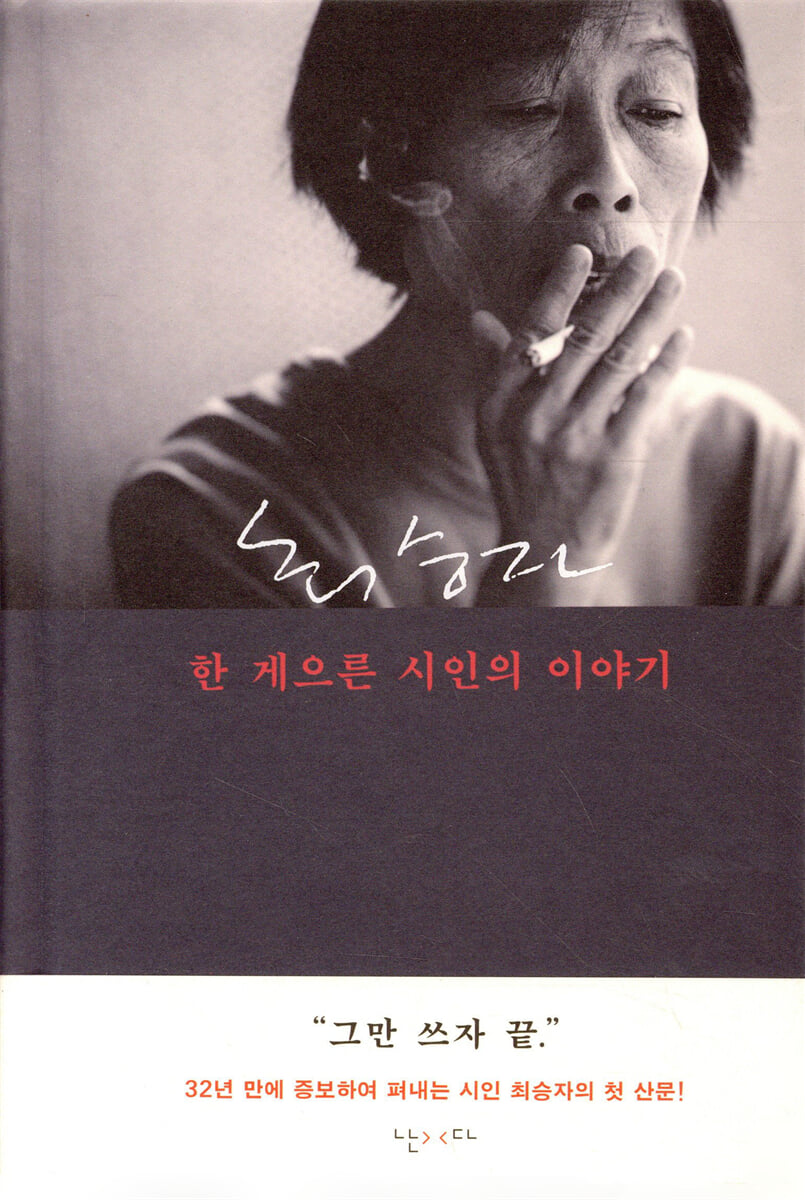
The Story of a Lazy Poet
 |
Description
Book Introduction
- A word from MD
-
Poet Choi Seung-ja's first prose collection, republished after 32 years.After 32 years since its publication, poet Choi Seung-ja's first collection of prose is being republished.
Prose written between 1995 and 2013 was added to the existing book.
The thoughts and sentences of a poet who calls himself a lazy poet, who wrote poetry but also strayed from it, but had no choice but to return to literature, shine transparently.
December 14, 2021. Essay PD Kim Tae-hee
“Let’s stop writing, that’s the end.”
Published in an expanded edition after 32 years
Poet Choi Seung-ja's first prose!
Nanda is republishing poet Choi Seung-ja's first prose collection, "The Story of a Lazy Poet."
It has been 32 years since it was first published in 1989.
This is a revised edition that adds prose written from 1995 to 2013 to the existing book, which contained 25 prose pieces in three parts, into a fourth part.
Since her debut in the quarterly 『Literature and Intelligence』 in 1979, she has been a poet who has stood up against the oppression of the times, which can be called the "oppression of the scissors," and has opened up the language of the body, the voice of women, and a "terrible and beautiful" world.
A poet who has become “the most transparent mirror of words in our time, with a poetic turn that is used economically but surely” (Hwang Hyeon-san).
But he is a poet who is so transparent that he forgets about the poems he was supposed to submit for months, putting them away in a drawer, and then casually says that it was all his own terrible 'laziness'.
He returned with a collection of prose instead of poetry, his first collection of prose from 32 years ago, adding new prose salvaged from those lost days.
The new 『Story of a Lazy Poet』 begins with the prose piece "Again on the Train of Youth" written in 1976, before his literary debut, and continues with the piece "Mystical Dreams" written in 2013.
These are the writings of poet Choi Seung-ja, from the beginning to the present, that serve as indicators of the passage of time and its flow.
This is a collection of prose that is sometimes a diary, sometimes a confession, sometimes a commentary on the times or a literary commentary, and eventually becomes a poetry essay and finally a poem.
Published in an expanded edition after 32 years
Poet Choi Seung-ja's first prose!
Nanda is republishing poet Choi Seung-ja's first prose collection, "The Story of a Lazy Poet."
It has been 32 years since it was first published in 1989.
This is a revised edition that adds prose written from 1995 to 2013 to the existing book, which contained 25 prose pieces in three parts, into a fourth part.
Since her debut in the quarterly 『Literature and Intelligence』 in 1979, she has been a poet who has stood up against the oppression of the times, which can be called the "oppression of the scissors," and has opened up the language of the body, the voice of women, and a "terrible and beautiful" world.
A poet who has become “the most transparent mirror of words in our time, with a poetic turn that is used economically but surely” (Hwang Hyeon-san).
But he is a poet who is so transparent that he forgets about the poems he was supposed to submit for months, putting them away in a drawer, and then casually says that it was all his own terrible 'laziness'.
He returned with a collection of prose instead of poetry, his first collection of prose from 32 years ago, adding new prose salvaged from those lost days.
The new 『Story of a Lazy Poet』 begins with the prose piece "Again on the Train of Youth" written in 1976, before his literary debut, and continues with the piece "Mystical Dreams" written in 2013.
These are the writings of poet Choi Seung-ja, from the beginning to the present, that serve as indicators of the passage of time and its flow.
This is a collection of prose that is sometimes a diary, sometimes a confession, sometimes a commentary on the times or a literary commentary, and eventually becomes a poetry essay and finally a poem.
- You can preview some of the book's contents.
Preview
index
Part 1: Hunger and Dreams
Back on the train of youth 13
Hunger and Dreams 16
This is life 20
Why write poetry? 24
Moral People 28
Journey to Adulthood 35
Maenghee or other eye 39
About Death 47
Leaving and returning 56
Singer and Poet 61
66 places I stayed
Part 2: A Wandering Dream
My Theistic Years 75
About the title 79
Wandering Dream 83
Round and Ripe Life 88
Short Thoughts 92
At the end of the year 97
100 empty and shining seats
Childhood Solitude Exercise 103
The Forest Without 109
Tin Drum Regret 113
Part 3: The Story of a Lazy Poet
Beyond Violence 119
The Tale of a Lazy Poet, Part 124
On Poetry in the 1980s 130
Poetic Resistance to "Scissors-Pushing" 135
Part 4 All water dies when it reaches the desert.
Woman to woman 145
Iljung's thoughts on uncle 150
Bird Fantasy 154
To H─All water dies when it reaches the desert 159
In the last 10 years or so 172
Mystical Dreams 176
Poet's Note 183
Revised Edition Poet's Note 187
Back on the train of youth 13
Hunger and Dreams 16
This is life 20
Why write poetry? 24
Moral People 28
Journey to Adulthood 35
Maenghee or other eye 39
About Death 47
Leaving and returning 56
Singer and Poet 61
66 places I stayed
Part 2: A Wandering Dream
My Theistic Years 75
About the title 79
Wandering Dream 83
Round and Ripe Life 88
Short Thoughts 92
At the end of the year 97
100 empty and shining seats
Childhood Solitude Exercise 103
The Forest Without 109
Tin Drum Regret 113
Part 3: The Story of a Lazy Poet
Beyond Violence 119
The Tale of a Lazy Poet, Part 124
On Poetry in the 1980s 130
Poetic Resistance to "Scissors-Pushing" 135
Part 4 All water dies when it reaches the desert.
Woman to woman 145
Iljung's thoughts on uncle 150
Bird Fantasy 154
To H─All water dies when it reaches the desert 159
In the last 10 years or so 172
Mystical Dreams 176
Poet's Note 183
Revised Edition Poet's Note 187
Detailed image

Into the book
But I want to leave this place now.
I want to look away and slowly get up from my seat.
I want to stretch my stiff legs from sitting for so long and walk somewhere else.
I want to move.
I want to see many other things.
Other beautiful things besides me.
If I just lift my eyes from the rotten puddle, countless beautiful things from the fields and roads will swim into the lenses of my eyes, and at some point I will shake myself off and start walking.
I'm dreaming of that moment right now.
The moment I take my first step.
So, life, who has always trampled on my dreams, will you have one last fun game? Then I will die peacefully.
It's not a branch that blooms like a flower, but I'll carefully break it off and offer it at your feet.
If you don't do well this time, I'll be the first to cause trouble.
I'm going to take off my shoe and hit you in the face.
And I will never let you die peacefully.
--- p.26~27, from “Why Write Poetry?”
Leaving is ultimately about returning to oneself, to one's own reality.
Like an ending and a beginning, leaving and returning are one and the same.
By leaving oneself, one returns to oneself.
By leaving and returning countless times, devoting much time, most of it in suffering and unhappiness, what we gain may be only the slightly bitter but generous realization that happiness does not exist separately, but rather that the absence of unhappiness is happiness.
(……) Humans are strong, but they cannot completely leave that life, and they cannot completely leave, but they leave and return often, and if we ask once what efforts we have made for that life, it rains before we know it, and if we ask twice what efforts we have made for that life, it snows before we know it, and in the meantime, the calendar turns pages one by one, quickly or slowly, and if we float a small boat on the years of suffering or lethargy that have passed, is it love or small regrets, the bare branches that have already lost all their leaves knock on the windowpane, and the year now extends its cold, final hand of farewell.
But in that nakedness, in that cold final farewell, perhaps it is finally time to say that we are alive, that we must live.
--- p.59~60, from “Leaving and Returning”
Even if he had no faith or illusions about poetry or writing poetry from the beginning, how did a poet who had a passion for writing poetry that was no less than anyone else around the time of his debut end up like this?
A poet who has no faith, belief, or passion for poetry, who doesn't want to read poetry again after writing it, who doesn't feel satisfied after writing it, and who ultimately returns to the place of poetry in a state of disarray, feeling something is lacking and something is missing. A dry and barren poet.
It seems as if the criticism that such a poet has neither the value nor the right to exist as a poet is coming from somewhere.
Yet, as long as I write poetry, am I still a poet? I wonder if some readers of my poetry will say, "What kind of poetry is this? There's no meat left, only inedible bones."
A poet who cannot provide delicious lean meat full of nutrients.
A poet who only presents barren, hard bones that have no flesh attached and cannot be eaten (if only those bones could be boiled to make a delicious broth.
Please, if that's even possible).
--- p.127~128, from “The Story of a Lazy Poet”
Once fear arises, it grows fat through countless cell divisions, and thus, the fear that has become the foundation of our existence guides our lives by controlling us invisibly from deep within us, and its ultimate destination is death, and on the way there, it experiments with and demonstrates many forms of death.
Perhaps our lives are a journey of fear boarding a flower cart and reaching its destination, death.
Because fear, unable to overcome its own destructiveness, destroys itself by dying.
Once an emotion is born and expands, it gains strength and cannot contain its own power and weight, so it cannot help but spill out.
Perhaps the true nature of the 'condition' in Buddhism is a prison-like structure made up of various events, relationships, and situations that arise as a result of pouring outward like that.
And that last, final 'condition' may be death as an event.
Perhaps I had some instinctive awareness of the fear and its destination, death.
“So, before that fear could eat me/It was the rat that got tired and howled and threatened first./Maybe in the hope that maybe because of that the world wouldn’t eat me...” The rat that got tired and howled first and threatened, and constantly spewed out death, misfortune, and despair, that rat’s cry, was that my poem?
--- p.162~163, from “To H - All water dies when it touches the desert”
Now that I've let go of the things that have been making me sick, what should I do?
I will continue to write poetry, but I cannot help but return to literature, and I am no longer the person I used to be, so I am also secretly harboring other dreams.
It is my idea to write very short stories in the form of warm, beautiful, mysterious, strange, and sad tales that are connected to a certain originality.
I want to look away and slowly get up from my seat.
I want to stretch my stiff legs from sitting for so long and walk somewhere else.
I want to move.
I want to see many other things.
Other beautiful things besides me.
If I just lift my eyes from the rotten puddle, countless beautiful things from the fields and roads will swim into the lenses of my eyes, and at some point I will shake myself off and start walking.
I'm dreaming of that moment right now.
The moment I take my first step.
So, life, who has always trampled on my dreams, will you have one last fun game? Then I will die peacefully.
It's not a branch that blooms like a flower, but I'll carefully break it off and offer it at your feet.
If you don't do well this time, I'll be the first to cause trouble.
I'm going to take off my shoe and hit you in the face.
And I will never let you die peacefully.
--- p.26~27, from “Why Write Poetry?”
Leaving is ultimately about returning to oneself, to one's own reality.
Like an ending and a beginning, leaving and returning are one and the same.
By leaving oneself, one returns to oneself.
By leaving and returning countless times, devoting much time, most of it in suffering and unhappiness, what we gain may be only the slightly bitter but generous realization that happiness does not exist separately, but rather that the absence of unhappiness is happiness.
(……) Humans are strong, but they cannot completely leave that life, and they cannot completely leave, but they leave and return often, and if we ask once what efforts we have made for that life, it rains before we know it, and if we ask twice what efforts we have made for that life, it snows before we know it, and in the meantime, the calendar turns pages one by one, quickly or slowly, and if we float a small boat on the years of suffering or lethargy that have passed, is it love or small regrets, the bare branches that have already lost all their leaves knock on the windowpane, and the year now extends its cold, final hand of farewell.
But in that nakedness, in that cold final farewell, perhaps it is finally time to say that we are alive, that we must live.
--- p.59~60, from “Leaving and Returning”
Even if he had no faith or illusions about poetry or writing poetry from the beginning, how did a poet who had a passion for writing poetry that was no less than anyone else around the time of his debut end up like this?
A poet who has no faith, belief, or passion for poetry, who doesn't want to read poetry again after writing it, who doesn't feel satisfied after writing it, and who ultimately returns to the place of poetry in a state of disarray, feeling something is lacking and something is missing. A dry and barren poet.
It seems as if the criticism that such a poet has neither the value nor the right to exist as a poet is coming from somewhere.
Yet, as long as I write poetry, am I still a poet? I wonder if some readers of my poetry will say, "What kind of poetry is this? There's no meat left, only inedible bones."
A poet who cannot provide delicious lean meat full of nutrients.
A poet who only presents barren, hard bones that have no flesh attached and cannot be eaten (if only those bones could be boiled to make a delicious broth.
Please, if that's even possible).
--- p.127~128, from “The Story of a Lazy Poet”
Once fear arises, it grows fat through countless cell divisions, and thus, the fear that has become the foundation of our existence guides our lives by controlling us invisibly from deep within us, and its ultimate destination is death, and on the way there, it experiments with and demonstrates many forms of death.
Perhaps our lives are a journey of fear boarding a flower cart and reaching its destination, death.
Because fear, unable to overcome its own destructiveness, destroys itself by dying.
Once an emotion is born and expands, it gains strength and cannot contain its own power and weight, so it cannot help but spill out.
Perhaps the true nature of the 'condition' in Buddhism is a prison-like structure made up of various events, relationships, and situations that arise as a result of pouring outward like that.
And that last, final 'condition' may be death as an event.
Perhaps I had some instinctive awareness of the fear and its destination, death.
“So, before that fear could eat me/It was the rat that got tired and howled and threatened first./Maybe in the hope that maybe because of that the world wouldn’t eat me...” The rat that got tired and howled first and threatened, and constantly spewed out death, misfortune, and despair, that rat’s cry, was that my poem?
--- p.162~163, from “To H - All water dies when it touches the desert”
Now that I've let go of the things that have been making me sick, what should I do?
I will continue to write poetry, but I cannot help but return to literature, and I am no longer the person I used to be, so I am also secretly harboring other dreams.
It is my idea to write very short stories in the form of warm, beautiful, mysterious, strange, and sad tales that are connected to a certain originality.
--- p.175, from “The Last 10 Years”
Publisher's Review
A place that shines empty,
Choi Seung-ja's 40 years
"The Story of a Lazy Poet" is a message from poet Choi Seung-ja, who has been 'sitting for a long time'.
This is the first publication in five years since the 2016 poetry collection, “Empty Like an Empty Boat.”
There was also a five-year silence between the last poetry collection and the previous work, “Written on Water.”
The gap between the fifth and sixth collections of poetry was even longer, at 11 years.
A poet who rarely writes.
“That I am alive, / is but an eternal rumor” (from “Once Upon a Time”), said the poet.
Among the recent works added in Part 4, there is one titled “The Last 10 Years or so.”
There is no need for any decoration as there is no greed.
While publishing his poetry collection, “Lovers,” in 1998, he was diagnosed with schizophrenia and was repeatedly admitted to and discharged from a psychiatric ward. He said nonchalantly that he was “acting like a child” on that bridge, “looking back and forth on some secret bridge” between Western astrology and mystical systems, and later between Lao-tzu and Zhuang-tzu, but did not even allow him to see the structure, let alone dismantle it.
I decided to just let go of the things that were making me sick and tired, and just 'letting go'.
So when we ask what we should do now, the poet's answer is simply indifferent.
“I have no choice but to return to literature,” so “I will continue to write poetry.”
Although he says he has already become irreversibly different from his former self, there is no doubt that literature is where he will return.
He also hinted at a vision: “I want to write very short stories in the form of warm, beautiful, mysterious, strange, and sad tales that are connected to a certain originality.”
With the determination to return to the place of literature, he said, “So these days, I am diligently reading literary books,” in clear, unquestioning language (“Mystical Dreams”).
Another 10 years have passed since I looked back on the 'last 10 years or so'.
Meanwhile, in 2014, the publisher requested the poet to republish this collection of essays, and permission was granted in 2019.
On November 11, 2021, I received a new 'Poet's Note' from the poet who had moved to a hospital ahead of the republication.
The pronunciation on the other end of the phone was loud and clear, like a turnip being cut into pieces.
I have finally published a collection of essays that I had been putting off for a long time.
It seems like a long time has passed.
Thinking about the time that has passed
It makes me laugh.
Is this something to laugh about?
Let's stop using it
end.
─ Full text of the "Revised Edition Poet's Note"
Rather than despair mixed with germs
Always pure hope
When talking about this book, or rather, when talking about Choi Seung-ja, the one thing that cannot be left out is 'death'.
When the poet suddenly looks back on the past, death is calmly there.
There is even an article titled “About Death” in the book.
The 'self-inflicted' death of my maternal grandmother's servant, Iljung, the 'joke-like' death of my first boarding house owner, and the death of my grandmother, who 'became a comfort' in the midst of my sorrow.
But in this way, the victor goes beyond death, to the next death, to the 'death of death'.
He simply confesses, “Death is something connected to a deep, dark, intense, and ripe sensuality,” and immediately reflects on the fact that “I have not found enough satisfaction in my life.”
Finally, when the reality of 'death', which he had believed to be sensual, is killed in the face of his mother's death, the poet reads the title of his fourth poetry collection, 'My Grave, Blue', differently.
“Well, maybe that was the tomb that contained my death.” (To H)
The poet said, “I always choose certain despair over uncertain hope.”
But instead of ultimately falling into despair and death, the winner always returns to life.
Suddenly, I return to the rumor called life.
“Since I came out to have fun anyway, I have no choice but to have fun” (“This Is What Living Is”), he declares, and vows that if he is not going to let me have fun in life, he will cause a “fuck” first, and that he will never die peacefully (“Why Are You Writing Poetry?”).
The poet is not bent toward death, but faces death and looks beyond it.
From there, it seems as if we have taken a big step forward and escaped into the world of space, mystery, and the spirit.
“It is an attempt to understand the world fundamentally rather than conceptually” (Hwang Hyeon-san).
But even if everything he can hear, see, and touch in this world brings him to despair, the 'only thing' that the poet holds onto until the end is this place where he can touch and hear, the place of life again.
With the habit of “going back and forth like a pendulum between blind despair and blind hope,” he wrote a record of a life that became stronger by ‘leaving and returning’ while facing life without completely abandoning it.
Humans are strong, but they cannot completely leave that life, and they cannot completely leave, but they leave and return often. If we ask once what efforts we have made for that life, it rains before we know it, and if we ask twice what efforts we have made for that life, it snows before we know it, and in the meantime, the calendar turns pages one by one, quickly or slowly, and if we float a small boat on the years of suffering or lethargy that have passed, is it love or small regrets? Bare tree branches that have already lost all their leaves knock on the windowpane, and the year now extends its cold, final hand of farewell.
But in that nakedness, in that cold final farewell, perhaps it is finally time to say that we are alive, that we must live.
And as a poet once said, in the end, 'to live is to love.
You have to pronounce that word.'
─ From "Leaving and Returning"
I'm dreaming of that moment right now.
The moment I take my first step.
The poet suffers from “a disease of the beginning” due to longing for the beginning (the poet’s words in “Written on Water”).
“The first poet of our time to register her birth as a woman who was reborn as a woman” (Kim So-yeon).
He opened the door leading to the cool room, and then opened the door behind the door, and the door beyond the door, and came forward.
He survived by being alive, and thus became a name that will never be forgotten by us.
As the name suggests, “Wherever the winner is, he is the winner.
“He has never surrendered” (Hwang Hyeon-san).
A 38-year-old poet who said he could only laugh when he came across the sentence he wrote at the age of 25: “I am about to board the train called youth again.”
“It makes me laugh to think about the time that has passed,” said the 70-year-old poet, looking back on his own words after 32 years.
A poet who asks himself, “Is this something to laugh about?” and answers himself, “I should stop writing.”
“The end,” said a lazy poet, putting a period like this.
The story of a poet named Choi Seung-ja, who is constantly lazy.
A poet who has no faith, belief, or passion for poetry, who doesn't want to read poetry again after writing it, who doesn't feel satisfied after writing it, and who ultimately returns to the place of poetry in a state of disarray, feeling something is lacking and something is missing. A dry and barren poet.
(……) But maybe the reason I seem to believe in nothing is because there is only one thing I believe in.
In that respect, I am a romantic.
But I know that one thing can never come true.
So I naturally and groggily return to things I don't believe in.
─ From “The Story of a Lazy Poet”
● Revised edition poet's note
I have finally published a collection of essays that I had been putting off for a long time.
It seems like a long time has passed.
Thinking about the time that has passed
It makes me laugh.
Is this something to laugh about?
Let's stop using it
end.
November 11, 2021
Choi Seung-ja
Choi Seung-ja's 40 years
"The Story of a Lazy Poet" is a message from poet Choi Seung-ja, who has been 'sitting for a long time'.
This is the first publication in five years since the 2016 poetry collection, “Empty Like an Empty Boat.”
There was also a five-year silence between the last poetry collection and the previous work, “Written on Water.”
The gap between the fifth and sixth collections of poetry was even longer, at 11 years.
A poet who rarely writes.
“That I am alive, / is but an eternal rumor” (from “Once Upon a Time”), said the poet.
Among the recent works added in Part 4, there is one titled “The Last 10 Years or so.”
There is no need for any decoration as there is no greed.
While publishing his poetry collection, “Lovers,” in 1998, he was diagnosed with schizophrenia and was repeatedly admitted to and discharged from a psychiatric ward. He said nonchalantly that he was “acting like a child” on that bridge, “looking back and forth on some secret bridge” between Western astrology and mystical systems, and later between Lao-tzu and Zhuang-tzu, but did not even allow him to see the structure, let alone dismantle it.
I decided to just let go of the things that were making me sick and tired, and just 'letting go'.
So when we ask what we should do now, the poet's answer is simply indifferent.
“I have no choice but to return to literature,” so “I will continue to write poetry.”
Although he says he has already become irreversibly different from his former self, there is no doubt that literature is where he will return.
He also hinted at a vision: “I want to write very short stories in the form of warm, beautiful, mysterious, strange, and sad tales that are connected to a certain originality.”
With the determination to return to the place of literature, he said, “So these days, I am diligently reading literary books,” in clear, unquestioning language (“Mystical Dreams”).
Another 10 years have passed since I looked back on the 'last 10 years or so'.
Meanwhile, in 2014, the publisher requested the poet to republish this collection of essays, and permission was granted in 2019.
On November 11, 2021, I received a new 'Poet's Note' from the poet who had moved to a hospital ahead of the republication.
The pronunciation on the other end of the phone was loud and clear, like a turnip being cut into pieces.
I have finally published a collection of essays that I had been putting off for a long time.
It seems like a long time has passed.
Thinking about the time that has passed
It makes me laugh.
Is this something to laugh about?
Let's stop using it
end.
─ Full text of the "Revised Edition Poet's Note"
Rather than despair mixed with germs
Always pure hope
When talking about this book, or rather, when talking about Choi Seung-ja, the one thing that cannot be left out is 'death'.
When the poet suddenly looks back on the past, death is calmly there.
There is even an article titled “About Death” in the book.
The 'self-inflicted' death of my maternal grandmother's servant, Iljung, the 'joke-like' death of my first boarding house owner, and the death of my grandmother, who 'became a comfort' in the midst of my sorrow.
But in this way, the victor goes beyond death, to the next death, to the 'death of death'.
He simply confesses, “Death is something connected to a deep, dark, intense, and ripe sensuality,” and immediately reflects on the fact that “I have not found enough satisfaction in my life.”
Finally, when the reality of 'death', which he had believed to be sensual, is killed in the face of his mother's death, the poet reads the title of his fourth poetry collection, 'My Grave, Blue', differently.
“Well, maybe that was the tomb that contained my death.” (To H)
The poet said, “I always choose certain despair over uncertain hope.”
But instead of ultimately falling into despair and death, the winner always returns to life.
Suddenly, I return to the rumor called life.
“Since I came out to have fun anyway, I have no choice but to have fun” (“This Is What Living Is”), he declares, and vows that if he is not going to let me have fun in life, he will cause a “fuck” first, and that he will never die peacefully (“Why Are You Writing Poetry?”).
The poet is not bent toward death, but faces death and looks beyond it.
From there, it seems as if we have taken a big step forward and escaped into the world of space, mystery, and the spirit.
“It is an attempt to understand the world fundamentally rather than conceptually” (Hwang Hyeon-san).
But even if everything he can hear, see, and touch in this world brings him to despair, the 'only thing' that the poet holds onto until the end is this place where he can touch and hear, the place of life again.
With the habit of “going back and forth like a pendulum between blind despair and blind hope,” he wrote a record of a life that became stronger by ‘leaving and returning’ while facing life without completely abandoning it.
Humans are strong, but they cannot completely leave that life, and they cannot completely leave, but they leave and return often. If we ask once what efforts we have made for that life, it rains before we know it, and if we ask twice what efforts we have made for that life, it snows before we know it, and in the meantime, the calendar turns pages one by one, quickly or slowly, and if we float a small boat on the years of suffering or lethargy that have passed, is it love or small regrets? Bare tree branches that have already lost all their leaves knock on the windowpane, and the year now extends its cold, final hand of farewell.
But in that nakedness, in that cold final farewell, perhaps it is finally time to say that we are alive, that we must live.
And as a poet once said, in the end, 'to live is to love.
You have to pronounce that word.'
─ From "Leaving and Returning"
I'm dreaming of that moment right now.
The moment I take my first step.
The poet suffers from “a disease of the beginning” due to longing for the beginning (the poet’s words in “Written on Water”).
“The first poet of our time to register her birth as a woman who was reborn as a woman” (Kim So-yeon).
He opened the door leading to the cool room, and then opened the door behind the door, and the door beyond the door, and came forward.
He survived by being alive, and thus became a name that will never be forgotten by us.
As the name suggests, “Wherever the winner is, he is the winner.
“He has never surrendered” (Hwang Hyeon-san).
A 38-year-old poet who said he could only laugh when he came across the sentence he wrote at the age of 25: “I am about to board the train called youth again.”
“It makes me laugh to think about the time that has passed,” said the 70-year-old poet, looking back on his own words after 32 years.
A poet who asks himself, “Is this something to laugh about?” and answers himself, “I should stop writing.”
“The end,” said a lazy poet, putting a period like this.
The story of a poet named Choi Seung-ja, who is constantly lazy.
A poet who has no faith, belief, or passion for poetry, who doesn't want to read poetry again after writing it, who doesn't feel satisfied after writing it, and who ultimately returns to the place of poetry in a state of disarray, feeling something is lacking and something is missing. A dry and barren poet.
(……) But maybe the reason I seem to believe in nothing is because there is only one thing I believe in.
In that respect, I am a romantic.
But I know that one thing can never come true.
So I naturally and groggily return to things I don't believe in.
─ From “The Story of a Lazy Poet”
● Revised edition poet's note
I have finally published a collection of essays that I had been putting off for a long time.
It seems like a long time has passed.
Thinking about the time that has passed
It makes me laugh.
Is this something to laugh about?
Let's stop using it
end.
November 11, 2021
Choi Seung-ja
GOODS SPECIFICS
- Publication date: November 30, 2021
- Format: Hardcover book binding method guide
- Page count, weight, size: 192 pages | 276g | 130*195*15mm
- ISBN13: 9791191859133
- ISBN10: 1191859134
You may also like
카테고리
korean


korean

![GQ KOREA Mark (Monthly): December [2025]](http://librairie.coreenne.fr/cdn/shop/files/8ef265dbbfbf186523ed75ba7319009d.jpg?v=1765340328&width=3840)


