

specification
 |
Description
Book Introduction
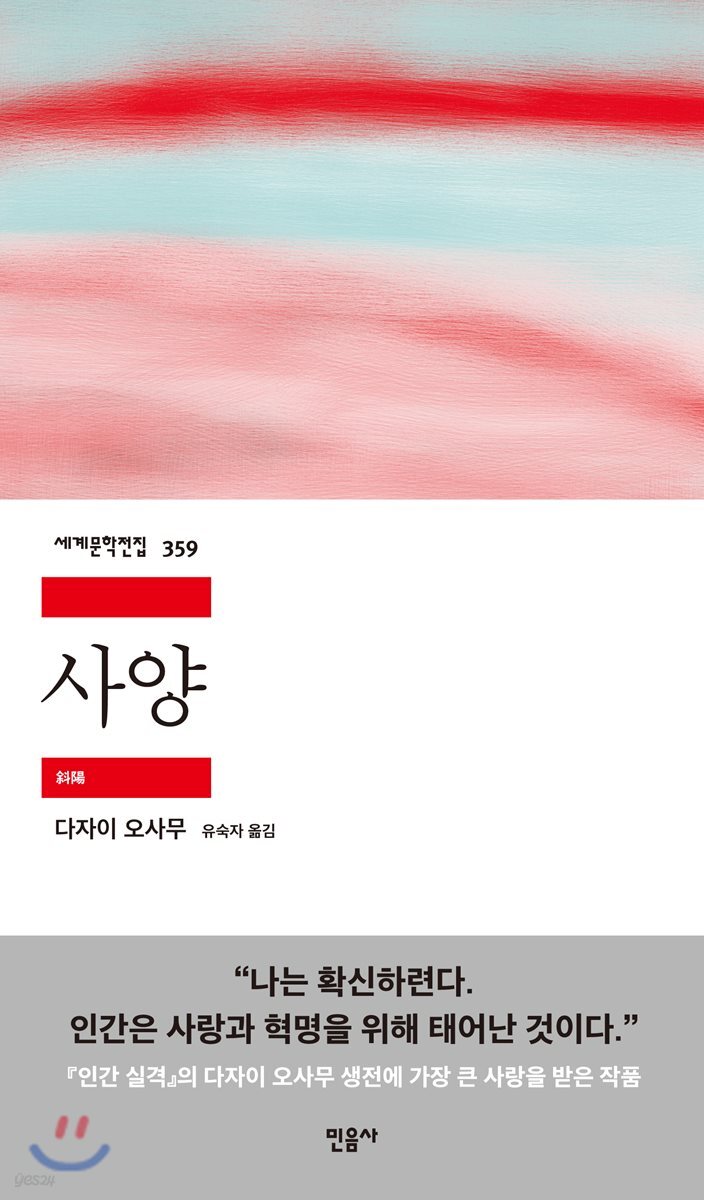
A symbol of self-destruction, A masterpiece that best reveals the full scope of Osamu Dazai's literature. Dazai Osamu's most beloved work during his lifetime, "The Decline," was published as the 359th volume of Minumsa's World Literature Collection. Osamu Dazai, who was enthusiastically supported by young Japanese people who were in a state of mental panic after the war, published "The Decline" in 1947 and became an instant bestseller. This work caused a huge stir in Japanese society, to the point of giving rise to the buzzword "sayanjok", which refers to the declining nobility of the time. "Sayang" is a unique novel that shows the rich and deep worldview of Dazai's mid-to-late period, unlike the dark and destructive worldview that usually comes to mind when thinking of Dazai's literature. It depicts the struggles, realities, and choices of four unique characters through various narrative methods such as monologues, confession letters, diaries, dreams, and memories. In particular, the monologue of the strong female protagonist who chooses an independent life reveals a new side of Dazai and his feminist status, making it significant in the history of Japanese literature. |
- You can preview some of the book's contents.
Preview
index
Specification 7
Commentary on the work 165
Author's Chronology 173
Commentary on the work 165
Author's Chronology 173
Into the book
The evening sun shone on my mother's face, making her eyes sparkle blue.
That face, which seemed to be slightly angry, was so beautiful that I wanted to run to it and hug it.
And I thought, oh, my mother's face somehow resembled that sad snake I had seen earlier.
--- p.19
I ended up starting a fire.
I'm setting fire.
I never once, not even in my dreams, since I was little, did I think that something so scary would happen in my life.
--- p.31
My uncle said that we are almost out of money now.
Because of the savings blockade and the property tax, it's now difficult for my uncle to send us money like before.
--- p.47
Decadent? But I can't survive without doing something like this.
I'd rather have someone tell me to "go die!" than someone who criticizes me with such words.
It's refreshing.
But people rarely say, “Just die!”
You petty and hypocritical hypocrites!
--- pp.65~66
This time, when I receive my sister's money, I plan to pay off all my pharmacy debt with it, then go to the villa in Shiobara and come back healthy. I'm serious. Once I pay off all my pharmacy debt, I plan to quit drugs from that day on. I swear to God. Please believe me. Keep it a secret from Mom and have Oseki ask Mr. Uehara of the Kayano Apartment.
--- p.70
I like bad guys.
Moreover, I like defective products with labels attached.
And I want to be a labeled bad guy too.
I don't think there's any other way for me to survive.
You must be the biggest labeled delinquent in Japan.
And recently, I heard from my brother that many people hate you and attack you, calling you ugly and disgusting, and I like you even more.
--- p.92
“Now that summer is over, Mother has overcome the danger.
Mother, the dahlias are blooming in the yard.
And the primrose, the cucumber plant, the bellflower, the pine tree, and the reed.
The yard has become a full-blown autumn garden.
“The fever will definitely go down in October.”
--- p.99
Oh, there's something wrong with these people.
But these people, like my love, may not be able to survive without doing something like this.
Since people are born into this world and must live to the end no matter what, can't we hate the way these people live to the end?
Being alive.
Being alive.
Ah, what a daunting and breathtaking undertaking this is!
--- p.136
“Do you still like me?”
It was a rough tone.
“Do you want to have my child?”
I didn't answer.
The man's face came closer with the momentum of a rock rolling down, and I was suddenly kissed.
It was a kiss that was full of sexual desire.
I shed tears while receiving the kiss.
They were bitter tears shed in humiliation and anger.
The tears flowed without stopping.
--- p.141
I wanted to be vulgar.
I wanted to be strong, no, violent.
And I thought that was the only way to become a so-called friend of the people.
Alcohol alone won't do it.
I had to constantly feel dizzy and lightheaded.
If that's the case, there was nothing else but drugs.
I have to forget about home.
You must rebel against your father's blood.
You have to reject your mother's kindness.
You should treat your older sister coldly.
Otherwise, I thought I wouldn't be able to get a ticket to enter the people's room.
--- p.147
Giving birth to and raising a child of a loved one is the completion of my moral revolution.
Even if you forget me, and even if you lose your life to alcohol, I think I can live on bravely to complete my revolution.
That face, which seemed to be slightly angry, was so beautiful that I wanted to run to it and hug it.
And I thought, oh, my mother's face somehow resembled that sad snake I had seen earlier.
--- p.19
I ended up starting a fire.
I'm setting fire.
I never once, not even in my dreams, since I was little, did I think that something so scary would happen in my life.
--- p.31
My uncle said that we are almost out of money now.
Because of the savings blockade and the property tax, it's now difficult for my uncle to send us money like before.
--- p.47
Decadent? But I can't survive without doing something like this.
I'd rather have someone tell me to "go die!" than someone who criticizes me with such words.
It's refreshing.
But people rarely say, “Just die!”
You petty and hypocritical hypocrites!
--- pp.65~66
This time, when I receive my sister's money, I plan to pay off all my pharmacy debt with it, then go to the villa in Shiobara and come back healthy. I'm serious. Once I pay off all my pharmacy debt, I plan to quit drugs from that day on. I swear to God. Please believe me. Keep it a secret from Mom and have Oseki ask Mr. Uehara of the Kayano Apartment.
--- p.70
I like bad guys.
Moreover, I like defective products with labels attached.
And I want to be a labeled bad guy too.
I don't think there's any other way for me to survive.
You must be the biggest labeled delinquent in Japan.
And recently, I heard from my brother that many people hate you and attack you, calling you ugly and disgusting, and I like you even more.
--- p.92
“Now that summer is over, Mother has overcome the danger.
Mother, the dahlias are blooming in the yard.
And the primrose, the cucumber plant, the bellflower, the pine tree, and the reed.
The yard has become a full-blown autumn garden.
“The fever will definitely go down in October.”
--- p.99
Oh, there's something wrong with these people.
But these people, like my love, may not be able to survive without doing something like this.
Since people are born into this world and must live to the end no matter what, can't we hate the way these people live to the end?
Being alive.
Being alive.
Ah, what a daunting and breathtaking undertaking this is!
--- p.136
“Do you still like me?”
It was a rough tone.
“Do you want to have my child?”
I didn't answer.
The man's face came closer with the momentum of a rock rolling down, and I was suddenly kissed.
It was a kiss that was full of sexual desire.
I shed tears while receiving the kiss.
They were bitter tears shed in humiliation and anger.
The tears flowed without stopping.
--- p.141
I wanted to be vulgar.
I wanted to be strong, no, violent.
And I thought that was the only way to become a so-called friend of the people.
Alcohol alone won't do it.
I had to constantly feel dizzy and lightheaded.
If that's the case, there was nothing else but drugs.
I have to forget about home.
You must rebel against your father's blood.
You have to reject your mother's kindness.
You should treat your older sister coldly.
Otherwise, I thought I wouldn't be able to get a ticket to enter the people's room.
--- p.147
Giving birth to and raising a child of a loved one is the completion of my moral revolution.
Even if you forget me, and even if you lose your life to alcohol, I think I can live on bravely to complete my revolution.
--- p.163
Publisher's Review
Will you remain a noble?
Should I somehow live as a commoner?
The light and shadow cast by the different choices of the four characters
Kazuko, the eldest daughter of a rapidly declining noble family after the war, leaves Tokyo with her frail mother and moves to a mountain lodge in Izu.
Although she is a beautiful mother with the dignity of a noblewoman, she is defenseless when it comes to financial power and has no other option as she depends on her uncle for help.
His younger brother, Naoji, who had been out of contact, returns from the battlefield alive, but he is unable to adapt to the rapidly changing reality and ends up hanging out with novelist Uehara, indulging in alcohol and drugs, squandering the family's meager funds.
Unfortunate events continue to happen.
The snake eggs that were carelessly burned with the children, the fire, the mother's worsening condition, Naoji's will, Kazuko's love for Uehara...
With the death of their last noble mother, Kazuko and Naoji are finally faced with a choice.
Should I remain a noble, or should I give up everything and somehow adapt to living as a commoner?
Amidst the chaotic defeat and turbulent times, the fateful choices of four characters—mother, eldest daughter Kazuko, younger brother Naoji, and novelist Uehara—are strangely intertwined, heightening the tension closely linked to the social and cultural background of the time.
The ending, which concludes with Kazuko's resolute letter, offers a contrasting sense of downfall and hope.
“Giving birth to and raising a child of a loved one,
“This is the completion of my moral revolution.”
A quintessence of poetic beauty, you can't talk about Osamu Dazai without reading "The Spectacle."
Dazai is said to have said this during a visit to Shinchosha and a meeting with publishing officials.
“I will write a masterpiece.
I will write a masterpiece.
The concept of the novel is almost finished.
I'm thinking of writing a Japanese version of "The Cherry Orchard."
It is a tragedy of the fallen class.
I've already decided on a title.
"specification".
The leaning sun.
“It’s a ‘spec.’”
-From the “Work Commentary”
"The Decline" was written by Osamu Dazai a year before he passed away at the age of thirty-nine.
We can glimpse a colorful perspective on the human soul, different from the self-destruction shown in 『No Longer Human』.
The image of Naoji, who harbors both a sense of superiority and inferiority due to his noble birth, and Kazuko, who transforms into an independent and strong woman after a failed loveless marriage, captures his worldview that has become richer and deeper.
Revolution and love are actually the best and sweetest things in the world, and they are so good that I have come to believe that the mean adults must have taught us lies by saying that grapes are sour.
I am sure.
Humans are born for love and revolution.
(Page 109)
In particular, 『Sayoshi』, which continues as a female monologue, was praised by Yasunari Kawabata as “a masterpiece that most brilliantly depicts women among Osamu Dazai’s writings.”
It is also said that the poetic and aesthetic sentences are closer to poetry than prose.
"The Speculation" transcends the chaos following defeat, depicting the loneliness of modern people and the courage to press on with life despite it all, and shows off its ability to overcome the limits of savagery and decadence.
Should I somehow live as a commoner?
The light and shadow cast by the different choices of the four characters
Kazuko, the eldest daughter of a rapidly declining noble family after the war, leaves Tokyo with her frail mother and moves to a mountain lodge in Izu.
Although she is a beautiful mother with the dignity of a noblewoman, she is defenseless when it comes to financial power and has no other option as she depends on her uncle for help.
His younger brother, Naoji, who had been out of contact, returns from the battlefield alive, but he is unable to adapt to the rapidly changing reality and ends up hanging out with novelist Uehara, indulging in alcohol and drugs, squandering the family's meager funds.
Unfortunate events continue to happen.
The snake eggs that were carelessly burned with the children, the fire, the mother's worsening condition, Naoji's will, Kazuko's love for Uehara...
With the death of their last noble mother, Kazuko and Naoji are finally faced with a choice.
Should I remain a noble, or should I give up everything and somehow adapt to living as a commoner?
Amidst the chaotic defeat and turbulent times, the fateful choices of four characters—mother, eldest daughter Kazuko, younger brother Naoji, and novelist Uehara—are strangely intertwined, heightening the tension closely linked to the social and cultural background of the time.
The ending, which concludes with Kazuko's resolute letter, offers a contrasting sense of downfall and hope.
“Giving birth to and raising a child of a loved one,
“This is the completion of my moral revolution.”
A quintessence of poetic beauty, you can't talk about Osamu Dazai without reading "The Spectacle."
Dazai is said to have said this during a visit to Shinchosha and a meeting with publishing officials.
“I will write a masterpiece.
I will write a masterpiece.
The concept of the novel is almost finished.
I'm thinking of writing a Japanese version of "The Cherry Orchard."
It is a tragedy of the fallen class.
I've already decided on a title.
"specification".
The leaning sun.
“It’s a ‘spec.’”
-From the “Work Commentary”
"The Decline" was written by Osamu Dazai a year before he passed away at the age of thirty-nine.
We can glimpse a colorful perspective on the human soul, different from the self-destruction shown in 『No Longer Human』.
The image of Naoji, who harbors both a sense of superiority and inferiority due to his noble birth, and Kazuko, who transforms into an independent and strong woman after a failed loveless marriage, captures his worldview that has become richer and deeper.
Revolution and love are actually the best and sweetest things in the world, and they are so good that I have come to believe that the mean adults must have taught us lies by saying that grapes are sour.
I am sure.
Humans are born for love and revolution.
(Page 109)
In particular, 『Sayoshi』, which continues as a female monologue, was praised by Yasunari Kawabata as “a masterpiece that most brilliantly depicts women among Osamu Dazai’s writings.”
It is also said that the poetic and aesthetic sentences are closer to poetry than prose.
"The Speculation" transcends the chaos following defeat, depicting the loneliness of modern people and the courage to press on with life despite it all, and shows off its ability to overcome the limits of savagery and decadence.
GOODS SPECIFICS
- Date of publication: September 21, 2018
- Page count, weight, size: 188 pages | 264g | 132*225*20mm
- ISBN13: 9788937463594
- ISBN10: 8937463598
You may also like
카테고리
korean


korean

![GQ KOREA Mark (Monthly): December [2025]](http://librairie.coreenne.fr/cdn/shop/files/8ef265dbbfbf186523ed75ba7319009d.jpg?v=1765340328&width=3840)


