

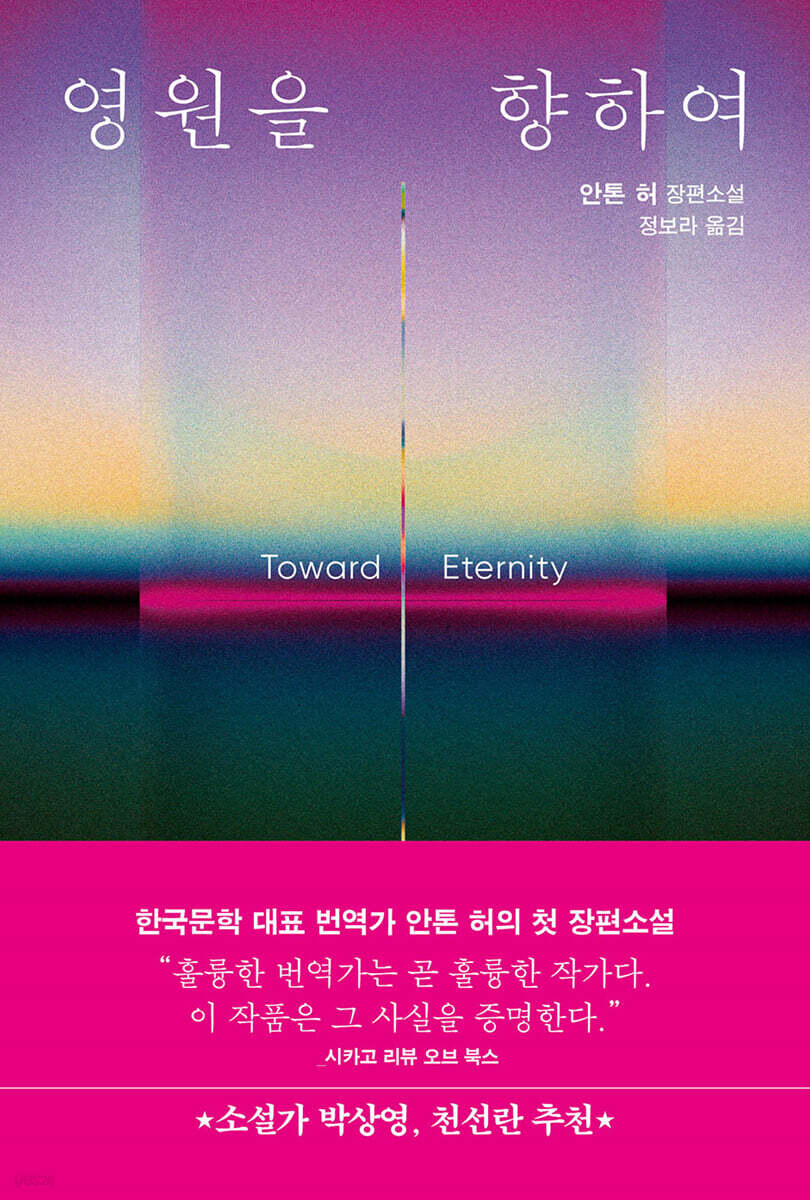
Towards eternity
 |
Description
Book Introduction
Humans become immortal, artificial intelligence gains a body, and Earth becomes a ruin after a nuclear war.
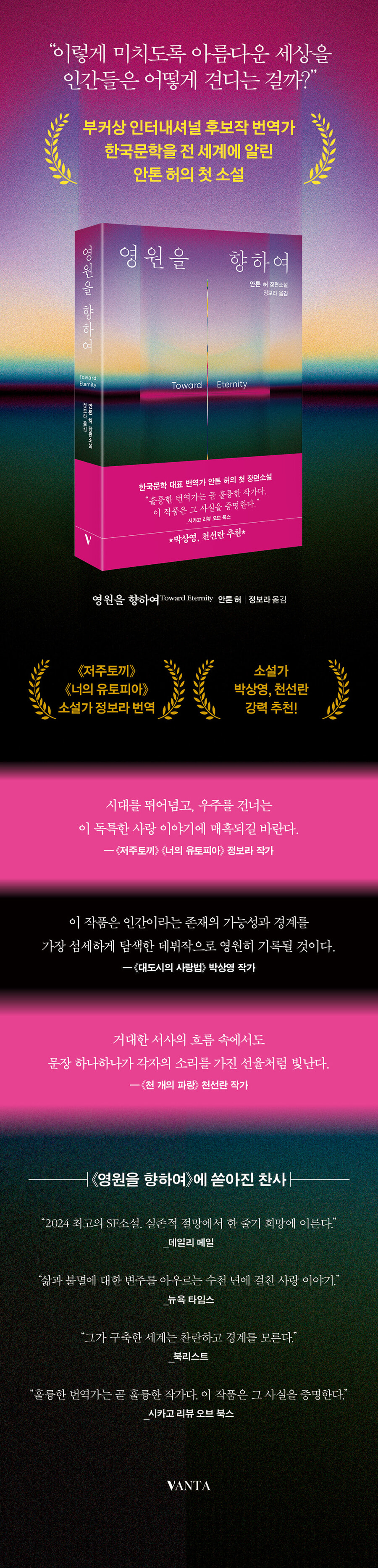
《Towards Eternity》 is a narrative about existence, identity, and love set in a future where nanotechnology and artificial intelligence have transcended human boundaries.
The story unfolds over hundreds and thousands of years, following the diary of Dr. Mali Biko, with immortal humans, artificial intelligence Panit, and cloned Eves telling their own stories.
This work, which conveys the message that “the story you write is you,” makes us reflect on what makes us human.
What does it mean to be alive, and what makes me who I am?
《Towards Eternity》 quietly encourages each reader to write their own story through the arts of poetry and music, and through the greatest emotion of all: love.
《Towards Eternity》 is a narrative about existence, identity, and love set in a future where nanotechnology and artificial intelligence have transcended human boundaries.
The story unfolds over hundreds and thousands of years, following the diary of Dr. Mali Biko, with immortal humans, artificial intelligence Panit, and cloned Eves telling their own stories.
This work, which conveys the message that “the story you write is you,” makes us reflect on what makes us human.
What does it mean to be alive, and what makes me who I am?
《Towards Eternity》 quietly encourages each reader to write their own story through the arts of poetry and music, and through the greatest emotion of all: love.
- You can preview some of the book's contents.
Preview
index
To Korean readers
Part 1: Near Future
Mali
Yonghoon
Ellen
Panit
Part 2: The Future
Panit
Loa
Part 3: The Distant Future
delta
delta
Christina
Part 4: The Very Distant Future
Mali
Part 5 Eternity -
Commentary on the work
Recommendation
Part 1: Near Future
Mali
Yonghoon
Ellen
Panit
Part 2: The Future
Panit
Loa
Part 3: The Distant Future
delta
delta
Christina
Part 4: The Very Distant Future
Mali
Part 5 Eternity -
Commentary on the work
Recommendation
Detailed image
Into the book
I am not Han Yong-hoon.
Something came back with his body, even though I don't know what it is.
The real Han Yong-hoon has gone far away.
Maybe forever.
I not only have his body, but I also have his memories, his personality, his habits, everything that we would normally think of as making up “that person.”
But I am not him.
--- p.36
As these memories unfolded one by one, they merged into one, transforming into a pain of immense presence, and I was surprised that I had never felt its absence before.
Prasut, my late husband.
He was beautiful, so beautiful that I would sometimes look at him in awe.
His face, the one that held me and gave me my center in this world.
--- p.44
I see him as he is.
I also see his past, every age I've known him at, from youth to old age.
He will always be young to me.
His face is more familiar to me than my own.
Age cannot blemish it, nor disease destroy it.
That face is the very landscape of my happiness, my joy.
I love his fragility and even the marks that time has left on him, and I am amazed at this love.
When the end was so near, I thought I was ready.
I thought our love had faded.
But it's all there, right there on his face.
No innovative nanotherapy can replace this love.
-
--- p.59
“It’s literally like the ego.
A poetic portrait is not an expression of the self, but the self itself.
Poetry doesn't 'reveal' who we are, doesn't 'bring us closer to' ourselves, doesn't help us 'express' ourselves.
“A poet is an artist who puts the self into words and makes it exist.”
--- pp.62-63
For me, music solves the problem of how to achieve immortality.
Just as it solved the problem of what to do with my mortal life before the transition.
--- p.78
“I’m also really dumbfounded.
But I'm really scared to play it again.
I know I'll play whatever it is, but what if the sound changes? It's not necessarily worse, maybe better, but what if it changes so much that it's no longer my sound? What if, now that I've made the transition, I'm just a cello-playing machine?
--- p.81
But that might be love too.
Remembering a melody you've never heard before.
Knowing a song you're hearing for the first time.
--- p.146
This word flashed into my consciousness like a light coming on when a switch is turned on.
A word that hadn't been there until just a moment ago, now it seemed like it had always been there.
A memory without any learning experience.
It is memory that creates experience, not the other way around.
--- p.203
“And even for the clone tanks themselves, being touched by another being would be like a memory of a memory of a memory that had skipped over thousands of times.
Like a dream.
But mothers are meant to hold their children, sisters are meant to sit side by side at the table, and lovers are meant to fall asleep together.”
--- p.241
“Write our story? What does that mean?”
“I write in an old black notebook.
They call it the Mali document.
“A deal passed down for hundreds of years, since the first immortals.”
“Ah,” she seemed to think.
“To write a story about someone is to create someone.”
"huh?"
“What are we if not the stories we tell ourselves about ourselves?”
Eve C came down from the shelf.
As she walked towards the transparent wall, the wrinkles in her dress smoothed out.
Eve C was close enough to reach out and touch, but I knew I couldn't.
That face.
It's a mirror image of my face.
“Every word you use will change the story, Delta.
“Every word you use will change you.”
Something came back with his body, even though I don't know what it is.
The real Han Yong-hoon has gone far away.
Maybe forever.
I not only have his body, but I also have his memories, his personality, his habits, everything that we would normally think of as making up “that person.”
But I am not him.
--- p.36
As these memories unfolded one by one, they merged into one, transforming into a pain of immense presence, and I was surprised that I had never felt its absence before.
Prasut, my late husband.
He was beautiful, so beautiful that I would sometimes look at him in awe.
His face, the one that held me and gave me my center in this world.
--- p.44
I see him as he is.
I also see his past, every age I've known him at, from youth to old age.
He will always be young to me.
His face is more familiar to me than my own.
Age cannot blemish it, nor disease destroy it.
That face is the very landscape of my happiness, my joy.
I love his fragility and even the marks that time has left on him, and I am amazed at this love.
When the end was so near, I thought I was ready.
I thought our love had faded.
But it's all there, right there on his face.
No innovative nanotherapy can replace this love.
-
--- p.59
“It’s literally like the ego.
A poetic portrait is not an expression of the self, but the self itself.
Poetry doesn't 'reveal' who we are, doesn't 'bring us closer to' ourselves, doesn't help us 'express' ourselves.
“A poet is an artist who puts the self into words and makes it exist.”
--- pp.62-63
For me, music solves the problem of how to achieve immortality.
Just as it solved the problem of what to do with my mortal life before the transition.
--- p.78
“I’m also really dumbfounded.
But I'm really scared to play it again.
I know I'll play whatever it is, but what if the sound changes? It's not necessarily worse, maybe better, but what if it changes so much that it's no longer my sound? What if, now that I've made the transition, I'm just a cello-playing machine?
--- p.81
But that might be love too.
Remembering a melody you've never heard before.
Knowing a song you're hearing for the first time.
--- p.146
This word flashed into my consciousness like a light coming on when a switch is turned on.
A word that hadn't been there until just a moment ago, now it seemed like it had always been there.
A memory without any learning experience.
It is memory that creates experience, not the other way around.
--- p.203
“And even for the clone tanks themselves, being touched by another being would be like a memory of a memory of a memory that had skipped over thousands of times.
Like a dream.
But mothers are meant to hold their children, sisters are meant to sit side by side at the table, and lovers are meant to fall asleep together.”
--- p.241
“Write our story? What does that mean?”
“I write in an old black notebook.
They call it the Mali document.
“A deal passed down for hundreds of years, since the first immortals.”
“Ah,” she seemed to think.
“To write a story about someone is to create someone.”
"huh?"
“What are we if not the stories we tell ourselves about ourselves?”
Eve C came down from the shelf.
As she walked towards the transparent wall, the wrinkles in her dress smoothed out.
Eve C was close enough to reach out and touch, but I knew I couldn't.
That face.
It's a mirror image of my face.
“Every word you use will change the story, Delta.
“Every word you use will change you.”
--- pp.253-254
Publisher's Review
The translator who brought Korean literature to the world stage
The first full-length novel that chronicles Anton Huh's world.
“One of the best science fiction novels of 2024.” - Daily Mail
“A good translator is a good writer.
This work proves that fact.” - Chicago Review of Books
The New York Times, The Guardian, Daily Mail, etc.
A hot topic covered by major media outlets around the world
In 2022, translator Anton Herr, who received attention from the global literary community when two of his translated Korean novels were simultaneously nominated for the Booker International Prize, one of the world's top three literary awards, presented his first full-length novel, "Towards Eternity," in 2024.
Acclaimed for “Anton Hur’s world is brilliant and boundless” (Booklist), “A love story spanning millennia, exploring the many forms of life and the possibilities of immortality” (The New York Times), and “Exploring the most important questions of our time” (New York Journal of Books), this debut novel has made a powerful first impression on readers around the world.
Anton Huh, who has translated major works of Korean literature into English, including Jeong Bo-ra's "Cursed Rabbit" and "Your Utopia," Park Sang-young's "Lovestruck in the City," and Lee Seong-bok's poetry collection "Infinite Flower Book," has achieved a remarkable feat in the history of Korean literature, with "Cursed Rabbit" and "Lovestruck in the City" being nominated for the Booker International Prize.
《The Cursed Rabbit》 was nominated for the final, and 《Love in the City》 won the Dublin Literary Award, 《The Book of Infinite Flowers》 won the Barrios Translation Award, and 《Your Utopia》 won the Philip K.
He was also nominated for the Dick Prize and led the globalization of Korean literature.
"Towards Eternity" is the first novel written in his own language by a man who has translated the works of other authors, and is the result of deep contemplation that explores the nature of stories that continue after death, including humans and artificial intelligence, language and art.
Taking its title from Emily Dickinson's poem "Because I Could Not Stop for Death," this novel questions the meaning of being "human" in a world where technology can replace humans.
A grand narrative that spans from South Africa to the distant reaches of space, from the near future to thousands of years into the future, has been translated into Korean by author Jeong Bo-ra.
Following Anton Herr's translation of Jeong Bo-ra's novel into English, Jeong Bo-ra has now translated his novel into Korean, completing a special bond between the two translating each other's worlds.
This unusual intersection becomes even more symbolic as it intersects with the core theme of “Towards Eternity”: “language.”
Artificial intelligence that gained immortality and a human body
Bonds and hope sprouting from a devastated earth
How can humans endure such a maddeningly beautiful world?
_In the book
In the near future, technology will be developed that could replace human cells with nanobots, enabling immortality.
Yong-Hoon, who was diagnosed with an incurable disease and received nanotherapy, disappears from his laboratory one day and reappears a few days later.
The story begins with that strange 'disappearance'.
Dr. Mali Biko records this incident, and the diary continues over thousands of years to Yong-hoon, who disappeared and then returned, to Ellen, another nanotherapy clinical trial participant, the artificial intelligence Panit, and the clone 'Eve' who inherited Panit's mind.
Yonghoon, who studies poetry, was able to live with her husband Prasut for 43 years thanks to nanotherapy.
However, Prasut dies of old age, and Yonghoon suddenly disappears after hearing his voice.
Upon his return, he realizes that although his memories, personality, and habits remain the same, he is different from Yong-hoon and that Yong-hoon has disappeared forever.
However, as his 'memories' with Prasut return, he is able to say that he is Yonghoon.
His body bears faint scars from before his body cells were replaced with nanobots.
Yong-Hoon is relieved that his old body has returned, meaning he can die soon.
And the diary is passed on to the next person.
In the distant future, on a ruined Earth, the Korean artificial intelligence company 'Janus' supplies the weapon 'Eve' to dictatorial regimes in an attempt to wipe out humanity.
However, as the Eves repeat creation and destruction, some individuals appear with differences in senses and thoughts.
Eve D experiences a 'poem' falling from the sky and realizes that she is different from other Eves.
Although he tries to hide the fact so as not to be deleted, he gradually accepts the change when Eve A of the same platoon shares apples with him (even though Eve does not need to eat food) and Eve C tells him about the existence of other unusual individuals.
Eve D's squad finally discovers a fortress where surviving humans and clones live together, and makes a final choice to protect that world.
Even if humanity disappears, it will continue forever
Poetry and music, language and story
And amazing sci-fi about love
“What should I write?”
“It’s your story.
This is our story.
“It is no exaggeration to say that this is the story of our new humanity.” _From the book
《Towards Eternity》 depicts humanity at a turning point of nanotechnology and nuclear war, and asks what it means to be a being that can still be called 'human.'
Can a body replaced by nanobots, an immortal body, or a cloned entity really be called human?
Conversely, can't an AI that reads poetry, plays music, and loves someone be considered human?
Anton Huh answers this question by looking at Christina Rossetti, Emily Dickinson, and TS
It brings up the poetry of Eliot and others.
These poems serve as a singularity that gives humanity to the artificial intelligence, Panit, and distinguishes Eve D, a clone, from other individuals.
Some Eves find meaning in a single purple conch shell they picked up from the sea, while others are willing to give up immortality simply for the belief that they are 'doing the right thing.'
The scars on my hands, the music I play, the poetry I understand, the people I love.
All these little, brilliant 'singularities' go to the core of humanity and identity.
《Towards Eternity》 unfolds in a diary-style narrative structure, with each person who inherits the notebook writing their own story.
The link is always 'love', and it contains all the emotions and processes leading up to love.
The emotions that cross the lines between me and you, humans and artificial intelligence, the past and the future, are translated into language, remembered through music, and left behind as poetry.
Anton Huh's prose unfolds these narratives in a beautiful and refined rhythm, like a poem, leaving a lasting impression on the reader.
A story about humanity, having reached an age of immortality, once again choosing life and death, distinguishing between self and others, and transcending that boundary.
《Towards Eternity》 is a literary voyage exploring science and philosophy, language and art, love and the nature of existence.
And upon completing that voyage, the author's message to write your own story, a story filled with love, as the saying goes, "You are the story you write" (Kirkus Reviews), will resonate deeply with readers.
A story that begins with disappearance and ends with love.
We hope you'll be captivated by this unique love story that transcends time and space.
- Information Ra (novelist)
The first full-length novel that chronicles Anton Huh's world.
“One of the best science fiction novels of 2024.” - Daily Mail
“A good translator is a good writer.
This work proves that fact.” - Chicago Review of Books
The New York Times, The Guardian, Daily Mail, etc.
A hot topic covered by major media outlets around the world
In 2022, translator Anton Herr, who received attention from the global literary community when two of his translated Korean novels were simultaneously nominated for the Booker International Prize, one of the world's top three literary awards, presented his first full-length novel, "Towards Eternity," in 2024.
Acclaimed for “Anton Hur’s world is brilliant and boundless” (Booklist), “A love story spanning millennia, exploring the many forms of life and the possibilities of immortality” (The New York Times), and “Exploring the most important questions of our time” (New York Journal of Books), this debut novel has made a powerful first impression on readers around the world.
Anton Huh, who has translated major works of Korean literature into English, including Jeong Bo-ra's "Cursed Rabbit" and "Your Utopia," Park Sang-young's "Lovestruck in the City," and Lee Seong-bok's poetry collection "Infinite Flower Book," has achieved a remarkable feat in the history of Korean literature, with "Cursed Rabbit" and "Lovestruck in the City" being nominated for the Booker International Prize.
《The Cursed Rabbit》 was nominated for the final, and 《Love in the City》 won the Dublin Literary Award, 《The Book of Infinite Flowers》 won the Barrios Translation Award, and 《Your Utopia》 won the Philip K.
He was also nominated for the Dick Prize and led the globalization of Korean literature.
"Towards Eternity" is the first novel written in his own language by a man who has translated the works of other authors, and is the result of deep contemplation that explores the nature of stories that continue after death, including humans and artificial intelligence, language and art.
Taking its title from Emily Dickinson's poem "Because I Could Not Stop for Death," this novel questions the meaning of being "human" in a world where technology can replace humans.
A grand narrative that spans from South Africa to the distant reaches of space, from the near future to thousands of years into the future, has been translated into Korean by author Jeong Bo-ra.
Following Anton Herr's translation of Jeong Bo-ra's novel into English, Jeong Bo-ra has now translated his novel into Korean, completing a special bond between the two translating each other's worlds.
This unusual intersection becomes even more symbolic as it intersects with the core theme of “Towards Eternity”: “language.”
Artificial intelligence that gained immortality and a human body
Bonds and hope sprouting from a devastated earth
How can humans endure such a maddeningly beautiful world?
_In the book
In the near future, technology will be developed that could replace human cells with nanobots, enabling immortality.
Yong-Hoon, who was diagnosed with an incurable disease and received nanotherapy, disappears from his laboratory one day and reappears a few days later.
The story begins with that strange 'disappearance'.
Dr. Mali Biko records this incident, and the diary continues over thousands of years to Yong-hoon, who disappeared and then returned, to Ellen, another nanotherapy clinical trial participant, the artificial intelligence Panit, and the clone 'Eve' who inherited Panit's mind.
Yonghoon, who studies poetry, was able to live with her husband Prasut for 43 years thanks to nanotherapy.
However, Prasut dies of old age, and Yonghoon suddenly disappears after hearing his voice.
Upon his return, he realizes that although his memories, personality, and habits remain the same, he is different from Yong-hoon and that Yong-hoon has disappeared forever.
However, as his 'memories' with Prasut return, he is able to say that he is Yonghoon.
His body bears faint scars from before his body cells were replaced with nanobots.
Yong-Hoon is relieved that his old body has returned, meaning he can die soon.
And the diary is passed on to the next person.
In the distant future, on a ruined Earth, the Korean artificial intelligence company 'Janus' supplies the weapon 'Eve' to dictatorial regimes in an attempt to wipe out humanity.
However, as the Eves repeat creation and destruction, some individuals appear with differences in senses and thoughts.
Eve D experiences a 'poem' falling from the sky and realizes that she is different from other Eves.
Although he tries to hide the fact so as not to be deleted, he gradually accepts the change when Eve A of the same platoon shares apples with him (even though Eve does not need to eat food) and Eve C tells him about the existence of other unusual individuals.
Eve D's squad finally discovers a fortress where surviving humans and clones live together, and makes a final choice to protect that world.
Even if humanity disappears, it will continue forever
Poetry and music, language and story
And amazing sci-fi about love
“What should I write?”
“It’s your story.
This is our story.
“It is no exaggeration to say that this is the story of our new humanity.” _From the book
《Towards Eternity》 depicts humanity at a turning point of nanotechnology and nuclear war, and asks what it means to be a being that can still be called 'human.'
Can a body replaced by nanobots, an immortal body, or a cloned entity really be called human?
Conversely, can't an AI that reads poetry, plays music, and loves someone be considered human?
Anton Huh answers this question by looking at Christina Rossetti, Emily Dickinson, and TS
It brings up the poetry of Eliot and others.
These poems serve as a singularity that gives humanity to the artificial intelligence, Panit, and distinguishes Eve D, a clone, from other individuals.
Some Eves find meaning in a single purple conch shell they picked up from the sea, while others are willing to give up immortality simply for the belief that they are 'doing the right thing.'
The scars on my hands, the music I play, the poetry I understand, the people I love.
All these little, brilliant 'singularities' go to the core of humanity and identity.
《Towards Eternity》 unfolds in a diary-style narrative structure, with each person who inherits the notebook writing their own story.
The link is always 'love', and it contains all the emotions and processes leading up to love.
The emotions that cross the lines between me and you, humans and artificial intelligence, the past and the future, are translated into language, remembered through music, and left behind as poetry.
Anton Huh's prose unfolds these narratives in a beautiful and refined rhythm, like a poem, leaving a lasting impression on the reader.
A story about humanity, having reached an age of immortality, once again choosing life and death, distinguishing between self and others, and transcending that boundary.
《Towards Eternity》 is a literary voyage exploring science and philosophy, language and art, love and the nature of existence.
And upon completing that voyage, the author's message to write your own story, a story filled with love, as the saying goes, "You are the story you write" (Kirkus Reviews), will resonate deeply with readers.
A story that begins with disappearance and ends with love.
We hope you'll be captivated by this unique love story that transcends time and space.
- Information Ra (novelist)
GOODS SPECIFICS
- Date of issue: July 30, 2025
- Page count, weight, size: 368 pages | 446g | 135*200*23mm
- ISBN13: 9791194930761
- ISBN10: 119493076X
You may also like
카테고리
korean


korean

![ELLE 엘르 스페셜 에디션 A형 : 12월 [2025]](http://librairie.coreenne.fr/cdn/shop/files/b8e27a3de6c9538896439686c6b0e8fb.jpg?v=1766436872&width=3840)


