

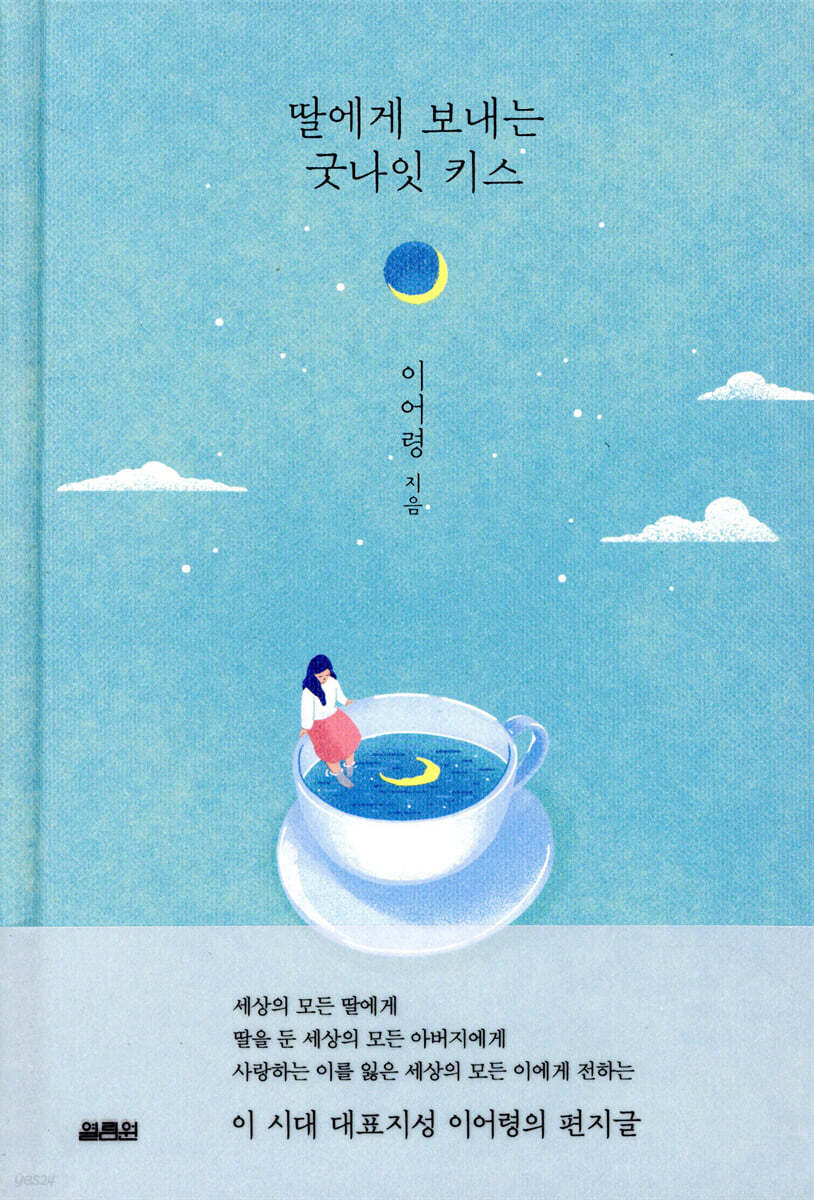
A goodnight kiss to my daughter
 |
Description
Book Introduction
To commemorate the 9th anniversary of the late Pastor Lee Min-ah's passing, a newly revised edition of "A Goodnight Kiss to My Daughter" has been published.
Nearly ten years later, Professor Lee Eo-ryeong, who is battling cancer, rewrote the preface with his daughter in mind.
The poems that took up one part of the first edition have been omitted, and both parts are comprised of letters, along with warm illustrations.
Part 1 contains the words of father Lee Eo-ryeong to his departed daughter, and Part 2 contains letters exchanged with the late pastor Lee Min-a during her lifetime.
After sending off his beloved daughter, Professor Lee Eo-ryeong wrote the first draft of this book with the hope of comforting all daughters, fathers, and all those who have lost loved ones in the world.
The time I couldn't hug my daughter who was loitering in front of the study, hoping for a goodnight kiss, the time I fell asleep at the beauty salon and delayed my daughter's bride's entrance, the time a few days before leaving, when I cautiously asked if my daughter could stay one more night at the hotel...
The author, who was looking back on his daughter's life to mourn her, opens up about the love he was unable to convey as an immature father.
Death is not an end in itself, but signifies another beginning, birth.
As he struggles with illness, the concept of death becomes more concrete and realistic for the author, but as his daughter shows, it is not futility or the end.
The author speaks to herself, to her daughter, and to everyone else enduring loss.
'Now you can cry with peace of mind.'
Because our parting will be a new meeting.
Nearly ten years later, Professor Lee Eo-ryeong, who is battling cancer, rewrote the preface with his daughter in mind.
The poems that took up one part of the first edition have been omitted, and both parts are comprised of letters, along with warm illustrations.
Part 1 contains the words of father Lee Eo-ryeong to his departed daughter, and Part 2 contains letters exchanged with the late pastor Lee Min-a during her lifetime.
After sending off his beloved daughter, Professor Lee Eo-ryeong wrote the first draft of this book with the hope of comforting all daughters, fathers, and all those who have lost loved ones in the world.
The time I couldn't hug my daughter who was loitering in front of the study, hoping for a goodnight kiss, the time I fell asleep at the beauty salon and delayed my daughter's bride's entrance, the time a few days before leaving, when I cautiously asked if my daughter could stay one more night at the hotel...
The author, who was looking back on his daughter's life to mourn her, opens up about the love he was unable to convey as an immature father.
Death is not an end in itself, but signifies another beginning, birth.
As he struggles with illness, the concept of death becomes more concrete and realistic for the author, but as his daughter shows, it is not futility or the end.
The author speaks to herself, to her daughter, and to everyone else enduring loss.
'Now you can cry with peace of mind.'
Because our parting will be a new meeting.
- You can preview some of the book's contents.
Preview
index
Part 1: Things I Couldn't Say While I Was Alive
0. PREFACE
- Goodnight kiss without you
- Leave on a wooden horse
1.
Birth and Beginning
- How did you come from so far away?
- Love is from pain
2.
The house I want to live in
- From the baby's home to the world's home
- From the house of the world to the house of the soul
- A father secretly crying in the dark
3.
Dream of Travel
- Losing my father at sea
- Piano, the instrument of fantasy
- The door to a competitive society
- Pass the first test
4.
When my daughter has her first love
- Your first love
- The day you got married
- Father's wedding speech
- A telegram from LA
5.
When my daughter gave birth to a child
- What Leonardo da Vinci Couldn't Do
- Becoming a grandfather
6.
A letter that could not be sent from Kyoto
- When the crows stop croaking
- Crossroads of Fate
- The heart that makes holes in the cast
- Love your enemies
7.
Open the eyes of the soul
- The call of fate
- The power of being attracted to a certain smile
8.
Sunset Bell
- Your last night
- Everything you taught me
- When the sunset spreads to the sound of bells
- Treasure hidden in the field
Part 2: The Miracle of the Red Mailbox
The Miracle of the Red Mailbox
You are my companion
Letter without zip code
Mom to Minah
Postscript│Iminah and the Children of the End of the Earth
0. PREFACE
- Goodnight kiss without you
- Leave on a wooden horse
1.
Birth and Beginning
- How did you come from so far away?
- Love is from pain
2.
The house I want to live in
- From the baby's home to the world's home
- From the house of the world to the house of the soul
- A father secretly crying in the dark
3.
Dream of Travel
- Losing my father at sea
- Piano, the instrument of fantasy
- The door to a competitive society
- Pass the first test
4.
When my daughter has her first love
- Your first love
- The day you got married
- Father's wedding speech
- A telegram from LA
5.
When my daughter gave birth to a child
- What Leonardo da Vinci Couldn't Do
- Becoming a grandfather
6.
A letter that could not be sent from Kyoto
- When the crows stop croaking
- Crossroads of Fate
- The heart that makes holes in the cast
- Love your enemies
7.
Open the eyes of the soul
- The call of fate
- The power of being attracted to a certain smile
8.
Sunset Bell
- Your last night
- Everything you taught me
- When the sunset spreads to the sound of bells
- Treasure hidden in the field
Part 2: The Miracle of the Red Mailbox
The Miracle of the Red Mailbox
You are my companion
Letter without zip code
Mom to Minah
Postscript│Iminah and the Children of the End of the Earth
Detailed image
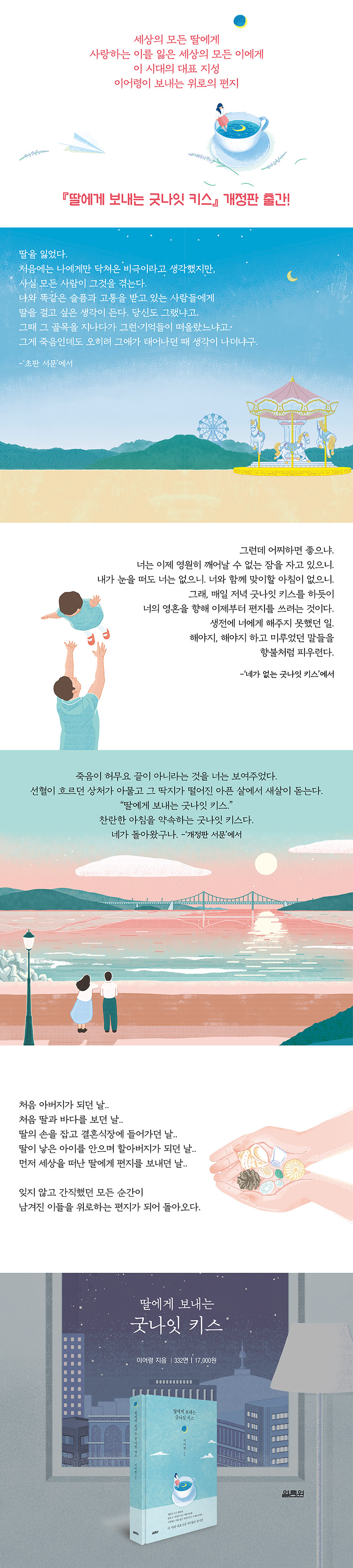
Into the book
If I were given thirty seconds right now, if God would perform such a miracle, then yes, Min-ah, even just once would be fine.
Let's go back to the old days, like rewinding an old video tape.
I'll write like I did then, and you'll wear the white lace pajamas your mom bought you.
And then he opens the study door with great force and shouts, “Good night, Dad!”
I promise.
This time, you don't have to stand there hesitating.
I put down the pen I was writing with, closed the book I was reading, and stretched out my arms.
You run and hug me.
I lift you up high enough to reach the ceiling as high as I am, and kiss your sleepy eyes and your flushed cheeks goodnight.
Good night Minah, sleep well Minah.
--- p.23
Fathers believe they are saving their daughters, but in reality, it is more often the daughters who save their fathers.
Just like Simcheong opened her father's eyes.
How many daughters must die in the water before their blind fathers open their eyes?
I think that if fathers knew that, they would never do things like war, violence that takes other people's lives, or destroy the environment by turning forests into deserts.
--- p.51
But the moment I gave birth to you and became a father, I was born with you as a father, not as a writer, a professor, or a journalist.
From then on, I started following in my father's footsteps.
Yes, I promised myself that I would not let my future children shiver in their rooms on cold winter days.
If I didn't have a family, if you didn't exist, everything I write might have been completely different.
Because of you, my dreams were always directed towards the ground.
Just like that legendary bird.
Like the Merops, a strange bird that flies with its eyes looking at the ground and its tail pointing towards the sky, a bird that always flies upside down with its eyes looking at the ground instead of the sky.
I thought that the petty bourgeois who only looked at the ground and ran, calling themselves the 'vulgar' that I had so despised in my youth, was the love I gave you, the sacrifice I made.
--- p.90
The sea I look down at while holding you in my heart, our sea.
The white sand beach and the green, rippling sea made a louder sound than the sea I had first seen with my acne-covered face.
Why, you ask? Because I held you in my heart and at the same time, I held the sea in my arms and watched the waves.
The sound of your little heart beating, the sound of life, resonated through the waves and spread throughout the ocean.
That's life.
Something that has no end, small waves, big waves, and even the wind that never stops swaying.
Following the wind, a strand of your hair, as thin and delicate as a capillary, brushed past my cheek.
Your little hands held onto mine tighter as your surprise grew.
As if it would never fall.
Perhaps a little frightened by the wonders of the sea you saw for the first time, you refused to leave my side.
--- p.96
Okay, let's tell you the story of the girl who fought with her father and ran away from home.
The child who had been living alone for several years sent a KakaoTalk message to his father, who had cut ties with him after hearing your story.
“I love you, Dad.”
Then, in just a few seconds, I got a reply.
“Nadung.”
The father who broke up with his daughter, pushed her away, and resented her, always had love by his side.
Even in a relationship filled with hatred and distrust, love persists.
That's why, despite being separated for a long time, the father was able to reply to his daughter's message with "Nadung" within seconds.
We were waiting for each other.
--- p.221
I won't talk about your death anymore.
Because death is that close to me.
Death came to me like that, not as an abstract noun, but as a very concrete noun, like the name of an object, like a glass bowl that can be held in the hand, smelled, and broken when thrown.
First of all, I started learning how to forgive myself.
I learned compassion and comfort for my own self-deception, and the generosity to love and cover up my lies.
I've hated myself so many times.
I once answered in a survey that if I met someone on the street who looked exactly like me and lived the same way, I would slap them nicely.
But now I love even my weaknesses.
That's why it's like that.
Because I have learned a little about how to love, embracing, and sympathize with the imperfect and fragile life of human beings.
--- p.254
I'm just looking at the sunset in Jeongseojin, but it's the sunset of the morning sun rising in Jeongdongjin.
The only difference is that you are in Jeongdongjin and I am in Jeongseojin.
It's the same sunset.
I have no reason to cry for you, nor for you to be heartbroken for me.
I really want to tell you this.
It is not that I have forgotten the sorrow of your death, but rather that I believe in the power of rebirth and resurrection that can transform the glow of that sorrow into the glow of morning.
Even if everyone else makes fun of you, I think that power is the power of faith, hope, and light that you speak of.
Let's go back to the old days, like rewinding an old video tape.
I'll write like I did then, and you'll wear the white lace pajamas your mom bought you.
And then he opens the study door with great force and shouts, “Good night, Dad!”
I promise.
This time, you don't have to stand there hesitating.
I put down the pen I was writing with, closed the book I was reading, and stretched out my arms.
You run and hug me.
I lift you up high enough to reach the ceiling as high as I am, and kiss your sleepy eyes and your flushed cheeks goodnight.
Good night Minah, sleep well Minah.
--- p.23
Fathers believe they are saving their daughters, but in reality, it is more often the daughters who save their fathers.
Just like Simcheong opened her father's eyes.
How many daughters must die in the water before their blind fathers open their eyes?
I think that if fathers knew that, they would never do things like war, violence that takes other people's lives, or destroy the environment by turning forests into deserts.
--- p.51
But the moment I gave birth to you and became a father, I was born with you as a father, not as a writer, a professor, or a journalist.
From then on, I started following in my father's footsteps.
Yes, I promised myself that I would not let my future children shiver in their rooms on cold winter days.
If I didn't have a family, if you didn't exist, everything I write might have been completely different.
Because of you, my dreams were always directed towards the ground.
Just like that legendary bird.
Like the Merops, a strange bird that flies with its eyes looking at the ground and its tail pointing towards the sky, a bird that always flies upside down with its eyes looking at the ground instead of the sky.
I thought that the petty bourgeois who only looked at the ground and ran, calling themselves the 'vulgar' that I had so despised in my youth, was the love I gave you, the sacrifice I made.
--- p.90
The sea I look down at while holding you in my heart, our sea.
The white sand beach and the green, rippling sea made a louder sound than the sea I had first seen with my acne-covered face.
Why, you ask? Because I held you in my heart and at the same time, I held the sea in my arms and watched the waves.
The sound of your little heart beating, the sound of life, resonated through the waves and spread throughout the ocean.
That's life.
Something that has no end, small waves, big waves, and even the wind that never stops swaying.
Following the wind, a strand of your hair, as thin and delicate as a capillary, brushed past my cheek.
Your little hands held onto mine tighter as your surprise grew.
As if it would never fall.
Perhaps a little frightened by the wonders of the sea you saw for the first time, you refused to leave my side.
--- p.96
Okay, let's tell you the story of the girl who fought with her father and ran away from home.
The child who had been living alone for several years sent a KakaoTalk message to his father, who had cut ties with him after hearing your story.
“I love you, Dad.”
Then, in just a few seconds, I got a reply.
“Nadung.”
The father who broke up with his daughter, pushed her away, and resented her, always had love by his side.
Even in a relationship filled with hatred and distrust, love persists.
That's why, despite being separated for a long time, the father was able to reply to his daughter's message with "Nadung" within seconds.
We were waiting for each other.
--- p.221
I won't talk about your death anymore.
Because death is that close to me.
Death came to me like that, not as an abstract noun, but as a very concrete noun, like the name of an object, like a glass bowl that can be held in the hand, smelled, and broken when thrown.
First of all, I started learning how to forgive myself.
I learned compassion and comfort for my own self-deception, and the generosity to love and cover up my lies.
I've hated myself so many times.
I once answered in a survey that if I met someone on the street who looked exactly like me and lived the same way, I would slap them nicely.
But now I love even my weaknesses.
That's why it's like that.
Because I have learned a little about how to love, embracing, and sympathize with the imperfect and fragile life of human beings.
--- p.254
I'm just looking at the sunset in Jeongseojin, but it's the sunset of the morning sun rising in Jeongdongjin.
The only difference is that you are in Jeongdongjin and I am in Jeongseojin.
It's the same sunset.
I have no reason to cry for you, nor for you to be heartbroken for me.
I really want to tell you this.
It is not that I have forgotten the sorrow of your death, but rather that I believe in the power of rebirth and resurrection that can transform the glow of that sorrow into the glow of morning.
Even if everyone else makes fun of you, I think that power is the power of faith, hope, and light that you speak of.
--- p.263
Publisher's Review
The father's monologue after sending his daughter away
It becomes a conversation that comforts those left behind.
“I lost my daughter.
At first I thought it was a tragedy that only happened to me, but in fact, everyone experiences it.
I feel like I want to talk to people who are going through the same sadness and pain as me.
Did you do that too?
Did those memories come to mind when you were passing through that alley?
“Even though it was death, did you remember the time when the child was born?” - From the ‘Preface to the First Edition’
People are reluctant to show others things like their crying faces or tear stains.
It's like the common memory of crying while turning on the tap to muffle the sound of crying.
The author, who wrote about the grief of losing her daughter as a monologue, feels that as time passes, her writing is gradually becoming a conversation with her daughter.
The words of sorrow and healing poured out like a stream reach even those who have no relationship with him.
To appease himself, to appease his daughter, and to appease the fate of all those who must part after meeting, he calmly reveals his own weakness and painful wounds, recalling the futility of life's end.
So that someone who says, “I don’t know why, but I keep crying these days” can easily raise their head from the pain of everyday life.
So that the tears that would not dry can willingly stop.
The author reminisces about her daughter's short life from birth to their eternal separation, and retraces the traces of love she left on this earth.
The journey's final destination is a discovery of immense love and hope that embraces countless losses.
Because the moment you were born, I became a father too.
A confession from Father Lee Eo-ryeong, representing the love he could not convey.
“You defended me by saying it was just a difference in the way you expressed your love, but that’s not true.
That's not the truth.
I will not hide the fact that it was not a difference in the way we loved, but a lack of love itself.
Expressing love only takes a blink of an eye.
But that moment might have been the whole day of your life.” - From ‘Goodnight Kiss Without You’
A child loitering in front of the study, hoping for a goodnight kiss before going to bed, while the father, with his back turned, is absorbed in his work.
Recalling those irrevocable days, the author sends a belated 'goodnight kiss' to his daughter, albeit through writing.
He thinks like that sometimes.
When I was lying in the hospital bed, when the free afternoon sunlight illuminated the room, and more than anything, when I lost all motivation as a father and could only look at the blue veins on the back of my hand.
He asks himself what a father is and what kind of father he was.
He sometimes misunderstands his wife's morning sickness as a fluke, feels concern and awe for his daughter who is considerate and considerate rather than competitive, and learns a purer truth by witnessing the miraculous moments that occur in her life.
The author says that while many fathers in the world believe that they save their daughters, in reality, it is more often the daughters who save their fathers.
As a father who was immature until the very end, he belatedly confesses his regret and regret that the things he did for his daughter actually ended up making her lonely.
In his honest confession, we can feel the gentle love that he could not express in his clumsy days.
“There is no reason for me to cry for you or for you to be heartbroken for me.”
Rather than despairing before the cliff of death, I look forward to the world of reunion beyond it.
“I will not speak of your death any more.
Because death is that close to me.
“Death came to me like that, not as an abstract noun, but as a very concrete noun, like the name of an object, like a glass bowl that can be held in the hand, smelled, and broken when thrown.” - From ‘Everything You Taught Me’
When a loved one passes away, sadness isn't the only thing that remains.
It is often said that children are buried in the heart, not in the ground.
It's not wrong, but it doesn't end with just burying it.
Just as the sunset in one west becomes the dawn in another east, death is not an end in itself, but signifies another beginning, another birth.
The author says, 'You did not leave my side.'
He remembers his daughter's birth from the cries of another child being born.
In that memory, the sorrow of losing a daughter is embraced with the joy of rebirth.
As the author battles cancer, the concept of death becomes more concrete and realistic.
But as my daughter showed me, death is not meaningless or the end.
Rather than being consumed by sadness or fear, he looks back on his past life with dignity.
And I speak to myself, to my daughter, to everyone else who is enduring loss.
'Now you can cry with peace of mind.'
Because our parting will be a new meeting.
The wound that was bleeding is healing, and new flesh is growing from the sore flesh where the scab has fallen off.
Written to offer comfort to those suffering similar pain after overcoming the grief of losing a daughter, this piece serves as a loving message of encouragement, helping readers overcome the pain and frustration of loss.
It becomes a conversation that comforts those left behind.
“I lost my daughter.
At first I thought it was a tragedy that only happened to me, but in fact, everyone experiences it.
I feel like I want to talk to people who are going through the same sadness and pain as me.
Did you do that too?
Did those memories come to mind when you were passing through that alley?
“Even though it was death, did you remember the time when the child was born?” - From the ‘Preface to the First Edition’
People are reluctant to show others things like their crying faces or tear stains.
It's like the common memory of crying while turning on the tap to muffle the sound of crying.
The author, who wrote about the grief of losing her daughter as a monologue, feels that as time passes, her writing is gradually becoming a conversation with her daughter.
The words of sorrow and healing poured out like a stream reach even those who have no relationship with him.
To appease himself, to appease his daughter, and to appease the fate of all those who must part after meeting, he calmly reveals his own weakness and painful wounds, recalling the futility of life's end.
So that someone who says, “I don’t know why, but I keep crying these days” can easily raise their head from the pain of everyday life.
So that the tears that would not dry can willingly stop.
The author reminisces about her daughter's short life from birth to their eternal separation, and retraces the traces of love she left on this earth.
The journey's final destination is a discovery of immense love and hope that embraces countless losses.
Because the moment you were born, I became a father too.
A confession from Father Lee Eo-ryeong, representing the love he could not convey.
“You defended me by saying it was just a difference in the way you expressed your love, but that’s not true.
That's not the truth.
I will not hide the fact that it was not a difference in the way we loved, but a lack of love itself.
Expressing love only takes a blink of an eye.
But that moment might have been the whole day of your life.” - From ‘Goodnight Kiss Without You’
A child loitering in front of the study, hoping for a goodnight kiss before going to bed, while the father, with his back turned, is absorbed in his work.
Recalling those irrevocable days, the author sends a belated 'goodnight kiss' to his daughter, albeit through writing.
He thinks like that sometimes.
When I was lying in the hospital bed, when the free afternoon sunlight illuminated the room, and more than anything, when I lost all motivation as a father and could only look at the blue veins on the back of my hand.
He asks himself what a father is and what kind of father he was.
He sometimes misunderstands his wife's morning sickness as a fluke, feels concern and awe for his daughter who is considerate and considerate rather than competitive, and learns a purer truth by witnessing the miraculous moments that occur in her life.
The author says that while many fathers in the world believe that they save their daughters, in reality, it is more often the daughters who save their fathers.
As a father who was immature until the very end, he belatedly confesses his regret and regret that the things he did for his daughter actually ended up making her lonely.
In his honest confession, we can feel the gentle love that he could not express in his clumsy days.
“There is no reason for me to cry for you or for you to be heartbroken for me.”
Rather than despairing before the cliff of death, I look forward to the world of reunion beyond it.
“I will not speak of your death any more.
Because death is that close to me.
“Death came to me like that, not as an abstract noun, but as a very concrete noun, like the name of an object, like a glass bowl that can be held in the hand, smelled, and broken when thrown.” - From ‘Everything You Taught Me’
When a loved one passes away, sadness isn't the only thing that remains.
It is often said that children are buried in the heart, not in the ground.
It's not wrong, but it doesn't end with just burying it.
Just as the sunset in one west becomes the dawn in another east, death is not an end in itself, but signifies another beginning, another birth.
The author says, 'You did not leave my side.'
He remembers his daughter's birth from the cries of another child being born.
In that memory, the sorrow of losing a daughter is embraced with the joy of rebirth.
As the author battles cancer, the concept of death becomes more concrete and realistic.
But as my daughter showed me, death is not meaningless or the end.
Rather than being consumed by sadness or fear, he looks back on his past life with dignity.
And I speak to myself, to my daughter, to everyone else who is enduring loss.
'Now you can cry with peace of mind.'
Because our parting will be a new meeting.
The wound that was bleeding is healing, and new flesh is growing from the sore flesh where the scab has fallen off.
Written to offer comfort to those suffering similar pain after overcoming the grief of losing a daughter, this piece serves as a loving message of encouragement, helping readers overcome the pain and frustration of loss.
GOODS SPECIFICS
- Publication date: March 15, 2021
- Format: Hardcover book binding method guide
- Page count, weight, size: 332 pages | 486g | 135*195*22mm
- ISBN13: 9791170400417
- ISBN10: 1170400418
You may also like
카테고리
korean


korean

![GQ KOREA Mark (Monthly): December [2025]](http://librairie.coreenne.fr/cdn/shop/files/8ef265dbbfbf186523ed75ba7319009d.jpg?v=1765340328&width=3840)


