

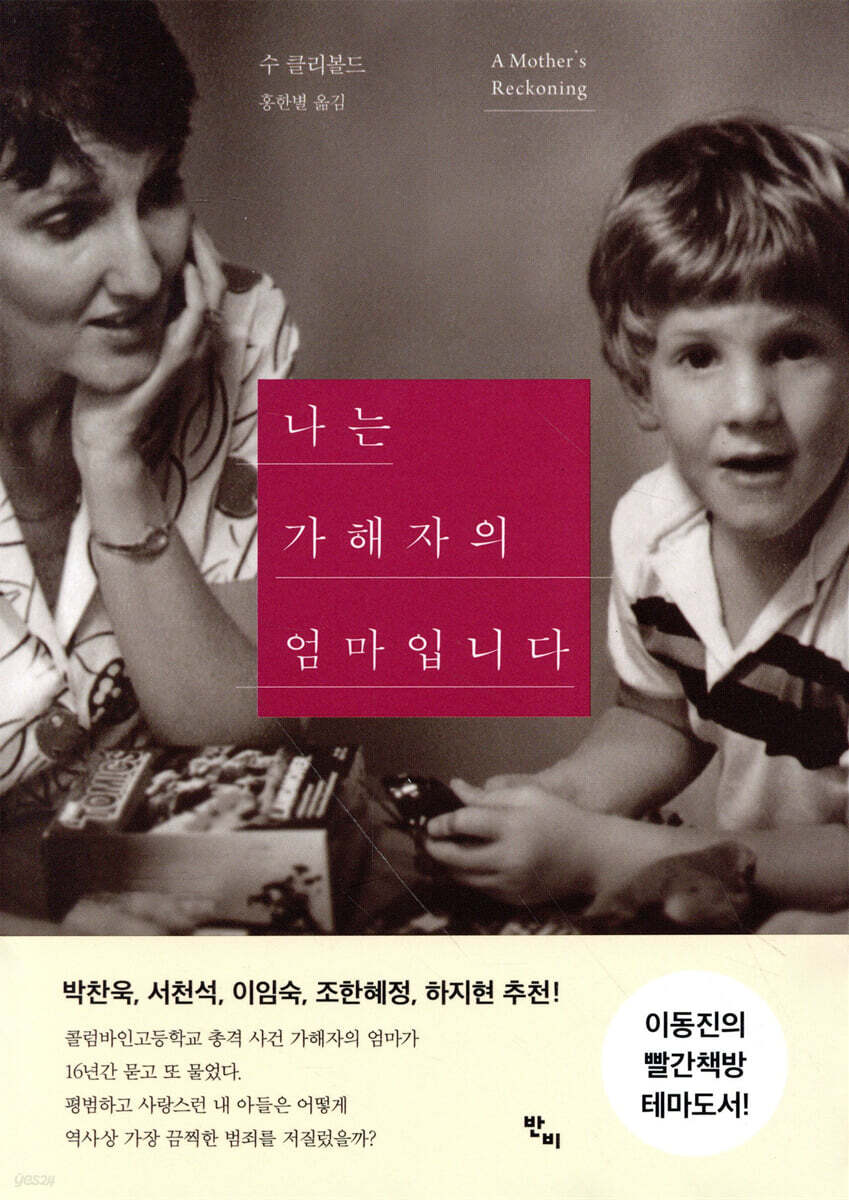
I am the mother of the perpetrator.
 |
Description
Book Introduction
The story of the parents of the perpetrator of the most shocking school shooting in history.
Even in a world where more shocking events occur every day, and earlier ones are forgotten all too quickly, the Columbine shooting remains one of the most shocking events in history.
In April 1999, two seniors at Columbine High School opened fire on their school for no apparent reason, killing 13 students and teachers and wounding 24 others before taking their own lives.
The social repercussions were even greater because the victims were children and the perpetrators were also children.
The impact of this incident was so great that copycat incidents continued to occur, including the Virginia Tech shooting and the Sandy Hook Elementary School shooting.
At the time of the incident, the perpetrators were 17 years old.
And 17 years later, Sue Klebold, the mother of one of the perpetrators, Dylan Klebold, published this book.
This book is so comprehensive that it is difficult to summarize in a few sentences, covering the 17 years from Dylan Klebold's birth until the incident, and another 17 years after the incident, a total of 34 years.
The story centers around why such an incident occurred and what kind of children committed the crime, but it also honestly and meticulously details what the perpetrator's family went through after the incident and what thoughts and feelings they experienced.
This book is not intended to justify the son or restore the family's honor, but rather to be written by a human being who, faced with the fundamental violence of humanity that is utterly incomprehensible, does his best to understand, explain, and prevent it.
In particular, unlike other books or movies that coldly denounce human violence from an appropriate distance, this is a very unique, persuasive, and deeply moving story written by a 'mother' with an undeniable 'love' at its core.
Even in a world where more shocking events occur every day, and earlier ones are forgotten all too quickly, the Columbine shooting remains one of the most shocking events in history.
In April 1999, two seniors at Columbine High School opened fire on their school for no apparent reason, killing 13 students and teachers and wounding 24 others before taking their own lives.
The social repercussions were even greater because the victims were children and the perpetrators were also children.
The impact of this incident was so great that copycat incidents continued to occur, including the Virginia Tech shooting and the Sandy Hook Elementary School shooting.
At the time of the incident, the perpetrators were 17 years old.
And 17 years later, Sue Klebold, the mother of one of the perpetrators, Dylan Klebold, published this book.
This book is so comprehensive that it is difficult to summarize in a few sentences, covering the 17 years from Dylan Klebold's birth until the incident, and another 17 years after the incident, a total of 34 years.
The story centers around why such an incident occurred and what kind of children committed the crime, but it also honestly and meticulously details what the perpetrator's family went through after the incident and what thoughts and feelings they experienced.
This book is not intended to justify the son or restore the family's honor, but rather to be written by a human being who, faced with the fundamental violence of humanity that is utterly incomprehensible, does his best to understand, explain, and prevent it.
In particular, unlike other books or movies that coldly denounce human violence from an appropriate distance, this is a very unique, persuasive, and deeply moving story written by a 'mother' with an undeniable 'love' at its core.
- You can preview some of the book's contents.
Preview
index
Recommendation 4
Commentary: 7 Hidden Horrors in Everyday Life
On the Book: Sixteen Years and Twenty Dedicated to Trying to Understand the Unknown
Part 1: The Unthinkable
1 shot 30
2 Last Night 53
3 Other People's Lives 74
4 Resting Places 99
5 Ominous Premonitions 103
6 Childhood 111
7 Mom to Mom 148
8 The Seat of Sorrow 185
9 Living with Grief 188
10 The End of Denial 213
Part 2 Towards Understanding
11 Depths of Despair 248
12 Deadly Mechanics 269
13 The Road to Suicide (3rd Grade) 281
14 The Road to Violence (4th Grade) 333
15 Collateral Damage 383
16 New Perceptions 387
17 Sworn Testimony 407
18 The Intersection of Brain Health and Violence 427
Conclusion: A Safer World for Everyone 443
Acknowledgments 446
Week 452
Data 462
Translator's Note 466
Commentary: 7 Hidden Horrors in Everyday Life
On the Book: Sixteen Years and Twenty Dedicated to Trying to Understand the Unknown
Part 1: The Unthinkable
1 shot 30
2 Last Night 53
3 Other People's Lives 74
4 Resting Places 99
5 Ominous Premonitions 103
6 Childhood 111
7 Mom to Mom 148
8 The Seat of Sorrow 185
9 Living with Grief 188
10 The End of Denial 213
Part 2 Towards Understanding
11 Depths of Despair 248
12 Deadly Mechanics 269
13 The Road to Suicide (3rd Grade) 281
14 The Road to Violence (4th Grade) 333
15 Collateral Damage 383
16 New Perceptions 387
17 Sworn Testimony 407
18 The Intersection of Brain Health and Violence 427
Conclusion: A Safer World for Everyone 443
Acknowledgments 446
Week 452
Data 462
Translator's Note 466
Publisher's Review
The mother of the Columbine High School shooter has been asking questions for 16 years.
How did my ordinary, loving son become the most horrific murderer in history?
Strongly recommended by Jo Han-hye-jeong, Seo Cheon-seok, Ha Ji-hyeon, and Lee Im-sook!
Sue's deep affection for her son is evident in every page and phrase of this sad book.
This book is also evidence of how complex this issue is.
Sue Klebold argues that good people can do bad things, that everyone is morally confused, and that doing something terrible doesn't nullify other actions or motivations.
The ultimate message of this book is shocking.
That I may not know my own child.
No, maybe it's impossible to know your child.
The stranger you fear could be your son or daughter.
― Andrew Solomon, from the commentary
The story of the parents of the perpetrator of the most shocking school shooting in history.
Even in a world where more shocking events occur every day, and earlier ones are forgotten all too quickly, the Columbine shooting remains one of the most shocking events in history.
In April 1999, two seniors at Columbine High School opened fire on their school for no apparent reason, killing 13 students and teachers and wounding 24 others before taking their own lives.
The social repercussions were even greater because the victims were children and the perpetrators were also children.
The impact of this incident was so great that copycat incidents continued to occur, including the Virginia Tech shooting and the Sandy Hook Elementary School shooting.
At the time of the incident, the perpetrators were 17 years old.
And 17 years later, Sue Klebold, the mother of one of the perpetrators, Dylan Klebold, published this book.
This book is so comprehensive that it is difficult to summarize in a few sentences, covering the 17 years from Dylan Klebold's birth until the incident, and another 17 years after the incident, a total of 34 years.
The story centers around why such an incident occurred and what kind of children committed the crime, but it also honestly and meticulously details what the perpetrator's family went through after the incident and what thoughts and feelings they experienced.
This book is not intended to justify the son or restore the family's honor, but rather to be written by a human being who, faced with the fundamental violence of humanity that is utterly incomprehensible, does his best to understand, explain, and prevent it.
In particular, unlike other books or movies that coldly denounce human violence from an appropriate distance, this is a very unique, persuasive, and deeply moving story written by a 'mother' with an undeniable 'love' at its core.
At first, I sought answers for personal reasons, driven by a primal need to know that was as intense as the overwhelming shame, fear, and sadness.
But then it occurred to me that the pieces I might be holding might be the keys to a puzzle that many people are desperately trying to solve.
As I began to hope that what I had learned might be helpful to others, I began to feel that sharing my story, even if it was difficult, was something I couldn't avoid. (21)
My head was a whirlwind of confusion.
I couldn't fit the information we had heard with what I knew about my life and my son.
It couldn't have been Dylan's story.
Our 'Sunshine', a good child, a child who always made me feel like a good mother.
If it's true that Dylan intentionally hurt others, where in Dylan's life did that come from? (45)
In writing this book, I want to honor the memory of those my son killed.
The best way I know to do that is to write as honestly as I can.
So, I'm telling you, this is the truth.
In the end, I cried because of the victims, and I still cry now, but I didn't cry that day. (55)
I wasn't in my right mind, but I was still able to understand how ridiculous it was to be upset about seeing strange pictures of Dylan on the news instead of his handsome real self.
My son is a murderer, and I'm freaking out because I can't get a picture.
It's a dramatic example of the tricks the mind plays when unbearable emotions come crashing down.
Ironically, I wanted Dylan to appear on television exactly as I remembered him. (80)
Dylan, wherever you are, I love you and miss you.
I'm struggling through the chaos you left behind.
If there is any way you can be forgiven for all this, please let me know.
Help us find the answers that will give us peace and help us live the life that has been given to us.
Help me. (103)
There was no way to escape the horrific truth that my son had planned and committed such a nightmarish act.
But the warm-hearted kid who made me a Pegasus, the cute and shy kid who always wanted to help me put together a thousand-piece jigsaw puzzle, the young man who would add a unique barking laugh when we watched the comedy drama "Mystery Science Theater 3000" together.
That was true too.
Who did I love, and why did I love him? (242)
A friend once copied and sent me an excerpt via email, and the passage struck me so deeply that I looked up the book to learn more.
“Have patience with what remains unresolved in your heart.” This is a phrase from Rainer Maria Rilke’s Fourth Letter to a Young Poet.
“Treat that question as if it were a locked room or a book written in a foreign language, and try to love it for what it is.
Don't bother trying to find the answer.
The answer is not given now because it is unacceptable.
The key is to experience everything.
Now is the time to live that question.
Then, one day, gradually, without even realizing it, you will find yourself experiencing the answer.” The time will come when my heart will be completely open to my Son again. (242)
As you might have guessed, it's been a long time since I gave up on finding the one piece of the puzzle that would explain why Dylan and Eric did what they did.
It would have been better if the force that drove the children to ruin had been clearly shown.
On the other hand, the easy explanations that came out immediately after the incident are also worrisome.
Were school culture and bullying the "cause" of Columbine? Violent video games? Neglectful parenting? American pop culture's influx of military culture? These pieces could be part of a larger puzzle.
However, I believe that none of these effects alone, or even a combination of them, would be sufficient to explain the hatred and violence exhibited by the two children. (248-249)
I often think about watching Dylan fold paper.
Origami experts fold the corners precisely, but Dylan, who was in the fourth grade, did it a bit haphazardly and his fingers were still clumsy.
Still, I was able to create a complex pattern just by looking at it once.
I liked to make a cup of tea and sit silently beside Dylan, watching his hands move like a hummingbird.
It was fascinating to see Dylan transform square pieces of paper into frogs, bears, and crayfish.
I've always been amazed at how something as ordinary as a sheet of paper can take on so many different shapes with just a few folds, and how it can take on new meaning in an instant.
Looking at the finished form, I was amazed by the complex, hidden folds that were unknown to me.
This experience was in many ways similar to what I went through after Columbine.
I had to turn everything I thought I knew about myself, my son, and my family upside down, watching a child become a monster and then become a child again. (444-445)
Surviving as the mother of the perpetrator and the family of the perpetrator
The subtitle of this book is 'Living in the Aftermath of Tragedy'.
It is literally a description of the process of going through such an unprecedented and horrific incident from the perspective of the 'perpetrator's family.'
Despite the sensitive nature of the task, which requires careful consideration of the possibility of secondary damage, the author, fully aware of this fact, carries out this difficult task by consistently prioritizing "courtesy" toward the victims, their families, and friends.
It is particularly noteworthy that no other book has so delicately described the identity crisis experienced by the families of perpetrators.
It is difficult to imagine fully feeling, reflecting on, and recording the pain, sorrow, self-reproach, shame, and regret of such a complex incident.
The process of initial denial as a defense mechanism, the process of frustration when that denial is broken, and the process of finding meaning in life again can be read as a significant achievement that does not give up on humanity.
Andrew Solomon, in his book Parents and Other Children, summarized his experience interviewing Sue Klebold as “like Germany [with its constant revisiting of its past].”
Her husband, Tom Klebold, also describes them as being like the “Addams Family” in their obsessive reflection on the case.
This effort to face the darkness into which one has fallen most honestly makes one think about one's responsibilities as a human being, one's rights as a human being, and one's dignity as a human being.
The stories of countless people (including some of the victims' families) who helped, comforted, and supported this author also shine like stars in the darkness.
In particular, we can see that the amazing empathy of families of criminals, murderers, and those who have lost loved ones has been their greatest help.
It is significant that expressions of gratitude are found throughout this book, which seems to be filled with nothing but self-reproach, regret, pain, and sorrow.
It's hard to imagine that we were able to sleep that first night, but then our minds finally, as if by mercy, shut off.
For years after that, waking up was the cruelest moment of the day.
Because the possibility that all this was a nightmare, the worst nightmare a person could have, comes and goes for a moment. (107)
In the immediate aftermath of Columbine, I found temporary, but real, solace in writing.
I used my journal as a space to store my complex and contradictory feelings about my son and the things he did.
Writing those first days allowed me to chew on the infinite grief for the sorrow and pain Dylan had caused.
Before approaching the victims' families directly, I apologized to them and mourned alone in my diary. (111)
One morning I was sitting on the edge of my bed trying to get dressed.
I put on one sock, stared into space for an hour, and then put the other sock on.
It took me almost four hours to get all dressed.
Another afternoon, a friend called and asked how I was doing.
“Do nothing.
“But why am I so tired?” I answered, sounding genuinely perplexed.
My friend, who also experienced losing a family member, told me this.
“It’s not that I’m doing nothing.
You're sad.
“That’s a very difficult thing.” The grief over losing Dylan was central to everything for me.
It would have been hard to bear even under different circumstances, but it was even harder because I couldn't understand it and because of my guilt over the tragedy Dylan had caused.
My world has gone off its axis. (160)
After that night, I made Byron promise never to intentionally hurt himself or anyone else.
But I was surprised that Byron asked me to make the same promise.
After that incident, we became closer than before, but our relationship became more complicated than before.
I encouraged Byron to open up to me, but when he did reveal his deep despair (which was natural under the circumstances), I was afraid he would kill himself.
I have unfairly harassed Byron.
Byron tried to get assurances that he was okay when he obviously wasn't.
In reality, it is like forcing something that should be okay.
It took a long time for us to find a way to talk about our frustrations openly while still giving each other the confidence that we wouldn't give up on life.
In fact, I wasn't sure if we could really survive.
There were many times when dying felt easier than living.
All three of us talked about death, ashes, epitaphs, and the meaning of life.
Tom said he thought he knew what his last words would be.
“Thank goodness it’s over now.” (168)
We've been able to maintain a good marriage for almost 30 years because we complemented each other's shortcomings.
But after Columbine, it seemed like everything I thought about was going wrong.
We were both on the same roller coaster, but it seemed like we were never in the same place at the same time.
When Tom was sad, I was angry.
I felt sad when Tom got angry.
Before, I could just leave Tom alone when he was feeling down, and I could laugh it off when he complained about all sorts of things.
But when you're in this state of extreme sadness, your stress tolerance disappears.
It feels like my skin has been ripped off while I'm still alive, and there's no protective barrier to block the overwhelming emotions.
I wrote this in my diary:
'What Tom says sounds like a hammer to me.
The same applies when speaking quietly.
Tom's thoughts and mine don't align and keep clashing.
It always seems so far away and so unfamiliar to me.' (166)
So I couldn't help but be surprised to see someone I'd never met take pity on our sorrow and plight and reach out to us.
That is why we cannot help but respect and be grateful to the victims' families who reached out to us without blaming us.
They offered a shred of empathy, even though they didn't know what it was like to be the mother of a murderer.
It was truly amazing to me.
I wouldn't be able to do that. (169)
These letters allowed me to feel a sense of kinship with people in the wider world.
Far more people were experiencing extreme pain and loss than I could have imagined.
There was so much suffering in the world that it was horrific.
It was as if I had tapped into a deep well of universal human trials.
Every day, I couldn't help but be amazed by people's empathy and generosity.
Some cards had only one phrase written in the old man's weary, trembling handwriting: "God bless you."
It was amazing to think of the enormous and arduous effort that a stranger living far away had put into buying a card, buying a stamp, writing a note, and mailing a card to give me strength.
They were people with a wide range of emotions, born from the pain they had experienced in their own lives, and with a broad and deep understanding.
The only regret is that it was too early for me to find solace in the stories of those who had suffered and persevered.
It never occurred to me that there would be an 'afterlife'. (174)
More than anything, I desperately wanted to talk to Dylan.
In my head, the conversation with Dylan continued endlessly, like background music.
Shortly after that, while I was staying at Ruth and Don's house, the doctor prescribed me some anti-anxiety medication.
I took that medicine only once.
As my anxiety subsided, my sadness surged to the surface at full strength.
I couldn't stop crying, like a broken faucet with the faucet still on.
After going through that, I decided to live by accepting my emotions without medication.
It occurred to me that there was no point in avoiding or overcoming confusion or sadness.
All I could do was hold on, and do everything I could to understand what I didn't know about my son, even if it took months or years. (184)
So when the truth comes out, it comes with a terrible impact.
In my case, because I couldn't quite accept Dylan's ending, I felt even more shaken by the sense of identity that I couldn't believe everything I had thought about my life, my family, and myself.
When I was working at a community college, a student once told me what the hardest thing about living with a disability was.
“Everyone sees the disability first.
“In their eyes, I am a person with a disability before I am a human being.” At the time, I was grateful for the insight contained in those words, as it helped me understand my work.
But it was only after Columbine that I understood exactly what that student meant.
I knew for sure that I would forever be seen as the mother who raised a murderer, and that no one, not even myself, would ever see me as anything other than that. (189)
There was a monthly meeting and I was a little late.
All the chairs were taken, so I leaned against the back wall with the others.
For the first time since the tragedy, I was in a room full of people.
Some of them were strangers.
Even though people were careful not to stare at me, I could feel everyone's attention focused on me.
At this time, I still hadn't recovered my strength, so just standing was too much of a burden.
A few minutes into the meeting, I was out of breath and struggling to stand.
I was worried that sitting on the floor would make me look insincere, and I absolutely hated doing anything that would attract people's attention, but I felt like I was going to collapse if I kept doing this.
So I climbed down the wall to the floor, sat down, and pulled my skirt up above my knees.
In the end, I sat down with my legs crossed behind the chair.
One of my colleagues saw me and motioned for me to take my seat.
It was a truly beautiful gesture.
He let me know that he cared and was concerned about me, while keeping it to a minimum so that I wouldn't panic.
I shook my head.
'Thank you, it's okay.
Just sit there.' I sat on the floor until the meeting was over, there and then, watching people's backs and listening to someone I couldn't see speak.
They say small victories.
I wanted to hide, but I stayed there anyway. (198-199)
Strangely enough, I have nothing more to say about beating cancer.
At the time of that experience, I wasn't as indifferent as I was to other people's problems.
I was cured of cancer and was grateful that the treatment went well.
But after I recovered, I realized that what I said in my diary at the beginning of this chapter was not true.
I didn't want to die.
Tom often said, 'I wish Dylan had killed us too, or if we had never been born.'
I prayed to die in my sleep.
I wanted to be quietly free from the pain of waking up, from the pain of realizing that all this wasn't a terrible nightmare.
As I sat in the car, I daydreamed about how great it would be to have the chance to sacrifice my life for those who died at school, how great it would be to have the chance to save so many people by sacrificing myself.
If I die, I can escape all this, and if I can die for someone else, my miserable life will have meaning.
After beating breast cancer, I was able to see my life as a gift (as everyone should be able to do). My job, moving forward, was to find ways to make that gift meaningful. (386)
Social efforts to overcome unprecedented events
In today's world, where school violence, hate crimes, and other incomprehensible violence and crimes are on the rise, a more comprehensive perspective is needed to truly understand the true nature of these crimes.
While stories about perpetrators' experiences are understandably taboo, there is a societal need to tell and hear these difficult stories.
Moreover, it is worth listening carefully to the stories of how communities, thrown into chaos by unprecedented events, cope with them.
Some very practical reference points can be drawn here.
Sue Klebold has continued to live in Littleton since the incident.
It's worth reconsidering whether something like this is possible in Korea.
The Sue family received various threats, including death threats, but were not expelled from the community.
In addition, the local community supported them in various ways.
In particular, the measures taken by the local university where Soo worked are worthy of being a model for any organization.
The author meticulously reflects on his own experiences, ponders the limitations and challenges of how the media, law, and police handle these unusual cases, and explores alternatives, seeking serious advice from experts.
Much has been written about what happened in Littleton after the disaster.
Just as a person who was physically attacked went into shock, so did the community.
On the night of the massacre, President Clinton said, “If something like this could happen in a place like Littleton….”
Littleton is neither a drug-addled inner-city slum nor a morally lax metropolis like New York or Los Angeles.
The people who live in Littleton are solid citizens, live in nice suburban homes, and their children are healthy, happy, and well-cared for.
We thought our school was safe.
In the months following Columbine, everyone in Littleton felt threatened and fearful.
It was as if the nerves of the entire neighborhood were exposed, and people showed all kinds of sensitive reactions.
Some people appealed to forgiveness and mercy.
Some people exploded in anger.
People who had previously been silent have become influential and important figures and are now raising their voices.
Some people fell for that authority.
I believed that there would be some good in other people speaking up too.
(392)
By the first weekend back home, we knew we wouldn't be leaving Littleton.
People who knew Dylan before, people who remember the incredible day he threw a no-hitter, people who can laugh with Dylan about eating a whole bucket of KFC chicken by himself, people who have laughed their butts off at Dylan's off-the-cuff jokes.
All of those people were here and wanted to share their memories of Dylan with us.
How could we live without them? And besides, could we really escape?
There will never be an escape from the horrors Dylan's hands have created.
Even if I went somewhere else, I couldn't get away from the truth, from that stigma.
Wherever we go, this terrifying reality will follow us. (158)
This pattern of juxtaposing legal issues and personal lives continued after Columbine, forcing us to constantly go back and forth between the two.
The need to deal with legal issues has always overshadowed our sorrow.
Fortunately, our lawyer was ethical, compassionate, and genuinely wanted us to do well. (88)
It was a special situation now.
There will be no guidance on how to act after the worst school shooting in history. (161)
Even though lawyers helped, the piles of incomprehensible documents and decisions piled up every day.
It was even more difficult because I couldn't quite understand what it meant.
Everyone has filed a lawsuit against someone.
There was also a lawsuit filed against Dylan's friend Robin, who purchased three of the four pistols.
Mark Mains, who sold the remaining one, was also sued.
There was a lawsuit against a gun manufacturer, and another lawsuit against the manufacturer of Eric's antidepressants.
There were also lawsuits against the sheriff's office, the military, and the police.
There were a total of thirty-six lawsuits filed against us.
Our lawyers were meticulous and did their best to explain what was going on, but the legal situation was so complex that it was far beyond my grasp. (193)
Fortunately, the president of the local university where I worked was an excellent leader who understood complex situations well.
The president was considerate of me and made sure that the other faculty members didn't feel overly uncomfortable with my presence.
A week before I returned, I sent a message to the entire staff, telling them that anyone who had any problems working with me could come to me at any time.
We've already issued guidelines to help our staff navigate the endless barrage of questions from the press, and we've also placed counselors on hand to help anyone who needs help.
It wasn't easy being the one who caused this to happen, but I was still grateful for the school's wise decision.
I met with the HR representative to discuss my personal information and security concerns.
I was surprised when the HR person talked about what I was going through as if it were something as common as a chronic illness or my parents' dementia.
I decided to have the phone operator block my calls and not write my schedule on the whiteboard.
One manager gave me his office so I could make private phone calls behind closed doors.
I took off the name tag that was attached to my cubicle and put it in my desk drawer.
A day or two after I returned, the president sent another message to the staff, offering the discouraging advice to give me some time to regain my composure.
I asked for your consideration, saying that even if you wanted to express your condolences, you might feel burdened if you showed too much interest.
I was again impressed by his wisdom. (196-197)
What happened during the deposition cannot be made public.
Let me just say that it was very painful and it must have been disappointing for everyone who was there.
Regrets remain.
I wanted to apologize directly to the bereaved families during my deposition, but my lawyer opposed it.
“It’s not the right time or place,” he said.
It would have been better if he had been more forceful in his apology.
I think everyone who was there must have felt deeply that there was no apology, and it remains a regret to this day.
One of the reasons I wrote this book was to offer a profound apology. (415-416)
When the Columbine crime scene photos of Eric and Dylan lying in a pool of blood were sold to the National Enquirer, it seemed like no line could be crossed.
But later I learned that many of the reporters covering the story in Littleton had also suffered trauma. (394)
As time went on, our concerns that Dylan and Eric's actions would inspire other children were repeatedly confirmed.
Among the possessions of Seung-Hui Cho, the Virginia Polytechnic Institute and State University shooter, were items related to Columbine, as did Adam Lanza, the Sandy Hook Elementary School shooter.
According to an ABC News investigation published in 2014, “since the 1999 Columbine High School shooting, there have been at least 17 attacks on schools and 36 planned or serious threats related to the incident.”4 (232)
Research continues to show that the rise in mass shootings in the United States is significantly linked to the accessibility of high-powered guns, a lack of mental health knowledge and support, and the way the media covers these incidents.
If media coverage can both suppress and stimulate the spread, I believe it is urgent to establish new reporting guidelines for murder-suicide, as media experts such as Frank Okberg and Dr. Cheyneev Tupeki have suggested. (234)
He advises journalists to educate themselves about trauma, avoiding sensationalizing shocking events and instead broadening the discussion about them.
What details can truly help us understand what happened? Where can we direct people to seek help? How can we place this tragedy within the larger context of mental health?
It would be a great advancement if we could just avoid jumping to simplistic conclusions by pointing out the cause too easily.
School shooters don't kill people because of violent video games or techno music, and people don't kill themselves because they got fired or dumped by their significant other.
After Robin Williams' death, I read many articles expressing shock that someone so wealthy and beloved could think that life had no meaning.
Of course, money and popularity do not prevent brain diseases. (236)
I hope my proposal here is not seen as advocating censorship or suppressing free speech, but as a call for ethical reporting. (Novelist Stephen King, after school shooters cited his novel Rege, respectfully asked his publisher to withdraw it.) (237)
There is a clear precedent for changing the way media reports are conducted with the public interest in mind.
A good journalist would never dream of revealing the names of sexual assault victims or the movements of specific units.
Likewise, the day will soon come when it will be unthinkable to print a murderer's photo alongside the number of people he has killed and injured, printed in blood red. (237)
Some media outlets are starting to listen.
In 2014, a conservative Canadian broadcaster decided not to show the name or photo of the shooter who shot five police officers, killing two.
In an editorial, he explained the decision as follows:
“It’s easy to report on a killer’s life, scrape their disturbing Facebook posts, and speculate on their motives, but doing so can create the impression that their heinous actions are somehow justified.” I don’t really know about hiding the killer’s name.
It seems like we should listen to the opinions of experts, such as media analysts.
In any case, it should be noted that this broadcaster reported the incident without these specific elements, but still provided in-depth coverage without any shortcomings. (237-238)
In many European countries, national press commissions monitor reporting and punish violations.
In the United States, this would probably be difficult, and perhaps even desirable.
In the newsrooms of top news organizations, discussions about sensitivity, repercussions, and trauma are routine.
Over time and with sufficient education, media outlets will likely adopt these guidelines voluntarily.
Because that is the right thing to do. (238)
How should we raise children in this world?
This book is, above all, about what parenting can and cannot do.
This book strongly reminds us of humility, which can be considered the basic attitude of a parent.
This book reminds us of the sublimity of loving a child for who they are, despite recognizing them as beings different from us and unknown to us.
A common mistake that parents (especially mothers) who are confident in their parenting skills often fall into is thinking that they know their child inside out.
Parents who fail to do so are looked down upon as if they are derelict in their duties, and they become so absorbed in their child's life that they do not distinguish their child's life from their own.
The author of this book also confesses that, as a naturally active parent and a professionally trained educator, he gained a great deal of confidence while raising his second son, Dylan.
They were 'good' parents who communicated closely with their children, always checked on their children's whereabouts and friendships, were passionate about their children's education, tried to provide their children with good food and a good natural environment, and especially tried to help them develop the right values.
But when he realizes with shock that the child he thought he knew so well is a strange and frightening stranger, he begins to reexamine his parenting methods one by one.
The author's advice on brain health issues, especially in children and adolescents, deserves heed.
Tom and I were loving, caring, and active parents, and Dylan was an energetic and affectionate child.
He wasn't a child you had to constantly worry about and pray for when he would come to his senses and find his place.
We called Dylan 'Sunshine'.
It was partly because Dylan's blonde hair shone like a halo, but also because everything went smoothly for Dylan.
I was grateful that Dylan was my child and I loved him with all my heart and soul. (22)
In the months and years that followed, I was confronted with countless things I didn't know about my son.
It seemed like Pandora's box would never bottom out.
I would spend the rest of my life trying to piece together the kid I knew and what Dylan had done.
That night was the last night I could hold in my heart the Dylan I knew.
In the form of a loving son, brother, and friend. (73)
One of the more favorable portrayals of us as parents in the media was that we were useless, incompetent, and clueless as parents.
Elsewhere, we covered up for a hateful, racist son we knew was alive, and turned a blind eye to a stockpile of weapons under our roofs, putting our entire community at risk.
I can more than understand why they are criticizing us.
Even I would feel endless anger towards the parents of such a child.
If I weren't that child's parent.
I would have hated it.
Of course, it would be the parents' fault.
But I also knew that neither of the two images that described us as parents was true.
The truth is much more disturbing than that. (93)
I don't remember much about the funeral preparations.
I remember being surprised to hear myself calmly talking about practical matters, even though my head was filled with endless screams of pain and doubt.
This child was my son.
The person I raised, embraced, and loved with all my heart and soul.
The thought of never hearing Dylan's voice or touching his face again suffocated me.
I had to gather every ounce of strength I had to prepare for the final farewell ceremony.
I'm done raising Dylan.
All the love and effort that went into creating this child was gone.
In the most miserable way. (95)
We raised our children with confidence.
I was especially attached to it when I had my second child.
I'm a naturally anxious person, so I'm always worried that something might get stuck in my children's throats, and I tend to make a fuss about teaching them good habits.
On the other hand, I worked part-time as a childcare worker since I was young, and after I got a job, I taught children and adults for a long time.
When I was getting my master's degree, child development and child psychology courses were required.
Naively, I thought that with my intuition, honed through knowledge and experience, I could raise my children well.
At least I thought I knew where to turn for help when I ran into trouble. (117)
The police led us to the spot where Eric and Dylan committed suicide.
The moment I saw the long, lean, and lanky figure drawn on the floor, my heart stopped.
That was Dylan.
He looked just like Dylan.
Tears flowed down my face.
Byron placed a gentle hand on my shoulder as I crouched down beside the figure that resembled my son, stroking the rug that had once held him as he fell. (186-187)
“I felt a tremendous sense of shame at having been the target of bullying and assault.
I know from firsthand experience that children blame themselves for the pain they experience.
“I also thought that people treating me this way meant there was something wrong with me.” (181)
“This should have happened to Dylan too.
I wish I had a friend or comrade by my side.
A friend who will comfort you, not incite your anger and depression.
You should know this.
Parents can't be that friend.
The same goes for Byron.
“Because we are in the process of growing up and separating, it is extremely difficult to confide in our parents or siblings about painful issues that we have been hiding.” (182)
I also didn't know that depression manifests differently in adolescents than in adults.
While adults may appear sad and listless, teenagers (especially boys) tend to be withdrawn, irritable, self-critical, frustrated, and angry.
Depression in younger children often presents with symptoms such as unexplained pain, whining, sleep disturbances, and clinginess. (283)
This is one of the paradoxes.
It would be easier to help depressed teenagers if they were kind enough to talk about their thoughts.
A child who looks neat and pretty, like a picture from a depression guidebook, resting his chin on his fist and looking out the rainy window with sad eyes! But a child who is struggling is often unpleasant to meet.
They can be aggressive, belligerent, rude, angry, hostile, lazy, irritable, dishonest, and sometimes not very hygienic.
But these difficult and pushy kids are the ones who need help from others the most.
In fact, this tendency may be a signal for help. (312)
Of course it would have been better if we hadn't fought, especially on Mother's Day, but I thought it was worth it.
Shouldn't you scold your child when he or she seems to be straying from the path? I think differently about that fight now.
Even if I had hugged my son and told him I loved him, I might not have been able to stop him from hurting himself and others.
But even so, it would have been nice if I had held that hand.
Come and sit here.
Let's talk.
"Tell me what's going on." Instead of listing Dylan's faults and telling him what he should be thankful for, if only he had listened and acknowledged his pain.
If I could go back in time, I would say this.
'You have changed.
So that's why I'm scared.' But at that time, I wasn't scared.
It should have been so, but it wasn't so. (328)
You might think it would be easier if it were aimed at younger children, but even a four-year-old can easily fool an expert.
Dr. Lane summarizes his research findings in a tone that sounds like he's being accused of something.
“Parents think they know their children well, but in reality, they often don’t know anything about the babies they gave birth to and raised.
That's why it's a problem.
“Unfortunately, my parents are just as clueless as I am about who the psychopathic liar is.”
Eric's mom said that Eric wasn't sure what he would do after graduation, so I bragged that Dylan would be going to college in the fall.
Deep down, I was glad Dylan had a more concrete plan than Eric.
I will forever bow my head whenever I think about how foolish that pride was. (354)
If I thought there was something seriously wrong with Dylan, I would have moved mountains to fix it.
If I had known about Eric's website, or the guns, or Dylan's depression, I would have reacted differently.
But I raised the child I knew the best way I knew how, and I didn't know the best way to raise the child I had become. (424)
I considered myself both knowledgeable and sensitive about this topic.
But like many people, I realized that I had unthinkingly accepted some of the most common (and most damaging) myths about suicide.
As I opened these books, I took the first steps in what would become a lifelong quest: to teach myself and others, and to come to a practical understanding of what was wrong in our home. (257)
Even though I've been a suicide prevention activist for 10 years, I'm still shocked when I see these numbers and the general public's ignorance.
I taught Dylan, as I did Byron, to be careful of lightning, snakes, and hypothermia.
I taught them to floss, apply sunscreen, and always check their blind spots.
Once they were teenagers, I talked to them as openly as possible about the dangers of drinking and drugs, and also taught them about safe and ethical sexual practices.
I never once considered that the greatest danger Dylan faced was not from outside, but already within himself. (256)
“There are times when the difference between suicide and murder is only a thin sheet of paper.
“Most people who commit suicide have nothing to do with murder, but those who commit murder often do so because they have suicidal tendencies.” I think that’s what happened to Dylan. (276)
I know this is a very dangerous statement.
The idea that people with brain disorders are dangerous is one of the most common, destructive, and incorrect beliefs today.
Most people with brain abnormalities are not violent.
Only a very small number are like that.
We need a way to discuss the intersection of brain health and violence openly and without bias.
To do that, we must first talk about the stigma of society. (435)
Recommendation
If you truly love your children and truly want them to be happy, there is no other way than to create a good society.
The distance between the victim and the perpetrator is not that far.
This book awakens us to that truth.
I hope this will be a reflective read on blind parenting that fails to see the dark times ahead.
Jo Han-hye-jeong (cultural anthropologist)
The father and mother saw but failed to interpret the child's signs of depression and suicidal thoughts.
The mother bitterly blames herself for not recognizing the meaning of the signs and for not being someone the child could confide in.
It tells us to be more sensitive to what lies beyond the child's face, to shine a light on it, and to offer help.
I'm scared.
It's like a warning that my child could end up like Dylan.
If you are a parent, teacher, or counselor, this is a must-read, even if it feels uncomfortable.
Lee Im-sook (Director of the Clear Forest Children and Youth Counseling Center)
Was my child a monster, and was I a failed parent? The author, who prided herself on being a good mother, finally found her way to life after the accident through the painful but inevitable process of discovering her child's hidden inner self.
There have been many books that deal with the psychology of victims, but none that deal with the pain suffered by the families of perpetrators.
This book answers the question, "What if something terrible happens to me that I never thought would happen to me?"
Ha Ji-hyun (neuropsychiatrist)
This book is darkness.
It takes great courage to leap into the darkness.
But the author did not take the risk.
One day, the perfectly good floor suddenly collapsed and I fell into darkness.
Still, he passes through the darkness, relying on the faint light and sense of touch in the darkness.
The power came from love for children.
I didn't want to read any message from this book.
Life is so inexplicable that it's usually a bit obscured, but it's inherently vague.
I saw a human figure passing through that darkness.
That alone makes it a great book.
Seo Cheon-seok (pediatric and adolescent psychiatrist)
Anyone who has read Sue's memoir will know that her book is incredibly honest and that her suffering is real.
Her story is uncomfortable to read.
However, it is enough to raise public awareness about brain health issues and the importance of early intervention and correction.
If people listened to her, if they remembered everything she had been through and how it had changed her life forever, they would be more responsive to depression in young people, adolescents, and the suicidal thoughts that come with it.
And when those who love and care for them are distracted by other issues in life, they will react more quickly to the immense anger that these young people tend to keep hidden deep inside.
Paul Gionfriddo (President, National Mental Health Association)
As a critic, reading this book was not easy.
As a parent, reading this book was horrifying.
I see pieces of my children in Dylan Klebold.
I see shadows of my own parenting style in Sue and Tom's.
Perhaps many parents will find something in common with these families.
The insights in this book are so painful, yet so necessary.
It is an unavoidable contradiction.
Carlos Rochada, The Washington Post
It's incredibly detailed, honest, clear, and simply unbelievably compelling.
It is a most unusual testimony of honesty, love, suffering, doubt, and peace.
It is a memoir of high public value.
I highly recommend reading it.
Bruce Feiler, The New York Times
This book feels like it was written on some kind of oath and pledge.
A pledge to confront major problems and find answers as honestly and completely as possible.
The question is, what could parents have done to prevent this tragedy?
[… … ] Through this book, we come to pity her, empathize with her, and often even respect her.
In any case, the ultimate purpose of this book is not to exonerate, but to tell a story of warning.
The New York Times Book Review
A must-read for all parents of adolescent children.
It is a piece of writing that feels like it has an honesty that penetrates the soul.
A piece written with tremendous courage and intelligence.
It is a noble and important book.
"times"
It may be an uncomfortable read depending on the circumstances, but it is an important book.
It gives us a new understanding of how Columbine happened.
This will help avoid other tragedies.
Entertainment Weekly
This story might be so scary that you might want to run away.
But Klebold's empathy and honesty, and her message that parents and educators must work to uncover children's hidden suffering, will keep you glued to the screen.people.com
A must-read for every parent.
parents.com
How did my ordinary, loving son become the most horrific murderer in history?
Strongly recommended by Jo Han-hye-jeong, Seo Cheon-seok, Ha Ji-hyeon, and Lee Im-sook!
Sue's deep affection for her son is evident in every page and phrase of this sad book.
This book is also evidence of how complex this issue is.
Sue Klebold argues that good people can do bad things, that everyone is morally confused, and that doing something terrible doesn't nullify other actions or motivations.
The ultimate message of this book is shocking.
That I may not know my own child.
No, maybe it's impossible to know your child.
The stranger you fear could be your son or daughter.
― Andrew Solomon, from the commentary
The story of the parents of the perpetrator of the most shocking school shooting in history.
Even in a world where more shocking events occur every day, and earlier ones are forgotten all too quickly, the Columbine shooting remains one of the most shocking events in history.
In April 1999, two seniors at Columbine High School opened fire on their school for no apparent reason, killing 13 students and teachers and wounding 24 others before taking their own lives.
The social repercussions were even greater because the victims were children and the perpetrators were also children.
The impact of this incident was so great that copycat incidents continued to occur, including the Virginia Tech shooting and the Sandy Hook Elementary School shooting.
At the time of the incident, the perpetrators were 17 years old.
And 17 years later, Sue Klebold, the mother of one of the perpetrators, Dylan Klebold, published this book.
This book is so comprehensive that it is difficult to summarize in a few sentences, covering the 17 years from Dylan Klebold's birth until the incident, and another 17 years after the incident, a total of 34 years.
The story centers around why such an incident occurred and what kind of children committed the crime, but it also honestly and meticulously details what the perpetrator's family went through after the incident and what thoughts and feelings they experienced.
This book is not intended to justify the son or restore the family's honor, but rather to be written by a human being who, faced with the fundamental violence of humanity that is utterly incomprehensible, does his best to understand, explain, and prevent it.
In particular, unlike other books or movies that coldly denounce human violence from an appropriate distance, this is a very unique, persuasive, and deeply moving story written by a 'mother' with an undeniable 'love' at its core.
At first, I sought answers for personal reasons, driven by a primal need to know that was as intense as the overwhelming shame, fear, and sadness.
But then it occurred to me that the pieces I might be holding might be the keys to a puzzle that many people are desperately trying to solve.
As I began to hope that what I had learned might be helpful to others, I began to feel that sharing my story, even if it was difficult, was something I couldn't avoid. (21)
My head was a whirlwind of confusion.
I couldn't fit the information we had heard with what I knew about my life and my son.
It couldn't have been Dylan's story.
Our 'Sunshine', a good child, a child who always made me feel like a good mother.
If it's true that Dylan intentionally hurt others, where in Dylan's life did that come from? (45)
In writing this book, I want to honor the memory of those my son killed.
The best way I know to do that is to write as honestly as I can.
So, I'm telling you, this is the truth.
In the end, I cried because of the victims, and I still cry now, but I didn't cry that day. (55)
I wasn't in my right mind, but I was still able to understand how ridiculous it was to be upset about seeing strange pictures of Dylan on the news instead of his handsome real self.
My son is a murderer, and I'm freaking out because I can't get a picture.
It's a dramatic example of the tricks the mind plays when unbearable emotions come crashing down.
Ironically, I wanted Dylan to appear on television exactly as I remembered him. (80)
Dylan, wherever you are, I love you and miss you.
I'm struggling through the chaos you left behind.
If there is any way you can be forgiven for all this, please let me know.
Help us find the answers that will give us peace and help us live the life that has been given to us.
Help me. (103)
There was no way to escape the horrific truth that my son had planned and committed such a nightmarish act.
But the warm-hearted kid who made me a Pegasus, the cute and shy kid who always wanted to help me put together a thousand-piece jigsaw puzzle, the young man who would add a unique barking laugh when we watched the comedy drama "Mystery Science Theater 3000" together.
That was true too.
Who did I love, and why did I love him? (242)
A friend once copied and sent me an excerpt via email, and the passage struck me so deeply that I looked up the book to learn more.
“Have patience with what remains unresolved in your heart.” This is a phrase from Rainer Maria Rilke’s Fourth Letter to a Young Poet.
“Treat that question as if it were a locked room or a book written in a foreign language, and try to love it for what it is.
Don't bother trying to find the answer.
The answer is not given now because it is unacceptable.
The key is to experience everything.
Now is the time to live that question.
Then, one day, gradually, without even realizing it, you will find yourself experiencing the answer.” The time will come when my heart will be completely open to my Son again. (242)
As you might have guessed, it's been a long time since I gave up on finding the one piece of the puzzle that would explain why Dylan and Eric did what they did.
It would have been better if the force that drove the children to ruin had been clearly shown.
On the other hand, the easy explanations that came out immediately after the incident are also worrisome.
Were school culture and bullying the "cause" of Columbine? Violent video games? Neglectful parenting? American pop culture's influx of military culture? These pieces could be part of a larger puzzle.
However, I believe that none of these effects alone, or even a combination of them, would be sufficient to explain the hatred and violence exhibited by the two children. (248-249)
I often think about watching Dylan fold paper.
Origami experts fold the corners precisely, but Dylan, who was in the fourth grade, did it a bit haphazardly and his fingers were still clumsy.
Still, I was able to create a complex pattern just by looking at it once.
I liked to make a cup of tea and sit silently beside Dylan, watching his hands move like a hummingbird.
It was fascinating to see Dylan transform square pieces of paper into frogs, bears, and crayfish.
I've always been amazed at how something as ordinary as a sheet of paper can take on so many different shapes with just a few folds, and how it can take on new meaning in an instant.
Looking at the finished form, I was amazed by the complex, hidden folds that were unknown to me.
This experience was in many ways similar to what I went through after Columbine.
I had to turn everything I thought I knew about myself, my son, and my family upside down, watching a child become a monster and then become a child again. (444-445)
Surviving as the mother of the perpetrator and the family of the perpetrator
The subtitle of this book is 'Living in the Aftermath of Tragedy'.
It is literally a description of the process of going through such an unprecedented and horrific incident from the perspective of the 'perpetrator's family.'
Despite the sensitive nature of the task, which requires careful consideration of the possibility of secondary damage, the author, fully aware of this fact, carries out this difficult task by consistently prioritizing "courtesy" toward the victims, their families, and friends.
It is particularly noteworthy that no other book has so delicately described the identity crisis experienced by the families of perpetrators.
It is difficult to imagine fully feeling, reflecting on, and recording the pain, sorrow, self-reproach, shame, and regret of such a complex incident.
The process of initial denial as a defense mechanism, the process of frustration when that denial is broken, and the process of finding meaning in life again can be read as a significant achievement that does not give up on humanity.
Andrew Solomon, in his book Parents and Other Children, summarized his experience interviewing Sue Klebold as “like Germany [with its constant revisiting of its past].”
Her husband, Tom Klebold, also describes them as being like the “Addams Family” in their obsessive reflection on the case.
This effort to face the darkness into which one has fallen most honestly makes one think about one's responsibilities as a human being, one's rights as a human being, and one's dignity as a human being.
The stories of countless people (including some of the victims' families) who helped, comforted, and supported this author also shine like stars in the darkness.
In particular, we can see that the amazing empathy of families of criminals, murderers, and those who have lost loved ones has been their greatest help.
It is significant that expressions of gratitude are found throughout this book, which seems to be filled with nothing but self-reproach, regret, pain, and sorrow.
It's hard to imagine that we were able to sleep that first night, but then our minds finally, as if by mercy, shut off.
For years after that, waking up was the cruelest moment of the day.
Because the possibility that all this was a nightmare, the worst nightmare a person could have, comes and goes for a moment. (107)
In the immediate aftermath of Columbine, I found temporary, but real, solace in writing.
I used my journal as a space to store my complex and contradictory feelings about my son and the things he did.
Writing those first days allowed me to chew on the infinite grief for the sorrow and pain Dylan had caused.
Before approaching the victims' families directly, I apologized to them and mourned alone in my diary. (111)
One morning I was sitting on the edge of my bed trying to get dressed.
I put on one sock, stared into space for an hour, and then put the other sock on.
It took me almost four hours to get all dressed.
Another afternoon, a friend called and asked how I was doing.
“Do nothing.
“But why am I so tired?” I answered, sounding genuinely perplexed.
My friend, who also experienced losing a family member, told me this.
“It’s not that I’m doing nothing.
You're sad.
“That’s a very difficult thing.” The grief over losing Dylan was central to everything for me.
It would have been hard to bear even under different circumstances, but it was even harder because I couldn't understand it and because of my guilt over the tragedy Dylan had caused.
My world has gone off its axis. (160)
After that night, I made Byron promise never to intentionally hurt himself or anyone else.
But I was surprised that Byron asked me to make the same promise.
After that incident, we became closer than before, but our relationship became more complicated than before.
I encouraged Byron to open up to me, but when he did reveal his deep despair (which was natural under the circumstances), I was afraid he would kill himself.
I have unfairly harassed Byron.
Byron tried to get assurances that he was okay when he obviously wasn't.
In reality, it is like forcing something that should be okay.
It took a long time for us to find a way to talk about our frustrations openly while still giving each other the confidence that we wouldn't give up on life.
In fact, I wasn't sure if we could really survive.
There were many times when dying felt easier than living.
All three of us talked about death, ashes, epitaphs, and the meaning of life.
Tom said he thought he knew what his last words would be.
“Thank goodness it’s over now.” (168)
We've been able to maintain a good marriage for almost 30 years because we complemented each other's shortcomings.
But after Columbine, it seemed like everything I thought about was going wrong.
We were both on the same roller coaster, but it seemed like we were never in the same place at the same time.
When Tom was sad, I was angry.
I felt sad when Tom got angry.
Before, I could just leave Tom alone when he was feeling down, and I could laugh it off when he complained about all sorts of things.
But when you're in this state of extreme sadness, your stress tolerance disappears.
It feels like my skin has been ripped off while I'm still alive, and there's no protective barrier to block the overwhelming emotions.
I wrote this in my diary:
'What Tom says sounds like a hammer to me.
The same applies when speaking quietly.
Tom's thoughts and mine don't align and keep clashing.
It always seems so far away and so unfamiliar to me.' (166)
So I couldn't help but be surprised to see someone I'd never met take pity on our sorrow and plight and reach out to us.
That is why we cannot help but respect and be grateful to the victims' families who reached out to us without blaming us.
They offered a shred of empathy, even though they didn't know what it was like to be the mother of a murderer.
It was truly amazing to me.
I wouldn't be able to do that. (169)
These letters allowed me to feel a sense of kinship with people in the wider world.
Far more people were experiencing extreme pain and loss than I could have imagined.
There was so much suffering in the world that it was horrific.
It was as if I had tapped into a deep well of universal human trials.
Every day, I couldn't help but be amazed by people's empathy and generosity.
Some cards had only one phrase written in the old man's weary, trembling handwriting: "God bless you."
It was amazing to think of the enormous and arduous effort that a stranger living far away had put into buying a card, buying a stamp, writing a note, and mailing a card to give me strength.
They were people with a wide range of emotions, born from the pain they had experienced in their own lives, and with a broad and deep understanding.
The only regret is that it was too early for me to find solace in the stories of those who had suffered and persevered.
It never occurred to me that there would be an 'afterlife'. (174)
More than anything, I desperately wanted to talk to Dylan.
In my head, the conversation with Dylan continued endlessly, like background music.
Shortly after that, while I was staying at Ruth and Don's house, the doctor prescribed me some anti-anxiety medication.
I took that medicine only once.
As my anxiety subsided, my sadness surged to the surface at full strength.
I couldn't stop crying, like a broken faucet with the faucet still on.
After going through that, I decided to live by accepting my emotions without medication.
It occurred to me that there was no point in avoiding or overcoming confusion or sadness.
All I could do was hold on, and do everything I could to understand what I didn't know about my son, even if it took months or years. (184)
So when the truth comes out, it comes with a terrible impact.
In my case, because I couldn't quite accept Dylan's ending, I felt even more shaken by the sense of identity that I couldn't believe everything I had thought about my life, my family, and myself.
When I was working at a community college, a student once told me what the hardest thing about living with a disability was.
“Everyone sees the disability first.
“In their eyes, I am a person with a disability before I am a human being.” At the time, I was grateful for the insight contained in those words, as it helped me understand my work.
But it was only after Columbine that I understood exactly what that student meant.
I knew for sure that I would forever be seen as the mother who raised a murderer, and that no one, not even myself, would ever see me as anything other than that. (189)
There was a monthly meeting and I was a little late.
All the chairs were taken, so I leaned against the back wall with the others.
For the first time since the tragedy, I was in a room full of people.
Some of them were strangers.
Even though people were careful not to stare at me, I could feel everyone's attention focused on me.
At this time, I still hadn't recovered my strength, so just standing was too much of a burden.
A few minutes into the meeting, I was out of breath and struggling to stand.
I was worried that sitting on the floor would make me look insincere, and I absolutely hated doing anything that would attract people's attention, but I felt like I was going to collapse if I kept doing this.
So I climbed down the wall to the floor, sat down, and pulled my skirt up above my knees.
In the end, I sat down with my legs crossed behind the chair.
One of my colleagues saw me and motioned for me to take my seat.
It was a truly beautiful gesture.
He let me know that he cared and was concerned about me, while keeping it to a minimum so that I wouldn't panic.
I shook my head.
'Thank you, it's okay.
Just sit there.' I sat on the floor until the meeting was over, there and then, watching people's backs and listening to someone I couldn't see speak.
They say small victories.
I wanted to hide, but I stayed there anyway. (198-199)
Strangely enough, I have nothing more to say about beating cancer.
At the time of that experience, I wasn't as indifferent as I was to other people's problems.
I was cured of cancer and was grateful that the treatment went well.
But after I recovered, I realized that what I said in my diary at the beginning of this chapter was not true.
I didn't want to die.
Tom often said, 'I wish Dylan had killed us too, or if we had never been born.'
I prayed to die in my sleep.
I wanted to be quietly free from the pain of waking up, from the pain of realizing that all this wasn't a terrible nightmare.
As I sat in the car, I daydreamed about how great it would be to have the chance to sacrifice my life for those who died at school, how great it would be to have the chance to save so many people by sacrificing myself.
If I die, I can escape all this, and if I can die for someone else, my miserable life will have meaning.
After beating breast cancer, I was able to see my life as a gift (as everyone should be able to do). My job, moving forward, was to find ways to make that gift meaningful. (386)
Social efforts to overcome unprecedented events
In today's world, where school violence, hate crimes, and other incomprehensible violence and crimes are on the rise, a more comprehensive perspective is needed to truly understand the true nature of these crimes.
While stories about perpetrators' experiences are understandably taboo, there is a societal need to tell and hear these difficult stories.
Moreover, it is worth listening carefully to the stories of how communities, thrown into chaos by unprecedented events, cope with them.
Some very practical reference points can be drawn here.
Sue Klebold has continued to live in Littleton since the incident.
It's worth reconsidering whether something like this is possible in Korea.
The Sue family received various threats, including death threats, but were not expelled from the community.
In addition, the local community supported them in various ways.
In particular, the measures taken by the local university where Soo worked are worthy of being a model for any organization.
The author meticulously reflects on his own experiences, ponders the limitations and challenges of how the media, law, and police handle these unusual cases, and explores alternatives, seeking serious advice from experts.
Much has been written about what happened in Littleton after the disaster.
Just as a person who was physically attacked went into shock, so did the community.
On the night of the massacre, President Clinton said, “If something like this could happen in a place like Littleton….”
Littleton is neither a drug-addled inner-city slum nor a morally lax metropolis like New York or Los Angeles.
The people who live in Littleton are solid citizens, live in nice suburban homes, and their children are healthy, happy, and well-cared for.
We thought our school was safe.
In the months following Columbine, everyone in Littleton felt threatened and fearful.
It was as if the nerves of the entire neighborhood were exposed, and people showed all kinds of sensitive reactions.
Some people appealed to forgiveness and mercy.
Some people exploded in anger.
People who had previously been silent have become influential and important figures and are now raising their voices.
Some people fell for that authority.
I believed that there would be some good in other people speaking up too.
(392)
By the first weekend back home, we knew we wouldn't be leaving Littleton.
People who knew Dylan before, people who remember the incredible day he threw a no-hitter, people who can laugh with Dylan about eating a whole bucket of KFC chicken by himself, people who have laughed their butts off at Dylan's off-the-cuff jokes.
All of those people were here and wanted to share their memories of Dylan with us.
How could we live without them? And besides, could we really escape?
There will never be an escape from the horrors Dylan's hands have created.
Even if I went somewhere else, I couldn't get away from the truth, from that stigma.
Wherever we go, this terrifying reality will follow us. (158)
This pattern of juxtaposing legal issues and personal lives continued after Columbine, forcing us to constantly go back and forth between the two.
The need to deal with legal issues has always overshadowed our sorrow.
Fortunately, our lawyer was ethical, compassionate, and genuinely wanted us to do well. (88)
It was a special situation now.
There will be no guidance on how to act after the worst school shooting in history. (161)
Even though lawyers helped, the piles of incomprehensible documents and decisions piled up every day.
It was even more difficult because I couldn't quite understand what it meant.
Everyone has filed a lawsuit against someone.
There was also a lawsuit filed against Dylan's friend Robin, who purchased three of the four pistols.
Mark Mains, who sold the remaining one, was also sued.
There was a lawsuit against a gun manufacturer, and another lawsuit against the manufacturer of Eric's antidepressants.
There were also lawsuits against the sheriff's office, the military, and the police.
There were a total of thirty-six lawsuits filed against us.
Our lawyers were meticulous and did their best to explain what was going on, but the legal situation was so complex that it was far beyond my grasp. (193)
Fortunately, the president of the local university where I worked was an excellent leader who understood complex situations well.
The president was considerate of me and made sure that the other faculty members didn't feel overly uncomfortable with my presence.
A week before I returned, I sent a message to the entire staff, telling them that anyone who had any problems working with me could come to me at any time.
We've already issued guidelines to help our staff navigate the endless barrage of questions from the press, and we've also placed counselors on hand to help anyone who needs help.
It wasn't easy being the one who caused this to happen, but I was still grateful for the school's wise decision.
I met with the HR representative to discuss my personal information and security concerns.
I was surprised when the HR person talked about what I was going through as if it were something as common as a chronic illness or my parents' dementia.
I decided to have the phone operator block my calls and not write my schedule on the whiteboard.
One manager gave me his office so I could make private phone calls behind closed doors.
I took off the name tag that was attached to my cubicle and put it in my desk drawer.
A day or two after I returned, the president sent another message to the staff, offering the discouraging advice to give me some time to regain my composure.
I asked for your consideration, saying that even if you wanted to express your condolences, you might feel burdened if you showed too much interest.
I was again impressed by his wisdom. (196-197)
What happened during the deposition cannot be made public.
Let me just say that it was very painful and it must have been disappointing for everyone who was there.
Regrets remain.
I wanted to apologize directly to the bereaved families during my deposition, but my lawyer opposed it.
“It’s not the right time or place,” he said.
It would have been better if he had been more forceful in his apology.
I think everyone who was there must have felt deeply that there was no apology, and it remains a regret to this day.
One of the reasons I wrote this book was to offer a profound apology. (415-416)
When the Columbine crime scene photos of Eric and Dylan lying in a pool of blood were sold to the National Enquirer, it seemed like no line could be crossed.
But later I learned that many of the reporters covering the story in Littleton had also suffered trauma. (394)
As time went on, our concerns that Dylan and Eric's actions would inspire other children were repeatedly confirmed.
Among the possessions of Seung-Hui Cho, the Virginia Polytechnic Institute and State University shooter, were items related to Columbine, as did Adam Lanza, the Sandy Hook Elementary School shooter.
According to an ABC News investigation published in 2014, “since the 1999 Columbine High School shooting, there have been at least 17 attacks on schools and 36 planned or serious threats related to the incident.”4 (232)
Research continues to show that the rise in mass shootings in the United States is significantly linked to the accessibility of high-powered guns, a lack of mental health knowledge and support, and the way the media covers these incidents.
If media coverage can both suppress and stimulate the spread, I believe it is urgent to establish new reporting guidelines for murder-suicide, as media experts such as Frank Okberg and Dr. Cheyneev Tupeki have suggested. (234)
He advises journalists to educate themselves about trauma, avoiding sensationalizing shocking events and instead broadening the discussion about them.
What details can truly help us understand what happened? Where can we direct people to seek help? How can we place this tragedy within the larger context of mental health?
It would be a great advancement if we could just avoid jumping to simplistic conclusions by pointing out the cause too easily.
School shooters don't kill people because of violent video games or techno music, and people don't kill themselves because they got fired or dumped by their significant other.
After Robin Williams' death, I read many articles expressing shock that someone so wealthy and beloved could think that life had no meaning.
Of course, money and popularity do not prevent brain diseases. (236)
I hope my proposal here is not seen as advocating censorship or suppressing free speech, but as a call for ethical reporting. (Novelist Stephen King, after school shooters cited his novel Rege, respectfully asked his publisher to withdraw it.) (237)
There is a clear precedent for changing the way media reports are conducted with the public interest in mind.
A good journalist would never dream of revealing the names of sexual assault victims or the movements of specific units.
Likewise, the day will soon come when it will be unthinkable to print a murderer's photo alongside the number of people he has killed and injured, printed in blood red. (237)
Some media outlets are starting to listen.
In 2014, a conservative Canadian broadcaster decided not to show the name or photo of the shooter who shot five police officers, killing two.
In an editorial, he explained the decision as follows:
“It’s easy to report on a killer’s life, scrape their disturbing Facebook posts, and speculate on their motives, but doing so can create the impression that their heinous actions are somehow justified.” I don’t really know about hiding the killer’s name.
It seems like we should listen to the opinions of experts, such as media analysts.
In any case, it should be noted that this broadcaster reported the incident without these specific elements, but still provided in-depth coverage without any shortcomings. (237-238)
In many European countries, national press commissions monitor reporting and punish violations.
In the United States, this would probably be difficult, and perhaps even desirable.
In the newsrooms of top news organizations, discussions about sensitivity, repercussions, and trauma are routine.
Over time and with sufficient education, media outlets will likely adopt these guidelines voluntarily.
Because that is the right thing to do. (238)
How should we raise children in this world?
This book is, above all, about what parenting can and cannot do.
This book strongly reminds us of humility, which can be considered the basic attitude of a parent.
This book reminds us of the sublimity of loving a child for who they are, despite recognizing them as beings different from us and unknown to us.
A common mistake that parents (especially mothers) who are confident in their parenting skills often fall into is thinking that they know their child inside out.
Parents who fail to do so are looked down upon as if they are derelict in their duties, and they become so absorbed in their child's life that they do not distinguish their child's life from their own.
The author of this book also confesses that, as a naturally active parent and a professionally trained educator, he gained a great deal of confidence while raising his second son, Dylan.
They were 'good' parents who communicated closely with their children, always checked on their children's whereabouts and friendships, were passionate about their children's education, tried to provide their children with good food and a good natural environment, and especially tried to help them develop the right values.
But when he realizes with shock that the child he thought he knew so well is a strange and frightening stranger, he begins to reexamine his parenting methods one by one.
The author's advice on brain health issues, especially in children and adolescents, deserves heed.
Tom and I were loving, caring, and active parents, and Dylan was an energetic and affectionate child.
He wasn't a child you had to constantly worry about and pray for when he would come to his senses and find his place.
We called Dylan 'Sunshine'.
It was partly because Dylan's blonde hair shone like a halo, but also because everything went smoothly for Dylan.
I was grateful that Dylan was my child and I loved him with all my heart and soul. (22)
In the months and years that followed, I was confronted with countless things I didn't know about my son.
It seemed like Pandora's box would never bottom out.
I would spend the rest of my life trying to piece together the kid I knew and what Dylan had done.
That night was the last night I could hold in my heart the Dylan I knew.
In the form of a loving son, brother, and friend. (73)
One of the more favorable portrayals of us as parents in the media was that we were useless, incompetent, and clueless as parents.
Elsewhere, we covered up for a hateful, racist son we knew was alive, and turned a blind eye to a stockpile of weapons under our roofs, putting our entire community at risk.
I can more than understand why they are criticizing us.
Even I would feel endless anger towards the parents of such a child.
If I weren't that child's parent.
I would have hated it.
Of course, it would be the parents' fault.
But I also knew that neither of the two images that described us as parents was true.
The truth is much more disturbing than that. (93)
I don't remember much about the funeral preparations.
I remember being surprised to hear myself calmly talking about practical matters, even though my head was filled with endless screams of pain and doubt.
This child was my son.
The person I raised, embraced, and loved with all my heart and soul.
The thought of never hearing Dylan's voice or touching his face again suffocated me.
I had to gather every ounce of strength I had to prepare for the final farewell ceremony.
I'm done raising Dylan.
All the love and effort that went into creating this child was gone.
In the most miserable way. (95)
We raised our children with confidence.
I was especially attached to it when I had my second child.
I'm a naturally anxious person, so I'm always worried that something might get stuck in my children's throats, and I tend to make a fuss about teaching them good habits.
On the other hand, I worked part-time as a childcare worker since I was young, and after I got a job, I taught children and adults for a long time.
When I was getting my master's degree, child development and child psychology courses were required.
Naively, I thought that with my intuition, honed through knowledge and experience, I could raise my children well.
At least I thought I knew where to turn for help when I ran into trouble. (117)
The police led us to the spot where Eric and Dylan committed suicide.
The moment I saw the long, lean, and lanky figure drawn on the floor, my heart stopped.
That was Dylan.
He looked just like Dylan.
Tears flowed down my face.
Byron placed a gentle hand on my shoulder as I crouched down beside the figure that resembled my son, stroking the rug that had once held him as he fell. (186-187)
“I felt a tremendous sense of shame at having been the target of bullying and assault.
I know from firsthand experience that children blame themselves for the pain they experience.
“I also thought that people treating me this way meant there was something wrong with me.” (181)
“This should have happened to Dylan too.
I wish I had a friend or comrade by my side.
A friend who will comfort you, not incite your anger and depression.
You should know this.
Parents can't be that friend.
The same goes for Byron.
“Because we are in the process of growing up and separating, it is extremely difficult to confide in our parents or siblings about painful issues that we have been hiding.” (182)
I also didn't know that depression manifests differently in adolescents than in adults.
While adults may appear sad and listless, teenagers (especially boys) tend to be withdrawn, irritable, self-critical, frustrated, and angry.
Depression in younger children often presents with symptoms such as unexplained pain, whining, sleep disturbances, and clinginess. (283)
This is one of the paradoxes.
It would be easier to help depressed teenagers if they were kind enough to talk about their thoughts.
A child who looks neat and pretty, like a picture from a depression guidebook, resting his chin on his fist and looking out the rainy window with sad eyes! But a child who is struggling is often unpleasant to meet.
They can be aggressive, belligerent, rude, angry, hostile, lazy, irritable, dishonest, and sometimes not very hygienic.
But these difficult and pushy kids are the ones who need help from others the most.
In fact, this tendency may be a signal for help. (312)
Of course it would have been better if we hadn't fought, especially on Mother's Day, but I thought it was worth it.
Shouldn't you scold your child when he or she seems to be straying from the path? I think differently about that fight now.
Even if I had hugged my son and told him I loved him, I might not have been able to stop him from hurting himself and others.
But even so, it would have been nice if I had held that hand.
Come and sit here.
Let's talk.
"Tell me what's going on." Instead of listing Dylan's faults and telling him what he should be thankful for, if only he had listened and acknowledged his pain.
If I could go back in time, I would say this.
'You have changed.
So that's why I'm scared.' But at that time, I wasn't scared.
It should have been so, but it wasn't so. (328)
You might think it would be easier if it were aimed at younger children, but even a four-year-old can easily fool an expert.
Dr. Lane summarizes his research findings in a tone that sounds like he's being accused of something.
“Parents think they know their children well, but in reality, they often don’t know anything about the babies they gave birth to and raised.
That's why it's a problem.
“Unfortunately, my parents are just as clueless as I am about who the psychopathic liar is.”
Eric's mom said that Eric wasn't sure what he would do after graduation, so I bragged that Dylan would be going to college in the fall.
Deep down, I was glad Dylan had a more concrete plan than Eric.
I will forever bow my head whenever I think about how foolish that pride was. (354)
If I thought there was something seriously wrong with Dylan, I would have moved mountains to fix it.
If I had known about Eric's website, or the guns, or Dylan's depression, I would have reacted differently.
But I raised the child I knew the best way I knew how, and I didn't know the best way to raise the child I had become. (424)
I considered myself both knowledgeable and sensitive about this topic.
But like many people, I realized that I had unthinkingly accepted some of the most common (and most damaging) myths about suicide.
As I opened these books, I took the first steps in what would become a lifelong quest: to teach myself and others, and to come to a practical understanding of what was wrong in our home. (257)
Even though I've been a suicide prevention activist for 10 years, I'm still shocked when I see these numbers and the general public's ignorance.
I taught Dylan, as I did Byron, to be careful of lightning, snakes, and hypothermia.
I taught them to floss, apply sunscreen, and always check their blind spots.
Once they were teenagers, I talked to them as openly as possible about the dangers of drinking and drugs, and also taught them about safe and ethical sexual practices.
I never once considered that the greatest danger Dylan faced was not from outside, but already within himself. (256)
“There are times when the difference between suicide and murder is only a thin sheet of paper.
“Most people who commit suicide have nothing to do with murder, but those who commit murder often do so because they have suicidal tendencies.” I think that’s what happened to Dylan. (276)
I know this is a very dangerous statement.
The idea that people with brain disorders are dangerous is one of the most common, destructive, and incorrect beliefs today.
Most people with brain abnormalities are not violent.
Only a very small number are like that.
We need a way to discuss the intersection of brain health and violence openly and without bias.
To do that, we must first talk about the stigma of society. (435)
Recommendation
If you truly love your children and truly want them to be happy, there is no other way than to create a good society.
The distance between the victim and the perpetrator is not that far.
This book awakens us to that truth.
I hope this will be a reflective read on blind parenting that fails to see the dark times ahead.
Jo Han-hye-jeong (cultural anthropologist)
The father and mother saw but failed to interpret the child's signs of depression and suicidal thoughts.
The mother bitterly blames herself for not recognizing the meaning of the signs and for not being someone the child could confide in.
It tells us to be more sensitive to what lies beyond the child's face, to shine a light on it, and to offer help.
I'm scared.
It's like a warning that my child could end up like Dylan.
If you are a parent, teacher, or counselor, this is a must-read, even if it feels uncomfortable.
Lee Im-sook (Director of the Clear Forest Children and Youth Counseling Center)
Was my child a monster, and was I a failed parent? The author, who prided herself on being a good mother, finally found her way to life after the accident through the painful but inevitable process of discovering her child's hidden inner self.
There have been many books that deal with the psychology of victims, but none that deal with the pain suffered by the families of perpetrators.
This book answers the question, "What if something terrible happens to me that I never thought would happen to me?"
Ha Ji-hyun (neuropsychiatrist)
This book is darkness.
It takes great courage to leap into the darkness.
But the author did not take the risk.
One day, the perfectly good floor suddenly collapsed and I fell into darkness.
Still, he passes through the darkness, relying on the faint light and sense of touch in the darkness.
The power came from love for children.
I didn't want to read any message from this book.
Life is so inexplicable that it's usually a bit obscured, but it's inherently vague.
I saw a human figure passing through that darkness.
That alone makes it a great book.
Seo Cheon-seok (pediatric and adolescent psychiatrist)
Anyone who has read Sue's memoir will know that her book is incredibly honest and that her suffering is real.
Her story is uncomfortable to read.
However, it is enough to raise public awareness about brain health issues and the importance of early intervention and correction.
If people listened to her, if they remembered everything she had been through and how it had changed her life forever, they would be more responsive to depression in young people, adolescents, and the suicidal thoughts that come with it.
And when those who love and care for them are distracted by other issues in life, they will react more quickly to the immense anger that these young people tend to keep hidden deep inside.
Paul Gionfriddo (President, National Mental Health Association)
As a critic, reading this book was not easy.
As a parent, reading this book was horrifying.
I see pieces of my children in Dylan Klebold.
I see shadows of my own parenting style in Sue and Tom's.
Perhaps many parents will find something in common with these families.
The insights in this book are so painful, yet so necessary.
It is an unavoidable contradiction.
Carlos Rochada, The Washington Post
It's incredibly detailed, honest, clear, and simply unbelievably compelling.
It is a most unusual testimony of honesty, love, suffering, doubt, and peace.
It is a memoir of high public value.
I highly recommend reading it.
Bruce Feiler, The New York Times
This book feels like it was written on some kind of oath and pledge.
A pledge to confront major problems and find answers as honestly and completely as possible.
The question is, what could parents have done to prevent this tragedy?
[… … ] Through this book, we come to pity her, empathize with her, and often even respect her.
In any case, the ultimate purpose of this book is not to exonerate, but to tell a story of warning.
The New York Times Book Review
A must-read for all parents of adolescent children.
It is a piece of writing that feels like it has an honesty that penetrates the soul.
A piece written with tremendous courage and intelligence.
It is a noble and important book.
"times"
It may be an uncomfortable read depending on the circumstances, but it is an important book.
It gives us a new understanding of how Columbine happened.
This will help avoid other tragedies.
Entertainment Weekly
This story might be so scary that you might want to run away.
But Klebold's empathy and honesty, and her message that parents and educators must work to uncover children's hidden suffering, will keep you glued to the screen.people.com
A must-read for every parent.
parents.com
GOODS SPECIFICS
- Date of issue: July 12, 2016
- Page count, weight, size: 472 pages | 606g | 146*205*30mm
- ISBN13: 9788983717863
- ISBN10: 8983717866
You may also like
카테고리
korean


korean

![GQ KOREA Mark (Monthly): December [2025]](http://librairie.coreenne.fr/cdn/shop/files/8ef265dbbfbf186523ed75ba7319009d.jpg?v=1765340328&width=3840)


