

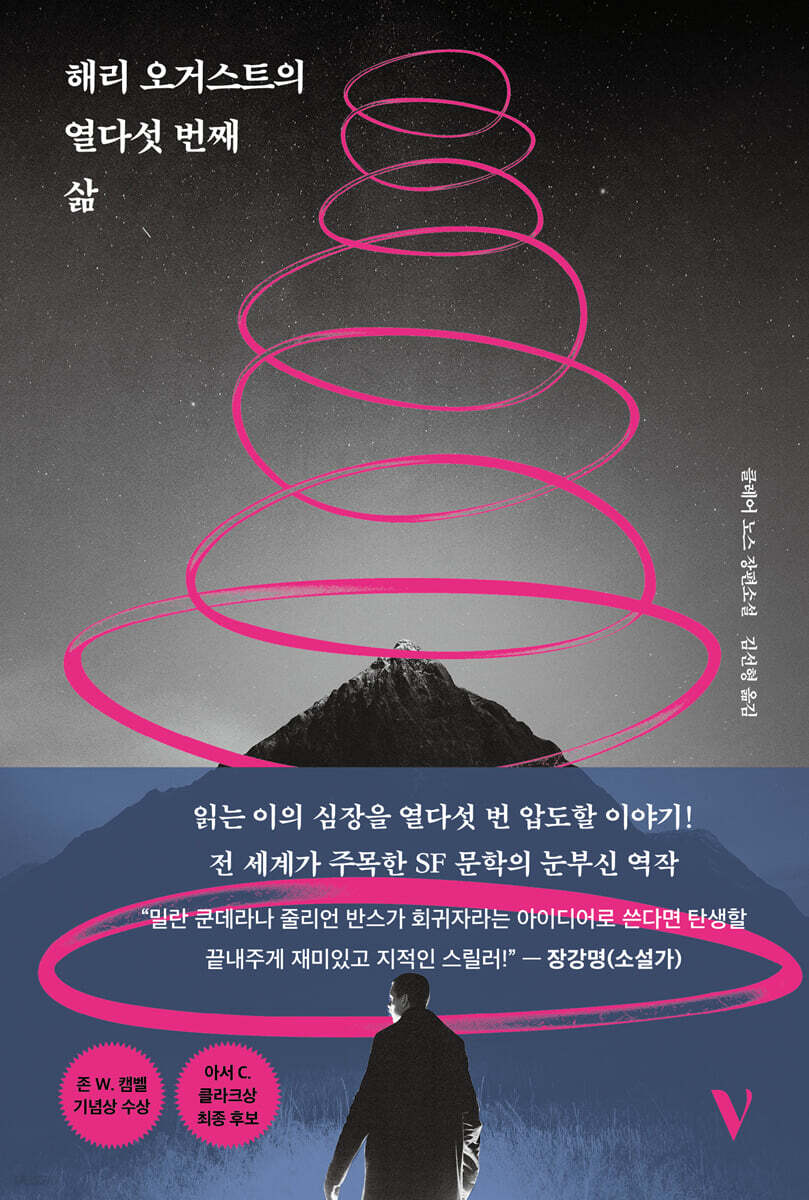
The Fifteenth Life of Harry August
 |
Description
Book Introduction
A story that will thrill your heart fifteen times over!
A dazzling masterpiece of science fiction literature that captured the attention of the entire world.
★★★★★ John W.
Campbell Memorial Award
★★★★★ Arthur C.
Clark Prize Finalist
★★★★★ Finalist for the British Science Fiction Award
Despite its massive volume, epic scale, and the psychological distance that comes with the setting of 'Europe before and after World War II,' the time travel SF thriller 'The Fifteenth Life of Harry August' has captivated readers, drawing praise such as "a truly crazy book," "I ran until dawn to see the ending," and "an author whose name you absolutely must remember." It has been republished by Banta.
It has received praise from the world's leading media for its in-depth treatment of issues of memory, identity, science and ethics, and has been awarded the John W.
Winner of the Campbell Memorial Award and Arthur C.
This work, which was a finalist for the Clarke Prize and the British Science Fiction Association Award, has been loved by word of mouth since its publication in Korea, and there have been continuous requests for republication.
Harry August is trapped in an endless loop of life.
No matter how he lives or dies, he returns to the moment he was first born into this world, on January 1, 1919, in the women's restroom at the train station.
Despite exploring faith and scholarship, yearning for answers to existence, and interacting with people who were repeating the same life cycle as him, Harry August could not escape the listlessness of life, was terribly lonely, and nothing changed.
And on the eleventh day of death, a girl comes to deliver a message for future generations a thousand years from now.
“The world is ending, and we can’t stop it.
So now it's up to you, Doctor." From this message, his life takes a drastic turn.
A dazzling masterpiece of science fiction literature that captured the attention of the entire world.
★★★★★ John W.
Campbell Memorial Award
★★★★★ Arthur C.
Clark Prize Finalist
★★★★★ Finalist for the British Science Fiction Award
Despite its massive volume, epic scale, and the psychological distance that comes with the setting of 'Europe before and after World War II,' the time travel SF thriller 'The Fifteenth Life of Harry August' has captivated readers, drawing praise such as "a truly crazy book," "I ran until dawn to see the ending," and "an author whose name you absolutely must remember." It has been republished by Banta.
It has received praise from the world's leading media for its in-depth treatment of issues of memory, identity, science and ethics, and has been awarded the John W.
Winner of the Campbell Memorial Award and Arthur C.
This work, which was a finalist for the Clarke Prize and the British Science Fiction Association Award, has been loved by word of mouth since its publication in Korea, and there have been continuous requests for republication.
Harry August is trapped in an endless loop of life.
No matter how he lives or dies, he returns to the moment he was first born into this world, on January 1, 1919, in the women's restroom at the train station.
Despite exploring faith and scholarship, yearning for answers to existence, and interacting with people who were repeating the same life cycle as him, Harry August could not escape the listlessness of life, was terribly lonely, and nothing changed.
And on the eleventh day of death, a girl comes to deliver a message for future generations a thousand years from now.
“The world is ending, and we can’t stop it.
So now it's up to you, Doctor." From this message, his life takes a drastic turn.
- You can preview some of the book's contents.
Preview
index
letter
Chapters 1-82
Translator's Note
Chapters 1-82
Translator's Note
Detailed image

Into the book
"The world is changing! In the past 200 years, humanity has made far more progress than in the previous 2,000! The pace of human evolution, both as a species and as a civilization, is accelerating.
It is our job to oversee this process.
It's something that good people should take on.
"We must guide this historical process so we don't mess things up again, cause disaster, or ruin things! Do you want another World War II? What if the Holocaust happens again? We can change things, we can make things better."
“Teacher, are you confident that you are qualified to govern the future?”
“Fuck, yeah!” he shouted angrily.
“Because I’m a fucking defender of democracy! I’m a fucking believer in freedom, and I’m a fucking good person with a fucking good heart, and somebody’s got to do it!”
--- p.93
“You can’t waste time being young.
“There are so many things that society doesn’t allow people under 30 to do, but there are so many things that need to be done.”
His words instantly touched my heart.
Because I too have lived that way for 25 boring years.
“Are you interested in time?”
“Complexity and simplicity,” he answered.
“Time is simple if it is simple.
We measure time by dividing it into simple parts, prepare our meals accordingly, and drink our whiskey in accordance with the flow.
We can mathematically organize time and use it to express ideas about the observable universe, but when asked to explain it to a child in simple language (simple language, of course, not deceptive language), we are powerless.
It always seems like the best we can do with our time is waste it.”
--- pp.124-125
When I'm feeling optimistic, I choose to believe that every life I've lived, every choice I've made, has consequences.
I believe that I am not one Harry August, but many Harry Augusts, flickering spirits that move between lives in parallel universes, and that when I die, my actions will change something, and the world will continue on without me, bearing the traces of my existence.
Then I look at the things I have done.
No, it's probably more important to see things that haven't been done.
When such thoughts come to mind, I become depressed and start to dismiss the assumptions I made earlier as unfair.
What is the meaning of my existence?
Either you change the world or you become nothing at all.
If you change the world, many, many worlds will change.
Because every single choice I make in life will have an impact.
For every action has a consequence, and there is truth in love and sorrow.
--- p.240
“Have you ever influenced the outcome of a war through your own personal power?”
“Fuck, no!” Fidel chuckled.
“We’re just fucking soldiers.
If we kill a few people, they kill us back, and we kill them back, so what the fuck does that mean, right? It's just a number written on a piece of paper.
When the numbers get big enough, then the well-fed upper echelons who decide the direction of this shithole will sit down and say, "It's time to make a decision since it had to be made anyway."
Someone like me is no threat to the direction of historical events, my friend.
It's just firewood in the stove.
And you know what the best thing is?”
Fidel slowly raised his large body, stood tall like a tower, and then he crumpled up a piece of paper and threw it into a corner of the house, like a landlord throwing leftover food to his pet.
“It doesn’t make any fucking sense.
One bullet, one drop of blood, nothing means anything.
“It won’t make any fucking difference.”
--- p.356
“I live with the flow.
You talk about decent people living decent lives as if it means nothing, as if it's nothing special.
But listen to me.
This 'respectable' thing, that's the only thing that has any meaning.
Mr. Scientist, if you were to theorize a machine that would make all men kind and all women beautiful, I wouldn't think it would be a big deal.
Even if you're building a machine, you don't stop and help your grandmother cross the street.
Even if we cure aging, eliminate famine, or end nuclear war, it means nothing if we forget here (he said, then touched my forehead with the bone on the back of his hand) and here (he said, pressing his palm to his chest).
Because everyone must first become decent, and then become a genius.
Otherwise, instead of helping people, we will just become slaves to machines.”
--- pp.375-376
“Our actions… have meaning.
We have a responsibility to consider not only the big things but also the small things.
The mere fact that the world around us is the basis of existence for a world of conscious, living beings is reason enough.
We are not gods, Vincent.
Our knowledge does not give us the authority to act as gods.
That… that’s not the meaning of our existence.”
--- pp.390-391
Even after all these years, I still don't know how to make my father happy in his old age.
It is our job to oversee this process.
It's something that good people should take on.
"We must guide this historical process so we don't mess things up again, cause disaster, or ruin things! Do you want another World War II? What if the Holocaust happens again? We can change things, we can make things better."
“Teacher, are you confident that you are qualified to govern the future?”
“Fuck, yeah!” he shouted angrily.
“Because I’m a fucking defender of democracy! I’m a fucking believer in freedom, and I’m a fucking good person with a fucking good heart, and somebody’s got to do it!”
--- p.93
“You can’t waste time being young.
“There are so many things that society doesn’t allow people under 30 to do, but there are so many things that need to be done.”
His words instantly touched my heart.
Because I too have lived that way for 25 boring years.
“Are you interested in time?”
“Complexity and simplicity,” he answered.
“Time is simple if it is simple.
We measure time by dividing it into simple parts, prepare our meals accordingly, and drink our whiskey in accordance with the flow.
We can mathematically organize time and use it to express ideas about the observable universe, but when asked to explain it to a child in simple language (simple language, of course, not deceptive language), we are powerless.
It always seems like the best we can do with our time is waste it.”
--- pp.124-125
When I'm feeling optimistic, I choose to believe that every life I've lived, every choice I've made, has consequences.
I believe that I am not one Harry August, but many Harry Augusts, flickering spirits that move between lives in parallel universes, and that when I die, my actions will change something, and the world will continue on without me, bearing the traces of my existence.
Then I look at the things I have done.
No, it's probably more important to see things that haven't been done.
When such thoughts come to mind, I become depressed and start to dismiss the assumptions I made earlier as unfair.
What is the meaning of my existence?
Either you change the world or you become nothing at all.
If you change the world, many, many worlds will change.
Because every single choice I make in life will have an impact.
For every action has a consequence, and there is truth in love and sorrow.
--- p.240
“Have you ever influenced the outcome of a war through your own personal power?”
“Fuck, no!” Fidel chuckled.
“We’re just fucking soldiers.
If we kill a few people, they kill us back, and we kill them back, so what the fuck does that mean, right? It's just a number written on a piece of paper.
When the numbers get big enough, then the well-fed upper echelons who decide the direction of this shithole will sit down and say, "It's time to make a decision since it had to be made anyway."
Someone like me is no threat to the direction of historical events, my friend.
It's just firewood in the stove.
And you know what the best thing is?”
Fidel slowly raised his large body, stood tall like a tower, and then he crumpled up a piece of paper and threw it into a corner of the house, like a landlord throwing leftover food to his pet.
“It doesn’t make any fucking sense.
One bullet, one drop of blood, nothing means anything.
“It won’t make any fucking difference.”
--- p.356
“I live with the flow.
You talk about decent people living decent lives as if it means nothing, as if it's nothing special.
But listen to me.
This 'respectable' thing, that's the only thing that has any meaning.
Mr. Scientist, if you were to theorize a machine that would make all men kind and all women beautiful, I wouldn't think it would be a big deal.
Even if you're building a machine, you don't stop and help your grandmother cross the street.
Even if we cure aging, eliminate famine, or end nuclear war, it means nothing if we forget here (he said, then touched my forehead with the bone on the back of his hand) and here (he said, pressing his palm to his chest).
Because everyone must first become decent, and then become a genius.
Otherwise, instead of helping people, we will just become slaves to machines.”
--- pp.375-376
“Our actions… have meaning.
We have a responsibility to consider not only the big things but also the small things.
The mere fact that the world around us is the basis of existence for a world of conscious, living beings is reason enough.
We are not gods, Vincent.
Our knowledge does not give us the authority to act as gods.
That… that’s not the meaning of our existence.”
--- pp.390-391
Even after all these years, I still don't know how to make my father happy in his old age.
--- p.569
Publisher's Review
“Harry August has died, again.
And then I was born again, with all my memories.”
Harry August was born in a train station women's restroom in January 1919.
He was raised by adoptive parents in place of his deceased biological mother and lived as a caretaker of a noble estate until he died in 1989, when the Berlin Wall fell.
An ordinary life, but when Harry August is reborn in a train station women's restroom in January 1919 with all his memories of his previous life, he becomes convinced he is mad.
His second life ended in suicide at the age of seven, when he threw himself from the third floor of a mental hospital.
And from his third life, born again, Harry August begins to prepare for his destiny, which will repeat itself endlessly.
Harry August, who was searching for the reason for his existence in his repetitive life while delving into subjects such as religion, biology, physics, and philosophy, eventually learns of the existence of the 'Kalachakra', a group of people who live the same repetitive lives as him, and the 'Chronos Club', a group they founded. He follows the teachings of the Chronos Club, which prohibits intervention in history due to its complexity.
However, someone appears who wants to use the ability to be reborn to completely change the future of humanity.
Vincent Lanquis, Harry August's disciple, true friend, and lifelong rival.
Harry, who feels a strange sense of disillusionment with the Chronos Club members who, having been given infinite time, no longer even try to find meaning in life, is fascinated by Vincent's ambition to introduce future scientific theories into the present timeline, accelerate technological advancements, fully understand the universe, and become a sort of "god."
However, this momentary choice brings about a great disaster, and soon he begins a fight with Vincent that will determine the fate of humanity… … .
It is a philosophical epic in search of answers to existence.
A time-travel sci-fi thriller set in the aftermath of the apocalypse.
In this novel, author Claire North not only created an original worldview centered around the society of the 'Kalachakras' who endlessly repeat the same life and the 'Chronos Club' group they founded, but also unpredictably depicted the fierce conflict between those who want to leave history as it is and those who want to change it, and depicted the landscape of modern Europe with the introduction of modern science and technology with amazing imagination.
Additionally, the clever battle between the protagonist Harry and his arch-enemy Vincent, who fight for the future of humanity, provides a thrilling tension that will keep you from putting the book down until you see the ending.
The three-dimensional relationship between Harry and Vincent, who are each other's only understanding, best friends, and at the same time, worst enemies, adds to the fun of watching.
Claire North offers a dystopian answer to the universal fantasy that if we could live our lives over again with all our memories intact, we would achieve a better life. At the same time, she raises fundamental questions about the ethical responsibilities that come with technological progress and where humans, unable to defy the absolute flow of time, can find solace in existence.
It also emphasizes that it is not 'abilities' such as knowledge, immortality, or wealth that save humans, but rather love and understanding of others, a curiosity about the world, and human desires and emotions to find the meaning of life that are the motivations that sustain our lives.
Solving the problem of reason scientifically and implementing it lyrically
A remarkable achievement in science fiction literature
"The Fifteenth Life of Harry August" is a page-turner with such a gripping power that most readers say, "Once the story gets going, you can't put it down." However, its message and narrative perfection are profound and sophisticated.
Despite the vast knowledge and philosophical explorations that fill the story, including the international situation, quantum physics, the conflicting values of the Kalachakras, and existential questions, set in Europe before and after World War II, this novel does not feel overly difficult or cold because emotions such as compassion for humanity, loneliness, and desolation flow under the work.
Claire North vividly portrays the weary inner self of 'Kalachakra', who must repeat life and death at the same time and place no matter how many times she lives and dies, with a dry and restrained style, and vividly conveys the weight of memories that still weighs on the soul even after living for eons.
Even Kalachakra, who possesses a life nearly immortal, is fundamentally powerless against the harsh flow of time, and although his body may enjoy comfort, he cannot save his life or change the tragedy of history.
However, Harry August, even as he is worn down by the endless fatigue of the accumulating years, contemplates what it means to be human and longs for the reason for his existence.
In this world that will always reset, even if it is a meaningless attempt, I try to find something meaningful in my life.
The intellectual lyricism created by the exquisite combination of restrained monologue, metaphysical insight, and heartfelt emotion is considered the greatest virtue of this work.
The Fifteenth Life of Harry August is a rare work that achieves genre tension, depth of thought, and linguistic elegance.
And then I was born again, with all my memories.”
Harry August was born in a train station women's restroom in January 1919.
He was raised by adoptive parents in place of his deceased biological mother and lived as a caretaker of a noble estate until he died in 1989, when the Berlin Wall fell.
An ordinary life, but when Harry August is reborn in a train station women's restroom in January 1919 with all his memories of his previous life, he becomes convinced he is mad.
His second life ended in suicide at the age of seven, when he threw himself from the third floor of a mental hospital.
And from his third life, born again, Harry August begins to prepare for his destiny, which will repeat itself endlessly.
Harry August, who was searching for the reason for his existence in his repetitive life while delving into subjects such as religion, biology, physics, and philosophy, eventually learns of the existence of the 'Kalachakra', a group of people who live the same repetitive lives as him, and the 'Chronos Club', a group they founded. He follows the teachings of the Chronos Club, which prohibits intervention in history due to its complexity.
However, someone appears who wants to use the ability to be reborn to completely change the future of humanity.
Vincent Lanquis, Harry August's disciple, true friend, and lifelong rival.
Harry, who feels a strange sense of disillusionment with the Chronos Club members who, having been given infinite time, no longer even try to find meaning in life, is fascinated by Vincent's ambition to introduce future scientific theories into the present timeline, accelerate technological advancements, fully understand the universe, and become a sort of "god."
However, this momentary choice brings about a great disaster, and soon he begins a fight with Vincent that will determine the fate of humanity… … .
It is a philosophical epic in search of answers to existence.
A time-travel sci-fi thriller set in the aftermath of the apocalypse.
In this novel, author Claire North not only created an original worldview centered around the society of the 'Kalachakras' who endlessly repeat the same life and the 'Chronos Club' group they founded, but also unpredictably depicted the fierce conflict between those who want to leave history as it is and those who want to change it, and depicted the landscape of modern Europe with the introduction of modern science and technology with amazing imagination.
Additionally, the clever battle between the protagonist Harry and his arch-enemy Vincent, who fight for the future of humanity, provides a thrilling tension that will keep you from putting the book down until you see the ending.
The three-dimensional relationship between Harry and Vincent, who are each other's only understanding, best friends, and at the same time, worst enemies, adds to the fun of watching.
Claire North offers a dystopian answer to the universal fantasy that if we could live our lives over again with all our memories intact, we would achieve a better life. At the same time, she raises fundamental questions about the ethical responsibilities that come with technological progress and where humans, unable to defy the absolute flow of time, can find solace in existence.
It also emphasizes that it is not 'abilities' such as knowledge, immortality, or wealth that save humans, but rather love and understanding of others, a curiosity about the world, and human desires and emotions to find the meaning of life that are the motivations that sustain our lives.
Solving the problem of reason scientifically and implementing it lyrically
A remarkable achievement in science fiction literature
"The Fifteenth Life of Harry August" is a page-turner with such a gripping power that most readers say, "Once the story gets going, you can't put it down." However, its message and narrative perfection are profound and sophisticated.
Despite the vast knowledge and philosophical explorations that fill the story, including the international situation, quantum physics, the conflicting values of the Kalachakras, and existential questions, set in Europe before and after World War II, this novel does not feel overly difficult or cold because emotions such as compassion for humanity, loneliness, and desolation flow under the work.
Claire North vividly portrays the weary inner self of 'Kalachakra', who must repeat life and death at the same time and place no matter how many times she lives and dies, with a dry and restrained style, and vividly conveys the weight of memories that still weighs on the soul even after living for eons.
Even Kalachakra, who possesses a life nearly immortal, is fundamentally powerless against the harsh flow of time, and although his body may enjoy comfort, he cannot save his life or change the tragedy of history.
However, Harry August, even as he is worn down by the endless fatigue of the accumulating years, contemplates what it means to be human and longs for the reason for his existence.
In this world that will always reset, even if it is a meaningless attempt, I try to find something meaningful in my life.
The intellectual lyricism created by the exquisite combination of restrained monologue, metaphysical insight, and heartfelt emotion is considered the greatest virtue of this work.
The Fifteenth Life of Harry August is a rare work that achieves genre tension, depth of thought, and linguistic elegance.
GOODS SPECIFICS
- Date of issue: October 28, 2025
- Page count, weight, size: 664 pages | 760g | 135*200*23mm
- ISBN13: 9791194979821
- ISBN10: 1194979823
You may also like
카테고리
korean


korean

![ELLE 엘르 스페셜 에디션 A형 : 12월 [2025]](http://librairie.coreenne.fr/cdn/shop/files/b8e27a3de6c9538896439686c6b0e8fb.jpg?v=1766436872&width=3840)


