

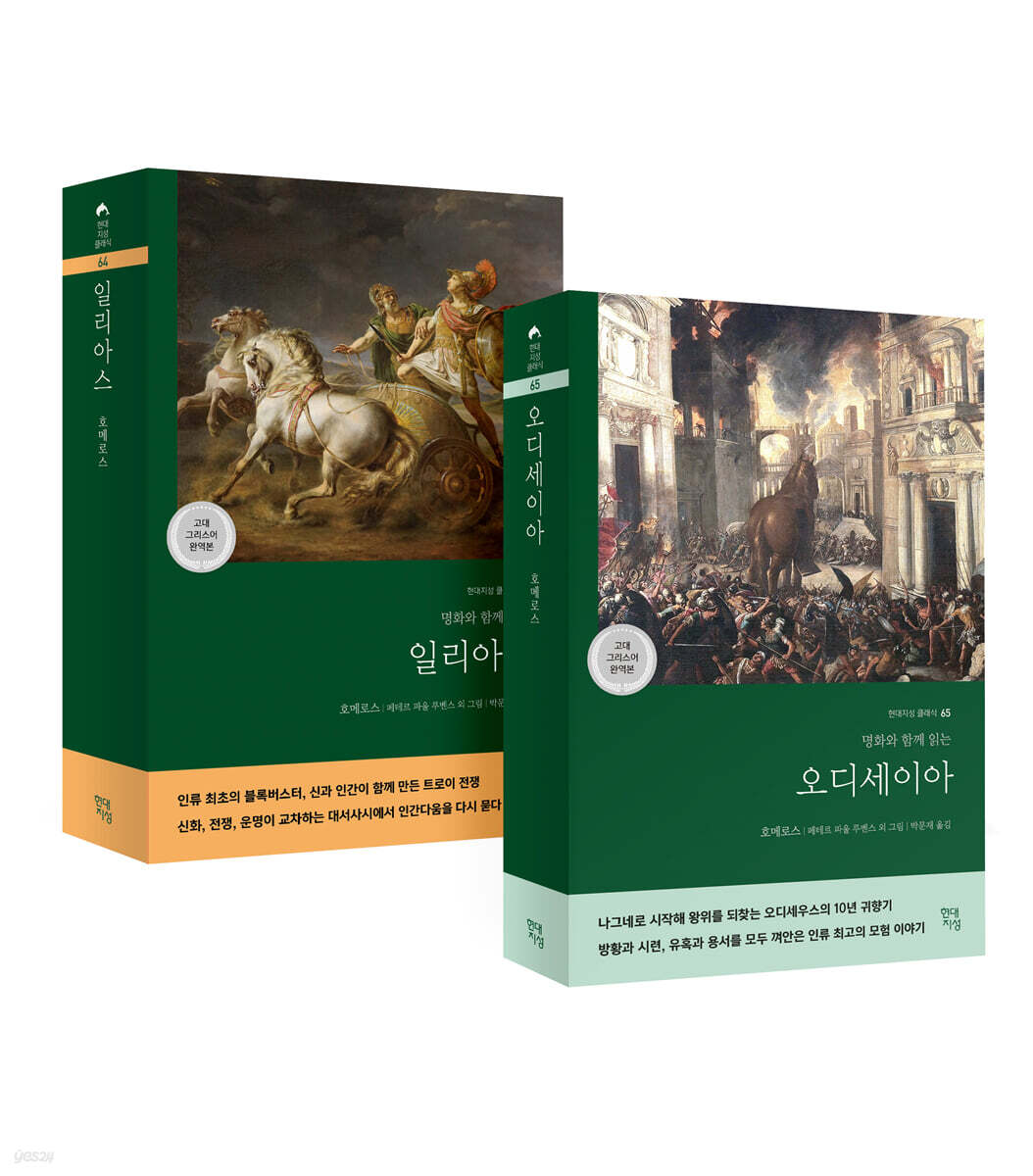
Iliad & Odyssey Set (Complete Ancient Greek Translation)
 |
Description
Book Introduction
The first story of mankind, the greatest epic
Simultaneous publication of Homer's epic series, "Iliad" and "Odyssey"
"The beginning of all great epics, a classic of our time spanning three thousand years."
* A sophisticated translation that preserves the rhythm of ancient Greek.
* The only complete translation of the original text in Korea, along with 207 masterpieces by masters.
* 118 pages of in-depth commentary, 738 detailed footnotes (complete set)
Iliad - Modern Intelligence Classic 64:
mankind's first blockbuster
The archetype of all great stories, where anger and love, hate and forgiveness intersect.
The beginning of Western literature and the origin of the spectacular narrative
Homer's epic poem, The Iliad, is the oldest surviving epic poem in Western literature.
The author Homer not only recorded the myths and legends of the ancient Greeks, which had long been passed down orally, but also compressed them into the context of the Trojan War, creating a coherent and complete literary work.
'Iliad' means 'the story of Ilion', and Ilion is one of the names referring to Troy.
A breathtaking battle unfolds between heroes risking their lives to decide the fate of Troy and gods divided into two sides based on their vested interests.
In this magnificent epic poem, consisting of 15,693 lines and 24 volumes, we see the literary excellence of the ancients, their worldview of gods and humans, their values in life, and the suffering and sorrow experienced by mortal humans.
The Iliad is a story about anger.
The wrath of Achilles, the hero of the Trojan War, shakes even the gods and brings death to countless warriors.
Through this anger, Homer reveals the tragic truth of a world where gods and humans are intertwined.
This work, which is the starting point of existing Western literature, is the first epic poem in human history and became the prototype for all subsequent literature.
The complete translation of the modern intellectual classic was translated and refined to allow Korean readers to immerse themselves in it while preserving the rhythm, style, and order of the original poem as much as possible.
103 vivid paintings and images, 435 footnotes, and 75 pages of detailed and extensive commentary thoroughly explain the geography and history of ancient Greece, its mythological background, and the characteristics of its characters and gods, helping readers gain a deeper understanding of the work.
In particular, the genealogy and stories of the heroes surrounding the Trojan War are richly explained, allowing for a three-dimensional reading experience.
Odyssey - Modern Intellect Classics 65:
Odysseus's ten-year journey home, from wanderer to reclaiming the throne.
A tale of human adventure, embracing wandering, trials, temptations, and forgiveness.
Synopsis
The story begins with the ten-year Trojan War finally coming to an end, and the victorious Greek forces returning home with their spoils of war.
Odysseus, the king of Ithaca, also sets out from Troy with twelve ships and his comrades.
However, his journey home is not smooth from the start as he offends the sea god Poseidon.
It took another ten years to return home after the war.
Along the way, he encounters fierce storms, cannibalistic monsters and tribes, and the supernatural temptations of sirens and wizards, all of which he confronts with wisdom and courage.
Meanwhile, in his hometown of Ithaca, unruly suitors have taken over the palace and are holding a banquet under the pretense of courting Queen Penelope, aiming for the throne.
Will Odysseus, who has returned after 20 years, be able to reunite with his family and reclaim his throne?
A record of humanity's wisdom and courage as it navigates an uncertain world.
Odysseus, the hero of the Trojan War, tries to return to his hometown of Ithaca after winning the war, but his journey is by no means smooth.
Poseidon's wrath, the mischief of the gods, and human arrogance and weakness block his journey, and he wanders the seas for ten long years, struggling against the limits of humanity.
Through this great wandering, Homer reveals the truth about the world where gods and humans are intertwined.
The Odyssey is a work that condenses the worldview of the ancient Greeks, the values of life, and the meaning of a human life into a simple story structure of 'return'.
Through his confrontation with the one-eyed giant Polyphemus, the seduction of the witch Circe, his time with the sea nymph Calypso, and the constant intervention of the sea gods and sky gods, Odysseus is portrayed not as a simple hero, but as a being possessing both human weakness and strength.
The complete translation of the modern intellectual classic is a delicate and faithful translation of this epic poem, which has been passed down orally for 3,000 years, so that today's readers can fully savor it.
104 famous paintings and images stimulate the imagination and vividly portray the circumstances of the time and the lives of heroes, while 303 detailed footnotes and commentaries provide a three-dimensional portrayal of the geography, mythology, and cultural context of ancient Greece.
In particular, it meticulously traces the genealogy of major figures and events, as well as their historical background, enabling deeper insight beyond simple reading.
Simultaneous publication of Homer's epic series, "Iliad" and "Odyssey"
"The beginning of all great epics, a classic of our time spanning three thousand years."
* A sophisticated translation that preserves the rhythm of ancient Greek.
* The only complete translation of the original text in Korea, along with 207 masterpieces by masters.
* 118 pages of in-depth commentary, 738 detailed footnotes (complete set)
Iliad - Modern Intelligence Classic 64:
mankind's first blockbuster
The archetype of all great stories, where anger and love, hate and forgiveness intersect.
The beginning of Western literature and the origin of the spectacular narrative
Homer's epic poem, The Iliad, is the oldest surviving epic poem in Western literature.
The author Homer not only recorded the myths and legends of the ancient Greeks, which had long been passed down orally, but also compressed them into the context of the Trojan War, creating a coherent and complete literary work.
'Iliad' means 'the story of Ilion', and Ilion is one of the names referring to Troy.
A breathtaking battle unfolds between heroes risking their lives to decide the fate of Troy and gods divided into two sides based on their vested interests.
In this magnificent epic poem, consisting of 15,693 lines and 24 volumes, we see the literary excellence of the ancients, their worldview of gods and humans, their values in life, and the suffering and sorrow experienced by mortal humans.
The Iliad is a story about anger.
The wrath of Achilles, the hero of the Trojan War, shakes even the gods and brings death to countless warriors.
Through this anger, Homer reveals the tragic truth of a world where gods and humans are intertwined.
This work, which is the starting point of existing Western literature, is the first epic poem in human history and became the prototype for all subsequent literature.
The complete translation of the modern intellectual classic was translated and refined to allow Korean readers to immerse themselves in it while preserving the rhythm, style, and order of the original poem as much as possible.
103 vivid paintings and images, 435 footnotes, and 75 pages of detailed and extensive commentary thoroughly explain the geography and history of ancient Greece, its mythological background, and the characteristics of its characters and gods, helping readers gain a deeper understanding of the work.
In particular, the genealogy and stories of the heroes surrounding the Trojan War are richly explained, allowing for a three-dimensional reading experience.
Odyssey - Modern Intellect Classics 65:
Odysseus's ten-year journey home, from wanderer to reclaiming the throne.
A tale of human adventure, embracing wandering, trials, temptations, and forgiveness.
Synopsis
The story begins with the ten-year Trojan War finally coming to an end, and the victorious Greek forces returning home with their spoils of war.
Odysseus, the king of Ithaca, also sets out from Troy with twelve ships and his comrades.
However, his journey home is not smooth from the start as he offends the sea god Poseidon.
It took another ten years to return home after the war.
Along the way, he encounters fierce storms, cannibalistic monsters and tribes, and the supernatural temptations of sirens and wizards, all of which he confronts with wisdom and courage.
Meanwhile, in his hometown of Ithaca, unruly suitors have taken over the palace and are holding a banquet under the pretense of courting Queen Penelope, aiming for the throne.
Will Odysseus, who has returned after 20 years, be able to reunite with his family and reclaim his throne?
A record of humanity's wisdom and courage as it navigates an uncertain world.
Odysseus, the hero of the Trojan War, tries to return to his hometown of Ithaca after winning the war, but his journey is by no means smooth.
Poseidon's wrath, the mischief of the gods, and human arrogance and weakness block his journey, and he wanders the seas for ten long years, struggling against the limits of humanity.
Through this great wandering, Homer reveals the truth about the world where gods and humans are intertwined.
The Odyssey is a work that condenses the worldview of the ancient Greeks, the values of life, and the meaning of a human life into a simple story structure of 'return'.
Through his confrontation with the one-eyed giant Polyphemus, the seduction of the witch Circe, his time with the sea nymph Calypso, and the constant intervention of the sea gods and sky gods, Odysseus is portrayed not as a simple hero, but as a being possessing both human weakness and strength.
The complete translation of the modern intellectual classic is a delicate and faithful translation of this epic poem, which has been passed down orally for 3,000 years, so that today's readers can fully savor it.
104 famous paintings and images stimulate the imagination and vividly portray the circumstances of the time and the lives of heroes, while 303 detailed footnotes and commentaries provide a three-dimensional portrayal of the geography, mythology, and cultural context of ancient Greece.
In particular, it meticulously traces the genealogy of major figures and events, as well as their historical background, enabling deeper insight beyond simple reading.
index
Iliad
Book 1: The Wrath of Achilles
Volume 2 Ship List
Book 3: The Confrontation Between Paris and Menelaus
Book IV: The Trojan Oath Breach and the Beginning of Battle
Book 5: The Activities of Diomedes
Book 6: The Parting of Hector and Andromache
Book 7: The Confrontation between Hector and Ajax, the Truce, and the Funeral of the Fallen
Book 8: Hector and the Trojans' Onslaught
Book 9: Agamemnon Attempts Reconciliation with Achilles
Book 10: The Expeditions of Diomedes and Odysseus
Book 11: Agamemnon's Deeds and Hector's Counterattack
Volume 12: The Battle of the Wall
Volume 13: The Battle Next to the Ships
Book 14: Hera Deceives Zeus and the Greeks Counterattack
Book 15: The Trojan Counterattack
Book 16: The Activities of Patroclus
Book 17: The Battle Over the Body of Patroclus
Book 18: Achilles' New Weapon
Book 19: The Reconciliation of Achilles and Agamemnon
Book 20: Achilles's Vigorous Activity
Volume 21: The River Xanthos and the Battle of the Gods
Book 22: The Death of Hector
Book 23: The Funeral and Memorial Games of Patroclus
Book 24: Hector's Funeral
Commentary | Park Moon-jae
Formation of Greek and Trojan armies
Map of Ancient Greece and the Anatolian Peninsula
Key figures
Major deities
Odyssey
Book 1: Athena Visits Telemachus
Book 2: Telemachus Sets Off on a Voyage
Book 3: Nestor of Pylos
Book 4: Menelaus of Lacedaemon
Book 5: Calypso and the Shipwreck of Odysseus
Book 6: Princess Nausicaä and Odysseus
Book 7: The Land of the Phaeacians
Book 8: Odysseus's Farewell Game and Banquet
Book 9: The Cyclops, the One-Eyed Giants
Book 10: Aeolus, Antiphates, and Circe
Volume 11: Hades, the Land of the Dead
Book 12: The Siren Sisters, Scylla and Charybdis, and the Cattle of Helios
Book 13: Odysseus Returns to Ithaca
Book 14: Odysseus Meets the Swineherd
Book 15: Telemachus on his way home
Book 16: The Meeting of Odysseus and Telemachus
Volume 17: The Old Beggar Appears Before the Suitors
The Beggar Old Man Among the Suitors, Volume 18
Book 19: Penelope and the Guest Odysseus
Volume 20: Omens
Book 21: Odysseus Strings His Bow
Book 22: Executing the Suitors
Book 23: The Secret of Odysseus and Penelope's Bed
Volume 24: The Souls of the Suitors Who Descended to Hades and Peace
Commentary | Park Moon-jae
Main characters
Book 1: The Wrath of Achilles
Volume 2 Ship List
Book 3: The Confrontation Between Paris and Menelaus
Book IV: The Trojan Oath Breach and the Beginning of Battle
Book 5: The Activities of Diomedes
Book 6: The Parting of Hector and Andromache
Book 7: The Confrontation between Hector and Ajax, the Truce, and the Funeral of the Fallen
Book 8: Hector and the Trojans' Onslaught
Book 9: Agamemnon Attempts Reconciliation with Achilles
Book 10: The Expeditions of Diomedes and Odysseus
Book 11: Agamemnon's Deeds and Hector's Counterattack
Volume 12: The Battle of the Wall
Volume 13: The Battle Next to the Ships
Book 14: Hera Deceives Zeus and the Greeks Counterattack
Book 15: The Trojan Counterattack
Book 16: The Activities of Patroclus
Book 17: The Battle Over the Body of Patroclus
Book 18: Achilles' New Weapon
Book 19: The Reconciliation of Achilles and Agamemnon
Book 20: Achilles's Vigorous Activity
Volume 21: The River Xanthos and the Battle of the Gods
Book 22: The Death of Hector
Book 23: The Funeral and Memorial Games of Patroclus
Book 24: Hector's Funeral
Commentary | Park Moon-jae
Formation of Greek and Trojan armies
Map of Ancient Greece and the Anatolian Peninsula
Key figures
Major deities
Odyssey
Book 1: Athena Visits Telemachus
Book 2: Telemachus Sets Off on a Voyage
Book 3: Nestor of Pylos
Book 4: Menelaus of Lacedaemon
Book 5: Calypso and the Shipwreck of Odysseus
Book 6: Princess Nausicaä and Odysseus
Book 7: The Land of the Phaeacians
Book 8: Odysseus's Farewell Game and Banquet
Book 9: The Cyclops, the One-Eyed Giants
Book 10: Aeolus, Antiphates, and Circe
Volume 11: Hades, the Land of the Dead
Book 12: The Siren Sisters, Scylla and Charybdis, and the Cattle of Helios
Book 13: Odysseus Returns to Ithaca
Book 14: Odysseus Meets the Swineherd
Book 15: Telemachus on his way home
Book 16: The Meeting of Odysseus and Telemachus
Volume 17: The Old Beggar Appears Before the Suitors
The Beggar Old Man Among the Suitors, Volume 18
Book 19: Penelope and the Guest Odysseus
Volume 20: Omens
Book 21: Odysseus Strings His Bow
Book 22: Executing the Suitors
Book 23: The Secret of Odysseus and Penelope's Bed
Volume 24: The Souls of the Suitors Who Descended to Hades and Peace
Commentary | Park Moon-jae
Main characters
Detailed image

Publisher's Review
※Please refer to each book page for more detailed reviews.
Humanity's First Narrative: Speaking to Us Now
Homer's Iliad and Odyssey published simultaneously
1.
Questioning Humanity in the Middle of a Battlefield - The Iliad
The Iliad is humanity's first epic, a story of myth and war, anger and love, heroism and community.
But what's surprising about this work is that, while dealing with a huge ancient war, it doesn't lose sight of the 'emotional details' at its core.
In the tenth year of the Trojan War, Achilles, the greatest warrior, is humiliated by the commander-in-chief, Agamemnon, and refuses to fight.
This rift, sparked by individual anger, ultimately leads to the collapse of the entire community and completely changes the course of the war.
In this process, Homer weaves together the archetypes of human emotions in a dense manner.
The desire to preserve one's pride, the anger at injustice, the love for one's family, the fear and devotion encountered on the battlefield, and the possibility of compassion and reconciliation that blossoms at its end.
Although it covers the events of only 50 days, the emotional ties contained within it transcend time.
The parting scene between Hector and Andromache, the scene where Achilles insults Hector's body as a corpse and then finally sheds tears at Priam's plea, shakes the boundaries between anger and forgiveness, hatred and love within us.
The complete translation of the modern intellectual classic revives the rhythm of the battlefield in Korean, preserving the ancient Greek rhythm and style to the fullest extent possible.
With 103 famous images, 435 footnotes, and 75 pages of commentary detailing the context and characterization of the Trojan War, this book is a reading tool that allows readers to understand the Iliad not simply as a classic, but as a story relevant to today.
2.
Back to Life After Suffering and Temptation - The Odyssey
If the Iliad illuminated the anger and tragedy of humanity in the midst of battle, the Odyssey is a story that asks how humans can return to their 'place in life' in the post-war world.
Odysseus leaves the victorious battlefield and tries to return to his hometown of Ithaca, but the road is extremely difficult.
He is confronted by the curse of Poseidon, the god of the sea, by monsters such as the Sirens, Circe, and the one-eyed giant Polyphemus, and above all, by the temptations and loneliness that constantly test his humanity.
Yet Odysseus survives.
With wisdom, patience, self-control and godliness.
He always seeks God's will, offers hospitality, and understands the suffering of others even in the shadow of death.
His return is not just a man's revenge, but a journey to reestablish the ethics and order of life.
Even in the face of the fate of the gods, he withheld judgment until the very end and maintained his dignity as a human being, offering wisdom that is still valid for us as we navigate through an age of confusion and uncertainty.
The modern intellectual classic, "The Odyssey," vividly captures the rhythm and story of the ancient original, while revealing the philosophy and anthropology hidden beyond the adventure through 104 iconic images, 303 footnotes, and 43 pages of commentary.
The composition will satisfy everyone, from readers unfamiliar with classics to those seeking in-depth reading.
3.
From Anger to Return: The Completion of the Human Narrative
The Iliad and the Odyssey are independent masterpieces, but when read together, they unfold into one vast narrative world.
One is a battlefield where human passion explodes, and the other is a journey home where one begins again after losing everything.
How to survive war, and how to live after war.
A journey to restore the broken order and humanity.
These two epics are not just ancient stories, but mirrors that illuminate our lives today, and prologues to the most ancient questions about human existence.
Anger and sorrow, pain and regret, courage and moderation, justice and return.
All the archetypes of the story are in these two works.
Humanity's First Narrative: Speaking to Us Now
Homer's Iliad and Odyssey published simultaneously
1.
Questioning Humanity in the Middle of a Battlefield - The Iliad
The Iliad is humanity's first epic, a story of myth and war, anger and love, heroism and community.
But what's surprising about this work is that, while dealing with a huge ancient war, it doesn't lose sight of the 'emotional details' at its core.
In the tenth year of the Trojan War, Achilles, the greatest warrior, is humiliated by the commander-in-chief, Agamemnon, and refuses to fight.
This rift, sparked by individual anger, ultimately leads to the collapse of the entire community and completely changes the course of the war.
In this process, Homer weaves together the archetypes of human emotions in a dense manner.
The desire to preserve one's pride, the anger at injustice, the love for one's family, the fear and devotion encountered on the battlefield, and the possibility of compassion and reconciliation that blossoms at its end.
Although it covers the events of only 50 days, the emotional ties contained within it transcend time.
The parting scene between Hector and Andromache, the scene where Achilles insults Hector's body as a corpse and then finally sheds tears at Priam's plea, shakes the boundaries between anger and forgiveness, hatred and love within us.
The complete translation of the modern intellectual classic revives the rhythm of the battlefield in Korean, preserving the ancient Greek rhythm and style to the fullest extent possible.
With 103 famous images, 435 footnotes, and 75 pages of commentary detailing the context and characterization of the Trojan War, this book is a reading tool that allows readers to understand the Iliad not simply as a classic, but as a story relevant to today.
2.
Back to Life After Suffering and Temptation - The Odyssey
If the Iliad illuminated the anger and tragedy of humanity in the midst of battle, the Odyssey is a story that asks how humans can return to their 'place in life' in the post-war world.
Odysseus leaves the victorious battlefield and tries to return to his hometown of Ithaca, but the road is extremely difficult.
He is confronted by the curse of Poseidon, the god of the sea, by monsters such as the Sirens, Circe, and the one-eyed giant Polyphemus, and above all, by the temptations and loneliness that constantly test his humanity.
Yet Odysseus survives.
With wisdom, patience, self-control and godliness.
He always seeks God's will, offers hospitality, and understands the suffering of others even in the shadow of death.
His return is not just a man's revenge, but a journey to reestablish the ethics and order of life.
Even in the face of the fate of the gods, he withheld judgment until the very end and maintained his dignity as a human being, offering wisdom that is still valid for us as we navigate through an age of confusion and uncertainty.
The modern intellectual classic, "The Odyssey," vividly captures the rhythm and story of the ancient original, while revealing the philosophy and anthropology hidden beyond the adventure through 104 iconic images, 303 footnotes, and 43 pages of commentary.
The composition will satisfy everyone, from readers unfamiliar with classics to those seeking in-depth reading.
3.
From Anger to Return: The Completion of the Human Narrative
The Iliad and the Odyssey are independent masterpieces, but when read together, they unfold into one vast narrative world.
One is a battlefield where human passion explodes, and the other is a journey home where one begins again after losing everything.
How to survive war, and how to live after war.
A journey to restore the broken order and humanity.
These two epics are not just ancient stories, but mirrors that illuminate our lives today, and prologues to the most ancient questions about human existence.
Anger and sorrow, pain and regret, courage and moderation, justice and return.
All the archetypes of the story are in these two works.
GOODS SPECIFICS
- Date of issue: April 18, 2025
- Page count, weight, size: 1,520 pages | 2,130g | 150*225*80mm
- ISBN13: 9791139721942
- ISBN10: 1139721941
You may also like
카테고리
korean


korean

![ELLE 엘르 스페셜 에디션 A형 : 12월 [2025]](http://librairie.coreenne.fr/cdn/shop/files/b8e27a3de6c9538896439686c6b0e8fb.jpg?v=1766436872&width=3840)


