

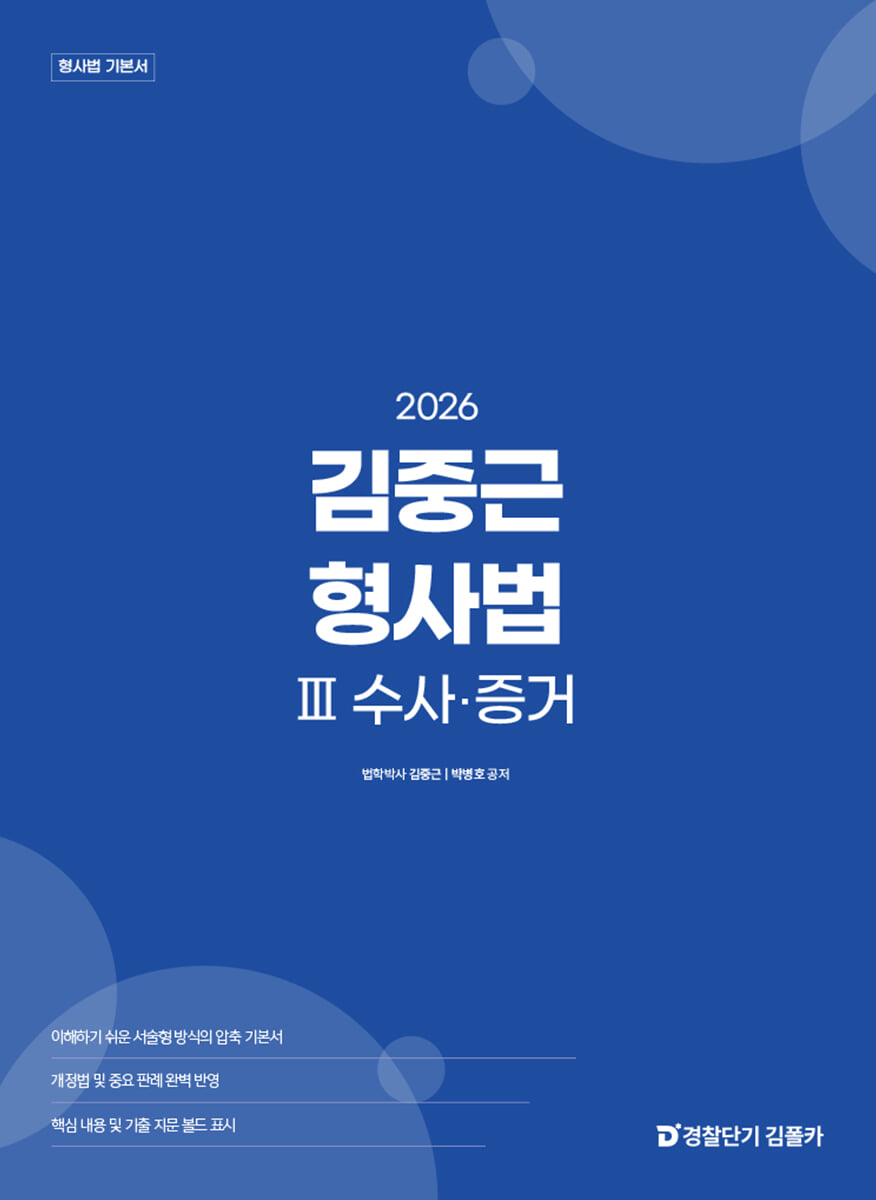
2026 Kim Jung-geun Criminal Law 3 Investigation and Evidence
 |
Description
Book Introduction
A condensed, descriptive, and easy-to-understand primer
Fully reflects revised laws and important precedents
Bold and underline based on frequency of previous questions
Fully reflects revised laws and important precedents
Bold and underline based on frequency of previous questions
- You can preview some of the book's contents.
Preview
index
PART 01 Investigation
CHAPTER 01 Investigation 14
SECTION (1) GENERAL 14
Ⅰ Introduction 14
01.
Meaning 14
02.
Period of investigation 14
03.
Distinction concept 14
04.
Nature of the Investigation 14
Ⅱ Investigative Agencies and Suspects and Victims 15
01.
Investigative Agency 15
02.
Suspect 34
03.
Victim 35
III Investigative Structure Theory 35
01.
Inquisitorial Investigator 36
02.
Impeachment investigator 36
03.
Litigation Investigator 36
04.
Investigative Structure and Suspect Human Rights Protection 37
Ⅳ Conditions for Investigation 37
01.
Introduction 37
02.
The Need for Investigation 37
03.
Reasonableness of the Investigation 39
SECTION (2) Initiation of Investigation 45
Ⅰ Investigative Clue 45
01.
Meaning 45
02.
Type 45
03.
Initiation of the Investigation 45
Ⅱ Autopsy of the deceased 46
01.
Meaning 46
02.
Distinction between Autopsy and Verification 46
03.
Autopsy Procedure 47
Ⅲ. Random Inspection 48
01.
Introduction 48
02.
48 people subject to random checks
03.
Methods of Random Checks (Job Questions) 49
04.
Baggage Inspection 51
05.
Vehicle Inspection 52
Ⅳ Complaint 53
01.
Introduction 53
02.
Procedure for filing a complaint 56
03.
The principle of inseparability
(Scope of the complaint) 63
04.
Withdrawal of complaint 67
05.
Waiver of the Right to Prosecute 74
V Accusation 75
01.
Meaning 75
02.
Legal nature 75
03.
Accuser 75
04.
Limitation of Accusation 75
05.
Procedure and method of reporting 76
Ⅵ Embroidery 77
01.
Meaning 77
02.
Legal nature 77
03.
Distinction between self-confession and confession 77
04.
Procedure 78
SECTION (3) Random Investigation 80
Ⅰ Meaning 80
Ⅱ Random investigation and compulsory investigation
Theory of Distinction 80
01.
The Need for Distinction 80
02.
Theory on the Criteria for Distinction 81
Ⅲ Principles of Discretionary Investigation and Regulation of Compulsory Investigation 81
01.
Principle 81 of Random Investigation
02.
Regulation 81 on compulsory investigations
Ⅳ Limits to the Legitimacy of Random Investigations 82
01.
Inherent Limitations of Random Investigation 82
02.
As stipulated in the current criminal procedure law
Method of Random Investigation 82
03.
The legitimacy of random investigation
82 in case of problem
04.
Limitations of Random and Compulsory Investigations 89
V. Method of Random Investigation 90
01.
Suspect Interrogation 90
02.
Investigation of persons other than the suspect 99
03.
Fact Check (Public Office Check) 103
04.
Notification of Investigation Progress 104
CHAPTER 02: Compulsory Dispositions and Compulsory Investigations 107
SECTION (1) INTRODUCTION 107
Ⅰ The Significance of Compulsory Disposition 107
Ⅱ Types of Compulsory Dispositions 107
01.
Classification by object 107
02.
Classification by subject 107
03.
Classification by before and after filing of the complaint 107
04.
The Essentials of a Preliminary Warrant 108
05.
Degree of Coercion 108
Ⅲ Human Rights Protection System from Forced Dispositions 108
SECTION (2) PERSONAL DETENTION SYSTEM 109
Ⅰ Arrest of the suspect 109
01.
Arrest by Arrest Warrant 109
02.
Emergency arrest 116
03.
Arrest of a criminal caught red-handed 122
Ⅱ Detention of the Suspect and Defendant 129
01.
The Meaning of Redemption 129
02.
Requirements for Detention 132
03.
Arrest Procedure 133
04.
Limitation of detention period 144
05.
Related Issue 148
Ⅲ Right of Visitation and Communication between Suspect and Defendant 149
01.
Meaning 149
02.
With the suspect/defendant's lawyer
Visiting transportation ticket 150
03.
Not the suspect or defendant's attorney
Java and Transportation Rights 153
04.
Defendant/Suspect of the Defense Attorney
Right to meet and travel with the back 154
05.
Remedies for Violation of the Right to Visitation and Transportation 157
Ⅳ Suspect and Defendant Release System 158
V Arrest and Detention Review System 158
01.
Introduction 158
02.
Request for Arrest/Detention Review 159
03.
Court Review 161
04.
Court Decision 163
05.
Method of appeal 166
Ⅵ Jewel 167
01.
Meaning 167
02.
Types of Gemstones 167
03.
Jewel Procedure 169
04.
Cancellation and lapse of bail 172
05.
Forfeiture and refund of deposit and
Loss of effectiveness of bail conditions, etc. 173
Ⅶ Suspension of Execution of Detention 175
01.
Meaning 175
02.
Procedure 175
03.
Effect 175
04.
Cancellation of stay of execution 176
05.
How to Appeal a Stay of Execution 176
Ⅷ The effectiveness of restraint
(Cancellation of arrest and automatic lapse of arrest) 176
01.
Detention Cancellation 176
02.
The lapse of the restraint 177
SECTION (3) Seizure, Search, and Verification 181
Ⅰ Material Compulsory Disposition 181
01.
Meaning 181
02.
Requirements for Compulsory Disposition 181
Ⅱ Seizure and Search 182
01.
The Significance of Search and Seizure 182
02.
Objects of Seizure and Search 183
03.
Procedures for Seizure and Search 198
04.
Disposal of Seized Items 208
05.
In case of seizure and search
Exception to the principle of primacy 217
Ⅲ Investigative Verification 224
01.
The meaning and target of verification 224
02.
Type 224 of Verification
03.
Investigative Verification Procedure 224
04.
Physical Examination 225
IV Investigative Emotions and Emotional Attraction 228
01.
Emotion 228
02.
Investigative Emotional Attraction 228
Ⅴ Communication restriction measures under the Communication Secrets Protection Act
Provision of communication fact confirmation data 230
01.
Communication Restriction Measure 230
02.
Request for confirmation of communication facts 243
SECTION (4) APPLICATION FOR COMPULSORY DISPUTES AGAINST A JUDGE 248
Ⅰ Request for preservation of evidence during investigation 248
01.
Meaning 248
02.
Requirements for Evidence Preservation 248
03.
Procedure for Preserving Evidence 249
04.
Procedures after Evidence Preservation 251
Ⅱ Request for Witness Examination of Reference Persons 251
01.
Meaning 251
02.
Witness Examination Request Requirement 252
03.
Witness Examination Procedure 254
04.
Actions after Witness Interrogation 255
CHAPTER 03: The Investigation Concludes 256
SECTION (1) Investigation Conclusion 256
Ⅰ Introduction 256
01.
The Significance of the Investigation's Conclusion 256
02.
Investigation after the conclusion of the investigation 256
Ⅱ Judicial Police Officer's Investigation Conclusion Disposition 256
Ⅲ Prosecutor's Investigation Conclusion Disposition 258
01.
Filing of the complaint 258
02.
(broad) non-prosecution decision
(Prosecution Case Management Rules) 259
03.
260 Taguan Songchi
Ⅳ After the disposition of the prosecutor or judicial police officer
Notification Obligation 261
01.
Notification of investigation results (Article 245-6 of the Act,
Article 53 of the Investigation Guidelines) 261
02.
Appeal against the decision to suspend the investigation
(Article 54 of the Investigative Guidelines) 262
03.
Cooperation in material investigation
(Article 55 of the Investigative Guidelines) 262
04.
Copy of case record
(Article 56 of the Investigative Guidelines) 262
05.
Provision of materials related to the Songchi case
(Article 57 of the Rules) 262
Ⅴ After the prosecutor’s disposition under the Criminal Procedure Act
Notification Obligation 263
01.
Duty to notify the complainant/accuser 263
02.
Notice to Victims, etc. 263
03.
Notice of Disposition to Suspect 263
Ⅵ Case forwarding by judicial police officers
Prosecutor's Request for Supplementary Investigation 264
01.
Forwarding of cases by judicial police officers (Article 245-5 of the Act,
Article 58 of the Investigation Guidelines) 264
02.
Request for Supplementary Investigation (Article 197-2 of the Act) 264
03.
Subject and scope of supplementary investigation request
(Article 59 of the Investigative Guidelines) 265
04.
Methods and procedures for requesting supplementary investigation
(Article 60 of the Investigative Guidelines) 266
05.
Request for exclusion from work or disciplinary action
Methods and Procedures (Article 61 of the Investigative Guidelines) 267
Ⅶ Request for reinvestigation of non-prosecution decisions, etc. 267
Ⅷ Appeal against the decision not to prosecute 269
01.
Prosecution Appeal and Reappeal 269
02.
Financial Application 270
03.
Constitutional Petition 270
SECTION (2) Financial Application 272
Ⅰ Meaning 272
01.
Meaning 272
02.
The Purpose of the System 272
Ⅱ Financial Application Procedure 272
01.
Financial Application Procedure 272
02.
High Court Decision 275
03.
Trial Procedure 280
Ⅲ Special Provisions for Financial Applications under the Public Procurement Service Act 280
01.
Special Provision 280 for Financial Applications
SECTION (3) Investigation after filing of a complaint 282
Ⅰ The necessity and scope of investigation 282
Ⅱ. Mandatory Investigation After Filing a Public Prosecution 282
01.
Personal Coercion 282
02.
Seizure, Search, and Verification 283
Ⅲ. Random investigation after filing of a public complaint 283
01.
Defendant's statement 283
02.
Reference Investigation 284
03.
Other investigative activities 284
CHAPTER 04 The Effects of Filing a Public Prosecution 285
SECTION (1) Procedural Effects of Filing a Public Prosecution 285
Ⅰ Litigation Continuation 285
01.
Meaning 285
02.
Types of litigation 285
03.
Legal Effects of Continued Litigation 285
Ⅱ Limitation of the scope of judgment 286
01.
Personal (subjective) scope of public prosecution 286
02.
Material (objective) scope of public prosecution 287
Ⅲ Suspension of the Statute of Limitations 288
SECTION (2) Statute of Limitations 289
Ⅰ Introduction 289
01.
Meaning 289
02.
Reason for the Statute of Limitations 289
03.
Comparison of the Statute of Limitations and the Statute of Limitations 289
04.
Essence 289
Ⅱ Period of Statute of Limitations 290
01.
Statute of limitations 290
02.
Criteria for Determining the Statute of Limitations 291
03.
Statute of Limitations Starting Point 294
04.
Calculating the Statute of Limitations 297
Ⅲ Suspension of the Statute of Limitations 297
01.
Reason for suspension of statute of limitations 297
02.
Constitutional petition and statute of limitations
Analogical application of the suspension rule 299
03.
Scope of effect of suspension of statute of limitations 300
04.
Resumption of the suspended statute of limitations 301
Ⅳ Effect of Completion of the Statute of Limitations 301
01.
Before filing a complaint (prosecution) 301
02.
Before filing a complaint (judicial police officer) 301
03.
After filing a complaint (court) 302
V Exclusion of the Statute of Limitations 302
PART 02 Evidence
CHAPTER 01 Evidence 304
SECTION (1) Significance and Types of Evidence 304
Ⅰ The Significance of Evidence 304
01.
The Significance of Evidence 304
02.
The Meaning of Proof 304
Ⅱ Types of Evidence 305
01.
Direct and Circumstantial Evidence 305
02.
Personal Evidence, Physical Evidence, and Documentary Evidence 307
03.
Evidence and Counterevidence 308
04.
Statement and Non-Statement Evidence 308
05.
Substantive and Auxiliary Evidence 308
Ⅲ Evidence and Probative Power 309
SECTION (2) Basic Principles of Evidence Law 310
Ⅰ Principle of Evidence Trial 310
01.
The Significance of the Evidence Trial Principle 310
02.
Strict proof 310
03.
Object of Free Proof 314
04.
Facts that do not require proof
(Unnecessary evidence) 316
05.
The Violation of the Evidence Trial Principle 317
Ⅱ Burden of Proof 318
01.
Introduction 318
02.
Distribution of the Burden of Proof 319
03.
Shifting the burden of proof 322
III. Free Confidence 323
01.
The Significance of Free Psychiatry 323
02.
Contents of Free Psychiatry 324
03.
The Inherent Limitations of Liberal Empiricalism 326
04.
Ensuring the rationality of probative judgments 328
05.
Exception to Free Psychiatry 328
06.
Liberalism and in dubio pro
reo(when in doubt, the defendant's
Principle 328 of (profit)
SECTION (3) Rule of Exclusion of Illegally Obtained Evidence 336
Ⅰ Meaning 336
II History 336
Ⅲ Whether the rule of exclusion of illegally collected evidence is recognized 336
01.
Theory 336
02.
Case Law 336
Ⅳ Scope of Application of the Exclusion Rule for Illegal Collection of Evidence 338
01.
Criteria for exclusion 338
02.
Type-specific considerations 338
03.
The exclusionary rule for illegally collected evidence
Relationship with the Exclusionary Confession Rule 346
V. Theory of the Poisonous Fruit 347
01.
Meaning 347
02.
Exceptions to the theory of negligence (limited theory) 347
Ⅵ Related Issue 348
01.
Theory of Good Faith Exceptions 348
02.
Illegal Collection of Evidence and Consent to Evidence 348
03.
Illegal Evidence and Impeachment Evidence 349
Ⅶ Effect of the Exclusion Rule on Illegally Obtained Evidence 349
SECTION (4) Confession Exclusion Law 350
Ⅰ The Significance of Confession 350
01.
Meaning 350
02.
Confession Form 350
03.
Subject of Confession 350
04.
Distinction Concept 351
Ⅱ The Significance of the Exclusionary Confession Rule 351
Ⅲ History of the Confession Exclusion Rule 351
Ⅳ Theoretical Basis of the Exclusionary Confession Rule 352
Ⅴ Specific scope of application of the exclusionary rule 353
01.
Torture, assault, threats, and physical restraint
Confession due to unfair prolongation 353
02.
By deception or other means
Confession 354, questionable in its randomness
Ⅵ The necessity of causality 357
Ⅶ Proof of Randomness 357
01.
Burden of Proof Regarding Voluntariness of Confession 357
02.
Proof of the Voluntariness of Confession 358
Ⅷ The Effect of the Exclusionary Confession Rule 358
01.
Absolute exclusion of evidentiary capacity 358
02.
Collected through random confessions
Admissibility of evidence (the eagle's fault)
The question of whether to accept the theory) 358
SECTION (5) PROFESSIONAL LAW 359
Ⅰ Expert Evidence and Hearsay Rules 359
01.
Expert Evidence 359
02.
Professional Law 360
03.
Exceptions to the Expert Rule 362
Ⅱ Exceptions to the Expert Rule in Criminal Procedure Act 364
01.
Record of Appearance of Court or Judge 368
02.
Suspect Interrogation Record 370
03.
Statement 377
04.
Statement 382
05.
Verification Report 389
06.
Emotional Statement 395
07.
Recognition of evidentiary capacity under Article 314 395
08.
Document 401, which has evidentiary power
09.
Expert Statement 404
10.
Arbitrariness of statements 409
Ⅲ Related Issues of the Law of Specialization 411
01.
Evidence of Photographs 411
02.
Evidence of Recorded Tapes 414
03.
Evidence of videotapes, etc. 418
04.
The evidentiary value of lie detector test results 419
SECTION (6) Parties' consent to evidence and evidentiary capacity 421
Ⅰ Introduction 421
01.
Meaning 421
02.
The Purpose of the System 421
03.
Relationship with Litigation Structure 421
Ⅱ Legal Nature of Consent 421
01.
The Nature of Consent 421
02.
The Relationship Between Consent and Expert Rules 422
Ⅲ Method of Consent 422
01.
Subject and counterpart of consent 422
02.
Subject of consent 423
03.
Timing and Method of Consent 424
04.
Agenda 425 of the Evidence Agreement
Ⅳ Effect of consent to evidence 427
01.
Recognition of Evidence 427
02.
Scope of the effect of consent 427
V Withdrawal and Cancellation of Consent to Evidence 429
01.
Withdrawal of consent to evidence 429
02.
Cancellation of consent to evidence 429
SECTION (7) Impeachment Evidence 430
Ⅰ Meaning 430
01.
Meaning 430
02.
Legal basis
(Evidence for contesting probative power) 431
03.
The Purpose of the System 431
04.
Distinction Concept 431
Ⅱ The Nature of Impeachment Evidence 432
01.
Impeachment Evidence and Expert Rule 432
02.
The Relationship Between Impeachment Evidence and the Principle of Free Evidence 432
Ⅲ The permissible scope of impeachment evidence and
Limitations on Impeachment Evidence 432
01.
Permissible Scope of Impeachment Evidence 432
02.
Limitations on Impeachment Evidence 432
Ⅳ Subject and Scope of Impeachment 434
01.
434 subjects of impeachment
02.
Scope of Impeachment 435
V. Method of Investigating Impeachment Evidence 435
Ⅵ Presentation of Evidence for Memory Refreshment 436
SECTION (8) The Law of Reinforcement of Confession 438
Ⅰ Introduction 438
01.
Meaning 438
02.
Legal basis 438
03.
Relations with other systems 438
04.
Scope of Application of the Law of Reinforcement of Confession 439
Ⅱ Confession Needing Reinforcement 439
01.
Defendant's Confession 439
02.
Confession in Court 440
03.
Accomplice's confession 440
Ⅲ Qualification of Supporting Evidence 440
01.
Admissible evidence 440
02.
Independent Evidence 441
03.
Circumstantial evidence 442
04.
Confession of an Accomplice as Corroborating Evidence 444
Ⅳ Scope of supporting evidence 445
01.
Scope requiring further evidence 446
02.
Specific Considerations 446
03.
The probative power of corroborating evidence 448
Ⅴ Effects of Violation of the Law of Reinforcement 448
SECTION (9) Evidential Power of Trial Records 450
Ⅰ Introduction 450
01.
The Significance of Trial Records 450
02.
Ensuring the Accuracy of Trial Records 450
Ⅱ Exceptions to the Free-Evidence Principle 450
Ⅲ Scope of Application of Exclusive Proof 451
01.
Litigation Procedures for the Trial Date 451
02.
Litigation Procedures Described in the Trial Record 451
Ⅳ Loss and Invalidity of Trial Records 453
- Appendix 455
- Case law index 500
CHAPTER 01 Investigation 14
SECTION (1) GENERAL 14
Ⅰ Introduction 14
01.
Meaning 14
02.
Period of investigation 14
03.
Distinction concept 14
04.
Nature of the Investigation 14
Ⅱ Investigative Agencies and Suspects and Victims 15
01.
Investigative Agency 15
02.
Suspect 34
03.
Victim 35
III Investigative Structure Theory 35
01.
Inquisitorial Investigator 36
02.
Impeachment investigator 36
03.
Litigation Investigator 36
04.
Investigative Structure and Suspect Human Rights Protection 37
Ⅳ Conditions for Investigation 37
01.
Introduction 37
02.
The Need for Investigation 37
03.
Reasonableness of the Investigation 39
SECTION (2) Initiation of Investigation 45
Ⅰ Investigative Clue 45
01.
Meaning 45
02.
Type 45
03.
Initiation of the Investigation 45
Ⅱ Autopsy of the deceased 46
01.
Meaning 46
02.
Distinction between Autopsy and Verification 46
03.
Autopsy Procedure 47
Ⅲ. Random Inspection 48
01.
Introduction 48
02.
48 people subject to random checks
03.
Methods of Random Checks (Job Questions) 49
04.
Baggage Inspection 51
05.
Vehicle Inspection 52
Ⅳ Complaint 53
01.
Introduction 53
02.
Procedure for filing a complaint 56
03.
The principle of inseparability
(Scope of the complaint) 63
04.
Withdrawal of complaint 67
05.
Waiver of the Right to Prosecute 74
V Accusation 75
01.
Meaning 75
02.
Legal nature 75
03.
Accuser 75
04.
Limitation of Accusation 75
05.
Procedure and method of reporting 76
Ⅵ Embroidery 77
01.
Meaning 77
02.
Legal nature 77
03.
Distinction between self-confession and confession 77
04.
Procedure 78
SECTION (3) Random Investigation 80
Ⅰ Meaning 80
Ⅱ Random investigation and compulsory investigation
Theory of Distinction 80
01.
The Need for Distinction 80
02.
Theory on the Criteria for Distinction 81
Ⅲ Principles of Discretionary Investigation and Regulation of Compulsory Investigation 81
01.
Principle 81 of Random Investigation
02.
Regulation 81 on compulsory investigations
Ⅳ Limits to the Legitimacy of Random Investigations 82
01.
Inherent Limitations of Random Investigation 82
02.
As stipulated in the current criminal procedure law
Method of Random Investigation 82
03.
The legitimacy of random investigation
82 in case of problem
04.
Limitations of Random and Compulsory Investigations 89
V. Method of Random Investigation 90
01.
Suspect Interrogation 90
02.
Investigation of persons other than the suspect 99
03.
Fact Check (Public Office Check) 103
04.
Notification of Investigation Progress 104
CHAPTER 02: Compulsory Dispositions and Compulsory Investigations 107
SECTION (1) INTRODUCTION 107
Ⅰ The Significance of Compulsory Disposition 107
Ⅱ Types of Compulsory Dispositions 107
01.
Classification by object 107
02.
Classification by subject 107
03.
Classification by before and after filing of the complaint 107
04.
The Essentials of a Preliminary Warrant 108
05.
Degree of Coercion 108
Ⅲ Human Rights Protection System from Forced Dispositions 108
SECTION (2) PERSONAL DETENTION SYSTEM 109
Ⅰ Arrest of the suspect 109
01.
Arrest by Arrest Warrant 109
02.
Emergency arrest 116
03.
Arrest of a criminal caught red-handed 122
Ⅱ Detention of the Suspect and Defendant 129
01.
The Meaning of Redemption 129
02.
Requirements for Detention 132
03.
Arrest Procedure 133
04.
Limitation of detention period 144
05.
Related Issue 148
Ⅲ Right of Visitation and Communication between Suspect and Defendant 149
01.
Meaning 149
02.
With the suspect/defendant's lawyer
Visiting transportation ticket 150
03.
Not the suspect or defendant's attorney
Java and Transportation Rights 153
04.
Defendant/Suspect of the Defense Attorney
Right to meet and travel with the back 154
05.
Remedies for Violation of the Right to Visitation and Transportation 157
Ⅳ Suspect and Defendant Release System 158
V Arrest and Detention Review System 158
01.
Introduction 158
02.
Request for Arrest/Detention Review 159
03.
Court Review 161
04.
Court Decision 163
05.
Method of appeal 166
Ⅵ Jewel 167
01.
Meaning 167
02.
Types of Gemstones 167
03.
Jewel Procedure 169
04.
Cancellation and lapse of bail 172
05.
Forfeiture and refund of deposit and
Loss of effectiveness of bail conditions, etc. 173
Ⅶ Suspension of Execution of Detention 175
01.
Meaning 175
02.
Procedure 175
03.
Effect 175
04.
Cancellation of stay of execution 176
05.
How to Appeal a Stay of Execution 176
Ⅷ The effectiveness of restraint
(Cancellation of arrest and automatic lapse of arrest) 176
01.
Detention Cancellation 176
02.
The lapse of the restraint 177
SECTION (3) Seizure, Search, and Verification 181
Ⅰ Material Compulsory Disposition 181
01.
Meaning 181
02.
Requirements for Compulsory Disposition 181
Ⅱ Seizure and Search 182
01.
The Significance of Search and Seizure 182
02.
Objects of Seizure and Search 183
03.
Procedures for Seizure and Search 198
04.
Disposal of Seized Items 208
05.
In case of seizure and search
Exception to the principle of primacy 217
Ⅲ Investigative Verification 224
01.
The meaning and target of verification 224
02.
Type 224 of Verification
03.
Investigative Verification Procedure 224
04.
Physical Examination 225
IV Investigative Emotions and Emotional Attraction 228
01.
Emotion 228
02.
Investigative Emotional Attraction 228
Ⅴ Communication restriction measures under the Communication Secrets Protection Act
Provision of communication fact confirmation data 230
01.
Communication Restriction Measure 230
02.
Request for confirmation of communication facts 243
SECTION (4) APPLICATION FOR COMPULSORY DISPUTES AGAINST A JUDGE 248
Ⅰ Request for preservation of evidence during investigation 248
01.
Meaning 248
02.
Requirements for Evidence Preservation 248
03.
Procedure for Preserving Evidence 249
04.
Procedures after Evidence Preservation 251
Ⅱ Request for Witness Examination of Reference Persons 251
01.
Meaning 251
02.
Witness Examination Request Requirement 252
03.
Witness Examination Procedure 254
04.
Actions after Witness Interrogation 255
CHAPTER 03: The Investigation Concludes 256
SECTION (1) Investigation Conclusion 256
Ⅰ Introduction 256
01.
The Significance of the Investigation's Conclusion 256
02.
Investigation after the conclusion of the investigation 256
Ⅱ Judicial Police Officer's Investigation Conclusion Disposition 256
Ⅲ Prosecutor's Investigation Conclusion Disposition 258
01.
Filing of the complaint 258
02.
(broad) non-prosecution decision
(Prosecution Case Management Rules) 259
03.
260 Taguan Songchi
Ⅳ After the disposition of the prosecutor or judicial police officer
Notification Obligation 261
01.
Notification of investigation results (Article 245-6 of the Act,
Article 53 of the Investigation Guidelines) 261
02.
Appeal against the decision to suspend the investigation
(Article 54 of the Investigative Guidelines) 262
03.
Cooperation in material investigation
(Article 55 of the Investigative Guidelines) 262
04.
Copy of case record
(Article 56 of the Investigative Guidelines) 262
05.
Provision of materials related to the Songchi case
(Article 57 of the Rules) 262
Ⅴ After the prosecutor’s disposition under the Criminal Procedure Act
Notification Obligation 263
01.
Duty to notify the complainant/accuser 263
02.
Notice to Victims, etc. 263
03.
Notice of Disposition to Suspect 263
Ⅵ Case forwarding by judicial police officers
Prosecutor's Request for Supplementary Investigation 264
01.
Forwarding of cases by judicial police officers (Article 245-5 of the Act,
Article 58 of the Investigation Guidelines) 264
02.
Request for Supplementary Investigation (Article 197-2 of the Act) 264
03.
Subject and scope of supplementary investigation request
(Article 59 of the Investigative Guidelines) 265
04.
Methods and procedures for requesting supplementary investigation
(Article 60 of the Investigative Guidelines) 266
05.
Request for exclusion from work or disciplinary action
Methods and Procedures (Article 61 of the Investigative Guidelines) 267
Ⅶ Request for reinvestigation of non-prosecution decisions, etc. 267
Ⅷ Appeal against the decision not to prosecute 269
01.
Prosecution Appeal and Reappeal 269
02.
Financial Application 270
03.
Constitutional Petition 270
SECTION (2) Financial Application 272
Ⅰ Meaning 272
01.
Meaning 272
02.
The Purpose of the System 272
Ⅱ Financial Application Procedure 272
01.
Financial Application Procedure 272
02.
High Court Decision 275
03.
Trial Procedure 280
Ⅲ Special Provisions for Financial Applications under the Public Procurement Service Act 280
01.
Special Provision 280 for Financial Applications
SECTION (3) Investigation after filing of a complaint 282
Ⅰ The necessity and scope of investigation 282
Ⅱ. Mandatory Investigation After Filing a Public Prosecution 282
01.
Personal Coercion 282
02.
Seizure, Search, and Verification 283
Ⅲ. Random investigation after filing of a public complaint 283
01.
Defendant's statement 283
02.
Reference Investigation 284
03.
Other investigative activities 284
CHAPTER 04 The Effects of Filing a Public Prosecution 285
SECTION (1) Procedural Effects of Filing a Public Prosecution 285
Ⅰ Litigation Continuation 285
01.
Meaning 285
02.
Types of litigation 285
03.
Legal Effects of Continued Litigation 285
Ⅱ Limitation of the scope of judgment 286
01.
Personal (subjective) scope of public prosecution 286
02.
Material (objective) scope of public prosecution 287
Ⅲ Suspension of the Statute of Limitations 288
SECTION (2) Statute of Limitations 289
Ⅰ Introduction 289
01.
Meaning 289
02.
Reason for the Statute of Limitations 289
03.
Comparison of the Statute of Limitations and the Statute of Limitations 289
04.
Essence 289
Ⅱ Period of Statute of Limitations 290
01.
Statute of limitations 290
02.
Criteria for Determining the Statute of Limitations 291
03.
Statute of Limitations Starting Point 294
04.
Calculating the Statute of Limitations 297
Ⅲ Suspension of the Statute of Limitations 297
01.
Reason for suspension of statute of limitations 297
02.
Constitutional petition and statute of limitations
Analogical application of the suspension rule 299
03.
Scope of effect of suspension of statute of limitations 300
04.
Resumption of the suspended statute of limitations 301
Ⅳ Effect of Completion of the Statute of Limitations 301
01.
Before filing a complaint (prosecution) 301
02.
Before filing a complaint (judicial police officer) 301
03.
After filing a complaint (court) 302
V Exclusion of the Statute of Limitations 302
PART 02 Evidence
CHAPTER 01 Evidence 304
SECTION (1) Significance and Types of Evidence 304
Ⅰ The Significance of Evidence 304
01.
The Significance of Evidence 304
02.
The Meaning of Proof 304
Ⅱ Types of Evidence 305
01.
Direct and Circumstantial Evidence 305
02.
Personal Evidence, Physical Evidence, and Documentary Evidence 307
03.
Evidence and Counterevidence 308
04.
Statement and Non-Statement Evidence 308
05.
Substantive and Auxiliary Evidence 308
Ⅲ Evidence and Probative Power 309
SECTION (2) Basic Principles of Evidence Law 310
Ⅰ Principle of Evidence Trial 310
01.
The Significance of the Evidence Trial Principle 310
02.
Strict proof 310
03.
Object of Free Proof 314
04.
Facts that do not require proof
(Unnecessary evidence) 316
05.
The Violation of the Evidence Trial Principle 317
Ⅱ Burden of Proof 318
01.
Introduction 318
02.
Distribution of the Burden of Proof 319
03.
Shifting the burden of proof 322
III. Free Confidence 323
01.
The Significance of Free Psychiatry 323
02.
Contents of Free Psychiatry 324
03.
The Inherent Limitations of Liberal Empiricalism 326
04.
Ensuring the rationality of probative judgments 328
05.
Exception to Free Psychiatry 328
06.
Liberalism and in dubio pro
reo(when in doubt, the defendant's
Principle 328 of (profit)
SECTION (3) Rule of Exclusion of Illegally Obtained Evidence 336
Ⅰ Meaning 336
II History 336
Ⅲ Whether the rule of exclusion of illegally collected evidence is recognized 336
01.
Theory 336
02.
Case Law 336
Ⅳ Scope of Application of the Exclusion Rule for Illegal Collection of Evidence 338
01.
Criteria for exclusion 338
02.
Type-specific considerations 338
03.
The exclusionary rule for illegally collected evidence
Relationship with the Exclusionary Confession Rule 346
V. Theory of the Poisonous Fruit 347
01.
Meaning 347
02.
Exceptions to the theory of negligence (limited theory) 347
Ⅵ Related Issue 348
01.
Theory of Good Faith Exceptions 348
02.
Illegal Collection of Evidence and Consent to Evidence 348
03.
Illegal Evidence and Impeachment Evidence 349
Ⅶ Effect of the Exclusion Rule on Illegally Obtained Evidence 349
SECTION (4) Confession Exclusion Law 350
Ⅰ The Significance of Confession 350
01.
Meaning 350
02.
Confession Form 350
03.
Subject of Confession 350
04.
Distinction Concept 351
Ⅱ The Significance of the Exclusionary Confession Rule 351
Ⅲ History of the Confession Exclusion Rule 351
Ⅳ Theoretical Basis of the Exclusionary Confession Rule 352
Ⅴ Specific scope of application of the exclusionary rule 353
01.
Torture, assault, threats, and physical restraint
Confession due to unfair prolongation 353
02.
By deception or other means
Confession 354, questionable in its randomness
Ⅵ The necessity of causality 357
Ⅶ Proof of Randomness 357
01.
Burden of Proof Regarding Voluntariness of Confession 357
02.
Proof of the Voluntariness of Confession 358
Ⅷ The Effect of the Exclusionary Confession Rule 358
01.
Absolute exclusion of evidentiary capacity 358
02.
Collected through random confessions
Admissibility of evidence (the eagle's fault)
The question of whether to accept the theory) 358
SECTION (5) PROFESSIONAL LAW 359
Ⅰ Expert Evidence and Hearsay Rules 359
01.
Expert Evidence 359
02.
Professional Law 360
03.
Exceptions to the Expert Rule 362
Ⅱ Exceptions to the Expert Rule in Criminal Procedure Act 364
01.
Record of Appearance of Court or Judge 368
02.
Suspect Interrogation Record 370
03.
Statement 377
04.
Statement 382
05.
Verification Report 389
06.
Emotional Statement 395
07.
Recognition of evidentiary capacity under Article 314 395
08.
Document 401, which has evidentiary power
09.
Expert Statement 404
10.
Arbitrariness of statements 409
Ⅲ Related Issues of the Law of Specialization 411
01.
Evidence of Photographs 411
02.
Evidence of Recorded Tapes 414
03.
Evidence of videotapes, etc. 418
04.
The evidentiary value of lie detector test results 419
SECTION (6) Parties' consent to evidence and evidentiary capacity 421
Ⅰ Introduction 421
01.
Meaning 421
02.
The Purpose of the System 421
03.
Relationship with Litigation Structure 421
Ⅱ Legal Nature of Consent 421
01.
The Nature of Consent 421
02.
The Relationship Between Consent and Expert Rules 422
Ⅲ Method of Consent 422
01.
Subject and counterpart of consent 422
02.
Subject of consent 423
03.
Timing and Method of Consent 424
04.
Agenda 425 of the Evidence Agreement
Ⅳ Effect of consent to evidence 427
01.
Recognition of Evidence 427
02.
Scope of the effect of consent 427
V Withdrawal and Cancellation of Consent to Evidence 429
01.
Withdrawal of consent to evidence 429
02.
Cancellation of consent to evidence 429
SECTION (7) Impeachment Evidence 430
Ⅰ Meaning 430
01.
Meaning 430
02.
Legal basis
(Evidence for contesting probative power) 431
03.
The Purpose of the System 431
04.
Distinction Concept 431
Ⅱ The Nature of Impeachment Evidence 432
01.
Impeachment Evidence and Expert Rule 432
02.
The Relationship Between Impeachment Evidence and the Principle of Free Evidence 432
Ⅲ The permissible scope of impeachment evidence and
Limitations on Impeachment Evidence 432
01.
Permissible Scope of Impeachment Evidence 432
02.
Limitations on Impeachment Evidence 432
Ⅳ Subject and Scope of Impeachment 434
01.
434 subjects of impeachment
02.
Scope of Impeachment 435
V. Method of Investigating Impeachment Evidence 435
Ⅵ Presentation of Evidence for Memory Refreshment 436
SECTION (8) The Law of Reinforcement of Confession 438
Ⅰ Introduction 438
01.
Meaning 438
02.
Legal basis 438
03.
Relations with other systems 438
04.
Scope of Application of the Law of Reinforcement of Confession 439
Ⅱ Confession Needing Reinforcement 439
01.
Defendant's Confession 439
02.
Confession in Court 440
03.
Accomplice's confession 440
Ⅲ Qualification of Supporting Evidence 440
01.
Admissible evidence 440
02.
Independent Evidence 441
03.
Circumstantial evidence 442
04.
Confession of an Accomplice as Corroborating Evidence 444
Ⅳ Scope of supporting evidence 445
01.
Scope requiring further evidence 446
02.
Specific Considerations 446
03.
The probative power of corroborating evidence 448
Ⅴ Effects of Violation of the Law of Reinforcement 448
SECTION (9) Evidential Power of Trial Records 450
Ⅰ Introduction 450
01.
The Significance of Trial Records 450
02.
Ensuring the Accuracy of Trial Records 450
Ⅱ Exceptions to the Free-Evidence Principle 450
Ⅲ Scope of Application of Exclusive Proof 451
01.
Litigation Procedures for the Trial Date 451
02.
Litigation Procedures Described in the Trial Record 451
Ⅳ Loss and Invalidity of Trial Records 453
- Appendix 455
- Case law index 500
GOODS SPECIFICS
- Date of issue: October 31, 2025
- Page count, weight, size: 508 pages | 190*260*35mm
- ISBN13: 9791165236113
- ISBN10: 1165236117
You may also like
카테고리
korean


korean

![GQ KOREA Mark (Monthly): December [2025]](http://librairie.coreenne.fr/cdn/shop/files/8ef265dbbfbf186523ed75ba7319009d.jpg?v=1765340328&width=3840)


