

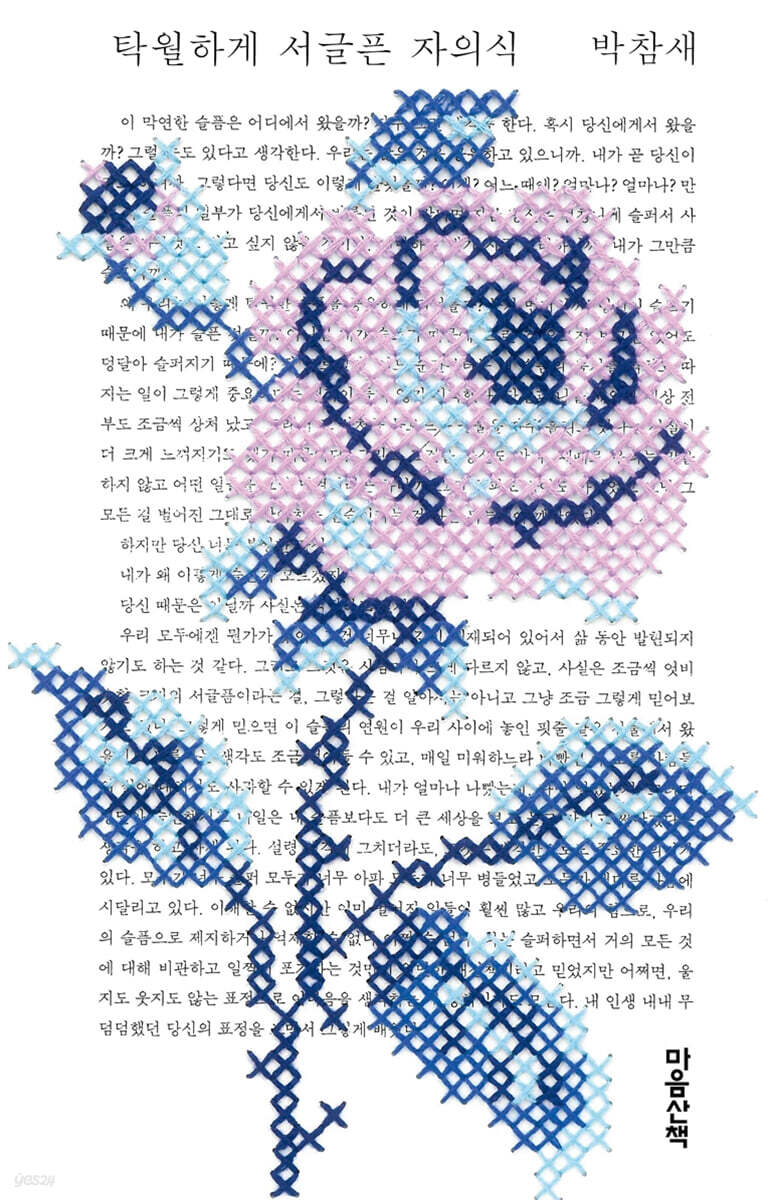
A remarkably sad self-consciousness
 |
Description
Book Introduction
- A word from MD
-
A portrait of a young poet with unwavering transparencyThe first collection of essays by Park Cham-sae, winner of the Kim Su-yeong Literary Award.
The poet, who considers sadness to be his destiny, confesses the reasonless sadness that permeates his life through his book.
I constantly think about my surroundings, the world, and poetry, and read life through literature.
A book that boldly and transparently expresses one's identity as a person who continues to write and read.
July 4, 2025. Essay PD Lee Ju-eun
“You can tell by looking at the fluctuating letters.
“How much weight did I have to bear to write this?”
Sentences that pulsate between life and literature
Poet Park Cham-sae, winner of the 42nd Kim Su-yeong Literary Award, publishes his first prose collection.
Poet Park Cham-sae, who displayed a sharp poetic sensibility in her first poetry collection, “Mind,” which won the 42nd Kim Su-yeong Literary Award, has published her first prose collection.
"Excellently Sad Self-Consciousness" is the poet's first solo work since releasing the "energy seething like an active volcano" he has been condensing for a long time into a poetry collection.
The book is a portrait of a young poet, filled with all sorts of attention he received after winning awards and publishing a collection of poems, yet still struggling with the hardships of life, the shame he felt for remaining silent about social issues, the dull days spent shivering and crying, and his escape into books as his only means of self-preservation.
For the sparrow, sadness without a source is like a fate that he must carry throughout his life.
Rather than a special emotion, it is closer to the default value of emotions that are entangled in the ‘spirit’ and ‘head’.
The poet confesses the sadness he encounters as he goes through life, from himself to his family, others, the world, poetry, and ultimately to 'being alive' itself.
This immersion that permeates youth, however, ultimately acts as a driving force for writing.
Even when my hands were shaking, even when I was shaking so much that I couldn't tell if it was a letter or not, even when I was looking at what was being written, I didn't stop writing.
All the time I spent like that is piled up here.
(…) You can tell by looking at the fluctuating letters.
How much weight did I bear while writing?
How much I wanted to write down how I endured it and how it didn't matter.
Words speak volumes.
The letters written with difficulty say more.
More than necessary.
_In the text
The writings, which continue on without hesitation and with transparency, sometimes sound like a wild shout.
At first glance, the poet appears to be at odds with the world and even with himself, but his continued immersion in writing and reading is nothing more than a gesture of confronting that discord head-on.
“How much weight did I have to bear to write this?”
Sentences that pulsate between life and literature
Poet Park Cham-sae, winner of the 42nd Kim Su-yeong Literary Award, publishes his first prose collection.
Poet Park Cham-sae, who displayed a sharp poetic sensibility in her first poetry collection, “Mind,” which won the 42nd Kim Su-yeong Literary Award, has published her first prose collection.
"Excellently Sad Self-Consciousness" is the poet's first solo work since releasing the "energy seething like an active volcano" he has been condensing for a long time into a poetry collection.
The book is a portrait of a young poet, filled with all sorts of attention he received after winning awards and publishing a collection of poems, yet still struggling with the hardships of life, the shame he felt for remaining silent about social issues, the dull days spent shivering and crying, and his escape into books as his only means of self-preservation.
For the sparrow, sadness without a source is like a fate that he must carry throughout his life.
Rather than a special emotion, it is closer to the default value of emotions that are entangled in the ‘spirit’ and ‘head’.
The poet confesses the sadness he encounters as he goes through life, from himself to his family, others, the world, poetry, and ultimately to 'being alive' itself.
This immersion that permeates youth, however, ultimately acts as a driving force for writing.
Even when my hands were shaking, even when I was shaking so much that I couldn't tell if it was a letter or not, even when I was looking at what was being written, I didn't stop writing.
All the time I spent like that is piled up here.
(…) You can tell by looking at the fluctuating letters.
How much weight did I bear while writing?
How much I wanted to write down how I endured it and how it didn't matter.
Words speak volumes.
The letters written with difficulty say more.
More than necessary.
_In the text
The writings, which continue on without hesitation and with transparency, sometimes sound like a wild shout.
At first glance, the poet appears to be at odds with the world and even with himself, but his continued immersion in writing and reading is nothing more than a gesture of confronting that discord head-on.
- You can preview some of the book's contents.
Preview
index
At the beginning of the book
sad self-consciousness
tied to the body
Ticklish scream
Poetry (running)
Paper grave
supplement
sad self-consciousness
tied to the body
Ticklish scream
Poetry (running)
Paper grave
supplement
Detailed image
.jpg)
Into the book
There are sad people.
Such people are sad for no reason.
Even if they seem to have it all, they have a huge, never-ending hole that follows them through all their lives, past, present, and future.
--- p.22
If you lose your way, it takes time.
When you lose someone, your heart is heavy.
But if I'm at a loss for words, I still don't know what to do.
And this makes me sad for a very long time.
--- p.40
Am I qualified? Can I speak of sorrow, of mourning? I still don't know.
I can't find my way to sadness.
Because I was always on the road, always wandering around in the middle of the road, lost, everything had already begun.
There is no purpose and even less of a destination.
A path of tears that can never be forgotten or become boring.
On that dead-end wide road.
--- p.49
It's sad and more difficult to feel that people don't talk about the broken parts, the patterns of their own cross-hatching.
--- p.74
I will grow old.
You will get very old.
Could I still be a sparrow then? Would my sparrow-ness be unrelated to aging? Could I even be a seventy-year-old sparrow? Could I survive as a serious old lady poet among the old men?
--- p.111
If I think that the sadness that kept flowing from somewhere and was missed or forgotten has all come to me, it's like a cute gift.
And maybe it's a real gift.
Now I'm practicing receiving it gratefully.
This absurd, overwhelming sadness, it's all mine.
--- p.158
I went to the book with an old heart.
And hid inside the book.
All the real things were poured out or said in the book.
I only chose to say or not say things that were okay to say.
Then, I was often misunderstood, hated, or loved, but the book remained the same.
He was speechless.
Don't speak.
Just be there.
Right where I asked you to be.
On days when I was really torn, I thought it was fortunate to just see the book there.
This guy is paper and I'm a human, but I'm the one getting torn.
You won't abandon me.
You will stay by my side until I abandon you.
You will continue to be a book.
Such people are sad for no reason.
Even if they seem to have it all, they have a huge, never-ending hole that follows them through all their lives, past, present, and future.
--- p.22
If you lose your way, it takes time.
When you lose someone, your heart is heavy.
But if I'm at a loss for words, I still don't know what to do.
And this makes me sad for a very long time.
--- p.40
Am I qualified? Can I speak of sorrow, of mourning? I still don't know.
I can't find my way to sadness.
Because I was always on the road, always wandering around in the middle of the road, lost, everything had already begun.
There is no purpose and even less of a destination.
A path of tears that can never be forgotten or become boring.
On that dead-end wide road.
--- p.49
It's sad and more difficult to feel that people don't talk about the broken parts, the patterns of their own cross-hatching.
--- p.74
I will grow old.
You will get very old.
Could I still be a sparrow then? Would my sparrow-ness be unrelated to aging? Could I even be a seventy-year-old sparrow? Could I survive as a serious old lady poet among the old men?
--- p.111
If I think that the sadness that kept flowing from somewhere and was missed or forgotten has all come to me, it's like a cute gift.
And maybe it's a real gift.
Now I'm practicing receiving it gratefully.
This absurd, overwhelming sadness, it's all mine.
--- p.158
I went to the book with an old heart.
And hid inside the book.
All the real things were poured out or said in the book.
I only chose to say or not say things that were okay to say.
Then, I was often misunderstood, hated, or loved, but the book remained the same.
He was speechless.
Don't speak.
Just be there.
Right where I asked you to be.
On days when I was really torn, I thought it was fortunate to just see the book there.
This guy is paper and I'm a human, but I'm the one getting torn.
You won't abandon me.
You will stay by my side until I abandon you.
You will continue to be a book.
--- pp.178-179
Publisher's Review
Hiding inside a book, I comfort my worn-out heart
Tell me about your own diagonal pattern
As can be seen from the title, ‘Excellently Sad Self-Consciousness,’ in his first collection of prose, Park Sparrow inscribes the identity of a poet who writes poetry based on sadness.
Even after going through a period where I called myself a poet “with the intention of allowing myself to be myself” and finally gaining “recognition from the establishment,” I still cannot shake off the feeling that I remain in an ambiguous existence.
The misconception that I will always be busy, the poetry that I don't write like it used to, and the issues of survival and punishment always hold me back, regardless of whether I debut.
Even while crouching like that, the poet hums a small, hopeful pledge: “I want to continue writing and write more poetry.”
This is how I feel when I accept that I have written something.
My body was empty, and I just wrote it down, faithfully becoming someone else's.
Then that writing becomes my armor.
Strong and unique.
It seems like it could survive any attack.
_In the text
It is also interesting to see Park Cham-sae as a reader before a writer, as he is known for his abundance of literary references.
While reading 『The Diary of Sylvia Plath』, he analyzes her duality and what writing meant to her as she went through the process of death, and he also presents the unique perspective that Virginia Woolf's 『The Waves』 can be read as a long poem rather than a novel "due to the aesthetics of observation and the appearance of multiple narrators who cannot be diagrammed."
In particular, in the passage where the act of 'translation' is likened to sailing and shipping in Tawada Yoko's 'People Who Move Letters', the poet's characteristically astute insight is felt.
Language does not stay still.
Float forever.
Sailing and shipping.
It is moved while traveling.
And there are people willing to track it.
There are people who cross languages.
_In the text
Crossing the stepping stones of words laid down by the poet
Find solace in a bruised heart
Just as in the interview where he said, “I don’t want to distinguish between content and form,” Park Cham-sae breaks away from the stereotypical framework in this collection of essays.
The poet divides the book into five large chapters, and within each chapter, the writing is connected like a tail biting its own tail without being divided.
The text, arranged in long breaths, is organically connected within each chunk, increasing the reader's immersion.
On the other hand, it is also quite fun to encounter the devices that the writer has prepared for the reader's lingering thoughts and rest.
Humans are fragile beings.
This will be especially true for poets who are always sensitive to everything and are aware of the gap between them and others.
The reason we seek out and read the poet's sentences is because we feel a sense of security and comfort in the writing that weaves a certain sense of homogeneity into our own language.
The young poet's desire to focus solely on writing, despite the day-to-day sense of a precarious crack, is quite endearing to those who know the difficulties of creation.
The sentences that pour out from the poet's embrace, who willingly embraces "overflowing sadness," will provide deep comfort to the reader.
Author's Note
I am a sad person.
A person who is sad for no reason.
No time, no person could ever be the reason for my sadness.
But not all sadness needs a reason, and a great deal of sadness wanders among us without a reason.
The sorrows of those who have lost their way go for a walk every day.
And you too will be a sad person.
He must be a sad person for no reason.
We often feel like we've been kicked out when we look at the things happening in the outside world, both near and far, and we're tormented by the thought that we'll be at odds with everyone forever.
Even if you cry because of me, when you hear the world's cries, you become confused again.
With a face that knows that life, life is too long.
Tell me about your own diagonal pattern
As can be seen from the title, ‘Excellently Sad Self-Consciousness,’ in his first collection of prose, Park Sparrow inscribes the identity of a poet who writes poetry based on sadness.
Even after going through a period where I called myself a poet “with the intention of allowing myself to be myself” and finally gaining “recognition from the establishment,” I still cannot shake off the feeling that I remain in an ambiguous existence.
The misconception that I will always be busy, the poetry that I don't write like it used to, and the issues of survival and punishment always hold me back, regardless of whether I debut.
Even while crouching like that, the poet hums a small, hopeful pledge: “I want to continue writing and write more poetry.”
This is how I feel when I accept that I have written something.
My body was empty, and I just wrote it down, faithfully becoming someone else's.
Then that writing becomes my armor.
Strong and unique.
It seems like it could survive any attack.
_In the text
It is also interesting to see Park Cham-sae as a reader before a writer, as he is known for his abundance of literary references.
While reading 『The Diary of Sylvia Plath』, he analyzes her duality and what writing meant to her as she went through the process of death, and he also presents the unique perspective that Virginia Woolf's 『The Waves』 can be read as a long poem rather than a novel "due to the aesthetics of observation and the appearance of multiple narrators who cannot be diagrammed."
In particular, in the passage where the act of 'translation' is likened to sailing and shipping in Tawada Yoko's 'People Who Move Letters', the poet's characteristically astute insight is felt.
Language does not stay still.
Float forever.
Sailing and shipping.
It is moved while traveling.
And there are people willing to track it.
There are people who cross languages.
_In the text
Crossing the stepping stones of words laid down by the poet
Find solace in a bruised heart
Just as in the interview where he said, “I don’t want to distinguish between content and form,” Park Cham-sae breaks away from the stereotypical framework in this collection of essays.
The poet divides the book into five large chapters, and within each chapter, the writing is connected like a tail biting its own tail without being divided.
The text, arranged in long breaths, is organically connected within each chunk, increasing the reader's immersion.
On the other hand, it is also quite fun to encounter the devices that the writer has prepared for the reader's lingering thoughts and rest.
Humans are fragile beings.
This will be especially true for poets who are always sensitive to everything and are aware of the gap between them and others.
The reason we seek out and read the poet's sentences is because we feel a sense of security and comfort in the writing that weaves a certain sense of homogeneity into our own language.
The young poet's desire to focus solely on writing, despite the day-to-day sense of a precarious crack, is quite endearing to those who know the difficulties of creation.
The sentences that pour out from the poet's embrace, who willingly embraces "overflowing sadness," will provide deep comfort to the reader.
Author's Note
I am a sad person.
A person who is sad for no reason.
No time, no person could ever be the reason for my sadness.
But not all sadness needs a reason, and a great deal of sadness wanders among us without a reason.
The sorrows of those who have lost their way go for a walk every day.
And you too will be a sad person.
He must be a sad person for no reason.
We often feel like we've been kicked out when we look at the things happening in the outside world, both near and far, and we're tormented by the thought that we'll be at odds with everyone forever.
Even if you cry because of me, when you hear the world's cries, you become confused again.
With a face that knows that life, life is too long.
GOODS SPECIFICS
- Date of issue: June 20, 2025
- Page count, weight, size: 220 pages | 378g | 135*210*17mm
- ISBN13: 9788960909342
- ISBN10: 8960909343
You may also like
카테고리
korean


korean

![GQ KOREA Mark (Monthly): December [2025]](http://librairie.coreenne.fr/cdn/shop/files/8ef265dbbfbf186523ed75ba7319009d.jpg?v=1765340328&width=3840)


