

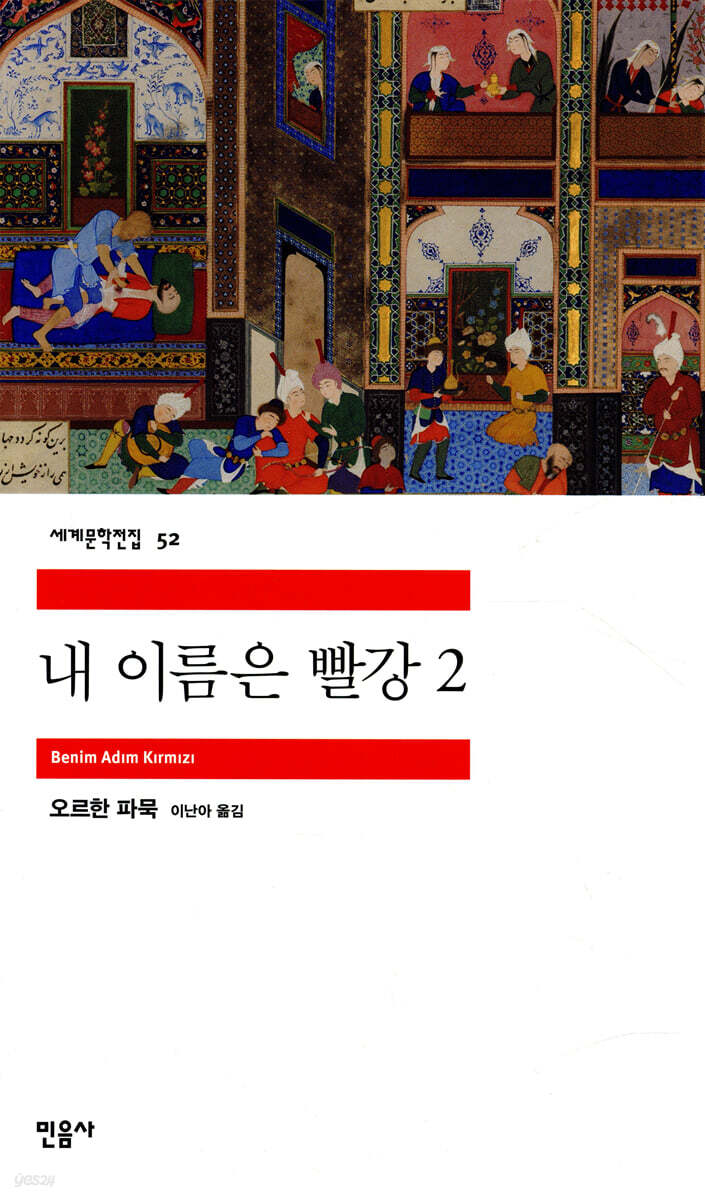
My name is Red 2
 |
Description
Book Introduction
Istanbul, a great city created by the combined civilizations of the East and the West A tale of intrigue, betrayal, and life-threatening love set in the Ottoman Empire. 2002 France's Best Foreign Literature Award, 2003 Italy's Grinzane Cavour Award, Winner of the International Impact Dublin Literary Award “I am now lying dead at the bottom of a well. It's been a long time since I took my last breath and my heart has already stopped. But no one knows what happened to me except that vile murderer who killed me. “The bones are broken and there is blood in the mouth.” The extraordinary ability to magically bring the 16th century to life in 20th-century writing, The work that gave Orhan Pamuk the title of "the true master of storytelling" "My Name is Red" is structured in such a way that the story unfolds as characters take turns telling their own stories, adopting a modern narrative technique that is rare in historical novels. The murdered corpses, the female protagonist Shekure, the male protagonist Kara, the second victim Enishite, who actively tried to adopt Western painting styles while directing the production of the Sultan's secret letters, the three miniature painters with the pseudonyms 'Butterfly', 'Olive', and 'Stork', as well as gold coins, trees, death, red (color), the devil, and even the dog in the painting speak. This narrative technique not only makes readers wonder who among them is the murderer, but also makes them feel close to the characters as they understand the circumstances and thoughts of each character from various angles. This narrative technique, in which voices of various colors overlap one another to complete a single, large story, gives the impression of building blocks, and one discovers that this work has a very dense architectural composition. At the same time, each story evokes objects painted with great detail and precision on a wide canvas, which, when overlapped with the images of painters painting miniatures in the work, embody the miniatures, the flower of Islamic culture, in the form of a story. In this way, Pamuk combines the techniques of the detective novel with a remarkably modern narrative style that shatters stereotypes about historical novels, and by displaying profound insight that lovingly embraces the history, culture, and rise and fall of Islamic civilization, he allows readers to experience anew the joy of reading a captivating novel that is both intellectually and literaryally accomplished. |
- You can preview some of the book's contents.
Preview
index
34.
I, Securé
35.
I am saying
36.
My name is Kara
37.
I am your Enishite
38.
I am the flower garden manager Osman
39.
My name is Esther
40.
My name is Kara
41.
I am the flower garden manager Osman
42.
My name is Kara
43.
Call me Olive
44.
Call me a butterfly
45.
Call me a stork
46.
They will call me a murderer
47.
I am the devil
48.
I, Securé
49.
My name is Kara
50.
We are two monks
51.
I am the flower gardener Osman
52.
My name is Kara
53.
My name is Esther
54.
I am a woman
55.
Call me a butterfly
56.
Call me a stork
57.
Call me Olive
58.
They will call me a murderer
59.
I, Securé
Commentary on the work
Author's chronology
I, Securé
35.
I am saying
36.
My name is Kara
37.
I am your Enishite
38.
I am the flower garden manager Osman
39.
My name is Esther
40.
My name is Kara
41.
I am the flower garden manager Osman
42.
My name is Kara
43.
Call me Olive
44.
Call me a butterfly
45.
Call me a stork
46.
They will call me a murderer
47.
I am the devil
48.
I, Securé
49.
My name is Kara
50.
We are two monks
51.
I am the flower gardener Osman
52.
My name is Kara
53.
My name is Esther
54.
I am a woman
55.
Call me a butterfly
56.
Call me a stork
57.
Call me Olive
58.
They will call me a murderer
59.
I, Securé
Commentary on the work
Author's chronology
Into the book
As the last of the guests at my sad wedding put on their shoes, put on their clothes, and disappeared out the front door with their candy-sucking children in tow, a long silence fell.
--- From the text
That life is like a tight-fitting shirt can only be realized by breaking free from the prison of time and space.
If true happiness in the realm of the dead is a disembodied soul, then the greatest happiness in the realm of the living is a soulless body, something no one can know until after death.
--- p.57
Of the two senators who contested before the Sultan, one, wearing a pink caftan, made a green pill so poisonous it could kill an elephant and gave it to the other, wearing a blue caftan.
The congressman in the blue caftan first took the poisoned pill, then gulped down the blue antidote and smiled sweetly.
Nothing happened to him.
Now it was his turn to taste death to his rival.
The congressman, dressed in a blue caftan, slowly plucked a pink rose, brought it to his lips, and whispered a dark poem into the rose so that no one could hear.
Then he confidently instructed the member in the pink caftan to smell the roses.
The senator in the pink caftan was so afraid of the power of the poem whispered in the rose that he died of fright the moment the rose, which had no other characteristic than its fragrance, touched his nose.
--- From the text
That life is like a tight-fitting shirt can only be realized by breaking free from the prison of time and space.
If true happiness in the realm of the dead is a disembodied soul, then the greatest happiness in the realm of the living is a soulless body, something no one can know until after death.
--- p.57
Of the two senators who contested before the Sultan, one, wearing a pink caftan, made a green pill so poisonous it could kill an elephant and gave it to the other, wearing a blue caftan.
The congressman in the blue caftan first took the poisoned pill, then gulped down the blue antidote and smiled sweetly.
Nothing happened to him.
Now it was his turn to taste death to his rival.
The congressman, dressed in a blue caftan, slowly plucked a pink rose, brought it to his lips, and whispered a dark poem into the rose so that no one could hear.
Then he confidently instructed the member in the pink caftan to smell the roses.
The senator in the pink caftan was so afraid of the power of the poem whispered in the rose that he died of fright the moment the rose, which had no other characteristic than its fragrance, touched his nose.
--- p.131
Publisher's Review
In this world filled with the threat of war and terrorism,
A problematic work that reminds us of the importance of the virtues of reconciliation and mutual understanding.
Orhan Pamuk, who dreamed of becoming a painter since childhood, developed an eye for art by copying the detailed paintings of Islamic painters from an early age.
He decided to become a writer and completed "My Name is Red" after ten years of preparation. In a word, it is a vivid record of the history of Islamic painting that surpasses even a documentary.
Set in the late 16th century, across a vast region stretching from Italy in the west to Egypt in the south and India and China in the east, the novel features Osman, who was the court painter during the reign of Suleiman the Magnificent and produced the Book of Festivals, and Belizan (a miniature painter known by the pseudonym 'Olive') as key figures.
Additionally, the creation and demise of Bihzad (?~1564), a master of Islamic miniature painting, and the Herat school, one of the important schools of Persian miniature painting, are recreated in the present day.
In addition, various Persian legends and folktales are introduced in detail, such as 『Huisreb and Shirin』, a love story comparable to Romeo and Juliet in Persian literature, as well as 『Leila and Meznun』, and 『Yusuf and Zulayha』, and the works of representative Persian poets and historians such as Rumi, Jami, Saadi, Lokman, Fuzuli, and Ferdowsi also appear in detail.
This work demonstrates that Orhan Pamuk's keen eye and insight into art and the arts exceeds that of a professional.
The conflict between the miniaturists in this novel is fundamentally contemporary, and in addition to the level of clash between civilizations, it also shows the conflict between the old and new generations resisting historical inevitability.
As we observe the conflict between pre-modern art theory, which aimed to perfectly imitate exemplary works and to approach God through such highly honed skills, and art after the emergence of 'authorial consciousness', that is, the concept of individual 'creativity' and 'creation', which ultimately leads to murder and destruction, we naturally come to understand why this novel is so persuasive to readers around the world today.
The individuality and uniqueness of each culture have value in themselves, and there are elements within them that must always be cherished, preserved, and protected.
At the same time, the world's civilization progresses while constantly colliding with new things, mixing, and changing.
In fact, the history of civilization's struggle over thousands of years has been precisely this process of progress.
"My Name is Red" shows each individual, or "human," within this macroscopic view of history.
It shows why they fight, what they sacrifice to protect their beliefs, and what they lose and gain in the process.
A problematic work that reminds us of the importance of the virtues of reconciliation and mutual understanding.
Orhan Pamuk, who dreamed of becoming a painter since childhood, developed an eye for art by copying the detailed paintings of Islamic painters from an early age.
He decided to become a writer and completed "My Name is Red" after ten years of preparation. In a word, it is a vivid record of the history of Islamic painting that surpasses even a documentary.
Set in the late 16th century, across a vast region stretching from Italy in the west to Egypt in the south and India and China in the east, the novel features Osman, who was the court painter during the reign of Suleiman the Magnificent and produced the Book of Festivals, and Belizan (a miniature painter known by the pseudonym 'Olive') as key figures.
Additionally, the creation and demise of Bihzad (?~1564), a master of Islamic miniature painting, and the Herat school, one of the important schools of Persian miniature painting, are recreated in the present day.
In addition, various Persian legends and folktales are introduced in detail, such as 『Huisreb and Shirin』, a love story comparable to Romeo and Juliet in Persian literature, as well as 『Leila and Meznun』, and 『Yusuf and Zulayha』, and the works of representative Persian poets and historians such as Rumi, Jami, Saadi, Lokman, Fuzuli, and Ferdowsi also appear in detail.
This work demonstrates that Orhan Pamuk's keen eye and insight into art and the arts exceeds that of a professional.
The conflict between the miniaturists in this novel is fundamentally contemporary, and in addition to the level of clash between civilizations, it also shows the conflict between the old and new generations resisting historical inevitability.
As we observe the conflict between pre-modern art theory, which aimed to perfectly imitate exemplary works and to approach God through such highly honed skills, and art after the emergence of 'authorial consciousness', that is, the concept of individual 'creativity' and 'creation', which ultimately leads to murder and destruction, we naturally come to understand why this novel is so persuasive to readers around the world today.
The individuality and uniqueness of each culture have value in themselves, and there are elements within them that must always be cherished, preserved, and protected.
At the same time, the world's civilization progresses while constantly colliding with new things, mixing, and changing.
In fact, the history of civilization's struggle over thousands of years has been precisely this process of progress.
"My Name is Red" shows each individual, or "human," within this macroscopic view of history.
It shows why they fight, what they sacrifice to protect their beliefs, and what they lose and gain in the process.
GOODS SPECIFICS
- Publication date: October 28, 2019
- Page count, weight, size: 388 pages | 448g | 132*225*20mm
- ISBN13: 9788937479809
- ISBN10: 893747980X
You may also like
카테고리
korean


korean

![ELLE 엘르 스페셜 에디션 A형 : 12월 [2025]](http://librairie.coreenne.fr/cdn/shop/files/b8e27a3de6c9538896439686c6b0e8fb.jpg?v=1766436872&width=3840)


