

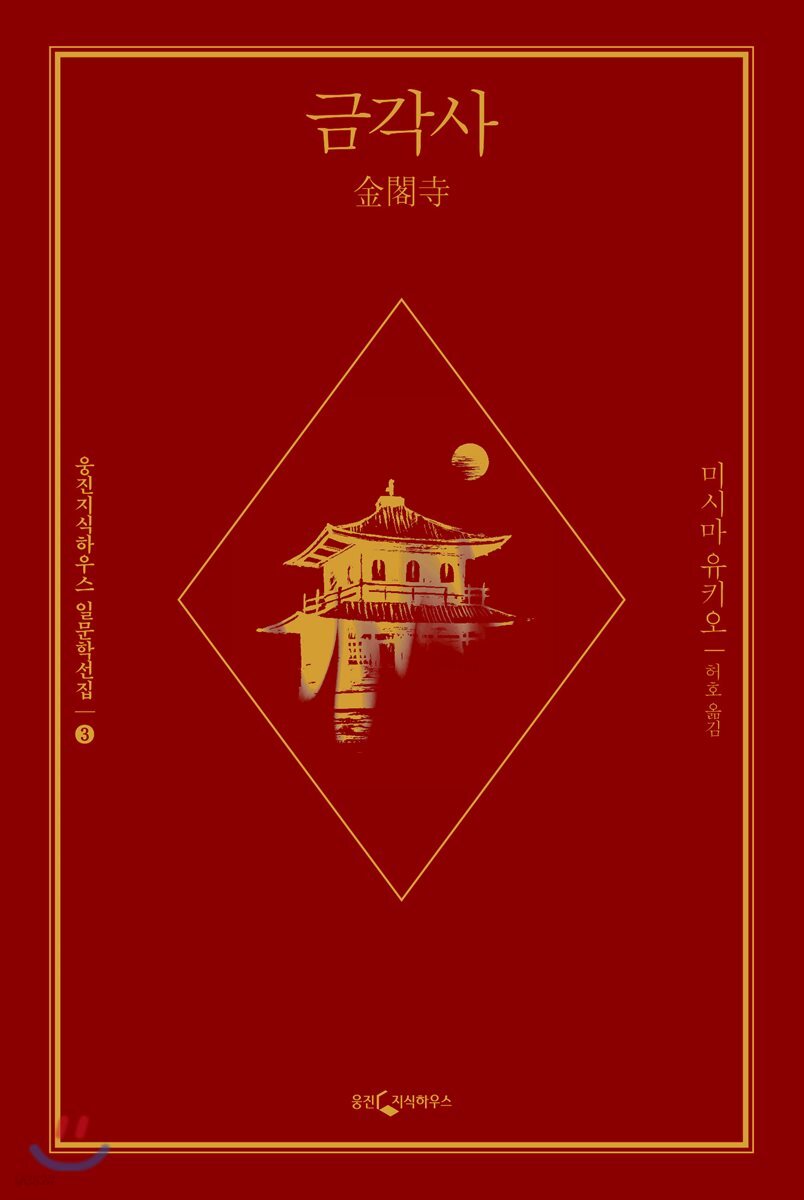
Golden Pavilion
 |
Description
Book Introduction
The third volume of the Woongjin Knowledge House Japanese Literature Collection, "The Temple of the Golden Pavilion," which contains the essence of Japanese literature.
A three-time Nobel Prize nominee, the "writer's writer"
Discover the pinnacle of aesthetic literature left behind by Yukio Mishima!
The third installment of the [Woongjin Knowledge House Japanese Literature Collection], which has been renovated after 20 years with the aim of promoting a deeper understanding of Japan, a “close but distant country,” by carefully selecting literature imbued with Japanese culture and sentiment, is now being published.
This work is the masterpiece “The Temple of the Golden Pavilion” by Yukio Mishima, a master of aesthetic literature and a three-time Nobel Prize nominee.
The work depicts in delicate and elegant language the events that unfold as the protagonist Mizoguchi, who lives alone with a complex about being ugly and having a stutter, develops a special affection and sense of unity with the "Golden Pavilion," a symbol of absolute beauty.
"The Temple of the Golden Pavilion," renowned for its aesthetic sense, splendid writing style, and meticulous composition unique to Mishima literature, is a "novel of current events" inspired by an actual arson incident that occurred in 1950, while also being a "confession novel" reflecting the author's inner self.
Perhaps that is why the work fully captures the anguish of his youth, as well as the inner conflict the author experienced before becoming absorbed in far-right ideology in his later years.
Even now, more than half a century after its publication, "The Temple of the Golden Pavilion" continues to enjoy its reputation as a masterpiece of aesthetic literature and a bible of novels not only in Japan but also around the world.
A three-time Nobel Prize nominee, the "writer's writer"
Discover the pinnacle of aesthetic literature left behind by Yukio Mishima!
The third installment of the [Woongjin Knowledge House Japanese Literature Collection], which has been renovated after 20 years with the aim of promoting a deeper understanding of Japan, a “close but distant country,” by carefully selecting literature imbued with Japanese culture and sentiment, is now being published.
This work is the masterpiece “The Temple of the Golden Pavilion” by Yukio Mishima, a master of aesthetic literature and a three-time Nobel Prize nominee.
The work depicts in delicate and elegant language the events that unfold as the protagonist Mizoguchi, who lives alone with a complex about being ugly and having a stutter, develops a special affection and sense of unity with the "Golden Pavilion," a symbol of absolute beauty.
"The Temple of the Golden Pavilion," renowned for its aesthetic sense, splendid writing style, and meticulous composition unique to Mishima literature, is a "novel of current events" inspired by an actual arson incident that occurred in 1950, while also being a "confession novel" reflecting the author's inner self.
Perhaps that is why the work fully captures the anguish of his youth, as well as the inner conflict the author experienced before becoming absorbed in far-right ideology in his later years.
Even now, more than half a century after its publication, "The Temple of the Golden Pavilion" continues to enjoy its reputation as a masterpiece of aesthetic literature and a bible of novels not only in Japan but also around the world.
- You can preview some of the book's contents.
Preview
index
Chapter 1
Chapter 2
Chapter 3
Chapter 4
Chapter 5
Chapter 6
Chapter 7
Chapter 8
Chapter 9
Chapter 10
Commentary on the Work - What is the theme of the immortal masterpiece "The Temple of the Golden Pavilion"?
annual report
Chapter 2
Chapter 3
Chapter 4
Chapter 5
Chapter 6
Chapter 7
Chapter 8
Chapter 9
Chapter 10
Commentary on the Work - What is the theme of the immortal masterpiece "The Temple of the Golden Pavilion"?
annual report
Into the book
Needless to say, my stuttering became a barrier between me and the outside world.
The first pronunciation didn't come out properly.
That first utterance was like a lock on a door that separated my inner and outer worlds, but the lock never opened easily.
Ordinary people can keep the door between the inner and outer worlds wide open and airy by speaking freely, but for me, that was simply impossible.
The lock is rusted.
--- p.10~11
Like the moon in the night sky, the Golden Pavilion was created as a symbol of the Dark Ages.
That is why the Golden Pavilion I dreamed of needed to be set against the backdrop of the darkness gathering around it.
In the darkness, a beautiful, slender structure of pillars sat quietly, emitting a faint light from within.
(……) To me, the Golden Pavilion itself seemed like a beautiful ship that had crossed the sea of time.
The Golden Pavilion has rowed for countless nights.
A voyage that may never end.
And during the day, this mysterious ship, with a face as if nothing had happened, drops anchor and becomes a spectacle for the crowds, but when night comes, it draws strength from the surrounding darkness, inflates its roof like a sail, and sets sail.
--- p.32~34
It is no exaggeration to say that the first problem I faced in life was beauty.
My father, a simple monk from the countryside, had a limited vocabulary and could only teach me, “There is nothing in this world as beautiful as the Golden Pavilion.”
I couldn't help but feel dissatisfied and anxious at the thought that something called beauty already existed in places I didn't even know about.
If beauty is clearly present there, then the existence of a country becomes alienated from beauty.
--- p.34
“Step on it.
“You, step on it!” I didn’t know what he was saying.
But his blue eyes commanded from on high.
Behind his broad shoulders, the snow-covered Golden Pavilion shone, and the blue winter sky, as if washed, was moist.
His blue eyes were not cruel at all.
Why did that moment, that moment, feel like the most lyrical thing in the world? (……) Since it was not a situation where I could resist, I put on my rubber boots.
My feet came down and stepped on something soft like mud on a spring day.
It was a woman's belly.
The woman moaned with her eyes closed.
--- p.113
“It’s called ‘Namcheon Chammyo.’
The cat that Monk Namcheon killed is not ordinary.
The cat was beautiful, you know? Absolutely beautiful.
A beauty is like, how should I put it, a cavity.
It touches the tongue, it makes you feel pain and it asserts its existence.
(……) It seems like killing a cat is like removing a painful cavity and purifying beauty, but it is not clear whether it was really the final solution.
The roots of beauty have not been eradicated, and even if the cat were to die, beauty might not have died.
To satirize the fact that the solution was so easy, Joju put a shoe on his head.
He knew that there was no solution other than enduring the pain of the cavity.”
For the first time, I felt true fear from Kashiwagi.
I was afraid to keep quiet, so I asked again.
“Then which one are you? Monk Namcheon or Joju?” “Well, which one is it?
For now, I am Namcheon and you are Joju, but someday, you may become Namcheon and I may become Joju.
This public security officer literally changes his eyes like a cat's."
--- p.211
I will not go into any further detail about the fact that when the eternal, absolute Golden Pavilion appears and my eyes become the eyes of that Golden Pavilion, the world will be transformed in this way, and that in that transformed world, only the Golden Pavilion will maintain its form and possess beauty, reducing everything else to dust.
Ever since I stepped on the prostitute in the Golden Pavilion Garden, and since Tsurukawa's sudden death, my mind has been asking itself the following question:
'Is evil really possible?'
--- p.231
Suddenly, I remembered what Kashiwagi had said to me the day we first met.
It was said that the moment we suddenly become cruel is the same as when we are absentmindedly watching the sunlight filtering through the trees on a well-mowed lawn on a bright spring afternoon.
(……) Could the thought that suddenly occurred to me be as cruel as Kashiwagi's words? The thought arose within me out of nowhere, revealing the meaning that had been floating around in my mind for some time, and began to brightly illuminate my inner self.
As soon as it was born, it became powerful and huge, and I was enveloped by it.
The thought was like this.
'The Golden Pavilion must be burned.'
The first pronunciation didn't come out properly.
That first utterance was like a lock on a door that separated my inner and outer worlds, but the lock never opened easily.
Ordinary people can keep the door between the inner and outer worlds wide open and airy by speaking freely, but for me, that was simply impossible.
The lock is rusted.
--- p.10~11
Like the moon in the night sky, the Golden Pavilion was created as a symbol of the Dark Ages.
That is why the Golden Pavilion I dreamed of needed to be set against the backdrop of the darkness gathering around it.
In the darkness, a beautiful, slender structure of pillars sat quietly, emitting a faint light from within.
(……) To me, the Golden Pavilion itself seemed like a beautiful ship that had crossed the sea of time.
The Golden Pavilion has rowed for countless nights.
A voyage that may never end.
And during the day, this mysterious ship, with a face as if nothing had happened, drops anchor and becomes a spectacle for the crowds, but when night comes, it draws strength from the surrounding darkness, inflates its roof like a sail, and sets sail.
--- p.32~34
It is no exaggeration to say that the first problem I faced in life was beauty.
My father, a simple monk from the countryside, had a limited vocabulary and could only teach me, “There is nothing in this world as beautiful as the Golden Pavilion.”
I couldn't help but feel dissatisfied and anxious at the thought that something called beauty already existed in places I didn't even know about.
If beauty is clearly present there, then the existence of a country becomes alienated from beauty.
--- p.34
“Step on it.
“You, step on it!” I didn’t know what he was saying.
But his blue eyes commanded from on high.
Behind his broad shoulders, the snow-covered Golden Pavilion shone, and the blue winter sky, as if washed, was moist.
His blue eyes were not cruel at all.
Why did that moment, that moment, feel like the most lyrical thing in the world? (……) Since it was not a situation where I could resist, I put on my rubber boots.
My feet came down and stepped on something soft like mud on a spring day.
It was a woman's belly.
The woman moaned with her eyes closed.
--- p.113
“It’s called ‘Namcheon Chammyo.’
The cat that Monk Namcheon killed is not ordinary.
The cat was beautiful, you know? Absolutely beautiful.
A beauty is like, how should I put it, a cavity.
It touches the tongue, it makes you feel pain and it asserts its existence.
(……) It seems like killing a cat is like removing a painful cavity and purifying beauty, but it is not clear whether it was really the final solution.
The roots of beauty have not been eradicated, and even if the cat were to die, beauty might not have died.
To satirize the fact that the solution was so easy, Joju put a shoe on his head.
He knew that there was no solution other than enduring the pain of the cavity.”
For the first time, I felt true fear from Kashiwagi.
I was afraid to keep quiet, so I asked again.
“Then which one are you? Monk Namcheon or Joju?” “Well, which one is it?
For now, I am Namcheon and you are Joju, but someday, you may become Namcheon and I may become Joju.
This public security officer literally changes his eyes like a cat's."
--- p.211
I will not go into any further detail about the fact that when the eternal, absolute Golden Pavilion appears and my eyes become the eyes of that Golden Pavilion, the world will be transformed in this way, and that in that transformed world, only the Golden Pavilion will maintain its form and possess beauty, reducing everything else to dust.
Ever since I stepped on the prostitute in the Golden Pavilion Garden, and since Tsurukawa's sudden death, my mind has been asking itself the following question:
'Is evil really possible?'
--- p.231
Suddenly, I remembered what Kashiwagi had said to me the day we first met.
It was said that the moment we suddenly become cruel is the same as when we are absentmindedly watching the sunlight filtering through the trees on a well-mowed lawn on a bright spring afternoon.
(……) Could the thought that suddenly occurred to me be as cruel as Kashiwagi's words? The thought arose within me out of nowhere, revealing the meaning that had been floating around in my mind for some time, and began to brightly illuminate my inner self.
As soon as it was born, it became powerful and huge, and I was enveloped by it.
The thought was like this.
'The Golden Pavilion must be burned.'
--- p.276~277
Publisher's Review
“My only pride was that I was not understood by others.”
The agony of a stutterer and ugly man who lived oppressed in stark contrast to the beauty of the Golden Pavilion
The power of true stories that made solid narratives and meticulous composition possible
The protagonist, Mizoguchi, is ugly, stutters, and has an introverted personality. He has lived a lonely life since childhood.
His father, a monk at a small temple, used to say, “There is nothing in this world as beautiful as the Golden Pavilion,” and Mizoguchi came to regard the Golden Pavilion, the polar opposite of his own ugliness, as a symbol of beauty, and felt a special affection and sense of unity with it.
The method was truly unique.
He, who had always prided himself on having been alienated from beauty, finally believed that in the midst of a war with unexpected bombings, he was reborn as the same being as the Golden Pavilion, the symbol of absolute beauty, and himself, a mere stammerer.
But even after the war, the Golden Pavilion still stood strong and shining, unblemished, and Mizoguchi was overcome with a sense of loneliness and frustration.
Despite the complex and ever-changing psychology of the characters, the plot is dense and the narrative continues solidly because "The Temple of the Golden Pavilion" is a "current affairs novel" inspired by the arson incident that occurred in 1950.
In fact, Yukio Mishima closely investigated the Kinkaku-ji arson incident and the life of its perpetrator, Hayashi Shoken, for about five years, and focused on Hayashi's testimony of "alienation of humanity" and "jealousy of beauty."
Of course, this wasn't just Hayashi Shoken's story.
The reason Yukio Mishima, who was in his 30s, became obsessed with physical training was also because of his inferiority complex about being born weak.
Ultimately, the series of events in the play where Mizoguchi suffers from an inferiority complex due to her body complex and, unable to bear her situation of being excluded from beauty, attempts to destroy the Golden Pavilion are also the author's own bare face.
A controversial writer and three-time Nobel Prize in Literature nominee
Yukio Mishima's "Confessions" written during a literary turning point
Living up to his nickname, "The Genius of the Showa Period," Yukio Mishima published 180 novels, 60 plays, and a vast amount of essays and critiques during his 23-year writing career.
Among his numerous works, “The Temple of the Golden Pavilion” was the masterpiece that made Yukio Mishima the greatest writer of his time.
For this work, he won the Yomiuri Literary Prize in 1957, and was nominated for the Nobel Prize in Literature three times in a row from 1963 to 1965.
As Japanese literary critic Yoshimi Usui commented, “It is surprising that one can fill oneself up like this and express it in a novel,” “The Temple of the Golden Pavilion” is a “confession novel” written during Yukio Mishima’s literary turning point.
Unlike his early days, when he focused on his innate anxiety and sensitive sensibilities, in his 30s he began to focus on his physical intellect, which actively attempts to 'self-reform'.
The first such attempt was The Sinking Falls, and the work that ultimately achieved its completed form was The Temple of the Golden Pavilion.
“I wanted to let you know.
It is perception that transforms this world.
You see, nothing else can change the world.
Only perception can transform the world from its unchanging state.
“You could say that in order to endure this life, humans have come to use perception as a weapon.”
“It is never perception that transforms the world,” I countered, risking a confession.
“It is action that transforms the world.
“That’s all there is to it.”
-From the text
It was not a mere coincidence that in the play, the main character Mizoguchi escaped the world of perception and was reborn as an 'actor' with the help of Kashiwagi, who had bow legs.
It is in line with the author's will to abandon his past self, who was physically and mentally weak, and to pioneer a new life by devoting himself to physical exercise.
Fourteen years after the publication of "The Temple of the Golden Pavilion," Yukio Mishima committed suicide by seppuku.
There are differing opinions as to how he, who tried to live his life by reforming himself, ended up in such an extreme death.
Even today, Yukio Mishima's later years continue to spark intense controversy, and the value of "The Temple of the Golden Pavilion," written at a crucial juncture both personally and literary, remains vivid.
The work contains the anguish of his youth, as well as the inner conflict he experienced before becoming absorbed in far-right ideology.
“There is a feeling that transcends the passage of time.
“This is a work that must be savored to the last line.” _Japanese Amazon Reader Review
The pinnacle of aesthetic literature that no one can surpass!
Depicting the fundamental human dilemma in a delicate and elegant style
The epithets that follow "The Temple of the Golden Pavilion" and Yukio Mishima are varied, but everyone agrees that he is a master of aesthetic literature that no one can surpass.
This is why, regardless of the extreme right-wing actions of Yukio Mishima in his later years, we must evaluate his unique aesthetic sense, flowing prose, meticulous composition, and delicate psychological depiction.
Hideo Kobayashi, the literary critic who established modern Japanese criticism, praised The Temple of the Golden Pavilion as “a very beautiful lyric poem rather than a novel,” and repeatedly expressed admiration for its splendid yet elegant style.
Tsuji Hitonari, the author of the best-selling book “Between Calm and Passion,” also showed his affection for Yukio Mishima, saying, “I’ve read ‘The Temple of the Golden Pavilion’ dozens of times.”
The idea of a mummy is shallow and foolish, but it may be enough to motive a crime of arson against a national treasure.
Yukio Mishima, Nudity and Clothing - Diary (1959)
The reason why 'beauty' shines even brighter in Yukio Mishima's literature is because it implies a fundamental dilemma: the inability to align one's inner self with the external world, which leads to self-loathing.
As humans are imperfect beings, we are bound to be fascinated by perfect objects while also being infinitely intimidated by them.
Everyone has aspects of Mizoguchi and Hayashi Shoken, who long for absolute beauty like the Golden Pavilion, but are tormented by their own inability to reach it, and ultimately try to destroy their idol.
"The Temple of the Golden Pavilion" starkly exposes the abyss held by the imperfect beings known as humans.
The sentences stand out even more like a lyric poem, the psychological descriptions of the characters are so delicate that even the slightest tremors are conveyed, and the expression of beauty itself is splendid but never excessive.
That is why, even now, half a century after its publication, 『The Temple of the Golden Pavilion』 continues to be renowned as a "novel bible" that countless writers practice with, and a "masterpiece of aesthetic literature" that touches the emotions and evokes empathy from readers around the world.
The agony of a stutterer and ugly man who lived oppressed in stark contrast to the beauty of the Golden Pavilion
The power of true stories that made solid narratives and meticulous composition possible
The protagonist, Mizoguchi, is ugly, stutters, and has an introverted personality. He has lived a lonely life since childhood.
His father, a monk at a small temple, used to say, “There is nothing in this world as beautiful as the Golden Pavilion,” and Mizoguchi came to regard the Golden Pavilion, the polar opposite of his own ugliness, as a symbol of beauty, and felt a special affection and sense of unity with it.
The method was truly unique.
He, who had always prided himself on having been alienated from beauty, finally believed that in the midst of a war with unexpected bombings, he was reborn as the same being as the Golden Pavilion, the symbol of absolute beauty, and himself, a mere stammerer.
But even after the war, the Golden Pavilion still stood strong and shining, unblemished, and Mizoguchi was overcome with a sense of loneliness and frustration.
Despite the complex and ever-changing psychology of the characters, the plot is dense and the narrative continues solidly because "The Temple of the Golden Pavilion" is a "current affairs novel" inspired by the arson incident that occurred in 1950.
In fact, Yukio Mishima closely investigated the Kinkaku-ji arson incident and the life of its perpetrator, Hayashi Shoken, for about five years, and focused on Hayashi's testimony of "alienation of humanity" and "jealousy of beauty."
Of course, this wasn't just Hayashi Shoken's story.
The reason Yukio Mishima, who was in his 30s, became obsessed with physical training was also because of his inferiority complex about being born weak.
Ultimately, the series of events in the play where Mizoguchi suffers from an inferiority complex due to her body complex and, unable to bear her situation of being excluded from beauty, attempts to destroy the Golden Pavilion are also the author's own bare face.
A controversial writer and three-time Nobel Prize in Literature nominee
Yukio Mishima's "Confessions" written during a literary turning point
Living up to his nickname, "The Genius of the Showa Period," Yukio Mishima published 180 novels, 60 plays, and a vast amount of essays and critiques during his 23-year writing career.
Among his numerous works, “The Temple of the Golden Pavilion” was the masterpiece that made Yukio Mishima the greatest writer of his time.
For this work, he won the Yomiuri Literary Prize in 1957, and was nominated for the Nobel Prize in Literature three times in a row from 1963 to 1965.
As Japanese literary critic Yoshimi Usui commented, “It is surprising that one can fill oneself up like this and express it in a novel,” “The Temple of the Golden Pavilion” is a “confession novel” written during Yukio Mishima’s literary turning point.
Unlike his early days, when he focused on his innate anxiety and sensitive sensibilities, in his 30s he began to focus on his physical intellect, which actively attempts to 'self-reform'.
The first such attempt was The Sinking Falls, and the work that ultimately achieved its completed form was The Temple of the Golden Pavilion.
“I wanted to let you know.
It is perception that transforms this world.
You see, nothing else can change the world.
Only perception can transform the world from its unchanging state.
“You could say that in order to endure this life, humans have come to use perception as a weapon.”
“It is never perception that transforms the world,” I countered, risking a confession.
“It is action that transforms the world.
“That’s all there is to it.”
-From the text
It was not a mere coincidence that in the play, the main character Mizoguchi escaped the world of perception and was reborn as an 'actor' with the help of Kashiwagi, who had bow legs.
It is in line with the author's will to abandon his past self, who was physically and mentally weak, and to pioneer a new life by devoting himself to physical exercise.
Fourteen years after the publication of "The Temple of the Golden Pavilion," Yukio Mishima committed suicide by seppuku.
There are differing opinions as to how he, who tried to live his life by reforming himself, ended up in such an extreme death.
Even today, Yukio Mishima's later years continue to spark intense controversy, and the value of "The Temple of the Golden Pavilion," written at a crucial juncture both personally and literary, remains vivid.
The work contains the anguish of his youth, as well as the inner conflict he experienced before becoming absorbed in far-right ideology.
“There is a feeling that transcends the passage of time.
“This is a work that must be savored to the last line.” _Japanese Amazon Reader Review
The pinnacle of aesthetic literature that no one can surpass!
Depicting the fundamental human dilemma in a delicate and elegant style
The epithets that follow "The Temple of the Golden Pavilion" and Yukio Mishima are varied, but everyone agrees that he is a master of aesthetic literature that no one can surpass.
This is why, regardless of the extreme right-wing actions of Yukio Mishima in his later years, we must evaluate his unique aesthetic sense, flowing prose, meticulous composition, and delicate psychological depiction.
Hideo Kobayashi, the literary critic who established modern Japanese criticism, praised The Temple of the Golden Pavilion as “a very beautiful lyric poem rather than a novel,” and repeatedly expressed admiration for its splendid yet elegant style.
Tsuji Hitonari, the author of the best-selling book “Between Calm and Passion,” also showed his affection for Yukio Mishima, saying, “I’ve read ‘The Temple of the Golden Pavilion’ dozens of times.”
The idea of a mummy is shallow and foolish, but it may be enough to motive a crime of arson against a national treasure.
Yukio Mishima, Nudity and Clothing - Diary (1959)
The reason why 'beauty' shines even brighter in Yukio Mishima's literature is because it implies a fundamental dilemma: the inability to align one's inner self with the external world, which leads to self-loathing.
As humans are imperfect beings, we are bound to be fascinated by perfect objects while also being infinitely intimidated by them.
Everyone has aspects of Mizoguchi and Hayashi Shoken, who long for absolute beauty like the Golden Pavilion, but are tormented by their own inability to reach it, and ultimately try to destroy their idol.
"The Temple of the Golden Pavilion" starkly exposes the abyss held by the imperfect beings known as humans.
The sentences stand out even more like a lyric poem, the psychological descriptions of the characters are so delicate that even the slightest tremors are conveyed, and the expression of beauty itself is splendid but never excessive.
That is why, even now, half a century after its publication, 『The Temple of the Golden Pavilion』 continues to be renowned as a "novel bible" that countless writers practice with, and a "masterpiece of aesthetic literature" that touches the emotions and evokes empathy from readers around the world.
GOODS SPECIFICS
- Date of issue: April 7, 2017
- Page count, weight, size: 408 pages | 398g | 126*188*30mm
- ISBN13: 9788901215907
- ISBN10: 890121590X
You may also like
카테고리
korean


korean

![ELLE 엘르 스페셜 에디션 A형 : 12월 [2025]](http://librairie.coreenne.fr/cdn/shop/files/b8e27a3de6c9538896439686c6b0e8fb.jpg?v=1766436872&width=3840)


