

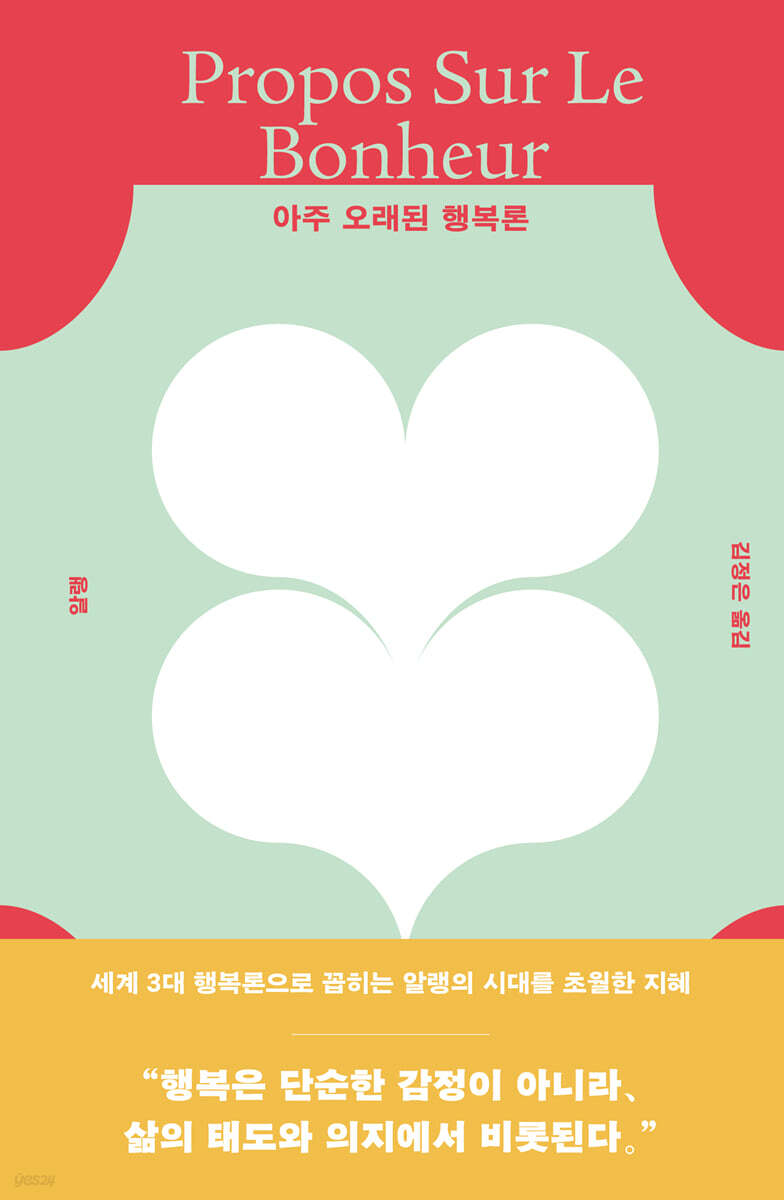
A very old theory of happiness
 |
Description
Book Introduction
★ A famous work considered one of the world's three greatest theories of happiness, along with Russell and Tolstoy's Theory of Happiness ★
★ A modern reinterpretation of Alain's theory of happiness, which remains unchanged even after 100 years ★
★ Highly recommended by Yoo Seong-ho, a forensic pathologist and professor of forensic medicine at Seoul National University College of Medicine ★
A clear insight into the mindset and attitude that keeps happiness close to you rather than pushing it away.
“If you don’t want to be happy, you will never be happy.”
『A Very Old Theory of Happiness』 is a collection of essays on the subject of happiness selected from among the philosophical and short essays (a type of column called propos) serialized in French newspapers from 1906 to 1936 by Alain, a representative 20th-century French philosopher and critic.
Even today, over 100 years later, his philosophy and guidance on happiness remain undiminished, but rather remain clear and distinct.
This may be because even as times change and values change, the core and essence of human happiness, such as emotions, will, actions, and relationships, remain unchanged.
Who doesn't want happiness?
As the Constitution of the Republic of Korea clearly states that everyone has the “right to pursue happiness,” happiness is a right that everyone can enjoy.
Even in his time, Alain shook up the perception of happiness by suggesting that happiness is both a right and a 'duty'.
Based on this philosophy, the book vividly depicts a vague happiness that seems within reach.
According to the dictionary, happiness is 'a state of feeling sufficient satisfaction and joy in life.'
At first glance, it seems very simple, but humans are complex beings who get caught up in the past, regret and become depressed, or fear and become anxious about the future, and thus, they become further and further from happiness.
Moreover, for modern people who live in a reality where the gap between the rich and the poor is widening and we are busy comparing ourselves to each other due to the development of media, happiness seems to be increasingly inflated and grandiose, and so the more we desire it, the further it seems to run away.
Alain emphasizes that happiness is an important topic for everyone, and that happiness is not an 'emotion' but an 'action'.
The more you think about everything, the more difficult, complicated, sad, and depressing it seems.
But if you stop thinking, have the will, get up from your seat, and do it yourself, happiness will come much closer.
When the New Year comes, everyone exchanges greetings like “Happy New Year” as if it were a habit.
The 'fortune' mentioned here is 'happiness'.
How wonderful it would be if good fortune just rolled in like this common greeting, but good fortune is not something you receive passively by just sitting still. You can obtain it when you actively create it yourself by moving your body, even if it is small.
Reading "A Very Old Theory of Happiness" deeply imprints on our hearts that happiness is not an abstract concept, but a way of life that must be consciously pursued and practiced in the small moments of everyday life.
If you are looking for the path to happiness, this book will light the way like a bright lighthouse.
★ A modern reinterpretation of Alain's theory of happiness, which remains unchanged even after 100 years ★
★ Highly recommended by Yoo Seong-ho, a forensic pathologist and professor of forensic medicine at Seoul National University College of Medicine ★
A clear insight into the mindset and attitude that keeps happiness close to you rather than pushing it away.
“If you don’t want to be happy, you will never be happy.”
『A Very Old Theory of Happiness』 is a collection of essays on the subject of happiness selected from among the philosophical and short essays (a type of column called propos) serialized in French newspapers from 1906 to 1936 by Alain, a representative 20th-century French philosopher and critic.
Even today, over 100 years later, his philosophy and guidance on happiness remain undiminished, but rather remain clear and distinct.
This may be because even as times change and values change, the core and essence of human happiness, such as emotions, will, actions, and relationships, remain unchanged.
Who doesn't want happiness?
As the Constitution of the Republic of Korea clearly states that everyone has the “right to pursue happiness,” happiness is a right that everyone can enjoy.
Even in his time, Alain shook up the perception of happiness by suggesting that happiness is both a right and a 'duty'.
Based on this philosophy, the book vividly depicts a vague happiness that seems within reach.
According to the dictionary, happiness is 'a state of feeling sufficient satisfaction and joy in life.'
At first glance, it seems very simple, but humans are complex beings who get caught up in the past, regret and become depressed, or fear and become anxious about the future, and thus, they become further and further from happiness.
Moreover, for modern people who live in a reality where the gap between the rich and the poor is widening and we are busy comparing ourselves to each other due to the development of media, happiness seems to be increasingly inflated and grandiose, and so the more we desire it, the further it seems to run away.
Alain emphasizes that happiness is an important topic for everyone, and that happiness is not an 'emotion' but an 'action'.
The more you think about everything, the more difficult, complicated, sad, and depressing it seems.
But if you stop thinking, have the will, get up from your seat, and do it yourself, happiness will come much closer.
When the New Year comes, everyone exchanges greetings like “Happy New Year” as if it were a habit.
The 'fortune' mentioned here is 'happiness'.
How wonderful it would be if good fortune just rolled in like this common greeting, but good fortune is not something you receive passively by just sitting still. You can obtain it when you actively create it yourself by moving your body, even if it is small.
Reading "A Very Old Theory of Happiness" deeply imprints on our hearts that happiness is not an abstract concept, but a way of life that must be consciously pursued and practiced in the small moments of everyday life.
If you are looking for the path to happiness, this book will light the way like a bright lighthouse.
- You can preview some of the book's contents.
Preview
index
preface
A Tribute to Madame de Mauve-Lamborghin
Chapter 1 Passion - To you who is seething with anxiety and anger
When you are feeling emotional, relax and stay calm.
How to overcome depression with ease
Moods rise and fall like a boat on waves
The more you chew on sadness, the more it grows.
Grief is a function of the body, not the head.
Worry is a disease, and ignorance is bliss.
Look at the reasons behind the actions
Imagination causes symptoms
Don't repeat the tragedy in your imagination.
Little things create happiness and unhappiness.
Worry and anxiety cause illness
Just smiling makes my heart lighter
Neither underestimate joy nor exaggerate sorrow
First, try to soften your attitude.
Yawn to distract your thoughts
Don't focus on yourself, just look far ahead.
Chapter 2: Affirmation - Out of the Darkness and into the Light
Hope creates reasons to hope
Don't judge fate so easily.
Make the experience your own
If you're going, you're already right
An active being who creates the future
Believe in fate, not in desire.
Despair is an illusion, we are all lucky.
This fate is my choice
The pleasures given and the pleasures won
Misfortune may be less than you think.
If you look closely, every sight is beautiful.
Back to life
I have the strength to endure misfortune.
Actively choose optimism
This too shall pass
The future is as much as you believe in it.
Chapter 3: Execution - Only Action Creates Emotion and Change
If you just think about this and that and do nothing
Don't delve into your thoughts, move your body.
If you want to do something, do it.
Don't look up, climb the mountain
There is no boredom for those who concentrate.
Pleasure arises naturally with action.
Only my actions create happiness and freedom.
Be happy with your actions, but beware of their power.
A working farmer is better than a boring king.
Best work, worst work
Discipline and consciousness bring inner peace.
Useful labor is more enjoyable than rest.
Let go of hope and just get started
My biggest enemy is within me.
Chapter 4 Relationships - May our relationship be comfortable and free
Love also requires conscious effort.
Not too close, not too far
Think from other people's perspectives
Indifference is better than excessive worry.
Balancing Intimacy and Courtesy
How to Live as a Good Couple
Sadness is not beautiful
Express kindness with words and facial expressions.
How to Deal with Annoying Words
Cheerfulness is more beautiful than sadness
True courtesy is comfortable and natural.
Joy to Joy
Friendship between two poets
Love is good for your health, hate is bad for your health.
Kindness is the greatest gift
Don't wait for happiness, go find it.
Make others happy
Chapter 5 Happiness - To you who will definitely become happy
Happiness you create yourself never betrays you.
Don't worry about death
Don't be fooled by the appeal of passion.
Don't regret anything, focus on the present.
Don't be a fool who chews over pain.
How to Use Your Time to Enjoy Your Trip
Choose positivity over complaining
Optimism breeds growth
Happiness is peace itself
Understand reality as it is
The pain does not belong to me
Cheerful mood therapy
You will be happy by hoping for happiness.
Plato's Prescription for Happiness and Health
Happiness is a virtue
Joy and happiness are the most capable doctors.
How to be happy in everyday life
Happiness is a duty
Happiness is within me
A Tribute to Madame de Mauve-Lamborghin
Chapter 1 Passion - To you who is seething with anxiety and anger
When you are feeling emotional, relax and stay calm.
How to overcome depression with ease
Moods rise and fall like a boat on waves
The more you chew on sadness, the more it grows.
Grief is a function of the body, not the head.
Worry is a disease, and ignorance is bliss.
Look at the reasons behind the actions
Imagination causes symptoms
Don't repeat the tragedy in your imagination.
Little things create happiness and unhappiness.
Worry and anxiety cause illness
Just smiling makes my heart lighter
Neither underestimate joy nor exaggerate sorrow
First, try to soften your attitude.
Yawn to distract your thoughts
Don't focus on yourself, just look far ahead.
Chapter 2: Affirmation - Out of the Darkness and into the Light
Hope creates reasons to hope
Don't judge fate so easily.
Make the experience your own
If you're going, you're already right
An active being who creates the future
Believe in fate, not in desire.
Despair is an illusion, we are all lucky.
This fate is my choice
The pleasures given and the pleasures won
Misfortune may be less than you think.
If you look closely, every sight is beautiful.
Back to life
I have the strength to endure misfortune.
Actively choose optimism
This too shall pass
The future is as much as you believe in it.
Chapter 3: Execution - Only Action Creates Emotion and Change
If you just think about this and that and do nothing
Don't delve into your thoughts, move your body.
If you want to do something, do it.
Don't look up, climb the mountain
There is no boredom for those who concentrate.
Pleasure arises naturally with action.
Only my actions create happiness and freedom.
Be happy with your actions, but beware of their power.
A working farmer is better than a boring king.
Best work, worst work
Discipline and consciousness bring inner peace.
Useful labor is more enjoyable than rest.
Let go of hope and just get started
My biggest enemy is within me.
Chapter 4 Relationships - May our relationship be comfortable and free
Love also requires conscious effort.
Not too close, not too far
Think from other people's perspectives
Indifference is better than excessive worry.
Balancing Intimacy and Courtesy
How to Live as a Good Couple
Sadness is not beautiful
Express kindness with words and facial expressions.
How to Deal with Annoying Words
Cheerfulness is more beautiful than sadness
True courtesy is comfortable and natural.
Joy to Joy
Friendship between two poets
Love is good for your health, hate is bad for your health.
Kindness is the greatest gift
Don't wait for happiness, go find it.
Make others happy
Chapter 5 Happiness - To you who will definitely become happy
Happiness you create yourself never betrays you.
Don't worry about death
Don't be fooled by the appeal of passion.
Don't regret anything, focus on the present.
Don't be a fool who chews over pain.
How to Use Your Time to Enjoy Your Trip
Choose positivity over complaining
Optimism breeds growth
Happiness is peace itself
Understand reality as it is
The pain does not belong to me
Cheerful mood therapy
You will be happy by hoping for happiness.
Plato's Prescription for Happiness and Health
Happiness is a virtue
Joy and happiness are the most capable doctors.
How to be happy in everyday life
Happiness is a duty
Happiness is within me
Detailed image
.jpg)
Into the book
It will be useful to keep this point in mind as you turn the pages of 『A Very Old Theory of Happiness』.
The subtle wisdom contained in Alain's proposal on the secret of happiness in the face of fortuitous circumstances is not moralism but fundamental philosophy.
To put it more simply, the expression 'the duty to be happy' is a beautiful hyperbole used to emphasize that existence is power, not subordination.
As a hero constantly whips himself, so the will gains strength by its own command.
This point should never be misunderstood.
--- p.11 From the “Preface”
Some people seem to particularly enjoy misfortune.
This tendency is more evident in lunatics.
Seeing such things makes us realize that humans can create certain mystical and demonic emotions.
But that is an illusion.
People who torment themselves do not do so because they have some great abyss of the mind or a taste for pain.
It is suffering from the agitation and excitement that comes from not knowing the cause of one's emotions and from one's own desire to maintain that state.
--- p.54 From “Chapter 1 Passion: To you who is seething with anxiety and anger - Small things create happiness and unhappiness”
No one chooses.
We are all just moving forward and all paths are right.
I think the secret to living in this world is to first of all not fight with yourself about your decisions and work.
Instead, it's about doing the job well.
We want to feel some kind of destiny from things that we did not choose, but have already chosen.
But the chosen work does not bind us at all.
Because there is no bad luck there.
If you try to make any luck good, it will become good luck.
There is no behavior that reveals one's own shortcomings more than talking too much about one's own nature.
Because no one chooses their nature.
Yet nature holds enough potential to satisfy any ambitious person.
Accepting necessity and making it a virtue is truly beautiful and great.
--- p.87 From “Chapter 2 Affirmation: If you are moving out of the darkness and toward the light, you are already right”
A truly foolish man is one who leaps ten times in two days, thinking he can snatch up a tasty prey all at once, like a magpie.
There's no way things will go well if you rush around without properly preparing.
I have seen capable people make a fortune overnight by sticking their claws out.
When we see things like that, we sometimes say that this society is unfair.
But that statement is actually unfair.
This society gives nothing to those who do not ask for it.
To seek here means to seek continuously and continuously.
In this society, there is nothing wrong with seeking, because knowledge and judgment are not everything.
--- pp.144-145 From “Chapter 3: Execution: Only Action Creates Emotions and Change - Don’t Look, Climb the Mountain”
Imagination deceives us in many ways.
Among them, the reason we are mainly deceived is because we believe that the vivid excitement that imagination gives tells us something.
But that useless agitation ends there.
Because the song is something that happens now, and the plan is always in the future.
A lazy person says, “I have to do it.”
Any decent person should say, “I am doing it.”
Because action holds the future.
--- p.173 From “Chapter 3: Execution: Only Action Creates Emotions and Change - Let Go of Hope and Just Get Started”
Even after we have overcome the lies of the priests, there is still work to be done.
We must hold on to life with dignity, not harm ourselves, and not infect others by appealing to tragedy.
Moreover, since everything is interconnected, we should not keep talking about or exaggerating the minor inconveniences of life to others.
We must be kind to others and kind to ourselves.
Helping others live their lives and helping yourself too, that is true compassion.
Kindness is joy.
Love is joy.
--- p.210 From “Chapter 4 Relationships: May we be comfortable and free between us - Joy is more beautiful than sadness”
People say that happiness always runs away from us.
Happiness that is given for free is like that.
Because there is nothing to find in such happiness.
But the happiness you create for yourself never betrays you.
Happiness is a learning process, and we always live while learning.
The more you know, the greater your ability to learn becomes.
--- p.238 From “Chapter 5 Happiness: To you who will definitely be happy - Happiness you create yourself will not betray you”
Happiness is something you cannot find the moment you start looking for it.
It's not strange at all.
Happiness is not something you can pick up, pay for, and take home on display in a display case.
If an item in a display case was blue or red, unless I'm mistaken, it will still be blue or red when I bring it home.
But happiness is only happiness when it is held by me.
If you try to find happiness in a world outside of yourself, nothing will seem like happiness.
In short, it is impossible to reason about or predict happiness.
Happiness must be possessed now.
The subtle wisdom contained in Alain's proposal on the secret of happiness in the face of fortuitous circumstances is not moralism but fundamental philosophy.
To put it more simply, the expression 'the duty to be happy' is a beautiful hyperbole used to emphasize that existence is power, not subordination.
As a hero constantly whips himself, so the will gains strength by its own command.
This point should never be misunderstood.
--- p.11 From the “Preface”
Some people seem to particularly enjoy misfortune.
This tendency is more evident in lunatics.
Seeing such things makes us realize that humans can create certain mystical and demonic emotions.
But that is an illusion.
People who torment themselves do not do so because they have some great abyss of the mind or a taste for pain.
It is suffering from the agitation and excitement that comes from not knowing the cause of one's emotions and from one's own desire to maintain that state.
--- p.54 From “Chapter 1 Passion: To you who is seething with anxiety and anger - Small things create happiness and unhappiness”
No one chooses.
We are all just moving forward and all paths are right.
I think the secret to living in this world is to first of all not fight with yourself about your decisions and work.
Instead, it's about doing the job well.
We want to feel some kind of destiny from things that we did not choose, but have already chosen.
But the chosen work does not bind us at all.
Because there is no bad luck there.
If you try to make any luck good, it will become good luck.
There is no behavior that reveals one's own shortcomings more than talking too much about one's own nature.
Because no one chooses their nature.
Yet nature holds enough potential to satisfy any ambitious person.
Accepting necessity and making it a virtue is truly beautiful and great.
--- p.87 From “Chapter 2 Affirmation: If you are moving out of the darkness and toward the light, you are already right”
A truly foolish man is one who leaps ten times in two days, thinking he can snatch up a tasty prey all at once, like a magpie.
There's no way things will go well if you rush around without properly preparing.
I have seen capable people make a fortune overnight by sticking their claws out.
When we see things like that, we sometimes say that this society is unfair.
But that statement is actually unfair.
This society gives nothing to those who do not ask for it.
To seek here means to seek continuously and continuously.
In this society, there is nothing wrong with seeking, because knowledge and judgment are not everything.
--- pp.144-145 From “Chapter 3: Execution: Only Action Creates Emotions and Change - Don’t Look, Climb the Mountain”
Imagination deceives us in many ways.
Among them, the reason we are mainly deceived is because we believe that the vivid excitement that imagination gives tells us something.
But that useless agitation ends there.
Because the song is something that happens now, and the plan is always in the future.
A lazy person says, “I have to do it.”
Any decent person should say, “I am doing it.”
Because action holds the future.
--- p.173 From “Chapter 3: Execution: Only Action Creates Emotions and Change - Let Go of Hope and Just Get Started”
Even after we have overcome the lies of the priests, there is still work to be done.
We must hold on to life with dignity, not harm ourselves, and not infect others by appealing to tragedy.
Moreover, since everything is interconnected, we should not keep talking about or exaggerating the minor inconveniences of life to others.
We must be kind to others and kind to ourselves.
Helping others live their lives and helping yourself too, that is true compassion.
Kindness is joy.
Love is joy.
--- p.210 From “Chapter 4 Relationships: May we be comfortable and free between us - Joy is more beautiful than sadness”
People say that happiness always runs away from us.
Happiness that is given for free is like that.
Because there is nothing to find in such happiness.
But the happiness you create for yourself never betrays you.
Happiness is a learning process, and we always live while learning.
The more you know, the greater your ability to learn becomes.
--- p.238 From “Chapter 5 Happiness: To you who will definitely be happy - Happiness you create yourself will not betray you”
Happiness is something you cannot find the moment you start looking for it.
It's not strange at all.
Happiness is not something you can pick up, pay for, and take home on display in a display case.
If an item in a display case was blue or red, unless I'm mistaken, it will still be blue or red when I bring it home.
But happiness is only happiness when it is held by me.
If you try to find happiness in a world outside of yourself, nothing will seem like happiness.
In short, it is impossible to reason about or predict happiness.
Happiness must be possessed now.
--- p.294 From “Chapter 5 Happiness: To You Who Will Definitely Be Happy - Happiness Is Within Me”
Publisher's Review
“Is your happiness truly yours?”
Alain's insight into the "essence of happiness" 100 years ago
There is a saying, 'outsourcing happiness.'
It refers to the phenomenon of relying on and entrusting happiness to external factors or other people rather than finding it within oneself or trying to create it on one's own.
In today's world, where it seems as though 'what you see is everything', it is especially easy to look for the standard of happiness outside of ourselves.
The 'standard of happiness' that says you have to have as much as others, be as high in status as others, and be as cool and beautiful as others to be happy actually makes people move further away from happiness.
This is because I constantly feel pressured to meet society's standards for happiness rather than my own.
It seems like you're asking for help from others to make it easier to be happy, but ironically, the more you do that, the more you alienate yourself from happiness.
What will happen if this phenomenon continues? We don't need to look far; just look at ourselves and our surroundings to easily understand.
Because we see the results every day.
How many people are so caught up in blaming others for their misfortunes, and so lost in a state of emotional control that they allow external circumstances to sway their emotions?
Additionally, while we become accustomed to conditional happiness, thinking, "If only ~~ would make me happy," it is not uncommon for people to feel chronically unhappy when these external conditions are not met.
This is the reason why modern people suffer from so much stress, are crushed by mental hunger, and often suffer from depression and panic disorder.
To overcome the externalization of happiness and find true happiness, we must cultivate the ability to regulate our emotions regardless of external circumstances and become the 'subject' who creates our own happiness.
We must also live faithfully in the present moment without being bound by the conditions we must achieve in the future or by past experiences.
This solution cannot but be in perfect agreement with the theory of happiness that Alain preached 100 years ago.
Alain emphasized that happiness does not come from outside sources, but rather comes from subjective will and actions, and that we must create happiness ourselves.
It cannot be said that happiness is when everyone looks the same and moves in the same direction.
Alain brilliantly reconstructs his concept of happiness from the perspective of ordinary people, while also suggesting specific ways to practice happiness in everyday life.
As you read this book, you will reflect on the true meaning of happiness and gain practical wisdom and insights that you can apply to your life.
“If you are aware and act, you will be happy, but if you are lazy, you will soon fall into worry and regret.”
The key to happiness is small daily practices.
This book, which presents the essence of happiness and how to practice it in a concrete and clear way rather than in a vague way, begins by talking about 'passion.'
Passion refers to thoughts that arise from emotions and are difficult to suppress.
We've all probably had times when we were lying awake late at night, tormented by endless thoughts.
Alain describes this condition as 'a pain that does not exist anywhere in the world, but is vivid.'
Alain's views on passions are based on Descartes's The Passions.
Descartes believed that our body and emotions influence each other.
For example, our physical state can affect our emotions, and conversely, our emotions can affect our body.
Alain emphasizes that to become happy, we must correctly understand and control these passions, and this requires willpower, active effort, and, above all, practical action.
We often get anxious by imagining things that haven't even happened, or we worry about problems by looking for the cause in the wrong places.
When I think back on this experience, I can easily empathize with Alain's argument.
After dealing with passion in Chapter 1, the book talks about 'affirmation' in Chapter 2.
Despair is just an illusion in our minds, and we are told to actively choose optimism.
Chapter 3 deals with ‘execution’.
Breaking free from negative emotions and creating change is 'action', and this can be said to be the core of Alain's theory of happiness.
Rather than setting grand goals, he advises that happiness can be found through small daily practices, and encourages people to just 'get started and get moving.'
Chapter 4 deals with 'relationships', which are essential to happiness, and Chapter 5 concludes with the topic of 'happiness' in general.
As you follow the natural flow of the book, you will be able to figure out what 'my happiness' is and what first steps you should take to realize that happiness.
“Be kind, but strike a balance between intimacy and courtesy.”
Happiness that spreads from me to you and to society
Chapter 4, which deals with relationships, focuses on love, friendship, kindness, and courtesy.
It explains in detail how to behave between couples, friends, and close friends so that relationships can be enriched and filled with joy.
If you maintain natural manners that are ingrained in you, you can speak and act naturally without making others feel uneasy or hurting them.
Rather, joy and happiness are contagious.
The following description of the joy and happiness being transmitted from me to you will make you smile just by reading the contents of the book.
If my presence brings true joy to my friend, I also feel joy when I see my friend's joy.
So, each person receives back the joy they gave.
At the same time, the treasure called joy opens wide.
So both friends think like this.
'I became happy without any effort.'
Alain offers the insight that individual happiness leads to the happiness of society.
The reason social conflicts arise and wars break out is because there are unhappy individuals and individuals who cannot control their anger.
In a modern world where people are becoming isolated amidst extreme individualism and competition, Alain's theory of happiness suggests the value of communal happiness by reminding people of the importance of 'happiness for all' rather than 'happiness for myself alone.'
Alain's "A Very Old Theory of Happiness" goes beyond simple comfort or advice to offer deep insights into the essence of life.
It also presents concrete and practical methods to modern people who say they want to be happy but are vague about what happiness truly is and how to achieve it.
In a time when intangible happiness, standardized happiness, and conditional happiness are rampant, this book will help you discover the path to true happiness, transcending the anxieties, fears, and loneliness of life.
Alain's insight into the "essence of happiness" 100 years ago
There is a saying, 'outsourcing happiness.'
It refers to the phenomenon of relying on and entrusting happiness to external factors or other people rather than finding it within oneself or trying to create it on one's own.
In today's world, where it seems as though 'what you see is everything', it is especially easy to look for the standard of happiness outside of ourselves.
The 'standard of happiness' that says you have to have as much as others, be as high in status as others, and be as cool and beautiful as others to be happy actually makes people move further away from happiness.
This is because I constantly feel pressured to meet society's standards for happiness rather than my own.
It seems like you're asking for help from others to make it easier to be happy, but ironically, the more you do that, the more you alienate yourself from happiness.
What will happen if this phenomenon continues? We don't need to look far; just look at ourselves and our surroundings to easily understand.
Because we see the results every day.
How many people are so caught up in blaming others for their misfortunes, and so lost in a state of emotional control that they allow external circumstances to sway their emotions?
Additionally, while we become accustomed to conditional happiness, thinking, "If only ~~ would make me happy," it is not uncommon for people to feel chronically unhappy when these external conditions are not met.
This is the reason why modern people suffer from so much stress, are crushed by mental hunger, and often suffer from depression and panic disorder.
To overcome the externalization of happiness and find true happiness, we must cultivate the ability to regulate our emotions regardless of external circumstances and become the 'subject' who creates our own happiness.
We must also live faithfully in the present moment without being bound by the conditions we must achieve in the future or by past experiences.
This solution cannot but be in perfect agreement with the theory of happiness that Alain preached 100 years ago.
Alain emphasized that happiness does not come from outside sources, but rather comes from subjective will and actions, and that we must create happiness ourselves.
It cannot be said that happiness is when everyone looks the same and moves in the same direction.
Alain brilliantly reconstructs his concept of happiness from the perspective of ordinary people, while also suggesting specific ways to practice happiness in everyday life.
As you read this book, you will reflect on the true meaning of happiness and gain practical wisdom and insights that you can apply to your life.
“If you are aware and act, you will be happy, but if you are lazy, you will soon fall into worry and regret.”
The key to happiness is small daily practices.
This book, which presents the essence of happiness and how to practice it in a concrete and clear way rather than in a vague way, begins by talking about 'passion.'
Passion refers to thoughts that arise from emotions and are difficult to suppress.
We've all probably had times when we were lying awake late at night, tormented by endless thoughts.
Alain describes this condition as 'a pain that does not exist anywhere in the world, but is vivid.'
Alain's views on passions are based on Descartes's The Passions.
Descartes believed that our body and emotions influence each other.
For example, our physical state can affect our emotions, and conversely, our emotions can affect our body.
Alain emphasizes that to become happy, we must correctly understand and control these passions, and this requires willpower, active effort, and, above all, practical action.
We often get anxious by imagining things that haven't even happened, or we worry about problems by looking for the cause in the wrong places.
When I think back on this experience, I can easily empathize with Alain's argument.
After dealing with passion in Chapter 1, the book talks about 'affirmation' in Chapter 2.
Despair is just an illusion in our minds, and we are told to actively choose optimism.
Chapter 3 deals with ‘execution’.
Breaking free from negative emotions and creating change is 'action', and this can be said to be the core of Alain's theory of happiness.
Rather than setting grand goals, he advises that happiness can be found through small daily practices, and encourages people to just 'get started and get moving.'
Chapter 4 deals with 'relationships', which are essential to happiness, and Chapter 5 concludes with the topic of 'happiness' in general.
As you follow the natural flow of the book, you will be able to figure out what 'my happiness' is and what first steps you should take to realize that happiness.
“Be kind, but strike a balance between intimacy and courtesy.”
Happiness that spreads from me to you and to society
Chapter 4, which deals with relationships, focuses on love, friendship, kindness, and courtesy.
It explains in detail how to behave between couples, friends, and close friends so that relationships can be enriched and filled with joy.
If you maintain natural manners that are ingrained in you, you can speak and act naturally without making others feel uneasy or hurting them.
Rather, joy and happiness are contagious.
The following description of the joy and happiness being transmitted from me to you will make you smile just by reading the contents of the book.
If my presence brings true joy to my friend, I also feel joy when I see my friend's joy.
So, each person receives back the joy they gave.
At the same time, the treasure called joy opens wide.
So both friends think like this.
'I became happy without any effort.'
Alain offers the insight that individual happiness leads to the happiness of society.
The reason social conflicts arise and wars break out is because there are unhappy individuals and individuals who cannot control their anger.
In a modern world where people are becoming isolated amidst extreme individualism and competition, Alain's theory of happiness suggests the value of communal happiness by reminding people of the importance of 'happiness for all' rather than 'happiness for myself alone.'
Alain's "A Very Old Theory of Happiness" goes beyond simple comfort or advice to offer deep insights into the essence of life.
It also presents concrete and practical methods to modern people who say they want to be happy but are vague about what happiness truly is and how to achieve it.
In a time when intangible happiness, standardized happiness, and conditional happiness are rampant, this book will help you discover the path to true happiness, transcending the anxieties, fears, and loneliness of life.
GOODS SPECIFICS
- Date of issue: January 20, 2025
- Format: Hardcover book binding method guide
- Page count, weight, size: 304 pages | 132*204*30mm
- ISBN13: 9791171179503
- ISBN10: 1171179502
You may also like
카테고리
korean


korean

![GQ KOREA Mark (Monthly): December [2025]](http://librairie.coreenne.fr/cdn/shop/files/8ef265dbbfbf186523ed75ba7319009d.jpg?v=1765340328&width=3840)


