

There is no love without pain
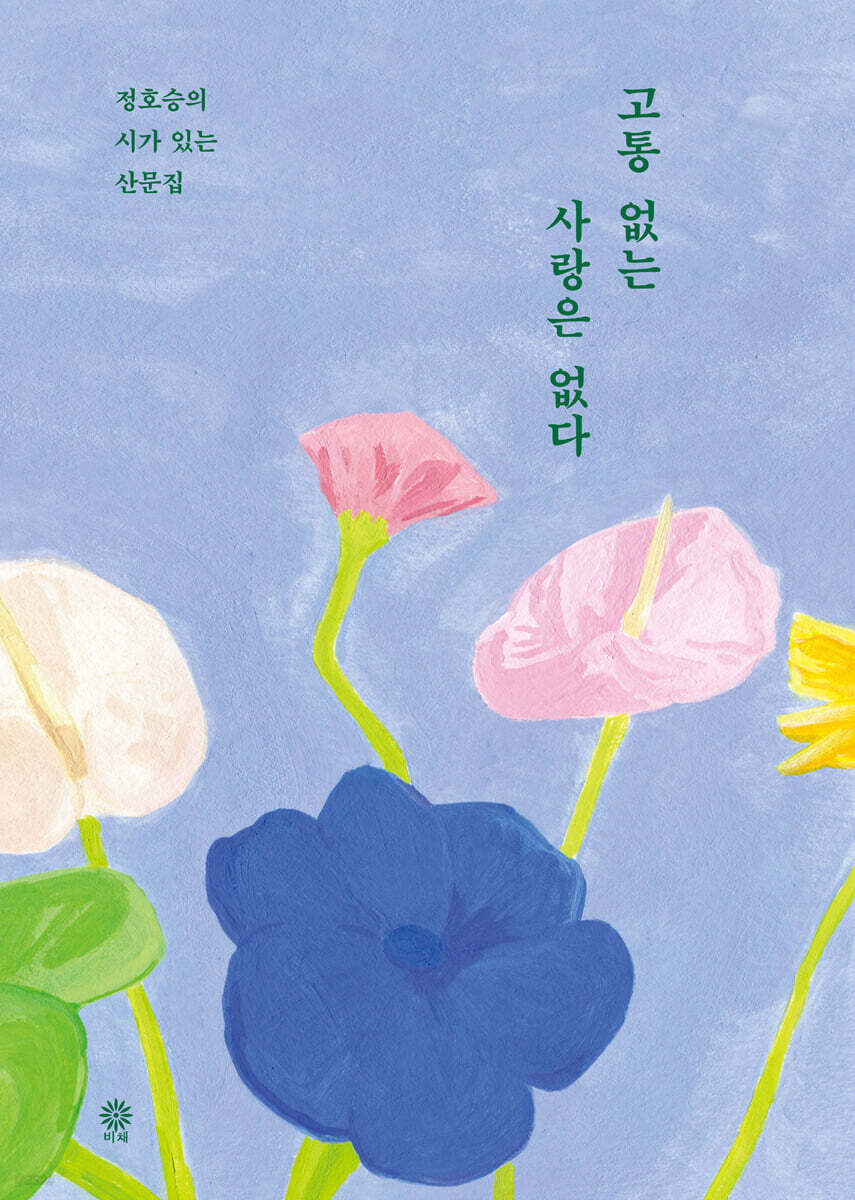 |
Description
Book Introduction
- A word from MD
-
Poet Jeong Ho-seung's Poetry and Life StoriesA collection of 68 poems and prose pieces personally selected by Jeong Ho-seung, a master of Korean lyric poetry.
Stories related to the poet's creation of poetry, such as his representative poems "Sorrow to Joy" and "From Which Star Are We," unfold gently.
It is not a simple commentary on the poem, but contains the poet's insight into a time when he endured countless loves and pains.
January 30, 2024. Essay PD Kim Yu-ri
Jeong Ho-seung, a master of Korean lyric poetry
A steady record of life beyond his poetry
Jeong Ho-seung, a master of Korean lyric poetry who has been writing for over 50 years, is a poet of our time loved by all generations.
What prompted him to write such beautiful poetry? Just as removing the paint from a masterpiece reveals a rough sketch, Jeong Ho-seung's poetry is imbued with the human spirit of life.
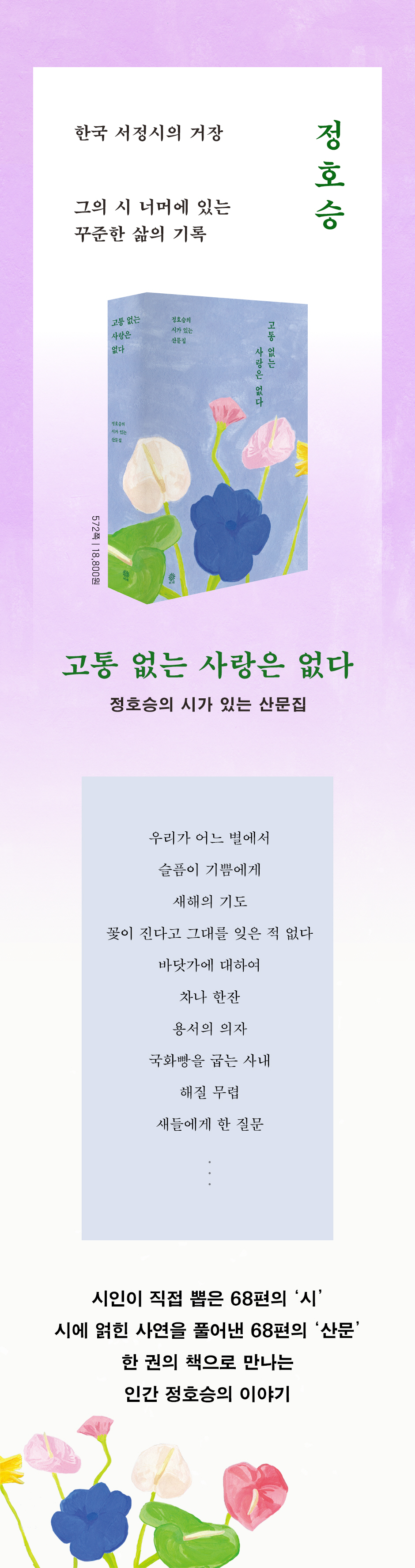
"There is no love without pain" is a collection of prose with poetry, which contains 68 poems personally selected by poet Jeong Ho-seung, and 68 prose pieces that unravel the stories behind those poems.
Many of the poet's representative poems, such as "Which Star Are We From?", "Sadness to Joy", and "I Never Forgot You Even When Flowers Fall," are included, and prose that explains the circumstances at the time the poems were created is presented in pairs.
The book includes over 20 photos that the poet has cherished, including those from his childhood, his military service, and especially those of his beloved and cherished parents.
A steady record of life beyond his poetry
Jeong Ho-seung, a master of Korean lyric poetry who has been writing for over 50 years, is a poet of our time loved by all generations.
What prompted him to write such beautiful poetry? Just as removing the paint from a masterpiece reveals a rough sketch, Jeong Ho-seung's poetry is imbued with the human spirit of life.
"There is no love without pain" is a collection of prose with poetry, which contains 68 poems personally selected by poet Jeong Ho-seung, and 68 prose pieces that unravel the stories behind those poems.
Many of the poet's representative poems, such as "Which Star Are We From?", "Sadness to Joy", and "I Never Forgot You Even When Flowers Fall," are included, and prose that explains the circumstances at the time the poems were created is presented in pairs.
The book includes over 20 photos that the poet has cherished, including those from his childhood, his military service, and especially those of his beloved and cherished parents.
- You can preview some of the book's contents.
Preview
Detailed image
Into the book
These days, when I drink tea, I often think about the pain of past failures.
Even when I try to think about the present, I often end up going back to the past.
In such cases, I don't necessarily try to avoid being dragged back to the past.
But what's surprising is that if I keep holding the car, I become indifferent to the past anger and hurt that I was dragged into.
Tea neutralizes my past with my present world, like river water and sea water meeting in my mind.
Just as river water eventually becomes seawater when it meets sea water, while I drink tea, I feel like I am in the past, but I am always in the present.
--- p.26
Stained glass is not made from clear glass.
It is made by gluing together pieces of colored glass.
The sunlight passing through the broken pieces of stained glass creates such beautiful patterns of color.
So, the reason my life was shattered was also to make my life beautiful.
Pain exists in my life to make me beautiful.
--- p.166
It was when I was waiting at the Chuncheon Reserve Forces Unit, where even fallen leaves fall at right angles, to be assigned to a unit after completing basic training.
When I was trembling with fear and anxiety, not knowing where I would be deployed to the forward area, someone came to visit me, a private.
I ran breathlessly across the wide parade ground where heavy snow was falling.
A small man stood with his coat collar turned up next to the guard post at the main gate where the interview room was located.
It was my father.
Unexpectedly, my father came all the way from Daegu to Chuncheon to visit me.
“Is it cold?”
My father took out his hand from inside his coat and held my hand, which was rough and bruised from arduous training.
“Are you hungry?”
Suddenly tears welled up in my eyes.
“Want some bread?”
I couldn't help but shed tears as I hurriedly ate several red bean buns my father had bought me at the meeting place.
--- p.358
I've also moved around quite a bit in my Titan truck.
If I count on my fingers, it seems like it's more than fifteen times.
The reason is because they were poor.
Unlike today when the lease contract period is two years, in the past the contract period was six months.
So if you do it wrong, you might end up moving twice a year.
When I move and load all my belongings into the Titan truck, there's no room for me, so sometimes I end up being loaded into the truck like a piece of luggage and driven around downtown Seoul.
The street scenery I saw at that time was so desolate that it was truly sad.
So, at that time, I thought that I didn't want to discuss life with someone who hadn't been loaded into a Titan truck and driven through the middle of the city like a piece of luggage.
Even now, in my mind, the Titan truck driven by the poor father runs with the sea in the background.
I run to the shore where the rocks are far away and then come back again several times.
I am grateful for the spring sea that makes even the Titan Truck beautiful.
The sea makes even memories of poverty beautiful.
--- p.392
I once made that promise too.
We once promised to meet at the Shinsoldong Rotary Tea House on the first snow day, and that we would wait all day to meet when the first snow fell.
And I've waited all day and walked arm in arm through the streets late into the night when the first snow fell.
I've even had a snowball fight while walking.
When I walked too much and got hungry, I would go up to the chestnut vendor who was standing on the snowy street with a carbide torch lit and became a part of the scenery, and buy chestnuts.
But now there is no one who can make such a promise.
From the moment that promise disappeared, I began to lose my youth.
There are no plans, but even now, when the first snow falls, I wander the snowy streets, hoping to meet someone.
--- p.461
It's a long time ago, but once I stopped by a shoe shine shop to get my shoes shined, and I saw a poem called "The Boy Who Shines Shoes" written in ballpoint pen and pasted on a piece of paper.
I couldn't help but be surprised to see a poem posted on a corner of the wall in that narrow space where shoe soles and various repair tools were strewn about.
“I like this poem.
“Is this your own poem?”
I pretended not to know and started talking.
"no.
Who sent me this wonderful poem?
He said that this poem was perfect for me.
So I put it up like this and read it every day.
“Every time I shine my shoes, I secretly feel better when I think of myself as shining a star.”
I was so touched by his words that I almost said that it was a poem I had written.
“Haha, if you think about it that way, I’m the one who asked you to shine my shoes, so I’m turning into a star.”
He didn't say that he was the poet who wrote the poem, but just continued speaking with a bright face.
He just smiled silently.
At that time, I felt the joy and satisfaction of writing poetry in my heart.
I think that was the first time I realized that poetry belongs not to the writer but to the reader.
How precious is the value of being able to bring laughter and joy to the arduous labor of shining and repairing someone else's shoes with a single poem?
Even when I try to think about the present, I often end up going back to the past.
In such cases, I don't necessarily try to avoid being dragged back to the past.
But what's surprising is that if I keep holding the car, I become indifferent to the past anger and hurt that I was dragged into.
Tea neutralizes my past with my present world, like river water and sea water meeting in my mind.
Just as river water eventually becomes seawater when it meets sea water, while I drink tea, I feel like I am in the past, but I am always in the present.
--- p.26
Stained glass is not made from clear glass.
It is made by gluing together pieces of colored glass.
The sunlight passing through the broken pieces of stained glass creates such beautiful patterns of color.
So, the reason my life was shattered was also to make my life beautiful.
Pain exists in my life to make me beautiful.
--- p.166
It was when I was waiting at the Chuncheon Reserve Forces Unit, where even fallen leaves fall at right angles, to be assigned to a unit after completing basic training.
When I was trembling with fear and anxiety, not knowing where I would be deployed to the forward area, someone came to visit me, a private.
I ran breathlessly across the wide parade ground where heavy snow was falling.
A small man stood with his coat collar turned up next to the guard post at the main gate where the interview room was located.
It was my father.
Unexpectedly, my father came all the way from Daegu to Chuncheon to visit me.
“Is it cold?”
My father took out his hand from inside his coat and held my hand, which was rough and bruised from arduous training.
“Are you hungry?”
Suddenly tears welled up in my eyes.
“Want some bread?”
I couldn't help but shed tears as I hurriedly ate several red bean buns my father had bought me at the meeting place.
--- p.358
I've also moved around quite a bit in my Titan truck.
If I count on my fingers, it seems like it's more than fifteen times.
The reason is because they were poor.
Unlike today when the lease contract period is two years, in the past the contract period was six months.
So if you do it wrong, you might end up moving twice a year.
When I move and load all my belongings into the Titan truck, there's no room for me, so sometimes I end up being loaded into the truck like a piece of luggage and driven around downtown Seoul.
The street scenery I saw at that time was so desolate that it was truly sad.
So, at that time, I thought that I didn't want to discuss life with someone who hadn't been loaded into a Titan truck and driven through the middle of the city like a piece of luggage.
Even now, in my mind, the Titan truck driven by the poor father runs with the sea in the background.
I run to the shore where the rocks are far away and then come back again several times.
I am grateful for the spring sea that makes even the Titan Truck beautiful.
The sea makes even memories of poverty beautiful.
--- p.392
I once made that promise too.
We once promised to meet at the Shinsoldong Rotary Tea House on the first snow day, and that we would wait all day to meet when the first snow fell.
And I've waited all day and walked arm in arm through the streets late into the night when the first snow fell.
I've even had a snowball fight while walking.
When I walked too much and got hungry, I would go up to the chestnut vendor who was standing on the snowy street with a carbide torch lit and became a part of the scenery, and buy chestnuts.
But now there is no one who can make such a promise.
From the moment that promise disappeared, I began to lose my youth.
There are no plans, but even now, when the first snow falls, I wander the snowy streets, hoping to meet someone.
--- p.461
It's a long time ago, but once I stopped by a shoe shine shop to get my shoes shined, and I saw a poem called "The Boy Who Shines Shoes" written in ballpoint pen and pasted on a piece of paper.
I couldn't help but be surprised to see a poem posted on a corner of the wall in that narrow space where shoe soles and various repair tools were strewn about.
“I like this poem.
“Is this your own poem?”
I pretended not to know and started talking.
"no.
Who sent me this wonderful poem?
He said that this poem was perfect for me.
So I put it up like this and read it every day.
“Every time I shine my shoes, I secretly feel better when I think of myself as shining a star.”
I was so touched by his words that I almost said that it was a poem I had written.
“Haha, if you think about it that way, I’m the one who asked you to shine my shoes, so I’m turning into a star.”
He didn't say that he was the poet who wrote the poem, but just continued speaking with a bright face.
He just smiled silently.
At that time, I felt the joy and satisfaction of writing poetry in my heart.
I think that was the first time I realized that poetry belongs not to the writer but to the reader.
How precious is the value of being able to bring laughter and joy to the arduous labor of shining and repairing someone else's shoes with a single poem?
--- p.567
Publisher's Review
Poetry and prose are inseparable, one body.
The stories behind his poetry, as told by poet Jeong Ho-seung himself.
Jeong Ho-seung, who debuted in 1972 and has been writing poetry for over 50 years.
He is loved by all generations as a friendly poet who uses everyday language.
He published poetry collections that sensitively responded to reality and contained profound reflections, such as 『Sadness to Joy』, 『Jesus of Seoul』, 『Because I'm Lonely, I'm Human』, and 『Sadness Came by Delivery』, establishing himself as a true master of Korean lyric poetry.
In addition, prose collections such as “A Word That Gave Strength to My Life” and “A Word That Gave Courage to My Life” have been consistently read for over 18 years since their publication.
A poet says that poetry and prose are inseparable and are 'one body'.
He confesses that he has long desired a book that combines poetry and prose, saying that poetry and prose both originate from a single moment in everyday life.
'Jeong Ho-seung's Prose Collection with Poetry' was born from this poet's wish.
The first collection of prose with poetry, "I'm Not Lonely Even When I'm Lonely," published in 2020, was enthusiastically welcomed by readers, becoming a bestseller in all major bookstores. Thanks to that love, the second collection of prose with poetry, "There Is No Love Without Pain," will meet readers in 2024.
Beyond the Poet Jeong Ho-seung, the Human Jeong Ho-seung
The poignant comfort that anyone's life can become a poem
『There is no love without pain』 is a collection of 68 poems personally selected by the poet and 68 prose pieces containing stories related to the poems.
This book is composed of the poet's representative poems such as "Which Star Are We From?", "Sorrow to Joy", and "I Never Forgot You Even When Flowers Fall", along with prose that reveals the feelings and stories at the time the poems were written.
Therefore, it is far from a commentary or analysis of the poem.
The poet reveals his innermost thoughts as if confessing.
How did he overcome the separation he experienced in his youth, what resolutions did he make as a young poet living in the 1970s, what was Seoul like at night as seen through the eyes of a poor head of household?
As the title of the book borrows from Cardinal Kim Su-hwan's words, "There is pain without love, but there is no love without pain," poet Jeong Ho-seung writes about the love and pain he has experienced and shows the sight of it blossoming into outstanding poetry.
Because it is a carefully selected collection of poems from his youth to recent times, “There is no love without pain” condenses the life of one man, Jeong Ho-seung, into literary form.
From childhood, when I was afraid of the dark and loved books, to the nights I walked through the snow with my loved ones, to old age, when I had to say goodbye to someone precious.
An ordinary life that could be the story of all of us: hating those close to us, suffering, and then loving them again.
“Everyone is a poet.
As the poet himself said, “I am just writing that poem on his behalf,” “There is no love without pain” shows the story of “Jeong Ho-seung the human” blossoming into the poetry of “Jeong Ho-seung the poet,” delivering a poignant consolation that anyone’s life can become a poem.
One of the joys of reading “There is no love without pain” is being able to vividly glimpse the past through the faded photographs in the poet’s drawer.
The stories behind his poetry, as told by poet Jeong Ho-seung himself.
Jeong Ho-seung, who debuted in 1972 and has been writing poetry for over 50 years.
He is loved by all generations as a friendly poet who uses everyday language.
He published poetry collections that sensitively responded to reality and contained profound reflections, such as 『Sadness to Joy』, 『Jesus of Seoul』, 『Because I'm Lonely, I'm Human』, and 『Sadness Came by Delivery』, establishing himself as a true master of Korean lyric poetry.
In addition, prose collections such as “A Word That Gave Strength to My Life” and “A Word That Gave Courage to My Life” have been consistently read for over 18 years since their publication.
A poet says that poetry and prose are inseparable and are 'one body'.
He confesses that he has long desired a book that combines poetry and prose, saying that poetry and prose both originate from a single moment in everyday life.
'Jeong Ho-seung's Prose Collection with Poetry' was born from this poet's wish.
The first collection of prose with poetry, "I'm Not Lonely Even When I'm Lonely," published in 2020, was enthusiastically welcomed by readers, becoming a bestseller in all major bookstores. Thanks to that love, the second collection of prose with poetry, "There Is No Love Without Pain," will meet readers in 2024.
Beyond the Poet Jeong Ho-seung, the Human Jeong Ho-seung
The poignant comfort that anyone's life can become a poem
『There is no love without pain』 is a collection of 68 poems personally selected by the poet and 68 prose pieces containing stories related to the poems.
This book is composed of the poet's representative poems such as "Which Star Are We From?", "Sorrow to Joy", and "I Never Forgot You Even When Flowers Fall", along with prose that reveals the feelings and stories at the time the poems were written.
Therefore, it is far from a commentary or analysis of the poem.
The poet reveals his innermost thoughts as if confessing.
How did he overcome the separation he experienced in his youth, what resolutions did he make as a young poet living in the 1970s, what was Seoul like at night as seen through the eyes of a poor head of household?
As the title of the book borrows from Cardinal Kim Su-hwan's words, "There is pain without love, but there is no love without pain," poet Jeong Ho-seung writes about the love and pain he has experienced and shows the sight of it blossoming into outstanding poetry.
Because it is a carefully selected collection of poems from his youth to recent times, “There is no love without pain” condenses the life of one man, Jeong Ho-seung, into literary form.
From childhood, when I was afraid of the dark and loved books, to the nights I walked through the snow with my loved ones, to old age, when I had to say goodbye to someone precious.
An ordinary life that could be the story of all of us: hating those close to us, suffering, and then loving them again.
“Everyone is a poet.
As the poet himself said, “I am just writing that poem on his behalf,” “There is no love without pain” shows the story of “Jeong Ho-seung the human” blossoming into the poetry of “Jeong Ho-seung the poet,” delivering a poignant consolation that anyone’s life can become a poem.
One of the joys of reading “There is no love without pain” is being able to vividly glimpse the past through the faded photographs in the poet’s drawer.
GOODS SPECIFICS
- Date of issue: January 29, 2024
- Format: Hardcover book binding method guide
- Page count, weight, size: 572 pages | 704g | 142*205*27mm
- ISBN13: 9788934946564
- ISBN10: 8934946563
You may also like
카테고리
korean


korean

![GQ KOREA Mark (Monthly): December [2025]](http://librairie.coreenne.fr/cdn/shop/files/8ef265dbbfbf186523ed75ba7319009d.jpg?v=1765340328&width=3840)


