

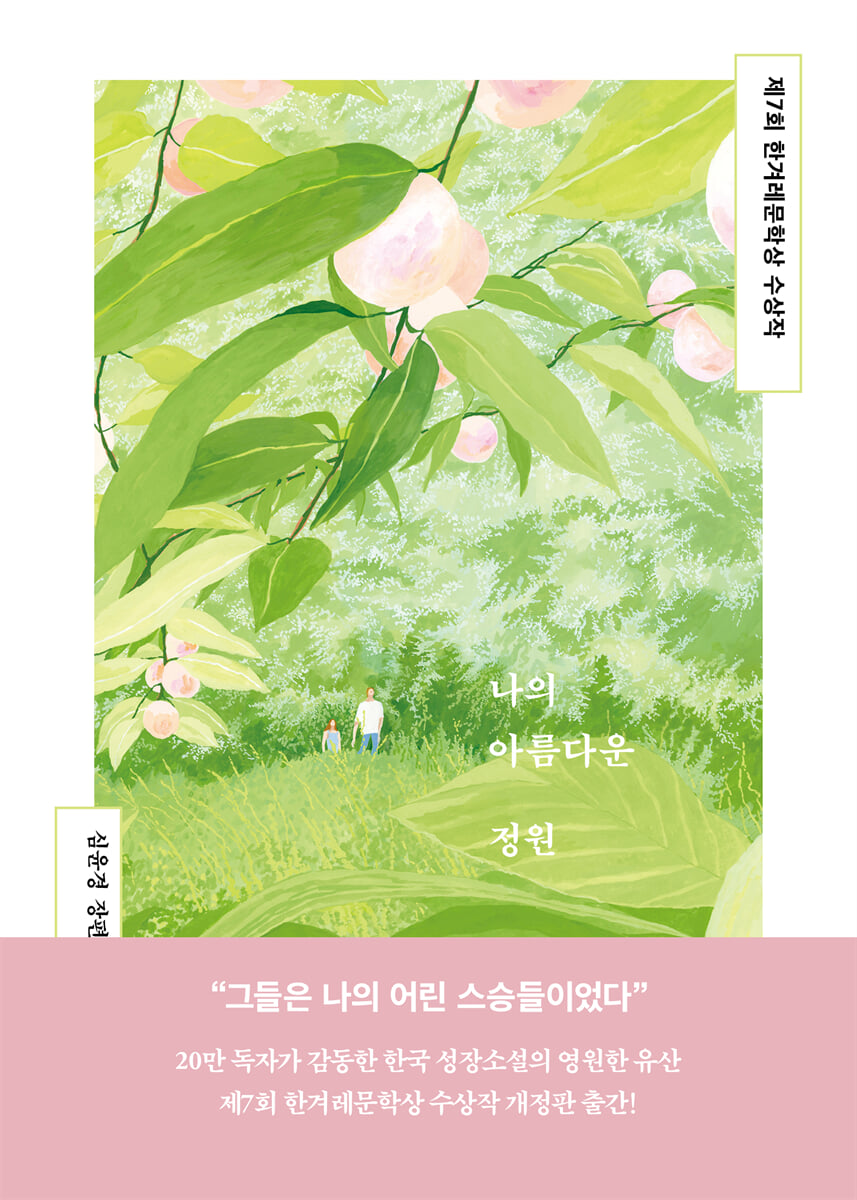
My Beautiful Garden
 |
Description
Book Introduction
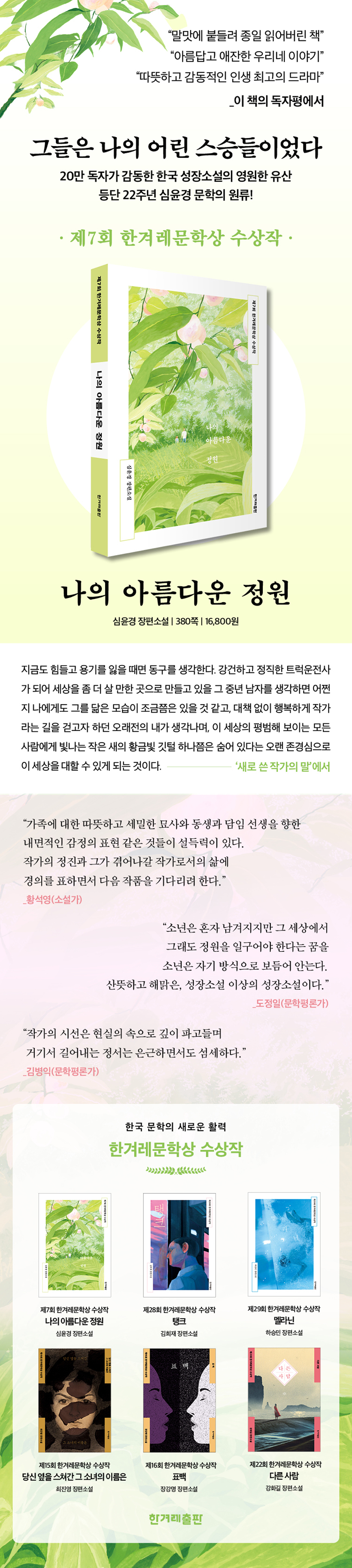
The revised edition of the 7th Hankyoreh Literary Award winner, "My Beautiful Garden," has been published!
“They were my young teachers.”
The Eternal Legacy of Korean Coming-of-Age Novels Chosen by 200,000 Readers
The 7th Hankyoreh Literary Award winner and bestseller that moved 200,000 readers, "My Beautiful Garden," is back in a revised edition.
The Hankyoreh Literary Award, established in 1996, has long received much support for drawing a new topography of Korean literature with works such as Park Min-gyu's The Last Fan Club of Sammi Superstars, Yoon Go-eun's Zero Gravity Syndrome, Choi Jin-young's The Name of the Girl Who Passed By You, Jang Kang-myeong's Bleach, Kang Hwa-gil's Another Person, Park Seo-ryeon's The Airship Girl Kang Ju-ryong, and Kim Hee-jae's Tank.
In 2002, 『My Beautiful Garden』 received favorable reviews, saying, “It is a convincing work with warm and detailed descriptions and expressions of inner emotions” (novelist Hwang Seok-young) and “a coming-of-age novel that goes beyond a coming-of-age novel” (literary critic Do Jeong-il).
The novel depicts the life of an ordinary family in South Korea during the turbulent times of 1977 to 1981, through the eyes of a gentle and upright boy.
Readers' generous praise for the work, such as "A book I read all day, captivated by the words," "A story I'd want to give as a gift to someone special," and "A warm and touching drama, the best of my life," proves that "My Beautiful Garden" has established itself as a classic in Korean literature.
“They were my young teachers.”
The Eternal Legacy of Korean Coming-of-Age Novels Chosen by 200,000 Readers
The 7th Hankyoreh Literary Award winner and bestseller that moved 200,000 readers, "My Beautiful Garden," is back in a revised edition.
The Hankyoreh Literary Award, established in 1996, has long received much support for drawing a new topography of Korean literature with works such as Park Min-gyu's The Last Fan Club of Sammi Superstars, Yoon Go-eun's Zero Gravity Syndrome, Choi Jin-young's The Name of the Girl Who Passed By You, Jang Kang-myeong's Bleach, Kang Hwa-gil's Another Person, Park Seo-ryeon's The Airship Girl Kang Ju-ryong, and Kim Hee-jae's Tank.
In 2002, 『My Beautiful Garden』 received favorable reviews, saying, “It is a convincing work with warm and detailed descriptions and expressions of inner emotions” (novelist Hwang Seok-young) and “a coming-of-age novel that goes beyond a coming-of-age novel” (literary critic Do Jeong-il).
The novel depicts the life of an ordinary family in South Korea during the turbulent times of 1977 to 1981, through the eyes of a gentle and upright boy.
Readers' generous praise for the work, such as "A book I read all day, captivated by the words," "A story I'd want to give as a gift to someone special," and "A warm and touching drama, the best of my life," proves that "My Beautiful Garden" has established itself as a classic in Korean literature.
- You can preview some of the book's contents.
Preview
index
1977 | Below the waist of Inwangsan Mountain
1978 | First birthday
1979 | The Age of Dyslexia
1980 | The Bird of Golden Feathers
1981 | Leaving the Garden
Author's Note
Author's Note for the Revised Edition
New author's note
Recommendation
1978 | First birthday
1979 | The Age of Dyslexia
1980 | The Bird of Golden Feathers
1981 | Leaving the Garden
Author's Note
Author's Note for the Revised Edition
New author's note
Recommendation
Detailed image
Into the book
My younger brother was a short-tempered baby.
--- p.9
For seven years, my mother lived with the same expression on her face, as if silence was the only way to survive, like a mute lump of tofu that neither laughed nor cried.
--- p.12
The brain structure of the Eastern Europeans is designed to make it difficult to read and write, so they may have trouble distinguishing between the letters when writing.
This symptom is called dyslexia. These children have normal intelligence, but they have difficulty learning because they do not have the ability to read and write.
--- p.79
The afternoon sunlight streaming in made the fluff on the teacher's cheeks appear white.
Milk, freshly fallen snowflakes, and honey added to the bluish flesh of a cucumber gave it the color of the teacher's skin.
The blue blood vessels flowing under the translucent skin looked like fresh seaweed in the shallow sea.
--- p.113
Everyone thought of Yeongju as a kind and smart man, and Donggu as a foolish and reckless man.
When we pulled back the curtain and went to the back of the stage, there was the young and immature Yeongju, the thoughtful and broad-minded Donggu.
For the first time, the teacher was trying to call me, the kind and wonderful person who was crouching behind the dark stage, up on stage.
--- p.116
The biggest change that happened to me as I entered the fourth grade was that I often lamented why I was born so late into the world.
--- p.228
How wonderful it would be if I could live even one day with confidence in my path.
If I can boldly walk the path I must take, without doubt, without fear, without wavering, with a flame burning brightly like the hatch in front of Gwanghwamun, wrapped around my body.
--- p.262
I realized that my brother had grown up enough to think differently from me and to have conversations with me.
Now, I have to not only hold my little brother, play with him, and feed him, but also prepare my own answer to his mental anguish.
Today, my role as an older brother enters a new phase.
A sudden sense of responsibility weighed heavily on my shoulders.
--- p.306
We were so accustomed to the child's outstretched arms and the child's protruding lips that we were conditioned not to laugh, not to talk, not to understand, except through the child.
Our family was like a group of bewildered people standing at a crossroads with a broken traffic light, unable to speak to each other or guess what the other was thinking. We just stared blankly.
Our green traffic lights, which magically guided some to wait, some to go straight, and some to turn left, so that our communication would not be tangled, have fallen asleep forever.
We didn't know how to cross the intersection without a traffic light.
--- p.321
I was just clapping my hands excitedly until my palms were puffed up, completely unaware that that moment was the most meaningful and precious moment of my life.
If only I could go back to that moment, just once, just once.
--- p.350
I thought of my loved ones who had left me, living or dead, and shed silent tears.
Could it be that the sight of the stray dog, who I thought was dead, showing up alive, albeit in a tired and weary state, is an auspicious sign that I will one day meet my loved ones again?
--- p.368
Pulling hard at the cold iron door, I said goodbye to the beautiful garden.
Hello, beautiful garden.
Hello, Golden Twisted One.
I will never be able to return to that beautiful garden again, but I try not to be sad.
--- p.9
For seven years, my mother lived with the same expression on her face, as if silence was the only way to survive, like a mute lump of tofu that neither laughed nor cried.
--- p.12
The brain structure of the Eastern Europeans is designed to make it difficult to read and write, so they may have trouble distinguishing between the letters when writing.
This symptom is called dyslexia. These children have normal intelligence, but they have difficulty learning because they do not have the ability to read and write.
--- p.79
The afternoon sunlight streaming in made the fluff on the teacher's cheeks appear white.
Milk, freshly fallen snowflakes, and honey added to the bluish flesh of a cucumber gave it the color of the teacher's skin.
The blue blood vessels flowing under the translucent skin looked like fresh seaweed in the shallow sea.
--- p.113
Everyone thought of Yeongju as a kind and smart man, and Donggu as a foolish and reckless man.
When we pulled back the curtain and went to the back of the stage, there was the young and immature Yeongju, the thoughtful and broad-minded Donggu.
For the first time, the teacher was trying to call me, the kind and wonderful person who was crouching behind the dark stage, up on stage.
--- p.116
The biggest change that happened to me as I entered the fourth grade was that I often lamented why I was born so late into the world.
--- p.228
How wonderful it would be if I could live even one day with confidence in my path.
If I can boldly walk the path I must take, without doubt, without fear, without wavering, with a flame burning brightly like the hatch in front of Gwanghwamun, wrapped around my body.
--- p.262
I realized that my brother had grown up enough to think differently from me and to have conversations with me.
Now, I have to not only hold my little brother, play with him, and feed him, but also prepare my own answer to his mental anguish.
Today, my role as an older brother enters a new phase.
A sudden sense of responsibility weighed heavily on my shoulders.
--- p.306
We were so accustomed to the child's outstretched arms and the child's protruding lips that we were conditioned not to laugh, not to talk, not to understand, except through the child.
Our family was like a group of bewildered people standing at a crossroads with a broken traffic light, unable to speak to each other or guess what the other was thinking. We just stared blankly.
Our green traffic lights, which magically guided some to wait, some to go straight, and some to turn left, so that our communication would not be tangled, have fallen asleep forever.
We didn't know how to cross the intersection without a traffic light.
--- p.321
I was just clapping my hands excitedly until my palms were puffed up, completely unaware that that moment was the most meaningful and precious moment of my life.
If only I could go back to that moment, just once, just once.
--- p.350
I thought of my loved ones who had left me, living or dead, and shed silent tears.
Could it be that the sight of the stray dog, who I thought was dead, showing up alive, albeit in a tired and weary state, is an auspicious sign that I will one day meet my loved ones again?
--- p.368
Pulling hard at the cold iron door, I said goodbye to the beautiful garden.
Hello, beautiful garden.
Hello, Golden Twisted One.
I will never be able to return to that beautiful garden again, but I try not to be sad.
--- p.369
Publisher's Review
“Grandma, should we go and live together in Noruneumi?”
A Record of a Golden Childhood, Its Touching Realism
In 1977, in a small village of houses the size of a palm clinging to a granite ridge near Inwangsan Mountain, Dong-gu, the eldest grandson of the Han family, gave birth to Yeong-ju, who was six years younger than him.
Before Yeongju came, Dong-gu's family was like "people standing at a four-way intersection with a broken traffic light, confused and bewildered."
While Young-ju, a love deliveryman between family members, learns to read and write Korean before she is three years old and can read all the letters on a bag of roasted chestnuts, the gentle and thoughtful Dong-gu cannot read Korean until he is in the third grade and is often treated as a nerd, a retarded child, and a “stupid guy” both at school and at home.
Meanwhile, the third-grade homeroom teacher, Park Young-eun, notices Dong-gu's dyslexia and, through after-school tutoring, carefully observes Dong-gu's kind nature and inner pain.
Dong-gu, who felt indescribable gratitude for the warmth he had received for the first time in his life, fell in love with Mr. Park.
However, in 1980, as the national tax surplus centered around Inwangsan became serious, Dong-gu experienced its first upheaval in 12 years.
Dong-gu, who had not been able to grasp the meaning of demonstrations, coups, tanks, and democratization, hears the news that Mr. Park has disappeared after being caught up in the turbulent currents of May 18th. The tragedy of Yeong-ju and the division in the family that follow inject dramatic tension into the story that he had thought would be just cheerful.
In this way, the author faithfully depicts the historical turning points that were the very life of the people at the time, while vividly and meticulously depicting the childlike emotions that the protagonist of childhood must possess, as well as the sorrow that comes to him all the more poignantly because of it.
The final entry, from 1981, is Dong-gu's poignant response to the question, "How on earth can we, the four of us, remain within the family fence?"
Will our boy Dong-gu ever be able to smile brightly again after these twists and turns? Will he once again dream of his younger brother Yeong-ju, his mother, and the lovely Ms. Park reaching out to him like a golden gourd in a beautiful garden?
Pulling hard at the cold iron door, I said goodbye to the beautiful garden.
Hello, beautiful garden.
Hello, Golden Twisted One.
I will never be able to return to that beautiful garden again, but I try not to be sad.
Page 369
"Even now, whenever I'm having a hard time or losing courage, I think of Dong-gu."
The Origins of Shim Yun-kyung's Literature: 22nd Anniversary of Her Debut
《My Beautiful Garden》, which has received a lot of support from readers, celebrates its 22nd anniversary by reproducing the profound emotions of 2002, presenting Dong-gu's boundless courage and love in a more refined form.
As if responding to novelist Yoon Go-eun’s praise, “Whenever I read Shim Yun-gyeong’s novels, I always needed a pen to underline them, and I wondered what kind of time the stories that shook me so much had lived through,” the author confesses that only when writing this book was she able to meet “myself, who is happy without a plan.”
“I can’t go back to that time, but it will always remain within me, giving me strength and becoming the source of my awareness that ‘this is me.’”
Therefore, the author's words, "Even now, when I feel tired and discouraged, I think of Dong-gu," will resonate deeply with new readers today as a comforting reminder that "there is a golden feather of a shining little bird hidden in every seemingly ordinary person in this world."
Hoping that they will be able to “face this world” through their own “beautiful gardens.”
Author's Note
My late twenties were a chaotic and chaotic time, almost beyond my awareness, as I fearlessly decided to give up my major and take on the unfamiliar field of writing, while simultaneously juggling the life-threatening challenges of pregnancy, childbirth, and childcare. One very vivid memory from that time was the happiness I felt while writing a novel.
In those brief moments when I sat down in front of my PC after work or while my kids were asleep, I felt like I had the world at my fingertips with just an empty monitor and a can of beer.
Feelings like, “That line from earlier was really thrilling,” or “This is really going to turn into a novel,” or “Wow, I really feel like I’ve become a novelist.”
It's such a distant memory that I can hardly even begin to emulate myself now, to think that I was so hopelessly happy while writing.
Twenty years have passed since my debut, and I have become a mid-career novelist through many experiences. I can no longer sit in front of my laptop with the bright smile I used to have, but "My Beautiful Garden" is like a happy childhood to me.
I can't go back to that time, but it will always remain within me, giving me strength and becoming the source of my awareness that 'this is me.'
Even now, whenever I feel tired or lose courage, I think of Dong-gu.
When I think of that middle-aged man, who is making the world a better place by becoming a strong and honest truck driver, I somehow feel like I have a little bit of him in me, and I think of myself a long time ago, when I was happily pursuing the path of a writer without any plan, and I can face this world with the long-held respect that everyone in this world, even the most ordinary-looking person, has hidden a golden feather of a shining little bird.
The long-standing love and encouragement I received through “My Beautiful Garden” has supported me even when I was struggling miserably until today.
I would like to thank Hankyoreh Publishing for inviting me, a young and anxious person, to become a novelist, and the many readers who have loved this novel to this day.
A Record of a Golden Childhood, Its Touching Realism
In 1977, in a small village of houses the size of a palm clinging to a granite ridge near Inwangsan Mountain, Dong-gu, the eldest grandson of the Han family, gave birth to Yeong-ju, who was six years younger than him.
Before Yeongju came, Dong-gu's family was like "people standing at a four-way intersection with a broken traffic light, confused and bewildered."
While Young-ju, a love deliveryman between family members, learns to read and write Korean before she is three years old and can read all the letters on a bag of roasted chestnuts, the gentle and thoughtful Dong-gu cannot read Korean until he is in the third grade and is often treated as a nerd, a retarded child, and a “stupid guy” both at school and at home.
Meanwhile, the third-grade homeroom teacher, Park Young-eun, notices Dong-gu's dyslexia and, through after-school tutoring, carefully observes Dong-gu's kind nature and inner pain.
Dong-gu, who felt indescribable gratitude for the warmth he had received for the first time in his life, fell in love with Mr. Park.
However, in 1980, as the national tax surplus centered around Inwangsan became serious, Dong-gu experienced its first upheaval in 12 years.
Dong-gu, who had not been able to grasp the meaning of demonstrations, coups, tanks, and democratization, hears the news that Mr. Park has disappeared after being caught up in the turbulent currents of May 18th. The tragedy of Yeong-ju and the division in the family that follow inject dramatic tension into the story that he had thought would be just cheerful.
In this way, the author faithfully depicts the historical turning points that were the very life of the people at the time, while vividly and meticulously depicting the childlike emotions that the protagonist of childhood must possess, as well as the sorrow that comes to him all the more poignantly because of it.
The final entry, from 1981, is Dong-gu's poignant response to the question, "How on earth can we, the four of us, remain within the family fence?"
Will our boy Dong-gu ever be able to smile brightly again after these twists and turns? Will he once again dream of his younger brother Yeong-ju, his mother, and the lovely Ms. Park reaching out to him like a golden gourd in a beautiful garden?
Pulling hard at the cold iron door, I said goodbye to the beautiful garden.
Hello, beautiful garden.
Hello, Golden Twisted One.
I will never be able to return to that beautiful garden again, but I try not to be sad.
Page 369
"Even now, whenever I'm having a hard time or losing courage, I think of Dong-gu."
The Origins of Shim Yun-kyung's Literature: 22nd Anniversary of Her Debut
《My Beautiful Garden》, which has received a lot of support from readers, celebrates its 22nd anniversary by reproducing the profound emotions of 2002, presenting Dong-gu's boundless courage and love in a more refined form.
As if responding to novelist Yoon Go-eun’s praise, “Whenever I read Shim Yun-gyeong’s novels, I always needed a pen to underline them, and I wondered what kind of time the stories that shook me so much had lived through,” the author confesses that only when writing this book was she able to meet “myself, who is happy without a plan.”
“I can’t go back to that time, but it will always remain within me, giving me strength and becoming the source of my awareness that ‘this is me.’”
Therefore, the author's words, "Even now, when I feel tired and discouraged, I think of Dong-gu," will resonate deeply with new readers today as a comforting reminder that "there is a golden feather of a shining little bird hidden in every seemingly ordinary person in this world."
Hoping that they will be able to “face this world” through their own “beautiful gardens.”
Author's Note
My late twenties were a chaotic and chaotic time, almost beyond my awareness, as I fearlessly decided to give up my major and take on the unfamiliar field of writing, while simultaneously juggling the life-threatening challenges of pregnancy, childbirth, and childcare. One very vivid memory from that time was the happiness I felt while writing a novel.
In those brief moments when I sat down in front of my PC after work or while my kids were asleep, I felt like I had the world at my fingertips with just an empty monitor and a can of beer.
Feelings like, “That line from earlier was really thrilling,” or “This is really going to turn into a novel,” or “Wow, I really feel like I’ve become a novelist.”
It's such a distant memory that I can hardly even begin to emulate myself now, to think that I was so hopelessly happy while writing.
Twenty years have passed since my debut, and I have become a mid-career novelist through many experiences. I can no longer sit in front of my laptop with the bright smile I used to have, but "My Beautiful Garden" is like a happy childhood to me.
I can't go back to that time, but it will always remain within me, giving me strength and becoming the source of my awareness that 'this is me.'
Even now, whenever I feel tired or lose courage, I think of Dong-gu.
When I think of that middle-aged man, who is making the world a better place by becoming a strong and honest truck driver, I somehow feel like I have a little bit of him in me, and I think of myself a long time ago, when I was happily pursuing the path of a writer without any plan, and I can face this world with the long-held respect that everyone in this world, even the most ordinary-looking person, has hidden a golden feather of a shining little bird.
The long-standing love and encouragement I received through “My Beautiful Garden” has supported me even when I was struggling miserably until today.
I would like to thank Hankyoreh Publishing for inviting me, a young and anxious person, to become a novelist, and the many readers who have loved this novel to this day.
GOODS SPECIFICS
- Date of issue: August 26, 2024
- Page count, weight, size: 380 pages | 528g | 150*210*18mm
- ISBN13: 9791172131067
You may also like
카테고리
korean


korean

![GQ KOREA Mark (Monthly): December [2025]](http://librairie.coreenne.fr/cdn/shop/files/8ef265dbbfbf186523ed75ba7319009d.jpg?v=1765340328&width=3840)


