

See Park Chung-hee directly
 |
Description
Book Introduction
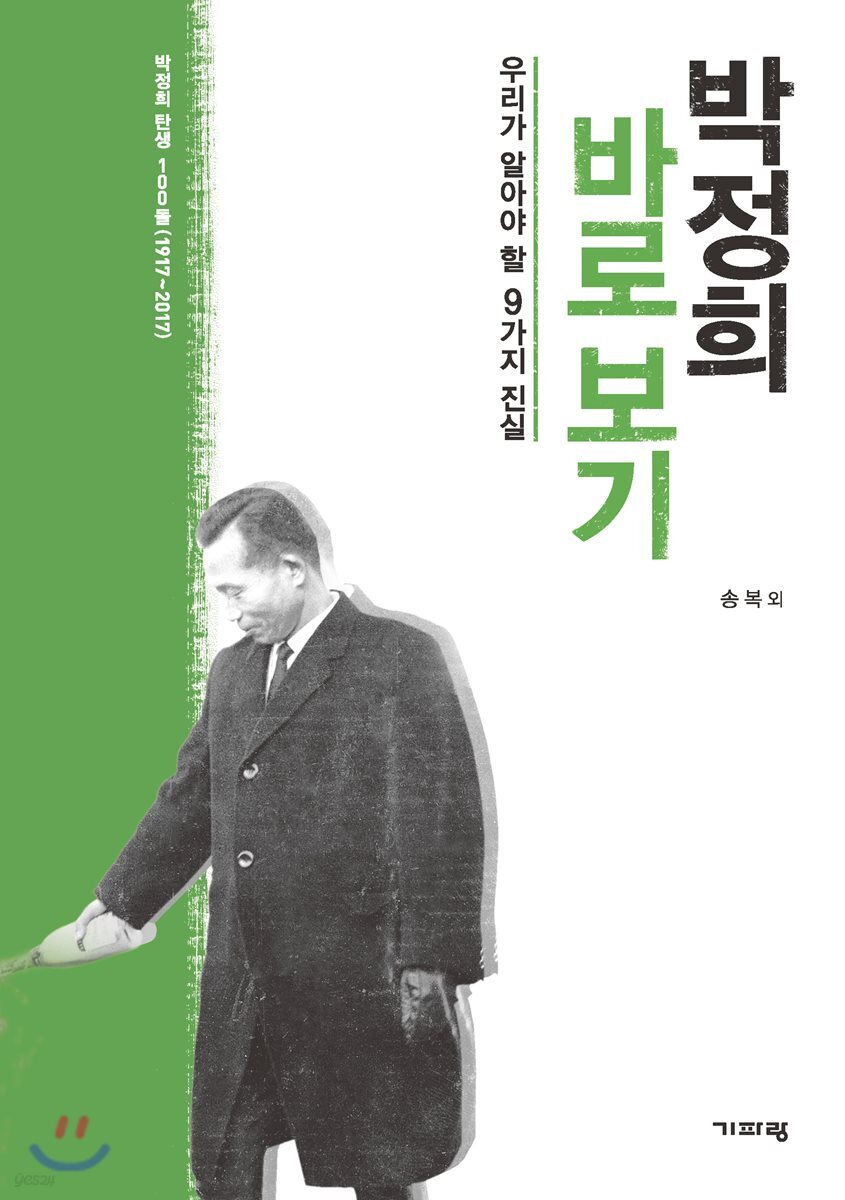
100th anniversary of Park Chung-hee's birth
2017 is the year of Park Chung-hee (1917.
11.
14~1979.
10.
26) 100th anniversary of birth.
The debate surrounding his merits and demerits appears to still be ongoing, but a closer look reveals that no one says, “This country would have been better off without Park Chung-hee.”
Even those who criticize or even hate politician Park Chung-hee cannot directly deny his contribution to 'designing today's Republic of Korea and achieving economic development unprecedented in world history.'
However, the evaluation of this 'giant of modern Korean history', who was in power for 18 years and died 38 years ago, has always focused only on 'his faults' rather than 'his merits and demerits'.
2017 is the year of Park Chung-hee (1917.
11.
14~1979.
10.
26) 100th anniversary of birth.
The debate surrounding his merits and demerits appears to still be ongoing, but a closer look reveals that no one says, “This country would have been better off without Park Chung-hee.”
Even those who criticize or even hate politician Park Chung-hee cannot directly deny his contribution to 'designing today's Republic of Korea and achieving economic development unprecedented in world history.'
However, the evaluation of this 'giant of modern Korean history', who was in power for 18 years and died 38 years ago, has always focused only on 'his faults' rather than 'his merits and demerits'.
- You can preview some of the book's contents.
Preview
index
The Why, How, and Future of the Distortions of the Park Chung-hee Era (Song Bok)
1.
History and People Killed by Partisanship
2.
Distortion and Truth
3.
Clue: Pragmatism vs. Fundamentalism, Dogmatism
01 Park Chung-hee engaged in collusion between politics and business? - If I do it, it's networking; if others do it, it's collusion? (Kim In-young)
1.
Dictatorship and collusion between politics and business: A concept aimed at denigrating President Park Chung-hee's industrial miracle.
2.
Theorizing Economic Growth and Government-Business Collaboration Networks
3.
Park Chung-hee's industrialization and government-business cooperation
4.
'Political-Business Collusion' from the Perspective of Political Modernization
5.
Park Chung-hee's Industrialization: Cooperation, Not Collusion, Was the Key
02 Park Chung-hee was the original pro-Japanese collaborator? - If so, India's Gandhi was a national traitor (Yeongmyeong)
Introduction
Standards of pro-Japanese collaboration
A question of shame and justice
The Unruly Teacher Park Chung-hee
Suppressing the independence army? If there is, then suppressing it is necessary.
To the young intellectuals of the colony at the time, Manchukuo was
The Korea-Japan Agreement is a humiliating diplomacy?
More fundamentally, regarding pro-Japanese sentiments
03 Park Chung-hee Spread the Evil Tradition of Military Culture? - Military Culture: The Real Power That Invigorated and Driven North Korea Away (Cho Woo-seok)
Sergeant Kim returned from Vietnam
The rapid modernization made possible by military culture
Why the modern bureaucracy took hold in the 1960s
Civil servant salaries have increased 3.2 times in five years.
The Gyeongbu Expressway, a masterpiece of efficiency-first principles
And we beat North Korea in the system competition.
Park Chung-hee, who pursued fundamental reform of society and humanity
04 Park Chung-hee's anti-communism was anti-democratic? - Protecting democracy is anti-communism (Yoo Gwang-ho)
Entering
1.
Why did Park Chung-hee make anti-communism a national policy?
2.
Anti-communism is a prerequisite for protecting the liberal democratic system.
3.
The 'democratization struggle' and 'unification movement' were leftist activities aimed at overthrowing the system.
4.
Was Park Chung-hee's anti-communist policy successful?
Coming out
05 Park Chung-hee exploited workers? - Did the middle class fall from the sky? (Ryu Seok-chun)
1.
A hundred years of Park Chung-hee versus a hundred years of communism
2.
Exploitation and the Study of Korean Workers
3.
Light Industry Workers in the Park Chung-hee Era: Jeon Tae-il in the Garment Industry and the Case of Pyeonghwa Market
4.
Heavy and Chemical Industry Workers in the Park Chung-hee Era: The Case of Hyundai Heavy Industries Workers in the Shipbuilding Industry
5.
Marginal Labor Productivity and Wage Growth: Time Series Data (1963–1999)
6.
Conclusion: Labor unions must abandon hereditary employment and strive to serve the nation through labor.
Is the October Yushin regime a product of dictatorship aimed at long-term rule? - Consider North Korea, Singapore, and Taiwan (Lee Ji-soo)
1.
Answer me, time that has passed
2.
At the entrance in 1972
3.
October of that year
4.
The back alley of Yushin
5.
In the case of North Korea, Taiwan, and Singapore
6.
Did Park Chung-hee privatize power?
7.
Looking back at Park Chung-hee
07. Verifying Park Chung-hee's Morality? - Park Chung-hee: Frugal, Honest, and Free-spirited (Choi Jong-bu)
As you go in
In a world where lies reign supreme, telling the truth is a revolution.
The failure of Joseon, the country of 'morality'
A story of a great man that exists only in Korea
Power is a double-edged sword
Just looking at the collusion between politics and business, does that mean Park Chung-hee was morally problematic?
Was Park Chung-hee greedy? And therefore morally corrupt?
Park Chung-hee, Yuk Young-soo, and the remaining Sabugok (思婦曲)
Park Chung-hee was so frugal
Park Chung-hee's Integrity as Seen Through Memoirs and Testimony
A laid-back attitude that was far from a sense of privilege
In closing
08 Park Chung-hee fueled regionalism? - The truth behind regionalism and Honamphobia (Bae Jin-young)
As you go in
1.
Was there no regionalism before Park Chung-hee?
2.
Didn't regionalism play a role in politics before Park Chung-hee?
3.
Regional bias in personnel appointments began during the Park Chung-hee era, and was most severe during his time.
4.
Is the regional imbalance growth policy a product of Park Chung-hee's regional discrimination policy?
5.
Was this the beginning of Park Chung-hee's political exploitation of regionalism?
Coming out
09 Is normalizing Korea-Japan diplomatic relations treason? - Such ignorant criticism is pro-Japanese treason (Wang Hye-sook)
1.
How do we understand the normalization of Korea-Japan diplomatic relations?
2.
Was Park Chung-hee the only one who pushed for the normalization of Korea-Japan relations?
3.
Was Japan willing to normalize diplomatic relations?
4.
Was the normalization of diplomatic relations solely aimed at introducing loans for economic development?
5.
After the normalization of diplomatic relations between Korea and Japan in 1965
6.
conclusion
1.
History and People Killed by Partisanship
2.
Distortion and Truth
3.
Clue: Pragmatism vs. Fundamentalism, Dogmatism
01 Park Chung-hee engaged in collusion between politics and business? - If I do it, it's networking; if others do it, it's collusion? (Kim In-young)
1.
Dictatorship and collusion between politics and business: A concept aimed at denigrating President Park Chung-hee's industrial miracle.
2.
Theorizing Economic Growth and Government-Business Collaboration Networks
3.
Park Chung-hee's industrialization and government-business cooperation
4.
'Political-Business Collusion' from the Perspective of Political Modernization
5.
Park Chung-hee's Industrialization: Cooperation, Not Collusion, Was the Key
02 Park Chung-hee was the original pro-Japanese collaborator? - If so, India's Gandhi was a national traitor (Yeongmyeong)
Introduction
Standards of pro-Japanese collaboration
A question of shame and justice
The Unruly Teacher Park Chung-hee
Suppressing the independence army? If there is, then suppressing it is necessary.
To the young intellectuals of the colony at the time, Manchukuo was
The Korea-Japan Agreement is a humiliating diplomacy?
More fundamentally, regarding pro-Japanese sentiments
03 Park Chung-hee Spread the Evil Tradition of Military Culture? - Military Culture: The Real Power That Invigorated and Driven North Korea Away (Cho Woo-seok)
Sergeant Kim returned from Vietnam
The rapid modernization made possible by military culture
Why the modern bureaucracy took hold in the 1960s
Civil servant salaries have increased 3.2 times in five years.
The Gyeongbu Expressway, a masterpiece of efficiency-first principles
And we beat North Korea in the system competition.
Park Chung-hee, who pursued fundamental reform of society and humanity
04 Park Chung-hee's anti-communism was anti-democratic? - Protecting democracy is anti-communism (Yoo Gwang-ho)
Entering
1.
Why did Park Chung-hee make anti-communism a national policy?
2.
Anti-communism is a prerequisite for protecting the liberal democratic system.
3.
The 'democratization struggle' and 'unification movement' were leftist activities aimed at overthrowing the system.
4.
Was Park Chung-hee's anti-communist policy successful?
Coming out
05 Park Chung-hee exploited workers? - Did the middle class fall from the sky? (Ryu Seok-chun)
1.
A hundred years of Park Chung-hee versus a hundred years of communism
2.
Exploitation and the Study of Korean Workers
3.
Light Industry Workers in the Park Chung-hee Era: Jeon Tae-il in the Garment Industry and the Case of Pyeonghwa Market
4.
Heavy and Chemical Industry Workers in the Park Chung-hee Era: The Case of Hyundai Heavy Industries Workers in the Shipbuilding Industry
5.
Marginal Labor Productivity and Wage Growth: Time Series Data (1963–1999)
6.
Conclusion: Labor unions must abandon hereditary employment and strive to serve the nation through labor.
Is the October Yushin regime a product of dictatorship aimed at long-term rule? - Consider North Korea, Singapore, and Taiwan (Lee Ji-soo)
1.
Answer me, time that has passed
2.
At the entrance in 1972
3.
October of that year
4.
The back alley of Yushin
5.
In the case of North Korea, Taiwan, and Singapore
6.
Did Park Chung-hee privatize power?
7.
Looking back at Park Chung-hee
07. Verifying Park Chung-hee's Morality? - Park Chung-hee: Frugal, Honest, and Free-spirited (Choi Jong-bu)
As you go in
In a world where lies reign supreme, telling the truth is a revolution.
The failure of Joseon, the country of 'morality'
A story of a great man that exists only in Korea
Power is a double-edged sword
Just looking at the collusion between politics and business, does that mean Park Chung-hee was morally problematic?
Was Park Chung-hee greedy? And therefore morally corrupt?
Park Chung-hee, Yuk Young-soo, and the remaining Sabugok (思婦曲)
Park Chung-hee was so frugal
Park Chung-hee's Integrity as Seen Through Memoirs and Testimony
A laid-back attitude that was far from a sense of privilege
In closing
08 Park Chung-hee fueled regionalism? - The truth behind regionalism and Honamphobia (Bae Jin-young)
As you go in
1.
Was there no regionalism before Park Chung-hee?
2.
Didn't regionalism play a role in politics before Park Chung-hee?
3.
Regional bias in personnel appointments began during the Park Chung-hee era, and was most severe during his time.
4.
Is the regional imbalance growth policy a product of Park Chung-hee's regional discrimination policy?
5.
Was this the beginning of Park Chung-hee's political exploitation of regionalism?
Coming out
09 Is normalizing Korea-Japan diplomatic relations treason? - Such ignorant criticism is pro-Japanese treason (Wang Hye-sook)
1.
How do we understand the normalization of Korea-Japan diplomatic relations?
2.
Was Park Chung-hee the only one who pushed for the normalization of Korea-Japan relations?
3.
Was Japan willing to normalize diplomatic relations?
4.
Was the normalization of diplomatic relations solely aimed at introducing loans for economic development?
5.
After the normalization of diplomatic relations between Korea and Japan in 1965
6.
conclusion
Publisher's Review
"In a world where lies reign supreme, telling the truth is a revolution."
Park Chung-hee, a Giant of Modern History - Answering Nine Misunderstandings
Did Park Chung-hee corrupt both politics and the economy through collusion between politics and business? Was he a pro-Japanese collaborator, and as an extension of that, did he force the humiliating normalization of diplomatic relations with Japan? Did he scheme to solidify division and establish a long-term dictatorship through military culture, anti-communism, and the October Revitalizing Reforms, exploiting workers and inciting regionalism while enjoying immoral glory behind the scenes?
[A Look at Park Chung-hee] is a book that corrects perspectives by revealing the 'revealed distortions and hidden truths' for each issue.
The writing team included 10 experts in the field, including researchers, journalists, and writers.
The nine articles in the special section are direct and provocative from the title.
"Park Chung-hee engaged in collusion between politics and business?" "Park Chung-hee exploited workers?" "Park Chung-hee incited regionalism?" ...
The truth re-established based on clear data looks like this.
This is an exemplary success story of "cooperation" or "network," not "collusion" between politics and business (Professor Kim In-young, Hallym University)
It wasn't pro-Japanese, but rather an attempt to learn from the "enemy's success" and win (Yeong, Vice President of the Youth Park Chung-hee Research Association)
It was the universal military experience and ethos that truly energized our society and enabled us to defeat North Korea (Jo Woo-seok, Editor-in-Chief of Mediapen)
Anti-communism is not anti-democracy; protecting democracy is anti-communism (Yoo Gwang-ho, Visiting Researcher, Park Chung-hee Memorial Foundation)
Far from exploiting labor, Park Chung-hee was the "father of the middle class," teaching skills and creating jobs (Ryu Seok-chun, Professor at Yonsei University).
If you're looking for dictatorship and the privatization of power, look no further than the October Yushin (Lee Ji-soo, Professor, Myongji University).
Park Chung-hee was the most morally upright leader (Choi Jong-bu, researcher at the Korea Institute for Free Economic Research)
Regional animosity is commonplace, and some groups exploit this as "regionalism" (Bae Jin-young, Monthly Chosun reporter)
The normalization of diplomatic relations between Korea and Japan saved our country and our people, and criticism born of ignorance is a pro-Japanese, treasonous act (Wang Hye-sook)
Rebuttal to rebuttal isn't the only way to go.
Shouldn't we know the cause and circumstances before we can come up with a solution?
The introduction (written by Song Bok, Professor Emeritus of Yonsei University) provides a concise summary of the nine articles in the main text and diagnoses the cause of the conflict, including the distortion of Park Chung-hee, as deep-rooted “partisanship” since before the founding of the nation, that is, the division between the democratization and industrialization forces (conservatives) and the socialist forces (leftists).
As a way to preserve the democratic Republic of Korea, he proposes a rather magnanimous prescription: "consolidating the veins of democratization and industrialization" armed with empiricism, gradualism, pragmatism, and moralism, and for conservatives to embrace the left more flexibly, considering it as a cost of maintaining democracy.
The Root of 21st-Century Korean Disease: The Liquidation of Park Chung-hee - [A New Look at Park Chung-hee]
The biggest problem for those who criticize Park Chung-hee and belittle his era is that after 30 years of feverish efforts to “liquidate Park Chung-hee,” 21st-century Korean society, far from becoming healthy, is losing vitality and suffering from all sorts of ills.
The book [A New Look at Park Chung-hee: 7 Success Models to Revive Today] (co-authored by Lee Young-hoon and 7 others) was also published, reminding us that the root of the 21st century Korean disease lies in the abandonment of the Park Chung-hee model, and seeking ways to re-examine and restore 7 of Park Chung-hee's proven success models.
Several surveys have shown that the distorted perception of Park Chung-hee among teenagers and young adults is not something they have learned through their own studies, but rather something they have acquired and solidified through the media, the internet, and what their teachers, senior friends, and acquaintances say.
[A Closer Look at Park Chung-hee] [A New Look at Park Chung-hee] is a guide for the generation that did not directly experience the Park Chung-hee era.
As the title suggests, one aims to look back on Park Chung-hee and his era and expose and correct the distortions and defamations that existed, while the other aims to look back on Park Chung-hee's "proven success" and find useful models for the future.
Following these two books, a series of research and educational books will follow, including [Park Chung-hee's Economics of Shared Growth] and [Park Chung-hee and the Dawn of the Workers] (both tentative titles). At the same time, reprints of his works, including [Park Chung-hee's Poetry Collection], and a compilation of these works, [Park Chung-hee's Complete Works] (9 volumes in total), are also in preparation.
It is published by Kiparang Publishing and supported by the Park Chung-hee 100th Birthday Commemoration Project Promotion Committee (Chairman Jeong Hong-won, former Prime Minister) and the Park Chung-hee Presidential Memorial Foundation (Chairman Joa Seung-hee).
Park Chung-hee, a Giant of Modern History - Answering Nine Misunderstandings
Did Park Chung-hee corrupt both politics and the economy through collusion between politics and business? Was he a pro-Japanese collaborator, and as an extension of that, did he force the humiliating normalization of diplomatic relations with Japan? Did he scheme to solidify division and establish a long-term dictatorship through military culture, anti-communism, and the October Revitalizing Reforms, exploiting workers and inciting regionalism while enjoying immoral glory behind the scenes?
[A Look at Park Chung-hee] is a book that corrects perspectives by revealing the 'revealed distortions and hidden truths' for each issue.
The writing team included 10 experts in the field, including researchers, journalists, and writers.
The nine articles in the special section are direct and provocative from the title.
"Park Chung-hee engaged in collusion between politics and business?" "Park Chung-hee exploited workers?" "Park Chung-hee incited regionalism?" ...
The truth re-established based on clear data looks like this.
This is an exemplary success story of "cooperation" or "network," not "collusion" between politics and business (Professor Kim In-young, Hallym University)
It wasn't pro-Japanese, but rather an attempt to learn from the "enemy's success" and win (Yeong, Vice President of the Youth Park Chung-hee Research Association)
It was the universal military experience and ethos that truly energized our society and enabled us to defeat North Korea (Jo Woo-seok, Editor-in-Chief of Mediapen)
Anti-communism is not anti-democracy; protecting democracy is anti-communism (Yoo Gwang-ho, Visiting Researcher, Park Chung-hee Memorial Foundation)
Far from exploiting labor, Park Chung-hee was the "father of the middle class," teaching skills and creating jobs (Ryu Seok-chun, Professor at Yonsei University).
If you're looking for dictatorship and the privatization of power, look no further than the October Yushin (Lee Ji-soo, Professor, Myongji University).
Park Chung-hee was the most morally upright leader (Choi Jong-bu, researcher at the Korea Institute for Free Economic Research)
Regional animosity is commonplace, and some groups exploit this as "regionalism" (Bae Jin-young, Monthly Chosun reporter)
The normalization of diplomatic relations between Korea and Japan saved our country and our people, and criticism born of ignorance is a pro-Japanese, treasonous act (Wang Hye-sook)
Rebuttal to rebuttal isn't the only way to go.
Shouldn't we know the cause and circumstances before we can come up with a solution?
The introduction (written by Song Bok, Professor Emeritus of Yonsei University) provides a concise summary of the nine articles in the main text and diagnoses the cause of the conflict, including the distortion of Park Chung-hee, as deep-rooted “partisanship” since before the founding of the nation, that is, the division between the democratization and industrialization forces (conservatives) and the socialist forces (leftists).
As a way to preserve the democratic Republic of Korea, he proposes a rather magnanimous prescription: "consolidating the veins of democratization and industrialization" armed with empiricism, gradualism, pragmatism, and moralism, and for conservatives to embrace the left more flexibly, considering it as a cost of maintaining democracy.
The Root of 21st-Century Korean Disease: The Liquidation of Park Chung-hee - [A New Look at Park Chung-hee]
The biggest problem for those who criticize Park Chung-hee and belittle his era is that after 30 years of feverish efforts to “liquidate Park Chung-hee,” 21st-century Korean society, far from becoming healthy, is losing vitality and suffering from all sorts of ills.
The book [A New Look at Park Chung-hee: 7 Success Models to Revive Today] (co-authored by Lee Young-hoon and 7 others) was also published, reminding us that the root of the 21st century Korean disease lies in the abandonment of the Park Chung-hee model, and seeking ways to re-examine and restore 7 of Park Chung-hee's proven success models.
Several surveys have shown that the distorted perception of Park Chung-hee among teenagers and young adults is not something they have learned through their own studies, but rather something they have acquired and solidified through the media, the internet, and what their teachers, senior friends, and acquaintances say.
[A Closer Look at Park Chung-hee] [A New Look at Park Chung-hee] is a guide for the generation that did not directly experience the Park Chung-hee era.
As the title suggests, one aims to look back on Park Chung-hee and his era and expose and correct the distortions and defamations that existed, while the other aims to look back on Park Chung-hee's "proven success" and find useful models for the future.
Following these two books, a series of research and educational books will follow, including [Park Chung-hee's Economics of Shared Growth] and [Park Chung-hee and the Dawn of the Workers] (both tentative titles). At the same time, reprints of his works, including [Park Chung-hee's Poetry Collection], and a compilation of these works, [Park Chung-hee's Complete Works] (9 volumes in total), are also in preparation.
It is published by Kiparang Publishing and supported by the Park Chung-hee 100th Birthday Commemoration Project Promotion Committee (Chairman Jeong Hong-won, former Prime Minister) and the Park Chung-hee Presidential Memorial Foundation (Chairman Joa Seung-hee).
GOODS SPECIFICS
- Date of publication: October 16, 2017
- Page count, weight, size: 328 pages | 550g | 148*210*30mm
- ISBN13: 9788965236771
- ISBN10: 8965236770
You may also like
카테고리
korean


korean

![GQ KOREA Mark (Monthly): December [2025]](http://librairie.coreenne.fr/cdn/shop/files/8ef265dbbfbf186523ed75ba7319009d.jpg?v=1765340328&width=3840)


