

Nadia Boulanger, the musician's musician
 |
Description
Book Introduction
Piazzolla, Aaron Copland, etc.
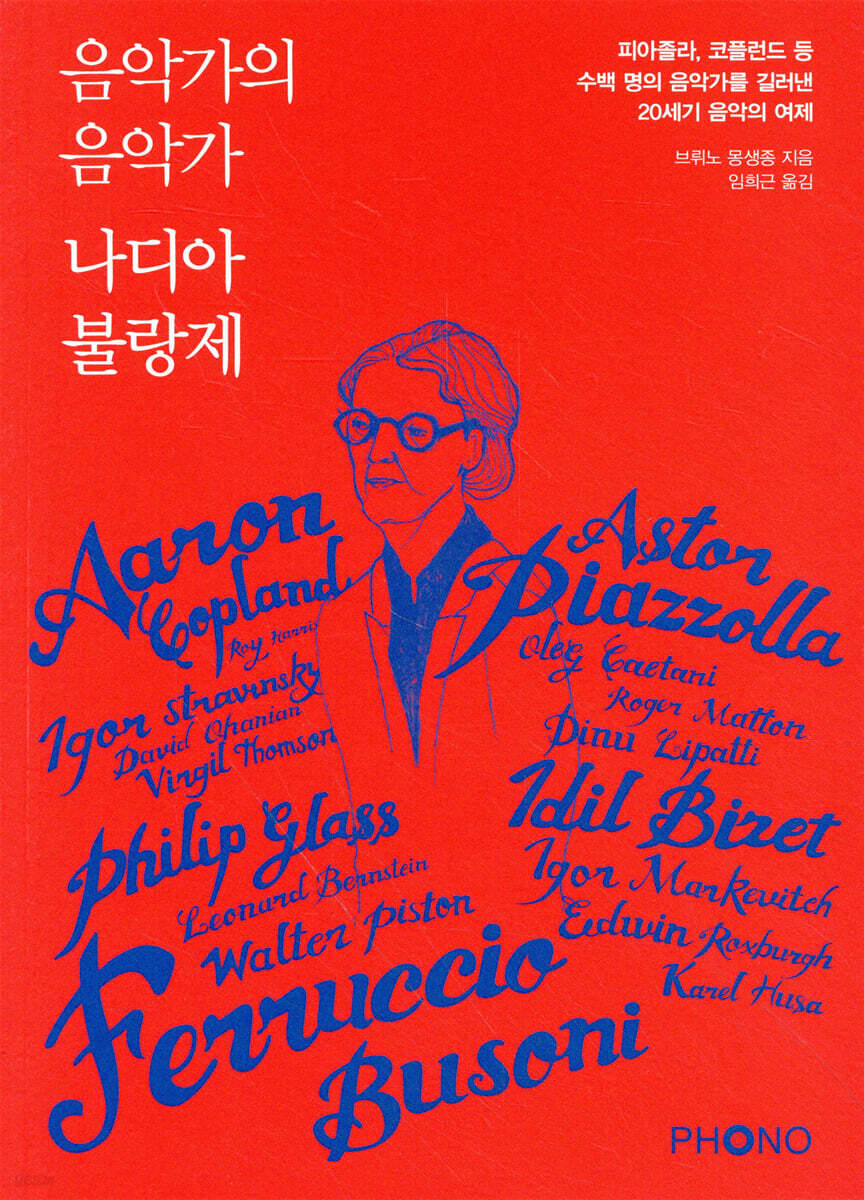
The empress of 20th-century music who nurtured hundreds of musicians
This is a memoir of Nadia Boulanger, a genius musician who made history as the first female conductor of the London Royal Philharmonic, New York Philharmonic, and Boston Philharmonic, and whose mother tongue is music, and who had conversations with violinist and videographer Bruno Monsaingon over five years from the age of 86 to 91.
Nadia Boulanger, a teacher of musicians who had a great influence on the history of 20th century music and are still respected today, is also the teacher of many musicians, including John Eliot Gardiner, Philip Glass, and Leonard Bernstar.
She was an outstanding mentor who, free from formality and convention, had a broad perspective on music and discovered the individuality and talent of each of her students, guiding them to create their own music.
In 『Musician's Musician Nadida Boulanger』, she discusses the virtues that should be possessed as a family, a disciple, and a true musician, based on her deep insight into her music, art, and life as a whole.
Her story of experiencing the joy of music with her whole body provides an opportunity for us to find the same beautiful meaning in our own lives.
The empress of 20th-century music who nurtured hundreds of musicians
This is a memoir of Nadia Boulanger, a genius musician who made history as the first female conductor of the London Royal Philharmonic, New York Philharmonic, and Boston Philharmonic, and whose mother tongue is music, and who had conversations with violinist and videographer Bruno Monsaingon over five years from the age of 86 to 91.
Nadia Boulanger, a teacher of musicians who had a great influence on the history of 20th century music and are still respected today, is also the teacher of many musicians, including John Eliot Gardiner, Philip Glass, and Leonard Bernstar.
She was an outstanding mentor who, free from formality and convention, had a broad perspective on music and discovered the individuality and talent of each of her students, guiding them to create their own music.
In 『Musician's Musician Nadida Boulanger』, she discusses the virtues that should be possessed as a family, a disciple, and a true musician, based on her deep insight into her music, art, and life as a whole.
Her story of experiencing the joy of music with her whole body provides an opportunity for us to find the same beautiful meaning in our own lives.
- You can preview some of the book's contents.
Preview
index
Letter of condolence
Entering
Letter to Nadia Boulanger
Chapter 1 French Overture
family
Music comes like lightning
Study and daily life
Fontainebleau
Get drunk on music
Chapter 2: Basic Virtues
caution
craving
memory
Chapter 3 Occupation
Two attitudes
The awakening of the sounds
The job of teaching
Mentor
Class content
Occupation and Masterpiece
Chapter 4: The Disciples
American musician
European musicians
Dinu Lipatti
Igor Markevich
Lily Boulanger
Igor Stravinsky
A moment of curiosity
Princess Polignac
Chapter 5: Talent and Reason
rendition
performers
Change and continuity
A Tribute to Nadia Boulanger
Nadia Boulanger's Biography
Nadia Boulanger's discography
Search
Entering
Letter to Nadia Boulanger
Chapter 1 French Overture
family
Music comes like lightning
Study and daily life
Fontainebleau
Get drunk on music
Chapter 2: Basic Virtues
caution
craving
memory
Chapter 3 Occupation
Two attitudes
The awakening of the sounds
The job of teaching
Mentor
Class content
Occupation and Masterpiece
Chapter 4: The Disciples
American musician
European musicians
Dinu Lipatti
Igor Markevich
Lily Boulanger
Igor Stravinsky
A moment of curiosity
Princess Polignac
Chapter 5: Talent and Reason
rendition
performers
Change and continuity
A Tribute to Nadia Boulanger
Nadia Boulanger's Biography
Nadia Boulanger's discography
Search
Detailed image
Into the book
The more I try to think about the phenomena that might play an essential role in music, the more they seem to depend on general phenomena that determine human values.
It's great to make a living as a musician.
It's a good thing to have genius.
But your inner values, which form the essence of your mind, heart, and sensibility, ultimately determine what kind of person you are.
Maybe the way you live makes it so no one can understand your true self.
Nevertheless, I think everything is based on 'caution'.
I have to pay attention to how you look to me.
Only when I pay attention to myself do I see myself as existing. --- p.54
I was recently surprised to receive a letter from a former student.
“When I first entered your class, if I may be so inclined, you said, in a rather unpleasant tone, ‘Either devote your life to music or quit music!’”
But not only music, but the fundamental conditions of everything we do must be established under the symbols of choice, affection, and passion.
The wonderful adventure of living beings depends entirely on the atmosphere created by your passion, conviction, and understanding.
If you do anything, you have to do it with that mindset.
But without skilled techniques, you won't be able to express what you feel at all.
This is where the teacher intervenes. --- p.82
It's a choice, an artistic will, a taste.
My role is to try to understand the student as he or she is.
I absolutely cannot understand students as they are.
If a disciple repeats exactly what I said, I give him a sharp rebuke.
“That’s nothing.
What do you think about that? Say it, even if it's awkward.
Say whatever you want.
If you have no thoughts, say you have no thoughts.
And learn your own rules… ”--- p.88
I try desperately to make my students understand that they should express what they want to express.
It doesn't matter whether the disciple agrees with it or not.
He said, “That’s exactly what I want to say, that’s exactly what I like.
It doesn't matter if you can just say, "That's what I'm looking for!" --- p.98
I believe that a perfect work is created when obedience and freedom are properly combined.
A perfect work satisfies not only the mind but also that peculiar thing called artistic emotion.
Stravinsky said:
“If everything were permitted to me, I would be lost and drown in the abyss of this freedom…” On the one hand, he knows his limits, but on the other hand, he is constantly running beyond those limits.
If we look at the history of everything humanly created, we see a kind of implicit and profound agreement between what is realized and what is overcome.
Let's take as an example an important piece from Bach's Well-Tempered Clavier.
Bach's obedience to convention is so certain that when he makes a decision, it always coincides with a rule, a convention, that can be clearly expressed.
Therefore, Bach begins with obedience.
But in obedience he is absolutely free.
It's not about being subjected to obedience, it's about choosing obedience. --- p.100
I am reluctant to subject students to a set system.
This is an even more important issue the younger you are.
I don't want my students to think that music after Bach is inferior to Bach.
Because music after Bach is just different from Bach. --- p.111
A single work of art is a bundle of strengths that come from focus, energy, practice, and self-absorption! Self-realization through art means forgetting yourself completely and devoting yourself entirely to the work.
But there is another element that must be included in the creation itself.
It is the very spirit of craftsmanship that gave rise to the saying, “A good weaver does not make bad cloth.”
Talent without genius is nothing, but genius without talent is not to be taken lightly. -- pp.113-114
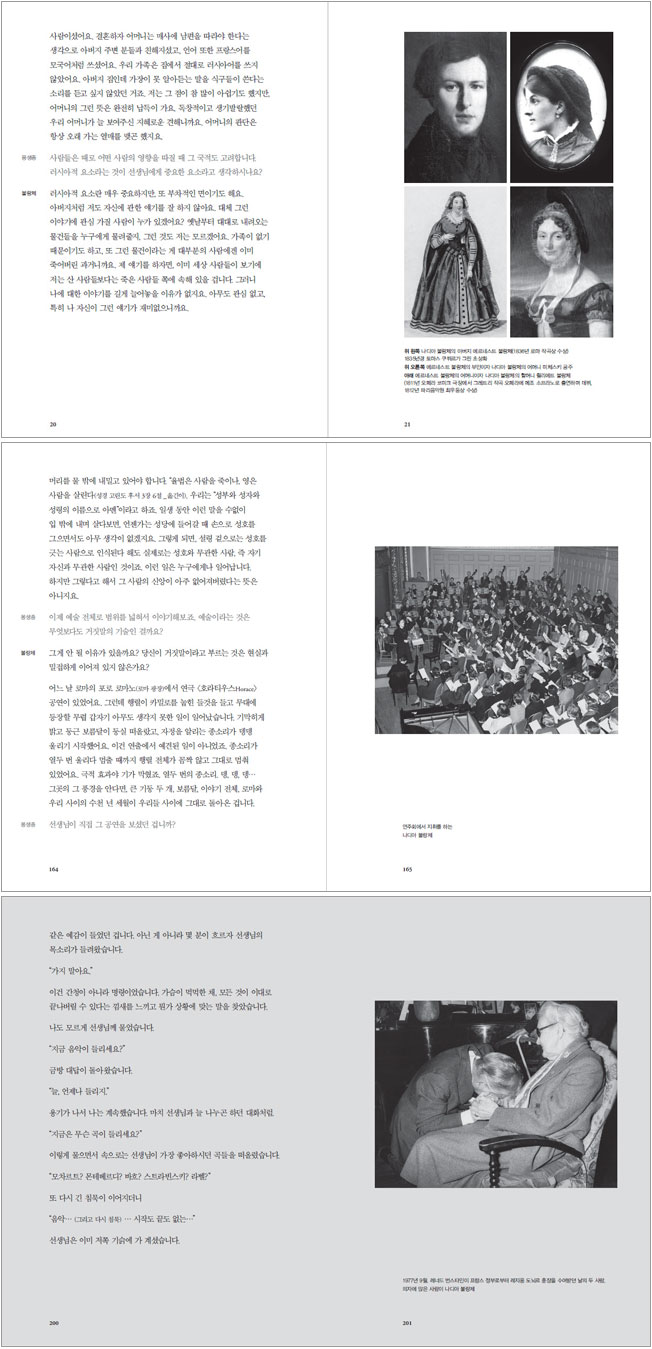
I asked the teacher without realizing it.
“Can you hear the music now?”
The answer came back quickly.
“Always, always hear me.”
I felt brave and continued.
Just like the conversations I always had with my teacher.
“What song are you listening to now?”
As I asked this question, I thought about the songs that my teacher liked the most.
“Mozart? Monteverdi? Bach? Stravinsky? Ravel?”
There was another long silence.
“Music… (and then silence again)… without beginning or end…”
The teacher was already on the other shore.
It's great to make a living as a musician.
It's a good thing to have genius.
But your inner values, which form the essence of your mind, heart, and sensibility, ultimately determine what kind of person you are.
Maybe the way you live makes it so no one can understand your true self.
Nevertheless, I think everything is based on 'caution'.
I have to pay attention to how you look to me.
Only when I pay attention to myself do I see myself as existing. --- p.54
I was recently surprised to receive a letter from a former student.
“When I first entered your class, if I may be so inclined, you said, in a rather unpleasant tone, ‘Either devote your life to music or quit music!’”
But not only music, but the fundamental conditions of everything we do must be established under the symbols of choice, affection, and passion.
The wonderful adventure of living beings depends entirely on the atmosphere created by your passion, conviction, and understanding.
If you do anything, you have to do it with that mindset.
But without skilled techniques, you won't be able to express what you feel at all.
This is where the teacher intervenes. --- p.82
It's a choice, an artistic will, a taste.
My role is to try to understand the student as he or she is.
I absolutely cannot understand students as they are.
If a disciple repeats exactly what I said, I give him a sharp rebuke.
“That’s nothing.
What do you think about that? Say it, even if it's awkward.
Say whatever you want.
If you have no thoughts, say you have no thoughts.
And learn your own rules… ”--- p.88
I try desperately to make my students understand that they should express what they want to express.
It doesn't matter whether the disciple agrees with it or not.
He said, “That’s exactly what I want to say, that’s exactly what I like.
It doesn't matter if you can just say, "That's what I'm looking for!" --- p.98
I believe that a perfect work is created when obedience and freedom are properly combined.
A perfect work satisfies not only the mind but also that peculiar thing called artistic emotion.
Stravinsky said:
“If everything were permitted to me, I would be lost and drown in the abyss of this freedom…” On the one hand, he knows his limits, but on the other hand, he is constantly running beyond those limits.
If we look at the history of everything humanly created, we see a kind of implicit and profound agreement between what is realized and what is overcome.
Let's take as an example an important piece from Bach's Well-Tempered Clavier.
Bach's obedience to convention is so certain that when he makes a decision, it always coincides with a rule, a convention, that can be clearly expressed.
Therefore, Bach begins with obedience.
But in obedience he is absolutely free.
It's not about being subjected to obedience, it's about choosing obedience. --- p.100
I am reluctant to subject students to a set system.
This is an even more important issue the younger you are.
I don't want my students to think that music after Bach is inferior to Bach.
Because music after Bach is just different from Bach. --- p.111
A single work of art is a bundle of strengths that come from focus, energy, practice, and self-absorption! Self-realization through art means forgetting yourself completely and devoting yourself entirely to the work.
But there is another element that must be included in the creation itself.
It is the very spirit of craftsmanship that gave rise to the saying, “A good weaver does not make bad cloth.”
Talent without genius is nothing, but genius without talent is not to be taken lightly. -- pp.113-114
I asked the teacher without realizing it.
“Can you hear the music now?”
The answer came back quickly.
“Always, always hear me.”
I felt brave and continued.
Just like the conversations I always had with my teacher.
“What song are you listening to now?”
As I asked this question, I thought about the songs that my teacher liked the most.
“Mozart? Monteverdi? Bach? Stravinsky? Ravel?”
There was another long silence.
“Music… (and then silence again)… without beginning or end…”
The teacher was already on the other shore.
--- p.200
Publisher's Review
Musician's Musician
Nadia Boulanger
Nadia Boulanger, who studied with Gabriel Fauré along with Maurice Ravel, interacted with the leading figures of contemporary music such as Igor Stravinsky, Paul Valéry, and Georges Enescu, and trained numerous musicians including Astor Piazzolla, Aaron Copland, John Eliot Gardiner, Philip Glass, Leonard Bernstein, Yehudi Menuhin, Jeremy Menuhin, Idil Biret, Francis Poulenc, Walter Piston, Virgil Thomson, Elliot Carter, Clifford Curzon, Dinu Lipatti, Lennox Berkeley, Hugues Quiénaud, Murray Perahia, Pierre Schaeffer, Edwin Roxburgh, Sigmund Michielski, and Witold Rudczynski, has a five-year conversation with violinist and videographer Bruno Monsaignon, from the age of 86 to 91.
Make your music,
Go your own way.
It has produced great modern musicians.
Nadia Boulanger, the teacher of musicians
Mentoring on Life and Music
A genius musician who was born into a musical family and whose native language was music.
The first female conductor of the London Royal Philharmonic, New York Philharmonic, and Boston Philharmonic.
Nadia Boulanger, a teacher of musicians who had a great influence on 20th century music history and is still respected today.
Unbound by formality and convention, she had a broad perspective on music, and discovered the individuality and talent of each of her students, leading them to create their own music. In particular, she is famous for leading Piazzolla, who was wandering in search of his own music, to rediscover tango music.
This book is a collection of conversations she had with Bruno Monsaignon over a period of five years, from the ages of 86 to 91. Based on her deep insights into music, art, and life as a whole, she talks about the virtues one must have as a family member, a disciple, and a true musician, as well as the joy of making music.
Listening to and pondering her story, we are led to reflect on what beautiful meaning we should find in our lives, just as a musician finds the most suitable note for his or her piece.
This book will serve as a good guide not only for those studying music, but also for those who are contemplating what notes to put on the musical score of life.
Nadia Boulanger
Nadia Boulanger, who studied with Gabriel Fauré along with Maurice Ravel, interacted with the leading figures of contemporary music such as Igor Stravinsky, Paul Valéry, and Georges Enescu, and trained numerous musicians including Astor Piazzolla, Aaron Copland, John Eliot Gardiner, Philip Glass, Leonard Bernstein, Yehudi Menuhin, Jeremy Menuhin, Idil Biret, Francis Poulenc, Walter Piston, Virgil Thomson, Elliot Carter, Clifford Curzon, Dinu Lipatti, Lennox Berkeley, Hugues Quiénaud, Murray Perahia, Pierre Schaeffer, Edwin Roxburgh, Sigmund Michielski, and Witold Rudczynski, has a five-year conversation with violinist and videographer Bruno Monsaignon, from the age of 86 to 91.
Make your music,
Go your own way.
It has produced great modern musicians.
Nadia Boulanger, the teacher of musicians
Mentoring on Life and Music
A genius musician who was born into a musical family and whose native language was music.
The first female conductor of the London Royal Philharmonic, New York Philharmonic, and Boston Philharmonic.
Nadia Boulanger, a teacher of musicians who had a great influence on 20th century music history and is still respected today.
Unbound by formality and convention, she had a broad perspective on music, and discovered the individuality and talent of each of her students, leading them to create their own music. In particular, she is famous for leading Piazzolla, who was wandering in search of his own music, to rediscover tango music.
This book is a collection of conversations she had with Bruno Monsaignon over a period of five years, from the ages of 86 to 91. Based on her deep insights into music, art, and life as a whole, she talks about the virtues one must have as a family member, a disciple, and a true musician, as well as the joy of making music.
Listening to and pondering her story, we are led to reflect on what beautiful meaning we should find in our lives, just as a musician finds the most suitable note for his or her piece.
This book will serve as a good guide not only for those studying music, but also for those who are contemplating what notes to put on the musical score of life.
GOODS SPECIFICS
- Date of issue: March 15, 2013
- Page count, weight, size: 240 pages | 368g | 141*195*20mm
- ISBN13: 9788993818512
- ISBN10: 8993818517
You may also like
카테고리
korean


korean

![GQ KOREA Mark (Monthly): December [2025]](http://librairie.coreenne.fr/cdn/shop/files/8ef265dbbfbf186523ed75ba7319009d.jpg?v=1765340328&width=3840)


