

The man who planted a tree
 |
Description
Book Introduction
A global bestseller translated into 25 languages worldwide.
It teaches us the direction we should take in the midst of a serious crisis of civilization and the environment.
A moving and heartwarming novel that changes people and the world!
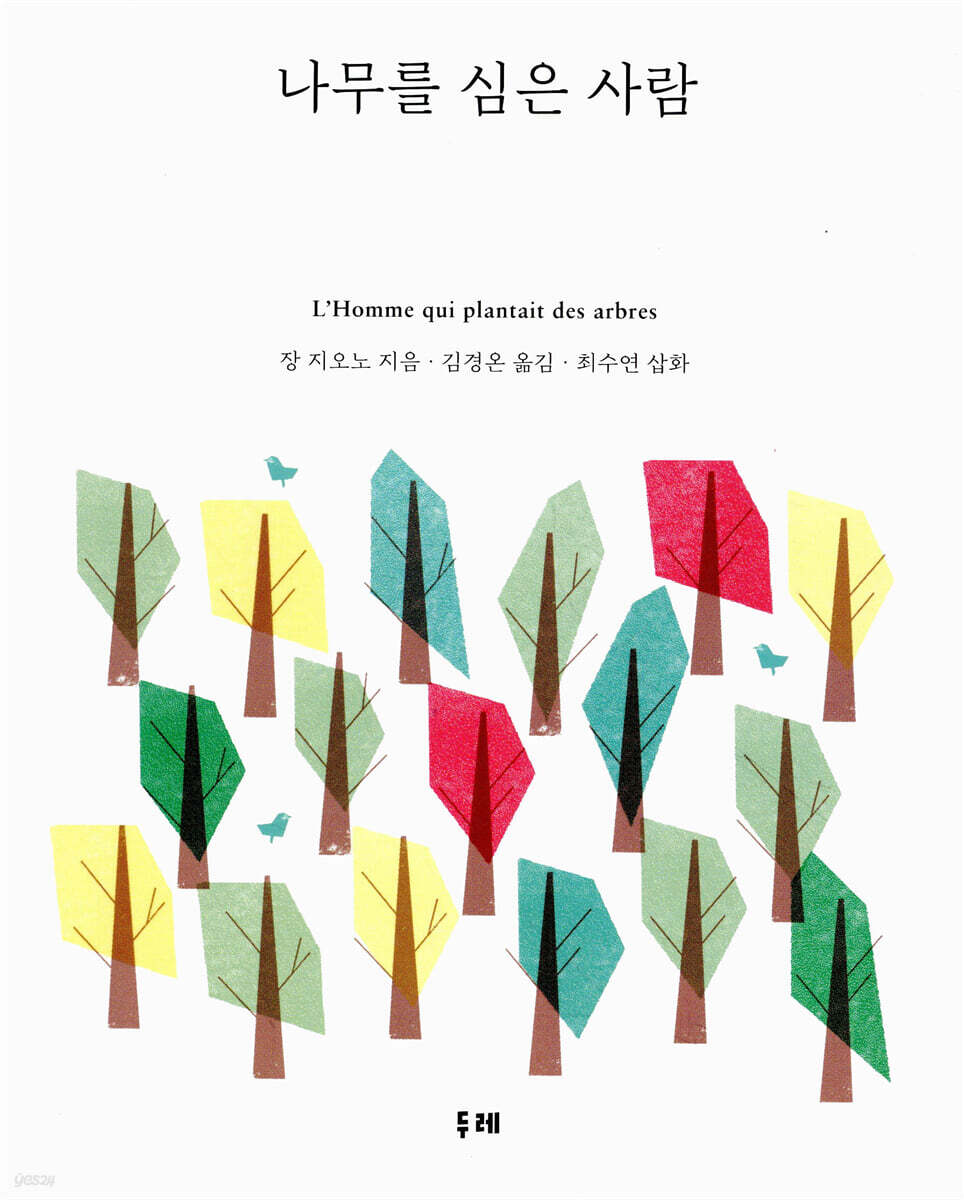
A revised edition republished with beautiful color illustrations by Choi Su-yeon, Korea's leading illustrator.
A superb fable, brimming with literary flavor and message!
This novel is the story of a man who 'planted hope and nurtured happiness' and transformed a barren, desolate land into a forest full of life by planting trees alone for decades. The author wrote the first manuscript based on his own experiences and then refined it over the course of 20 years to complete the work.
Since its first publication in 1953, it has been translated into 25 languages and is widely read around the world.
The reason such a short work leaves such a deep impression and resonance on us is because it conveys a powerful message along with a deep literary fragrance.
In an age of destruction where the air, water, and land are dying and all living things are suffering, this is an excellent fable that teaches us the direction that modern civilization should take in the future through the story of a noble person who loves and nurtures life.
This work movingly shows the miracle of how the noble spirit and practice of one person, who dedicated himself not for himself but for 'us' and the common good, without expecting any reward or compensation, changed the 'appearance of the Earth' and transformed the 'world'.
Through this, we plant a 'tree of hope' in our hearts and plant the acorns of tomorrow that will grow into green oak trees in our parched souls.
It has been newly published with beautiful color illustrations by Choi Su-yeon, a representative illustrator of our country.
It teaches us the direction we should take in the midst of a serious crisis of civilization and the environment.
A moving and heartwarming novel that changes people and the world!
A revised edition republished with beautiful color illustrations by Choi Su-yeon, Korea's leading illustrator.
A superb fable, brimming with literary flavor and message!
This novel is the story of a man who 'planted hope and nurtured happiness' and transformed a barren, desolate land into a forest full of life by planting trees alone for decades. The author wrote the first manuscript based on his own experiences and then refined it over the course of 20 years to complete the work.
Since its first publication in 1953, it has been translated into 25 languages and is widely read around the world.
The reason such a short work leaves such a deep impression and resonance on us is because it conveys a powerful message along with a deep literary fragrance.
In an age of destruction where the air, water, and land are dying and all living things are suffering, this is an excellent fable that teaches us the direction that modern civilization should take in the future through the story of a noble person who loves and nurtures life.
This work movingly shows the miracle of how the noble spirit and practice of one person, who dedicated himself not for himself but for 'us' and the common good, without expecting any reward or compensation, changed the 'appearance of the Earth' and transformed the 'world'.
Through this, we plant a 'tree of hope' in our hearts and plant the acorns of tomorrow that will grow into green oak trees in our parched souls.
It has been newly published with beautiful color illustrations by Choi Su-yeon, a representative illustrator of our country.
- You can preview some of the book's contents.
Preview
Publisher's Review
“A novel written to encourage tree planting”
Jean Giono's importance in French literature is evident from the fact that he received the Monaco Prize in 1953, was elected a member of the Académie Goncourt in 1954, and was even nominated for the Nobel Prize in Literature at one point.
Giono's position in France can be guessed from the fact that André Malraux said, "If I were asked to name three French writers of the 20th century, I would name Giono, Montelland, and Malraux."
Giono has often said that he does not want his works to become sermons.
However, when publishing this work, he explained that he wrote it “to make people love trees, or more precisely, to encourage tree planting.”
Geono's wish was passed on to people, and this book is widely used as a resource for the Earth Greening Movement around the world.
It is also widely read as a spiritual (moral) educational material for young people, beyond being just a great piece of literature.
A moving story of a man dedicated to "us" and the common good.
A highland area in the Provence region.
In the past, this place was covered with thick forests and was a village where people lived together.
However, people obsessed with selfishness and greed fought over everything and cut down trees indiscriminately to make money, turning the land into a barren wasteland where only the harsh wind blew.
Eventually, people, birds and animals all left the place.
An old shepherd, realizing that the land was barren and devoid of trees, entered this mountainous region and began planting trees.
This man, whose wife and only son had both died, lived alone in the mountains, planting acorns and birch trees every day.
After 40 years of continuous tree planting, a miraculous event occurred: the once barren land was covered with a beautiful, vast forest.
Water flowed again on the parched land, countless flowers bloomed in competition, and birds returned to chirp.
People come back here one by one, and bright laughter rings out.
The wasteland became a land where life lived and breathed.
It showed that the noble spirit and practice of a person who abandons selfishness and sacrifices himself to work for the common good without expecting any reward can produce miraculous results.
A work that was refined and completed over 20 years based on the author's experience.
This short story was written by Jean Giono based on his own experiences.
While traveling in Haute-Provence, Jean Giono met a special person.
He was a shepherd who lived alone, and he constantly planted trees to bring life to the barren land.
The author was so impressed by this that he wrote the first draft of this work, which he is known to have refined over the next 20 years.
The protagonist of this work, Elzéard Bouffier, instills hope and confidence that anyone can create a 'miracle' if they have a holy will and put it into practice.
It tells us that anyone can turn an 'ordinary life' into an 'extraordinary life'.
It also reminds us who the real heroes we should respect are.
It reminds us that those who truly change the world and make it more beautiful are not those who enjoy power, wealth, or fame, but those who work silently for others, those who practice in silence.
It awakens us to the fact that we are people who do good deeds without speaking, without rushing, without worshipping speed, without sacrificing ourselves, and without bending.
Meanwhile, this work was also made into an animation and caused a huge sensation worldwide.
The animated film of the same name, illustrated by world-renowned artist Frederic Beck and produced by the Canadian Broadcasting Corporation, won the Academy Award for Best Animated Short Film, as well as awards at numerous film festivals, including the Annecy, Los Angeles, Royan, Hiroshima, Valladolid, and Ottawa film festivals.
The reason his novels remain beloved over time is because Giono's naturalistic ideas shine even brighter in the face of the crisis of modern civilization, which worships material things.
This is because the old worldview that has maintained modern civilization up to the present day has reached its limits due to environmental pollution, destruction of the earth, devastation of the human spirit, and materialization of humanity.
That is why people evaluate Jean Giono's 'The Man Who Planted Trees' as a meditation that purifies our souls and opens our eyes anew amidst the crisis of today's civilization and the corruption of a decaying material civilization.
Jean Giono's importance in French literature is evident from the fact that he received the Monaco Prize in 1953, was elected a member of the Académie Goncourt in 1954, and was even nominated for the Nobel Prize in Literature at one point.
Giono's position in France can be guessed from the fact that André Malraux said, "If I were asked to name three French writers of the 20th century, I would name Giono, Montelland, and Malraux."
Giono has often said that he does not want his works to become sermons.
However, when publishing this work, he explained that he wrote it “to make people love trees, or more precisely, to encourage tree planting.”
Geono's wish was passed on to people, and this book is widely used as a resource for the Earth Greening Movement around the world.
It is also widely read as a spiritual (moral) educational material for young people, beyond being just a great piece of literature.
A moving story of a man dedicated to "us" and the common good.
A highland area in the Provence region.
In the past, this place was covered with thick forests and was a village where people lived together.
However, people obsessed with selfishness and greed fought over everything and cut down trees indiscriminately to make money, turning the land into a barren wasteland where only the harsh wind blew.
Eventually, people, birds and animals all left the place.
An old shepherd, realizing that the land was barren and devoid of trees, entered this mountainous region and began planting trees.
This man, whose wife and only son had both died, lived alone in the mountains, planting acorns and birch trees every day.
After 40 years of continuous tree planting, a miraculous event occurred: the once barren land was covered with a beautiful, vast forest.
Water flowed again on the parched land, countless flowers bloomed in competition, and birds returned to chirp.
People come back here one by one, and bright laughter rings out.
The wasteland became a land where life lived and breathed.
It showed that the noble spirit and practice of a person who abandons selfishness and sacrifices himself to work for the common good without expecting any reward can produce miraculous results.
A work that was refined and completed over 20 years based on the author's experience.
This short story was written by Jean Giono based on his own experiences.
While traveling in Haute-Provence, Jean Giono met a special person.
He was a shepherd who lived alone, and he constantly planted trees to bring life to the barren land.
The author was so impressed by this that he wrote the first draft of this work, which he is known to have refined over the next 20 years.
The protagonist of this work, Elzéard Bouffier, instills hope and confidence that anyone can create a 'miracle' if they have a holy will and put it into practice.
It tells us that anyone can turn an 'ordinary life' into an 'extraordinary life'.
It also reminds us who the real heroes we should respect are.
It reminds us that those who truly change the world and make it more beautiful are not those who enjoy power, wealth, or fame, but those who work silently for others, those who practice in silence.
It awakens us to the fact that we are people who do good deeds without speaking, without rushing, without worshipping speed, without sacrificing ourselves, and without bending.
Meanwhile, this work was also made into an animation and caused a huge sensation worldwide.
The animated film of the same name, illustrated by world-renowned artist Frederic Beck and produced by the Canadian Broadcasting Corporation, won the Academy Award for Best Animated Short Film, as well as awards at numerous film festivals, including the Annecy, Los Angeles, Royan, Hiroshima, Valladolid, and Ottawa film festivals.
The reason his novels remain beloved over time is because Giono's naturalistic ideas shine even brighter in the face of the crisis of modern civilization, which worships material things.
This is because the old worldview that has maintained modern civilization up to the present day has reached its limits due to environmental pollution, destruction of the earth, devastation of the human spirit, and materialization of humanity.
That is why people evaluate Jean Giono's 'The Man Who Planted Trees' as a meditation that purifies our souls and opens our eyes anew amidst the crisis of today's civilization and the corruption of a decaying material civilization.
GOODS SPECIFICS
- Date of issue: March 10, 2018
- Format: Hardcover book binding method guide
- Page count, weight, size: 104 pages | 312g | 150*190*20mm
- ISBN13: 9788974431143
- ISBN10: 8974431149
You may also like
카테고리
korean


korean

![GQ KOREA Mark (Monthly): December [2025]](http://librairie.coreenne.fr/cdn/shop/files/8ef265dbbfbf186523ed75ba7319009d.jpg?v=1765340328&width=3840)


