

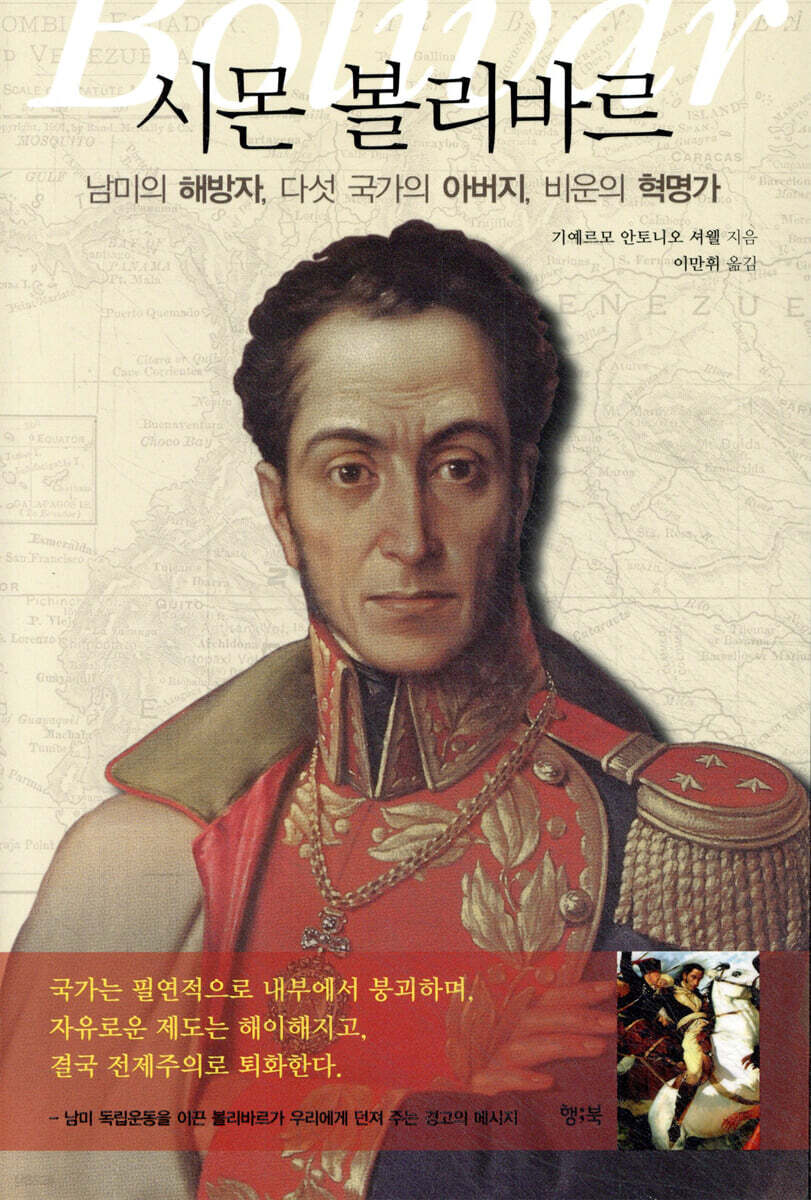
Simon Bolivar
 |
Description
Book Introduction
A mirror reflecting an era of division
Guillermo A.
Sherwell's "Simon Bolívar: Liberator of South America, Father of Five Nations, Ill-fated Revolutionary" is a classic that delves into Bolívar's life and thought with humanistic depth.
The unfamiliar and complex context of South American independence history is brought to life naturally, as if it were a vivid historical scene, with various maps, illustrations, chronological tables, and biographies to help readers easily follow it.
『Simon Bolivar』 is not just a simple heroic tale.
This is a record of political and philosophical reflection that deeply explores how leaders are born in times of chaos, what decisions they must make, and what epochal responsibilities and tragedies they must shoulder.
- You can preview some of the book's contents.
Preview
index
Introduction | Liberators, Towards Freedom in Latin America
Chapter 1: Spanish Colonies in the Americas
Chapter 2: Bolívar's Early Life 1783–1810
Chapter 3: The Establishment and Failure of the First Venezuelan Republic, 1811–1812
Chapter 4: The Cartagena Declaration and the Beginning of the War of Liberation, 1812–1813
Chapter 5: The Liberator of Venezuela and His First Victory, 1813
Chapter 6: The Ideal of Pan-American Cooperation, 1813-1814
Chapter 7: The Collapse of the Second Venezuelan Republic, 1814
Chapter 8: Jamaican Letters Written from the Ashes, 1814-1815
Chapter 9: The Return of Bolívar, 1815–1817
Chapter 10: The United Front of the Revolutionary Armies, 1817-1818
Chapter 11: The Congress of Angostura and Bolívar's Speech, 1819
Chapter 12: The Birth of Gran Colombia, 1819
Chapter 13: Santa Ana Peace Conference, 1820
Chapter 14: The Dream of a Confederate America, 1821
Chapter 15: Political Conflicts Surrounding Guayaquil, 1822
Chapter 16: Sucre, Liberator of Peru, 1822–1824
Chapter 17: The Birth of Bolivia, 1825–1827
Chapter 18: The Separatist Conspiracy, 1828
Chapter 19: The Collapse of Bolívar's Ideals, 1829-1830
Chapter 20: Bolívar's Last Proclamation, 1830
Conclusion | Simon Bolívar, the Symbol of Latin American Freedom
Appendix 1 The Life of Simon Bolivar
Appendix 2: Bolívar Biographical Dictionary
index
Into the book
History has essentially been, and will continue to be, a process of recording the great ideas and achievements of the heroes who led an era.
--- p.6
He was a Moses-like figure.
He led countless people according to God's will and accomplished miraculous feats that seemed impossible to ordinary people.
However, at the moment of final victory, they failed to become the masters of the land and quietly disappeared into history, leaving behind a legacy called 'freedom'.
--- p.9
Spanish colonial rule was based on strict regulations and closed control. … Communication and trade with foreign countries were strictly prohibited, and any ship sailing American waters without the Crown's permission was considered an enemy.
--- p.14
“Americans were suddenly thrust into the positions of legislator, administrator, treasurer, diplomat, general, and governmental figure, without any preparation or prior knowledge.
However, a series of events in South America have clearly demonstrated that a fully representative government is not suitable for our current national character, educational level, or social conditions.
…if we do not possess the political morality and governance capacity of our American brethren in North America, these institutions may be more destructive than helpful.
--- p.101
“Colombians, you have seen firsthand the struggles I have made for freedom in this land of tyranny.
I worked without selfish desires, giving up all my wealth and comfort.
And when I felt that you no longer believed in my innocence, I selflessly resigned from command.
…my last wish is the happiness of my country.
If my death can help even a little to end division and strengthen unity, I will go to my grave in peace.”
--- p.237
Publisher's Review
■ Why ‘Bolivar’ now?
The name 'Bolivar' is quite familiar to travelers visiting South America today.
His name is on countless streets and place names, and his statues stand in historic squares.
Even Venezuela's currency, the Bolivar, and Bolivia's country name are named in his honor.
Simón Bolívar (1783-1830) is a figure who led the independence of five countries: Venezuela, Colombia, Ecuador, Peru, and Bolivia. The people of South America revere him as a revolutionary who liberated them from the oppression of the Spanish Empire and laid the foundation for a republic, and as a father of the nation like Mahatma Gandhi of India.
However, the name Bolívar is not widely known outside South America.
Although he laid the foundation for independence, he suffered painful frustrations amid endless internal divisions, power struggles, and the gap between the people and the leaders, ultimately failing to achieve the happy ending of the lofty ideal he had dreamed of: a "United South American Nation."
Bolívar, on the brink of success, disappeared into the back alleys of history amidst all kinds of betrayal and contempt, labeled a dictator by his beloved comrades and the people.
■ A question raised again in an age of division and conflict
Today, Korea and the world are in the midst of fierce conflict and extreme division.
In South Korea, the foundations of democracy still appear solid due to political conflict, but the energy of trust and unity that underpins it is rapidly being depleted.
This chaos is not limited to Korea.
The rise of Trump, the shaken American democracy, and the rise of extremism around the world are all clear indicators of the crisis facing our civilization today.
It is at this very point that Simón Bolívar, the 19th-century South American "Liberator" (El Libertador), is being re-examined for us today.
Even in situations of extreme division and conflict, Bolivar never lost his belief that "we are one people" until the very end.
The ideal of a "united America" that he ultimately failed to achieve makes us reflect on the reality of division and conflict that our society faces today.
As we follow the trajectory of his life, which ended in a fall while pursuing his ideals like Don Quixote, we are led to ask the question of what path humans and society should choose when ideals and reality collide.
■ A mirror reflecting the era of division
Guillermo A.
Sherwell's "Simon Bolívar: Liberator of South America, Father of Five Nations, Ill-fated Revolutionary" is a classic that delves into Bolívar's life and thought with humanistic depth.
The unfamiliar and complex context of South American independence history is brought to life naturally, as if it were a vivid historical scene, with various maps, illustrations, chronological tables, and biographies to help readers easily follow it.
This book is not simply a heroic tale.
This is a record of political and philosophical reflection that deeply explores how leaders emerge in times of chaos, what decisions they must make, and what tragedies and responsibilities they must shoulder.
GOODS SPECIFICS
- Date of issue: November 25, 2025
- Page count, weight, size: 288 pages | 426g | 152*225*14mm
- ISBN13: 9791198817334
- ISBN10: 119881733X
You may also like
카테고리
korean


korean


