

Pablo Neruda's autobiography
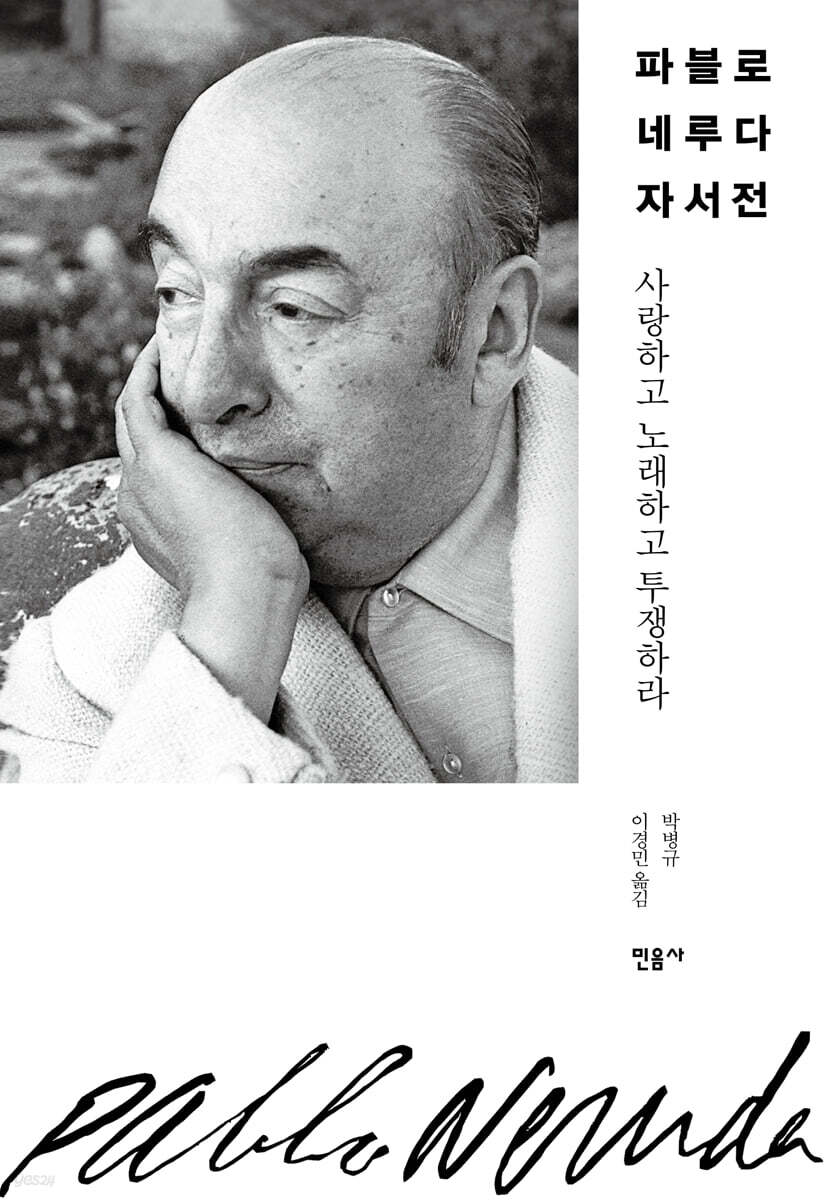 |
Description
Book Introduction
Pablo Neruda's autobiography published in a revised edition to commemorate the 50th anniversary of his death.
In the 20th century, when men of letters had no choice but to live political lives, a revised edition of "Pablo Neruda's Autobiography: Love, Sing, Fight," which contains the poet Neruda's thoughts and messages on poetry, literature, and politics, has been published.
The memoirs that Neruda began writing a year before his death were never completed.
Two years after his death, his wife Matilde Urrutia and his friend Miguel Otero Silva collected manuscripts and compiled a new edition of his autobiography, which was published with the intention of supplementing it with lectures and unpublished manuscripts held by the Pablo Neruda Memorial Society.
The 20th century in which Neruda lived was a time of struggle against colonialism and dictatorship.
Neruda, who sang of nature and love, fought for the freedom of Latin America through poetry and was always with the people.
Having experienced the Spanish Civil War and the death of the poet García Lorca, Neruda came to the conclusion that “a mature writer cannot write without a sense of human fellowship and social consciousness,” and became a poet of the people, “singing and fighting for the joy of the future, the peace of tomorrow, and a just world.”
From then on, my path began to merge with that of others.
And suddenly I found myself turning from the south called solitude to the north called the people.
I longed for my humble poem to become a sword and a handkerchief for the people, to wipe away the sweat shed from heavy suffering and become a weapon in the struggle for bread.
―From Chapter 6, “In Search of the Fallen”
For those who dreamed of liberation from political oppression and shackles, Neruda wrote poetry, demanded social justice, and engaged in political activism.
Neruda, who joined the Communist Party to fight against the world war and protect human values, was forced to say, “They have betrayed Chile again” when the people were trampled by Stalin’s dictatorship.
Pablo Neruda's Autobiography: Love, Sing, Struggle captures Neruda's life as a poet, diplomat, exile, communist, and pacifist, as well as his perspective on the 20th century.
- You can preview some of the book's contents.
Preview
index
Editor's Preface 15
My Journey Through Poetry 21
Chapter 1: Country Boy 25
Chapter 2: The City Wanderer 65
Chapter 3: The Way of the World 103
Chapter 4: Shining Solitude 137
Chapter 5: Spain in the Heart 185
Chapter 6: In Search of the Fallen 229
Chapter 7: Mexico, the Land of Flowers and Thorns 257
Chapter 8: A Gloomy Homeland 283
Chapter 9: The Beginning and End of Exile 323
Chapter 10: Journey and Return 365
Chapter 11: Poetry is a Profession 409
Chapter 12: A Homeland of Hope and Suffering 545
Appendix 579
Author's Note 637
Pablo Neruda Chronology 663
Translator's Note (Park Byeong-gyu) 685
Into the book
Living among the lush forests and endless beaches, the exchange between my soul, or rather my poetry, and the loneliest land in the world began.
It's already been a long time since then.
But the exchange that began then, the enlightenment that I gained then, and the promise I made with the land then remain in my life to this day.
---From "Chapter 1: Country Boy"
“I have always thought that the work of a writer, or at least the work of a poet, is not something mystical or tragic, but rather a personal work, a work for the public.
“The things most similar to poetry are bread, earthenware, and wooden sculptures carved with care, even if clumsily.”
---From "Chapter 2: The City Wanderer"
Can poetry serve humanity? Can it become a companion in humanity's struggles? Poetry has, up until now, traversed irrational and negative territory.
Now is the time to stop and find the path of humanism.
Although humanism has been banished from modern literature, it is deeply rooted in the aspirations of human existence.
---From "Chapter 6: Finding the Fallen"
My humble poems aspired to become a sword and a handkerchief for the people, to wipe away the sweat shed from heavy suffering and to become weapons in the struggle for bread.
Then the world became wider, deeper, and eternal.
Now we stand proudly on the earth
---From "Chapter 6: Finding the Fallen"
It was my part to suffer and struggle, to love and sing.
It was my job to share the joy of victory and the pain of defeat with the world.
I tasted both bread and blood.
What more could a poet wish for? From tears to kisses, from loneliness to the people, everything lives and moves within my poetry.
I have lived for poetry, and poetry has been the foundation of my struggle.
---From "Chapter 8: The Gloomy Homeland"
When the horrific war raged on, when the invaders sought to destroy the people and their culture, Soviet writers fought, fell, fought and won, sacrificing their blood, their words, their love and their passion to preserve the sublime humanism of the October Revolution and your legacy.
Books have become powerful, invading cities, countryside, and villages, filling libraries, roads, homes, hospitals, and factories, reaching far-off places.
---From "Chapter 9: The Beginning and End of Exile"
I want to live in a world where people are just people, without any rules, titles, or labels.
I wish everyone could enter the cathedral and the printing house.
I hope we don't have to interview the mayor to arrest or deport anyone.
I hope everyone can come and go from the city hall with a smile on their face.
I hope no one escapes in a gondola or chases after them on a motorcycle.
And most people, no, everyone, wants to speak, read, listen, and prosper.
The struggle I think of is simply the struggle to end all struggles, and the strong response is the strong response to end all strong responses.
I have pursued only one path so far because I believe that this path can lead us all to eternal love.
---From "Chapter 10: Journey and Return"
I don't believe in originality.
Originality is nothing more than a superstition created by our rapidly decaying age.
I believe in individuality.
No matter what language or form you use in creating art, or what meaning you give to the artwork, individuality is bound to be revealed.
But the absurd notion of originality is a modern invention and a product of deception.
Among poets, there are those who aspire to be crowned poet laureate of a country, a language area, or the entire world.
These people are always going around looking for electoral college members and slandering potential rivals, so there's no way they can produce a decent poem.
---From “Chapter 11 Poetry is a Profession”
As I spoke to you, as I was with you, as I allowed my poetry and struggles to touch your thoughts and hearts, I hoped I would not hurt anyone's feelings or shatter any of your dreams.
I hope you will find in my words the answers to the hidden questions that weigh on your hearts.
But I also hope that new questions and new dissatisfaction will awaken in you.
I hope that life, joy, and the pain the world gives us will break down the front door and enter our home every day.
Life is made up of mysterious entities that die at night and are reborn at dawn.
So, I hope that with the answers I have just found, new questions will be born.
---From "Chapter 12: A Homeland of Hope and Suffering"
Publisher's Review
●Nobel Prize-winning author and Latin America's greatest poet
Born in Chile in 1904, Neruda dreamed of becoming a poet from the age of ten, and became known to the world with the publication of Twenty Love Poems and a Song of Despair in 1924, which was greatly loved.
Chapter 1, "The Country Boy," and Chapter 2, "The Urban Wanderer," of this book describe in detail Neruda's life leading up to his first fame as a poet.
Afterwards, in 1927, Neruda began his life in Asia when he was appointed consul in Rangoon (now Yangon, Myanmar), an unfamiliar region.
Afterwards, while traveling to various Asian countries, including Myanmar, India, Korea, and China, Neruda became disillusioned with the society of the aristocracy and diplomats, and became interested in the poor and marginalized people.
The poets who sat around me, singing and reciting poetry, were so different from these miserable pilgrims.
(Omitted) I can never forget the worried eyes of these young poets I met all over India.
They were people who had just gotten out of prison and might end up back in there the next day.
The reason is that they prayed to overturn the miserable reality and the oppressive god.
This is the reality of the times we live in.
―From Chapter 4, “Shining Solitude”
Neruda, who published "Above Ground" containing the loneliness he felt at that time, had to endure unfortunate events during the Spanish Civil War that broke out in 1936.
He was separated from his wife and daughter, and his friend Lorca was assassinated.
Neruda later recalled, “For me, the Spanish Civil War began with the disappearance of a poet, and it soon changed the nature of my poetry.”
Neruda, who was famous for his romantic poems singing about nature and love, went a step further and began writing poems that embraced the lives and struggles of the people.
American literary critic Harold Bloom called Neruda "one of the most classic Western poets of all time," and Carlos Fuentes commented, "There would be no modern Latin American literature without the poetic adventures of Neruda."
Neruda's collection of odes, "When I Close You, I Open Life: Basic Odes," is considered an innovative poem that inherits the ode form of the Greek poet Pindar, but by paying homage to simple objects, it drives out solemnity and authority and achieves the aesthetic of simplicity.
In 1971, Neruda was awarded the Nobel Prize in Literature for writing "poems that vividly convey the destiny and hope of the Latin American continent."
“The people’s poet… this is the true award I have received.” ―Pablo Neruda
In 1950, Neruda published a poetry collection titled "Songs of All" in Mexico, which contained his vision of nature, history, and culture. That same year, he was awarded the Lenin Peace Prize along with Pablo Picasso and Paul Robeson.
Although Neruda's name continued to grow as he attended the World Peace Conference and was appointed as a judge for the International Committee for the Stalin Peace Prize, he was most proud of the title of people's poet.
I have lived for poetry, and poetry has been the foundation of my struggle.
(Omitted) After going through difficult aesthetic training and navigating the labyrinths of countless languages, I became a poet of the people, and this is the award I received.
It is not a collection of my writings or poems translated into several languages, nor is it a critical work that interprets or dissects poetic language.
My award was that moment when a miner, his face bruised from hard work in broad daylight and his eyes bloodshot from the dust, came out of the mine shaft of the Rota coal mine as if he had come out of hell, and as soon as he saw me, he immediately extended his rough hand and said with sparkling eyes, “I’ve known you for a long time.”
―From Chapter 8, “The Gloomy Homeland”
In 1973, the Allende regime that Neruda supported collapsed due to Pinochet's military coup, and on September 23, about ten days later, Neruda passed away from cancer.
Isla Negra, where Neruda lived, Chascona in Santiago, and Sebastiana in Valparaiso became famous landmarks for the unique ship's head statues and seashells collected by Negra.
GOODS SPECIFICS
- Date of issue: April 20, 2023
- Format: Hardcover book binding method guide
- Page count, weight, size: 692 pages | 1,000g | 145*215*35mm
- ISBN13: 9788937416996
- ISBN10: 8937416999
You may also like
카테고리
korean


korean


