

Dream transmission
 |
Description
Book Introduction
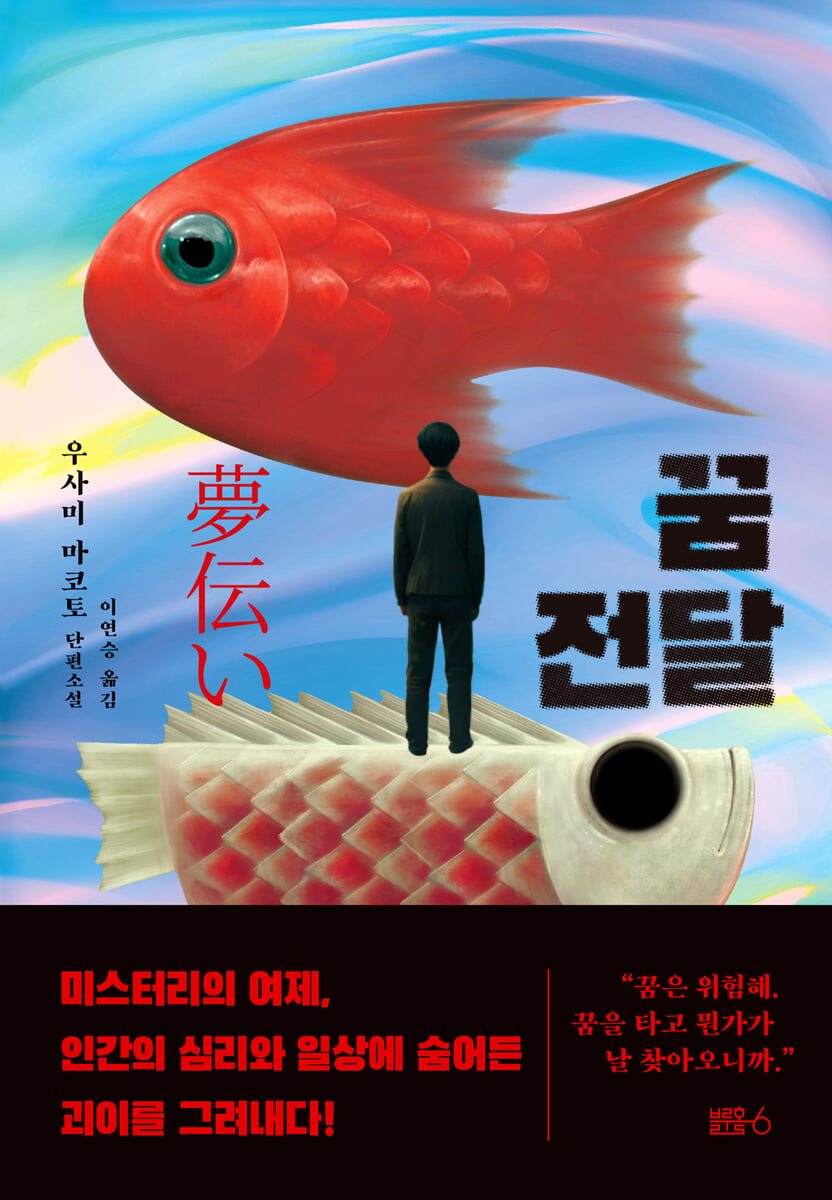
Makoto Usami's "Dream Transmission" was published by Bluehole Six.
Bluehole Six is a publishing company that has been overwhelmingly number one in the number of mystery and detective novels published every year since its founding.
We have been publishing works by authors who have not yet been published in Korea, such as 'Yuki Haruo', 'Miki Akiko', 'Asakura Akinari', 'Hayasaka Yabusaka', and 'Furuta Den', as well as works by authors who were not yet well known in Korea, such as 'Oh Seung-ho' (the late Katsuhiro) and 'Usami Makoto', as we understand it to be Bluehole Six's mission.
In particular, by consistently publishing Nakayama Shichiri's works in series, Nakayama Shichiri has become a popular author representing Japan.
This can also be said to be an achievement and goal unique to Bluehole Six Publishing Company.
"Dream Delivery" is a short horror mystery that beautifully depicts the strangeness and psychological ramifications that lurk in the cracks of everyday life.
It stands out for its ability to cross the line between reality and unreality, emitting chilling horror, suspense, and lyrical aftertaste.
Bluehole Six is a publishing company that has been overwhelmingly number one in the number of mystery and detective novels published every year since its founding.
We have been publishing works by authors who have not yet been published in Korea, such as 'Yuki Haruo', 'Miki Akiko', 'Asakura Akinari', 'Hayasaka Yabusaka', and 'Furuta Den', as well as works by authors who were not yet well known in Korea, such as 'Oh Seung-ho' (the late Katsuhiro) and 'Usami Makoto', as we understand it to be Bluehole Six's mission.
In particular, by consistently publishing Nakayama Shichiri's works in series, Nakayama Shichiri has become a popular author representing Japan.
This can also be said to be an achievement and goal unique to Bluehole Six Publishing Company.
"Dream Delivery" is a short horror mystery that beautifully depicts the strangeness and psychological ramifications that lurk in the cracks of everyday life.
It stands out for its ability to cross the line between reality and unreality, emitting chilling horror, suspense, and lyrical aftertaste.
- You can preview some of the book's contents.
Preview
index
1.
Dream transmission
2.
Water tribe
3.
Air plant
4.
Let's cross the sinking bridge
5.
Love is indistinguishable
6.
Oviparous
7.
aristocrats
8.
Sending Pilgrim
9.
The End of the Endless World
10.
The village where the full moon rises
11.
Mother's self-portrait
Translator's Note
Dream transmission
2.
Water tribe
3.
Air plant
4.
Let's cross the sinking bridge
5.
Love is indistinguishable
6.
Oviparous
7.
aristocrats
8.
Sending Pilgrim
9.
The End of the Endless World
10.
The village where the full moon rises
11.
Mother's self-portrait
Translator's Note
Detailed image
Into the book
The bus I transferred to in front of the station ran along the seaside road and headed to the end of the cape.
--- From "First Sentence"
The novels he writes are mostly dark fantasy stories set in modern society.
It is a style that seems to delve into the dark side of human nature and vomit out sticky things.
Readers may feel uncomfortable, but their unique charm draws them in and they find themselves looking for the next work, and the one after that.
Just as the seeds of darkness that Saruhashi had sown took root.
--- p.10
- Something comes to me in my dreams.
At that moment, Saruhashi's words flashed through my mind.
Masumoto shook his head, shaking off the absurd thought.
--- p.38
“What on earth happened?”
Doi barely managed to ask.
“I can’t sleep.”
Masumoto answered.
“When I sleep, I dream.
Dreams are dangerous.
“Because something comes to you through dreams.”
--- p.47
“But strangely enough, when I come here, I understand.
I think the word 'water limbs' is exactly right.
I think it's probably because of the water.
“The reason I keep wanting to come here is because the water calls me.”
Takuya's voice echoed through the deserted aquarium.
What did that mean?
Now I can never know.
Because we're separated forever.
--- p.53
Vega recognized me through the glass, rolled her black eyes around, and wiggled the melon on her head.
Vega, lend me your strength! I cried out inwardly.
Ryo was shuddering as he looked at himself reflected in the acrylic glass mirror.
His face is as white as a sheet of paper.
Vega's appearance in the tank overlapped with my reflection in the glass.
--- p.81
But sometimes I think this too.
Could it be that something inside us is being absorbed by something without us even realizing it?
The elements that make up a human being melt away and flow into the void with the slightest carelessness.
And it becomes, so to speak, the nutrient for that ominous plant.
Without realizing it, humans become empty.
--- p.101
I knew that the child loved his mother and liked to do whatever she said.
But, you know.
At that time, I didn't know exactly why, but I got goosebumps.
There was a strong bond between the two that no one could interfere with.
Could you call it a beautiful hat? Still, I felt something ominous.
--- p.151
Since then I have stayed here.
Looking at the circularly cut landscape inside the tunnel.
The paulownia tree bloomed and bore fruit several times.
Now I don't even know how much time has passed.
Cars pass through the tunnel.
At night, people sometimes walk into the tunnel.
I just stand there dumbfounded.
I don't know why I, who am dead, am still here.
One thing is certain: there is no escape from this.
No matter who comes, I just watch quietly without doing anything.
--- p.188
And above all, this bulging belly.
Could there be an egg in this?
No, how many of them have already hatched from eggs and are growing?
As I imagined it, a shiver ran through my whole body.
The snake, carrying its young on its belly, seemed to be showing off its maternal instincts with its entire body.
I want to go home and swim in the tank.
Unable to bear it any longer, imagining its elegant appearance, Tetsuro hurriedly greeted the fishermen, took a bucketful of black-backed sea snakes, and headed home.
--- p.203
A groan erupted from Destroyer's throat.
In the tank that should have been empty, there were three baby black-backed sea snakes swimming around.
“These are your children.”
Maya turned her head again and smiled.
Two small, sharp teeth shone inside the mouth.
--- p.234
“Age.
"That woman, is she perhaps a powerful woman? She came to seduce people."
When I heard Yoshitaka's words, I burst out laughing.
“Akemi never bathes with other people.
“That’s probably because they’re afraid of exposing their back scales.”
--- p.242
The person I killed, you know.
He's my younger brother.
My younger brother, who is exactly ten years younger than me.
I just killed him in the mountains and buried him.
When he was born into this world, I was the one who heard his mother's words and received the child.
So it makes sense that I, as your older sister, am the one who first brought him into this world and the one who killed him.
--- p.263
- But have you ever thought, there's another world out there, one I didn't choose?
Hearing that, my father tilted his head in bewilderment.
Ikushima had a habit of making people feel embarrassed and enjoying himself.
- What if there is a world that I did not choose, and it is running in its own way?
Ikushima smiled at his speechless father.
- Sometimes people make foolish choices.
Don't regret your choice.
And think about it.
If I had definitely chosen that side back then, things would have turned out well.
--- From "First Sentence"
The novels he writes are mostly dark fantasy stories set in modern society.
It is a style that seems to delve into the dark side of human nature and vomit out sticky things.
Readers may feel uncomfortable, but their unique charm draws them in and they find themselves looking for the next work, and the one after that.
Just as the seeds of darkness that Saruhashi had sown took root.
--- p.10
- Something comes to me in my dreams.
At that moment, Saruhashi's words flashed through my mind.
Masumoto shook his head, shaking off the absurd thought.
--- p.38
“What on earth happened?”
Doi barely managed to ask.
“I can’t sleep.”
Masumoto answered.
“When I sleep, I dream.
Dreams are dangerous.
“Because something comes to you through dreams.”
--- p.47
“But strangely enough, when I come here, I understand.
I think the word 'water limbs' is exactly right.
I think it's probably because of the water.
“The reason I keep wanting to come here is because the water calls me.”
Takuya's voice echoed through the deserted aquarium.
What did that mean?
Now I can never know.
Because we're separated forever.
--- p.53
Vega recognized me through the glass, rolled her black eyes around, and wiggled the melon on her head.
Vega, lend me your strength! I cried out inwardly.
Ryo was shuddering as he looked at himself reflected in the acrylic glass mirror.
His face is as white as a sheet of paper.
Vega's appearance in the tank overlapped with my reflection in the glass.
--- p.81
But sometimes I think this too.
Could it be that something inside us is being absorbed by something without us even realizing it?
The elements that make up a human being melt away and flow into the void with the slightest carelessness.
And it becomes, so to speak, the nutrient for that ominous plant.
Without realizing it, humans become empty.
--- p.101
I knew that the child loved his mother and liked to do whatever she said.
But, you know.
At that time, I didn't know exactly why, but I got goosebumps.
There was a strong bond between the two that no one could interfere with.
Could you call it a beautiful hat? Still, I felt something ominous.
--- p.151
Since then I have stayed here.
Looking at the circularly cut landscape inside the tunnel.
The paulownia tree bloomed and bore fruit several times.
Now I don't even know how much time has passed.
Cars pass through the tunnel.
At night, people sometimes walk into the tunnel.
I just stand there dumbfounded.
I don't know why I, who am dead, am still here.
One thing is certain: there is no escape from this.
No matter who comes, I just watch quietly without doing anything.
--- p.188
And above all, this bulging belly.
Could there be an egg in this?
No, how many of them have already hatched from eggs and are growing?
As I imagined it, a shiver ran through my whole body.
The snake, carrying its young on its belly, seemed to be showing off its maternal instincts with its entire body.
I want to go home and swim in the tank.
Unable to bear it any longer, imagining its elegant appearance, Tetsuro hurriedly greeted the fishermen, took a bucketful of black-backed sea snakes, and headed home.
--- p.203
A groan erupted from Destroyer's throat.
In the tank that should have been empty, there were three baby black-backed sea snakes swimming around.
“These are your children.”
Maya turned her head again and smiled.
Two small, sharp teeth shone inside the mouth.
--- p.234
“Age.
"That woman, is she perhaps a powerful woman? She came to seduce people."
When I heard Yoshitaka's words, I burst out laughing.
“Akemi never bathes with other people.
“That’s probably because they’re afraid of exposing their back scales.”
--- p.242
The person I killed, you know.
He's my younger brother.
My younger brother, who is exactly ten years younger than me.
I just killed him in the mountains and buried him.
When he was born into this world, I was the one who heard his mother's words and received the child.
So it makes sense that I, as your older sister, am the one who first brought him into this world and the one who killed him.
--- p.263
- But have you ever thought, there's another world out there, one I didn't choose?
Hearing that, my father tilted his head in bewilderment.
Ikushima had a habit of making people feel embarrassed and enjoying himself.
- What if there is a world that I did not choose, and it is running in its own way?
Ikushima smiled at his speechless father.
- Sometimes people make foolish choices.
Don't regret your choice.
And think about it.
If I had definitely chosen that side back then, things would have turned out well.
--- p.377
Publisher's Review
"I want to write about human fear and madness."
The dark side of human relationships and emotions.
A collection of 11 ghost stories where everything swirls!
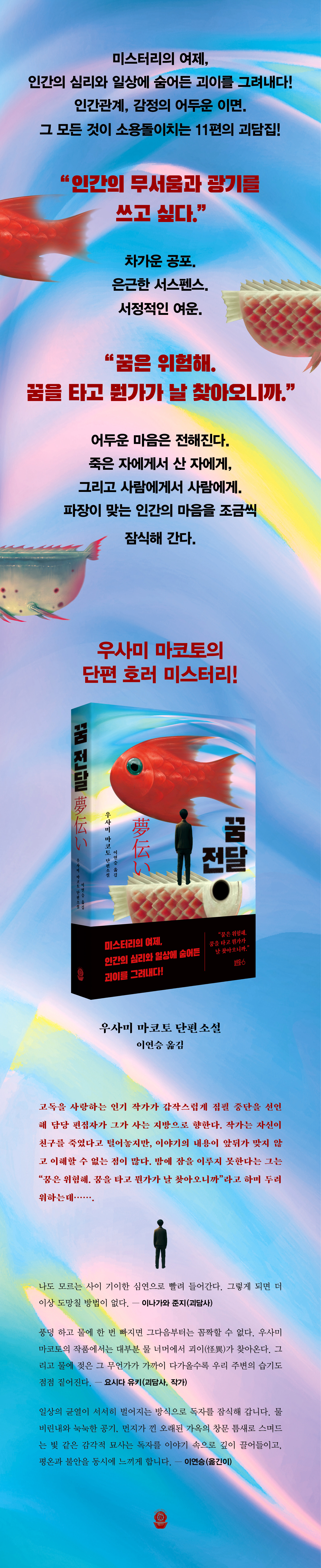
"Dream Transmission" is a collection of 11 short horror mystery stories written with a chilling touch by Makoto Usami.
First, the title piece, "Dream Delivery," begins with a popular author suddenly declaring that he will stop writing.
The writer leaves a strange message to the editor who came to see him, saying, “Something comes to me in a dream,” and from this single line, reality and inexplicable phenomena intersect.
In "Aquarium," a mysterious incident at a local aquarium blurs the line between water and land, and in "Air Plant," strange changes permeate the daily lives of isolated people, like plants that survive without soil.
In "Crossing the Sinking Bridge," the mysterious connection between the actions of one's childhood and the tragedy of the present is revealed.
In addition, each episode, including “Love Cannot Be Distinguished,” “Nantaesaeng,” “Hojok,” “Sending Pilgrims,” “The End of the Endless World,” “The Street Where the Full Moon Rises,” and “Mother’s Self-Portrait,” exudes its own personality and unique charm.
However, if there is a point that runs through each of the individual short stories, each with its own distinct personality, it is that they focus on human 'psychology' and 'relationships' even within a surreal framework.
Makoto Usami's writing style, which has so far been about human psychology and relationships from a three-dimensional perspective, is also clearly revealed in "Dream Transmission."
In particular, the author said that this time he wanted to return to 'ghost stories' and "write about human fear and madness," and these words of Makoto Usami are reflected in the work.
The author's conviction to ultimately tell a story about 'humanity' is evident as he sets up a surreal situation that crosses the line between reality and unreality.
Another common point worth noting is that all of the works are set in closed spaces and limited time and space.
Seaside villages, sparsely populated provincial towns, old houses, and closed worlds like underwater act as devices to confine the characters' emotions while simultaneously amplifying the strange energy seeping in from the outside.
As it tells the story of everyday life, the scale of the events that occur in each short story is usually not large.
Rather, it penetrates the reader in a way that gradually widens the cracks in everyday life.
The sensory descriptions, such as the smell of water, the damp air, and the light seeping through the cracks in the windows of a dusty old house, draw the reader deep into the story and make them feel both peace and anxiety.
I hope you can experience that cool aftertaste for yourself.
The dark heart is conveyed.
From the dead to the living,
And from person to person.
It gradually eats away at the hearts of humans who are on the same wavelength.
Makoto Usami, the Empress of Mystery, is not widely known in Japan despite her fame, but she is one of the most active writers in the country.
Born in Ehime Prefecture, Japan in 1957.
The author made a brilliant debut in 2006 when he was 50 years old, winning the grand prize in the short story category of the first 'Yu' Ghost Story Literature Award with 'The Child of Lumbini', and has published a whopping 23 works as of 2024.
Makoto Usami's works are characterized by a style that draws on her experience as a housewife living in a provincial city to draw out the negative aspects of humanity through ghost stories.
He is particularly adept at depicting the dark emotions latent in humans.
Moreover, his talent for skillfully revealing the darkness within humans through the strangeness that always lurks in everyday life is unparalleled.
It is said that the author was inspired to enter the world of fantasy and horror novels by Edgar Allan Poe's 'The Black Cat', and that he was also inspired by the works of Ray Bradbury, Stephen King, and Thomas Cook.
In this way, after his debut, the author stood out by presenting works with a strong horror theme such as 『Seven Colored Fairy Tale』 and 『The Forest That Does Not Enter』, but suddenly stopped his activities as an author in 2009.
Then, in 2016, he reappeared and began producing works that fused horror, psychological suspense, mystery, and human drama with a different atmosphere from his previous works.
In particular, he made a spectacular comeback in 2017 by winning the 70th Japan Mystery Writers Association Award in the long story and short story compilation categories for 『The Poison of a Fool』.
Published domestically by Bluehole Six in 2020, "The Poison of the Fool" is a shocking masterpiece that densely and weightily captures human despair and inner self, freely striding across the boundaries of crime fiction, mystery, and horror.
Furthermore, it is reminiscent of a human drama that captures the desperate psychology, karma, and tragedy of human beings.
Works with this kind of atmosphere are called 'black' ('white' works, which mainly talk about healing from wounds and hope through solidarity, include 'The Distance Where Moonlight Touches', 'Listen to the Sounds of the Night', and 'The Child Has a Scary Dream').
However, in the case of 『Dream Transmission』, it is difficult to simply classify it as black or white.
If I had to explain it, it could be said to have a similar atmosphere to the author's horror short story collection, "Girls Walk the Night," published in Korea in 2020.
For example, he keenly captures the invisible gaps that exist in extremely ordinary scenery, and does not miss the strangeness and psychological ripples that hide through those gaps.
Coolness and strangeness blur the boundaries of genre, creating different textures and temperatures for each story, presenting readers with a comprehensive gift set of cold horror, subtle suspense, and lyrical lingering emotions.
Even in his late 60s, Makoto Usami continues to publish three or four volumes of works every year, maintaining his obsession with human nature. We look forward to seeing what he does next.
The cracks in everyday life slowly eat away at the reader.
Sensory descriptions, such as the smell of water, damp air, and light seeping through the cracks in the windows of a dusty old house, draw readers deep into the story and create a sense of both peace and anxiety.
- Lee Yeon-seung (translator)
The dark side of human relationships and emotions.
A collection of 11 ghost stories where everything swirls!
"Dream Transmission" is a collection of 11 short horror mystery stories written with a chilling touch by Makoto Usami.
First, the title piece, "Dream Delivery," begins with a popular author suddenly declaring that he will stop writing.
The writer leaves a strange message to the editor who came to see him, saying, “Something comes to me in a dream,” and from this single line, reality and inexplicable phenomena intersect.
In "Aquarium," a mysterious incident at a local aquarium blurs the line between water and land, and in "Air Plant," strange changes permeate the daily lives of isolated people, like plants that survive without soil.
In "Crossing the Sinking Bridge," the mysterious connection between the actions of one's childhood and the tragedy of the present is revealed.
In addition, each episode, including “Love Cannot Be Distinguished,” “Nantaesaeng,” “Hojok,” “Sending Pilgrims,” “The End of the Endless World,” “The Street Where the Full Moon Rises,” and “Mother’s Self-Portrait,” exudes its own personality and unique charm.
However, if there is a point that runs through each of the individual short stories, each with its own distinct personality, it is that they focus on human 'psychology' and 'relationships' even within a surreal framework.
Makoto Usami's writing style, which has so far been about human psychology and relationships from a three-dimensional perspective, is also clearly revealed in "Dream Transmission."
In particular, the author said that this time he wanted to return to 'ghost stories' and "write about human fear and madness," and these words of Makoto Usami are reflected in the work.
The author's conviction to ultimately tell a story about 'humanity' is evident as he sets up a surreal situation that crosses the line between reality and unreality.
Another common point worth noting is that all of the works are set in closed spaces and limited time and space.
Seaside villages, sparsely populated provincial towns, old houses, and closed worlds like underwater act as devices to confine the characters' emotions while simultaneously amplifying the strange energy seeping in from the outside.
As it tells the story of everyday life, the scale of the events that occur in each short story is usually not large.
Rather, it penetrates the reader in a way that gradually widens the cracks in everyday life.
The sensory descriptions, such as the smell of water, the damp air, and the light seeping through the cracks in the windows of a dusty old house, draw the reader deep into the story and make them feel both peace and anxiety.
I hope you can experience that cool aftertaste for yourself.
The dark heart is conveyed.
From the dead to the living,
And from person to person.
It gradually eats away at the hearts of humans who are on the same wavelength.
Makoto Usami, the Empress of Mystery, is not widely known in Japan despite her fame, but she is one of the most active writers in the country.
Born in Ehime Prefecture, Japan in 1957.
The author made a brilliant debut in 2006 when he was 50 years old, winning the grand prize in the short story category of the first 'Yu' Ghost Story Literature Award with 'The Child of Lumbini', and has published a whopping 23 works as of 2024.
Makoto Usami's works are characterized by a style that draws on her experience as a housewife living in a provincial city to draw out the negative aspects of humanity through ghost stories.
He is particularly adept at depicting the dark emotions latent in humans.
Moreover, his talent for skillfully revealing the darkness within humans through the strangeness that always lurks in everyday life is unparalleled.
It is said that the author was inspired to enter the world of fantasy and horror novels by Edgar Allan Poe's 'The Black Cat', and that he was also inspired by the works of Ray Bradbury, Stephen King, and Thomas Cook.
In this way, after his debut, the author stood out by presenting works with a strong horror theme such as 『Seven Colored Fairy Tale』 and 『The Forest That Does Not Enter』, but suddenly stopped his activities as an author in 2009.
Then, in 2016, he reappeared and began producing works that fused horror, psychological suspense, mystery, and human drama with a different atmosphere from his previous works.
In particular, he made a spectacular comeback in 2017 by winning the 70th Japan Mystery Writers Association Award in the long story and short story compilation categories for 『The Poison of a Fool』.
Published domestically by Bluehole Six in 2020, "The Poison of the Fool" is a shocking masterpiece that densely and weightily captures human despair and inner self, freely striding across the boundaries of crime fiction, mystery, and horror.
Furthermore, it is reminiscent of a human drama that captures the desperate psychology, karma, and tragedy of human beings.
Works with this kind of atmosphere are called 'black' ('white' works, which mainly talk about healing from wounds and hope through solidarity, include 'The Distance Where Moonlight Touches', 'Listen to the Sounds of the Night', and 'The Child Has a Scary Dream').
However, in the case of 『Dream Transmission』, it is difficult to simply classify it as black or white.
If I had to explain it, it could be said to have a similar atmosphere to the author's horror short story collection, "Girls Walk the Night," published in Korea in 2020.
For example, he keenly captures the invisible gaps that exist in extremely ordinary scenery, and does not miss the strangeness and psychological ripples that hide through those gaps.
Coolness and strangeness blur the boundaries of genre, creating different textures and temperatures for each story, presenting readers with a comprehensive gift set of cold horror, subtle suspense, and lyrical lingering emotions.
Even in his late 60s, Makoto Usami continues to publish three or four volumes of works every year, maintaining his obsession with human nature. We look forward to seeing what he does next.
The cracks in everyday life slowly eat away at the reader.
Sensory descriptions, such as the smell of water, damp air, and light seeping through the cracks in the windows of a dusty old house, draw readers deep into the story and create a sense of both peace and anxiety.
- Lee Yeon-seung (translator)
GOODS SPECIFICS
- Date of issue: November 14, 2025
- Page count, weight, size: 408 pages | 462g | 136*196*23mm
- ISBN13: 9791193149614
- ISBN10: 1193149614
You may also like
카테고리
korean


korean

![ELLE 엘르 스페셜 에디션 A형 : 12월 [2025]](http://librairie.coreenne.fr/cdn/shop/files/b8e27a3de6c9538896439686c6b0e8fb.jpg?v=1766436872&width=3840)


