

Breaking the taboo in South Korea
 |
Description
Book Introduction
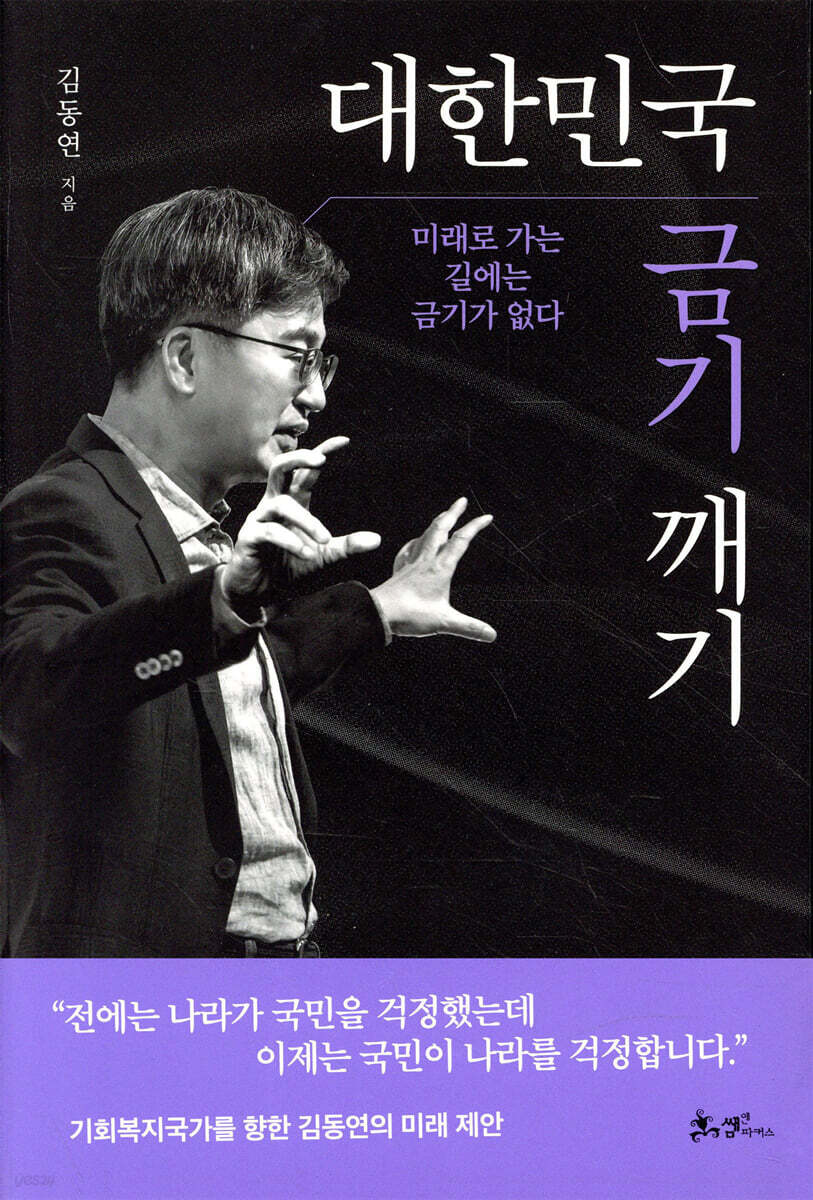
Former Deputy Prime Minister Kim Dong-yeon publishes "Breaking the Taboos of the Republic of Korea," a book containing his national vision and vision for the future.
Former Deputy Prime Minister Kim Dong-yeon published a book titled “Breaking the Taboos of the Republic of Korea,” which contains proposals for the future of the Republic of Korea.
The book begins with the story of a villager met at a fishing site in Anpo Village, Yeosu.
Before we went out to sea together on a fishing boat late at night, I had a conversation with the locals, and one of them said:
“In the past, the country worried about its people, but now the people worry about the country.”
Even as I pulled up the fishing net in the dark night sea, these words kept ringing in my ears.
My chest felt stuffy.
-8p, A cheerful rebellion toward the welfare state
As soon as he left his post as Deputy Prime Minister in 2018, he declined all the offers coming in and spent two years traveling around the country, meeting countless people.
However, the more he met people and saw their daily lives, the more he felt ashamed and desperate as someone who had once been in charge of state affairs.
Our people work harder than anyone else. Each of us is smart, passionate, and brimming with brilliant ideas. Why do they all struggle so much? Why do they lack opportunities? Why are the opportunities given to them so unfair? Ultimately, I wrote this book after much thought and reflection, seeking answers in this era of complex crises, driven by a sense of urgency that "South Korea can't continue on this path."
Former Deputy Prime Minister Kim Dong-yeon published a book titled “Breaking the Taboos of the Republic of Korea,” which contains proposals for the future of the Republic of Korea.
The book begins with the story of a villager met at a fishing site in Anpo Village, Yeosu.
Before we went out to sea together on a fishing boat late at night, I had a conversation with the locals, and one of them said:
“In the past, the country worried about its people, but now the people worry about the country.”
Even as I pulled up the fishing net in the dark night sea, these words kept ringing in my ears.
My chest felt stuffy.
-8p, A cheerful rebellion toward the welfare state
As soon as he left his post as Deputy Prime Minister in 2018, he declined all the offers coming in and spent two years traveling around the country, meeting countless people.
However, the more he met people and saw their daily lives, the more he felt ashamed and desperate as someone who had once been in charge of state affairs.
Our people work harder than anyone else. Each of us is smart, passionate, and brimming with brilliant ideas. Why do they all struggle so much? Why do they lack opportunities? Why are the opportunities given to them so unfair? Ultimately, I wrote this book after much thought and reflection, seeking answers in this era of complex crises, driven by a sense of urgency that "South Korea can't continue on this path."
- You can preview some of the book's contents.
Preview
index
Starting with _ A cheerful rebellion toward the welfare state of opportunity
Part 1.
Not three times
1.
First frustration
Vision 2030 Embroiled in Political Strife | Leaving 'Exile' | Deepening Concerns
2.
Second frustration
Limits that even the Deputy Prime Minister for Economic Affairs can't overcome | Income-led growth or innovation-led growth? | The crisis of political decision-making.
3.
Not three times
Wedding Anniversary Gifts | Three Questions
Part 2.
Where are we now?
4.
Daehan High School and the Republic of Korea
The Story of Daehan High School | The Story of the Republic of Korea
5.
State overreach
The nation's greed for choice | No to the Republic | Winner-take-all politics and the "Blue House government" | Stifling public education
6.
Excessive gap
A society driven by excess profits | The collapse of the middle class, a "dumbbell republic" | A vicious cycle of inheritance, the educational opportunity gap | A dual-structured labor market | A perforated social safety net
7.
Excessive distrust
Low-Trust Society | Politics as a Source of Distrust | Imbalance of Power and Responsibility in the Media | Immoral and Victim-Producing Leadership
8.
A house divided
The Reality of Division and Conflict | A 'House Divided' Cannot Stand Properly | "What Kind of Time Was This in History?"
Part 3.
Where should we go?
9.
king pin
The Kingpin of Our Society: The Winner-Take-All Structure | Musical Chairs | The End of the Winner-Take-All War
10.
The Path to an 'Opportunity Welfare State'
Every problem is connected to opportunity | A land of 'more opportunity' | A land of 'more equal opportunity' | A land of 'opportunity welfare safety net'
11.
New social contract
Social Burden-Sharing Agreement | What States Should and Should Not Do | Rebellion from Below
Part 4.
Breaking the Taboo on the Opportunity Welfare State
12.
Breaking the taboo of the catch-up economy
There's No Third Venture Boom | Let's Increase the Number of Big Blur Conglomerates | Let's Expand the Economic Territory of SMEs | Let's Target the Three Major Growth Engines of the Digital Economy | Let's Cut the Number of Regulators in Half | Let's Establish a Korean-Style Labor Security and Flexibility Model | A "Great Sharing" Movement for Young Workers
13.
Breaking the taboo on hereditary economics
Let's break the "iron rice bowl" system in the public sector | End elite nepotism | Utilize a renaissance of entrepreneurship and job creation | Allow only "good" income disparities | Expand employment and education quotas | Unleash the "catfish" in education | Stop the pension reform bombshell
14.
Breaking the bubble economy taboo
Let's overturn the all-in structure of the metropolitan area | Let's make the one-household-one-household dream come true | The real estate civil war can end | Let's support students, not universities | Let's spark a revolt among education demanders | Let's establish a universal income safety net
Part 5.
rebellion from below
15.
Let's reduce politics and share power.
Breaking the winner-take-all structure of politics | Achieving a "common pledge" and "future legislation" that fosters citizen participation | Transforming the "Blue House government" | Strengthening democratic control over power institutions
16.
Opening an era of citizen participation
Expanding Citizen Participation Platforms | From "Shaving Men's Hair" to Collaboration | The Future of Media: Solution Journalism | Building a Blockchain Ecosystem
In closing _ The past 20 years, the next 20 years
Part 1.
Not three times
1.
First frustration
Vision 2030 Embroiled in Political Strife | Leaving 'Exile' | Deepening Concerns
2.
Second frustration
Limits that even the Deputy Prime Minister for Economic Affairs can't overcome | Income-led growth or innovation-led growth? | The crisis of political decision-making.
3.
Not three times
Wedding Anniversary Gifts | Three Questions
Part 2.
Where are we now?
4.
Daehan High School and the Republic of Korea
The Story of Daehan High School | The Story of the Republic of Korea
5.
State overreach
The nation's greed for choice | No to the Republic | Winner-take-all politics and the "Blue House government" | Stifling public education
6.
Excessive gap
A society driven by excess profits | The collapse of the middle class, a "dumbbell republic" | A vicious cycle of inheritance, the educational opportunity gap | A dual-structured labor market | A perforated social safety net
7.
Excessive distrust
Low-Trust Society | Politics as a Source of Distrust | Imbalance of Power and Responsibility in the Media | Immoral and Victim-Producing Leadership
8.
A house divided
The Reality of Division and Conflict | A 'House Divided' Cannot Stand Properly | "What Kind of Time Was This in History?"
Part 3.
Where should we go?
9.
king pin
The Kingpin of Our Society: The Winner-Take-All Structure | Musical Chairs | The End of the Winner-Take-All War
10.
The Path to an 'Opportunity Welfare State'
Every problem is connected to opportunity | A land of 'more opportunity' | A land of 'more equal opportunity' | A land of 'opportunity welfare safety net'
11.
New social contract
Social Burden-Sharing Agreement | What States Should and Should Not Do | Rebellion from Below
Part 4.
Breaking the Taboo on the Opportunity Welfare State
12.
Breaking the taboo of the catch-up economy
There's No Third Venture Boom | Let's Increase the Number of Big Blur Conglomerates | Let's Expand the Economic Territory of SMEs | Let's Target the Three Major Growth Engines of the Digital Economy | Let's Cut the Number of Regulators in Half | Let's Establish a Korean-Style Labor Security and Flexibility Model | A "Great Sharing" Movement for Young Workers
13.
Breaking the taboo on hereditary economics
Let's break the "iron rice bowl" system in the public sector | End elite nepotism | Utilize a renaissance of entrepreneurship and job creation | Allow only "good" income disparities | Expand employment and education quotas | Unleash the "catfish" in education | Stop the pension reform bombshell
14.
Breaking the bubble economy taboo
Let's overturn the all-in structure of the metropolitan area | Let's make the one-household-one-household dream come true | The real estate civil war can end | Let's support students, not universities | Let's spark a revolt among education demanders | Let's establish a universal income safety net
Part 5.
rebellion from below
15.
Let's reduce politics and share power.
Breaking the winner-take-all structure of politics | Achieving a "common pledge" and "future legislation" that fosters citizen participation | Transforming the "Blue House government" | Strengthening democratic control over power institutions
16.
Opening an era of citizen participation
Expanding Citizen Participation Platforms | From "Shaving Men's Hair" to Collaboration | The Future of Media: Solution Journalism | Building a Blockchain Ecosystem
In closing _ The past 20 years, the next 20 years
Into the book
After resigning as Deputy Prime Minister, he traveled around various regions.
I met countless people and saw countless lives.
Farmers, fishermen, self-employed, small business owners, youth, small business owners…
They were neighbors and common people whom I did not have many opportunities to meet while in public office.
When I went to Anpo Village in Yeosu, it was the season for catching flatfish.
In a small fishing village with only 312 residents, most of the people were elderly.
Before we went out to sea together on a fishing boat late at night, I had a conversation with the locals, and one of them said:
“In the past, the country worried about its people, but now the people worry about the country.”
Even as I pulled up the fishing net in the dark night sea, these words kept ringing in my ears.
My chest felt stuffy.
--- p.8
What did I do during my 34 years of public service, including as Deputy Prime Minister for Economic Affairs?
What did I do, and what did I fail to do?
What were the limitations that even the Deputy Prime Minister could not overcome?
The magnitude of the achievements and frustrations was proportional to the sense of urgency.
The greater the sense of urgency, the greater the pain from frustration.
Especially the two failures and frustrations.
Both attempts were to change the framework and paradigm of our economy, and neither produced satisfactory results.
One was the work on ‘Vision 2030’ in 2005, and the other was the economic management while serving as Deputy Prime Minister for Economic Affairs in 2017.
So, I wrote this book with the intention of not failing again.
Desperation gave me courage beyond hesitation.
--- p.13
The 'innovative growth' he advocated throughout his term did not initially receive much attention.
Even though I shouted hard, there was no big response.
This was because ‘income-led growth’ had been at the core of economic policy since the government was launched.
There were also major differences of opinion with the Blue House.
However, we consistently pursued innovative growth and it eventually became established as one of the three major axes of economic management.
Of course, there is great regret about the results of the innovative growth policy.
Although some results, such as startup performance, were good, there was a sense of frustration that they did not lead to visible effects.
A major reason is the failure to provide the market with trust, consistency, and predictability in policies.
Changing the innovation ecosystem is difficult to achieve with policy tools such as short-term financial support alone.
It is something that requires steady progress with long breaths.
--- p.36
The problem doesn't stop there.
The country is being split in two.
Fierce battles and disputes are taking place in all areas of life, including politics, economy, society, and education.
Because it has become a winner-take-all structure where winning means gaining everything and losing everything, there is little room for empathy, compromise, or cooperation.
Factional politics and factional logic are rampant, and my side is always good, and the other side is always evil.
As ideological conflict and political polarization intensify, the rift between division and conflict deepens.
They are so divided and fighting inside that they don't have the energy to look outside.
--- p.64
Now we must create 20 years that are clearly different from the past 20 years.
To do that, we must first and foremost share a vision and direction for where our society should go.
It's not the rosy vision of the past.
This is not a story about giving more or raising hopes.
It's not a pleasant sound, and it's not a sound I want to hear.
This is a story about what we 'must do'.
So, this book suggests a republic of opportunity and a welfare state of opportunity as the direction we should pursue together.
And we argued that breaking the taboos of the Korean economy, creating more opportunities and more equal opportunities, and providing a robust opportunity welfare safety net, is what we must do.
It is the framework of a catch-up economy, a hereditary economy, and a bubble economy.
--- p.238
Most of the problems in our society are connected to 'opportunity'.
First, as the economy's dynamism declines, opportunities are not being created.
So there is a struggle over the lack of opportunities.
Moreover, as polarization deepens, opportunities are given unequally.
Some people are given an abundance of opportunities, while others are given extremely limited opportunities.
It is a phenomenon of the rich getting richer and the poor getting poorer due to opportunities.
For others, even the bare minimum of safety nets is lacking, making it difficult to find opportunities while maintaining human dignity.
We are now living in an era of 'complex crises of opportunity.'
Now, we must make the Republic of Korea a 'Republic of Opportunity.'
This is a 'welfare state of opportunity' where the door of opportunity is wide open to everyone.
We must create a nation that provides 'more' and 'more equal' opportunities and establishes a robust 'opportunity welfare safety net' to guarantee the quality of life for its citizens.
It is a national system in which the economy, jobs, and welfare organically form a virtuous cycle.
--- p.14
Moreover, it makes ‘innovation’ difficult while further exacerbating the gap.
Innovation is the creative destruction of existing regulations, jobs, industries, and ways of working.
It clashes with existing methods and collides with existing industries.
The biggest enemies of this innovation are the excess profits and vested interests created by the winner-take-all structure.
Within the walls of the privileged are the public sector, regulated or licensed businesses, and monopolistic companies, and there are also people who have secured a lifelong iron rice bowl by passing a test or obtaining a license once.
The entrance gate is very narrow, and a bloody competition to get in takes place outside the castle.
The loser is always the majority.
In particular, most of the wealthy and influential people in our society, regardless of whether they are ruling or opposition party, progressive or conservative, are from the privileged class.
These are people who have achieved great success and profit within the current system and rules of the game, whether through their own efforts or luck.
There is no need to change the system and structure, nor is there any will to do so.
Rather, there are many cases where efforts to protect vested interests hinder innovation.
--- p.103
In this way, the issue of opportunity is not only about the ‘quantity’ of opportunity, but also about its ‘quality’.
A true republic of opportunity can be created not only by increasing the number or total amount of opportunities, but also by achieving ‘fairness’ in opportunities.
In particular, the issue of 'quality' of opportunity is directly related to 'fairness', which has been a hot topic in our society recently.
While procedural and formal fairness are highlighted, more importantly is the trap of 'meritocracy' that underlies our society.
In all areas, only economy, efficiency, and performance are emphasized, while the 'tilted playing field' is overlooked.
We need to consider whether it is fair to ignore the fact that those born with a silver spoon and those born with a dirt spoon have different starting points and acknowledge the inequality in outcomes based on differences in ability.
Because if we place meritocracy at the foundation of fairness, further inequality will inevitably be created.
Ultimately, the core of the fair debate is how to change the hereditary system that is taken for granted under the guise of meritocracy.
Therefore, to talk about fairness, we must understand ‘fairness of opportunity.’
To pursue the values of true fairness, we must look beyond meritocracy.
We need to look at the ‘quality’ of the given opportunity.
In other words, in addition to creating more opportunities, more equal opportunities must be provided.
--- p.117
The first is ‘not doing what you shouldn’t do.’
It is about reducing the government's role in the economy and markets.
It is about reducing the government and public sector's involvement or involvement as players.
This is the role of the ‘entrepreneurial nation.’
For the market to flow dynamically, the freedom and creativity of the private sector must be fostered, and the state must abandon its patriarchal patronage.
The state and government should be referees, not coaches.
The government must be clear about when and how it intervenes in the market.
Intervention is only necessary when the market is unfair, winners are overpaid, or the market is not functioning properly.
This is because both are causes that solidify the winner-take-all structure.
Finding new industries and creating jobs should be led by the private sector.
Private and market initiatives must be recognized.
We must eliminate state excess by giving up the right to distribute excess profits and grant licenses.
The state must present a long-term vision that transcends the regime and do what the private sector cannot do.
--- p.127
The Blue House's excessive authority and role must be reduced to some extent and a responsible minister system must be introduced.
The Blue House should focus on mid- to long-term national vision, diplomacy, security, national defense, and key tasks, while the Prime Minister's Office should play a role in actual policy coordination.
Ministers should be given the power to appoint and empower themselves.
It is difficult to expect civil servants to be loyal to a minister who has no power to appoint personnel.
We need to create a system that clearly assigns responsibility along with authority.
This will also create a buffer zone to block the arrows of criticism directed at the president.
We must also break free from the illusion of a ‘small government.’
The big government, small government issue is a question of the degree of government intervention, not the number of organizations.
To increase efficiency, authority and information are centralized, disrupting checks and balances. Incidents like the real estate speculation by LH employees are also partly due to the centralization of all tasks related to public housing supply and new city development.
I met countless people and saw countless lives.
Farmers, fishermen, self-employed, small business owners, youth, small business owners…
They were neighbors and common people whom I did not have many opportunities to meet while in public office.
When I went to Anpo Village in Yeosu, it was the season for catching flatfish.
In a small fishing village with only 312 residents, most of the people were elderly.
Before we went out to sea together on a fishing boat late at night, I had a conversation with the locals, and one of them said:
“In the past, the country worried about its people, but now the people worry about the country.”
Even as I pulled up the fishing net in the dark night sea, these words kept ringing in my ears.
My chest felt stuffy.
--- p.8
What did I do during my 34 years of public service, including as Deputy Prime Minister for Economic Affairs?
What did I do, and what did I fail to do?
What were the limitations that even the Deputy Prime Minister could not overcome?
The magnitude of the achievements and frustrations was proportional to the sense of urgency.
The greater the sense of urgency, the greater the pain from frustration.
Especially the two failures and frustrations.
Both attempts were to change the framework and paradigm of our economy, and neither produced satisfactory results.
One was the work on ‘Vision 2030’ in 2005, and the other was the economic management while serving as Deputy Prime Minister for Economic Affairs in 2017.
So, I wrote this book with the intention of not failing again.
Desperation gave me courage beyond hesitation.
--- p.13
The 'innovative growth' he advocated throughout his term did not initially receive much attention.
Even though I shouted hard, there was no big response.
This was because ‘income-led growth’ had been at the core of economic policy since the government was launched.
There were also major differences of opinion with the Blue House.
However, we consistently pursued innovative growth and it eventually became established as one of the three major axes of economic management.
Of course, there is great regret about the results of the innovative growth policy.
Although some results, such as startup performance, were good, there was a sense of frustration that they did not lead to visible effects.
A major reason is the failure to provide the market with trust, consistency, and predictability in policies.
Changing the innovation ecosystem is difficult to achieve with policy tools such as short-term financial support alone.
It is something that requires steady progress with long breaths.
--- p.36
The problem doesn't stop there.
The country is being split in two.
Fierce battles and disputes are taking place in all areas of life, including politics, economy, society, and education.
Because it has become a winner-take-all structure where winning means gaining everything and losing everything, there is little room for empathy, compromise, or cooperation.
Factional politics and factional logic are rampant, and my side is always good, and the other side is always evil.
As ideological conflict and political polarization intensify, the rift between division and conflict deepens.
They are so divided and fighting inside that they don't have the energy to look outside.
--- p.64
Now we must create 20 years that are clearly different from the past 20 years.
To do that, we must first and foremost share a vision and direction for where our society should go.
It's not the rosy vision of the past.
This is not a story about giving more or raising hopes.
It's not a pleasant sound, and it's not a sound I want to hear.
This is a story about what we 'must do'.
So, this book suggests a republic of opportunity and a welfare state of opportunity as the direction we should pursue together.
And we argued that breaking the taboos of the Korean economy, creating more opportunities and more equal opportunities, and providing a robust opportunity welfare safety net, is what we must do.
It is the framework of a catch-up economy, a hereditary economy, and a bubble economy.
--- p.238
Most of the problems in our society are connected to 'opportunity'.
First, as the economy's dynamism declines, opportunities are not being created.
So there is a struggle over the lack of opportunities.
Moreover, as polarization deepens, opportunities are given unequally.
Some people are given an abundance of opportunities, while others are given extremely limited opportunities.
It is a phenomenon of the rich getting richer and the poor getting poorer due to opportunities.
For others, even the bare minimum of safety nets is lacking, making it difficult to find opportunities while maintaining human dignity.
We are now living in an era of 'complex crises of opportunity.'
Now, we must make the Republic of Korea a 'Republic of Opportunity.'
This is a 'welfare state of opportunity' where the door of opportunity is wide open to everyone.
We must create a nation that provides 'more' and 'more equal' opportunities and establishes a robust 'opportunity welfare safety net' to guarantee the quality of life for its citizens.
It is a national system in which the economy, jobs, and welfare organically form a virtuous cycle.
--- p.14
Moreover, it makes ‘innovation’ difficult while further exacerbating the gap.
Innovation is the creative destruction of existing regulations, jobs, industries, and ways of working.
It clashes with existing methods and collides with existing industries.
The biggest enemies of this innovation are the excess profits and vested interests created by the winner-take-all structure.
Within the walls of the privileged are the public sector, regulated or licensed businesses, and monopolistic companies, and there are also people who have secured a lifelong iron rice bowl by passing a test or obtaining a license once.
The entrance gate is very narrow, and a bloody competition to get in takes place outside the castle.
The loser is always the majority.
In particular, most of the wealthy and influential people in our society, regardless of whether they are ruling or opposition party, progressive or conservative, are from the privileged class.
These are people who have achieved great success and profit within the current system and rules of the game, whether through their own efforts or luck.
There is no need to change the system and structure, nor is there any will to do so.
Rather, there are many cases where efforts to protect vested interests hinder innovation.
--- p.103
In this way, the issue of opportunity is not only about the ‘quantity’ of opportunity, but also about its ‘quality’.
A true republic of opportunity can be created not only by increasing the number or total amount of opportunities, but also by achieving ‘fairness’ in opportunities.
In particular, the issue of 'quality' of opportunity is directly related to 'fairness', which has been a hot topic in our society recently.
While procedural and formal fairness are highlighted, more importantly is the trap of 'meritocracy' that underlies our society.
In all areas, only economy, efficiency, and performance are emphasized, while the 'tilted playing field' is overlooked.
We need to consider whether it is fair to ignore the fact that those born with a silver spoon and those born with a dirt spoon have different starting points and acknowledge the inequality in outcomes based on differences in ability.
Because if we place meritocracy at the foundation of fairness, further inequality will inevitably be created.
Ultimately, the core of the fair debate is how to change the hereditary system that is taken for granted under the guise of meritocracy.
Therefore, to talk about fairness, we must understand ‘fairness of opportunity.’
To pursue the values of true fairness, we must look beyond meritocracy.
We need to look at the ‘quality’ of the given opportunity.
In other words, in addition to creating more opportunities, more equal opportunities must be provided.
--- p.117
The first is ‘not doing what you shouldn’t do.’
It is about reducing the government's role in the economy and markets.
It is about reducing the government and public sector's involvement or involvement as players.
This is the role of the ‘entrepreneurial nation.’
For the market to flow dynamically, the freedom and creativity of the private sector must be fostered, and the state must abandon its patriarchal patronage.
The state and government should be referees, not coaches.
The government must be clear about when and how it intervenes in the market.
Intervention is only necessary when the market is unfair, winners are overpaid, or the market is not functioning properly.
This is because both are causes that solidify the winner-take-all structure.
Finding new industries and creating jobs should be led by the private sector.
Private and market initiatives must be recognized.
We must eliminate state excess by giving up the right to distribute excess profits and grant licenses.
The state must present a long-term vision that transcends the regime and do what the private sector cannot do.
--- p.127
The Blue House's excessive authority and role must be reduced to some extent and a responsible minister system must be introduced.
The Blue House should focus on mid- to long-term national vision, diplomacy, security, national defense, and key tasks, while the Prime Minister's Office should play a role in actual policy coordination.
Ministers should be given the power to appoint and empower themselves.
It is difficult to expect civil servants to be loyal to a minister who has no power to appoint personnel.
We need to create a system that clearly assigns responsibility along with authority.
This will also create a buffer zone to block the arrows of criticism directed at the president.
We must also break free from the illusion of a ‘small government.’
The big government, small government issue is a question of the degree of government intervention, not the number of organizations.
To increase efficiency, authority and information are centralized, disrupting checks and balances. Incidents like the real estate speculation by LH employees are also partly due to the centralization of all tasks related to public housing supply and new city development.
--- p.216
Publisher's Review
“A house divided against itself cannot stand.”
Let's break the taboos that hinder the future of the Republic of Korea beyond partisan logic.
Former Deputy Prime Minister Kim Dong-yeon was a key figure in creating the national long-term development strategy, "Vision 2030," during the Roh Moo-hyun administration in 2005. He also served as Deputy Prime Minister and Minister of Strategy and Finance in the early days of the Moon Jae-in administration, where he devoted himself to changing the framework and paradigm of our economy.
Starting as a civil servant and rising to the position of Deputy Prime Minister for Economic Affairs, he devoted himself day and night to solving our economic and social problems during his 34-year career in public service, and was also called the country's most capable economic bureaucrat.
In that sense, this book is a compilation of former Deputy Prime Minister Kim Dong-yeon's long experience in public service, his reflections and reflections after leaving office, and his experiences connecting with people. It is also a journey to find answers to three questions: What are the real problems in our society? What are the solutions? How can we put them into practice?
“The opponent we are fighting is not a specific person or faction,
“It is a monster deeply rooted in our society: the winner-takes-all structure.”
But why is the title "Breaking the Taboo"? Former Deputy Prime Minister Kim identified the major problems hindering our society today as over-statement, over-growth of disparity, and over-distrust, and he said the "kingpin" to eradicate all of these is "breaking the winner-takes-all structure."
Former Deputy Prime Minister Kim says that all the problems we face today are connected to 'opportunities,' and that what we need are 'more opportunities' and 'more equal opportunities,' but that the monster called 'winner-takes-all' is devouring them all.
Therefore, the core message of this book is that we must eliminate the winner-take-all structure that has taken root throughout our society and move toward a "welfare state of opportunity."
To achieve this, a 'new social contract' is needed that promises to share social burdens, and the state must put aside its patriarchal guardianship and become a referee rather than a coach, clearly distinguishing between what should be done and what should not be done.
There are three main taboos that must be broken to achieve the "welfare state of opportunity" that this book speaks of: the catch-up economy, the hereditary economy, and the bubble economy.
Breaking the taboo on the "catch-up economy" presented specific plans to increase the number of "big blur" corporations, target the three major digital economy drivers, and implement a Korean-style labor stability and flexibility model.
It also proposes reducing the number of regulatory officials and launching a "Great Sharing" campaign for young people who want to work.
In addition, as a way to break the taboo of the hereditary economy, we introduce measures such as breaking the public sector's "iron rice bowl," implementing an "opportunity quota system" for education and employment, and allowing only "good" income gaps.
Finally, the bubble economy taboo was broken by proposing practical measures to overcome the three major safety nets of income, housing, and education, overturn the all-in structure of the metropolitan area, and end the real estate civil war.
“The river never gives up its way to the sea.”
New Vision 2030, rewritten after 15 years
What would the "opportunity welfare state" that former Deputy Prime Minister Kim envisions look like? He argues that if "opportunity welfare" were realized, going beyond meritocracy to examine the "quality" of opportunity and transcending "cash welfare," it could revive the rapidly collapsing middle class and revitalize an economy stalled by the critical moment of the Fourth Industrial Revolution.
Ultimately, the key is a rebellion from below that ‘reduces politics and shares power.’
He explains that it is not impossible to realize "common promises" and "future legislation" through citizen participation, and if a blockchain-based citizen participation platform is activated instead of the Blue House government.
In addition, the book covers all aspects of politics, society, economy, and education in South Korea, clearly presenting problems and solutions.
It is clearly distinct from other books by politicians published so far.
This is a truly comprehensive policy proposal for the Republic of Korea, offering a glimpse into former Deputy Prime Minister Kim's extensive experience and knowledge, while also generously demonstrating the earnest study and thought he has put into it.
South Korea is now in dire need of a leader with balanced perspective and capabilities.
A nation's leader should be someone who speaks of the future, not someone who sells the past.
In that sense, "Breaking the Taboo of the Republic of Korea" is a "New Vision 2030," a rewrite of our government's first long-term national development strategy, "Vision 2030," which was stranded in 2005 due to political strife, after 15 years.
Let's break the taboos that hinder the future of the Republic of Korea beyond partisan logic.
Former Deputy Prime Minister Kim Dong-yeon was a key figure in creating the national long-term development strategy, "Vision 2030," during the Roh Moo-hyun administration in 2005. He also served as Deputy Prime Minister and Minister of Strategy and Finance in the early days of the Moon Jae-in administration, where he devoted himself to changing the framework and paradigm of our economy.
Starting as a civil servant and rising to the position of Deputy Prime Minister for Economic Affairs, he devoted himself day and night to solving our economic and social problems during his 34-year career in public service, and was also called the country's most capable economic bureaucrat.
In that sense, this book is a compilation of former Deputy Prime Minister Kim Dong-yeon's long experience in public service, his reflections and reflections after leaving office, and his experiences connecting with people. It is also a journey to find answers to three questions: What are the real problems in our society? What are the solutions? How can we put them into practice?
“The opponent we are fighting is not a specific person or faction,
“It is a monster deeply rooted in our society: the winner-takes-all structure.”
But why is the title "Breaking the Taboo"? Former Deputy Prime Minister Kim identified the major problems hindering our society today as over-statement, over-growth of disparity, and over-distrust, and he said the "kingpin" to eradicate all of these is "breaking the winner-takes-all structure."
Former Deputy Prime Minister Kim says that all the problems we face today are connected to 'opportunities,' and that what we need are 'more opportunities' and 'more equal opportunities,' but that the monster called 'winner-takes-all' is devouring them all.
Therefore, the core message of this book is that we must eliminate the winner-take-all structure that has taken root throughout our society and move toward a "welfare state of opportunity."
To achieve this, a 'new social contract' is needed that promises to share social burdens, and the state must put aside its patriarchal guardianship and become a referee rather than a coach, clearly distinguishing between what should be done and what should not be done.
There are three main taboos that must be broken to achieve the "welfare state of opportunity" that this book speaks of: the catch-up economy, the hereditary economy, and the bubble economy.
Breaking the taboo on the "catch-up economy" presented specific plans to increase the number of "big blur" corporations, target the three major digital economy drivers, and implement a Korean-style labor stability and flexibility model.
It also proposes reducing the number of regulatory officials and launching a "Great Sharing" campaign for young people who want to work.
In addition, as a way to break the taboo of the hereditary economy, we introduce measures such as breaking the public sector's "iron rice bowl," implementing an "opportunity quota system" for education and employment, and allowing only "good" income gaps.
Finally, the bubble economy taboo was broken by proposing practical measures to overcome the three major safety nets of income, housing, and education, overturn the all-in structure of the metropolitan area, and end the real estate civil war.
“The river never gives up its way to the sea.”
New Vision 2030, rewritten after 15 years
What would the "opportunity welfare state" that former Deputy Prime Minister Kim envisions look like? He argues that if "opportunity welfare" were realized, going beyond meritocracy to examine the "quality" of opportunity and transcending "cash welfare," it could revive the rapidly collapsing middle class and revitalize an economy stalled by the critical moment of the Fourth Industrial Revolution.
Ultimately, the key is a rebellion from below that ‘reduces politics and shares power.’
He explains that it is not impossible to realize "common promises" and "future legislation" through citizen participation, and if a blockchain-based citizen participation platform is activated instead of the Blue House government.
In addition, the book covers all aspects of politics, society, economy, and education in South Korea, clearly presenting problems and solutions.
It is clearly distinct from other books by politicians published so far.
This is a truly comprehensive policy proposal for the Republic of Korea, offering a glimpse into former Deputy Prime Minister Kim's extensive experience and knowledge, while also generously demonstrating the earnest study and thought he has put into it.
South Korea is now in dire need of a leader with balanced perspective and capabilities.
A nation's leader should be someone who speaks of the future, not someone who sells the past.
In that sense, "Breaking the Taboo of the Republic of Korea" is a "New Vision 2030," a rewrite of our government's first long-term national development strategy, "Vision 2030," which was stranded in 2005 due to political strife, after 15 years.
GOODS SPECIFICS
- Publication date: July 28, 2021
- Page count, weight, size: 256 pages | 460g | 152*225*17mm
- ISBN13: 9791165343842
- ISBN10: 1165343843
You may also like
카테고리
korean


korean

![GQ KOREA Mark (Monthly): December [2025]](http://librairie.coreenne.fr/cdn/shop/files/8ef265dbbfbf186523ed75ba7319009d.jpg?v=1765340328&width=3840)


