

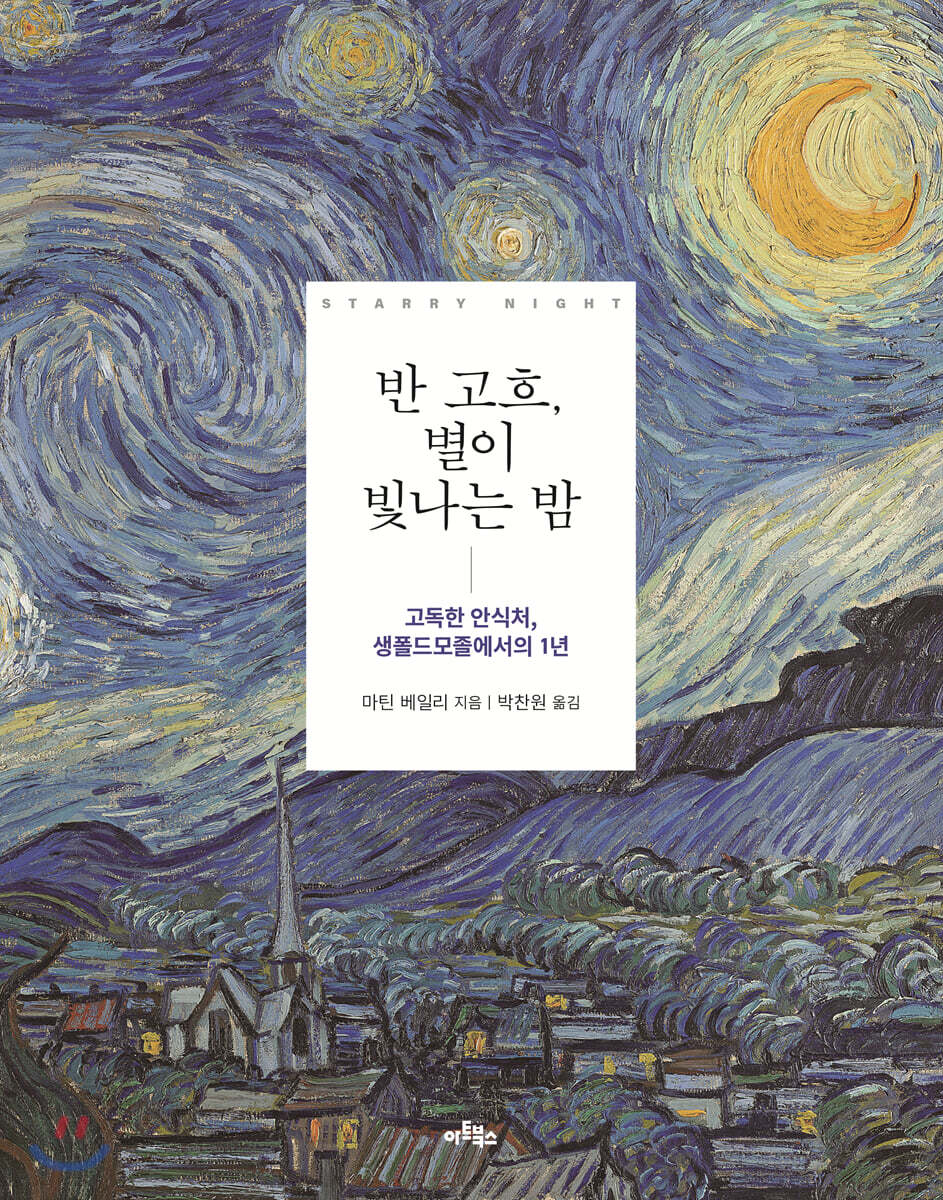
Van Gogh, The Starry Night
 |
Description
Book Introduction
“When I look at the stars, I always dream.”
The latter half of Van Gogh's life,
A year spent at the lonely haven of Saint-Paul-de-Mozole Sanatorium,
"Starry Night" was born there
Vincent van Gogh spent 374 days, from May 8, 1889, to May 16, 1890, at the Saint-Paul-de-Mausole mental asylum, located on the outskirts of the village of Saint-Rémy, 15 kilometers from Arles in southern France.
On December 23, 1888, about six months after the suicide attempt of cutting off his own ear following a violent argument with Gauguin, van Gogh was in a state of anxiety, suffering from repeated seizures and mental confusion, and being hospitalized in and out of the hospital.
Meanwhile, the neighbors in Arles became increasingly hostile to Van Gogh, and he made a major decision in his life.
I decided to admit myself to a mental hospital.
Many experts divide van Gogh's life into several periods, depending on where he lived and worked.
The period from May 1889 to May of the following year is called van Gogh's 'Saint-Rémy period', but author Martin Bailey says this is not an accurate term.
While he was hospitalized in the sanatorium, Van Gogh rarely visited the village of Saint-Rémy, and spent most of his time painting the sanatorium and the surrounding natural scenery.
"Van Gogh, The Starry Night" focuses on the people the artist lived with in this solitary sanctuary, and the process by which he continued to paint without putting down his brush even in times of despair, ultimately leaving behind masterpieces such as "The Starry Night" and "Almond Blossoms."
The latter half of Van Gogh's life,
A year spent at the lonely haven of Saint-Paul-de-Mozole Sanatorium,
"Starry Night" was born there
Vincent van Gogh spent 374 days, from May 8, 1889, to May 16, 1890, at the Saint-Paul-de-Mausole mental asylum, located on the outskirts of the village of Saint-Rémy, 15 kilometers from Arles in southern France.
On December 23, 1888, about six months after the suicide attempt of cutting off his own ear following a violent argument with Gauguin, van Gogh was in a state of anxiety, suffering from repeated seizures and mental confusion, and being hospitalized in and out of the hospital.
Meanwhile, the neighbors in Arles became increasingly hostile to Van Gogh, and he made a major decision in his life.
I decided to admit myself to a mental hospital.
Many experts divide van Gogh's life into several periods, depending on where he lived and worked.
The period from May 1889 to May of the following year is called van Gogh's 'Saint-Rémy period', but author Martin Bailey says this is not an accurate term.
While he was hospitalized in the sanatorium, Van Gogh rarely visited the village of Saint-Rémy, and spent most of his time painting the sanatorium and the surrounding natural scenery.
"Van Gogh, The Starry Night" focuses on the people the artist lived with in this solitary sanctuary, and the process by which he continued to paint without putting down his brush even in times of despair, ultimately leaving behind masterpieces such as "The Starry Night" and "Almond Blossoms."
- You can preview some of the book's contents.
Preview
index
introduction
Prologue: Two Brothers, Two Lives
CHAPTER 1 Arrival
CHAPTER 2 The Walled Garden
CHAPTER 3 LIFE IN A NURSING HOME
CHAPTER 4 Psychiatrist
CHAPTER 5 Wheat Field
CHAPTER 6 Stars
CHAPTER 7 Beyond the Wall
CHAPTER 8 Olive Grove
CHAPTER 9 Cyprus
CHAPTER 10 Those Who Travel Together
CHAPTER 11 Seizures
CHAPTER 12 Reflections in the Mirror
CHAPTER 13 Coloring
CHAPTER 14 Memories of the North
CHAPTER 15 Almond Blossom
CHAPTER 16 The Lonely Man
Postscript I The Sanatorium After Van Gogh's Departure
Postscript II: Trapped in Russia
Following in Van Gogh's footsteps
Key chronological figures of Van Gogh's Saint-Paul period
main
Acknowledgements
Translator's Note
References
Search
Image Credit
Prologue: Two Brothers, Two Lives
CHAPTER 1 Arrival
CHAPTER 2 The Walled Garden
CHAPTER 3 LIFE IN A NURSING HOME
CHAPTER 4 Psychiatrist
CHAPTER 5 Wheat Field
CHAPTER 6 Stars
CHAPTER 7 Beyond the Wall
CHAPTER 8 Olive Grove
CHAPTER 9 Cyprus
CHAPTER 10 Those Who Travel Together
CHAPTER 11 Seizures
CHAPTER 12 Reflections in the Mirror
CHAPTER 13 Coloring
CHAPTER 14 Memories of the North
CHAPTER 15 Almond Blossom
CHAPTER 16 The Lonely Man
Postscript I The Sanatorium After Van Gogh's Departure
Postscript II: Trapped in Russia
Following in Van Gogh's footsteps
Key chronological figures of Van Gogh's Saint-Paul period
main
Acknowledgements
Translator's Note
References
Search
Image Credit
Detailed image

Into the book
When I first became seriously interested in Van Gogh in 1987, I asked if I could see the interior of the hospital, specifically the old men's ward.
Naturally, the process was complicated, but the request was finally accepted, and the patients were kindly guided by Director Henri Mison while they remained in their respective wards.
I began to imagine what Van Gogh's life must have been like while he was trapped within these walls.
--- p.11
Today, with interior access virtually impossible, only a handful of Van Gogh experts have been able to enter the building, and I was one of them.
I was also granted permission to photograph the interior of the building, which allowed me to include the first color photographs in a Van Gogh-related publication.
Although I returned to Saint-Rémy many times after my first visit, it was nearly 30 years later that I heard of any new evidence confirming that van Gogh had stayed there.
Remi Venture, a local activist, discovered that the municipal archives contained records of Saint-Paul's hospitalizations in the late 19th century.
Remarkably, this hospitalization register is something that van Gogh scholars have never seen before, and the emergence of new records related to van Gogh is extremely rare these days.
--- p.13
On the day Van Gogh arrived, there were only 18 male patients in the sanatorium.
Van Gogh spent a full year among these few people, sharing their suffering.
As time went by, he got to know them well and called them 'my unfortunate companions'.
Although the hospitalization records contained no medical information, the patients' names were available, allowing me to research their various personal details and medical conditions using other sources.
And I was shocked when I learned how serious most of their illnesses were, and how difficult the circumstances were for Van Gogh.
I realized that he was not exaggerating when he wrote in his letter that “there is a constant, horrible howling and screaming, like that of wild animals trapped in a zoo.”
--- p.15
Although 62 letters written by Van Gogh in Saint-Paul are known to have survived, relatively few describe the details of daily life in the hospital.
Perhaps he did not want to reveal to the recipient the bleak circumstances of his life in the nursing home, or perhaps he saw his daily interactions with the outside world as a willing escape from the reality he faced.
It is understandable that van Gogh's biographers rely heavily on his letters, but this leaves behind a neatly organized narrative, leaving out potentially unpleasant aspects of his Saint-Paul years.
--- p.17
Saint-Paul's garden was meant to be a haven of escape, a sanctuary where he could momentarily forget his hospitalization.
Vincent spent countless hours here, finding peace in the fresh air, surrounded by trees and flowers.
He passionately draws these trees and flowers, giving birth to his most brilliant works.
--- p.57
"The Window of the Studio," which invites us into Vincent's own space, emphasizes the tenuous connection with nature and the outside world.
Surprisingly, the window is tightly shut, and October, when this picture was taken, is generally a pleasant month, as evidenced by the blue sky in the picture.
Perhaps the Mistral was blowing and forcing him to stay indoors, or perhaps he wanted to emphasize his feeling of isolation from the outside world.
Whatever the reason, the ochre and gray interior contrasts vividly with the vibrant colors beyond the windows.
--- p.64
Vincent often compared his work to that of a farmer who sows, tends, and harvests seeds.
Writing to his mother, who had spent her entire life in the Dutch countryside, he says that since coming to Provence he has acquired the appearance of a peasant.
And he adds:
“I cultivate my canvas as farmers cultivate their fields.”
--- p.95
It breaks my heart to think that Vincent lived with such mentally ill patients.
It is amazing that the artist was able to create such vibrant and positive paintings while surrounded by people suffering from such a disease.
Vincent was well aware of the danger.
“Nothing could be more terrible than being in the condition of my unfortunate colleagues, who do nothing all day, a week, a month, or a whole year.
--- p.157
He once wrote in Saint-Paul:
“The artist is so absorbed in what he sees that he doesn’t know how to live the rest of his life.” But that wasn’t necessarily the case.
Vincent blamed himself and his obsession with art, but in reality he had obvious psychological and mental problems.
It is true that painting practically absorbed all of his energy, but without his calling, his drive to live would have been much weaker, and it is quite possible that his life would have ended much earlier.
--- p.224~225
I will never forget that moment—suddenly encountering a 'lost', van Gogh work that no one in the world remembers having been exhibited.
Since it had never been reproduced in color—even for drawings, color images are essential for precise study—I had no idea what kind of drawing I would see.
My first impression after quickly examining the large drawing, which is over 60 centimeters wide, was that it was surprisingly well preserved, considering its turbulent history.
Naturally, the process was complicated, but the request was finally accepted, and the patients were kindly guided by Director Henri Mison while they remained in their respective wards.
I began to imagine what Van Gogh's life must have been like while he was trapped within these walls.
--- p.11
Today, with interior access virtually impossible, only a handful of Van Gogh experts have been able to enter the building, and I was one of them.
I was also granted permission to photograph the interior of the building, which allowed me to include the first color photographs in a Van Gogh-related publication.
Although I returned to Saint-Rémy many times after my first visit, it was nearly 30 years later that I heard of any new evidence confirming that van Gogh had stayed there.
Remi Venture, a local activist, discovered that the municipal archives contained records of Saint-Paul's hospitalizations in the late 19th century.
Remarkably, this hospitalization register is something that van Gogh scholars have never seen before, and the emergence of new records related to van Gogh is extremely rare these days.
--- p.13
On the day Van Gogh arrived, there were only 18 male patients in the sanatorium.
Van Gogh spent a full year among these few people, sharing their suffering.
As time went by, he got to know them well and called them 'my unfortunate companions'.
Although the hospitalization records contained no medical information, the patients' names were available, allowing me to research their various personal details and medical conditions using other sources.
And I was shocked when I learned how serious most of their illnesses were, and how difficult the circumstances were for Van Gogh.
I realized that he was not exaggerating when he wrote in his letter that “there is a constant, horrible howling and screaming, like that of wild animals trapped in a zoo.”
--- p.15
Although 62 letters written by Van Gogh in Saint-Paul are known to have survived, relatively few describe the details of daily life in the hospital.
Perhaps he did not want to reveal to the recipient the bleak circumstances of his life in the nursing home, or perhaps he saw his daily interactions with the outside world as a willing escape from the reality he faced.
It is understandable that van Gogh's biographers rely heavily on his letters, but this leaves behind a neatly organized narrative, leaving out potentially unpleasant aspects of his Saint-Paul years.
--- p.17
Saint-Paul's garden was meant to be a haven of escape, a sanctuary where he could momentarily forget his hospitalization.
Vincent spent countless hours here, finding peace in the fresh air, surrounded by trees and flowers.
He passionately draws these trees and flowers, giving birth to his most brilliant works.
--- p.57
"The Window of the Studio," which invites us into Vincent's own space, emphasizes the tenuous connection with nature and the outside world.
Surprisingly, the window is tightly shut, and October, when this picture was taken, is generally a pleasant month, as evidenced by the blue sky in the picture.
Perhaps the Mistral was blowing and forcing him to stay indoors, or perhaps he wanted to emphasize his feeling of isolation from the outside world.
Whatever the reason, the ochre and gray interior contrasts vividly with the vibrant colors beyond the windows.
--- p.64
Vincent often compared his work to that of a farmer who sows, tends, and harvests seeds.
Writing to his mother, who had spent her entire life in the Dutch countryside, he says that since coming to Provence he has acquired the appearance of a peasant.
And he adds:
“I cultivate my canvas as farmers cultivate their fields.”
--- p.95
It breaks my heart to think that Vincent lived with such mentally ill patients.
It is amazing that the artist was able to create such vibrant and positive paintings while surrounded by people suffering from such a disease.
Vincent was well aware of the danger.
“Nothing could be more terrible than being in the condition of my unfortunate colleagues, who do nothing all day, a week, a month, or a whole year.
--- p.157
He once wrote in Saint-Paul:
“The artist is so absorbed in what he sees that he doesn’t know how to live the rest of his life.” But that wasn’t necessarily the case.
Vincent blamed himself and his obsession with art, but in reality he had obvious psychological and mental problems.
It is true that painting practically absorbed all of his energy, but without his calling, his drive to live would have been much weaker, and it is quite possible that his life would have ended much earlier.
--- p.224~225
I will never forget that moment—suddenly encountering a 'lost', van Gogh work that no one in the world remembers having been exhibited.
Since it had never been reproduced in color—even for drawings, color images are essential for precise study—I had no idea what kind of drawing I would see.
My first impression after quickly examining the large drawing, which is over 60 centimeters wide, was that it was surprisingly well preserved, considering its turbulent history.
--- p.241
Publisher's Review
During my lonely and isolated days in the nursing home,
A world of light raised in that despair
The book begins with the news of Theo and Johanna Bonger's marriage in April 1889.
It was at this very moment that Vincent, who had suffered severe pain in Arles a year earlier, decided to pack up his studio in the south and voluntarily enter a mental asylum, hoping to find a new life as an artist.
The place where Van Gogh was admitted was a private sanatorium called Saint-Paul-de-Mausole near Saint-Rémy, just 15 kilometers from Arles.
Unlike other public nursing homes, it had a small patient population, provided a relatively autonomous living environment, and had a beautiful garden surrounded by a wall.
Van Gogh set out on May 8, 1889, accompanied by the priest of Arles, Pastor Sale, and after completing the admission formalities, he was assigned a hospital room and unpacked his bags.
Although the window was small and barred, the green wheat fields and beautifully grown trees spread out beneath it brought peace to my heart.
During his year in Saint-Paul, there were notable developments in Van Gogh's art.
The vibrant colors of the Arles period subside, but the brushstrokes become more powerful, and his unique, swirling, wave-like lines begin to appear during this period.
Van Gogh undoubtedly endured his stay in the asylum through his passion for art.
By focusing on his work, he escaped the humiliating daily life and endured adversity with a sense of purpose.
Some speculate that as his mental illness worsened, it inevitably affected his work, and indeed, there were certainly periods of several weeks when he was unable to draw at all.
However, only a few of his surviving paintings show evidence of mental disturbance, and for most of his time at Saint-Paul he remained lucid and calm.
It is clear that he was extremely productive.
Even excluding the 10 to 20 lost works, over 150 paintings still remain, an incredible amount that would have been possible if he had painted one every two days.
Among Van Gogh's masterpieces, "Irises," "Starry Night," "Wheatfield with Cypresses," "Almond Blossoms," and "Self-Portrait with a Swirling Background" were all painted during this period.
Van Gogh's time at the Saint-Paul Asylum, which has been missing or undisclosed,
An in-depth exploration of Van Gogh's work, with the first color images to be published in the literature.
Author Martin Bailey is a Van Gogh expert who has been conducting persistent research, following the footsteps of Vincent van Gogh since 1987 to the present.
The book is rich with new facts about the artist, discovered through decades of research, along with supporting materials and color photographs.
Especially now that access to the interior of the Saint-Paul-de-Mausole Sanatorium has become virtually impossible, the author is one of the few Van Gogh experts who has entered the building and obtained permission to photograph its interior, resulting in the first color photographs published in a Van Gogh-related publication.
In addition, he not only confirmed the records of patients admitted to the Saint-Paul Asylum in the late 19th century at the Municipal Archives of Saint-Rémy and included them in his book, but also studied other patients whom Van Gogh called “my unhappy companions,” and his research on these patients allows him to infer the conditions of the asylum during the time Van Gogh lived there.
This not only fills in the missing information that van Gogh biographers have left behind, relying solely on the artist's letters and not covering his life at the Saint-Paul Asylum in more detail, but also contributes to a deeper understanding of van Gogh's life and art.
According to Martin Bailey's research, there were 18 male patients in the sanatorium at the time of van Gogh's admission.
The author has identified most of these names and diagnoses, and infers the protagonists of the stories of fellow patients that van Gogh rarely mentioned in his letters.
One of the most notable aspects of Martin Bailey's research is his identification of the real subject of "The Gardener," widely considered one of van Gogh's most accomplished portraits from his Saint-Paul period.
His name was Jean Baral, he was twenty-eight years old at the time Vincent was in the sanatorium, and he may have worked as a gardener in Saint-Paul while cultivating the land.
Martin Bailey also uncovers some interesting and surprising facts surrounding "The Starry Night."
First, the author, who confirmed the scenery of the day the artist painted the night sky at the Royal Observatory in London, confirmed that "Starry Night" was not a painting of a scenery of a specific time or place, but a world newly created by the artist based on his imagination after looking at countless night skies.
Surprisingly, Theo, upon seeing this painting, criticized it as being overly decorative. After the deaths of the Van Gogh brothers, "Starry Night" was not exhibited for ten years, and during that time, only a very limited number of people could see it.
And again, new facts are discovered
The highlight of the book is that it is the first color image in Van Gogh literature of the drawing of "Starry Night," which had been recorded as "lost" until then.
After the end of World War II, a Russian Red Army officer discovered a drawing of "Starry Night" in Karntsow Castle in Germany.
He folded the painting neatly in half, put it in his suitcase, and brought it back to Russia, where its existence remained a state secret for decades.
Martin Bailey, who confirmed the existence of this work, asked the director of the Hermitage Museum in St. Petersburg to show him Van Gogh's drawing in September 1992, and returned after confirming the actual work, which had been caught up in the vortex of ideology, and interviewing the people involved.
But unfortunately, this painting is still fading away in the storage of an art museum in Russia without being displayed to the public.
This is another casualty of World War II.
In one interview, a questioner asked Martin Bailey:
"Hasn't almost everything about Van Gogh already been written and published? Why do you continue to obsess over him?" Martin Bailey replied, "Because Van Gogh is an artist who becomes more and more famous every year, and my passion for him grows with each passing year. There are always new discoveries to be made."
All you have to do is “ask the right questions and dig deep.”
"Van Gogh, The Starry Night" is also the result of such precise questions and passionate exploration.
“Starry Night” symbolizes Van Gogh’s time spent in the sanatorium.
For about three-quarters of that time, he was mentally clear and could do a tremendous amount of work, but there were also periods when he suffered a series of seizures that left him in a state of darkness and unable to paint.
But he recovered each time and came out of deep despair.
And then I returned to the world of light and picked up my brush once again.
“The Starry Night” is a vivid testimony to how Van Gogh fought and overcame the trials that lay before him with the sole determination to paint while living in the nursing home.” - From the “Preface”
Interesting TMI about Van Gogh revealed in the book
1_ The twelve months from May 1889 to May 1890 are commonly referred to as van Gogh's 'Saint-Rémy period', but this is an inaccurate designation.
Because Van Gogh rarely set foot in the village of Saint-Rémy.
In fact, it would be more accurate to call it the 'Saint-Paul period', as he spent almost all his time at the Saint-Paul Sanatorium and the surrounding countryside.
2_ Van Gogh was extremely productive in Saint-Paul.
Even excluding the 10 to 20 lost works, over 150 paintings still remain, an incredible amount that would have been possible if he had painted one every two days.
3_ With the help of the Royal Observatory in Greenwich, we observed the eastern sky over Provence on the night of June 14-15, 1889, when van Gogh conceived the idea for “Starry Night.” We found that the artist was not painting the night sky he saw through the window of the asylum, but rather creating a wondrous and quite personal fantasy by freely letting his imagination run wild while preserving his memories of countless night skies he had seen.
4_ During the 374 days that Van Gogh was staying at the Saint-Paul-de-Mausole Asylum, his younger brother Theo never visited him.
5_ In December 1888, Theo met Johanna Bonger, and they decided to get married just 11 days after meeting, and the wedding took place in April of the following year.
Super-speed wedding march.
The following month, in May, Van Gogh voluntarily entered the Saint-Paul Asylum.
6_ When Van Gogh was twenty-seven, he worked as a preacher in a coal mining village in the Borinage region of southern Belgium.
However, his life there did not end well, and his father once tried to have Van Gogh admitted to a sanatorium in Belgium.
This incident remained largely unknown until 1990, when relevant material was removed from Van Gogh's letters to conceal the family's unfortunate conflict.
7_ Van Gogh spoke four languages: his native Dutch, French, German, and English.
When exchanging letters with Theo, he used French mainly, and he read French and German novels as well as the complete works of Shakespeare written in English without any difficulty.
8_ On the day Van Gogh arrived, there were 18 male patients admitted to the sanatorium, most of them in serious condition, and Van Gogh was by no means exaggerating when he wrote that “there was a constant and terrible howling and screaming, as if from wild animals in a zoo.”
9_ After the outbreak of World War II, the Saint-Paul Sanatorium was operated as a prisoner-of-war camp.
Among the famous people accepted at the time were Dr. Albert Schweitzer and his wife.
10_ At the end of World War II, Russian officer Viktor Baldin discovered Van Gogh's drawing of "Starry Night" among numerous works of art hidden in Karntsow Castle in Germany.
He returned to Russia with the painting in his suitcase, and for decades its existence remained a state secret.
The whereabouts of the drawing are still unknown.
But it must exist somewhere in Russia.
A world of light raised in that despair
The book begins with the news of Theo and Johanna Bonger's marriage in April 1889.
It was at this very moment that Vincent, who had suffered severe pain in Arles a year earlier, decided to pack up his studio in the south and voluntarily enter a mental asylum, hoping to find a new life as an artist.
The place where Van Gogh was admitted was a private sanatorium called Saint-Paul-de-Mausole near Saint-Rémy, just 15 kilometers from Arles.
Unlike other public nursing homes, it had a small patient population, provided a relatively autonomous living environment, and had a beautiful garden surrounded by a wall.
Van Gogh set out on May 8, 1889, accompanied by the priest of Arles, Pastor Sale, and after completing the admission formalities, he was assigned a hospital room and unpacked his bags.
Although the window was small and barred, the green wheat fields and beautifully grown trees spread out beneath it brought peace to my heart.
During his year in Saint-Paul, there were notable developments in Van Gogh's art.
The vibrant colors of the Arles period subside, but the brushstrokes become more powerful, and his unique, swirling, wave-like lines begin to appear during this period.
Van Gogh undoubtedly endured his stay in the asylum through his passion for art.
By focusing on his work, he escaped the humiliating daily life and endured adversity with a sense of purpose.
Some speculate that as his mental illness worsened, it inevitably affected his work, and indeed, there were certainly periods of several weeks when he was unable to draw at all.
However, only a few of his surviving paintings show evidence of mental disturbance, and for most of his time at Saint-Paul he remained lucid and calm.
It is clear that he was extremely productive.
Even excluding the 10 to 20 lost works, over 150 paintings still remain, an incredible amount that would have been possible if he had painted one every two days.
Among Van Gogh's masterpieces, "Irises," "Starry Night," "Wheatfield with Cypresses," "Almond Blossoms," and "Self-Portrait with a Swirling Background" were all painted during this period.
Van Gogh's time at the Saint-Paul Asylum, which has been missing or undisclosed,
An in-depth exploration of Van Gogh's work, with the first color images to be published in the literature.
Author Martin Bailey is a Van Gogh expert who has been conducting persistent research, following the footsteps of Vincent van Gogh since 1987 to the present.
The book is rich with new facts about the artist, discovered through decades of research, along with supporting materials and color photographs.
Especially now that access to the interior of the Saint-Paul-de-Mausole Sanatorium has become virtually impossible, the author is one of the few Van Gogh experts who has entered the building and obtained permission to photograph its interior, resulting in the first color photographs published in a Van Gogh-related publication.
In addition, he not only confirmed the records of patients admitted to the Saint-Paul Asylum in the late 19th century at the Municipal Archives of Saint-Rémy and included them in his book, but also studied other patients whom Van Gogh called “my unhappy companions,” and his research on these patients allows him to infer the conditions of the asylum during the time Van Gogh lived there.
This not only fills in the missing information that van Gogh biographers have left behind, relying solely on the artist's letters and not covering his life at the Saint-Paul Asylum in more detail, but also contributes to a deeper understanding of van Gogh's life and art.
According to Martin Bailey's research, there were 18 male patients in the sanatorium at the time of van Gogh's admission.
The author has identified most of these names and diagnoses, and infers the protagonists of the stories of fellow patients that van Gogh rarely mentioned in his letters.
One of the most notable aspects of Martin Bailey's research is his identification of the real subject of "The Gardener," widely considered one of van Gogh's most accomplished portraits from his Saint-Paul period.
His name was Jean Baral, he was twenty-eight years old at the time Vincent was in the sanatorium, and he may have worked as a gardener in Saint-Paul while cultivating the land.
Martin Bailey also uncovers some interesting and surprising facts surrounding "The Starry Night."
First, the author, who confirmed the scenery of the day the artist painted the night sky at the Royal Observatory in London, confirmed that "Starry Night" was not a painting of a scenery of a specific time or place, but a world newly created by the artist based on his imagination after looking at countless night skies.
Surprisingly, Theo, upon seeing this painting, criticized it as being overly decorative. After the deaths of the Van Gogh brothers, "Starry Night" was not exhibited for ten years, and during that time, only a very limited number of people could see it.
And again, new facts are discovered
The highlight of the book is that it is the first color image in Van Gogh literature of the drawing of "Starry Night," which had been recorded as "lost" until then.
After the end of World War II, a Russian Red Army officer discovered a drawing of "Starry Night" in Karntsow Castle in Germany.
He folded the painting neatly in half, put it in his suitcase, and brought it back to Russia, where its existence remained a state secret for decades.
Martin Bailey, who confirmed the existence of this work, asked the director of the Hermitage Museum in St. Petersburg to show him Van Gogh's drawing in September 1992, and returned after confirming the actual work, which had been caught up in the vortex of ideology, and interviewing the people involved.
But unfortunately, this painting is still fading away in the storage of an art museum in Russia without being displayed to the public.
This is another casualty of World War II.
In one interview, a questioner asked Martin Bailey:
"Hasn't almost everything about Van Gogh already been written and published? Why do you continue to obsess over him?" Martin Bailey replied, "Because Van Gogh is an artist who becomes more and more famous every year, and my passion for him grows with each passing year. There are always new discoveries to be made."
All you have to do is “ask the right questions and dig deep.”
"Van Gogh, The Starry Night" is also the result of such precise questions and passionate exploration.
“Starry Night” symbolizes Van Gogh’s time spent in the sanatorium.
For about three-quarters of that time, he was mentally clear and could do a tremendous amount of work, but there were also periods when he suffered a series of seizures that left him in a state of darkness and unable to paint.
But he recovered each time and came out of deep despair.
And then I returned to the world of light and picked up my brush once again.
“The Starry Night” is a vivid testimony to how Van Gogh fought and overcame the trials that lay before him with the sole determination to paint while living in the nursing home.” - From the “Preface”
Interesting TMI about Van Gogh revealed in the book
1_ The twelve months from May 1889 to May 1890 are commonly referred to as van Gogh's 'Saint-Rémy period', but this is an inaccurate designation.
Because Van Gogh rarely set foot in the village of Saint-Rémy.
In fact, it would be more accurate to call it the 'Saint-Paul period', as he spent almost all his time at the Saint-Paul Sanatorium and the surrounding countryside.
2_ Van Gogh was extremely productive in Saint-Paul.
Even excluding the 10 to 20 lost works, over 150 paintings still remain, an incredible amount that would have been possible if he had painted one every two days.
3_ With the help of the Royal Observatory in Greenwich, we observed the eastern sky over Provence on the night of June 14-15, 1889, when van Gogh conceived the idea for “Starry Night.” We found that the artist was not painting the night sky he saw through the window of the asylum, but rather creating a wondrous and quite personal fantasy by freely letting his imagination run wild while preserving his memories of countless night skies he had seen.
4_ During the 374 days that Van Gogh was staying at the Saint-Paul-de-Mausole Asylum, his younger brother Theo never visited him.
5_ In December 1888, Theo met Johanna Bonger, and they decided to get married just 11 days after meeting, and the wedding took place in April of the following year.
Super-speed wedding march.
The following month, in May, Van Gogh voluntarily entered the Saint-Paul Asylum.
6_ When Van Gogh was twenty-seven, he worked as a preacher in a coal mining village in the Borinage region of southern Belgium.
However, his life there did not end well, and his father once tried to have Van Gogh admitted to a sanatorium in Belgium.
This incident remained largely unknown until 1990, when relevant material was removed from Van Gogh's letters to conceal the family's unfortunate conflict.
7_ Van Gogh spoke four languages: his native Dutch, French, German, and English.
When exchanging letters with Theo, he used French mainly, and he read French and German novels as well as the complete works of Shakespeare written in English without any difficulty.
8_ On the day Van Gogh arrived, there were 18 male patients admitted to the sanatorium, most of them in serious condition, and Van Gogh was by no means exaggerating when he wrote that “there was a constant and terrible howling and screaming, as if from wild animals in a zoo.”
9_ After the outbreak of World War II, the Saint-Paul Sanatorium was operated as a prisoner-of-war camp.
Among the famous people accepted at the time were Dr. Albert Schweitzer and his wife.
10_ At the end of World War II, Russian officer Viktor Baldin discovered Van Gogh's drawing of "Starry Night" among numerous works of art hidden in Karntsow Castle in Germany.
He returned to Russia with the painting in his suitcase, and for decades its existence remained a state secret.
The whereabouts of the drawing are still unknown.
But it must exist somewhere in Russia.
GOODS SPECIFICS
- Date of issue: April 10, 2020
- Page count, weight, size: 292 pages | 848g | 184*234*20mm
- ISBN13: 9788961963695
- ISBN10: 8961963694
You may also like
카테고리
korean


korean

![GQ KOREA Mark (Monthly): December [2025]](http://librairie.coreenne.fr/cdn/shop/files/8ef265dbbfbf186523ed75ba7319009d.jpg?v=1765340328&width=3840)


