

A moment at the convenience store
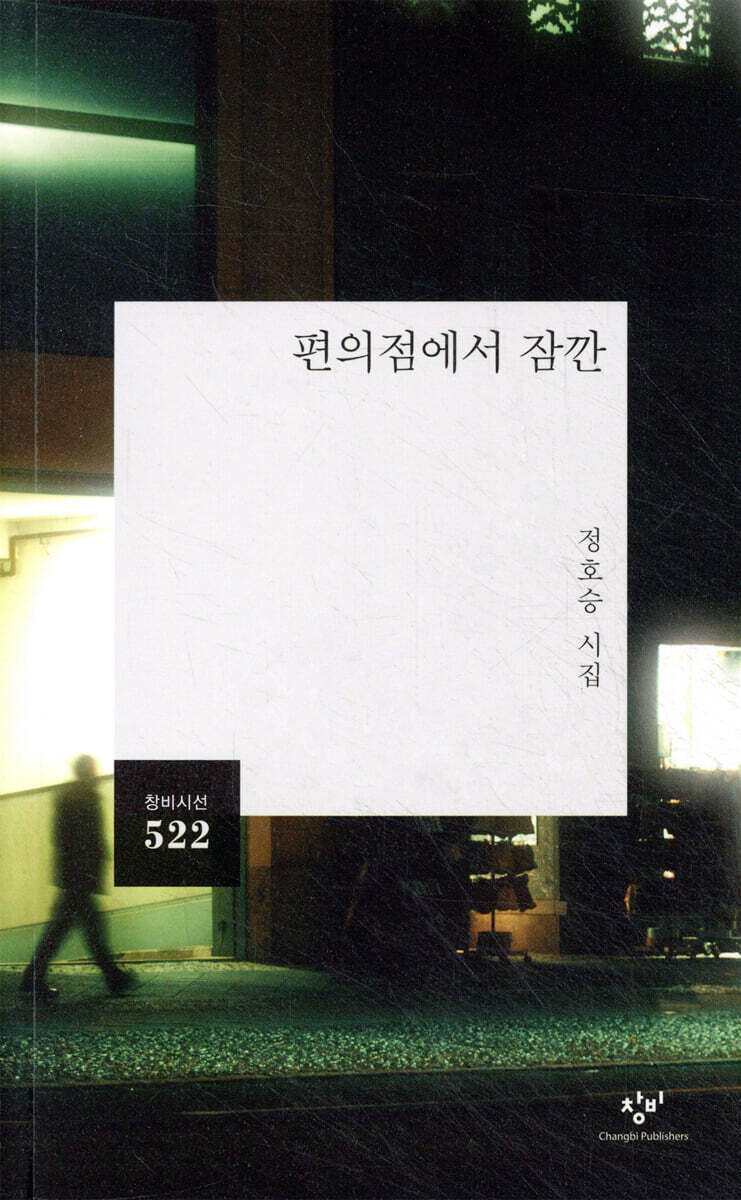 |
Description
Book Introduction
“Don’t be lonely, be alone
“Don’t kneel down and clasp your hands together.”
The most needed comfort in this age, delivered by a master of lyricism.
Sentences of the soul, cultivated through life, overcoming defeat and foolishness.
For the past half century, Jeong Ho-seung has been the poet who has most deeply comforted the Korean soul.
In an age where the language of love has faded and hatred for one another has become rampant, we still desperately need his warm touch and gaze.
This is why many readers have been waiting for the new poetry collection, “A Brief Moment at the Convenience Store,” which is being published after three years.
In this collection of poems, the poet goes beyond familiar comfort and shows a pure and mature beauty that has become even deeper.
We are moved and comforted by his poetry because it brings out the brightest values from the darkest moments of life.
The poet discovers the possibility of love in defeat ("On Defeat") and sings that foolishness is true wisdom ("On Foolishness").
This attitude of not turning away from failure and pain, but facing the truth of life within them, warmly comforts our imperfect lives.
The poet himself said, “I thought I would no longer be able to write poetry.
The moment of despair when he confessed, “I thought the fountain of poetry had dried up” (the poet’s words), paradoxically proves why he is still a new poet.
This is because this collection of poems was compiled after a persistent process of drawing water again from a well that was believed to have dried up.
All but twenty-five of the one hundred and twenty-five poems are unpublished new works.
The strength to not be buried in clichés despite his 50-year career in poetry is precisely here that we discover why Jeong Ho-seung is “a very old poet and at the same time a very new poet” (Poet Kim Seung-hee, recommendation).
His poetry is not a record proving his experience, but a passionate language that is still being fiercely created.
“Don’t kneel down and clasp your hands together.”
The most needed comfort in this age, delivered by a master of lyricism.
Sentences of the soul, cultivated through life, overcoming defeat and foolishness.
For the past half century, Jeong Ho-seung has been the poet who has most deeply comforted the Korean soul.
In an age where the language of love has faded and hatred for one another has become rampant, we still desperately need his warm touch and gaze.
This is why many readers have been waiting for the new poetry collection, “A Brief Moment at the Convenience Store,” which is being published after three years.
In this collection of poems, the poet goes beyond familiar comfort and shows a pure and mature beauty that has become even deeper.
We are moved and comforted by his poetry because it brings out the brightest values from the darkest moments of life.
The poet discovers the possibility of love in defeat ("On Defeat") and sings that foolishness is true wisdom ("On Foolishness").
This attitude of not turning away from failure and pain, but facing the truth of life within them, warmly comforts our imperfect lives.
The poet himself said, “I thought I would no longer be able to write poetry.
The moment of despair when he confessed, “I thought the fountain of poetry had dried up” (the poet’s words), paradoxically proves why he is still a new poet.
This is because this collection of poems was compiled after a persistent process of drawing water again from a well that was believed to have dried up.
All but twenty-five of the one hundred and twenty-five poems are unpublished new works.
The strength to not be buried in clichés despite his 50-year career in poetry is precisely here that we discover why Jeong Ho-seung is “a very old poet and at the same time a very new poet” (Poet Kim Seung-hee, recommendation).
His poetry is not a record proving his experience, but a passionate language that is still being fiercely created.
- You can preview some of the book's contents.
Preview
index
Part 1
About defeat
About sincerity
On foolishness
crash
Put the glass in front of you
empty bottle
A person who sweeps fallen leaves
Sharpening a pencil
A moment at the convenience store
While eating sundae soup
poor
A woman cleaning a men's bathroom
A person like a river
lightning
waterfall
cigarette butts
courtship
Mongdol
cherry blossoms
A man weaving a coffin
Thoughts on weight
trash
trash
front door
Fall
Part 2
I made up my mind
Master of the mind
To become poor in spirit
poor in spirit
The path to the heart
Lunch
Buddha's heart
sad and beautiful
How to pray
lanterns
bamboo rain
Ara lotus flower
Anonymous grass
sense of time
stone tower
In search of conscience
Declaration of Conscience
Dinner time
snowman
Looking at the snowy mountains
Sword and blade of grass
spider caught in a spider web
Absolute stop
Fool's Inn
heart attack
Part 3
Who is there?
earthquake
Please select
Holy place of the heart
winter bird
Seating stones
Prayer for Forgiveness
a glass of water
Where are you going
In one small bowl
Questions about angels
Crosswalk
With this handkerchief
If not you
Your glass
Under your feet
Seoul Station Pigeon
See you next time
Even though it's sad, it's beautiful
Shadow of Sorrow
snowman
Homeless Person Report Form
Waiting for the saint again
retreat
rainy season
Part 4
scourge
discouragement
To love
anchor and sail
crutch
The time we love
Baduk
Without an umbrella
columnar jointing
Folding paper cranes
Before I met you
Why so?
The train has left
As you wish
Moon in the Water
Letter received from yesterday
Letter received from Tomorrow
lighthouse
My mind has wandered
A stolen heart
Every time the first snow falls
When love is over
confession
in the end
Prayer of Parting
Part 5
If you are human
Follow the waterfowl and drink water
Spilled milk
Waiting for the day
Ask the bird
cold rice
public phone booth
Think of a spoon
Towing
pedestal
Downhill
To my collar
begging
How to Cross the Desert
Camel of the Day
errand
In the spider's web
mouse
Tears of the Wind
Future projections for vegetative state
nursing hospital
Last hope
leaf of grass
At Hadong Port
bird of paradise
Commentary | Oh Yeon-kyung
Poet's words
About defeat
About sincerity
On foolishness
crash
Put the glass in front of you
empty bottle
A person who sweeps fallen leaves
Sharpening a pencil
A moment at the convenience store
While eating sundae soup
poor
A woman cleaning a men's bathroom
A person like a river
lightning
waterfall
cigarette butts
courtship
Mongdol
cherry blossoms
A man weaving a coffin
Thoughts on weight
trash
trash
front door
Fall
Part 2
I made up my mind
Master of the mind
To become poor in spirit
poor in spirit
The path to the heart
Lunch
Buddha's heart
sad and beautiful
How to pray
lanterns
bamboo rain
Ara lotus flower
Anonymous grass
sense of time
stone tower
In search of conscience
Declaration of Conscience
Dinner time
snowman
Looking at the snowy mountains
Sword and blade of grass
spider caught in a spider web
Absolute stop
Fool's Inn
heart attack
Part 3
Who is there?
earthquake
Please select
Holy place of the heart
winter bird
Seating stones
Prayer for Forgiveness
a glass of water
Where are you going
In one small bowl
Questions about angels
Crosswalk
With this handkerchief
If not you
Your glass
Under your feet
Seoul Station Pigeon
See you next time
Even though it's sad, it's beautiful
Shadow of Sorrow
snowman
Homeless Person Report Form
Waiting for the saint again
retreat
rainy season
Part 4
scourge
discouragement
To love
anchor and sail
crutch
The time we love
Baduk
Without an umbrella
columnar jointing
Folding paper cranes
Before I met you
Why so?
The train has left
As you wish
Moon in the Water
Letter received from yesterday
Letter received from Tomorrow
lighthouse
My mind has wandered
A stolen heart
Every time the first snow falls
When love is over
confession
in the end
Prayer of Parting
Part 5
If you are human
Follow the waterfowl and drink water
Spilled milk
Waiting for the day
Ask the bird
cold rice
public phone booth
Think of a spoon
Towing
pedestal
Downhill
To my collar
begging
How to Cross the Desert
Camel of the Day
errand
In the spider's web
mouse
Tears of the Wind
Future projections for vegetative state
nursing hospital
Last hope
leaf of grass
At Hadong Port
bird of paradise
Commentary | Oh Yeon-kyung
Poet's words
Detailed image

Into the book
I am grateful for the defeat
If I had no defeat
I wouldn't have been able to survive
To survive
It's not like I lost, but
I survived because I lost.
Because I was defeated once
I wanted to jump off the cliff of anger
Anger was like the autumn wind.
--- From "On Defeat"
I met you at the convenience store checkout counter late at night.
You came to buy beer and I came to buy ramen.
Standing in line in front of the convenience store checkout counter
I wish I could see you for a moment before I die.
You, whom I loved so much, are still
Holding a can of beer with humble hands
I, whom you hated so much
Holding a cup of ramen with proud hands, we exchanged longing glances
Still pretending to love my parents and asking about their well-being
They both passed away last year
It's already been several years since my mother passed away.
On the false lips that are secretly asking about my parents' well-being
Only my deceased parents are passing away again
--- From "A Brief Moment at the Convenience Store"
Those who look at the stars are poor
Looking at the stars
A person who disappears like a shooting star is poor.
A person who looks at flowers is poor.
Looking at the flowers
I am ashamed of human beauty
A person who becomes a flower that withers is poor.
--- From "The Poor"
Now, when I'm hungry and miss you, I take out the heart I put in the fridge and eat it.
I also take out a piece of pizza and eat it with forgiveness.
Because love is completed through forgiveness
If you can't forgive, you can't love.
I eat the most forgiveness, just like I eat a whole pizza to love you.
The heart doesn't rot even if you keep it in the refrigerator for a long time.
Leftover kimchi stew and milk bread will rot and grow mold if left out for a long time.
A heart kept in the refrigerator never rots.
The reason people are always hungry is because they haven't yet decided to eat delicious food.
--- From "I Made Up My Mind"
Carrying the Tripitaka Koreana on one's head
Walking on a spring day
I finally found it
For the moment of parting
The Tripitaka Koreana is blooming like a flower
To Seonamsa Temple's Seonammae (仙巖梅)
To the Hwaeommae (華嚴梅) of Hwaeomsa Temple
Sin is punished
The bee blooms into a flower
All the tears of separation in the world
Sad and beautiful
--- From "Sad and Beautiful"
At your feet in the evening
It's nice to be able to stay quietly
To avoid being trampled under people's feet all day long
I ran here and there and chased after it
In the evening when the sun has set and a cool breeze blows
It's nice to be able to fall asleep at your feet
You can hear the sound of water flowing beneath your feet.
Sometimes it smells like acacia
The bell of Naksansa Temple can be heard from afar.
You can also hear the sound of waves from the East Sea as seen from the costume stand.
When evening comes, it is better than when morning comes.
The place I want to stay most is at your feet.
I've never been at your feet
I have never refused
Light the lamps tonight
It's my turn to wash your dirty feet.
--- From "Evening Time"
In front of Cheonggyecheon Peace Market
It doesn't melt even when spring comes
It doesn't melt even in autumn
A snowman
Pouring gasoline all over my body
Comply with the Labor Standards Act
I screamed and lit the fire
The snowman's body is on fire
People rushed in and put out the fire, but
The fire hasn't gone out
No matter how much I turned it off, it wouldn't turn off.
Even if autumn passes and spring comes
Snowman that doesn't melt
Even if spring passes and spring comes again
Burning Snowman
--- From "The Snowman"
The place I left to live
Now that I know that this is the place I left to die
You who came to live
Now that I know you're the one who came to me to die
I could never cross even when the traffic light was green
I'm hurriedly crossing the crosswalk.
--- From "Crosswalk"
I will become a fallen leaf that no one loves
The yellow ginkgo leaves will fall and be trampled underfoot on the streets.
Become a chrysanthemum pot placed on a stand in front of a bus stop
You'll be suffocated by the smoke and dust.
Become the flower of the girl who got on the bus holding a bouquet of flowers
It will soon be thrown in the trash.
Even if spring doesn't come while you're abandoned
I'll wave my hand without a hand and say thank you and take care
If I had no defeat
I wouldn't have been able to survive
To survive
It's not like I lost, but
I survived because I lost.
Because I was defeated once
I wanted to jump off the cliff of anger
Anger was like the autumn wind.
--- From "On Defeat"
I met you at the convenience store checkout counter late at night.
You came to buy beer and I came to buy ramen.
Standing in line in front of the convenience store checkout counter
I wish I could see you for a moment before I die.
You, whom I loved so much, are still
Holding a can of beer with humble hands
I, whom you hated so much
Holding a cup of ramen with proud hands, we exchanged longing glances
Still pretending to love my parents and asking about their well-being
They both passed away last year
It's already been several years since my mother passed away.
On the false lips that are secretly asking about my parents' well-being
Only my deceased parents are passing away again
--- From "A Brief Moment at the Convenience Store"
Those who look at the stars are poor
Looking at the stars
A person who disappears like a shooting star is poor.
A person who looks at flowers is poor.
Looking at the flowers
I am ashamed of human beauty
A person who becomes a flower that withers is poor.
--- From "The Poor"
Now, when I'm hungry and miss you, I take out the heart I put in the fridge and eat it.
I also take out a piece of pizza and eat it with forgiveness.
Because love is completed through forgiveness
If you can't forgive, you can't love.
I eat the most forgiveness, just like I eat a whole pizza to love you.
The heart doesn't rot even if you keep it in the refrigerator for a long time.
Leftover kimchi stew and milk bread will rot and grow mold if left out for a long time.
A heart kept in the refrigerator never rots.
The reason people are always hungry is because they haven't yet decided to eat delicious food.
--- From "I Made Up My Mind"
Carrying the Tripitaka Koreana on one's head
Walking on a spring day
I finally found it
For the moment of parting
The Tripitaka Koreana is blooming like a flower
To Seonamsa Temple's Seonammae (仙巖梅)
To the Hwaeommae (華嚴梅) of Hwaeomsa Temple
Sin is punished
The bee blooms into a flower
All the tears of separation in the world
Sad and beautiful
--- From "Sad and Beautiful"
At your feet in the evening
It's nice to be able to stay quietly
To avoid being trampled under people's feet all day long
I ran here and there and chased after it
In the evening when the sun has set and a cool breeze blows
It's nice to be able to fall asleep at your feet
You can hear the sound of water flowing beneath your feet.
Sometimes it smells like acacia
The bell of Naksansa Temple can be heard from afar.
You can also hear the sound of waves from the East Sea as seen from the costume stand.
When evening comes, it is better than when morning comes.
The place I want to stay most is at your feet.
I've never been at your feet
I have never refused
Light the lamps tonight
It's my turn to wash your dirty feet.
--- From "Evening Time"
In front of Cheonggyecheon Peace Market
It doesn't melt even when spring comes
It doesn't melt even in autumn
A snowman
Pouring gasoline all over my body
Comply with the Labor Standards Act
I screamed and lit the fire
The snowman's body is on fire
People rushed in and put out the fire, but
The fire hasn't gone out
No matter how much I turned it off, it wouldn't turn off.
Even if autumn passes and spring comes
Snowman that doesn't melt
Even if spring passes and spring comes again
Burning Snowman
--- From "The Snowman"
The place I left to live
Now that I know that this is the place I left to die
You who came to live
Now that I know you're the one who came to me to die
I could never cross even when the traffic light was green
I'm hurriedly crossing the crosswalk.
--- From "Crosswalk"
I will become a fallen leaf that no one loves
The yellow ginkgo leaves will fall and be trampled underfoot on the streets.
Become a chrysanthemum pot placed on a stand in front of a bus stop
You'll be suffocated by the smoke and dust.
Become the flower of the girl who got on the bus holding a bouquet of flowers
It will soon be thrown in the trash.
Even if spring doesn't come while you're abandoned
I'll wave my hand without a hand and say thank you and take care
--- From "Future Estimation of Vegetative State"
Publisher's Review
Defeat and divine punishment, the truth of life discovered on the downhill slope
The power of intense paradox that transcends everyday common sense
The essence of Jeong Ho-seung's poetry lies in the power of paradox that penetrates the other side of life.
As poet Seunghee Kim exclaimed in her recommendation, “The power of paradox that far surpasses the everyday is still strong,” the poet in this collection of poems also leads us into a new world of thought by breaking down the boundaries between defeat and success, happiness and unhappiness.
The poet finds the most important values in life in what the world defines as failure.
Representatively, “On Defeat” begins with the declaration, “I am grateful for defeat,” and leads to the realization, “If I had not been defeated/I would not have been able to love you/Because I was defeated, you/were able to love me.”
This paradox, that survival and love were possible because of defeat, directly contradicts the world's winner-takes-all logic.
This subversive thinking appears throughout the poetry collection.
The poet says, “Foolishness makes me wise,” and sings, “Foolish wisdom is my only wealth” (“On Folly”), and asserts, “A bird that has not experienced a fall cannot fly” and “A person who has not experienced separation cannot love” (“The Fall”), suggesting separation as a necessary condition for love.
As critic Oh Yeon-kyung said, “Words that overturn the world’s order and logic and make us realize paradoxical value deliver a gift-like comfort to us who have fallen, been hurt, been ruined, and survived.” (Commentary) When the poet says, “People are most beautiful when they walk downhill” (from “Downhill”), we finally realize the beauty of life, where we take a break from the world that forces us to only walk breathlessly uphill, and walk slowly down while looking at the flowers on the roadside.
Comfort in the most honest language
The warm embrace of a master who embraces an unfinished life
What makes this collection of poems even more special is that it sparkles with moments of discovering the truth of life in the most ordinary of everyday spaces.
The poet captures the moment when “even the past of separation becomes beautiful” (“Eating Sundae Soup”) in a bowl of sundae soup, and leads the reader to a time of self-reflection where he “sharpenes the anger like a dead branch” (“Sharpening a Pencil”) through the act of sharpening a pencil at dawn.
In particular, the human honesty that reveals even the emotions that cannot be controlled without hiding them, rather than the voice of a wise man who has mastered everything, is the highlight of this poetry collection.
This collection of poems “coexists with poems that pledge love and forgiveness in beautiful and restrained language, as well as poems that confess, without hiding, negative emotions that cannot be controlled” (commentary).
The poet, who had been praying devoutly, “Please do not forget that love is completed through forgiveness” (“Prayer for Forgiveness”), suddenly confesses, “I will refuse your bloody cup” and “I am ultimately a man of hate rather than love” (“Your Cup”).
This resonates even more deeply as the honest voice of a human being who has no choice but to live imperfectly and contradictorily.
Instead of showing the teachings of a saint or the state of perfect enlightenment, the poet embraces the failed, wavering, and unfinished life with the warm hand of positivity.
The poet said, “He who has two pieces of bread, let him trade one for a daffodil.
Quoting Muhammad's words, "Bread is for the body, but daffodils are for the soul," he says, "May this collection of poems be the daffodils your soul needs" (the poet's words).
Even after more than 50 years since his debut, Jeong Ho-seung continues to approach us with the freshest and most urgent language.
His poetry, which blooms as “the most beautiful flower of existence” (“Ara Yeonkkot”), guides our souls living in “this age where love is lacking and hatred is rampant” (the poet’s words) to a place of peaceful rest, and will become a warm bowl of rice that will give us the strength to live tomorrow.
And the old yet new 'spring of Jeong Ho-seung's poetry' will never dry up.
The existence of masters is the pride of Korean literature and the joy of our times.
Poet's words
This is the fifteenth new poetry collection and the twelfth in the Changbi Poetry Collection.
For a poet, publishing a book of poetry is the most joyful thing of all.
I thank the Absolute Being for giving me fifteen great joys in my life.
The joy of publishing this poetry collection is especially great.
After the publication of “Sadness Came by Delivery,” I thought I would no longer be able to write poetry.
After writing poetry for over 50 years, I thought my fountain of poetry had dried up.
It was thought that the well had not been buried, but that the water source had been completely dried up.
So for a while I didn't go near the fountain of poetry.
However, just as people need to eat water and food to live without dying, poets also need to think and write poetry to avoid dying.
As I began to write poetry, water began to slowly fill the dried-up well of poetry.
As the water was steadily drawn out, the well seemed to dry up, but it did not.
The more I dug, the more the spring water accumulated, and this book of poems was published.
Now, as long as death does not come, the fountain of my poetry will not dry up.
The belief that poetry loves people has grown stronger than that people love poetry.
Poets try to tell the truth through poetry.
I, too, want to tell the truth about the secrets of life and the people living in this era through poetry.
But there are parts of silence that hide the truth in the forest of metaphors.
Muhammad said, “Whoever has two pieces of bread, let him exchange one for a daffodil.
“Bread is for the body, but daffodils are for the soul.”
I hope this collection of poems will be the daffodil your heart needs.
In this age of lack of love and rife with hatred, the maternal love of poetry warms the heart.
All of the one hundred and twenty-five poems included in this collection, except for twenty-five, are new, unpublished poems.
The publication of a poetry collection also has significance as a venue for presenting new poetry.
Waiting for the fall of 2025
Jeong Ho-seung
The power of intense paradox that transcends everyday common sense
The essence of Jeong Ho-seung's poetry lies in the power of paradox that penetrates the other side of life.
As poet Seunghee Kim exclaimed in her recommendation, “The power of paradox that far surpasses the everyday is still strong,” the poet in this collection of poems also leads us into a new world of thought by breaking down the boundaries between defeat and success, happiness and unhappiness.
The poet finds the most important values in life in what the world defines as failure.
Representatively, “On Defeat” begins with the declaration, “I am grateful for defeat,” and leads to the realization, “If I had not been defeated/I would not have been able to love you/Because I was defeated, you/were able to love me.”
This paradox, that survival and love were possible because of defeat, directly contradicts the world's winner-takes-all logic.
This subversive thinking appears throughout the poetry collection.
The poet says, “Foolishness makes me wise,” and sings, “Foolish wisdom is my only wealth” (“On Folly”), and asserts, “A bird that has not experienced a fall cannot fly” and “A person who has not experienced separation cannot love” (“The Fall”), suggesting separation as a necessary condition for love.
As critic Oh Yeon-kyung said, “Words that overturn the world’s order and logic and make us realize paradoxical value deliver a gift-like comfort to us who have fallen, been hurt, been ruined, and survived.” (Commentary) When the poet says, “People are most beautiful when they walk downhill” (from “Downhill”), we finally realize the beauty of life, where we take a break from the world that forces us to only walk breathlessly uphill, and walk slowly down while looking at the flowers on the roadside.
Comfort in the most honest language
The warm embrace of a master who embraces an unfinished life
What makes this collection of poems even more special is that it sparkles with moments of discovering the truth of life in the most ordinary of everyday spaces.
The poet captures the moment when “even the past of separation becomes beautiful” (“Eating Sundae Soup”) in a bowl of sundae soup, and leads the reader to a time of self-reflection where he “sharpenes the anger like a dead branch” (“Sharpening a Pencil”) through the act of sharpening a pencil at dawn.
In particular, the human honesty that reveals even the emotions that cannot be controlled without hiding them, rather than the voice of a wise man who has mastered everything, is the highlight of this poetry collection.
This collection of poems “coexists with poems that pledge love and forgiveness in beautiful and restrained language, as well as poems that confess, without hiding, negative emotions that cannot be controlled” (commentary).
The poet, who had been praying devoutly, “Please do not forget that love is completed through forgiveness” (“Prayer for Forgiveness”), suddenly confesses, “I will refuse your bloody cup” and “I am ultimately a man of hate rather than love” (“Your Cup”).
This resonates even more deeply as the honest voice of a human being who has no choice but to live imperfectly and contradictorily.
Instead of showing the teachings of a saint or the state of perfect enlightenment, the poet embraces the failed, wavering, and unfinished life with the warm hand of positivity.
The poet said, “He who has two pieces of bread, let him trade one for a daffodil.
Quoting Muhammad's words, "Bread is for the body, but daffodils are for the soul," he says, "May this collection of poems be the daffodils your soul needs" (the poet's words).
Even after more than 50 years since his debut, Jeong Ho-seung continues to approach us with the freshest and most urgent language.
His poetry, which blooms as “the most beautiful flower of existence” (“Ara Yeonkkot”), guides our souls living in “this age where love is lacking and hatred is rampant” (the poet’s words) to a place of peaceful rest, and will become a warm bowl of rice that will give us the strength to live tomorrow.
And the old yet new 'spring of Jeong Ho-seung's poetry' will never dry up.
The existence of masters is the pride of Korean literature and the joy of our times.
Poet's words
This is the fifteenth new poetry collection and the twelfth in the Changbi Poetry Collection.
For a poet, publishing a book of poetry is the most joyful thing of all.
I thank the Absolute Being for giving me fifteen great joys in my life.
The joy of publishing this poetry collection is especially great.
After the publication of “Sadness Came by Delivery,” I thought I would no longer be able to write poetry.
After writing poetry for over 50 years, I thought my fountain of poetry had dried up.
It was thought that the well had not been buried, but that the water source had been completely dried up.
So for a while I didn't go near the fountain of poetry.
However, just as people need to eat water and food to live without dying, poets also need to think and write poetry to avoid dying.
As I began to write poetry, water began to slowly fill the dried-up well of poetry.
As the water was steadily drawn out, the well seemed to dry up, but it did not.
The more I dug, the more the spring water accumulated, and this book of poems was published.
Now, as long as death does not come, the fountain of my poetry will not dry up.
The belief that poetry loves people has grown stronger than that people love poetry.
Poets try to tell the truth through poetry.
I, too, want to tell the truth about the secrets of life and the people living in this era through poetry.
But there are parts of silence that hide the truth in the forest of metaphors.
Muhammad said, “Whoever has two pieces of bread, let him exchange one for a daffodil.
“Bread is for the body, but daffodils are for the soul.”
I hope this collection of poems will be the daffodil your heart needs.
In this age of lack of love and rife with hatred, the maternal love of poetry warms the heart.
All of the one hundred and twenty-five poems included in this collection, except for twenty-five, are new, unpublished poems.
The publication of a poetry collection also has significance as a venue for presenting new poetry.
Waiting for the fall of 2025
Jeong Ho-seung
GOODS SPECIFICS
- Date of issue: August 29, 2025
- Page count, weight, size: 200 pages | 226g | 125*200*13mm
- ISBN13: 9788936425227
- ISBN 10: 8936425226
You may also like
카테고리
korean


korean

![GQ KOREA Mark (Monthly): December [2025]](http://librairie.coreenne.fr/cdn/shop/files/8ef265dbbfbf186523ed75ba7319009d.jpg?v=1765340328&width=3840)


